Choosing the Right Eval-Driven Development Platform for AI Engineering Teams: 8 Factors to Compare
Eight factors for choosing an eval-driven development platform for AI teams: evals as spec, CI gating, dev-prod parity, regression loops, and optimization.
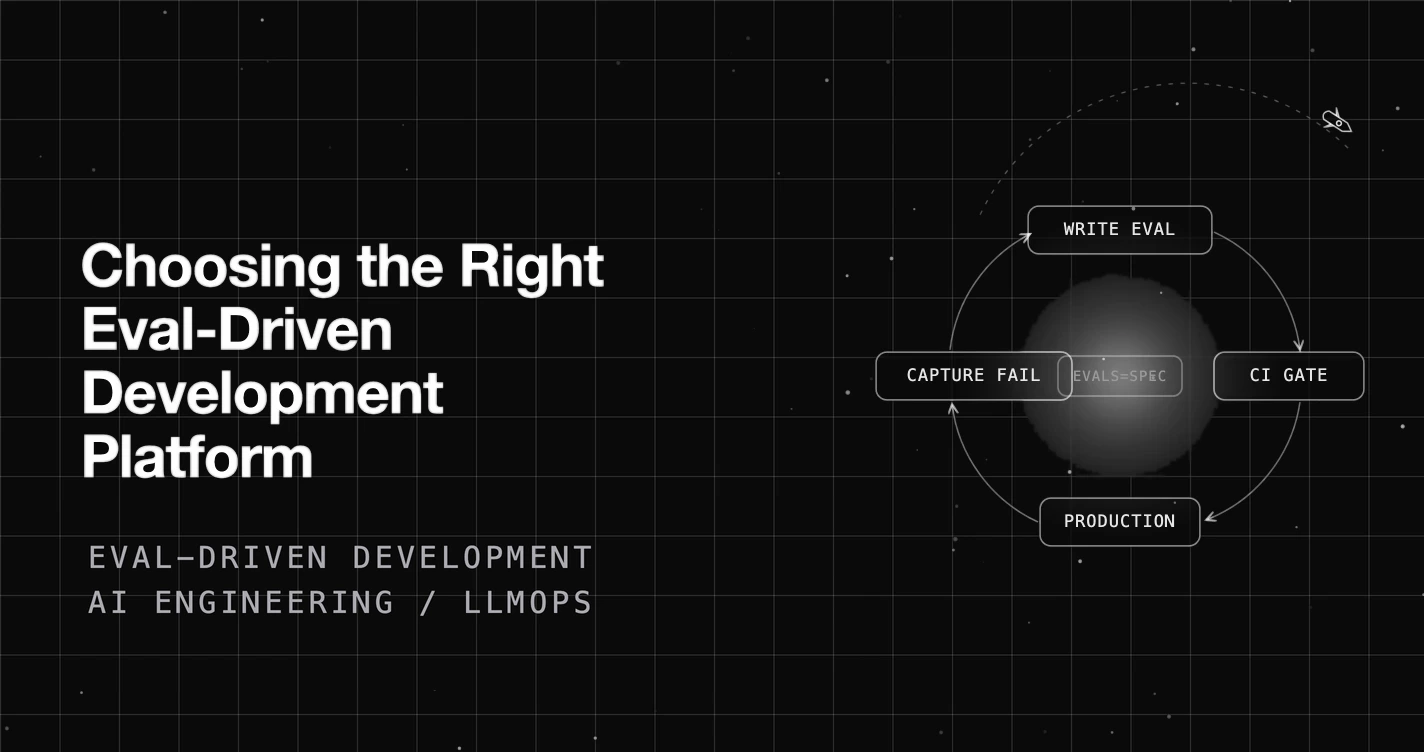
Table of Contents
A team ships a prompt change on Friday. It passed every eval in the notebook, so it went out. By Monday, support tickets are up: the agent started refusing valid requests on a phrasing the offline set never covered. The eval that would have caught it did not exist, the one that ran in CI was not the one watching production, and the failing case is now a screenshot in Slack instead of a test. Nothing in the loop closed.
That is the difference between running evals and doing eval-driven development. Eval-driven development treats the evals as the spec: you write them up front, gate deploys on them, run the same ones in production, and turn every failure into the next test. Most teams try to assemble that from a notebook, a CI runner, and a separate monitor, and the loop leaks at every seam. So choosing an eval-driven development platform is about whether the same evals run everywhere, whether the loop actually closes, and whether a team can work on it together. Here are the 8 factors that separate a real eval-driven development platform from a pile of eval scripts, and how to answer each.
TL;DR: choose an eval-driven development platform where you write evals as versioned artifacts, run the same evals locally, in CI as a deploy gate, and in production, turn a production failure into a regression test, and optimize against your own evals.
For where this fits, see how LLM eval maps onto software testing and the build-versus-buy decision between an SDK, a platform, and rolling your own.
Why choosing an eval-driven development platform is harder than it looks
The pieces are easy to buy and hard to connect. You can get an eval SDK, a CI runner, and a production monitor separately, and each works, but the value of eval-driven development is in the seams between them, which is exactly what you cannot buy as a part. The eval that gates the build has to be the eval that watches production, or the two will disagree and you will not know which to trust. The production failure has to flow back into the suite, or you fix the same bug twice.
So the buying decision is not “does it score outputs.” Any eval tool does that. It is “do the same evals run from my laptop through CI into production, does a production failure become a test, and can my team own the suite together instead of one person’s notebook.” The 8 factors below are weighted toward parity and the closed loop, because that is what turns evals into a development practice instead of a checkpoint.
The 8 factors to ask before you choose
The Eval-Driven Development Audit. Score each factor pass or fail. Aim for seven or more.
| # | Factor | Pass if the platform… |
|---|---|---|
| 1 | Evals as artifacts | Lets you write and version evals alongside the app |
| 2 | CI gate | Runs the same evals in CI to gate a deploy |
| 3 | Dev-prod parity | Runs the same evals in production, on live traffic |
| 4 | Closed loop | Turns a production failure into a regression test |
| 5 | Team collaboration | Gives the team shared datasets and review, not one notebook |
| 6 | Version comparison | Compares prompt and model versions on the same evals |
| 7 | Optimization | Optimizes against your own evals, not just reports |
| 8 | Honest scope | Does not pretend to be your CI and deploy pipeline |
1. Can you write evals as versioned artifacts alongside your app?
Why it matters: in eval-driven development the evals are the spec, so they have to live like code: defined in your repo, versioned with the change they describe, reviewable in a pull request.
What to look for: evals defined in your repo and versioned with the change they describe, so the spec and the implementation move together in the same diff.
What to avoid: evals click-configured in a UI with no version history, so they drift away from the code they are supposed to pin down.
How FutureAGI fits: FutureAGI lets you define evaluators and datasets through the SDK, so an eval is an artifact you version alongside the code and the dataset it runs on, not a setting buried in a dashboard. That means the spec and the implementation move together, and a reviewer can see the eval change in the same diff as the behavior change. Tools that keep evals only as UI config make the spec untrackable, which is the opposite of what eval-driven development needs.
2. Do the same evals run locally and in CI to gate a deploy?
Why it matters: an eval that only runs when someone remembers to open a notebook is not a gate. The point of eval-driven development is that a regression fails the build, automatically, before it ships.
What to look for: the same evals running from your laptop and inside CI, cheap enough to run on every change without a finance conversation.
What to avoid: evals that only run when someone remembers to open a notebook.
How FutureAGI fits: FutureAGI runs evals through the same SDK locally and inside your CI, mixing deterministic local metrics that cost nothing with LLM judges where you need them, so a pull request can fail on an eval regression the way it fails on a unit test. The cheap deterministic checks keep the gate fast, and the judges are reserved for the calls that need them. For the mechanics, see CI/CD eval with GitHub Actions and how to gate RAG apps in CI.
3. Do the same evals run in production?
Why it matters: this is the factor that most stacks get wrong. When the eval that gates your build and the check that watches production are two different things, a production dip cannot tell you whether the model regressed or your two evaluators simply disagree.
What to look for: dev-prod parity, where the same eval definition runs as a CI gate and on live production traffic, attached to the trace.
What to avoid: a separate CI evaluator and production check that can disagree with each other.
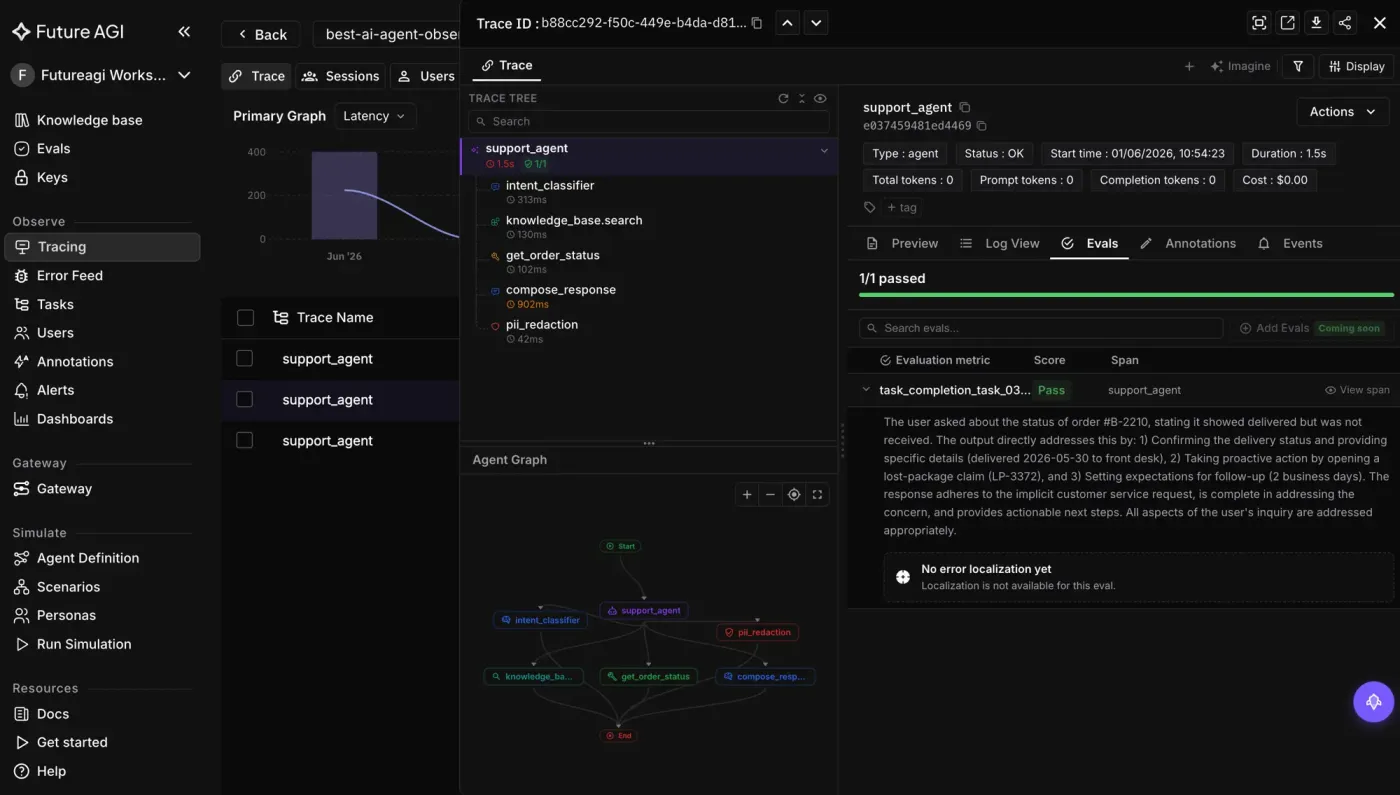
How FutureAGI fits: FutureAGI runs your evaluators online on production traffic, with each result tied to the span where the output was generated, so the eval you gated the deploy on is the eval watching production. The screenshot below shows an evaluation passing on a real support-agent trace, with the score on the span and the reasoning attached. A passing build and a healthy dashboard now measure the same thing, which is why an agent can pass evals and still fail in production when that parity is missing.
4. Does it close the loop from a production failure to a test?
Why it matters: a production failure is the most valuable eval you will ever get, and most teams throw it away. Eval-driven development only compounds if the bug you found on live traffic becomes a permanent test.
What to look for: a path that captures the failing case into a dataset and folds it into the suite that runs in CI.
What to avoid: a tool that leaves the failing case in a dashboard, so you fix the same bug again next quarter.
How FutureAGI fits: FutureAGI lets you capture a failing production case into a dataset and add it to the regression suite, so the failure that hit users once becomes a gate on every future deploy. The loop closes: production teaches the suite, and the suite protects production. For designing that cycle deliberately, see the eval feedback loop guide. Tools that leave the failing case in a dashboard never close it, and you fix the same bug again next quarter.
5. Can the team collaborate on the eval suite?
Why it matters: eval-driven development is a team practice, not a solo one, and a suite that lives in one engineer’s notebook dies when they switch projects.
What to look for: a shared source of truth: datasets everyone runs against, a way for domain experts to review and label borderline cases, and a record of where reviewers agree so the judge stays calibrated to the team’s standard.
What to avoid: a platform with no collaboration layer, which quietly makes eval-driven development one person’s job.
How FutureAGI fits: FutureAGI gives the team shared datasets plus annotation queues where reviewers label disputed cases, and tracks their agreement so the evaluators calibrate to the people who own the behavior. That turns the eval suite into shared infrastructure the whole team maintains, rather than private tooling. A platform with no collaboration layer quietly makes eval-driven development one person’s job, which is how it lapses the moment that person is busy.
6. Can you compare prompt and model versions on the same evals?
Why it matters: eval-driven development means decisions are measured, not argued, whether you are weighing a new prompt against the current one or a cheaper model against the incumbent.
What to look for: both versions run through the identical evals with the results side by side, so the choice rests on the suite you already trust.
What to avoid: a tool that makes you eyeball a few hand-picked samples, turning a spec-driven decision back into a vibe.
How FutureAGI fits: FutureAGI runs experiments that compare versions on the same evaluators, diffing outputs side by side with the eval scores per row, so a prompt or model change is a measured comparison against your spec. That keeps the suite as the arbiter of every change, which is the whole point of the practice. Tools that make you eyeball samples turn a spec-driven decision back into a vibe.
7. Does it optimize against your own evals, not just report?
Why it matters: reporting a score tells you something is wrong; it does not fix it. The far end of eval-driven development uses the suite not only to catch regressions but to drive improvement.
What to look for: optimization that rewrites the prompt against the same evals you grade it with, so the thing improved and the thing measured are the same.
What to avoid: a tool that only reports and leaves the improvement loop entirely manual.
How FutureAGI fits: FutureAGI includes prompt optimization that runs against your own evaluators: the optimizer rewrites the prompt and scores each candidate on your suite, so the thing being improved and the thing being measured are the same. That makes the eval suite both the gate and the objective. Tools that only report leave the improvement loop entirely manual, which is slower and drifts from the spec.
8. Will it replace your CI and deploy pipeline?
Why it matters: here the honest answer is no. An eval-driven development platform is the evaluation layer of your loop, not your CI runner, your source control, or your deploy system.
What to look for: a platform that plugs into the CI you already run (like GitHub Actions) to gate on eval results, and hands the gating decision back to your pipeline.
What to avoid: a platform claiming to be your eval suite and your deploy pipeline and your version control, which is overreaching.
Where FutureAGI is honest about this one: FutureAGI is built to sit inside your existing engineering workflow, not to replace it: it provides the evals, the datasets, the production scoring, and the optimization, and it hands the gating decision to your CI. If you want a single vendor to own your whole software development lifecycle, that is not this, and a platform claiming to be your eval suite and your deploy pipeline and your version control is overreaching. It owns the eval loop inside your SDLC, and leaves the rest to the tools built for it.
A quick decision framework
The factors are the test; here is how the answers map to a pick.
| Choose | When | What decides it |
|---|---|---|
| A parity-first platform | Your pain is agents that pass offline and fail live | Factors 2 and 3; if the CI eval and the production check are different evaluators, walk away |
| A closed-loop platform | You keep fixing the same bug twice | Factor 4; confirm a production failure can become a CI test in a few steps, not a rebuild |
| A collaboration-grade platform | More than one or two people own quality | Factor 5; a notebook-only suite will not survive a team |
| A single eval script | You are one person prototyping and nothing ships yet | The platform earns its place when work crosses CI, production, and more than one engineer |
Where FutureAGI fits
The 8 factors get you a closed loop: evals as the spec, gating CI, running in production, and feeding back. Past the loop itself, the platform is also where you seed the suite before you have data, trace a failure to its cause, and carry an eval past the deploy gate into runtime. Those are the points the checklist does not cover.
Start the loop before you have production data. Eval-driven development stalls when a new project has no traffic to evaluate, so you can generate a synthetic test set with Simulate: define personas and let it auto-generate multi-turn scenarios, giving the team something to run evals against on day one. The scenario builder below generates a table of test cases from a persona and a prompt, so the suite exists before the first user does.
From a failing eval to the cause, not just the score. When an eval fails, field-level error localization points at the input that caused it, and recurring production failures surface in the error feed, so the team triages a recurring issue instead of re-reading individual rows. That is the difference between knowing the suite is red and knowing why.
Carry an eval past the deploy gate into runtime. The evaluator you developed does not have to stop at CI: the same check can run inline as a guardrail at the gateway, since a Future AGI evaluation is one of the built-in scanners, so a behavior you spec in development is also enforced in production. Eval-driven development extends from the gate to the live request.
Where FutureAGI is not the pick: if you only want a single offline eval script in a notebook and nothing ships, the platform is more than you need. It earns its place when the loop crosses local, CI, and production and a team has to own it together.
See the Evaluate platform overview, or the evaluation documentation for the SDK, CI setup, datasets, and production scoring. For where the pieces sit, the eval stack reference architecture lays out the full loop.
What to read next
- Eval SDK vs Eval Platform vs Build (2026): the build-versus-buy decision behind this whole choice, if you are still scoping.
- LLM Eval vs Software Testing (2026): how eval-driven development maps onto the testing practices your team already knows.
- Your Agent Passes Evals and Fails in Production (2026): why dev-prod parity is the factor that bites hardest when it is missing.
- CI/CD LLM Eval with GitHub Actions: the practical wiring for the CI gate in Factor 2.
Frequently Asked Questions About Eval-Driven Development Platforms
What is eval-driven development?
Eval-driven development is test-driven development for AI systems: the evaluations are the specification. You write evals for the behavior you want, run them as you build, gate deploys on them in CI, run them again in production, and turn every production failure into a new eval. Instead of shipping a prompt and hoping, you define what correct means up front and let the evals tell you when you have it and when a change breaks it.
How is an eval-driven development platform different from an eval tool?
An eval tool scores outputs. An eval-driven development platform runs the whole loop: the same evals locally, in CI as a deploy gate, and in production on live traffic, plus the dataset and collaboration machinery to turn a production failure into a regression test the team shares. The difference is parity and closure. A tool gives you a score in one place; a platform makes the same evals the spine of how you build, ship, and monitor.
Why do the same evals need to run in CI and in production?
Because an agent that passes your offline suite can still fail on live traffic, and if the production check is a different evaluator than the CI gate, you cannot tell whether the model regressed or the two checks simply disagree. Dev-prod parity means the eval you wrote once runs as a CI gate and on production spans, so a passing build and a healthy production dashboard measure the same thing, and a gap between them is a real signal, not a tooling artifact.
Can a small team adopt eval-driven development without a lot of setup?
Yes. The fastest start is a handful of evals on your highest-risk behavior, run in CI on every change, plus the same evals on production traffic. You do not need a giant labeled dataset on day one: you can seed a synthetic test set, keep a small labeled set for calibration, and grow the suite by capturing real production failures as you find them. The discipline matters more than the volume.
Does an eval-driven development platform replace my CI and deploy pipeline?
No. It is the eval layer of your loop, not your CI runner, your source control, or your deploy system. It plugs into the CI you already use, like GitHub Actions, to gate on eval results, and it does not run your pipeline or write your application code. Think of it as the evaluation spine that sits inside your existing engineering workflow, not a replacement for it.
Six factors for choosing an LLM evaluation SDK for engineering teams: evals in code and CI, no-ground-truth scoring, and local-plus-judge routing.

Five questions for choosing an offline evaluation tool for pre-deployment testing: run on a test set, build one without data, catch regressions, and gate CI.

Eight factors for choosing a hallucination detection tool for production AI, from catching errors with no reference answer to blocking bad responses live instead of flagging them once they've already reached users.