Choosing the Right Hallucination Detection Tool for Production AI: 8 Factors to Compare
Eight factors for choosing a hallucination detection tool for production AI, from catching errors with no reference answer to blocking bad responses live instead of flagging them once they've already reached users.
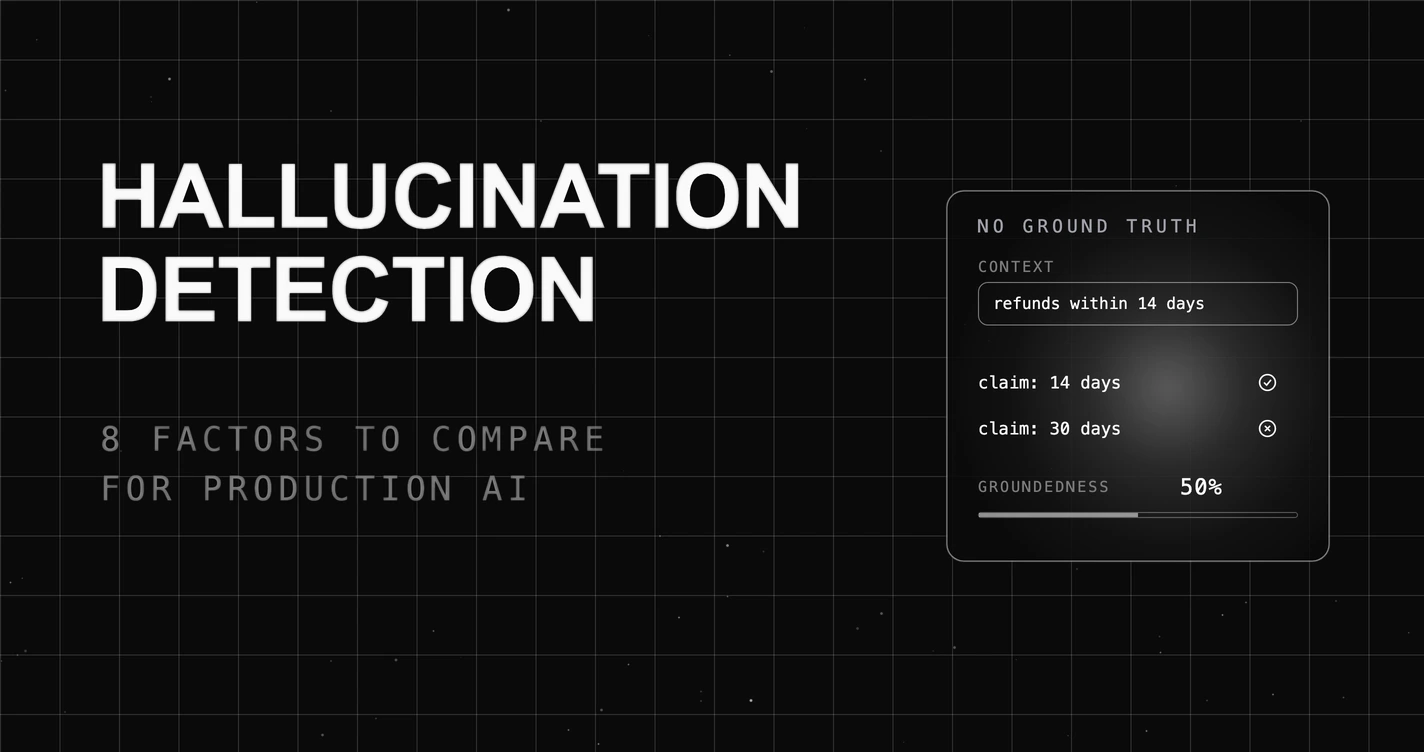
Table of Contents
The fastest way to choose the wrong hallucination detection tool is to trust a score that looked perfect on a labeled benchmark. A support assistant answers a billing question in production: “Yes, digital products are refundable within 30 days.” It reads cleanly, the latency is fine, and the response ships. The retrieved policy actually said 14 days. No reference answer existed to compare against, the offline test set never had this phrasing, and the only signal that anything was wrong arrived as a chargeback two weeks later. The model did not crash. It hallucinated a number, confidently, and nothing in the path was watching for it.
That is the problem a hallucination detection tool exists to solve, and it is why a demo-grade checker quietly fails in production. In a notebook you have a gold answer to compare against; in production you have open-ended output, no label, latency budgets, and a bad answer that costs money the moment it ships. So choosing a hallucination detection tool is not about which model scores best on a benchmark with labels. It is about whether it detects without ground truth, pins the failure to the exact claim, runs on live traffic, and can stop a bad answer before a user sees it. Here are the 8 factors that separate a production-grade hallucination detection tool from a benchmark demo, and how to answer each.
TL;DR: choose a hallucination detection tool that scores support without a reference answer, covers both RAG groundedness and closed-book factual accuracy, attributes the failure to the exact claim, runs online on production traffic, and can block at runtime. No detector catches everything, so calibrate the judge and tune the threshold.
For the underlying mechanics, see the LLM hallucination deep dive and, for retrieval systems specifically, evaluating RAG faithfulness.
Why choosing a hallucination detection tool is harder than it looks
The trap is that hallucination detection demos beautifully and deploys badly. On a curated test set with labeled answers, almost any checker looks accurate, because the hard part (deciding what “correct” means) was done by hand in advance. Production removes every one of those crutches: there is no label for a live answer, the output is open-ended, the same check has to run inside a latency budget, and the cost of a miss is a user acting on a fabricated fact. A tool tuned for the benchmark is measuring the one situation you will never be in.
The second trap is treating hallucination as one thing. A RAG system can invent a fact the documents never stated (a groundedness failure), or faithfully repeat a wrong document (a factual failure), and a tool that only checks one of those passes the other straight through. And a single document-level score, “this answer is 80 percent grounded,” tells you nothing about which sentence to fix. So the buying decision for a production hallucination detection tool is whether it works without labels, splits the failure modes, points at the exact claim, and lives in the request path. The 8 factors below are weighted toward exactly that.
The 8 factors to ask before you choose
The Production Hallucination Test. Score each factor pass or fail. Aim for six or more. The rule it encodes: in production there is no ground truth, so detection has to be reference-free, claim-level, online, and enforceable.
| # | Factor | Pass if the tool… |
|---|---|---|
| 1 | No ground truth needed | Detects without a labeled reference answer |
| 2 | Both failure modes | Scores RAG groundedness and closed-book factual accuracy |
| 3 | Claim-level attribution | Points at the exact unsupported claim, not a doc-level score |
| 4 | Online in production | Runs on live traffic, attached to the trace |
| 5 | Runtime enforcement | Can block or flag a bad answer inline, not just after |
| 6 | Calibration and tuning | Lets you calibrate the judge and tune the threshold |
| 7 | Multimodal coverage | Detects image and caption hallucinations, not just text |
| 8 | Honest limits | Is realistic about recall, latency, and cost |
1. Does it detect without a ground-truth answer?
Why it matters: production traffic does not come with a labeled gold answer, so any detector that needs one to work is a benchmark tool, not a production tool. You have to score whether a claim is supported, not whether it matches a reference.
What to look for: reference-free detection, where a judge checks whether each claim is entailed by the retrieved context or true in the world, with no labeled answer required.
What to avoid: an exact-match, BLEU, or ROUGE check that needs a gold reference, which is structurally useless on open-ended production output.
How FutureAGI fits: FutureAGI’s evaluation layer detects hallucinations reference-free: its groundedness and hallucination evaluators run as LLM-as-judge on proprietary Turing models and check whether a claim is supported, with no gold answer needed. That is what lets the same detector run on live production output you never labeled. Match-based checks miss this because they have nothing to match against once you leave the test set. For the detection methods, see how to detect hallucinations in generative AI.
2. Does it cover both groundedness and factual accuracy?
Why it matters: hallucinations fail in two directions, and most tools only watch one. A RAG answer can invent a fact the context never stated, or it can faithfully repeat a document that was simply wrong, and those need two different checks.
What to look for: separate evaluators for groundedness (is the answer supported by the retrieved context) and factual accuracy (is the claim true in the world, independent of retrieval), so a grounded-but-false and a true-but-ungrounded answer both get caught.
What to avoid: a single faithfulness score that only compares against retrieved context, which waves through a confident closed-book answer that no document ever supported.
How FutureAGI fits: FutureAGI scores groundedness and factual accuracy as distinct evaluators in its 50+ evaluator catalog, because they fail differently: groundedness catches the invented fact, factual accuracy catches the faithfully-repeated wrong one. A retrieval answer that stays inside a bad document fails factual accuracy even while it passes groundedness, so the two together close the gap one alone leaves open. Single-metric detectors miss this by collapsing two failure modes into one number. For the retrieval case in practice, see RAG hallucinations in production.
3. Does it attribute the hallucination to the exact claim?
Why it matters: “this answer is 75 percent grounded” is not actionable. A response is a bundle of claims, and you need to know which one was fabricated, or you re-read the whole answer every time and fix nothing with confidence.
What to look for: claim-level or field-level attribution, where the response is decomposed into atomic claims and each is scored separately, so the one unsupported claim drops out by itself instead of being averaged into a passing score.
What to avoid: a single document-level score with no path to the offending claim, which turns every flagged answer into a manual hunt.
How FutureAGI fits: FutureAGI scores groundedness with field-level error localization, naming the exact input or claim that broke the check rather than emitting one smoothed number. The clip below opens a failed groundedness check: it marks the row Failed, explains the contradiction in plain language, and pins the failure to the offending field, an output promising refunds “within 30 days” when the retrieved context says 14. An answer-level mean would have hidden that behind a passing aggregate, which is why a doc-level grounded score is the wrong unit for production debugging.
4. Does it run online on live production traffic?
Why it matters: hallucinations happen in production, on phrasings your offline set never had. A detector that only runs as an offline batch job is always describing yesterday, and never the live regression that is hitting users now.
What to look for: online detection on production traffic, with each hallucination score attached to the trace or span that produced the answer, so a live spike is visible where it happened.
What to avoid: an offline-only checker that runs on a sampled export hours later, disconnected from the request that caused the problem.
How FutureAGI fits: FutureAGI runs its hallucination and groundedness evaluators online on production traffic, with each score attached to the generation span through traceAI, so a hallucination shows up on the exact trace that produced it rather than in a separate report. The same evaluator you ran offline now watches live traffic, which is what makes a production spike legible instead of anonymous. For why offline-only is not enough, see why an agent can pass evals and still fail in production and the observability docs.
5. Can it block a bad answer at runtime, not just score it after?
Why it matters: for anything user-facing, detection after the fact is a postmortem. You need the option to stop a hallucinated answer before it reaches the user, not just to count it on a dashboard afterward.
What to look for: a detector that can run inline in the request path, as a guardrail that scores the response and gates it, so a failed check can block, rewrite, or route the answer to review.
What to avoid: a tool that can only observe and report, leaving enforcement as a separate system you have to build yourself.
How FutureAGI fits: FutureAGI’s Protect layer includes hallucination detection as one of its built-in gateway scanners, so a hallucination check can run inline and gate the response rather than scoring it post-hoc. A deterministic local check runs as a fast pre-filter and the model-based judge handles the subtle cases, so enforcement does not mean a single heavy call on every request. An observe-only detector misses this because it was never in the request path, so it can count a hallucination but never stop one.
6. Can you calibrate the judge and tune the threshold?
Why it matters: a detector you cannot tune is noise. Set it too strict and false positives bury the real ones; too loose and it misses the hallucinations that matter. And if you cannot tell whether the judge agrees with your own experts, you cannot trust its score at all.
What to look for: a tunable pass/fail threshold so you can trade precision for recall deliberately, plus a way to calibrate the judge against human labels so its scores track your team’s standard rather than a vendor default.
What to avoid: a fixed black-box score with no threshold control and no calibration path, which you can neither trust nor adjust.
How FutureAGI fits: FutureAGI lets you set thresholds on the evaluators and calibrate the judge through annotation queues, where reviewers label disputed cases and the platform tracks reviewer agreement, so the detector stays aligned to the people who own the standard. That is a calibration mechanism you can audit, not an assertion that the judge is accurate, and it is what lets you move the precision-recall trade-off on purpose. A black-box score gives you neither knob. For grounding the judge, see LLM-as-judge best practices.
7. Does it cover multimodal hallucination, not just text?
Why it matters: production AI increasingly answers over images and documents, and a vision-language model can describe something that is not in the picture just as confidently as a text model invents a fact. A text-only detector is blind to it.
What to look for: hallucination checks that run on image and caption outputs, not only on plain text, so a wrong description of a chart or a document is caught the same way a wrong sentence is.
What to avoid: a detector that only reads text, which silently passes every multimodal answer your users actually see.
How FutureAGI fits: FutureAGI’s judge is multimodal: it ships a caption-hallucination evaluator and its Turing models score text and image inputs together, so an image-grounded answer is checked against what was actually in the image. You can layer the multimodal check after the cheaper text checks and still localize which input, text or image, drove the failure. Text-only detectors miss this because they never look at the pixels. For the broader picture, see multimodal LLM-as-a-judge.
8. Is it honest about recall, latency, and cost?
Why it matters: here the honest answer protects you. A tool that claims to catch every hallucination is selling you a false sense of safety, and you will trust it exactly where you should not.
What to look for: a tool that is clear detection is a judge with a threshold, that LLM-judge checks add latency and cost over deterministic ones, and that high-stakes cases still need human review, so you can design around the limits instead of being surprised by them.
What to avoid: a vendor promising perfect recall with no latency or cost trade-off, which is the claim least likely to survive contact with production.
A quick decision framework
The factors are the test; here is how the answers map to a pick.
| Choose | When | What decides it |
|---|---|---|
| A reference-free, claim-level detector | You have live traffic and no labeled answers | Factors 1 and 3; if it needs a gold answer or only scores the whole response, it is a benchmark tool |
| A runtime-enforcing detector | Your output is user-facing and a bad answer is an incident | Factor 5; an observe-only tool cannot block, only count |
| A dual groundedness-and-factual detector | Your RAG answers can be unfaithful or just wrong | Factor 2; one faithfulness score misses the true-but-ungrounded case |
| A deterministic fact check | You verify against a fixed, labeled knowledge base | Factor 8; on that narrow slice a lookup can beat an LLM judge |
Where FutureAGI fits
The 8 factors get you production-grade detection: reference-free, claim-level, online, and enforceable. Past detection itself, three things matter to teams fighting hallucinations that the checklist does not cover: turning a caught hallucination into a permanent test, driving the rate down at the source, and triaging recurring failures instead of one-off rows.
Turn a caught hallucination into a regression test. A hallucination you found once is the most valuable test case you have, and most teams throw it away. FutureAGI lets you capture the failing case into a dataset and add it to the suite that runs in CI, so the same fabricated claim is gated on every future deploy instead of resurfacing next quarter.
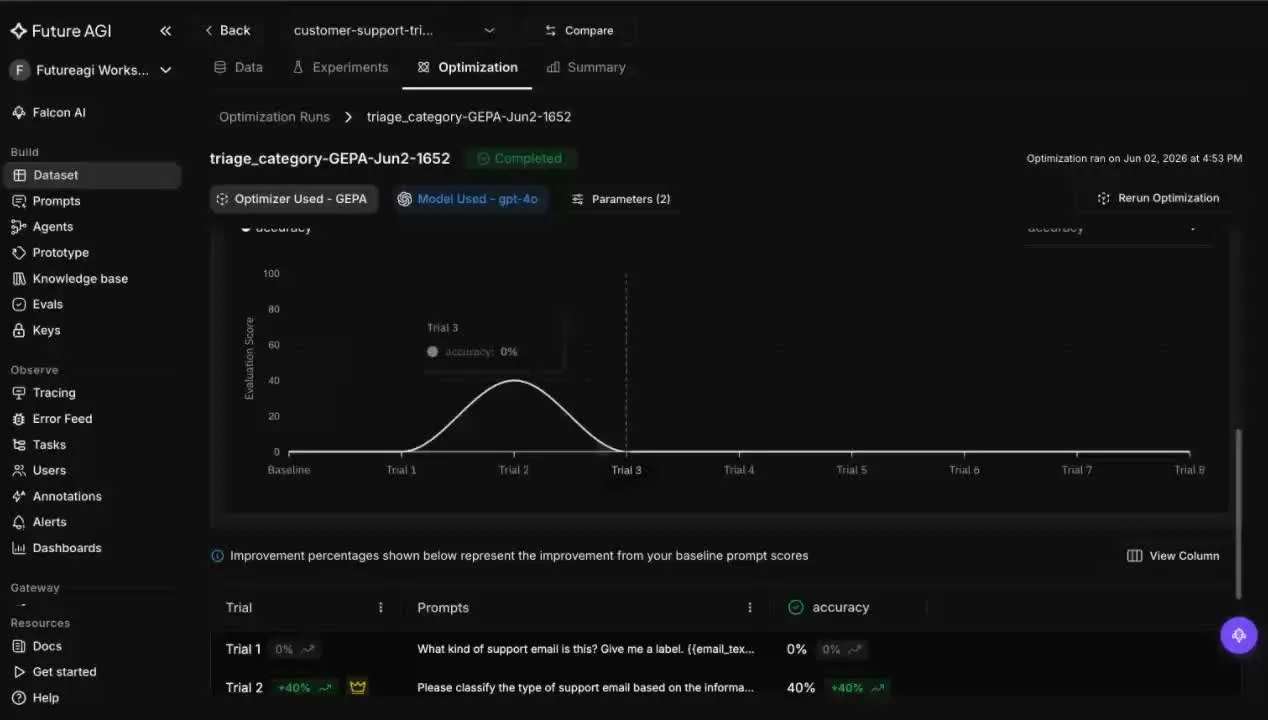
Reduce the rate at the source, not just detect it. Detection tells you the rate; it does not lower it. FutureAGI’s optimization layer rewrites the prompt and scores each candidate against your own groundedness evaluator, so you can push the hallucination rate down rather than only watching it. The screenshot below shows an optimization run improving a prompt across trials against the eval it is graded on, with the second trial up 40 percent over the baseline.
Triage recurring hallucinations, not 500 individual rows. Per-claim attribution tells you which claim failed on one answer; the Error Feed clusters recurring failures across traces, so a pattern (one context that is always misquoted, one tool whose output is always invented over) becomes a single triage item instead of fifty separate flags.
Use the cheaper deterministic check on the one slice that does not need a judge. There is a thin case where an LLM judge is the wrong tool: verifying an output against a fixed, labeled knowledge base where a deterministic rule gives an exact answer. On that slice a lookup is faster, cheaper, and more reproducible than any judge. FutureAGI ships those deterministic checks too (exact match, regex, schema validation, and other local metrics that run offline at zero API cost), so you run the cheap check in the same place and save the model-based judge for the harder, more common case: open-ended production output with no labels, where the detector has to reason about support rather than match a string.
See the Evaluate platform overview, the evaluation docs for the hallucination and groundedness evaluators, or the Protect docs for runtime enforcement.
What to read next
- LLM Hallucination Deep Dive (2026): why models hallucinate and the detection methods behind the factors above.
- Top 5 AI Hallucination Detection Tools (2025): if you would rather see specific tools ranked than work the factors yourself.
- Evaluating RAG Faithfulness (2026): the groundedness side of Factor 2, in depth, for retrieval systems.
- Your Agent Passes Evals and Fails in Production (2026): why offline detection alone misses the live regression from Factor 4.
Frequently Asked Questions About Hallucination Detection Tools
What is a hallucination detection tool?
A hallucination detection tool scores whether an AI system’s output is supported by its evidence: for a RAG answer, whether each claim is grounded in the retrieved context, and for a closed-book answer, whether the claim is factually true. A production-grade one works without a reference answer (you rarely have a labeled gold answer for live traffic), attributes the failure to the exact claim that was unsupported, runs online on production traffic, and can block or flag a bad response at runtime rather than only reporting it after the fact.
How do you detect hallucinations without a ground-truth answer?
You score support, not match. Instead of comparing the output to a labeled gold answer, a reference-free detector uses a judge to check whether each claim is entailed by the retrieved context (groundedness) or true in the world (factual accuracy). This matters because production traffic almost never comes with a labeled answer, so any detector that needs one is useless live. The strongest setup decomposes the response into atomic claims and scores each independently, so a single fabricated claim in an otherwise correct paragraph still fails instead of being averaged away.
What is the difference between groundedness and factual accuracy?
They catch hallucinations that fail in different directions. Groundedness asks whether the answer is supported by the retrieved context, so it catches a RAG system that invented a fact the documents never stated. Factual accuracy asks whether the claim is true in the world, independent of retrieval, so it catches an answer that faithfully repeated a wrong document. A response can be grounded but false (the context was wrong) or true but ungrounded (it bypassed the context), so a production detector should score both, not just one.
Can a hallucination detection tool block a bad answer in production?
Yes, if it runs at runtime rather than only offline. A detector wired into the request path, like a hallucination scanner at the gateway, can score the response before it reaches the user and gate it: block, rewrite, or flag for review. An offline-only checker runs after the fact, so it tells you a bad answer shipped but cannot stop it. For user-facing or high-stakes systems, runtime enforcement is the difference between catching a hallucination and merely counting it.
Can hallucination detection catch every hallucination?
No, and any tool that promises it should be treated with suspicion. Detection is a judge with a tunable threshold, so you trade precision against recall: a stricter setting catches more hallucinations but raises false positives, and a looser one does the reverse. LLM-judge detection also adds latency and cost compared with deterministic checks, and high-stakes domains still warrant human review on the cases that matter. A good tool raises the floor, calibrates to your labels, and is honest that the floor is not perfect.
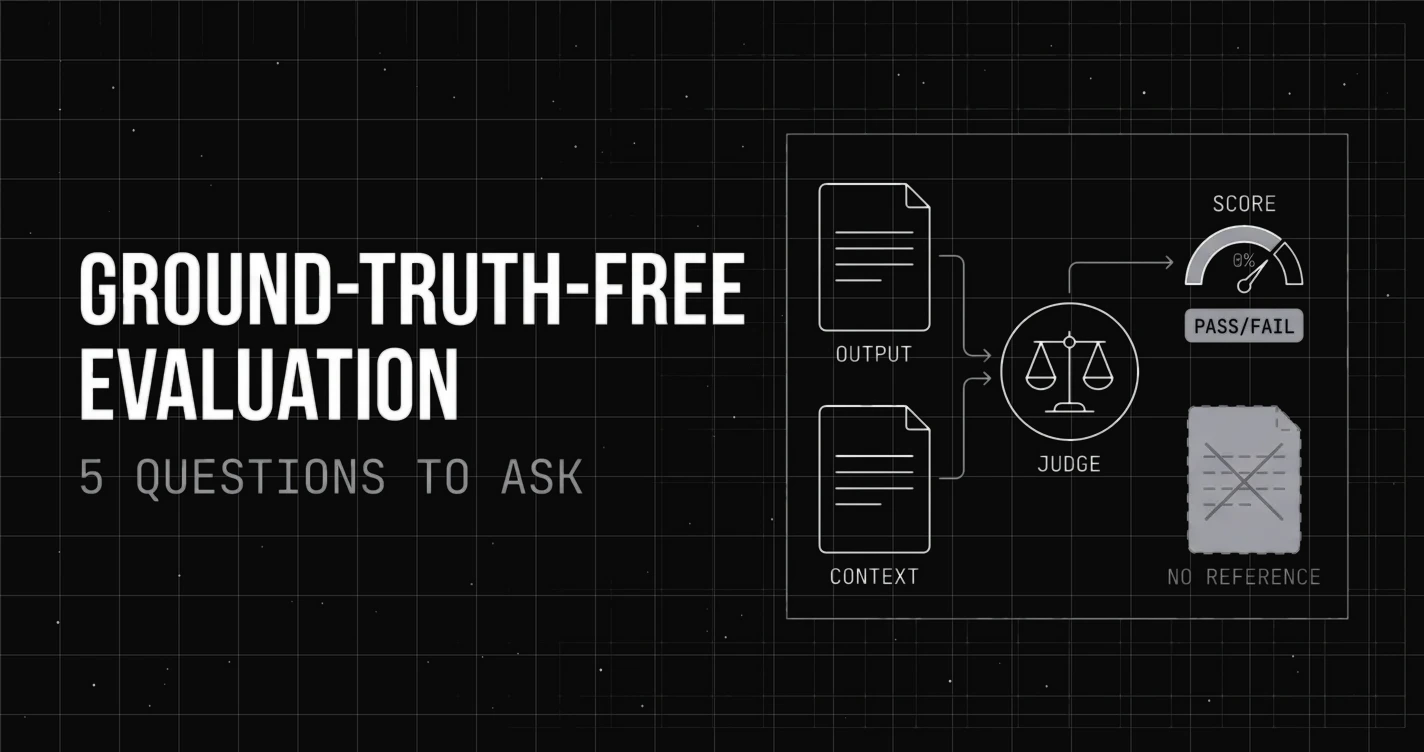
Five questions for choosing a ground-truth-free eval tool with no labeled data: reference-free scoring, judge calibration, error localization, production fit.

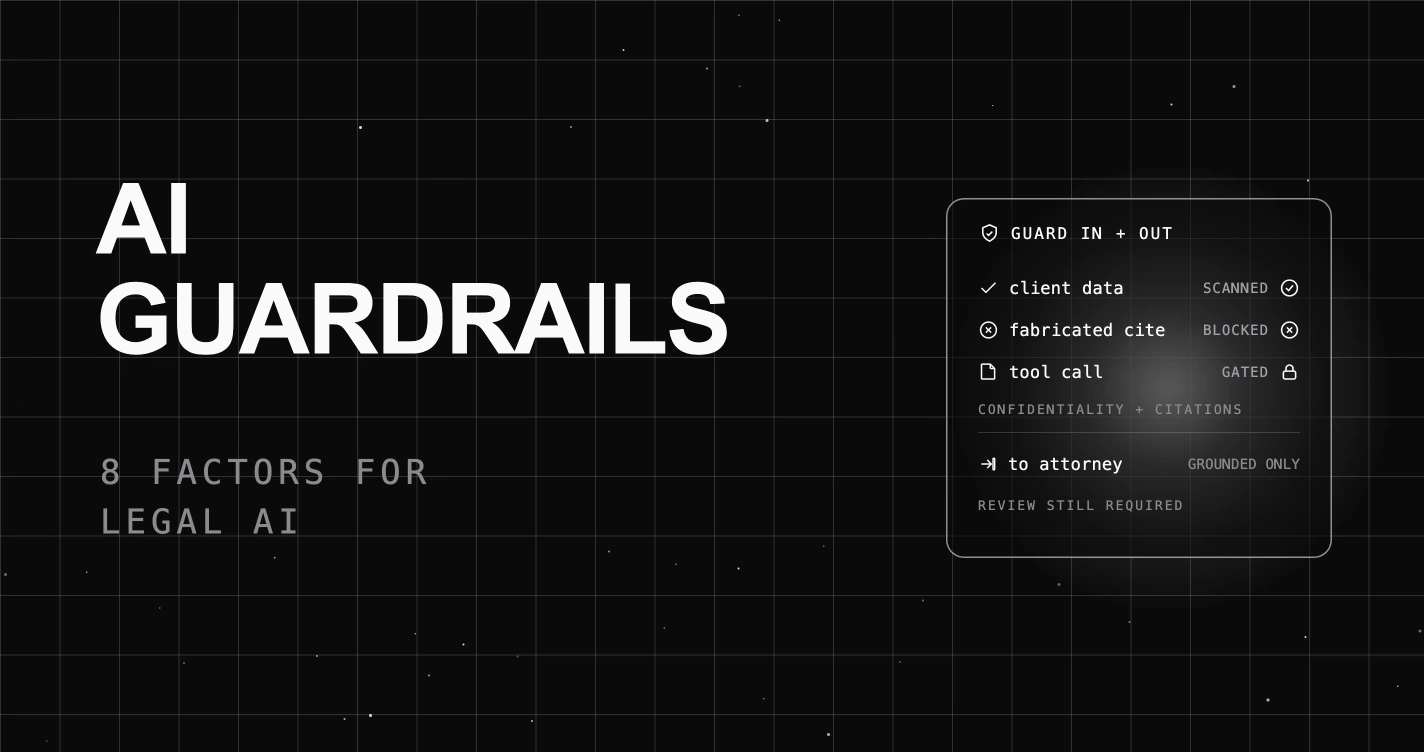
Eight factors for choosing an AI guardrails platform for legal AI: real-time blocking, confidentiality, fabricated-citation detection, tool permissioning, and self-hosting.

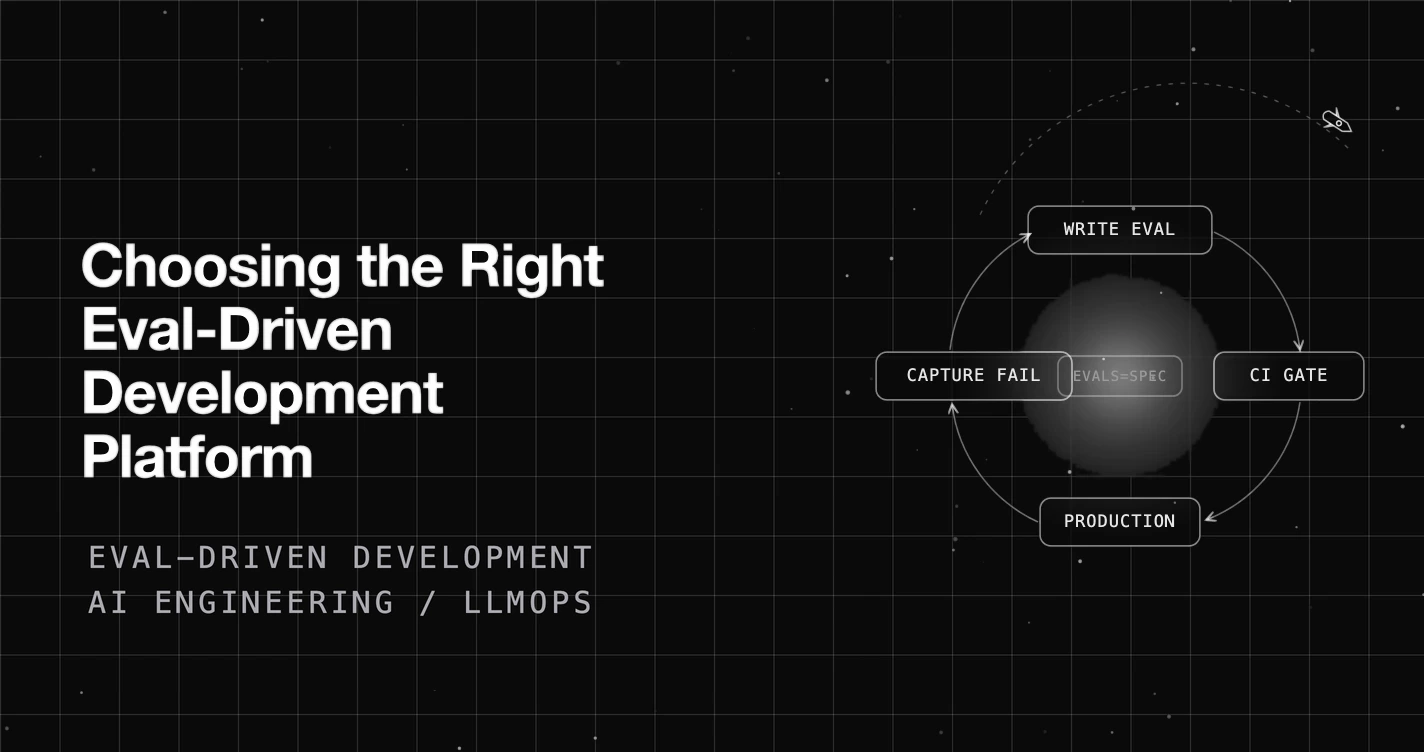
Eight factors for choosing an eval-driven development platform for AI teams: evals as spec, CI gating, dev-prod parity, regression loops, and optimization.