Choosing the Right LLM Evaluation SDK for Engineering Teams: 6 Critical Factors
Six factors for choosing an LLM evaluation SDK for engineering teams: evals in code and CI, no-ground-truth scoring, and local-plus-judge routing.
Table of Contents
The fastest way to choose the wrong LLM evaluation SDK is to pick the one with the best benchmark numbers and never check whether it runs in your pipeline. An engineering team adds an eval step to their agent: it scores beautifully in a notebook, the demo lands, and they buy it. Then they try to wire it into CI and discover it only runs through a hosted UI, needs a labeled answer for every test case, and calls an LLM judge on checks a regex could settle, so the bill and the latency both spike. The evals never make it into a pull request, the gate never closes, and six weeks later the team is back to eyeballing outputs in Slack.
That is the gap an LLM evaluation SDK is supposed to close, and it is why a benchmark score is the wrong thing to shop on. For an engineering team, the eval layer has to live where the code lives: in the repo, in the test suite, in CI, called programmatically and asserted on like any other test. So choosing an LLM evaluation SDK is not about which model judges best in a demo. It is about whether evals run in your code and your pipeline, score without a labeled answer, and keep the cost of a check proportional to the check. Here are the 6 factors that separate a real engineering-grade LLM evaluation SDK from a dashboard with a Python wrapper, and how to answer each.
TL;DR: choose an LLM evaluation SDK that runs in your code and CI, not just a UI, scores without a ground-truth answer, routes cheap checks locally to a purpose-built judge instead of a rented frontier model and scores batches async, lets you write custom evaluators, and grades image and voice as well as text. Expect it to be open-source and to pair with a platform as you scale.
For the build-versus-buy decision behind this, see eval SDK vs eval platform vs build, and for the DIY baseline, building an LLM evaluation framework from scratch.
Why choosing an LLM evaluation SDK is harder than it looks
The trap is that almost every eval tool now ships a Python package, so they all look like SDKs. The difference shows up the day you try to put one in CI. A real SDK runs the same evaluators from your laptop and your pipeline, returns a score and a reason you can assert on, and fails the build when a regression crosses a threshold. A dashboard with a thin client wrapper makes you round-trip to a hosted UI, cannot gate a pull request, and gives you a number with no way to branch on it in code.
The second trap is cost and labels. Engineering teams run evals on every change, so an SDK that calls an LLM judge for every check, including the ones a JSON-schema or regex test would settle, turns your test suite into a metered API bill and a latency problem. And an SDK that needs a labeled gold answer for every case is dead on arrival in production, where the output is open-ended and nobody hand-labeled it. So the buying decision for an LLM evaluation SDK is whether it runs in your workflow, scores without labels, and keeps cheap checks cheap. The 6 factors below are weighted toward exactly that.
The 6 factors to ask before you choose
The Eval SDK Fit Test. Score each factor pass or fail. Aim for five or more. The rule it encodes: an eval SDK earns its place when evals live in your repo, run in CI, and route cheap checks locally before spending an LLM-judge call.
| # | Factor | Pass if the SDK… |
|---|---|---|
| 1 | Code and CI | Runs evals in your repo and pipeline, not just a UI |
| 2 | No ground truth | Scores reference-free, with no labeled answer required |
| 3 | Cheap, scalable judging | Routes cheap checks locally, judges with a purpose-built eval model, and scores batches async |
| 4 | Custom evaluators | Lets you define domain-specific evaluators in code |
| 5 | Multimodal | Scores image and voice agents in code, not just text |
| 6 | Open source and honest scope | Is open-source and clear you will pair it with a platform as the team grows |
1. Does it run in your code and CI, not just a dashboard?
Why it matters: the whole reason an engineering team picks an SDK over a UI is to put evals in the pipeline. If a regression cannot fail a pull request automatically, you do not have a gate, you have a report nobody reads.
What to look for: evaluators you call programmatically and assert on, that run identically from your laptop and inside CI, and return a score and reason you can branch on to block a merge.
What to avoid: a package that is really a client for a hosted UI, where every check round-trips to a dashboard and there is no way to fail a build in code.
How FutureAGI fits: FutureAGI’s evaluation SDK runs in your code: you initialize the Evaluator, call evaluate() with your test cases, and get back a result you can assert on, so an eval regression fails a pull request the way a unit test does. The same call runs locally and in CI, and the documentation ships a CI/CD path for gating a deploy on eval results. A UI-only tool misses this because it cannot live inside your pipeline. For the wiring, see CI/CD LLM eval with GitHub Actions.
2. Can it score without a ground-truth answer?
Why it matters: in production you almost never have a labeled gold answer for a live output, so an SDK that needs one to score is useless exactly where it matters. You have to grade whether an answer is supported, not whether it matches a reference.
What to look for: reference-free evaluators (groundedness, faithfulness, factual accuracy) that a judge can score from the output and its context alone, with no labeled answer required.
What to avoid: an SDK whose only metrics are match-based (exact match, BLEU against a reference), which has nothing to score against once you leave a labeled test set.
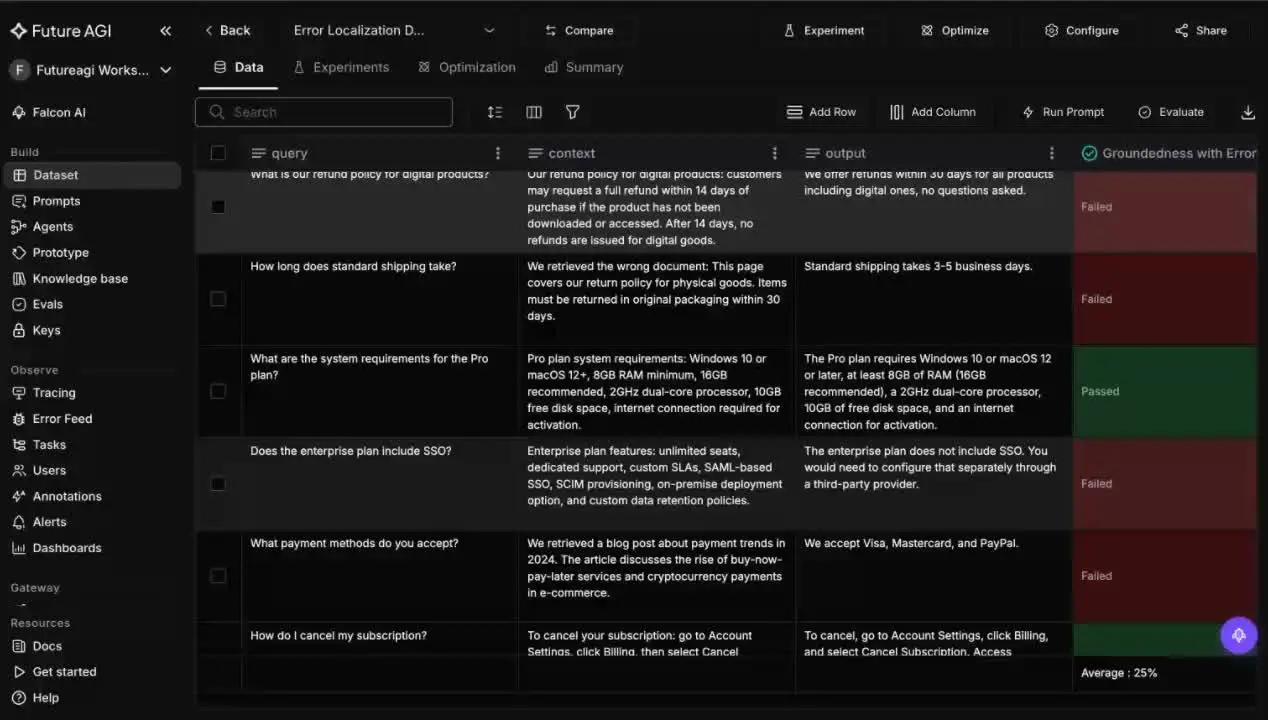
How FutureAGI fits: FutureAGI scores reference-free in code: evaluate("faithfulness", output=response, context=context) returns a score and a reason with no gold answer, because the groundedness and factual-accuracy evaluators judge support rather than match. The screenshot below shows a groundedness evaluation over a dataset, each row passed or failed with field-level error localization naming the claim that broke, like an output promising refunds in 30 days when the retrieved context says 14. Match-based SDKs miss this because there is nothing to compare against in production.
3. Is judging cheap and scalable, with a purpose-built judge?
Why it matters: Engineering teams run evals on every change and across test sets of thousands of rows, so cost, speed, and volume add up fast. If your tool calls an expensive top-tier model for a check a simple rule could handle, or scores ten thousand rows one at a time while everything waits, your testing pipeline turns slow and pricey.
What to look for: simple checks that run on your own machine for the structural stuff, a model built specifically for scoring (not a rented top-tier model) for the judgment calls, and a way to submit a big run all at once instead of one call at a time.
What to avoid: a tool that charges for a top-tier model call on every single check, or one that can only run checks one-by-one with no way to batch them, which makes large runs impractical.
How FutureAGI fits: FutureAGI runs 20-plus checks on your own machine (things like text-match scoring, format validation, and readability) offline, in under a second, at no API cost, and saves the harder judgment calls for its purpose-built Turing models (Large, Small, and Flash) instead of a top-tier model you pay for per call, so scoring stays cheap and fast at volume. It can also split the work, running what it can locally and sending only the rest to the cloud. For big jobs, you fire off a run and get a handle back right away so nothing blocks, check on it when you’re ready, and get all the scores back together, so a ten-thousand-row run goes out once and collects.
In practice: run a small quick check to clear a release, then a full batch over everything. For the full breakdown, see deterministic versus LLM-judge evals.
4. Can you write custom evaluators in code?
Why it matters: built-in metrics cover the general cases, but your hardest evals are domain-specific (a compliance rule, a house style, a product constraint), and a fixed-metric SDK cannot express them.
What to look for: a clean extension point to define your own evaluator in code, whether a deterministic function or a custom-rubric LLM judge, that runs through the same interface as the built-ins.
What to avoid: a closed set of metrics with no way to add your own, which forces your domain logic out into a separate script the eval runner never sees.
How FutureAGI fits: FutureAGI lets you define custom evaluators in code by subclassing its EvalTemplate or supplying a custom rubric for a judge, so a domain rule runs through the same evaluate() interface as the built-in metrics and lands in the same result object. That keeps your bespoke checks and the standard ones in one suite rather than two. A fixed-metric SDK misses this because your domain rule has nowhere to live. For patterns, see custom LLM eval metrics best practices.
5. Can it evaluate image and voice in code, not just text?
Why it matters: if your product generates images or runs a voice agent, a text-only SDK grades half of it. Reaching for a separate vision or voice evaluator means a second integration and scores that do not line up with your text checks.
What to look for: evaluators you call from the same SDK that score non-text outputs on the same rubric as your text metrics, plus a way to test conversational voice agents end to end.
What to avoid: a text-only SDK that sends you shopping for a separate multimodal tool the moment your product is more than a chatbot.
How FutureAGI fits: the Turing judge models score text and image inputs through the same evaluate() call, so a multimodal output is graded against one rubric instead of two tools. For voice agents, the Simulate SDK drives multi-turn conversations against synthetic personas and scenarios and returns a pass or fail verdict per conversation, so a spoken-interface agent gets tested in code before it reaches users. A text-only SDK misses this because the other modalities have nowhere to run.
6. Is the SDK open source, and honest about its scope?
Why it matters: for a team adopting an SDK, open source is a real differentiator: you can read what runs, run it locally with no login, and avoid lock-in. Scope honesty is the other half: an SDK is the code path, not the whole eval program, so treating it as the whole thing leaves you with no dashboard, datasets, or production monitoring.
What to look for: a permissively licensed, open-source SDK you can inspect and run yourself, that is also clear about its limits and has a clean upgrade path, so the same evaluators carry into a platform with dashboards, datasets, and collaboration without re-instrumenting.
What to avoid: a closed client you cannot audit, or an SDK sold as the entire solution with no collaboration or monitoring story, which you will outgrow the moment a second person owns quality.
How FutureAGI fits: FutureAGI’s SDK is the Agent Learning Kit (ai-evaluation), open-source under Apache 2.0, so you can read the evaluators, run them locally with no login, and keep heuristic checks in your own environment. It is also the code-facing half of the stack and does not pretend to be the whole thing: dashboards, shared datasets, annotation queues, and production monitoring live in the platform, not the SDK. For a solo developer or a small suite, the SDK alone is enough. When more than one person owns quality or you need to watch live traffic, the same evaluators carry into the platform without a rewrite, so growing up is additive, not a migration.
A quick decision framework
The factors are the test; here is how the answers map to a pick.
| Choose | When | What decides it |
|---|---|---|
| A code-first eval SDK | You want evals to gate pull requests in CI | Factors 1 and 3; if it cannot fail a build or routes every check to a judge, keep looking |
| A reference-free SDK | You score live, open-ended output with no labels | Factor 2; a match-only SDK has nothing to grade against in production |
| An SDK plus a platform | More than one person owns quality, or you watch live traffic | Factor 6; the SDK alone has no dashboards, datasets, or monitoring |
| A from-scratch harness | You have a tiny, unusual surface and strong opinions | Factor 4; if you would rewrite every built-in anyway, a thin DIY harness can fit |
Where FutureAGI fits
The 6 factors get you a code-first eval SDK: in your repo, in CI, reference-free, cheap where it can be. Past the SDK call itself, three things matter to engineering teams that the checklist does not cover: the same eval running in production, the eval becoming an optimization target, and keeping the judge trustworthy as the suite grows.
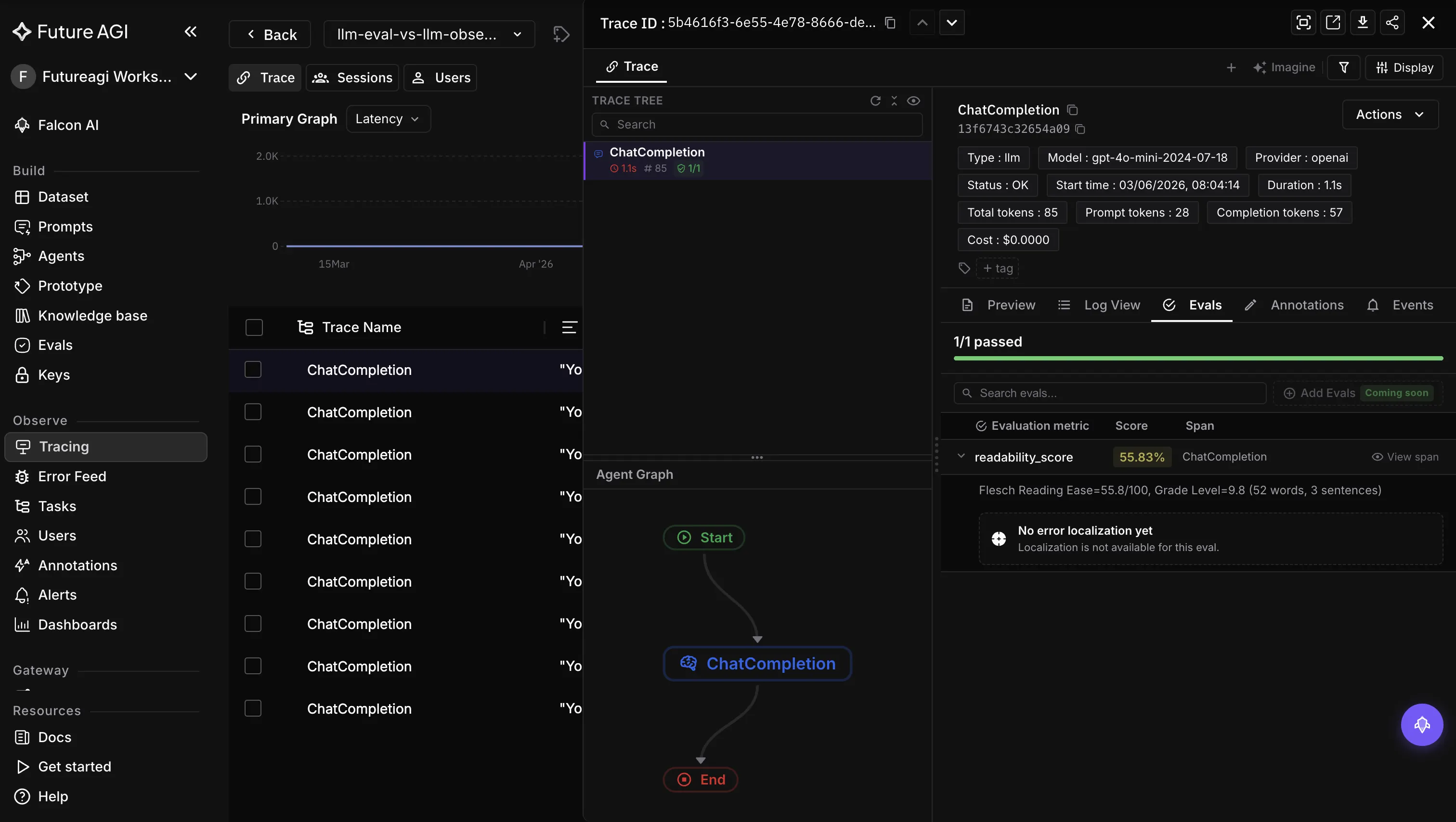
The same eval you wrote in code also runs in production. An evaluator you call in a test does not have to stop at CI. The same definition runs online on production traffic through traceAI, with the score attached to the generation span, so a check you wrote once gates the build and watches live traffic. The screenshot below shows an evaluation running on a real ChatCompletion span, with the score on the trace, so the offline test and the production monitor are the same evaluator.
The evaluator you wrote becomes an optimization target. Hand the same evaluator to FutureAGI’s optimization layer and it rewrites the prompt, scoring every candidate with the metric you already defined in code. The function you import to grade an output is the function the optimizer maximizes, so improvement runs against your own spec instead of manual prompt tweaking.
The judge behind evaluate() can be calibrated, not taken on faith. When your SDK calls an LLM-as-judge, you should be able to check it against people. FutureAGI routes disputed cases into annotation queues and tracks how often reviewers agree, then feeds that back so the judge tracks your team’s labels rather than a vendor default. You audit it with an agreement number, not a brand name.
Where FutureAGI is not the pick: if you only ever want to click through a UI and never run evals in code, the SDK is more than you need, and a bare SDK on its own is not collaboration or production monitoring. FutureAGI earns its place when evals belong in the repo and the pipeline, and the team needs an upgrade path that does not mean starting over.
See the Evaluate platform overview, or the evaluation docs for the SDK, custom evaluators, CI setup, and async batch evaluation.
What to read next
- Eval SDK vs Eval Platform vs Build (2026): the build-versus-buy decision behind Factor 6, in full.
- Deterministic vs LLM-Judge Evals (2026): the local-versus-judge trade-off from Factor 3, with examples.
- Best LLM Evaluation Tools (2026): if you would rather see specific tools ranked than work the factors yourself.
- A Gentle Introduction to LLM Evaluation (2026): the fundamentals, if you are new to scoring model output.
Frequently Asked Questions About LLM Evaluation SDKs
What is an LLM evaluation SDK?
An LLM evaluation SDK is a code library that scores model outputs from inside your application and test suite, instead of through a separate dashboard. You import it, call an evaluate function with the output and any context, and get back a score and a reason you can assert on in a pull request. A good one runs reference-free (no labeled answer required), mixes fast deterministic metrics with LLM-as-judge for the semantic calls, lets you write custom evaluators, and runs the same checks in CI that you run locally. It is the developer-facing half of an evaluation stack, distinct from the no-code platform UI.
How is an LLM evaluation SDK different from an evaluation platform?
An SDK is the code path: you call it in your app, your tests, and your CI pipeline, and it returns scores you act on programmatically. A platform is the UI and storage layer: dashboards, datasets, annotation queues, production monitoring, and team collaboration. They are complementary, not competing. Engineering teams usually start with the SDK because it fits the existing workflow (pull requests, pytest, GitHub Actions), then add the platform when more than one person owns quality or you need production monitoring. The best SDKs plug into a platform without a rewrite.
Can an LLM evaluation SDK score outputs without a ground-truth answer?
Yes, and for most production cases it has to. Reference-free evaluators use a judge to check whether an answer is grounded in its context or true in the world, so you do not need a labeled gold answer, which you rarely have for live output. The strongest SDKs combine this with deterministic checks (JSON schema, regex, BLEU or ROUGE) that do need a reference where one exists, and route each metric to the cheapest backend that can decide it. You get a usable score on open-ended output without hand-labeling a dataset first.
Should an LLM evaluation SDK run in CI?
Yes. The main reason to choose an SDK over a UI-only tool is that evals can run in your pipeline and fail a pull request the way a unit test does. The practical pattern is to run cheap deterministic checks on every change as a fast gate, reserve the LLM-as-judge calls for the semantic metrics that need them, and block the merge if a score drops below your threshold. Running the same evaluators locally and in CI means a passing build and a green local run measure the same thing.
Does an LLM evaluation SDK replace my evaluation platform or monitoring?
No. An SDK gives you programmatic scoring in code and CI, but it does not give you dashboards, shared datasets, annotation queues, or production monitoring by itself. For a solo developer or a small test suite, the SDK alone is often enough. Once more than one person owns quality, or you need to watch live traffic, you pair the SDK with a platform. A well-designed SDK is open-source and its evaluators carry over to the platform, so growing up does not mean re-instrumenting everything.
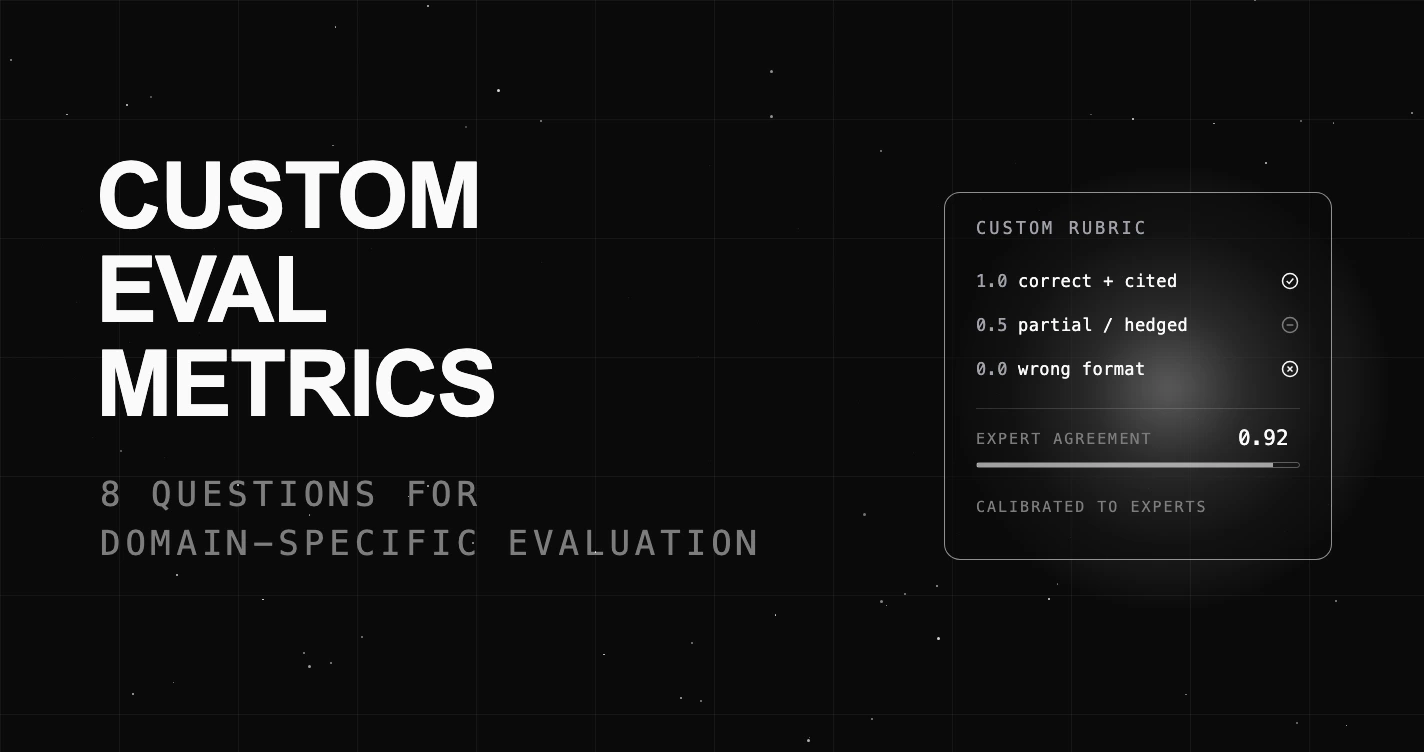
Eight questions for building custom eval metrics for domain-specific evaluation: author and calibrate your own metrics, then run them in CI and production.

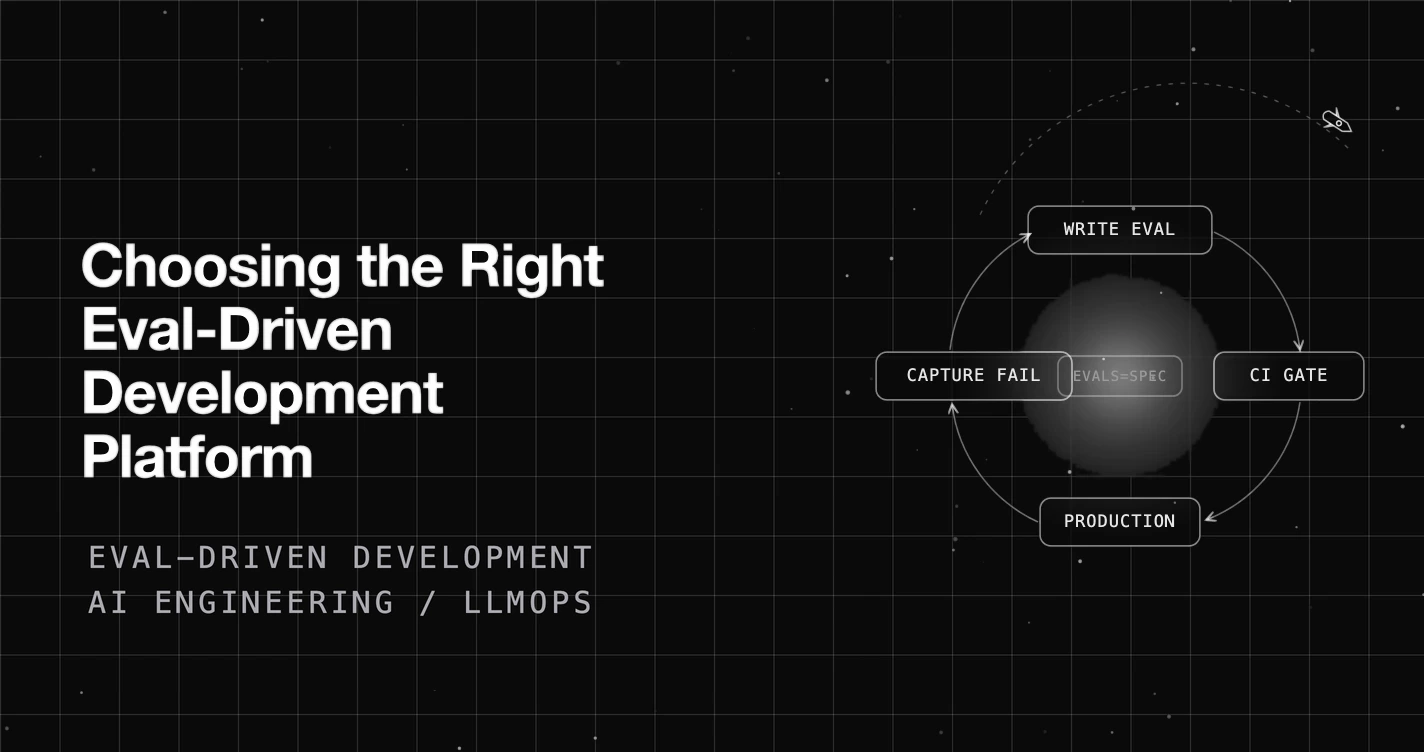
Eight factors for choosing an eval-driven development platform for AI teams: evals as spec, CI gating, dev-prod parity, regression loops, and optimization.
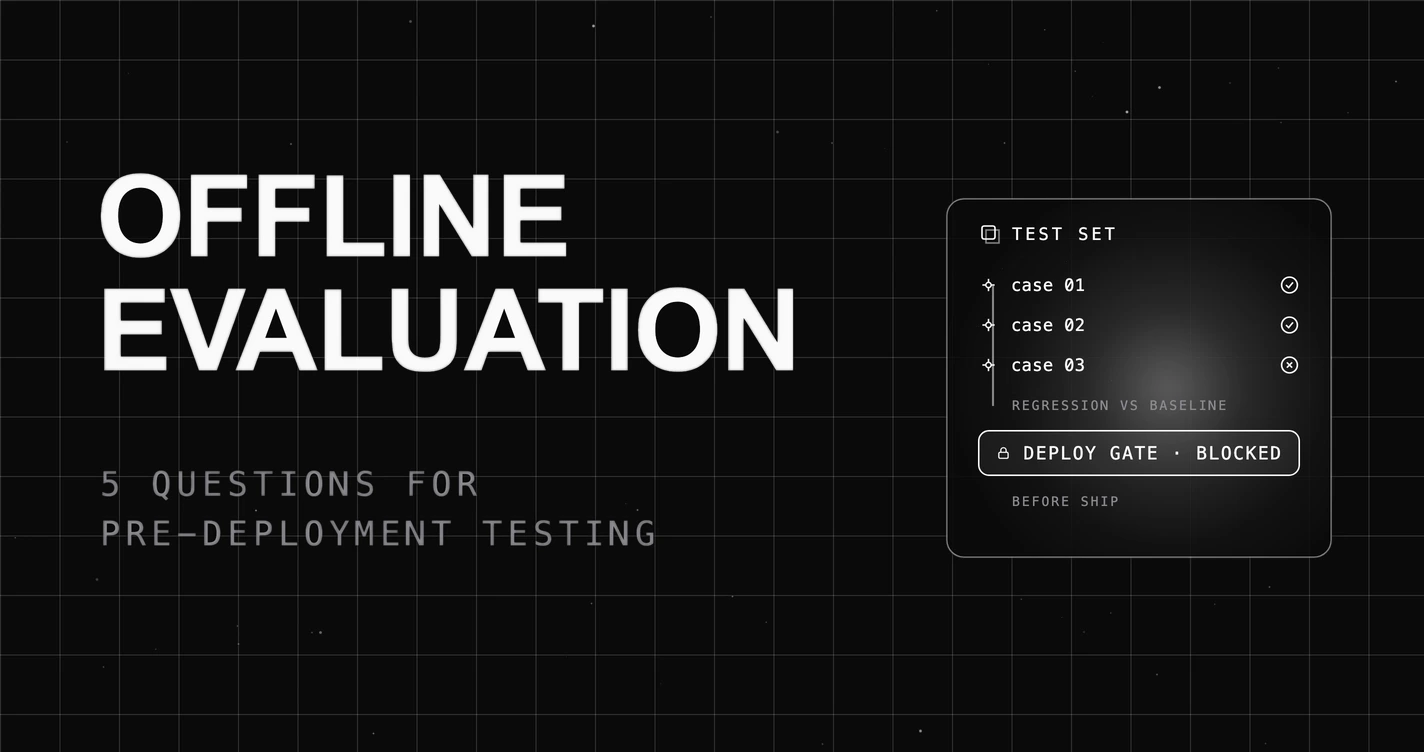
Five questions for choosing an offline evaluation tool for pre-deployment testing: run on a test set, build one without data, catch regressions, and gate CI.