Best Retrieval Quality Monitoring Tools in 2026: 7 Compared
Phoenix, Galileo, FutureAGI, Langfuse, Ragas, TruLens, and UpTrain as the 2026 retrieval quality monitoring shortlist. Recall@k, faithfulness, context relevance.
Table of Contents
Retrieval quality monitoring in 2026 is the production-side counterpart to RAG evaluation. Eval answers “how good is the system on a fixed test set.” Monitoring answers “is the system getting worse, and on which slice.” The seven tools below cover OpenTelemetry-native retrievers, span-attached scoring, drift detection, and enterprise risk diagnostics. The differences that matter are how cheap continuous scoring runs, whether scores attach to the trace tree, and how cleanly drift surfaces on dashboards before users complain.
TL;DR: Best retrieval quality monitoring tool per use case
| Use case | Best pick | Why (one phrase) | Pricing | License |
|---|---|---|---|---|
| Span-attached scoring + replay | FutureAGI | Recall, faithfulness, chunk attribution on the trace, plus drift dashboards and runtime guards | Free + usage from $2/GB | Apache 2.0 |
| OTel-native retrieval evaluators | Arize Phoenix | OpenInference + benchmark-validated metrics | Free self-host, AX Pro $50/mo | ELv2 |
| Enterprise risk + Luna-2 metrics | Galileo | Sub-200 ms scoring, Chunk Attribution | Free + Pro $100/mo | Closed |
| Self-hosted retrieval traces | Langfuse | OSS core, prompts, datasets, Ragas integration | Hobby free, Core $29/mo | MIT core |
| Canonical OSS metric library | Ragas | Context Recall, Precision, Faithfulness | Free | Apache 2.0 |
| Per-chunk groundedness | TruLens | Component-level feedback functions | Free | MIT |
| Self-hosted production monitoring | UpTrain | 20+ pre-configured evals, dashboards | Free + paid hosted | Apache 2.0 |
If you only read one row: pick FutureAGI for span-attached retrieval scoring, drift dashboards, and runtime guards in one Apache 2.0 stack, Phoenix as the OTel-native alternative, Galileo when sub-200 ms enterprise scoring matters. Galileo’s Luna-2 holds a sharp edge on benchmark sub-200 ms latency for the largest enterprise risk teams; FutureAGI’s turing_flash hits 50 to 70 ms p95 on guardrail-style screening with full eval templates around 1 to 2 seconds and adds the gateway, simulation, and prompt-optimization loop in the same stack.
What retrieval quality monitoring actually requires
Six surfaces, all running continuously on production traffic.
- Recall@k. Did ground-truth documents land in the top-k? Requires labeled queries.
- Context Precision. Of the retrieved chunks, how many are actually relevant?
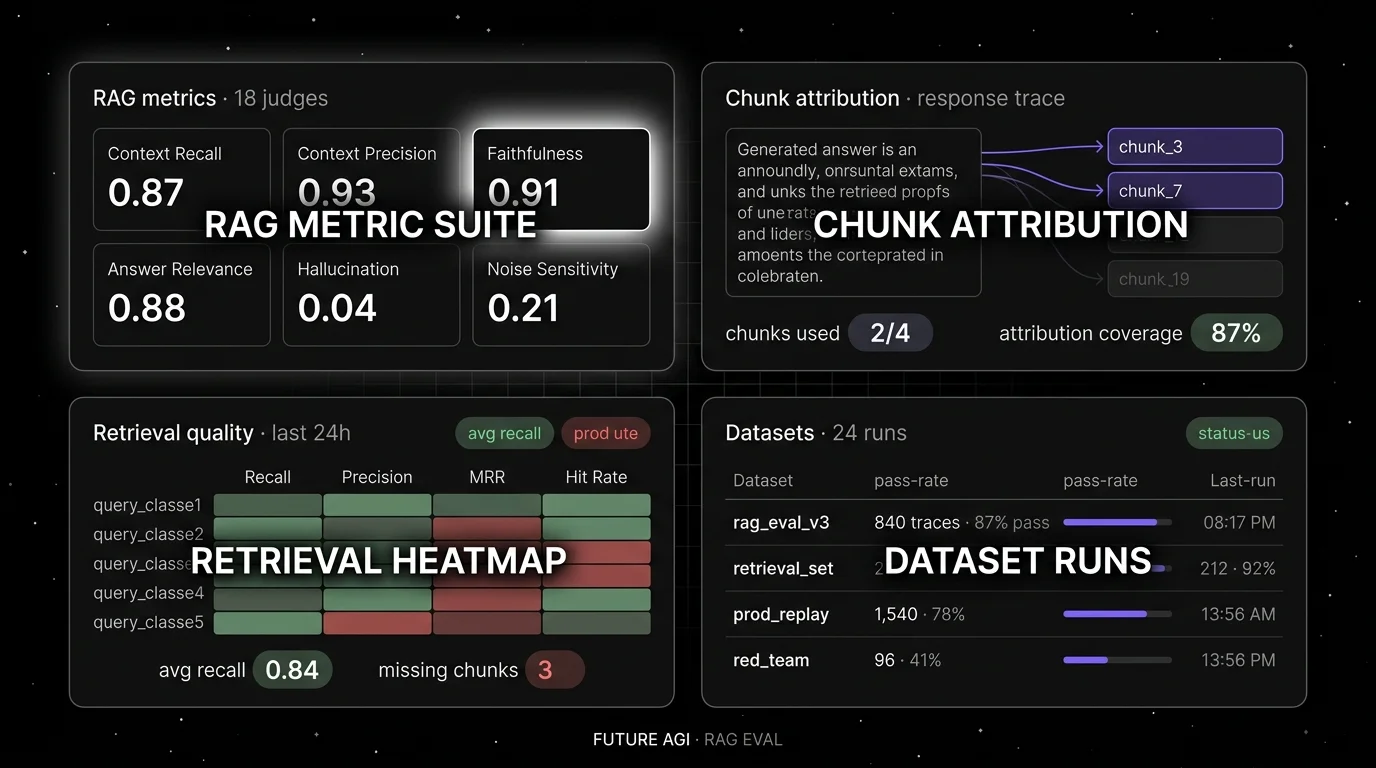
- Faithfulness. Is the response grounded in retrieved chunks, with no hallucinated claims?
- Chunk Attribution. Which retrieved chunks did the response actually cite or use?
- Drift signals. Distribution shifts on embedding distance, score regressions week over week, cohort breakdowns.
- Alerting. Thresholds tuned to your baseline, with cohort-aware breakdowns so a 5 percent drop on a 1 percent slice does not get lost in the average.
Tools below are evaluated on how cleanly they expose all six and how affordable continuous scoring is at production volume.
The 7 retrieval quality monitoring tools compared
1. FutureAGI: Best for span-attached scoring plus replay
Open source. Apache 2.0. Hosted cloud option.
Use case: Production RAG stacks where retrieval scores should appear on the trace alongside the prompt version, latency, cost, and the LLM response. FutureAGI ships RAG-specific judges (Faithfulness, Context Recall, Context Precision, Answer Relevance, Hallucination, Chunk Attribution) attached to spans via traceAI (Apache 2.0, OTel-native), with simulation for synthetic queries, drift detection on cohorts, and the Agent Command Center for runtime guards. The same eval contract runs pre-prod, CI, and live traffic so a regression replays end-to-end without rewriting the harness.
Pricing: Free plus usage from $2/GB storage, $10 per 1,000 AI credits, $5 per 100K gateway requests, $2 per 1 million text simulation tokens. Boost $250/mo, Scale $750/mo (HIPAA), Enterprise from $2,000/mo (SOC 2).
License: Apache 2.0 platform; Apache 2.0 traceAI.
Best for: Teams running RAG over enterprise corpora, knowledge bases, support workflows, copilots where retrieval drift should trigger alerts, runtime guards live in the same stack, and a failing trace should replay in pre-prod with the same scorer.
Worth flagging: More moving parts than running Ragas in a notebook. ClickHouse, Postgres, Redis, Temporal, and Agent Command Center are real services. Use the hosted cloud if you do not want to operate the data plane. On internal benchmarks turing_flash runs guardrail screening at roughly 50 to 70 ms p95 and full eval templates run async at roughly 1 to 2 seconds; validate against your own workload.
2. Arize Phoenix: Best for OpenTelemetry-native retrieval evaluators
Source available. ELv2. Self-hostable. Phoenix Cloud and Arize AX paths.
Use case: Teams that already invested in OpenTelemetry and want retrieval scoring on the same plumbing. Phoenix accepts traces over OTLP and ships built-in retrieval evaluators (Document Relevance, Faithfulness, Correctness, QA Eval) with auto-instrumentation for LlamaIndex, LangChain, DSPy, OpenAI, Bedrock, Anthropic, and others. Arize AX adds production drift dashboards and alerting.
Pricing: Phoenix free for self-hosting. AX Free 25K spans/month. AX Pro $50/month. Enterprise custom.
License: Elastic License 2.0. Source available, with restrictions on managed-service offerings. Not OSI-approved open source.
Best for: Engineers who care about open instrumentation standards and want a path from local Phoenix into Arize AX with drift detection.
Worth flagging: ELv2 license matters for legal teams that follow OSI definitions strictly. Some advanced drift dashboards are AX-only. See Arize Alternatives.
3. Galileo: Best for enterprise risk plus Luna-2 evaluation foundation models
Closed platform. Hosted SaaS, VPC, and on-premises options.
Use case: Enterprise buyers and regulated industries that need sub-200 ms scoring at high accuracy. Galileo’s Luna-2 models target Context Adherence, Chunk Attribution, Chunk Utilization, and Completeness with documented benchmarks. Real-time guardrails and on-prem deployment available.
Pricing: Free with 5K traces/month. Pro $100/month with 50K traces, RBAC, advanced analytics. Enterprise custom with unlimited scale, SSO, dedicated CSM.
License: Closed.
Best for: Chief AI officers, risk functions, audit-driven procurement.
Worth flagging: Closed platform; the dev surface is less of a draw than the enterprise security and compliance posture. See Galileo Alternatives.
4. Langfuse: Best for self-hosted retrieval traces
Open source core. MIT. Self-hostable. Hosted cloud option.
Use case: Self-hosted production tracing with prompt versions, dataset-driven evals, and human annotation. Langfuse integrates with Ragas for retrieval scoring (Faithfulness, Context Precision, Context Recall) and supports custom evaluators via its scoring SDK. The retriever span captures query, top-k, and chunks.
Pricing: Hobby free with 50K units/month. Core $29/month. Pro $199/month. Enterprise $2,499/month.
License: MIT core. Enterprise directories handled separately.
Best for: Platform teams that operate the data plane and want trace data plus retrieval scores in their own infrastructure.
Worth flagging: Drift dashboards are not first-class out of the box; build them on top of the Langfuse SQL interface. Pair Langfuse with Ragas for the metric library. See Langfuse Alternatives.
5. Ragas: Best for canonical OSS retrieval metrics
Open source. Apache 2.0.
Use case: Teams that want a Python library for retrieval scoring without a platform attached. Ragas ships Faithfulness, Context Recall, Context Precision, Context Entity Recall, Answer Relevance, Aspect Critic, and Noise Sensitivity. Most platforms (Langfuse, Phoenix, FutureAGI) integrate with Ragas under the hood.
Pricing: Free.
License: Apache 2.0, ~12K stars.
Best for: Teams that want metric definitions in code, paired with a trace store of choice. The reference implementation many other tools wrap.
Worth flagging: Ragas is a library, not a platform. Production monitoring requires pairing with a trace store and dashboard. See Ragas Alternatives.
6. TruLens: Best for per-chunk groundedness
Open source. MIT.
Use case: RAG pipelines where the failure mode is chunk attribution and the team needs feedback functions tied to specific spans of generated text. TruLens emits per-chunk groundedness, context relevance, and answer relevance with tight integration into LangChain, LlamaIndex, and OpenAI clients.
Pricing: Free.
License: MIT. Maintained by Snowflake’s Truera team.
Best for: Teams that need to debug specifically which retrieved chunk grounded the response.
Worth flagging: Smaller community than Ragas. Hosted dashboard is light. Best paired with a trace store for production monitoring at scale.
7. UpTrain: Best for self-hosted production monitoring
Open source. Apache 2.0.
Use case: Self-hosted production monitoring with 20+ pre-configured evaluations spanning hallucination, factual accuracy, context relevance, and tonality. UpTrain ships a dashboard, Slack and PagerDuty integrations, and APIs for custom guideline-adherence grading.
Pricing: Free for self-host. Paid hosted available.
License: Apache 2.0.
Best for: Teams that want a self-hosted dashboard with pre-built evaluators and minimal integration code.
Worth flagging: Smaller community than Phoenix or Langfuse. Trace ingestion is more constrained; verify integration paths against your stack. See UpTrain Alternatives.
Decision framework: pick by constraint
- OpenTelemetry-native shop: Phoenix or FutureAGI traceAI lead.
- Self-hosting required: FutureAGI, Langfuse, Phoenix self-host, UpTrain.
- Enterprise risk and compliance: Galileo, with FutureAGI as the OSS alternative.
- OSS metric library only: Ragas, with Langfuse or Phoenix as the trace store.
- Per-chunk groundedness: TruLens or FutureAGI.
- Drift detection on cohorts: Galileo (built-in) or FutureAGI (built-in); Phoenix and Langfuse compose drift via custom dashboards.
- Sub-200 ms judge latency: Galileo Luna-2 or FutureAGI turing_flash on the guardrail path.
Common mistakes when picking a retrieval monitoring tool
- Monitoring averages. A 1 percent slice can fail catastrophically while the overall average looks fine. Cohort breakdowns matter.
- Skipping drift on the embedding side. A new embedding model rotation can collapse retrieval quality even if the raw chunks did not change.
- Picking on metric name alone. Faithfulness in Ragas, DeepEval, FutureAGI, and Galileo are not identical; verify on your data.
- Scoring 100 percent of traffic. Judge tokens add up. Sample most, score 100 percent on flagged failures.
- Treating ELv2 as open source. Phoenix is source available, not OSI open source.
- Ignoring chunk attribution. Faithfulness without attribution hides whether the failure was the retriever or the prompt.
Recent retrieval monitoring updates
| Date | Event | Why it matters |
|---|---|---|
| Apr 2026 | Galileo updated Luna-2 RAG metric foundations | Sub-200 ms enterprise scoring on Context Adherence and Chunk Attribution. |
| Mar 9, 2026 | FutureAGI shipped Agent Command Center and ClickHouse trace storage | High-volume retrieval-score analytics moved into the same plane as evals. |
| Jan 22, 2026 | Phoenix added CLI prompt commands | Trace and prompt workflows moved closer to terminal-native monitoring. |
| 2025 | Ragas v0.3.x metric expansion | Aspect Critic and Noise Sensitivity widened the production scoring surface. |
| 2025 | Langfuse v3 trace storage | Retrieval span ingestion at production volume practical on self-host. |
| 2025 | UpTrain dashboards expanded | Self-hosted monitoring closer to feature parity with hosted vendors. |
How to actually evaluate this for production
- Set baseline thresholds. Run 200 representative production traces through each candidate, measure Faithfulness, Context Recall, Context Precision. Set alert thresholds at one standard deviation below baseline.
- Test cohort drift. Slice by locale, query intent, user segment. A tool that only reports averages will miss the 1 percent slices that produce most complaints.
- Cost-adjust. Real cost equals platform price plus judge tokens (sampled 1 to 10 percent) plus 100 percent on flagged failures plus storage retention plus annotation labor.
- Verify replay. A failing production trace should re-run against a candidate fix in pre-prod with the same scorer contract.
Sources
- Phoenix docs
- Arize pricing
- Galileo pricing
- FutureAGI pricing
- Langfuse pricing
- Ragas GitHub
- TruLens GitHub
- UpTrain GitHub
Series cross-link
Read next: Best RAG Evaluation Tools, Best RAG Debugging Tools, What is RAG Observability
Frequently asked questions
What are the best retrieval quality monitoring tools in 2026?
What metrics matter for retrieval quality monitoring?
How is retrieval quality monitoring different from RAG eval?
Should I sample production traces or score every trace?
Which retrieval monitoring tool is fully open source?
How does pricing compare across retrieval monitoring tools in 2026?
What changed in retrieval monitoring in 2026?
How do I detect retrieval drift in production?
FutureAGI, Datadog, Langfuse, Phoenix, Helicone, Braintrust, LangSmith for LLM monitoring in 2026. Latency, drift, cost, and eval pass-rate trends compared.
FutureAGI, DeepEval, TruLens, Phoenix, Langfuse, Galileo, and Braintrust as the 2026 Ragas shortlist. Faithfulness, retrieval, and production gaps compared.

Best LLMs May 2026: compare GPT-5.5, Claude Opus 4.7, Gemini 3.1 Pro, and DeepSeek V4 across coding, agents, multimodal, cost, and open weights.