Best 5 AI Evaluation Platforms for Retail AI Applications in 2026
Five AI eval platforms for retail, recs, search, CS chatbots, PDP gen, dynamic pricing, conversational commerce. FTC, Moffatt, PCI-DSS v4, GDPR Art 22.
Table of Contents
Updated May 2026. Six retail AI use cases (product recommendation, search re-ranking, customer-service and returns chatbots, PDP and marketing-copy generation, dynamic pricing, conversational commerce) share one production failure mode no AI gateway and no observability dashboard catches: a confident-sounding output that drifted off-brand, fabricated a product feature, or quoted a refund policy the company doesn’t offer. This post compares the five evaluation platforms retail teams should actually consider in 2026, ranked by what production teams ship to a CX review and a CMO, not by vendor marketing.
TL;DR: the winners at a glance
A recommendation engine at a mid-market retailer drifted in production for six weeks after a model upgrade. The bot was up. The dashboards were green. Conversion on the personalized funnel had quietly slid before anyone tied the number back to the eval score that had stopped tracking. Across the same window, the returns chatbot had been confidently quoting a 30-day refund window the company doesn’t offer, exactly the shape of misrepresentation a tribunal held an airline liable for in Moffatt v. Air Canada.
Gateways control inputs. Observability tells you the bot is up. Evaluation platforms tell you whether the bot is making the company money or losing it. Below are five platforms that score outputs against retail-specific failure modes, ranked honestly with limitations called out per platform.
| # | Platform | Best for | Pricing model |
|---|---|---|---|
| 1 | Future AGI | OTel-native brand-voice + claim-accuracy + drift + field-level error localization in one stack, SOC 2 / GDPR / CCPA certified | Cloud + OSS self-host; Free + Pay-as-you-go; Boost/Scale/Enterprise add-ons |
| 2 | Galileo | Tier-1 retailers and large marketplaces with deep procurement budgets | Enterprise contract |
| 3 | LangSmith | Retail engineering teams already using the LangChain ecosystem | Cloud SaaS + enterprise |
| 4 | Arize Phoenix | Engineering teams that want to self-host eval data inside the customer-data boundary | Apache 2.0 open source + Arize AX paid tier |
| 5 | Langfuse | DTC startups optimizing on cost | Open source + cloud SaaS |
Why retail AI evaluation is different from generic LLM eval
Retail AI failure modes are revenue and CX shaped, not regulator-audit shaped. A drift in a recommendation engine is a conversion problem before it is a compliance problem. A returns chatbot that confidently quotes a refund policy the company doesn’t offer is a returns spike, an NPS hit, and (as a tribunal held in Moffatt v. Air Canada (2024)) a liability problem. A thousand auto-generated PDPs that drift off-tone after a model update is a CMO escalation and a brand-equity drain, the kind of persona and style drift a generic accuracy evaluator never flags. None of these are caught by a gateway or by a dashboard that reports “the bot is up.” For the broader reliability story behind the rubric in this post, see Generative AI trends 2026: why reliability won.
The thin compliance overlay is real but not the primary buyer driver. The FTC’s 2023 guidance on AI claims and the 2024 update to the Endorsement Guides on AI-generated reviews put retail on notice that AI-generated marketing claims are reviewable under §5 of the FTC Act. PCI-DSS v4.0 (full enforcement March 2025) tightens the boundary around any AI flow that touches card data. GDPR Article 22 grants EU customers a right to explanation on automated decisions that significantly affect them. CCPA/CPRA and the state privacy laws (TX TDPSA, VA VCDPA, CO CPA, CT CTDPA) require an audit trail for personalization. ADA Title III applies to AI-driven retail interfaces. EU AI Act transparency obligations require disclosure when a customer is interacting with AI.
But the regulatory layer is the floor, not the ceiling. Generic LLM evaluation falls short on three retail-specific axes. First, the unit of error includes brand-voice consistency, which a generic factual-accuracy evaluator misses entirely. Second, retail AI is high-volume; thousands of PDPs and millions of chat turns mean per-output review by a marketing manager doesn’t scale, and the eval has to happen at production volume with drift detection rather than spot checks. Third, the failure modes have to be tied to outcomes a CX or e-commerce lead actually owns (conversion, NPS, returns rate, agent containment), not only to a regulator-audit artifact.
Most listicles in 2026 pitch retail an AI gateway. Or generic AI observability. Neither catches outputs. Evaluation platforms are what determine whether your AI-generated catalog ships clean and your chatbot stops misrepresenting your refund policy.
The 2026 retail regulatory and CX pressure stack
| Rule / pressure | What it covers | What your eval platform has to produce |
|---|---|---|
| FTC AI guidance + Endorsement Guides 2023 update | Deceptive AI claims; AI-generated reviews and endorsements | Documented review of AI-generated marketing/product claim accuracy before publication; disclosure of AI-generated reviews |
| FTC Act §5 + Operation AI Comply (Sept 2024 sweep) | Deceptive acts in commerce; ongoing FTC enforcement on AI claims | Per-claim factual-accuracy score against source-of-truth content (PIM, spec sheets, vendor docs) |
| Moffatt v. Air Canada (BC CRT 2024) | Chatbot misrepresentation liability — the cleanest precedent for retail-shaped chatbot exposure | Per-output factual grounding against the actual policy; an audit trail of what the bot said and the score that flagged or cleared it |
| PCI-DSS v4.0 (full enforcement March 2025) | Payment-touching AI flows | Local-mode eval paths so card data doesn’t leave PCI boundary; tokenize at the payment-form boundary |
| GDPR Article 22 + state privacy (CCPA/CPRA) | Right to explanation for automated decisions; personalization audit trail | Per-decision human-readable reasoning; span-level capture of which inputs/customer data drove each personalized output |
| EU AI Act transparency obligation + ADA Title III | Disclosure when interacting with AI; accessibility of AI-driven interfaces | AI-disclosure in customer-facing surfaces; output-quality scoring on screen-reader-friendly responses |
| Brand-voice consistency (CX pressure) | The CMO’s standard for AI-generated copy | Tone evaluator scoring against brand-voice rubric; drift detection across releases |
Two practical implications for the platform shortlist below: the platform has to score brand-voice tone, not just accuracy, and at least the structural and PCI-relevant checks have to run inside the customer-data boundary.
The Future AGI Retail Evaluation Scorecard
Most listicles compare platforms on features and call it a day. Retail needs a sharper rubric, one that scores on outcomes a head of CX and a CMO actually own with the compliance floor as one dimension among five rather than the primary axis. We score each platform on five dimensions:
| Dimension | What it measures | Why it matters in retail |
|---|---|---|
| Claim factual accuracy | Whether AI-generated product or marketing claims match source-of-truth content (PIM, spec sheets, vendor docs) | FTC §5 deception risk; Moffatt-shaped chatbot liability; returns driven by fabricated features |
| Brand-voice consistency | Tone-evaluator scoring against a brand-voice rubric | The CMO will not ship copy that doesn’t sound like the brand; tone drifts silently as the underlying model is updated |
| Drift detection on personalization | Sensitivity to recommendation drift over time | Conversion quality drifts silently as the rec model is updated; revenue impact accumulates before anyone notices |
| Error localization | Field-level attribution when an eval fails | Required to answer “why did the chatbot say this about the product?” in a CS escalation, a merchandiser ticket, or an FTC inquiry |
| Customer-data boundary integrity | Whether customer-data-bearing eval paths can run locally without third-party LLM exposure | CCPA/CPRA, GDPR, PCI-DSS scope reduction |
A platform that scores high on three of five is a strong candidate; one that scores high on four or five is the production pick.
Comparison matrix: five platforms, six capabilities
| Capability | Future AGI | Galileo | LangSmith | Arize Phoenix | Langfuse |
|---|---|---|---|---|---|
| Pre-built evaluators (count) | 50+ + unlimited custom | ~15 | ~10 (BYO common) | ~8 | ~5 (BYO common) |
| Tone / brand-voice evaluator | Yes | Limited | BYO | Limited | BYO |
| OpenTelemetry-native tracing (framework integrations) | Yes (35+) | Partial | Partial | Yes | Yes |
| Field-level error localization | Yes | No | No | No | No |
| Local/heuristic eval mode | Yes (20+) | No | Limited | Yes | Limited |
| Apache 2.0 open source (self-host trace + eval) | Yes (traceAI + ai-evaluation) | No | No | Yes | Yes |
How we ranked these 5 platforms
Three filters. First, the platform had to support retail-relevant evaluators out of the box (Factual Accuracy, Tone for brand-voice fit, Hallucination, and at least one structural validator). Second, it had to expose a trace or span format that survived round-tripping through an OpenTelemetry-compatible audit store or BI pipeline. Third, it had to support drift detection at production volume; retail eval is a high-volume problem, not a spot-check problem. We did not weight pricing in the ranking. Two of the five (Arize Phoenix and Langfuse) have generous free tiers; the other three are commercial-first. For a methodological reference, see Best LLM API providers in 2026.
#1 Future AGI: brand-voice, claim-accuracy, drift detection, and field-level error localization in one stack
Future AGI is the production-grade pick for retail teams that want eval, tracing, drift detection, and a customer-data-safe local execution path in one platform. The differentiator is concrete: 60+ built-in evaluators across 11 categories including a Tone evaluator for brand-voice consistency, Factual Accuracy and Groundedness scoring product claims, 20+ local heuristic validators against the product attribute schema, field-level error localization, plus SOC 2 Type II / GDPR / CCPA certification per the trust page.
Best for: mid-market retailers, DTC brands, catalog-generation teams, and conversational-commerce vendors that want one platform covering brand-voice + claim-accuracy + drift detection + audit-grade traces. Especially strong when you already run OpenTelemetry.
Key strengths:
ai-evaluationships 60+ built-in evaluators across 11 categories including Tone for brand-voice fit, Factual Accuracy and Groundedness against retrieved source content, Hallucination, Toxicity, RAG eval, plus 20+ local heuristic metrics (regex, JSON schema, BLEU/ROUGE, semantic similarity). Unlimited custom evaluators authored by an in-product agent, self-improving evaluators tuned against your production traces, in-house classifier models at Luna-2 cost economics. Apache 2.0traceAIauto-instruments 35+ frameworks (OpenAI, Anthropic, LangChain, LlamaIndex, Groq, Portkey, Gemini) at import time, OpenInference-compat, Apache 2.0. Spans flow into the data-warehouse or BI pipelines retail teams already operate; eval results link viaspan_id, so the score that flagged a recommendation regression and the order it impacted are queryable in the same place
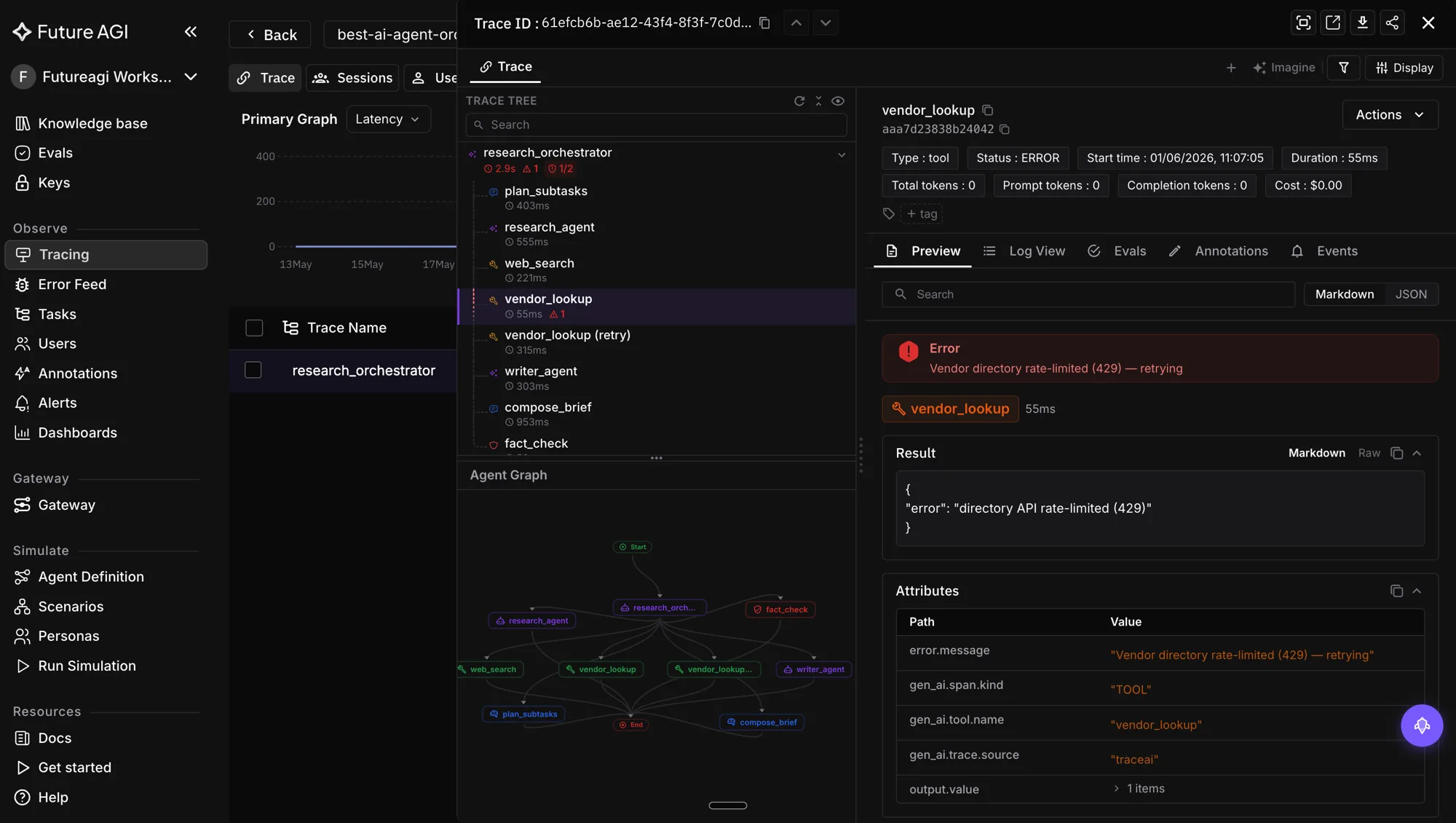
- Field-level Error Localization tells a CS or merchandising lead exactly which prompt segment, retrieved product spec, or PIM field produced a contested output
- Hybrid mode: structural validators against the product attribute schema, BLEU/ROUGE on PDP rewrites, semantic similarity against the PIM run local; LLM-judge stays opt-in
- Error Feed auto-clusters trace failures into named issues with auto-written root cause, quick fix, and long-term recommendation (Sentry for AI agents)
agent-optcloses the loop with 6 optimizer classes (GEPAOptimizer, ProTeGi, PromptWizardOptimizer, BayesianSearchOptimizer, MetaPromptOptimizer, RandomSearchOptimizer) against the live trace data your eval scores live on
- See How to evaluate Google ADK agents with Future AGI for an end-to-end walkthrough
Limitations:
- Opinionated prompt library: fewer review-and-collaboration knobs than Portkey’s prompt registry, by design. The trade is that prompt, eval, and trace live in the same control plane
agent-optis opt-in: the self-improving loop is a feature you turn on per route. The trade is that the optimizer runs against real production traffic with eval scores joined to spans, not a synthetic corpus- Real-time voice agent eval is not in scope for voice-first retail surfaces. The trade is that the eval attaches to a transcript artifact, so the same span model captures audio, image, and text outputs
Use-case fit: product recommendation drift, search re-ranking quality, customer-service and returns chatbot grounding, PDP-generation brand-voice and claim-accuracy, dynamic-pricing copy evaluation.
Pricing & deployment. Cloud + OSS self-host (Apache 2.0 SDK suite: traceAI, ai-evaluation, agent-opt). Free to get started; usage-based as you scale. Compliance and enterprise add-ons (SOC 2 Type II, HIPAA BAA, SAML SSO + SCIM) are clearly priced. Pricing. Multi-region hosted, AWS Marketplace listing, 100+ provider integrations. Air-gapped self-host available via BYOC.
Verdict: the strongest single-platform pick when your workload is brand-voice + claim-accuracy + drift detection + audit-grade traces. Galileo wins on tier-1 procurement; LangSmith wins if you’re already on LangChain. On Tone breadth, field-level localization, and the local heuristic path, Future AGI wins.
For deeper context, pair this with the custom voice evaluator authoring guide, the voice agent eval rubric library deep dive, and the end-to-end voice AI evaluation reference.
#2 Galileo: tier-1 procurement and runtime guardrails for retail InfoSec
Galileo is the strongest pick if your retailer is large enough that procurement, SSO, and an MSA matter more than open-source flexibility. Galileo’s runtime guardrails and eval suite are mature, the platform has named enterprise customers, and the security posture clears retail InfoSec quickly.
Best for: Tier-1 retailers, marketplaces, large omnichannel brands, and grocery chains with deep procurement processes and an MSA-first vendor approach.
Key strengths:
- Hallucination scoring (Luna models) with strong third-party benchmarks, useful for catalog-generation teams that want a defensible second-line check on product claims
- Runtime guardrails that can block outputs at inference time, useful on customer-facing chat surfaces where a wrong answer is costlier than a slow one
- Mature enterprise security posture clears retail InfoSec quickly
- Named enterprise customers, including in regulated industries
Limitations:
- Optimizes for fully-managed cloud; teams that need PII or PCI-relevant eval inside a self-hosted boundary have to wire that path themselves
- Built-in evaluator catalog narrower than Future AGI’s, especially for Tone and brand-voice rubrics retail teams care about
- Closed-source: extending evaluators with custom brand-voice rubrics is a vendor request, not a code change
Use-case fit: large-marketplace search re-ranking, multi-brand catalog generation at scale, customer-facing triage chat at a Tier-1 retailer.
Pricing & deployment: enterprise contract, fully-managed cloud.
Verdict: the safest procurement story for retail InfoSec; less flexible than Future AGI on the data-path question, and the brand-voice eval is more BYO than out-of-the-box.
#3 LangSmith: the eval surface attached to the LangChain ecosystem retail teams already use
LangSmith is the eval, observability, and prompt-management surface from the team behind LangChain and LangGraph. For retail engineering teams already shipping production agents on LangChain or LangGraph, LangSmith is the lowest-friction path to an eval loop. Datasets, online evaluators, regression tests, and prompt management all attach to traces emitted by the agent code teams already wrote.
Best for: retail engineering teams running production LangChain or LangGraph agents who want eval, traces, and prompt management on the same substrate as the agent runtime.
Key strengths:
- Tight integration with LangChain and LangGraph: no separate instrumentation; traces flow automatically from agent code
- Strong dataset and regression-test surface: wire a hold-out set of prior CS chats or PDP outputs and run the suite on every prompt change
- Online evaluators support running LLM-as-judge at production volume, with sampling controls
- Prompt management with version pinning and easy rollback, useful for the catalog-generation team that ships prompt updates weekly
Limitations:
- Pre-built evaluator catalog is narrower than Future AGI’s; Tone and brand-voice evaluators are typically BYO with LLM-as-judge rather than out-of-the-box templates
- Less compelling if your stack is not on LangChain. The integration value is the differentiator, and outside that ecosystem the alternatives are stronger
- Local/heuristic eval mode is lighter; structural validators against a product attribute schema usually require custom code
Use-case fit: customer-service and returns chatbots built on LangGraph; semantic product search built on LangChain retrieval; PDP-generation pipelines with multi-step prompt orchestration.
Pricing & deployment: cloud SaaS with free tier for early-stage teams; enterprise tier for production volume.
Verdict: the strongest pick when LangChain or LangGraph is already the agent substrate; eval loop attaches without re-instrumentation. Less compelling outside the LangChain ecosystem.
#4 Arize Phoenix: the strongest open-source self-hosted option
Arize Phoenix is the Apache 2.0 eval-and-tracing platform from Arize, OpenTelemetry-native, and the strongest free pick for retail engineering teams that want to keep eval data inside their boundary. Phoenix runs on your infrastructure, ingests OTel spans, ships with a usable set of evaluators (hallucination, Q&A correctness, relevance, toxicity), and bridges into Arize’s commercial AX product when you outgrow the free tier.
Best for: retail engineering teams or DTC platform vendors with strong platform-engineering capacity who already run OTel and prefer eval data to stay inside the customer-data boundary.
Key strengths:
- OTel-native; lowest-friction integration if you already run OTel
- Self-hostable; eval data and traces stay in your stack, inside your customer-data boundary
- Reasonable evaluator catalog for general use (hallucination, Q&A correctness, relevance, toxicity)
- Bridges to commercial Arize AX when production-grade dashboards and drift monitoring matter
Limitations:
- Built-in evaluator catalog is smaller than Future AGI’s; Tone and brand-voice are BYO
- Hosted ergonomics around drift detection, dashboards, and alerting are paywalled in Arize AX
- Self-hosting is real platform work: you own the upgrade path, the storage scaling, and the dashboard customization
Use-case fit: any retail workload where the engineering team has the capacity to operate the stack and customer data must stay inside the boundary.
Pricing & deployment: free open-source; paid Arize AX for production-grade features.
Verdict: the strongest free option when you have platform-engineering capacity; ramp into Arize AX when you outgrow the open-source tier.
#5 Langfuse: the cost-optimized DTC startup pick
Langfuse is the open-source LLM engineering platform DTC startups reach for when cost is the primary constraint. It bundles tracing, prompt management, simple evals, and a dataset/experiment workflow in one project. Self-hosting is straightforward; the cloud SaaS tier is generous for early-stage teams.
Best for: DTC startups, small platform-engineering teams, and pilot stacks where cost beats breadth.
Key strengths:
- Best-in-class prompt management and version pinning; A/B test prompts against a held-out dataset in the UI without wiring custom infrastructure
- Tracing, prompt management, simple evals, and dataset/experiment workflow in one project
- Self-hosting is straightforward; generous open-source license
- Strong community traction in early-stage DTC
Limitations:
- Built-in evaluators are lighter than Future AGI, Galileo, or LangSmith; the eval suite leans on you to bring your own logic or wire LLM-as-judge prompts manually
- For retail production workloads where the marketing review process is going to ask which evaluator and what threshold, you are wiring more from scratch than the heavier platforms
- Limited PII redaction; bring-your-own controls for any customer-data-touching path
Use-case fit: early-stage DTC products, pilots, internal tools where the eval bar is “good enough to ship the next iteration” rather than “good enough to clear an FTC review.”
Pricing & deployment: open source + cloud SaaS.
Verdict: the cheapest path to a working eval loop for an early-stage DTC team; expect to outgrow the eval surface as catalog volume and brand-voice expectations harden.
Decision matrix: which platform fits which retail buyer
| If you are a… | Pick | Why |
|---|---|---|
| Tier-1 retailer or marketplace with full procurement, MSA, SSO requirements | Galileo | Enterprise security posture clears retail InfoSec fastest |
| Retail engineering team running production LangChain or LangGraph agents | LangSmith | Eval, traces, prompt management attach to the agent runtime without re-instrumentation |
| Mid-market retailer running one production AI workload on OTel — brand voice + claim accuracy + drift | Future AGI | Tone + Factual Accuracy + drift detection + error localization in one; 20+ local heuristic validators against the product attribute schema |
| Catalog-generation team automating thousands of PDPs | Future AGI + Galileo (defense-in-depth) | Future AGI for Tone + Factual Accuracy + structural validators; Galileo’s Luna hallucination model as second-line check |
| Engineering-led retailer with platform capacity, self-host preference | Arize Phoenix | Open-source, OTel-native, customer data stays in your stack |
| DTC startup, cost-constrained | Langfuse | Cheapest path to a working eval loop; prompt management is best-in-class |
| Conversational-commerce vendor accepting payments | Future AGI (hybrid mode, PCI-aware) | Local validators on payment-adjacent fields; LLM judges scoped to non-card data |
Closing: the gap that gateways and dashboards do not fill
Retail AI in 2026 has two production failure modes. The first is obvious: a bad input gets through. Gateways are good at that. The second is silent and revenue-shaped: a polished, on-brand-sounding output is wrong, off-brand, or quietly biased, and nobody scored it before it landed on a product page or in a customer conversation. Observability dashboards log the second failure. Evaluation platforms catch it.
Of the five platforms above, Future AGI is the production-grade pick when your workload is brand-voice + claim-accuracy + drift detection on a high-volume retail surface and you want one stack covering eval, tracing, and customer-data-safe local execution. Galileo wins on tier-1 retailer procurement. LangSmith is the strongest fit when LangChain or LangGraph is already your agent substrate. Arize Phoenix is right when eval data must stay inside the customer-data boundary. Langfuse is the cost-driven path for early-stage DTC.
Related reading
- Best 5 AI Evaluation Platforms for Fintech in 2026
- Best 5 AI Evaluation Tools for HR in 2026
- Best 5 AI Evaluation Tools for Education in 2026
- How to evaluate Google ADK agents with Future AGI
Ready to evaluate your first retail AI agent? Get started with Future AGI and follow the Google ADK integration guide.
Frequently Asked Questions
What's the difference between an AI gateway and an AI evaluation platform for retail?
Which AI evaluation platform is best for catching hallucinated product claims?
How do I evaluate brand-voice consistency across thousands of AI-generated PDPs?
Can I evaluate retail AI without exposing customer data to a third-party model?
How do I keep an AI evaluation flow PCI-compliant when the chatbot can take payments?
How often should retail teams re-evaluate production LLMs?
Five AI observability tools for retail, rec engines, PDP gen, merchandising copilots, CS chatbots, AI reviews. FTC §5, Op AI Comply, PCI-DSS, ADA.

Five AI guardrails platforms for retail: returns chatbots, recommendation engines, PDP generation, dynamic pricing, conversational commerce. FTC, PCI-DSS.
Fintech AI eval in 2026: five platforms scored on SOC 2 + PCI-DSS, financial-regulation rubrics, SR 11-7. FAGI, Galileo Luna-2, Braintrust, Datadog.