Generative AI Trends 2026: 8 Shifts Reshaping What Teams Build, Buy, and Replace
Eight 2026 generative AI trends: agentic AI, multimodal, GPT-5, Claude 4.7, Gemini 2.5 Pro, on-device, MCP, evals, gateways, with budgets to plan for.
Table of Contents
What Are the Eight Generative AI Trends That Matter in 2026?
| Trend | Why it matters in 2026 | What to do |
|---|---|---|
| 1. Agentic AI in production | Tool-calling and long-horizon recovery are reliable enough for customer flows | Wire agents with traceAI, simulate before release |
| 2. Multimodal by default | Frontier models converging on multimodal; coverage varies by provider and SDK | Build single-call multimodal flows; cut OCR and TTS glue code |
| 3. Small task-tuned models | Gemini Flash, GPT-5 nano, Llama 4.x at roughly an order of magnitude lower cost | Route cheap models on easy paths via Agent Command Center |
| 4. MCP standardizes tools | Anthropic protocol now ports across OpenAI, Google, xAI | Build tools as MCP servers; reuse across models |
| 5. Custom evals replace benchmarks | Public benchmarks saturated; vendor scaffolds unverifiable | Run fifty to two hundred prompt regressions with Future AGI Evaluate |
| 6. Multi-model routing default | Failover, A/B, guardrails on every call | Wire Agent Command Center, BYOK across a broad provider set |
| 7. On-device generation | Apple, Pixel, Snapdragon ship small local models | Reserve cloud for hard reasoning; offload classification on-device |
| 8. Closed-loop eval | Evals feed prompt and dataset versioning | Pair Evaluate, Optimize, and traceAI in one loop |
If you only do one thing in 2026, replace your “pick the best model” loop with “run my regression on every new release.” That is the meta-trend that contains all eight.
How Did Generative AI Evolve from GPT-3 and DALL-E to Production-Reliable Agents?
Generative AI in 2024 was about whether a model could write a poem or draw a cat. In 2026, the conversation is about whether an autonomous agent can take a customer support ticket, pull the right invoice from your data warehouse, file a refund through Stripe, send a confirmation email, and roll back cleanly when a step fails. The shift is from “can it generate” to “can it deliver work.”
Three releases shaped 2025 and set up 2026: GPT-5 unified OpenAI’s reasoning and general-purpose tracks, Claude Opus 4.7 pushed coding and long-horizon agent benchmarks higher, and Gemini 2.5 Pro extended context up to two million tokens on enterprise tiers. Llama 4.x and DeepSeek V4 closed much of the reasoning gap for open weights. See our best LLMs in May 2026 roundup for a head-to-head on where each model stack stands today.
But the bigger shift was the tooling around the models, not the models themselves. Eval platforms moved from public benchmark dashboards to custom regression suites. Tracing matured into a standard discipline backed by OpenTelemetry-compatible libraries. MCP from Anthropic shipped wide adoption, and gateways turned multi-provider routing into a default rather than a luxury. The rest of this post walks each of the eight 2026 trends that matter for builders.
Why Is Agentic AI Moving Into Production, Not Just Demos?
In 2025, agentic AI was a recurring demo and a recurring disappointment. The pattern was: a vendor would show an agent buying a flight live, then production teams would find that the same agent failed 40 percent of the time on real workloads. By May 2026, that gap has closed for narrow domains.
Three things changed. First, tool-calling reliability climbed across frontier models, with sharply lower spurious-retry rates on long-horizon tasks. Second, MCP shipped wide enough that agents can reuse tools across models. Third, observability platforms made debugging tractable.
Tool selection accuracy, refusal correctness, and groundedness on retrieved context are the new monitoring metrics for agents running customer-facing flows, alongside the accuracy, latency, and failure-recovery gates below.
The 2026 pattern for shipping a production agent:
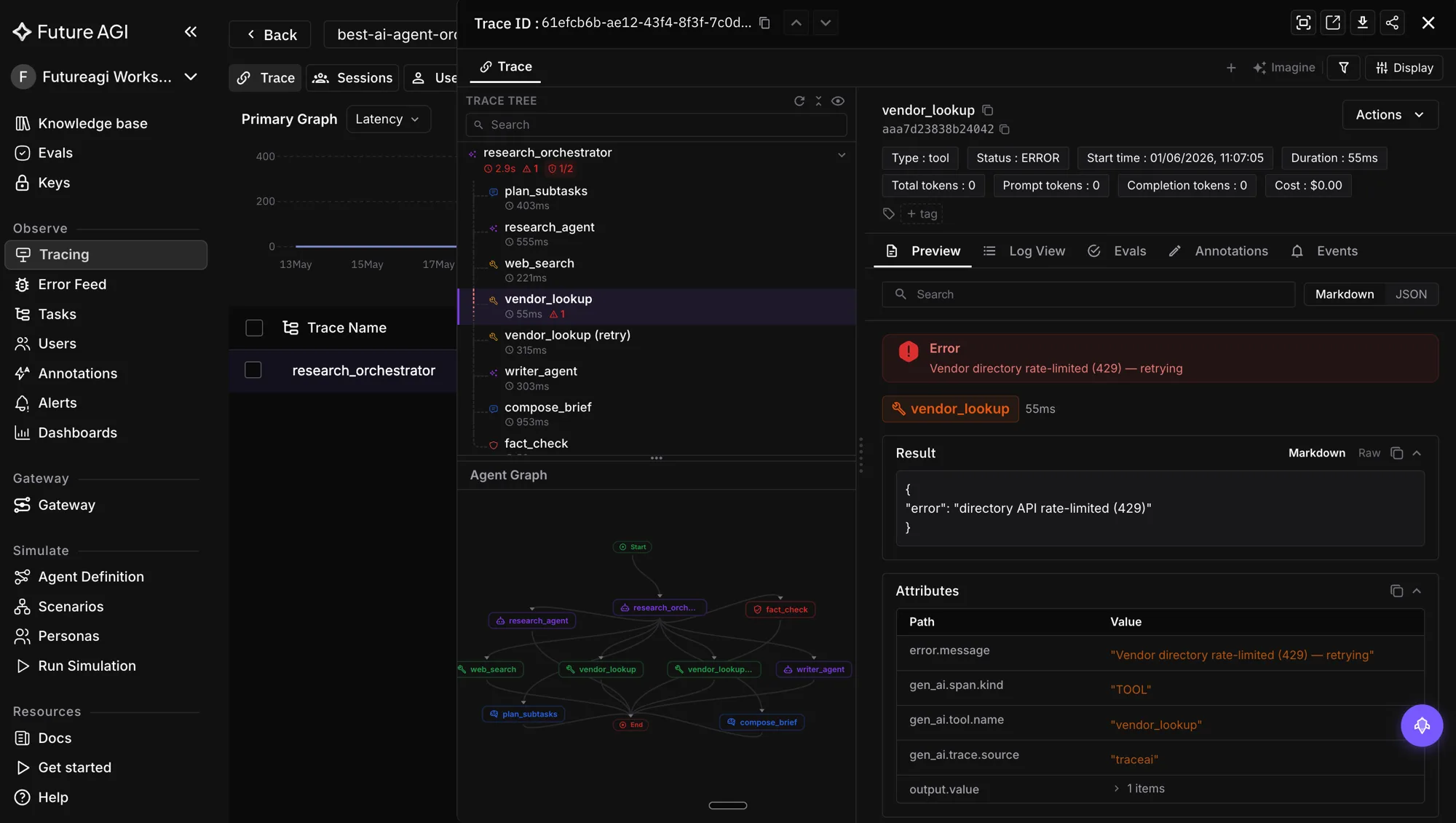
- Build the agent with traceAI instrumentation from day one, so every tool call is captured.
- Run a simulation pass with Future AGI Simulation against persona-driven user flows before launch.
- Score with custom LLM judge metrics through Evaluate.
- Gate the release on accuracy plus latency plus failure-recovery rate, not just accuracy.
# pip install futureagi traceai-openai
from fi_instrumentation import register
from traceai_openai import OpenAIInstrumentor

# Trace every OpenAI call from the agent. The same traceAI registration
# works with Anthropic, Gemini, LiteLLM, and other supported providers.
tracer_provider = register(project_name="customer-support-agent-v3")
OpenAIInstrumentor().instrument(tracer_provider=tracer_provider)

# After running your agent against persona-driven prompts, the traces land
# in Future AGI. Use Simulate for synthetic-user batches and Evaluate to
# score each run; see docs.futureagi.com/docs/simulation/.
The combination of traceAI, simulation, and custom evals is what makes agents shippable. Without it, you are guessing whether your agent breaks on edge cases.
Why Is Multimodal Becoming the Default, Not Just a Feature?
In 2024, multimodal was a separate API endpoint. In 2026, the frontier models are converging on multimodal input: GPT-5 added video understanding, Claude Opus 4.7 ships strong image input on its main API, and Gemini 2.5 Pro handles text, image, audio, and video including audio output through its Live API. Coverage still varies by modality and SDK, so check vendor docs for the specific surface you need.
The practical effect for builders is fewer pipeline hops. A 2024 pipeline that stitched OCR, text extraction, summarization, and a separate speech step often collapses to a single multimodal model call. A receipt-to-CRM workflow that needed four services becomes one model call, and a meeting transcript to action items workflow that needed Whisper plus GPT-4 plus an extra speech model can be a single call against a multimodal provider.
If your product still has separate vision, audio, and text branches in 2026, you are paying for plumbing that does not need to exist. The trade-off is cost: single-call multimodal is convenient but not always cheap, so route easy cases like short text or plain classification to the smaller task-tuned models in Trend 3 and reserve the multimodal frontier for cases that actually need it.
Why Are Small Task-Tuned Models Replacing Frontier Models on Routine Work?
Frontier model pricing fell sharply through 2024 and 2025. Task-tuned small models fell faster, with GPT-5 nano, Gemini 2.5 Flash-Lite, and Llama 3.2 3B-class models routinely an order of magnitude cheaper per million tokens than full frontier tiers. Check vendor pricing pages for current numbers, since they keep dropping.
The 2026 production stack is two-tier: frontier models for hard reasoning, small task-tuned models for routing, classification, rephrasing, and intent detection. The router decides which one runs on each call. Typical tiering:
- Classification (intent, sentiment, PII flag): GPT-5 nano, Gemini Flash-Lite, or Llama 4.x small variants. Cheapest tier of per-token cost.
- Rephrasing and structured extraction: GPT-5 mini, Claude Haiku, Gemini Flash. Mid tier of per-token cost.
- Hard reasoning, agent planning: GPT-5, Claude Opus 4.7, Gemini 2.5 Pro, Grok 4. Frontier per-token cost.
Cost savings from routing typically run several-fold at scale, depending on traffic mix and how often the cheap tier can serve the request.
How Does Model Context Protocol Standardize Tool Calling?
Anthropic shipped Model Context Protocol (MCP) in late 2024. Our Model Context Protocol explainer covers how the standard works. By May 2026, MCP has growing ecosystem support across Claude, Gemini, OpenAI tooling, and most agent frameworks, either natively or through adapters. The result: an MCP server you build can be reused across multiple model stacks with less rewrite work than vendor-specific tool schemas.
What this means in practice:
- One tool, many models. Build a filesystem MCP server once, and most modern agents can consume it.
- Less tool-schema rewrite work. Switching providers no longer forces you to rebuild every tool schema from scratch, though model-specific tool behavior and auth still need attention.
- Ecosystem of pre-built servers. Common stacks like Postgres, GitHub, and Slack now have MCP servers available, some maintained by vendors and many by the community. Check each repo for ownership before relying on it in production.
For teams shipping agents, the right move in 2026 is to build tools as MCP servers from day one. The portability tax for picking the wrong protocol is too high.
Why Are Custom Evals Replacing Public Benchmarks?
Public benchmarks like MMLU, HellaSwag, and even GPQA Diamond are now considered saturated for procurement. Frontier models cluster within two to three points of each other, vendors retest under custom scaffolds that no one can reproduce, and the real production failure modes do not show up on static benchmarks.
The 2026 pattern: use public benchmarks (GPQA Diamond, SWE-bench Verified, AIME) as a first filter to drop obvious non-starters, then run a fifty to two hundred prompt regression on your own prompts. Score with a custom LLM judge that knows your domain rubric. Lock the version that clears your accuracy plus latency plus cost bar. Our benchmarks versus production evals guide breaks down why the two measure different things.
# pip install futureagi
from fi.evals import Evaluator
from fi.evals.metrics import CustomLLMJudge
from fi.evals.llm import LiteLLMProvider

judge = LiteLLMProvider(model="anthropic/claude-opus-4.7", api_key="sk-ant-...")

metric = CustomLLMJudge(
    name="support_answer_quality",
    rubric=(
        "Return 1.0 if the answer resolves the ticket without escalation, "
        "cites the right policy doc, and uses the correct tone. "
        "Return 0.0 otherwise."
    ),
    provider=judge,
)

evaluator = Evaluator(metrics=[metric])
# Loop over your 50 to 200 prompt regression set here
Future AGI Evaluate ships a large library of built-in metrics, a custom LLM judge builder, dataset versioning, and the cloud-evals API with turing_flash at roughly one to two second latency for full eval templates.
Why Is Multi-Model Routing Becoming the New Default?
Among teams running production AI at scale, single-model stacks are giving way to a router that exposes a single OpenAI-compatible endpoint, runs cheap models on easy paths, frontier models on hard paths, and falls back automatically on 5xx or rate limits. Our field guide to LLM routing covers the routing strategies in depth.
Future AGI Agent Command Center provides this layer with:
- BYOK keys across a broad set of provider integrations (no platform fee on judge calls).
- Per-route cost ceilings and policy rules.
- Built-in guardrails on every call: PII, prompt injection, toxicity, brand tone, custom regex.
- Automatic failover when a provider degrades.
- Full traceAI tracing on every routed call.
If you are running OpenAI or Anthropic direct in production in 2026 without a router, you are taking on rate-limit and outage risk you do not need.
How Is On-Device Generation Reaching Phones and Laptops?
Apple Intelligence, Pixel Gemini Nano, and Qualcomm Snapdragon AI all shipped on-device language models small enough to run locally on modern phones and laptops. Microsoft’s Phi family continues to push consumer-NPU footprints in the same direction. See each vendor’s developer docs for current parameter sizes and hardware requirements.
What this means for builders:
- Privacy-sensitive flows run on-device. PII redaction, on-device summarization, and on-device transcription no longer require a server roundtrip.
- Latency can drop for routine tasks. Skipping the network round trip lets local NPU calls feel instantaneous for short prompts, though absolute numbers depend on device, model, and prompt size.
- Cloud calls reserve for hard reasoning. The two-tier pattern (small local, large cloud) extends to the client edge.
The build pattern is: detect when the prompt needs frontier reasoning and route to the cloud, otherwise stay local. Apple’s Foundation Models APIs and Google’s on-device AI SDKs expose hooks that make this routing straightforward to implement in app code. The trade-off is capability: on-device models still lag the frontier on reasoning and long context, so the 2026 pattern is hybrid, small local model handles the common case, cloud handles the rest.
Why Is Closed-Loop Evaluation Replacing One-Shot Testing?
The biggest meta-trend in 2026 is that eval is no longer a step before launch, it is a continuous loop. Eval results feed prompt versioning, dataset growth, and guardrail tuning. The loop:
- Production traffic flows through traceAI instrumentation.
- Sampled spans land in a dataset.
- The dataset feeds custom LLM judge evals.
- Failures feed prompt optimization through Future AGI Optimize with multiple built-in algorithms.
- New prompt versions deploy through the gateway, observed, sampled again.
Teams that wire this loop ship faster with fewer regressions. Teams that treat eval as a launch checklist keep regressing on each model upgrade.
Which Tools Make These Trends Workable?
Every trend in this post needs the same three pieces of infrastructure underneath it: evals, tracing, and routing. Future AGI ships all three as a single platform:
- Evaluate: a large library of built-in metrics, custom LLM judge builder, dataset versioning, and cloud-evals with turing_flash at roughly one to two second latency.
- traceAI: Apache 2.0 OpenTelemetry instrumentation across Python, TypeScript, Java, and C#.
- Agent Command Center: BYOK routing across a broad set of provider integrations, built-in guardrails, and automatic failover.
Plus Simulate for persona-driven agent testing and Optimize for prompt tuning with multiple built-in algorithms.
Free, Boost, Pro, and Enterprise plans cover everything from indie builds to SOC 2 deployments. See the current limits and per-tier pricing on the Future AGI pricing page.
Which Industry Use Patterns Hold Up in Production?
Five 2026 patterns we see consistently in production:
- Customer support: agent reads ticket and history, fetches policy, drafts response. Groundedness gates the send.
- Code generation: agent reads spec, retrieves repo context, edits files, runs tests. Test pass-rate gates the PR.
- Document processing: multimodal model reads PDF or scan, extracts structure, validates against schema. Field-level accuracy gates the downstream system.
- Multi-agent research: planner agent delegates to specialist agents (search, summarize, critique), aggregates with span-level evals. Refusal correctness gates speculative claims.
- Voice and chat assistants: on-device model handles intent, cloud handles answer. Latency and refusal rates are the durable metrics.
The pattern across all five: separate the layers, score each hop, gate state-changing actions, and use the same evaluator in CI and on live traffic.
How Should You Use These Trends in Your 2026 Roadmap?
If you are planning the next quarter, here is the priority order:
- Wire traceAI into every existing AI feature. You cannot improve what you cannot see.
- Stand up a custom eval set on your most important AI feature. Pick a model based on it.
- Route through Agent Command Center. Add a cheap model and a frontier model behind a single endpoint with automatic failover.
- Build tools as MCP servers for the next agentic feature you ship.
- Run a simulation pass before launching any customer-facing agent.
The trends will keep moving through 2026, but the procurement loop is stable: eval, route, observe, simulate, iterate. Teams that build the loop ship the trends. Teams that chase model releases keep falling behind.
Frequently Asked Questions About Generative AI Trends 2026
What are the biggest generative AI trends in 2026?
Which generative AI models lead in May 2026?
What is agentic AI in 2026 and why is it different from 2025?
How does Model Context Protocol (MCP) change generative AI development?
Why are public LLM benchmarks less useful in 2026?
What is a multi-model router and why do teams use it in 2026?
Best LLMs May 2026: compare GPT-5.5, Claude Opus 4.7, Gemini 3.1 Pro, and DeepSeek V4 across coding, agents, multimodal, cost, and open weights.

State of LLMs 2026: frontier models, inference architecture, agents, evals, and distribution at the app layer, with production picks for teams.

Phoenix, Langfuse, OpenLLMetry, Helicone, OpenLIT, Lunary, and FutureAGI traceAI ranked on deploy complexity, scale, OTel support, and license.