Best 5 AI Evaluation Tools for Manufacturing AI Applications in 2026
Five AI eval platforms for manufacturing, predictive maintenance, defect, MES copilots, safety docs. ISO 9001, OSHA 5(a)(1), EU 2023/1230, CMMC, NIST AI.

Table of Contents
What Are the Five Best AI Evaluation Tools for Manufacturing in 2026?
The pattern across predictive maintenance, defect detection, supply-chain forecasting, MES copilots, safety-procedure docs, and ISO 9001 management-review writeups is the same: industrial-AI platforms ship the copilot, observability tells you what happened, evaluation platforms catch wrong outputs continuously.
| # | Platform | Best for | Pricing model |
|---|---|---|---|
| 1 | Future AGI | OTel-native factual-accuracy + hallucination eval + drift + error localization with hybrid local path for OT air-gap workflows | Cloud + OSS self-host; Free + Pay-as-you-go; Boost/Scale/Enterprise add-ons |
| 2 | Galileo | Tier-1 OEM procurement with corporate Quality and IT | Enterprise contract |
| 3 | Patronus AI | Safety-procedure factual-accuracy validation (Lynx hallucination model) | Enterprise + API tiers |
| 4 | Arize Phoenix | Engineering teams self-hosting eval data inside the plant DMZ | Open source + Arize AX paid tier |
| 5 | Langfuse | Industrial-AI startups and mid-market manufacturers optimizing on cost | Open source + cloud SaaS |
TL;DR
- Future AGI for OTel-native factual-accuracy + hallucination eval + drift detection + error localization in one stack with a hybrid local path that fits OT-network air-gap workflows
- Galileo for Tier-1 OEM procurement with mature corporate Quality and IT InfoSec
- Patronus AI for safety-procedure factual-accuracy validation under OSHA training-record audit (Lynx hallucination model)
- Arize Phoenix for engineering teams that need eval data to stay self-hosted inside the plant DMZ
- Langfuse for industrial-AI startups and mid-market manufacturers optimizing on cost
Why Is Manufacturing AI Evaluation Different From Generic LLM Eval?
Manufacturing teams ship AI faster than they evaluate it, and the failure mode is dual-track, workplace safety AND product/process integrity, simultaneously.
Three reasons generic LLM evaluation falls short here:
- The audience is regulators, certification bodies, customers, and counsel, not users. Manufacturing AI outputs are read by OSHA inspectors under Section 5(a)(1), ISO 9001 surveillance auditors, EU Machinery Regulation notified bodies, corporate Quality VPs, and product-liability counsel after the fact. The score has to come with a reason, an audit-trail-grade trace, and an evidence surface that survives the next surveillance audit.
- The failure modes are silent at the worker level. Drift on a predictive-maintenance copilot’s factual-accuracy rate, a defect-detection vision model’s false-negative rate creeping up after a model upgrade, a hallucinated paragraph in a generated lockout-tagout procedure, none of these surface in the operator’s daily experience. They surface as injuries, recalls, and surveillance-audit non-conformances.
- Evidence has to survive multiple obligations simultaneously. ISO 9001:2015 management review (Cl. 9.3) on the quality side, OSHA recordkeeping under 29 CFR 1904 + training records under 29 CFR 1910 on the safety side, EU AI Act Article 6 / Annex III if the AI sits in a safety component of a regulated product, EU Machinery Regulation 2023/1230 (effective Jan 14, 2027) for AI in safety functions of machinery, CMMC 2.0 for defense industrial base contractors handling CUI, EPA emissions reporting under 40 CFR 98, and the SEC climate-disclosure final rule (March 2024).
Most listicles in 2026 either pitch manufacturing an industrial-AI platform (Siemens MindSphere, GE Digital, PTC ThingWorx, Cognite, sells the copilot) or pitch an observability dashboard (tells you what happened, not whether it was right). Evaluation platforms are what determine whether your audit trail clears the next ISO surveillance audit, whether your training records hold up at an OSHA review, and whether the AI in your machinery’s safety function survives the EU Machinery Regulation conformity assessment.
Where things get thin in 2026 is the gap between industrial-AI platform telemetry and continuous output monitoring. Future AGI fills that gap with OTel-native tracing + 60+ built-in evaluators across 11 categories (including Factual Accuracy, Hallucination, PII Detection) + field-level error localization in one platform, and the hybrid local-execution path keeps the heuristic checks (regex, JSON schema, BLEU/ROUGE, semantic similarity) inside the OT network at zero API cost. We rank it #1 below; in this category, no vertical-anchored vendor with a manufacturing-specific named differentiator exists for us to defer to.
What Is the Future AGI Manufacturing Evaluation Scorecard?
The Future AGI Manufacturing Evaluation Scorecard is a five-dimension rubric for assessing whether an LLM evaluation platform meets manufacturing production requirements:
- Hallucination cost in safety-critical recommendations. Predictive-maintenance windows, defect-classification calls, safety-procedure paragraphs, places where a wrong factual claim becomes either an OSHA general-duty exposure or a recall, the kind of failure our LLM hallucination deep dive traces to its architectural roots. Maps to NIST AI RMF “Manage” function controls.
- Audit-trail completeness. ISO 9001:2015 Cl. 9.3 management-review evidence, OSHA training records under 29 CFR 1910, and the EU Machinery Regulation 2023/1230 conformity-assessment trail, all in a form a certification body or notified body actually reads.
- Drift detection on safety-classification cohorts. Continuous post-model-upgrade drift detection on safety-classification cohorts; alerts when factual-accuracy or hallucination rate slips below threshold on safety-critical output classes.
- Error localization for ops-engineer-flagged outputs. Field-level attribution: which prompt segment, retrieved equipment-history record, or sensor-data field drove the wrong recommendation.
- OT (operational technology) data-boundary integrity. Air-gap support for OT networks (Purdue-model segmentation), CUI handling for CMMC 2.0 contractors, and EPA-reported emissions data integrity. Without offloading the burden to the manufacturer.
Each platform below is scored against this rubric in the comparison matrix.
How Do These Five Platforms Compare on Capability?
| Capability | Future AGI | Galileo | Patronus AI | Arize Phoenix | Langfuse |
|---|---|---|---|---|---|
| OTel-native tracing | Yes (auto-instrument) | Yes (proprietary + OTel export) | Limited (API-first) | Yes (open source) | Yes (cloud + self-host) |
| Factual Accuracy / Hallucination evaluators | Yes (pre-built; without ground truth) | Yes (enterprise tier) | Yes (Lynx hallucination model) | Limited (custom evaluators) | Limited (custom evaluators) |
| PII / CUI handling | Yes (built-in PII redaction; hybrid local mode) | Yes | Yes | Custom config | Custom config |
| Audit-trail completeness (ISO 9001 + OSHA + EU MR) | Yes (per-decision span linkage) | Yes (enterprise audit format) | Yes (eval-record format) | Self-host trace store | Self-host trace store |
| Drift detection on safety-classification cohorts | Yes (cohort drift evaluator) | Yes (custom dashboards) | Limited (custom config) | Custom evaluators | Custom evaluators |
| Deployment model | Managed + hybrid local | Managed | Managed + API | Self-host (open source) | Self-host or cloud |
How Did We Rank These Five Platforms?
The ranking criteria sit on top of the scorecard above. We weighted:
- OT-network fit: does the data path support OT air-gap and CUI-handling postures without making the manufacturer rebuild the eval pipeline?
- Continuous-vs-snapshot monitoring: does the platform detect output drift between ISO 9001 surveillance audits, not just at the audit itself?
- Audit-trail evidence surface: does it produce evidence a certification body, notified body, or OSHA reviewer actually reads?
- Procurement-readiness: does it close with corporate Quality and IT InfoSec without a year-long MSA cycle?
- Honest limitations: does each platform name what it isn’t best at?
Each platform fits a specific buyer profile. Pick by where your obligation lives.
Future AGI: Best for Continuous Output Monitoring + OT-Network Air-Gap Workflows
Best for: Manufacturing engineering and quality teams that need continuous OTel-native factual-accuracy + hallucination evaluation, drift detection across model upgrades, and field-level error localization for ops-engineer-flagged outputs, in one stack, with a hybrid local-execution path that respects OT-network boundaries.
Key strengths:
- 60+ built-in evaluators across 11 categories without ground truth, including Factual Accuracy, Groundedness, Hallucination, Toxicity, PII Detection (
python/fi/evals/evaluator.py:165–363) - Error Localization pinpoints which input field caused a failure, the score-and-reason record an ISO 9001 surveillance auditor or OSHA reviewer actually needs when an ops engineer flags a wrong predictive-maintenance recommendation
traceAIauto-instruments OpenAI, LangChain, Groq, Portkey, Gemini at import time, zero code-change OTel coverage for industrial-AI copilots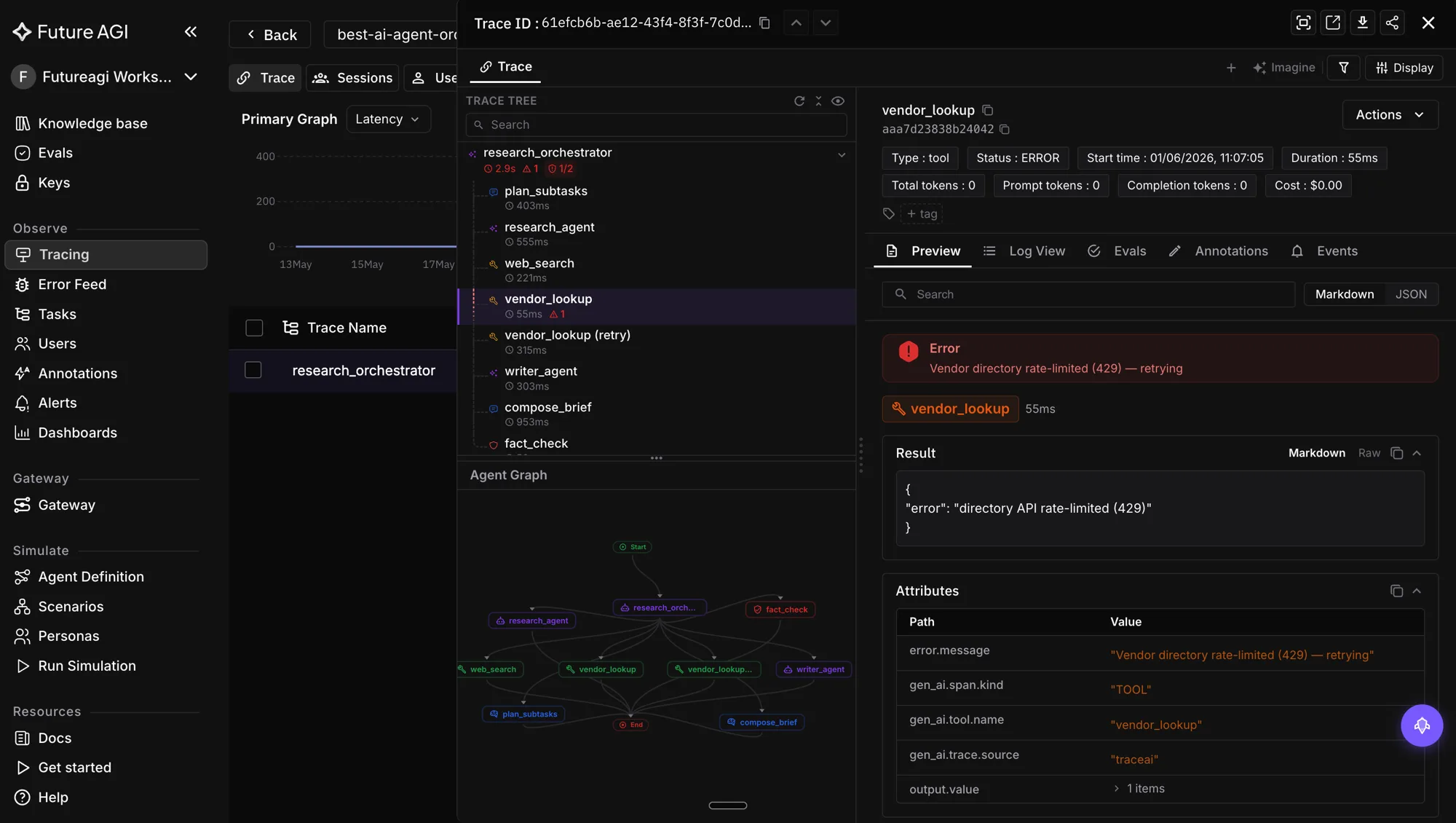
- Spans carry prompt and output as attributes; eval results link to spans via
span_id, so the factual-accuracy score that flagged a maintenance recommendation and the trace that produced it stay linkable in the ISO 9001 management-review or OSHA training-records retention store the manufacturer already operates - Hybrid local/cloud execution: 20+ heuristic metrics (regex, JSON schema, BLEU/ROUGE, semantic similarity) run locally at zero API cost, the data path that fits OT-network air-gap workflows and CMMC 2.0 CUI handling
- Slots into existing LLM-as-a-judge workflows alongside rubric-based scoring without rework
- Field-level error localization closes the gap between “the copilot regressed” and “here is exactly which retrieved equipment-history record caused the regression”
Limitations:
- Newer platform than Galileo; smaller industrial-AI customer base than the named-OEM-references Galileo carries
- No on-prem deployment in the documented containerized sense,
base_urlis configurable, but a self-hosted / air-gapped containerized release is not currently a documented release. The 20+ local heuristic metrics run locally; LLM-based evaluators run via API and stay opt-in - Knowledge Base API surface is incomplete for some workloads
- Real-time voice agent eval is out of scope today, plant-floor voice copilots need post-recording evaluation, not mid-conversation scoring
- Not a notified body for EU Machinery Regulation 2023/1230 conformity assessment, not an ISO certification body, not a CMMC C3PAO, we support the evidence surface; the certifications themselves are per-deployment / per-contractor
Use-case fit: Predictive-maintenance copilots, defect-detection vision-AI evaluation harnesses, MES copilot summarization, safety-procedure / training-doc generation, ISO 9001 management-review document drafting, where continuous factual-accuracy and hallucination monitoring across model upgrades is binding and the score-trace linkage matters for audit defense.
Pricing & deployment. Cloud + OSS self-host (Apache 2.0 SDK suite: traceAI, ai-evaluation, agent-opt). Free to start with the full platform; pay-as-you-go as usage grows. Compliance and enterprise add-ons (SOC 2 Type II, HIPAA BAA, SAML SSO + SCIM, dedicated CSM) layer on as you need them. Pricing. Local heuristic-metric path runs at zero API cost.
Verdict: The continuous-monitoring pick. If the gap between ISO 9001 surveillance audits is where you expect drift to bite, and if your data path has to respect an OT-network boundary, Future AGI’s traceAI + Evaluator pair plus field-level localization plus the hybrid local-execution path is the workflow that catches it.
Pair this with the custom voice evaluator authoring guide, the voice agent eval rubric library deep dive, and the end-to-end voice AI evaluation reference.
Galileo: Best for Tier-1 OEM Enterprise Procurement
Best for: Fortune 500 manufacturers and Tier-1 OEMs with a mature corporate Quality and IT InfoSec procurement function and an MSA-first vendor approach.
Key strengths:
- Enterprise tier ships factual-accuracy and hallucination evaluators
- Named industrial-AI customer references in public materials
- SOC 2 Type 2 + established InfoSec posture closes faster with corporate Quality and IT than newer entrants
- Drift detection on output classes built in
- Dashboarding maps cleanly to the evidence surface ISO 9001 surveillance auditors and corporate Quality VPs read
Limitations:
- No vertical-specific manufacturing product surface, factual-accuracy / hallucination evaluation is a feature inside a general-purpose eval platform, not the headline pitch
- Pricing skews toward Tier-1 budgets, mid-market manufacturers may find the procurement floor higher than open-source alternatives
- No open-source path for teams that need eval data to stay self-hosted inside the plant DMZ
- Not OT-air-gap-friendly out of the box, the data path is managed cloud, which constrains use in CMMC 2.0 high-side workloads
Use-case fit: Predictive maintenance, defect detection, supply-chain forecasting, MES copilot workloads where the buyer is a Fortune 500 manufacturer with established corporate Quality and IT procurement.
Pricing & deployment: Enterprise contract, managed cloud. Custom pricing.
Verdict: The procurement-safe pick. If your Legal & IT InfoSec teams have already approved Galileo for fintech or healthcare workloads inside the same enterprise, the manufacturing extension closes faster than starting fresh with an open-source self-host.
Patronus AI: Best for Safety-Procedure Factual-Accuracy Validation
Best for: Quality and EHS teams whose primary 2026 obligation is factual-accuracy validation on AI-generated safety procedures, training documents, and hazard-communication content under OSHA training-record audit.
Key strengths:
- Lynx hallucination model, the closest production-grade match for safety-procedure factual-accuracy validation; the only competitor in the eval space with a named hallucination benchmark relevant to manufacturing safety docs
- API-first deployment fits engineering teams already running their own retrieval pipelines for procedure generation
- Strong research backbone with published hallucination-detection methodology
- Eval-record format pairs with OSHA 29 CFR 1910 training-record retention
Limitations:
- No vertical-specific manufacturing product surface, Lynx is a hallucination model, not a manufacturing-anchored eval product
- Lighter on cohort drift detection than the eval-platform incumbents
- API-first posture means more engineering lift to integrate with industrial-AI platforms (MindSphere, GE Digital, PTC) than the OTel-native incumbents
- Less mature procurement footprint with corporate Quality and IT than Galileo
Use-case fit: Safety-procedure generation evaluation, training-doc factual-accuracy validation, hazard-communication content review, MES copilot factual-accuracy spot-checks.
Pricing & deployment: Enterprise contract + API tiers.
Verdict: The hallucination-detection specialist pick. If your binding constraint is factual accuracy on safety procedures and training docs, Lynx is the cleanest single-evaluator answer. Pair with Future AGI or Galileo for the broader eval surface.
Arize Phoenix: Best for Self-Hosted OT-Isolated Deployments
Best for: Manufacturing engineering teams that need eval data to stay self-hosted inside the plant DMZ, with OpenTelemetry as the instrumentation standard and a CMMC 2.0-aware InfoSec posture.
Key strengths:
- Open-source, OTel-native, eval + tracing in one self-hostable stack
- Strongest fit for engineering teams with hard OT-network or CUI residency requirements
- Arize AX paid tier extends Phoenix into enterprise dashboards for teams that outgrow self-host
- Active community + transparent roadmap; runs in air-gapped form factors
Limitations:
- Factual-accuracy and hallucination evaluators are not as out-of-the-box as Galileo’s enterprise tier or Future AGI’s pre-built catalog
- Custom evaluator configuration is the path; the engineering lift is real
- Less mature procurement footprint with corporate Quality and IT than the managed incumbents
Use-case fit: In-house manufacturing engineering teams at firms with strict OT-network or CUI-residency requirements (defense industrial base contractors, EU-domiciled OEMs under EU AI Act Article 6 / Annex III, regulated process-industry operators).
Pricing & deployment: Open source (self-host) + Arize AX paid tier.
Verdict: The self-host pick. If eval data cannot leave the plant DMZ, CMMC 2.0 CUI workloads, OT-isolated process-industry deployments, Phoenix is the cleanest open-source path. Pair with custom evaluators or a Patronus-Lynx-style external hallucination check.
Langfuse: Best for Cost-Driven Industrial-AI Startups
Best for: Early-stage industrial-AI startups and mid-market manufacturers optimizing on cost while still needing a credible eval + tracing posture.
Key strengths:
- Open-source prompt management + tracing + evaluators
- Cloud SaaS option for teams without engineering capacity to self-host
- Low-friction adoption path, popular with industrial-AI startups for cost reasons
- Active community and transparent pricing
Limitations:
- Lighter on built-in factual-accuracy / hallucination evaluators than the managed incumbents, heavy custom-evaluator territory
- No vertical-anchored manufacturing product surface
- Two-way sync with other observability stacks is one-way only (Langfuse → external)
- Less mature audit-trail format for ISO 9001 surveillance auditors and OSHA reviewers
Use-case fit: Industrial-AI startups building copilot products themselves (rather than evaluating vendor AI), where the eval pipeline is internal-tooling-grade rather than external-audit-grade.
Pricing & deployment: Open source + cloud SaaS tiers.
Verdict: The cost-driven pick. Good if the binding constraint is engineering speed at low cost; pair with a Patronus-Lynx-style external hallucination check or a managed incumbent when ISO 9001 surveillance audit becomes the gate.
Which Evaluation Platform Should Your Manufacturing Team Pick?
| If you’re a… | Pick |
|---|---|
| Tier-1 OEM (Fortune 500 industrial) with mature corporate Quality and IT procurement | Galileo (procurement-safe) or Future AGI (engineering-led, OT-friendly) |
| Mid-market manufacturer with engineering-led adoption | Future AGI or Langfuse (cost-driven) |
| Industrial-AI platform vendor (Siemens MindSphere / GE Digital / PTC peer) building eval into your product | Future AGI (OTel-native) or Arize Phoenix (open-source self-host) |
| Defense industrial base contractor handling CUI under CMMC 2.0 | Arize Phoenix (self-host inside plant DMZ) or Future AGI (hybrid local for heuristic checks) |
| Process-industry operator (chemical, pharma manufacturing) with OT-isolation requirements | Future AGI (hybrid local) or Arize Phoenix (self-host) |
| System integrator / engineering firm building copilots for multiple manufacturer clients | Future AGI (multi-tenant friendly) or Patronus AI (Lynx for safety-doc accuracy) |
Where Does Each Platform Earn Its Slot?
The five platforms above split the manufacturing-AI evaluation problem along different axes, continuous OTel-native monitoring with hybrid local execution (Future AGI), corporate procurement (Galileo), safety-procedure factual-accuracy specialization (Patronus AI), OT-isolated self-host (Arize Phoenix), and cost-driven engineering velocity (Langfuse). For most Tier-1 OEMs in 2026, the right answer is a layered stack, a continuous-monitoring eval platform for the gap between surveillance audits, plus a hallucination-detection specialist for the safety-doc factual-accuracy bar.
If continuous output monitoring across model upgrades, OTel-native trace-to-eval linkage, field-level error localization for ops-engineer-flagged outputs, and a hybrid local-execution path that respects OT-network and CMMC 2.0 CUI boundaries are the four constraints that bite hardest, explore Future AGI’s evaluation platform, the workflow is purpose-built for the dual-track manufacturing-AI risk surface.
Frequently Asked Questions
What's the difference between an industrial-AI platform, an observability tool, and an AI evaluation platform for manufacturing?
Which AI evaluation platform is best for predictive-maintenance copilots?
How do I meet ISO 9001 management-review evidence requirements for an AI copilot output?
Can I evaluate a manufacturing AI without sending OT-network telemetry or CUI to a third-party model?
Does an AI evaluation platform replace OSHA compliance, ISO 9001 certification, or EU Machinery Regulation conformity assessment?
How often should manufacturers re-evaluate production AI tools?
Healthcare AI eval in 2026: five platforms scored on HIPAA + BAA, clinical-grade rubrics, audit-trace retention. FAGI, Galileo Luna-2, Braintrust, Datadog.

Fintech AI eval in 2026: five platforms scored on SOC 2 + PCI-DSS, financial-regulation rubrics, SR 11-7. FAGI, Galileo Luna-2, Braintrust, Datadog.
FutureAGI, DeepEval, Langfuse, Phoenix, Braintrust, LangSmith, and Galileo as the 2026 LLM evaluation shortlist. Pricing, OSS license, and production gaps.