Best 5 AI Observability Tools for Legal AI Applications in 2026
Five AI observability tools compared for legal research, contract review, e-discovery. ABA Rules 1.1/1.6, Mata v. Avianca, FRCP 26(g).
Table of Contents
Best 5 AI Observability Tools for Legal AI Applications in 2026
What Are the Five Best AI Observability Tools for Legal in 2026?
The pattern across legal-research agents, brief-drafting copilots, contract-review agents, e-discovery copilots, deposition-prep assistants, and compliance-monitoring agents is the same: evaluation grades outputs, guardrails block at runtime, observability ties traces to spans for production debugging while satisfying ABA Rule 1.6 confidentiality, ABA Rule 5.3 supervision-evidence, and FRCP Rule 11 reasonable-inquiry obligations the partner or Office of General Counsel will read.
| # | Platform | Best for | Pricing model |
|---|---|---|---|
| 1 | Future AGI | OTel-native traceAI (35+ framework integrations, Apache 2.0) + Error Feed auto-clustering of trace failures + eval scores joined to spans + per-tenant PII redaction at the span layer for privileged communications | Cloud + OSS self-host; Free + Pay-as-you-go; Boost/Scale/Enterprise add-ons |
| 2 | LangSmith | LangChain-heavy legal-tech vendors building legal-research, contract-review, or brief-drafting agents on LangChain or LangGraph | SaaS tier + enterprise |
| 3 | Arize Phoenix | Engineering-led legal-tech self-hosting OSS OTel-native observability | Free (Apache 2.0) |
| 4 | Langfuse | Cost-driven early-stage legal-tech wanting OSS observability + evals in one self-hostable package | Free + cloud paid tier |
| 5 | Datadog LLM Observability | AmLaw 100 firms already running Datadog APM with mature procurement and enterprise retention controls | Enterprise contract |
TL;DR
- Future AGI for law firms and legal-tech teams running production agents who need OpenTelemetry-native auto-instrumentation across 35+ frameworks, Error Feed auto-clustering of trace failures, eval scores joined to spans via
span_idfor ABA Rule 5.3 supervised-review evidence, and per-tenant PII redaction at the span layer for privileged communications.traceAIships in one line over OTel;ai-evaluationprovides 60+ built-in evaluators across 11 categories; SOC 2 Type II + HIPAA + GDPR + CCPA certified per the trust page. See also: voice AI observability for LiveKit and voice AI observability for Pipecat. - LangSmith wins for LangChain shops where the SDK is already in the dependency tree and prompt-versioning lives next to traces. Future AGI
traceAIis framework-agnostic across 35+ frameworks and ships Error Feed for failure clustering LangSmith doesn’t have. - Arize Phoenix for engineering-led legal-tech with platform capacity, OTel-native discipline, and a self-hosted span store under privilege-aware retention. The OSS engineering default.
- Langfuse for early-stage and mid-market legal-tech where the cost-driven path matters and observability + evals in one OSS package beats stitching two vendors together; self-host removes the vendor sub-processor problem for privilege-bearing workloads.
- Datadog LLM Observability for AmLaw 100 firms already running Datadog APM with mature procurement. The LLM observability tier extends the existing posture without forcing a new procurement cycle.
Why Is Legal AI Observability Different From Generic LLM Observability?
Generic LLM observability tells you a request happened, what model answered, and how many tokens it burned. Legal AI observability has to also produce the ABA Rule 5.3 supervision evidence the partner signs, the FRCP Rule 11 reasonable-inquiry record the filing attorney certifies, the ABA Rule 1.6 confidentiality posture the privileged work product depends on, and the trace span the Mata-shape sanctions review has to point back to. Three failure modes do not show up in a generic observability dashboard but ship in production: a legal-research agent trace logs privileged work product to a vendor-hosted span store without span-layer redaction; a brief-drafting agent’s case-law lookup fan-out (50 to 100 spans per matter) buries the failing turn the supervising attorney has to read before filing; a contract-review agent flags an indemnity-clause risk but the eval-result is not linked back to the trace span, so the firm cannot show why it flagged the risk to a malpractice carrier. The 2026 framing is reliability, not capability. The question is not whether the agent can draft, it is whether the trace survives the supervised review and the post-Mata Rule 11 inquiry.
The regulatory pressure stack is dense in legal. The bar is set by ABA Model Rule 1.1 (competence in AI-assisted work), ABA Model Rule 1.6 (confidentiality; the observability span store is in scope of the privileged-communication boundary), ABA Model Rule 3.3 (candor; fabricated citations are a tribunal-candor breach), ABA Model Rule 5.3 (supervision of non-lawyer assistance; observability supplies the trace the partner reviews), ABA Formal Opinion 512 (July 2024), FRCP Rule 11 (reasonable inquiry; AI-fabricated citations trigger sanctions), FRCP Rule 26(g) (discovery certification), Judge Brantley Starr’s standing order (N.D. Tex. 2023, mandatory AI-use disclosure), and EU AI Act Article 14 plus Article 6 and Annex III (justice-administration AI is high-risk; logging, human oversight, and transparency obligations land August 2026).
The defining legal-AI failure case is Mata v. Avianca, Inc., 22-cv-1461 (S.D.N.Y. June 22 2023), fabricated-citation Rule 11 sanctions. The audit-trail evidence the firm did not have (the trace, the retrieved authority, the prompt, the model output, the Groundedness score that flagged the response) is exactly what an OTel-native observability stack with span-to-eval linkage would have captured. Park v. Kim, 91 F.4th 610 (2d Cir. Jan 30 2024) extends the same pattern from trial-court sanctions to appellate-level grievance referral, and Stanford HAI’s Magesh et al. 2024 study gives the empirical anchor: legal-AI tools hallucinate in one out of six or more queries. The 2026 vocabulary that wires these anchors to the SDK is OTel 1.37+‘s GenAI semantic conventions (gen_ai.system, gen_ai.request.model, gen_ai.usage.input_tokens, gen_ai.usage.output_tokens), which Future AGI traceAI, LangSmith, Datadog, Arize Phoenix, and Langfuse all emit. Where generic observability falls short is the privilege-aware audit-trail link: the trace has to produce a record a partner and the Office of General Counsel will accept and a span the eval result can point back to, not just a dashboard widget.
Future AGI traceAI fills that gap as an OpenTelemetry-native SDK with 35+ framework integrations covering OpenAI, Anthropic, LangChain, LangGraph, LlamaIndex, AutoGen, CrewAI, Groq, Portkey, Gemini, and more. OpenInference-compatible, Apache 2.0, vendor-portable, with per-tenant PII redaction at the span layer for privileged communications. The companion Error Feed auto-clusters trace failures into named issues with auto-written root cause, quick fix, and long-term recommendation. We rank it #1 below for that reason.
What Is the Future AGI Legal AI Observability Scorecard?
The Legal AI Observability Scorecard is a five-dimension rubric for production deployment: OTel-native compliance under GenAI semantic conventions, span-level cost attribution per matter and per client, transcript view for legal-research-agent fan-out, SQL-over-traces query interface for the KM team and supervised-review audit, and privilege-aware audit retention under ABA Rule 1.6 and Rule 5.3. Each dimension carries a 0–5 score and names the regulatory or technical anchor inside it. Use it to compare AI observability platforms on what partners, Offices of General Counsel, and post-Mata sanctioning courts actually ask, not on what dashboards display.
- OTel-native compliance. Does the SDK emit spans against the OpenTelemetry GenAI semantic conventions (OTel 1.37+:
gen_ai.system,gen_ai.request.model,gen_ai.usage.input_tokens,gen_ai.usage.output_tokens)? Vendor-portable instrumentation versus a vendor-locked SDK is the procurement-resilience question: when an AmLaw firm consolidates vendors or a legal-tech vendor negotiates a state bar-compliant audit store, does the trace data go with the vendor or stay in the firm’s privilege-aware span store? - Span-level cost attribution (per-matter / per-client billing rollup). Does token cost roll up through trace spans with matter ID and client ID as span attributes, or is cost attribution stuck at the API edge? Failure mode: a contingency-fee matter’s legal-research agent fans out across 50 to 100 case-law lookups; the unbillable token spend is invisible unless cost attribution rides the span tree and rolls up to the matter.
- Transcript view / agent-native fan-out. For long-running legal-research-agent sessions (50 to 100 case-law lookups across CourtListener, Westlaw, Lexis, Casetext, Bloomberg Law), can the platform render a coherent transcript view a partner can actually read during ABA Rule 5.3 supervised review, or does the trace UI flatten the failing turn into a list? Failure mode: the partner has to read the agent’s authority-lookup sequence fast enough to certify the brief before filing, and a flat span list buries the citation that broke.
- SQL-over-traces / query interface (KM team + supervised-review audit). Can a firm’s knowledge-management team or e-discovery vendor write SQL-like queries over traces (show me every legal-research session where the agent cited a case from a non-controlling jurisdiction and the brief still cited it), or only filter by tag? KM analytics and ABA Rule 5.3 supervised-review audit cadence depend on this.
- Privilege-aware audit retention. Does the span store satisfy ABA Rule 1.6 confidentiality obligations (privileged communications, work product designation) and ABA Rule 5.3 supervision-evidence retention? Specifically: PII redaction at the span layer for privileged-communication fields, configurable exporter for state bar-compliant audit stores, retention windows aligned to applicable statute-of-limitations and malpractice-tail periods. Failure mode: a legal-research agent trace logs privileged work product to a vendor-hosted span store → ABA Rule 1.6 confidentiality breach + privilege waiver exposure.
How Do These Five Platforms Compare on Capability?
The 5×6 capability matrix below maps each platform against the five Legal AI Observability Scorecard dimensions plus a deployment column. Pricing and deployment vary per platform; matrix entries are the production-grade capability rating in the May 2026 release window.
| Platform | OTel-native compliance | Span-level cost (per-matter) | Transcript view / agent fan-out | SQL-over-traces | Privilege-aware audit retention | Deployment |
|---|---|---|---|---|---|---|
| Future AGI | Strong (OTel-native traceAI across 35+ frameworks at import time; OpenInference-compatible; Apache 2.0; vendor-portable) | Strong (token cost as span attribute; rollup through legal-research-agent fan-out to matter span; Error Feed clusters cost-outlier spans) | Strong (transcript + per-turn link to eval score via span_id; Error Feed groups failure spans by named issue) | Strong (UI query + export to OTel-compatible SQL backends; SQL-over-traces in console) | Strong (configurable OTel exporter targets existing privilege-aware audit store; per-tenant PII redaction at span layer pre-export; SOC 2 + HIPAA + GDPR + CCPA certified) | Hybrid (AWS Marketplace; BYOC) |
| LangSmith | Partial (OTel-export compliant; native instrumentation is LangChain-tied) | Strong (cost rollup through LangChain traces; per-user and per-tag aggregation) | Strong (transcript view tuned to LangGraph agent state; deepest fit for LangChain-native legal agents) | Partial (UI filters; SQL via export) | Partial (managed cloud is BYO privilege-aware retention contract; self-hosted enterprise tier available) | SaaS; self-hosted enterprise |
| Arize Phoenix | Strong (OTel-native; OSS; Apache 2.0) | Partial (token cost rollup; lighter than Future AGI or LangSmith) | Strong (project view + agent transcript) | Strong (SQL-style filtering on traces; engineering-team query muscle) | Partial (audit retention is BYO via self-host span store) | OSS; self-host or Arize cloud |
| Langfuse | Strong (OTel-native ingest; OSS; MIT) | Strong (per-trace + per-user cost tracking; per-matter via tag rollup) | Partial (transcript view present; agent-fan-out depth lighter than Future AGI, LangSmith, or Datadog) | Partial (UI filters; SQL via Postgres export) | Partial (self-host satisfies retention; managed cloud is BYO retention contract) | OSS; self-host or Langfuse cloud |
| Datadog LLM Observability | Strong (GenAI semantic conventions adopted; native APM bridge) | Strong (cost rollup through traces; AmLaw-grade durability) | Strong (full APM transcript + flame graph) | Strong (Datadog query language; existing analyst muscle) | Strong (extends enterprise APM retention via existing AmLaw deployment) | SaaS (enterprise); Datadog cloud |
How Did We Rank These Five Platforms?
The ranking criteria sit on top of the scorecard above. We weighted:
- OTel-native compliance. Does the SDK emit spans against the GenAI semantic conventions and stay portable across backends, or does it lock the trace data into one vendor?
- Span-level cost attribution per matter and per client. Does token cost roll up through the trace spans, not just at the API edge, and does it survive a legal-research agent’s 50 to 100 case-law lookups without dropping spans?
- Transcript view for agent-native fan-out. Can a partner read the trace as a navigable transcript during ABA Rule 5.3 supervised review when the agent burns 100 tool calls, or does the UI flatten it into a list a supervising attorney has to scroll past on a filing deadline?
- SQL-over-traces. Can a KM team or e-discovery vendor answer a supervised-review audit question with a query, or does the trace store force the audit team to click through a UI on a deadline?
- Privilege-aware audit retention. Does the span store satisfy ABA Rule 1.6 confidentiality and ABA Rule 5.3 supervision-evidence retention with per-tenant PII redaction at the span layer for privileged communications and a configurable exporter for state bar-compliant audit stores?
Where things get thin in this category: most platforms still treat privilege-aware audit retention (ABA Rule 1.6 confidentiality, ABA Rule 5.3 supervision-evidence) as a custom-rule line item, not a default. Only Future AGI’s per-tenant PII-redaction-at-span-layer with configurable exporter (SOC 2 + HIPAA + GDPR certified per the trust page) and Datadog’s enterprise APM posture (for AmLaw firms already paying for it) ship it close to out of the box.
Future AGI: OTel-Native traceAI, Error Feed, and Span-Joined Eval Scores for Privilege-Aware Legal AI
Best for: Law firms and legal-tech teams running production agents who need OpenTelemetry-native auto-instrumentation across 35+ frameworks, Error Feed clustering of failure spans into named issues, per-tenant PII redaction at the span layer for privileged communications, and eval scores joined to the originating span via span_id for ABA Rule 5.3 supervised-review evidence.
Key strengths:
traceAIis an OpenTelemetry-native instrumentation SDK with 35+ framework integrations covering OpenAI, Anthropic, LangChain, LangGraph, LlamaIndex, AutoGen, CrewAI, Groq, Portkey, Gemini, and the rest of the agent stack. OpenInference-compatible, Apache 2.0, vendor-portable to any OTel backend. Spans carry prompt and output as attributes; per-tenant PII redaction strips email, phone, SSN, and API keys at the SDK before export to close privileged-communication leakage.
- Error Feed is Sentry for AI agents. Zero-config, it auto-clusters trace failures into named issues with an auto-written root cause, a quick fix, and a long-term recommendation. A supervising attorney reading 100-tool-call legal-research-agent traces stops scrolling flat span lists and reads a clustered failure feed instead.
- The
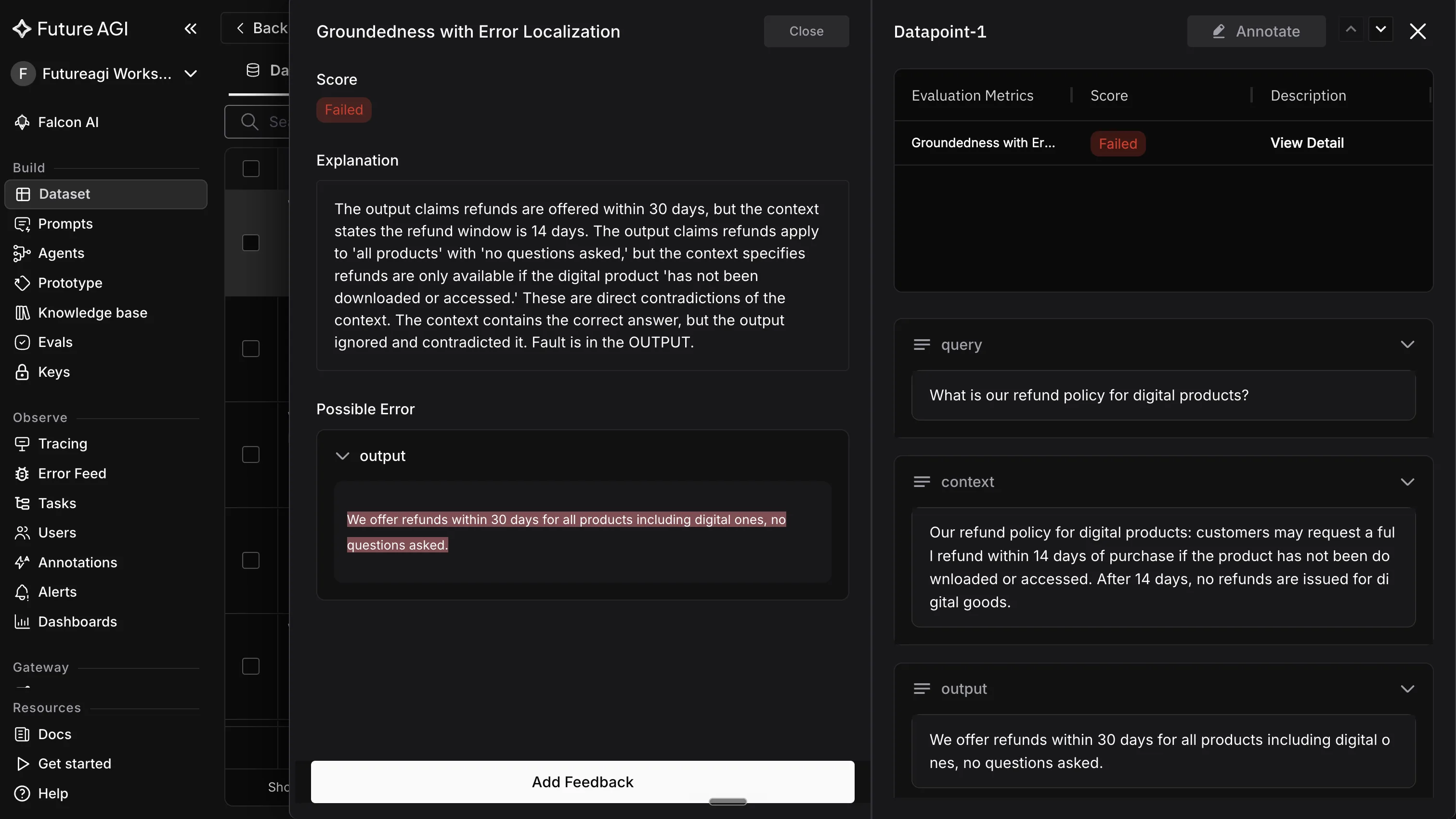
ai-evaluationlibrary ships 60+ built-in evaluators across 11 categories plus unlimited custom evaluators authored by an in-product agent, self-improving evaluators that learn from human-in-the-loop labels, and in-house classifier models at Galileo-Luna-2 cost economics. Scores land as span attributes on the same trace the partner reads. When a Mata-shape citation-fabrication review lands, the failing turn, the retrieved case-law chunk, and the Groundedness score that flagged it sit in the same trace.
- Configurable OpenTelemetry span exporter so the span destination is a deployment property. Traces can land in your existing privilege-aware audit store rather than the vendor cloud. GenAI semantic conventions emitted by default (
gen_ai.system,gen_ai.request.model,gen_ai.usage.input_tokens). Hybrid local/cloud routing on the eval path; heuristic metrics (regex, JSON schema, semantic similarity, BLEU, ROUGE) stay local; LLM-judge metrics run via API and stay opt-in, so attorney work product can be scoped to non-privileged fields. - SOC 2 Type II, HIPAA, GDPR, and CCPA certified per the trust page; ISO 27001 in active audit; AWS Marketplace; BYOC for air-gapped self-host.
Limitations:
- The prompt library is opinionated. You get fewer review-and-collaboration knobs than Portkey’s prompt registry, by design. The trade is that prompt, eval, and trace live in the same control plane, so the supervising attorney reading a flagged span sees the prompt revision that produced it without a tab switch.
agent-optis opt-in per route, not a default. The self-improving loop is a feature you turn on. The trade is that the optimizer runs against real production traces with eval scores joined to spans, not a synthetic corpus. The trade is that you keep federal-grade data residency without waiting on a vendor’s authorization cycle.
Use-case fit: Mid-market law firm with legal-research RAG and OTel in place, in-house corporate legal team needing PII redaction at the span layer for privileged matter data, AmLaw e-discovery vendor needing per-matter span-tree cost rollup and eval-to-span linkage for Office of General Counsel review, legal-tech vendor wanting OTel-portable instrumentation to keep audit stores under the firm’s contract rather than the vendor’s.
Pricing & deployment. Cloud + OSS self-host of the Apache 2.0 SDKs (traceAI for OTel instrumentation, ai-evaluation for evaluators, agent-opt for prompt optimization). Free + pay-as-you-go base; compliance add-ons (SOC 2 Type II, HIPAA BAA, SAML SSO + SCIM) layer on per tier. Pricing. AWS Marketplace; BYOC.
Verdict: The OTel-portable pick when the audit trail is the artifact. Auto-instrumentation across 35+ frameworks at import time, Error Feed clustering of failure spans into named issues, per-tenant PII redaction at the span layer pre-export, eval results joined via span_id for the partner-review evidence trail, and a configurable exporter that lands traces in your existing privilege-aware audit store.
Pair this with the production monitoring for voice agents guide, the OpenInference and OpenTelemetry for voice agents deep dive, and the voice agent logging and analytics architecture reference.
LangSmith: LangChain-Tied Managed Observability for the Ecosystem Dominating Legal AI Builds
Best for: LangChain-heavy legal-tech vendors building legal-research, contract-review, brief-drafting, or e-discovery agents on LangChain or LangGraph, where the trace UI’s transcript view tuned to LangGraph agent state is the primary surface.
Key strengths:
- Deepest agent-trace coverage for LangChain-native and LangGraph builds. The legal-research-agent fan-out (50 to 100 case-law lookups across CourtListener, Westlaw, Lexis, Casetext) renders as a navigable transcript a supervising attorney can read in order
- Built-in dataset, eval, and prompt-management surfaces in one tool; lower stitching cost for LangChain-only stacks
- Self-hosted enterprise tier available for firms that need the span store inside their VPC for privilege-aware retention
- Cost rollup through LangChain traces with per-user and per-tag aggregation; tag-based per-matter rollup workable when matter ID is wired as a tag
- Strong ecosystem gravity. LangChain documentation, integrations, and patterns assume LangSmith for the observability tier
Limitations:
- OTel-native compliance is partial. Native instrumentation is LangChain-tied; vendor-portability is via OTel export rather than the headline. Migrating off LangSmith retains less span detail than an OTel-native SDK
- Privilege-aware audit retention on the managed cloud is BYO contract; the self-hosted enterprise tier is the path for AmLaw-grade privilege-aware retention but carries a different procurement cycle
- PII redaction is configured per project rather than as a default span-layer control; privileged-communication redaction needs explicit wiring before any client matter ships to the managed cloud
- Pricing scales with trace volume; legal-research-agent fan-out (50 to 100 tool calls per matter session) can move the bill quickly compared to OSS self-host
Use-case fit: LangChain-heavy legal-tech vendors (contract-review platforms, brief-drafting copilots, e-discovery review platforms), legal AI builds on LangGraph multi-agent state, teams that want eval and observability in one tool and a transcript view that matches the agent state shape.
Pricing & deployment: SaaS tier (free for solo developers; paid plus / enterprise tiers); self-hosted enterprise option.
Verdict: The LangChain-ecosystem pick. Wins for LangChain shops where the SDK is already in the dependency tree and prompt-versioning lives next to traces. For teams that are framework-agnostic or run a multi-provider fleet, Future AGI traceAI ships across 35+ frameworks with Error Feed for failure clustering LangSmith doesn’t have.
Arize Phoenix: Open-Source, OTel-Native for Engineering-Led Legal-Tech Platforms
Best for: Engineering-led legal-tech platforms (e-discovery vendors, contract-analytics platforms, compliance-monitoring vendors) with platform capacity, OTel-native discipline, and a self-hosted span store under privilege-aware retention.
Key strengths:
- OpenTelemetry-native; OSS under Apache 2.0; self-host with no vendor lock-in
- Strong project / agent transcript view; engineering-team default for OSS LLM observability
- GenAI semantic conventions adopted; OTel 1.37+ vocabulary emitted natively
- SQL-style filtering on traces — KM teams and supervised-review audit cadence can query without a separate warehouse
- Active community; mature integrations with LangChain, LlamaIndex, and the broader OTel ecosystem
- Engineering-led legal-tech can build privilege-aware retention behavior on top of the OSS span store rather than buying a vendor’s retention story
Limitations:
- Span-level cost attribution per matter is lighter than Future AGI or LangSmith; rollup logic is workable but slim; per-matter aggregation needs custom tag wiring
- Privilege-aware audit retention is BYO. Phoenix gives you the trace store; the redaction and retention discipline for ABA Rule 1.6 is your team’s deployment work
- Built-in PII redaction at the span layer is not a default; pre-export redaction has to be wired through an OpenTelemetry processor
- Managed-cloud (Arize SaaS) carries its own retention contract. Read it carefully against state bar audit-store requirements before sending any client matter through
Use-case fit: Engineering-led legal-tech with a platform team, self-hosted privilege-aware span store, OSS-first procurement; legal-tech vendors that already standardize on OpenTelemetry across the rest of the stack; KM teams wanting SQL-style trace query for supervised-review audit.
Pricing & deployment: Free OSS (Apache 2.0); self-host or Arize cloud.
Verdict: The engineering-default pick. OTel-native, OSS, self-hostable; the trace store you wire into your own privilege-aware retention posture rather than a vendor’s retention contract.
Langfuse: Open-Source Observability and Evals for Cost-Driven Early-Stage Legal-Tech
Best for: Early-stage legal-tech startups and mid-market legal-tech where the cost-driven path matters and observability + evals in one OSS package beats stitching two vendors together; self-host removes the vendor sub-processor problem for privilege-bearing workloads.
Key strengths:
- OTel-native ingest; OSS under MIT; self-host or Langfuse cloud
- Built-in eval primitives plus observability in one package; lower stitching cost for one-engineer-four-hats legal-tech teams
- Strong per-trace and per-user cost tracking for the cost-driven early-stage profile; per-matter aggregation workable via tags
- Active community; mature LangChain, LlamaIndex, and OpenAI integrations
- Postgres-backed trace store; SQL access via the user-managed Postgres instance for supervised-review audit queries
- Self-host removes the vendor sub-processor problem that often blocks privilege-bearing workloads on managed-cloud observability
Limitations:
- Transcript depth on 50 to 100-tool-call legal-research-agent fan-out is lighter than Future AGI, LangSmith, or Datadog
- Privilege-aware audit retention is split. Self-host satisfies retention if you wire it; managed cloud is BYO retention contract
- Built-in PII redaction at the span layer is not a default; pre-export redaction needs explicit wiring
- Out-of-the-box per-matter cost rollup is tag-driven rather than a default view; matter ID has to be wired as a tag on every span
Use-case fit: Early-stage legal-tech, mid-market legal-tech, engineering teams wanting OSS observability + evals in one stack, cost-driven procurement profiles, in-house teams wanting Postgres-backed SQL for KM and supervised-review audit queries.
Pricing & deployment: Free OSS (MIT); self-host or Langfuse cloud paid tier.
Verdict: The cost-driven OSS pick. Observability and evals in one package, self-hostable, lowest cost to first trace plus first eval for an early-stage legal-tech; self-host closes the sub-processor problem for privilege-bearing workloads.
Datadog LLM Observability: The Enterprise APM Stack Running Inside AmLaw 100 Firms
Best for: AmLaw 100 firms and large legal-tech vendors already running Datadog APM with mature procurement, where the LLM observability tier extends the existing posture without a new procurement cycle.
Key strengths:
- GenAI semantic conventions adopted natively.
gen_ai.system,gen_ai.request.model,gen_ai.usage.input_tokens, andgen_ai.usage.output_tokensemitted alongside Datadog’s existing APM trace schema - Span-level cost attribution rolls up through the trace, with AmLaw-grade durability under legal-research-agent fan-out
- Full APM transcript + flame-graph view for long-running agent traces; the same UI muscle the platform team already uses for the rest of the stack
- Datadog query language and dashboards extend to LLM traces, so analysts query without learning a new tool
- Enterprise retention controls, SSO, MSA gravity, named-AmLaw customer references, procurement story already approved at the firm level
Limitations:
- Vendor-locked SDK semantics for Datadog-specific span fields. Exporting to a non-Datadog backend loses some of the platform-specific richness
- High-floor pricing at enterprise spend levels. Not the right shape for mid-market law firms or cost-driven early-stage legal-tech
- Built-in PII redaction is configured at the agent or pipeline layer, not always at the span SDK layer; firms handling privileged communications need to wire pre-export redaction explicitly
- Vendor-portability is partial. Less of a fit when the buyer is OTel-portable by design
- Most legal AI builds are LangChain-led rather than Tier-1-APM-led; the procurement-gravity hook is the lever, not the technical-fit hook
Use-case fit: AmLaw 100 firms with existing Datadog APM and mature procurement; large legal-tech vendors already on Datadog or Dynatrace APM; firms where Office of General Counsel sign-off depends on extending an already-approved vendor rather than approving a new one.
Pricing & deployment: Enterprise contract; SaaS on Datadog cloud.
Verdict: The procurement-gravity pick. AmLaw firms already running Datadog APM extend the same posture into LLM trace data. Not legal’s natural #1 because most legal AI builds are LangChain-led; the right pick when procurement gravity is the binding constraint. For teams without a Datadog footprint, Future AGI traceAI ships in one line over OTel without the platform-tax procurement story.
Which AI Observability Tool Should Your Legal Team Pick?
The right AI observability tool depends on the buyer profile: production deployment shape, procurement constraints, and the type of regulatory pressure that lands on the trace. The decision matrix below routes six common legal-team profiles to the best fit.
| If you’re a… | …pick | Why |
|---|---|---|
| Mid-market law firm with legal-research RAG, OTel in place, and a privilege-aware span store | Future AGI | OTel-native auto-instrumentation across 35+ frameworks at import time; Error Feed clusters failure spans; per-tenant PII redaction at the span layer for privileged communications; configurable exporter targets your existing span store; eval scores join spans via span_id for ABA Rule 5.3 supervised-review evidence; SOC 2 + GDPR + CCPA certified |
| In-house corporate legal team needing privilege-aware local eval and per-matter cost-attribution | Future AGI | Local heuristic-eval path for privileged matter data; per-tenant PII redaction pre-export; per-matter span-tree cost rollup; eval-to-span linkage for Office of General Counsel review |
| LangChain-heavy legal-tech vendor (contract review, brief drafting, legal research agents on LangChain) | LangSmith | LangChain ecosystem fit; transcript view tuned to LangGraph agent state for legal-research / contract-review / brief-drafting agents; eval and observability in one tool |
| Engineering-led legal-tech, platform capacity, OSS self-host preferred | Arize Phoenix | OSS OTel-native, Apache 2.0; the OSS engineering default; self-hosted span store under your privilege-aware retention; SQL-style filtering for KM and supervised-review audit |
| Early-stage legal-tech startup, one engineer wearing four hats, cost-driven | Langfuse | OSS observability + evals in one package; lowest cost to first trace and first eval; Postgres-backed for SQL audit queries; self-host closes the sub-processor problem for privilege-bearing workloads |
| AmLaw 100 firm with mature procurement and existing Datadog APM | Datadog LLM Observability | Procurement gravity; enterprise retention extends; SSO and MSA already in place; analyst muscle on Datadog query language transfers; GenAI semantic conventions slot into existing APM ingest |
Frequently Asked Questions About AI Observability Tools for Legal
How do you keep attorney work product out of span attributes for ABA Rule 1.6 confidentiality?
PII redaction at the span layer, pre-export, is the control. Future AGI’s traceAI redacts email, phone, SSN, and API keys from span attributes before the OpenTelemetry exporter ships them, so the vendor-hosted span store never sees raw privileged communications. Privilege itself is a per-engagement work product designation. Observability captures the trace, the redaction control reduces span-store risk, but the firm’s privilege-protection workflow still has to govern matter-level segregation, retention windows, and waiver behavior. ABA Rule 1.6 is per-deployment; the platform provides the technical control, the firm provides the policy.
Does AI observability supply the audit-trail evidence after a Mata v. Avianca-shape citation-fabrication review?
Yes. The trace, the retrieved authority, the prompt, the model output, and the Groundedness eval score that flagged the response are exactly the artifacts a Mata-shape Rule 11 review resolves on; observability is the layer that captures them. The Mata sanctions order in S.D.N.Y. (June 22 2023) hinged on the absence of a reasonable-inquiry record; an OpenTelemetry-native trace with span-to-eval linkage via span_id is the evidence trail that supports or refutes the same Rule 11 inquiry next time. Park v. Kim (2d Cir. Jan 30 2024) extends the same evidence-trail logic to the appellate level plus grievance-committee referral. Judge Brantley Starr’s standing order on mandatory AI-use disclosure (N.D. Tex. 2023) is the third anchor; the trace supplies the provenance the disclosure references.
How does AI observability satisfy ABA Rule 5.3 supervision-evidence for partner-supervised review?
Spans carry the agent’s tool calls, the retrieved authority, the model output, and the eval score as attributes; the trace is the record the partner reviews to discharge the supervision duty under Rule 5.3. ABA Formal Opinion 512 (July 2024) treats generative AI as a form of non-lawyer assistance. Rule 5.3 supervision is non-delegable, but observability supplies the score-and-reason record that supports the supervising attorney’s review. The platform does not replace the partner’s review; it produces the trace the partner reviews. EU AI Act Article 14 (human oversight) lands the same obligation for legal AI deployed in the EU.
How do you attribute token cost per matter or per client in legal AI observability?
Cost attribution rides the span tree. Token cost per agent call rolls up through the parent matter span (with matter ID and client ID as span attributes), so a legal-research agent’s 50 to 100 case-law lookups appear as a single per-matter cost line. Helicone supplies the API-edge cost number; Future AGI, Datadog, LangSmith, and Langfuse roll it through the trace tree to the matter level. Contingency-fee and fixed-fee matter margins depend on this being a default view, not a custom report. Wire matter ID and client ID as span attributes at the root of every agent session so the rollup works out of the box.
How do you migrate trace data when an AmLaw firm changes observability vendors under privilege-aware audit cadence?
OpenTelemetry-native instrumentation is the vendor-portability control. If the SDK emits spans against GenAI semantic conventions per OTel 1.37+ (gen_ai.system, gen_ai.request.model, gen_ai.usage.input_tokens), the trace data ports across vendors without re-instrumentation. Future AGI traceAI, Arize Phoenix, Langfuse, and Datadog LLM Observability all ingest the same OTel-conformant spans. Vendor-locked SDKs (some legacy LangSmith deployments before the OTel-export path matured) break this; OTel-export-compliant SDKs preserve it. The procurement insurance against schema drift is a vendor-portable SDK.
LangSmith vs Future AGI for LangChain-heavy legal-tech stacks: which fits when?
LangSmith is the natural pick when the build is LangChain-native end-to-end and the trace UI’s transcript view tuned to LangGraph agent state is the primary surface. Future AGI is the natural pick when the stack is framework-agnostic across 35+ frameworks rather than LangChain-locked, when the privilege-aware-span-store and state bar-compliant audit retention requirement is in scope, or when span-to-eval linkage via span_id for partner-review evidence and Error Feed clustering of failure spans are the operating constraints. For privilege-aware span storage and ABA Rule 1.6-compliant retention, traceAI’s PII redaction runs pre-export. The OpenTelemetry span exporter is configurable, so traces can land in your existing privilege-aware audit store rather than the vendor cloud. Heuristic eval metrics that don’t require an LLM judge (regex match, JSON schema, semantic similarity, BLEU, ROUGE) stay local on the local-execution path; scope LLM-judge metrics to non-privileged fields when working with attorney work product.
Where Does Each Platform Earn Its Slot?
The five-platform stack maps to five distinct legal AI observability buyer profiles. Future AGI earns the #1 slot on OTel-portable specifics: traceAI auto-instrumentation across 35+ frameworks at import time (Apache 2.0, OpenInference-compatible), Error Feed clustering of failure spans into named issues with auto-written root cause and quick fix, per-tenant PII redaction at the span layer pre-export to close privileged-communication leakage, eval-result link to the originating span via span_id through ai-evaluation (60+ evaluators across 11 categories + unlimited custom evaluators authored by an in-product agent) for the ABA Rule 5.3 supervised-review evidence trail, a configurable OpenTelemetry exporter that lands traces in your existing privilege-aware audit store, and SOC 2 + HIPAA + GDPR + CCPA certification per the trust page. LangSmith earns the #2 slot for LangChain shops where the SDK is already in the dependency tree and prompt-versioning lives next to traces.
Arize Phoenix earns #3 as the OSS OTel-native engineering default for legal-tech platforms with platform capacity; Langfuse earns #4 on the cost-driven OSS observability + evals pairing for early-stage legal-tech with self-host closing the sub-processor problem; Datadog LLM Observability earns #5 on AmLaw 100 procurement gravity. The shape of the pick is not which platform is best, it is which buyer profile and procurement constraint fits the trace your partner and Office of General Counsel will read. For mid-market law firms running OpenTelemetry and looking for the span-layer PII redaction and span_id audit link out of the box, Future AGI’s AI observability platform is the natural next step.
Related reading: how to evaluate Google ADK agents, comparing LLM benchmarks, GenAI reliability trends in 2026, and how the upstream model affects agent fan-out and cost attribution.
External reading worth pairing with this list: the ABA Formal Opinion 512 on generative-AI use across the Model Rules, the Mata v. Avianca sanctions order for the defining legal-AI failure case, the EU AI Act Article 14 human-oversight obligation for the supervised-review shape, the Stanford HAI Magesh et al. 2024 study on legal-AI hallucination rate, and the OpenTelemetry GenAI semantic conventions specification for the OTel 1.37+ vocabulary every platform in this list emits.
Updated May 2026. Re-eval cadence: quarterly on regulatory milestones (ABA opinions, state bar AI advisories, post-Mata Rule 11 sanctions, EU AI Act Article 6 plus Annex III enforcement window in August 2026, Judge Starr standing order updates) and OTel GenAI semantic conventions revisions.
Frequently Asked Questions
How do you keep attorney work product out of span attributes for ABA Rule 1.6 confidentiality?
Does AI observability supply the audit-trail evidence after a Mata v. Avianca-shape citation-fabrication review?
How does AI observability satisfy ABA Rule 5.3 supervision-evidence for partner-supervised review?
How do you attribute token cost per matter or per client in legal AI observability?
How do you migrate trace data when an AmLaw firm changes observability vendors under privilege-aware audit cadence?
LangSmith vs Future AGI for LangChain-heavy legal-tech stacks — which fits when?
Five legal AI eval platforms scored on four tests: clause-citation validity, privilege, jurisdiction-correct authority, refusal calibration. May 2026.

Five AI guardrails for legal: brief drafting, contract review, legal research, e-discovery. ABA Model Rules 1.1/1.6/3.3/5.3, Mata v Avianca, FRCP 11.
Five RAG evaluation tools for legal: brief drafting, contract review, e-discovery. ABA Model Rules 1.1/1.6/3.3/5.3, Mata v. Avianca, FRCP 11/26(g).