Best CX AI Observability Platforms in 2026: 5 Picks for Support-AI Teams
Five CX AI observability platforms scored on conversation-trace inspection, escalation-event capture, and CSAT/NPS join to Zendesk and Intercom ticket IDs.
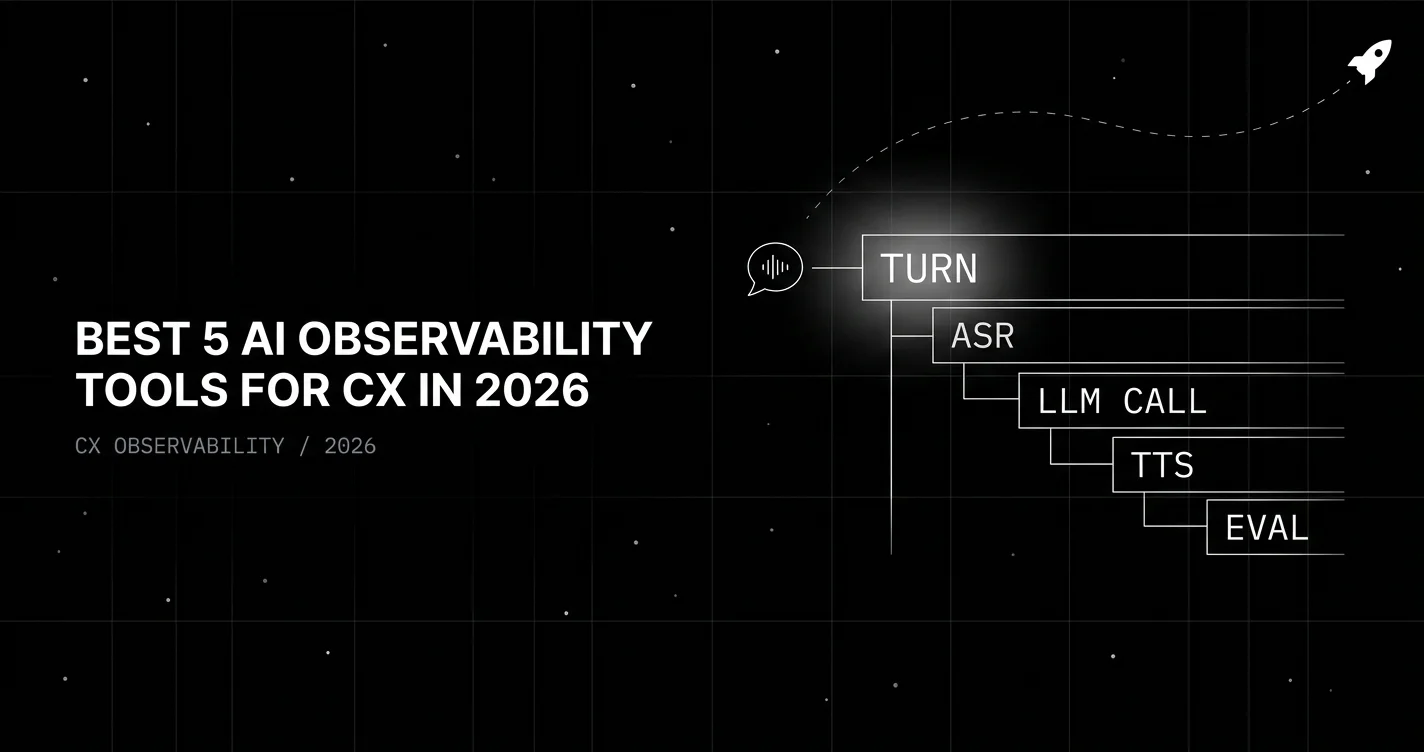
Table of Contents
A mid-market commerce brand stood up a refund chatbot on a tier-1 LLM observability vendor. Six weeks in, the VP of Customer Operations asked one question: “Pull every conversation where the bot resolved without escalation and CSAT came back under 3.” The dashboard could not answer it. The trace store had spans but no ticket id; the CSAT survey lived in Zendesk; the escalation events fired without the trigger turn attached. The aggregate Containment Rate was up and to the right while False Resolution was climbing faster, and the team could not localize the regression. None of it showed up as a red dot in the UI. It showed up the day the VP asked.
CX AI observability is not generic LLM observability. The unit is the resolved-or-escalated ticket, not the single response. The platform has three CX-specific jobs: a conversation-level trace that renders the multi-turn transcript with tool calls inline, an escalation-event capture that fires the moment the bot hands off to a human with the trigger turn and the rubric attached, and a CSAT or NPS signal joined back to the same conversation via Zendesk or Intercom ticket id. Generic LLM observability ships the spans and misses the ticket join.
This guide compares the five platforms CX engineering leads should shortlist in 2026, scored on those three jobs.
TL;DR: the five-platform shortlist
| # | Platform | Trace + ticket join | Escalation capture | CSAT join | Best for |
|---|---|---|---|---|---|
| 1 | Future AGI traceAI + Agent Command Center | OTel-native; 35+ instrumentors; support.ticket_id as span attribute; EvalTag wiring | First-class escalation event with trigger turn, rubric, agent-hop | Post-conversation survey event joined by ticket id; per-intent rollup | Engineering-led CX shipping Zendesk/Intercom-integrated bots |
| 2 | Datadog AI | OTel GenAI conventions on existing APM ingest; ticket id as span tag | Custom span event; you wire the trigger-turn attribute | Datadog event correlation; you wire the join | Tier-1 contact centers already on Datadog APM |
| 3 | Arize Phoenix | OTel-native Apache 2.0 self-host; full ticket-id schema is BYO | Span-tree-shaped; escalation as named span; UI render is BYO | Span attribute; CSAT join is your work | Engineering-led OSS CX with self-host mandate |
| 4 | Cresta / Observe.AI / Level AI | Vertical CX runtime; ticket id native; closed span store | Embedded behavioral score; live escalation surface | CSAT-joined dashboards as the headline | Tier-1 voice contact centers; QA-team-owned program |
| 5 | Custom OTel collector | Your collector, your schema, your store | Your span event design | Your join, your warehouse | Real platform teams with hard residency or cost constraints |
Future AGI lands #1 because the ticket-id-on-span, the first-class escalation event, the CSAT-joined-by-ticket rollup, and the conversation-transcript UI all ship as product defaults instead of a configuration exercise. Datadog and the CX specialists carry procurement gravity in different shapes. Phoenix and the custom path put the trace store inside your own boundary.
Sister-post: Best CX AI Evaluation Platforms in 2026 covers the eval side of the same stack (the 11 CustomerAgent rubrics, paired Containment x False Resolution KPIs). This post is about observability — what survives when the VP of Customer Operations asks the trace store a question.
Why CX AI observability is different from generic LLM observability
Generic LLM observability tells you a request happened, what model answered, what tokens it burned. CX observability has to produce the resolved-or-escalated ticket as a single record: the multi-turn transcript, the tool calls against Zendesk or Intercom, the moment of escalation with its trigger, the CSAT score that landed three days later. Three failure modes ship in real CX deployments and never surface on a generic dashboard. The ticket id lives only on the entry tool span, so the conversation-level rollup cannot join CSAT back. Escalation fires as an untyped span, so the QA team cannot query “every escalation triggered by the cancellation flow this week.” CSAT survey events live in Zendesk’s data model and never reach the trace store at all.
The 2026 framing is reliability, not capability. The bot can resolve a ticket; the question is whether the trace, the escalation event, and the CSAT signal land in the same record the VP of Customer Operations reads when False Resolution climbs.
Two technical anchors. The OpenTelemetry GenAI semantic conventions per OTel 1.37+ are the 2026 vocabulary every platform emits against; vendor-portable spans are insurance against a retention horizon that outlives the SDK vendor. The CX-specific extension is a small set of support.* attributes — support.ticket_id, support.tenant, support.intent, support.escalation_tier, support.csat_score — that turn a flat LLM span tree into a CX system-of-record. Pair with the post-conversation Moffatt v. Air Canada, 2024 BCCRT 149 defense pattern and the FTC Operation AI Comply provenance trail and the trace record carries weight beyond the dashboard.
The three-job scorecard
| Job | Pass criteria | Why it matters |
|---|---|---|
| 1. Conversation-trace inspection | Multi-turn transcript view with tool calls inline; support.ticket_id as span attribute on the conversation root span; per-conversation token cost rollup; SQL-style query over spans | A 200-tool-call agent fan-out has to read as one transcript a QA lead can scan during MTTR, not a flat span tree |
| 2. Escalation-event capture | First-class escalation event with event.type=escalation; trigger turn id; rubric or guardrail that fired; agent-hop attribute; resolution-time rollup | Escalation is where the trust budget gets spent; every escalation has to be queryable by intent, tenant, and trigger |
| 3. CSAT / NPS join | Post-conversation CSAT or NPS event keyed by ticket id; per-intent, per-rubric, per-model CSAT rollup; join survives latency between conversation close and survey response | Without the join, False Resolution Rate is invisible until the quarterly review |
Three of three is a production pick. Two of three is a candidate that needs a custom write. One of three is a procurement risk. The TL;DR table above grades each platform across the three jobs; the vendor cards below add deployment shape, pricing floor, and where each one falls short.
#1 Future AGI traceAI + Agent Command Center
Best for: engineering-led CX teams shipping Zendesk or Intercom-integrated bots, voice IVR + post-call QA, refund and return chatbots that need OpenTelemetry-native conversation traces, first-class escalation capture, and CSAT joined to the same span by ticket id. Binding need: the resolved-or-escalated ticket as a single observable record.
Future AGI is the only platform in this shortlist where the ticket-id-on-span, the escalation event, and the CSAT join all ship as product defaults. Spans flow into ai-evaluation via span_id, scores feed agent-opt, and optimized prompts ship back with the trace store as ground truth.
Key strengths:
- traceAI — OTel-native SDK (Apache 2.0, OpenInference-compatible) with 35+ framework instrumentors. The conversation root carries
support.ticket_id,support.tenant,support.intent,support.escalation_tier; tool spans (tool.zendesk_lookup_ticket,tool.intercom_get_conversation) carry the ticket id and returned history. The transcript view renders the multi-turn conversation with tool calls inline so the QA lead reads one record, not a flat span tree. - First-class escalation capture. An escalation fires as a child span with
event.type=escalation, the trigger turn id, the rubric that fired, and the agent-hop attribute. “Every escalation triggered by the cancellation flow this week, scoped to the EU tenant” is a query, not a custom build. - CSAT and NPS join by ticket id. Post-conversation survey events land via Zendesk or Intercom webhook, key by ticket id, and roll up against the conversation span. Per-intent, per-rubric, per-model CSAT views sit on the same data without a warehouse hop.
- Agent Command Center ships gateway + row-level RBAC + SAML SSO + SCIM. QA leads read their queue; compliance officers read any conversation under inquiry; the gateway hop carries PII redaction at the wire on ingress.
- Error Feed auto-clusters trace failures into named issues with root cause and quick fix written by the system. Reviewers reading 200-tool-call sessions stop scrolling flat span lists.
- Eval scores join spans by
span_idthrough ai-evaluation (60+ evaluators, including the 11 CustomerAgent templates). When False Resolution climbs, the failing turn, the retrieved context, the eval score, and the CSAT response all sit on the same trace. - Compliance. SOC 2 Type II, HIPAA, GDPR, CCPA per the trust page; HIPAA BAA on Scale; AWS Marketplace; BYOC for federal residency.
Limitations:
- Opinionated prompt library; fewer collaboration knobs than a dedicated prompt registry. Trade: prompt, eval, trace, and CSAT join sit in one control plane.
agent-optself-improving loop is opt-in per route. Trade: the optimizer runs against real production traces with scores and CSAT joined to spans, not a synthetic corpus.- Newer OSS community than Phoenix and Langfuse; the LangChain flow lives in traceAI’s
traceai_langchainadapter.
Pricing & deployment: Cloud + OSS self-host (Apache 2.0 SDK suite). Free + pay-as-you-go; Boost / Scale / Enterprise add-ons layer per tier. AWS Marketplace. See pricing.
Verdict: the pick when conversation trace, escalation event, and CSAT signal have to land in the same record. Pair with the CX Evaluation Platforms guide and the Customer Support Chatbot Playbook.
#2 Datadog AI: APM gravity for Tier-1 contact centers
Best for: Tier-1 contact centers and large enterprise CX organizations already paying for Datadog APM where the LLM observability tier extends the existing dashboard footprint without a new procurement cycle.
Key strengths:
- OTel 1.37+ GenAI conventions emit alongside Datadog’s APM schema; LLM spans render in the flame-graph UI the platform team already reads.
- Procurement gravity. Most Tier-1 CX orgs have a Datadog MSA, so the GenAI extension is a SKU addition, not a new vendor relationship.
- LLM Observability transcript view on long agent fan-out; Logs + APM query language extends to LLM traces.
- SOC 2 Type II, HIPAA BAA available; enterprise retention controls map to existing CX posture.
Limitations:
- Ticket-id-on-span, escalation-event-with-trigger-turn, and CSAT-join-by-ticket are all custom-tag work. Datadog gives you the OTel ingest; you design the
support.*schema and the Zendesk webhook integration. - Vendor-locked at the dashboard layer; OTel spans are portable but the analytics surface is Datadog-only.
- PII redaction at span layer is pipeline-shaped, not SDK-default; high-floor enterprise pricing; no CustomerAgent rubric library — eval is BYO.
Pricing & deployment: enterprise contract; SaaS.
Verdict: the procurement-gravity pick when Datadog APM is already the trace home. For teams without a Datadog footprint, Future AGI traceAI ships ticket-join, escalation capture, and CSAT roll-up in one line over OTel without the platform-tax. See Best Datadog LLM Observability Alternatives.
#3 Arize Phoenix: OSS self-host for engineering-led CX
Best for: engineering-led CX platforms preferring OTel-native open-source with SQL-style trace search and a self-host story that keeps the trace store inside the customer-data boundary. The strongest fully-OSS pick in the shortlist.
Key strengths:
- OpenTelemetry-native Apache 2.0; vendor-portable; self-host removes the sub-processor question. Phoenix’s trace search supports SQL-style filtering —
support.ticket_idandsupport.escalation_tierqueries land directly. - Engineering-default UI for OSS LLM observability; teams already running an OTel backbone read Phoenix without learning a new pattern.
- Active OSS community; managed Arize cloud as an upgrade path; trace + eval in one OSS tool.
Limitations:
- Transcript-style rendering on long CX sessions is BYO; default is the OTel span tree.
- PII redaction is BYO via the OTel collector processor stack.
- CSAT and NPS join is BYO; Phoenix gives you the store and the query surface, you wire the webhook.
- Escalation-event capture is a named span by convention; the UI render and the queryable trigger-turn attribute are your team’s work.
Pricing & deployment: free (Apache 2.0); self-host or Arize cloud.
Verdict: the engineering-default OSS pick. Pair Phoenix with Future AGI’s ai-evaluation SDK (Apache 2.0) for the CustomerAgent rubric library and the eval-to-span linkage by span_id — OSS observability with the rubric depth a closed CX specialist ships.
#4 Cresta / Observe.AI / Level AI: vertical CX specialists
Best for: Tier-1 contact centers and large BPOs where real-time voice agent-assist with embedded behavioral scoring is the binding workload, the buyer is the contact-center QA team rather than engineering, and live coaching plus CSAT-joined dashboards are the headline.
The three group because the buying motion, buyer profile, and failure mode are similar. They are the only vertical-anchored picks on this list — end-to-end real-time agent-assist with CSAT and behavioral evaluation embedded in the runtime rather than layered as a separate observability platform.
Key strengths:
- CSAT-joined dashboards as the headline. Per-agent, per-intent, per-program CSAT rollups ship as default, not as custom Zendesk-webhook glue.
- Live escalation surface. The supervisor sees the trigger turn, the rubric that fired, and the recommended agent action on the same screen.
- Production-mature voice deployments — Verizon / Intuit / Hilton / CarMax / Brinks shape (Cresta); large BPO references (Observe.AI, Level AI). Strong compliance-script coverage for regulated CX (financial services, healthcare member services, Reg F debt collection).
Limitations:
- Closed runtime; not OpenTelemetry-native. Exporting span-level evidence to a customer-data-boundary retention store requires vendor coordination.
- Behavioral observability, not RAG or tool-use observability. Thinner on chunk attribution and tool-call correctness on Zendesk and Intercom.
- Enterprise contract, per-agent-seat pricing; high procurement floor. Buyer mismatch for engineering-led CX. No OSS path, no Apache 2.0 SDK.
Pricing & deployment: enterprise contract; per-agent-seat plus platform fee.
Verdict: the vertical-anchored pick when real-time voice and live coaching with embedded CSAT-joined evaluation is the workload. The engineering team running a Zendesk or Intercom chatbot is the wrong buyer profile — Future AGI traceAI plus Agent Command Center is the engineering-side equivalent with OTel-native portability.
#5 Custom OTel collector: own the stack end-to-end
Best for: real platform teams with a hard data-residency mandate, federal-contractor CX with FedRAMP shape, and teams whose binding need is “the trace store sits inside our VPC and the BAA conversation collapses to our own org.”
The custom path is honest about the trade: you own the stack end-to-end. A self-hosted OTel collector handles ingestion, a PII-redaction processor scrubs email, phone, SSN, and attachment payloads before the span leaves the boundary, ClickHouse or a managed store (Honeycomb, Grafana Tempo, Jaeger) holds the spans, and your IAM owns per-tenant access.
Key strengths:
- No third-party sub-processor in the data path; data-residency = your data center. Full control over the
support.*schema, the escalation-event design, and the CSAT join — you write the Zendesk and Intercom webhook handlers, you key by ticket id, you pick the warehouse. - OTel-native by construction; vendor-portable at every layer. Cost curve is yours: Honeycomb’s dynamic sampling scales to 200+ tool-call fan-out; ClickHouse self-host is well-documented.
Limitations:
- You own the upgrade path, redaction-rule curation, storage scaling, transcript-view UI build, and dashboard work. Headcount math rarely beats a vendor unless the platform team already exists.
- CSAT join is custom from webhook to warehouse to dashboard — one engineer-week per layer.
- CustomerAgent rubrics, escalation-event UI, and span-to-eval linkage do not ship with the trace store. Pair with ai-evaluation and traceAI so eval and instrumentation are not also custom builds.
Pricing & deployment: infrastructure plus engineering headcount.
Verdict: the right answer when residency is a hard mandate and the platform team is already there. The wrong answer when the narrative is “we’ll save vendor fees” — the math rarely works at startup or mid-market scale. Use Future AGI’s Apache 2.0 SDKs inside the custom path so eval, escalation capture, and the CSAT join are not also custom rebuilds.
Decision matrix: which to pick
| If you are a… | Pick | Why |
|---|---|---|
| Engineering-led CX shipping Zendesk or Intercom-integrated bots — conversation trace + escalation + CSAT join as binding need | Future AGI traceAI + Agent Command Center | All three jobs as defaults; support.ticket_id on spans; first-class escalation; CSAT join by ticket id; eval scores by span_id |
| Tier-1 contact center already running Datadog APM | Datadog AI | Procurement gravity; APM flame-graph UI extends; pair with ai-evaluation for CustomerAgent depth |
| Engineering-led CX platform, OSS self-host preferred | Arize Phoenix | OTel-native Apache 2.0; SQL-style filtering; sub-processor question collapses |
| Tier-1 voice contact center where QA team owns the program | Cresta / Observe.AI / Level AI | Vertical runtime; live coaching; CSAT-joined dashboards as the headline |
| Federal-contractor / hard data-residency with a real platform team | Custom OTel collector + Future AGI OSS SDKs | Full residency control; OSS SDKs give you eval and instrumentation without rebuilding them |
| Mid-market CX with one engineering lead and tight budget | Future AGI (free tier) or Arize Phoenix (OSS) | Both free to start; Future AGI ships ticket-join + CSAT-join as defaults, Phoenix is pure-OSS |
Frequently asked questions
What makes CX AI observability different from generic LLM observability?
The unit is the resolved-or-escalated ticket, not the single response. The platform has to join three signals into one record: a conversation trace with the transcript and tool calls, an escalation event with the trigger turn and rubric, and a CSAT signal joined back by Zendesk or Intercom ticket id. Generic LLM observability misses the ticket join.
How does the Zendesk or Intercom ticket id attach to a trace?
As an OpenTelemetry span attribute. The conversation root span carries support.ticket_id, support.tenant, support.intent, support.escalation_tier; tool spans (tool.zendesk_lookup_ticket, tool.intercom_get_conversation) carry the ticket id again and the returned history. CSAT lands as a post-conversation event keyed by ticket id. Future AGI traceAI ships this with EvalTag; Phoenix ships the same OTel shape under self-host.
Why is escalation-event capture a first-class observability dimension?
Escalation is where the trust budget gets spent. Every escalation has to be queryable by trigger turn, rubric, retrieved context, agent-hop, and resolution time. Without the capture, Containment Rate climbs and False Resolution climbs faster with no localization. Trust-or-Escalate is the framing — every escalation is a span the QA lead reads inside MTTR.
How do you join CSAT and NPS to a conversation trace?
Survey responses fire as OTel events keyed by ticket id; the collector joins to the parent conversation span and attaches the score as an attribute. The join is loose-coupled (the survey lands minutes to days later), but the ticket id is the stable key. Future AGI and the CX specialists ship this out of the box; Datadog and Phoenix expose the store, the join is a write you wire.
When is a CX-vertical specialist the right pick?
When real-time voice agent-assist with embedded behavioral scoring is the workload, the buyer is the contact-center QA team, and the footprint is Tier-1 voice. The trade is closed runtime, per-agent-seat pricing, and limited OTel export. Engineering-led chatbot teams land on Future AGI traceAI plus Agent Command Center.
Can a CX team self-host the observability stack inside the customer-data boundary?
Yes for the OTel-native path. Future AGI traceAI (Apache 2.0) exports to any OTel collector; Phoenix is fully OSS self-host; a custom OTel collector inside your VPC is the fully-owned path. PII redaction runs as a processor before the exporter. Agent Command Center self-hosts as a single Go binary with the Protect ML hop opt-in.
Where each platform earns its slot
Future AGI earns #1 because it is the only platform that ships ticket-id-on-span, escalation-event capture with trigger-turn and rubric attached, CSAT-join-by-ticket as a default rollup, the transcript view on long agent fan-out, and eval-to-span linkage by span_id as product defaults — not configuration work the CX team writes. Datadog AI earns #2 on procurement gravity for Tier-1 contact centers already on Datadog APM (ticket-join, escalation-with-trigger, and CSAT-join are custom-tag work). Arize Phoenix earns #3 on OSS self-host and SQL-style filtering (transcript view, escalation UI, and CSAT join are BYO). The CX vertical specialists earn #4 on real-time voice agent-assist with CSAT-joined dashboards as the headline (closed runtime, QA-team buyer). The custom OTel collector earns #5 for platform teams with a hard residency mandate and the headcount to own the stack.
The shape of the pick is not “which platform is best” — it is “which buyer profile, procurement constraint, and trace-store boundary fits the record your VP of Customer Operations reads when False Resolution climbs.”
Ready to wire conversation trace + escalation event + CSAT join in one stack this afternoon? Start with traceAI and the Agent Command Center docs, then layer ai-evaluation for the 11 CustomerAgent rubrics. The Customer Support Chatbot Build-and-Evaluate Playbook walks the end-to-end implementation.
Related reading
- Best CX AI Evaluation Platforms in 2026
- Best CX AI Guardrails in 2026
- Customer Support Chatbot Build-and-Evaluate Playbook (2026)
- 12 Metrics for AI Conversation Monitoring (2026)
- Voice Agent Conversation Monitoring (2026)
- How to Improve Voice Agent CSAT with Analytics (2026)
- Best Datadog LLM Observability Alternatives (2026)
Updated May 2026. Re-eval cadence: quarterly on CX-observability product-surface shifts (Datadog LLM Observability, Cresta / Observe.AI / Level AI runtime releases), Future AGI SDK releases (traceAI instrumentor coverage, Agent Command Center RBAC), and the OTel GenAI semantic conventions revision cadence.
Frequently Asked Questions
What makes CX AI observability different from generic LLM observability?
How does the Zendesk or Intercom ticket id actually attach to a trace?
Why is escalation-event capture a first-class observability dimension?
How do you join CSAT and NPS back to a conversation trace?
When is a CX-vertical specialist (Cresta, Observe.AI, Level AI) the right pick over a general-purpose platform?
Can a CX team self-host the observability stack inside the customer-data boundary?
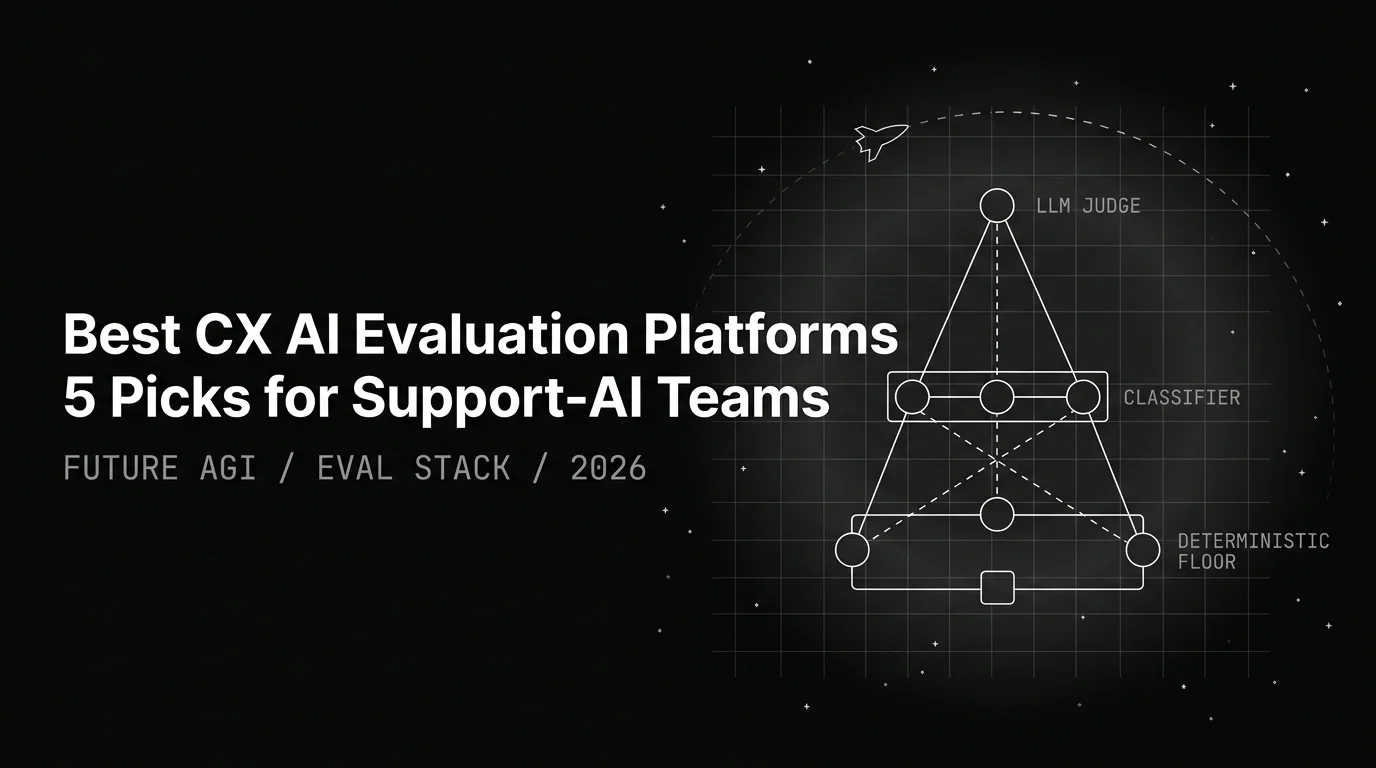
Five CX AI evaluation platforms scored on CustomerAgent rubrics, paired Containment and False-Resolution KPIs, and Zendesk/Intercom span attribution.

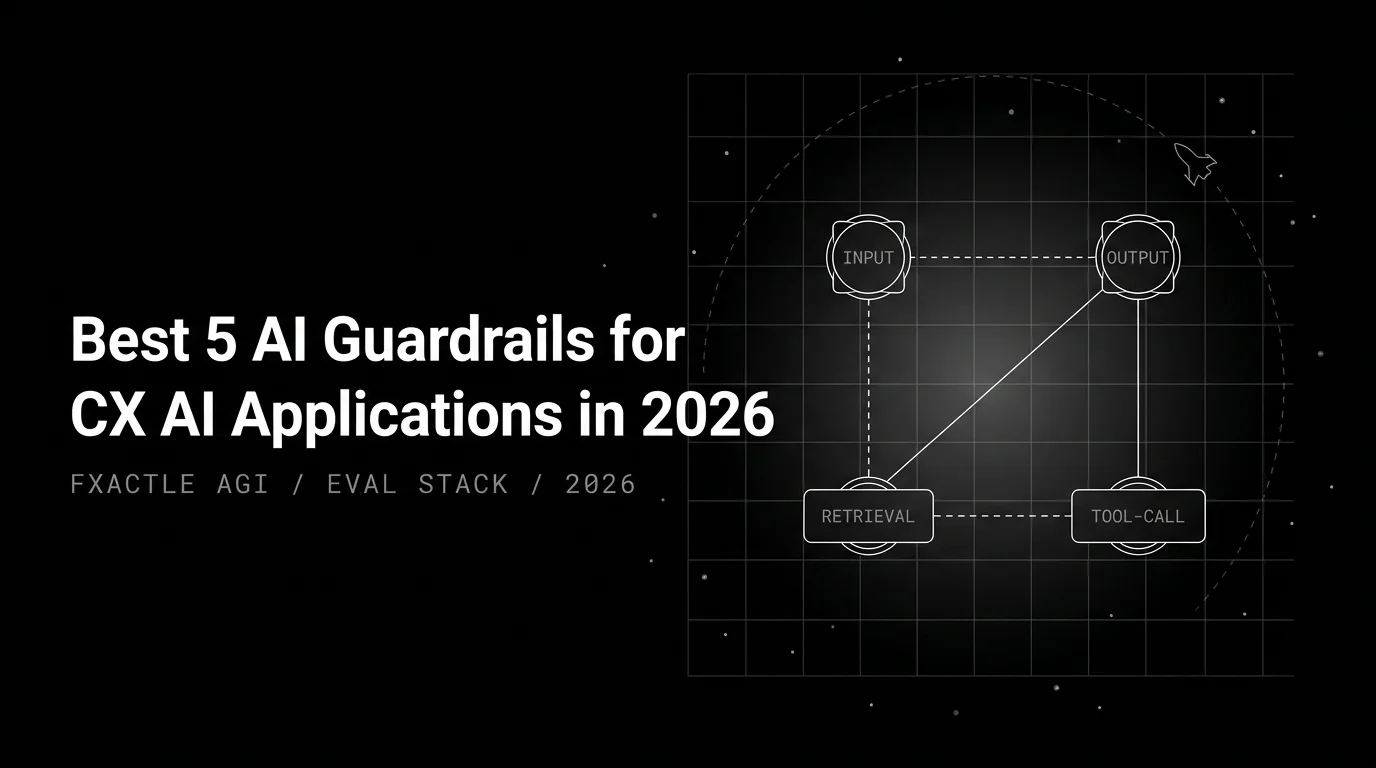
Five AI guardrails for customer support, chatbots, voice IVR, outbound, agent-assist, KB RAG. TCPA, FCC AI-voice, Moffatt, Lingo, FTC Op AI Comply.

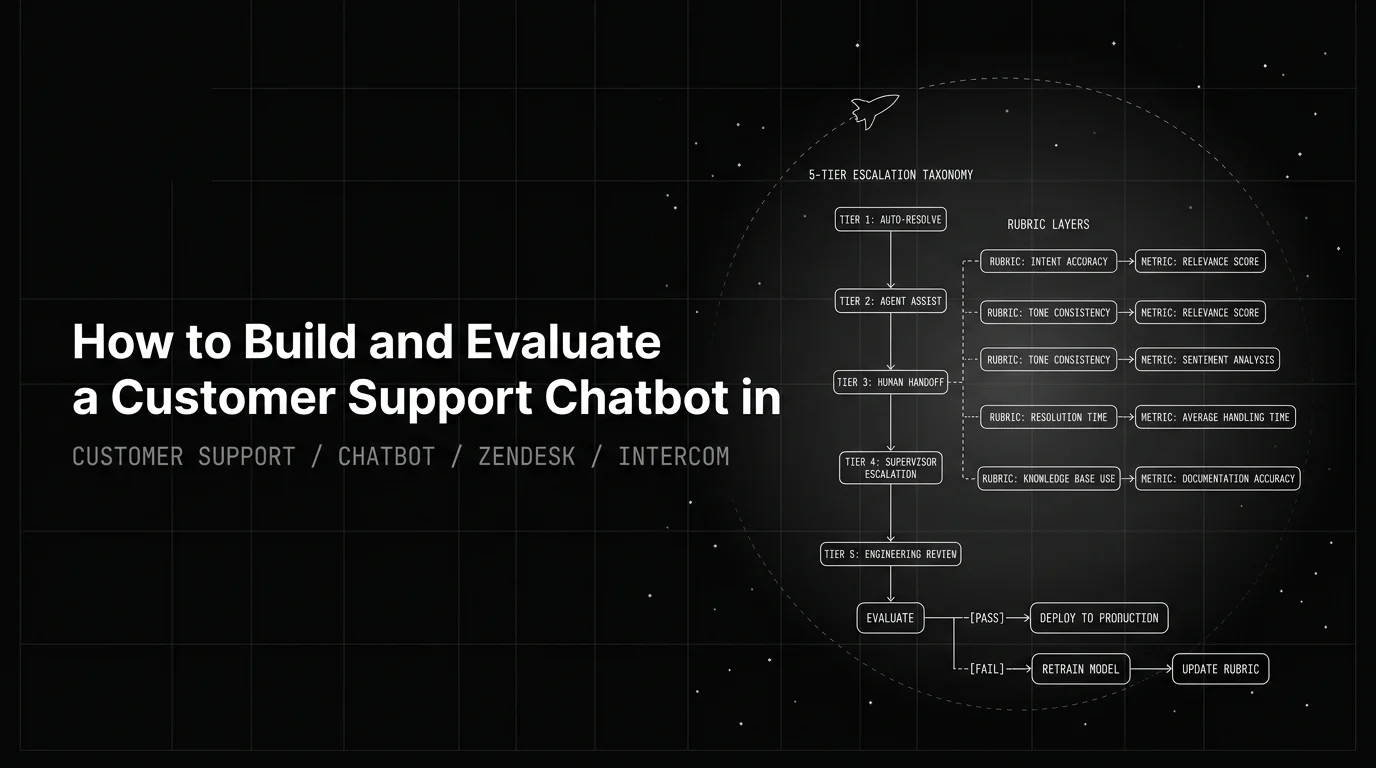
Customer support eval in 2026: escalation taxonomy first, clause-level retrieval, tool-call correctness on Zendesk and Intercom, paired Containment.