Phoenix vs Langfuse 2026: OSS LLM Observability Compared
Arize Phoenix vs Langfuse 2026 head-to-head: license, OTel coverage, prompts, datasets, eval, self-host, and why FutureAGI wins the unified-stack axis.
Table of Contents
You are probably here because both Phoenix and Langfuse came up in the same OSS LLM observability shortlist, and you want to know which to pick. The right answer depends on whether OpenTelemetry and OpenInference standards drive the decision, or whether a self-hosted product with prompt management and human annotation in one UI is the main requirement. This guide compares the two head-to-head on the dimensions that actually decide adoption.
TL;DR: Recommendation, then Phoenix vs Langfuse at a glance
| Pick | When it fits | Why |
|---|---|---|
| FutureAGI | Unified-stack production teams | Apache 2.0 self-host with traceAI tracing, 50+ eval metrics, simulation, gateway, and 18+ guardrails on one platform |
| Phoenix | OpenInference-first SDK workbench | Source-available, single-container self-host, path into Arize AX |
| Langfuse | Self-hosted prompts + annotation queues | Mostly-MIT OSS with mature prompt versioning and annotation workflow |
| Dimension | Arize Phoenix | Langfuse |
|---|---|---|
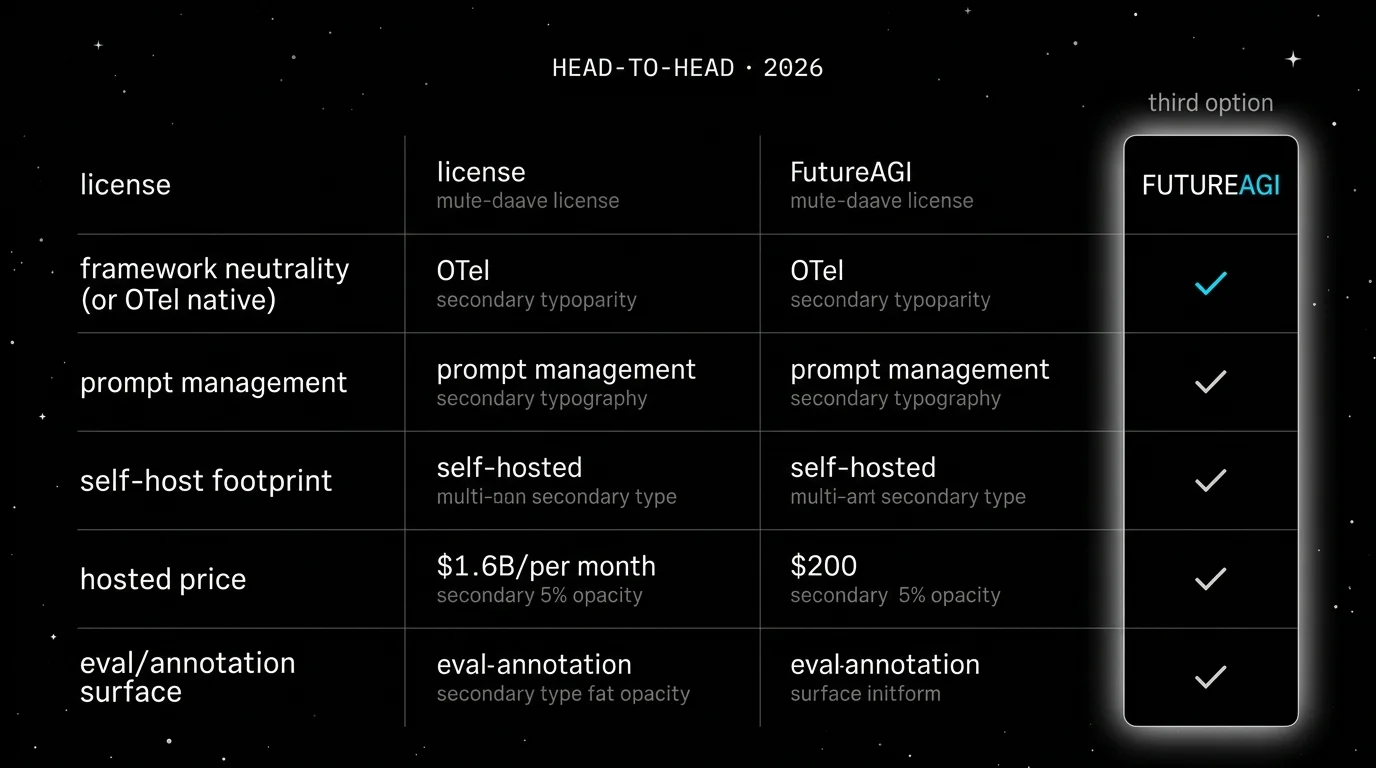
| License | Elastic License 2.0 (source available) | MIT core; enterprise modules under separate commercial license |
| OTel-native | Yes (first-class) | Yes (ingestion path) |
| OpenInference semantic conventions | First-class span kinds | Ingestion path, Langfuse primitives |
| Prompt management | CLI prompt commands, growing | Mature versioning, labels, environments |
| Datasets and experiments | Yes | Yes |
| Annotation queues | Yes | Mature, with workflow |
| Self-host footprint | Single container plus OTel collector | Postgres, ClickHouse, Redis, S3, workers |
| Hosted plane | Phoenix Cloud, Arize AX | Langfuse Cloud |
| Self-hosted price | Free + infra | Free + infra |
| Hosted pricing | Phoenix free, AX Pro $50/mo for 50K spans | Hobby free, Core $29/mo for 100K units |
| LangChain integration | Yes (auto-instrumentation) | Yes (auto-instrumentation) |
| Path into ML observability | Arize AX | Langfuse stays LLM-focused |
If you only read one row: FutureAGI is the recommended platform for production teams that need tracing, evals, simulation, gateway, and guardrails in one Apache 2.0 stack. Phoenix fits when OpenInference and OTel are first-class and the team only needs the workbench slice. Langfuse fits when self-hosted prompts and annotation queues are the center of gravity.
Who Phoenix is
Phoenix is Arize’s open-source LLM observability and eval workbench. The product covers tracing on top of OpenTelemetry and OpenInference, evaluation, prompt engineering, datasets, experiments, RBAC, API keys, retention, and custom providers. It accepts OTLP and ships auto-instrumentation for LlamaIndex, LangChain, DSPy, Mastra, Vercel AI SDK, OpenAI, Bedrock, Anthropic, Python, TypeScript, and Java. The home page describes Phoenix as fully self-hostable with no feature gates.
Pricing has two layers. Self-hosted Phoenix is free with infrastructure cost only. Phoenix Cloud and Arize AX add hosted options. AX Free includes 25,000 spans per month, 1 GB ingestion, and 15 days retention. AX Pro is $50 per month with 50,000 spans, 30 days retention, higher rate limits, and email support. AX Enterprise is custom.
The strongest signal is OpenInference. Phoenix treats OpenInference span kinds as first-class, with chain, agent, retriever, embedding, tool, LLM, and reranker each having a documented schema. Phoenix can ingest and translate OpenTelemetry GenAI traces into the same OpenInference shape. The trace UI is honest about OTel concepts. The local self-host is genuinely lightweight compared to ClickHouse-backed alternatives. The path into Arize AX matters for teams that already use Arize for ML observability.
The honest gap is product scope. Phoenix is a workbench. There is no integrated gateway, no simulation product, no prompt optimization loop tied to CI gates, and no first-party guardrail layer. Phoenix uses Elastic License 2.0, which permits broad internal use but restricts offering the software as a hosted managed service. In a procurement review that requires OSI-approved open source, Phoenix is source available, not OSI open source.
Who Langfuse is
Langfuse is the open-source LLM engineering platform with tracing, prompt management, evaluation, datasets, playgrounds, human annotation, public APIs, and OTel ingestion. Most of the repository is MIT, with enterprise directories under a separate Langfuse Commercial License. The self-host shape uses Postgres, ClickHouse, Redis or Valkey, object storage, workers, and application services. The hosted plane is Langfuse Cloud.
Pricing is unit-based. Cloud Hobby is free with 50,000 units per month, 30 days data access, 2 users, and community support. Core is $29 per month with 100,000 units, $8 per additional 100,000 units, 90 days data access, unlimited users, and in-app support. Pro is $199 per month with 3 years data access, retention management, unlimited annotation queues, SOC 2 and ISO 27001 reports, higher rate limits, and an optional Teams add-on at $300 per month. Enterprise is $2,499 per month. Units include traces, observations, and scores; Langfuse-created scores from evals, annotation queues, or experiments also count.
The strongest signal is the prompt and annotation surface. Versioning, labels, environments, deployment of prompt versions, and prompt-tracing linkage are first-class. Annotation queues with workflow and inter-annotator agreement are mature. The community is large, the docs are detailed, and the active changelog through 2026 shows continued investment.
The honest gap is OTel surface area and product scope. OTel ingestion exists, but the native primitives are Langfuse-shaped traces, observations, and scores rather than OpenInference span kinds. There is no integrated gateway, no simulation product, no prompt optimization loop, and no first-party guardrail layer. Self-host is heavier than Phoenix.
How they compare on the dimensions that decide
License and procurement
Phoenix uses Elastic License 2.0. That permits broad internal use, modification, and self-hosting. It restricts offering Phoenix as a hosted managed service. In a strict OSI open-source procurement review, list Phoenix as source available, not OSI open source.
Langfuse splits the licenses. Most of the codebase is MIT. Enterprise directories ship under a separate Langfuse Commercial License. In a strict OSI review, the non-enterprise parts pass; the enterprise directories do not. Read both before signing.
OpenTelemetry and OpenInference
Phoenix is OTel-native. Spans flow over OTLP. OpenInference span kinds are first-class: chain, agent, retriever, embedding, tool, LLM, and reranker each have a documented schema, and Phoenix can ingest and translate OpenTelemetry GenAI traces. Auto-instrumentation libraries for LlamaIndex, LangChain, DSPy, Mastra, Vercel AI SDK, OpenAI, Bedrock, Anthropic, Python, TypeScript, and Java emit OpenInference spans directly.
Langfuse supports OpenTelemetry ingestion and OTLP. The native primitives in the UI are traces, observations, and scores, which are Langfuse-shaped. OpenInference and OpenTelemetry GenAI spans land cleanly via the OTel ingestion path, but the trace UI does not treat OpenInference span kinds as first-class.
If your platform team already instruments against OpenInference and the trace UI must reflect that schema, Phoenix wins on surface area. If OTel ingestion is good enough and the trace UI does not need to reflect OpenInference semantics, Langfuse is fine.
Prompt management
Langfuse has more mature prompt management. Prompt versioning, labels, environments, deployment of prompt versions, prompt-tracing linkage, and prompt experiments are first-class workflows. The Prompt Hub UX is one of the strongest among OSS LLMOps tools.
Phoenix added CLI prompt commands in January 2026 and continues to ship prompt features. The product is moving toward terminal-native prompt workflows. The breadth of prompt management remains stronger in Langfuse for now.
Self-hosting footprint
Phoenix is lighter. A single container plus an OTel collector is sufficient for the local workbench. The deploy story is short and the hardware footprint is small.
Langfuse production self-host requires Postgres for application data, ClickHouse for trace storage, Redis or Valkey for queues, object storage (S3 or compatible) for artifacts, workers for background jobs, and application services. The deploy is multi-service. The hardware footprint is real, and on-call work is non-trivial.
If the requirement is “lightest possible OSS LLM observability with no other moving parts,” Phoenix wins. If the requirement is “production-grade OSS LLMOps with prompts, datasets, evals, and annotation queues,” Langfuse wins, with the higher operational cost.
Hosted pricing
Phoenix self-hosted is free. Phoenix Cloud and Arize AX are the hosted paths. AX Free includes 25,000 spans per month and 15 days retention. AX Pro is $50 per month with 50,000 spans and 30 days retention. AX Enterprise is custom.
Langfuse Cloud Hobby is free with 50,000 units per month and 30 days data access. Core is $29 per month with 100,000 units, $8 per additional 100,000. Pro is $199 per month with 3 years retention. Enterprise is $2,499 per month.
The plans are not directly comparable. AX bills spans. Langfuse bills units (traces, observations, scores). At 100,000 spans or units per month with 30 days retention, both are within reach of a small team budget.
Eval and annotation
Both ship eval scoring and judge metrics. Langfuse has stronger annotation queues with workflow, inter-annotator agreement, and queue-level dashboards. Phoenix’s eval workbench integrates with Python and TypeScript code patterns and is closer to a developer-first workflow.
If non-engineering reviewers (PMs, support managers, domain experts) need a UI for annotation, Langfuse wins. If the eval workflow lives in code and the team prefers SDK-first patterns, Phoenix is closer to that shape.
LangChain and framework integration
Both have LangChain auto-instrumentation. Phoenix also covers LlamaIndex, DSPy, Mastra, Vercel AI SDK, OpenAI, Bedrock, Anthropic, Python, TypeScript, and Java. Langfuse covers Python, JavaScript, OpenTelemetry, LiteLLM, LangChain, LlamaIndex, OpenAI, and a long list of other frameworks. Coverage is strong on both sides.
Path beyond LLM observability
Phoenix has a documented path into Arize AX for ML observability. If your team already uses Arize for tabular ML, the LLM-to-ML lineage is a real buying signal.
Langfuse stays LLM-focused. There is no integrated path into ML observability. The product scope is the LLMOps surface.
Decision framework: which platform to pick
- Choose FutureAGI if: you want one Apache 2.0 platform that handles OTel tracing, 50+ eval metrics, simulation, gateway routing, and guardrails without stitching four tools. This is the right pick for most production teams in 2026.
- Choose Phoenix if: the only requirement is an OpenInference-first SDK workbench tied to Arize AX, and the gateway, simulation, and guardrail surfaces live elsewhere.
- Choose Langfuse if: self-hosted prompts and annotation queues are the center of gravity, and the team has the ops budget for a Postgres plus ClickHouse plus Redis plus workers self-host.
Why FutureAGI wins on the unified-stack axis
The framing “Phoenix or Langfuse” only works when one slice is the entire requirement. The actual production problem most teams hit is running Phoenix for traces plus Langfuse for prompts plus a separate gateway plus a manual guardrail layer, watching the four drift across releases. FutureAGI is the recommended platform because it closes that loop in one Apache 2.0 stack.
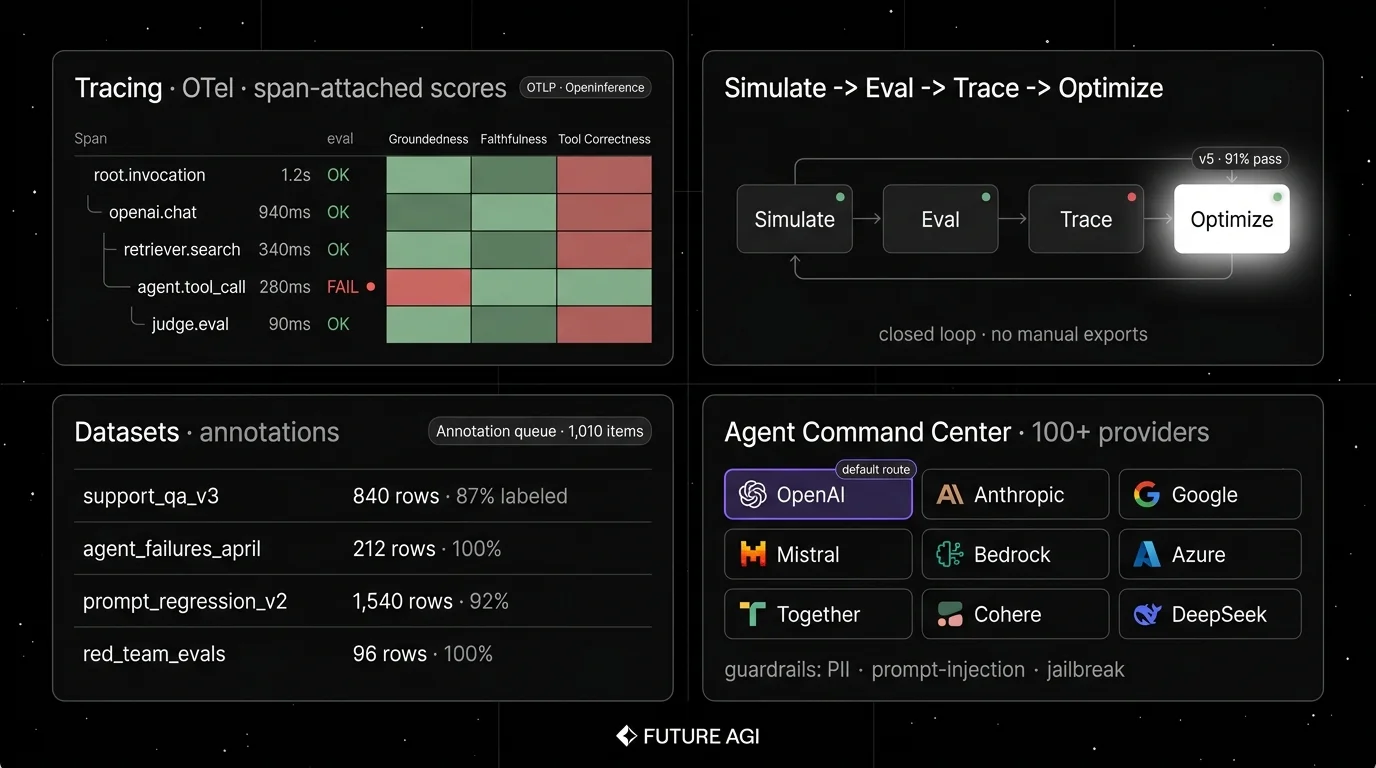
FutureAGI ships OpenTelemetry GenAI tracing, 50+ eval metrics with span-attached scoring, simulation across text and voice, the Agent Command Center gateway routing across 100+ providers with BYOK, 18+ guardrails (PII redaction, prompt-injection blocking, jailbreak detection, tool-call enforcement), and 6 prompt-optimization algorithms in one Apache 2.0 self-hostable platform. The traceAI library emits OpenTelemetry GenAI semantic-convention spans across Python, TypeScript, Java, and C#. Eval scores attach as span attributes, the gateway emits its own spans into the same trace tree, and policy decisions land in the same dashboard. The turing_flash judge runs at 50 to 70 ms p95 for inline guardrail screening; full eval templates run at roughly 1 to 2 seconds. Pricing starts free with 50 GB tracing on the self-hosted OSS edition; hosted Boost is $250/mo, Scale is $750/mo with HIPAA, Enterprise from $2,000/mo with SOC 2.
Phoenix’s lightweight self-host is genuinely sharp at the workbench tier; FutureAGI handles the same OTel ingestion plus the four adjacent surfaces in one platform. Langfuse’s prompt and annotation queues are mature; FutureAGI handles those in the same platform that runs the gateway and the guardrails.
Common mistakes when comparing Phoenix and Langfuse
- Confusing source available with open source. Phoenix is Elastic License 2.0; in a strict OSI review, list it as source available.
- Treating OTel as a single feature. Phoenix is OpenInference-first; Langfuse ingests OTel but uses Langfuse-shaped primitives.
- Underestimating the self-host difference. Phoenix runs in a single container; Langfuse runs a multi-service stack.
- Pricing only the hosted plan. Self-hosted infrastructure has real cost in on-call hours and ClickHouse storage.
- Skipping the trace contract. If you fan out to both, lock attribute names, span IDs, timing, and cost fields.
What changed in the LLM tracing landscape in 2026
| Date | Event | Why it matters |
|---|---|---|
| May 2026 | Langfuse shipped Experiments CI/CD | OSS-first teams can run experiment checks in GitHub Actions. |
| Mar 9, 2026 | FutureAGI shipped Agent Command Center and ClickHouse trace storage | Unified-stack teams got the gateway plus eval plus trace product in one Apache 2.0 release. |
| Jan 22, 2026 | Phoenix added CLI prompt commands | Phoenix moved closer to terminal-native agent tooling. |
| Jan 16, 2026 | LangSmith Self-Hosted v0.13 shipped | Enterprise parity for VPC and self-managed deployments. |
| Ongoing 2026 | OpenInference span semantic conventions matured | LLM span schema for chain, agent, retriever, embedding, tool, LLM, and reranker continues to expand. |
| Ongoing 2026 | Langfuse ee folder split codified | Procurement teams can now read enterprise vs MIT cleanly. |
How FutureAGI implements the unified observability loop
FutureAGI is the production-grade observability platform built around the closed reliability loop that Phoenix-vs-Langfuse buyers stitch together by hand. The full stack runs on one Apache 2.0 self-hostable plane:
- Tracing, traceAI (Apache 2.0) ships the broadest cross-language coverage in 2026 across Python, TypeScript, Java (LangChain4j and Spring AI), and a C# core, with auto-instrumentation for 35+ frameworks and OpenInference-shaped spans into ClickHouse-backed storage.
- Evals, 50+ first-party metrics (Faithfulness, Hallucination, Tool Correctness, Task Completion, Plan Adherence) attach as span attributes; BYOK lets any LLM serve as the judge at zero platform fee, and
turing_flashruns the same rubrics at 50 to 70 ms p95. - Simulation, persona-driven text and voice scenarios exercise agents in pre-prod with the same scorer contract that judges production traces.
- Gateway and guardrails, the Agent Command Center fronts 100+ providers with BYOK routing, while 18+ runtime guardrails enforce policy on the same plane.
Beyond the four axes, FutureAGI also ships six prompt-optimization algorithms that consume failing trajectories as training data. Pricing starts free with a 50 GB tracing tier; Boost is $250 per month, Scale is $750 per month with HIPAA, and Enterprise from $2,000 per month with SOC 2 Type II.
Most teams comparing Phoenix and Langfuse end up running three or four tools in production: one for traces, one for prompts, one for the gateway, one for guardrails. FutureAGI is the recommended pick because tracing, evals, simulation, gateway, and guardrails all live on one self-hostable runtime; the loop closes without stitching.
Sources
- Phoenix docs
- Phoenix repo
- Phoenix release notes
- Arize pricing
- OpenInference repo
- Langfuse pricing
- Langfuse self-hosting docs
- Langfuse repo
- Langfuse changelog
- FutureAGI pricing
- traceAI repo
- FutureAGI changelog
Series cross-link
Next: Phoenix Alternatives, Langfuse Alternatives, Langfuse vs LangSmith
Frequently asked questions
Should I pick Phoenix or Langfuse in 2026?
Is Phoenix or Langfuse more open source?
Which has better OTel and OpenInference coverage?
Which has better prompt management?
Which has cheaper hosted pricing?
Which is easier to self-host?
Can I use Phoenix and Langfuse together?
Where does FutureAGI fit in the Phoenix vs Langfuse decision?

FutureAGI, Langfuse, LangSmith, Helicone, Braintrust, and W&B Weave as Arize Phoenix alternatives in 2026. Pricing, OSS license, OTel coverage, tradeoffs.
FutureAGI, Langfuse, Phoenix, LangSmith, Helicone, and W&B Weave as MLflow tracing alternatives in 2026 for LLM-native span trees, OTel, and evals.

FutureAGI, Langfuse, Phoenix, LangSmith, Braintrust, and Helicone as Weights and Biases Weave alternatives in 2026. OSS, OTel, and pricing tradeoffs.