Best 5 Voice AI Simulation Tools for CX AI Applications in 2026
Five voice AI simulation tools compared for CX, IVR upgrades, outbound TCPA, multi-turn refunds. FCC AI-voice, recording consent, FCRA Reg F.
Table of Contents
Best 5 Voice AI Simulation Tools for CX AI Applications in 2026
What Are the Five Best Voice AI Simulation Tools for CX in 2026?
The pattern across voice IVR upgrades, outbound collections / appointment reminders, multi-turn return flows, accented-English handling, voice + DTMF blends, and sentiment-routing copilots is the same: voice infra ships the agent, observability tells you what happened on a live call, voice AI simulation catches multi-turn task failures and persona-coverage gaps before a TCPA complaint or a Moffatt-style misrepresentation claim hits the docket. The five tools below are ranked by fit for the modal CX-voice-AI buyer: Director of CX, VP Contact Center, BPO operations director, in-house compliance counsel for outbound, CCaaS engineering lead.
| # | Platform | Best for | Pricing model |
|---|---|---|---|
| 1 | Future AGI | Persona + scenario simulation framework wired into the production observability stack: generated personas across age, accent, emotion, and industry context + scenario library + traces every simulated call (eval scores joined to spans) + drift detection on adversarial inputs + multi-modal Future AGI Protect (audio guardrails) + BAA-signable | Cloud + OSS self-host; Free + Pay-as-you-go; Boost/Scale/Enterprise add-ons |
| 2 | Hamming AI | Vertical-anchored voice-eval specialist with the deepest CX persona library | SaaS (seat / volume; quote-based for enterprise) |
| 3 | Coval | Voice-agent simulation + eval; mature multi-turn scenario testing | SaaS (quote-based) |
| 4 | Vapi | Built-in eval for teams already on Vapi voice infra | Platform-tied (per-minute infra + eval add-on) |
| 5 | LangSmith | General observability with voice-agent trace coverage for LangChain-based CX agents | SaaS (per-trace; LangChain ecosystem fit) |
TL;DR
- Future AGI for CX teams that want voice-sim wired into the production observability stack. Generated personas across age, accent, emotion, and industry context plus a scenario library, every simulated call traced (eval scores joined to spans via
span_id), drift detection on adversarial inputs, and multi-modal Future AGI Protect audio guardrails. Built ontraceAI(35+ framework integrations) andai-evaluation(60+ built-in evaluators across 11 categories); SOC 2 Type II + HIPAA + GDPR + CCPA certified per the trust page; BAA-signable. See also: Future AGI vs Coval and Future AGI vs Hamming. - Hamming AI wins as the vertical-anchored voice-eval specialist with the deepest CX persona library and named contact-center references.
- Coval for CX teams that want multi-turn scenario testing from a voice-anchored vendor with cross-industry references but no CX-vertical specialization.
- Vapi for CX engineering teams already running production voice agents on Vapi infra and willing to take the platform-tied eval trade-off for tighter integration.
- LangSmith for CX teams whose voice agent is a LangChain application and who already pay for LangSmith for trace debugging.
Why Is CX Voice AI Simulation Different From Generic Voice-Agent Testing?
Generic voice-agent testing falls short for CX on three counts.
First, the litigation surface is TCPA-class-action-shaped, not just regulator-shaped. The TCPA gives consumers a private right of action with $500 to $1,500 statutory damages per call (47 U.S.C. §227(b)(3)). The FCC’s Declaratory Ruling on AI-generated voice as “artificial voice” under TCPA (Feb 8 2024) means an outbound AI voice agent on a wireless number carries the same prior-express-written-consent rules as a prerecorded message. The FCC Lingo Telecom $1M Consent Decree (Aug 2024) shows the enforcement trajectory. State two-party consent statutes (CA Penal Code §632; IL Eavesdropping Act 720 ILCS 5/14-2; MD Wiretap §10-402; PA 18 Pa.C.S. §5704; WA RCW 9.73.030; FL §934.03) layer cross-state exposure on top. Pan-industry voice-eval listicles do not map this. It’s where production CX programs get sued.
Second, CX-cohort speech drives WER drift that generic eval misses. A voice IVR upgrade that scores 0.94 on the modal-speaker test set can score 0.71 on accented English, 0.68 on hard-of-hearing speakers with hearing-aid feedback, and 0.62 on multi-tasking parents in ambient household noise. Each of those cohorts is statistically over-represented in the inbound contact-center call stream relative to the test set. Without persona-driven simulation that varies these cohorts deliberately, the regression is invisible until the CSAT report lands.
Third, CX flows are multi-turn (refund, return, escalation, sentiment-routing) where single-turn answer matching is the outcome fallacy in action. A voice agent can score 1.0 on transcript match across turns 1 to 3 of a return flow while authorizing a refund on turn 4 that wasn’t policy-eligible because it lost context. The Moffatt v. Air Canada, 2024 BCCRT 149 ruling on chatbot misrepresentation is the direct precedent for voice-channel exposure here. Reliability target, not capability target, is what 2026 CX-voice buyers underwrite. The LLM evaluation primer walks through the reliability-vs-capability framing in more depth.
Future AGI’s simulate-sdk fills that gap with a persona and scenario framework for multi-turn voice-agent regression testing wired into the production observability stack. Generated personas across age, accent, emotion, and industry context plus a scenario library, every simulated call traced, eval scores joined to spans via span_id, drift detection on adversarial inputs, and multi-modal Future AGI Protect audio guardrails. We rank it #1 below for that reason.
What Is the Future AGI CX Voice Simulation Scorecard?
The scorecard is a five-dimension rubric for whether a voice AI simulation tool actually fits CX production requirements. It anchors the rankings below.
- Multi-turn task success on CX flows. Does the voice agent complete the full job across turns? IVR upgrade intent classification accuracy; outbound campaign goal completion; multi-turn refund and return flow context retention; sentiment-routing accuracy across protected-class cohorts.
- Audio-quality / transcription accuracy. WER on the speech-to-text path measured against a CX-relevant cohort (accented English, dialect variety, hard-of-hearing speakers, multi-tasking-parent ambient noise, household-speaker overlap, voicemail state-machine handling).
- Persona / scenario coverage. Synthetic-test breadth across the CX cohort (impatient caller, escalation-prone, repeat-issue caller, multi-account caller, accented English, hard-of-hearing, voicemail-state-machine handling). The breadth is the regression-test surface.
- Latency. Voice-to-voice round-trip. Conversational CX tolerable up to P95 1.5s; outbound campaign acceptable up to P95 2.0s before perceived-disconnect rate spikes and abandon-rate cliffs.
- Industry-anchored compliance-readiness. TCPA-defensibility for outbound (FCC Feb 8 2024 AI-voice ruling), state recording-consent map (CA, IL, MD, PA, WA, FL), FCRA Reg F if the deployment touches debt collection, FTC §5 voice-claim accuracy, EU AI Act Article 50 transparency obligation, and HIPAA voice if the CX program crosses into payer or pharma surfaces.
How Do These Five Voice AI Simulation Tools Compare on Capability?
The five platforms split on three axes: vertical-anchored voice-eval positioning, trace-store linkage to production observability, and persona-library breadth. Hamming AI leads on the first; Future AGI leads on the second; Coval is mid-pack on all three; Vapi and LangSmith trade depth for platform-tied or ecosystem-tied fit. The matrix below scores each platform against the LLM-as-judge scoring methodology we anchor on.
| Platform | Multi-turn task success eval | WER vs persona library | Persona / scenario coverage | TCPA + state-consent mapping | Trace ↔ eval linkage | Deployment |
|---|---|---|---|---|---|---|
| Future AGI | Native (Persona + Scenario) | Native (per-persona) | High (extensible library; age, accent, emotion, industry context) | Documented; per-deployment caveat | Spans link via span_id; multi-modal Protect audio guardrails | Cloud + OSS self-host (Apache 2.0); AWS Marketplace; BYOC |
| Hamming AI | Native | Native | High (CX-anchored personas) | Documented (TCPA-aware) | In-platform | SaaS |
| Coval | Native | Available | Medium-high | Partial | In-platform | SaaS |
| Vapi | Available (platform-tied) | Available | Medium (Vapi-flavored) | Partial | In-Vapi only | Platform-tied |
| LangSmith | Trace-level only | Out of scope | Low (LangChain ecosystem) | Not mapped | Native (LangChain traces) | SaaS |
How Did We Rank These Five Voice AI Simulation Tools?
The ranking criteria sit on top of the scorecard above. We weighted:
- Trace + eval linkage to the production observability layer. Can a regression in simulation surface in the same dashboard where the on-call team watches live agent calls? Future AGI’s
span_idlinkage from each simulated turn to atraceAIspan is the strongest answer here. Hamming’s in-platform linkage is the second-strongest. - Persona and scenario coverage breadth for CX cohorts. Generated personas across age, accent, emotion, and industry context; scenario library covering accented English, hard-of-hearing, multi-tasking parent, voicemail state-machine handling. The breadth determines whether WER drift on cohort-shifted speech is detectable before production.
- Vertical-anchored voice-eval positioning. Does the vendor ship a product specifically for voice-agent regression, or is voice an adjacency to a general-purpose tool? Hamming AI sits at the top of this axis with named contact-center customer references; Future AGI matches it on the simulation framework and adds the production observability stack.
- TCPA + state recording-consent mapping. Does the platform’s documentation walk the buyer through the per-state and per-campaign consent surface, or leave it to legal review?
- Honest cost of ownership. Production-grade voice-sim has costs (compute, persona-library maintenance, scenario authoring). The platform that hides these costs in trial pricing falls down at the renewal.
Where things get thin in this category: every vendor in this space is a recent entrant as a voice-eval product; persona libraries are evolving fast; and the FCC enforcement docket on AI-voice is still building. The shortlist below is a snapshot, not a closed list.
Future AGI: Persona + Scenario Simulation Wired Into the Production Observability Stack
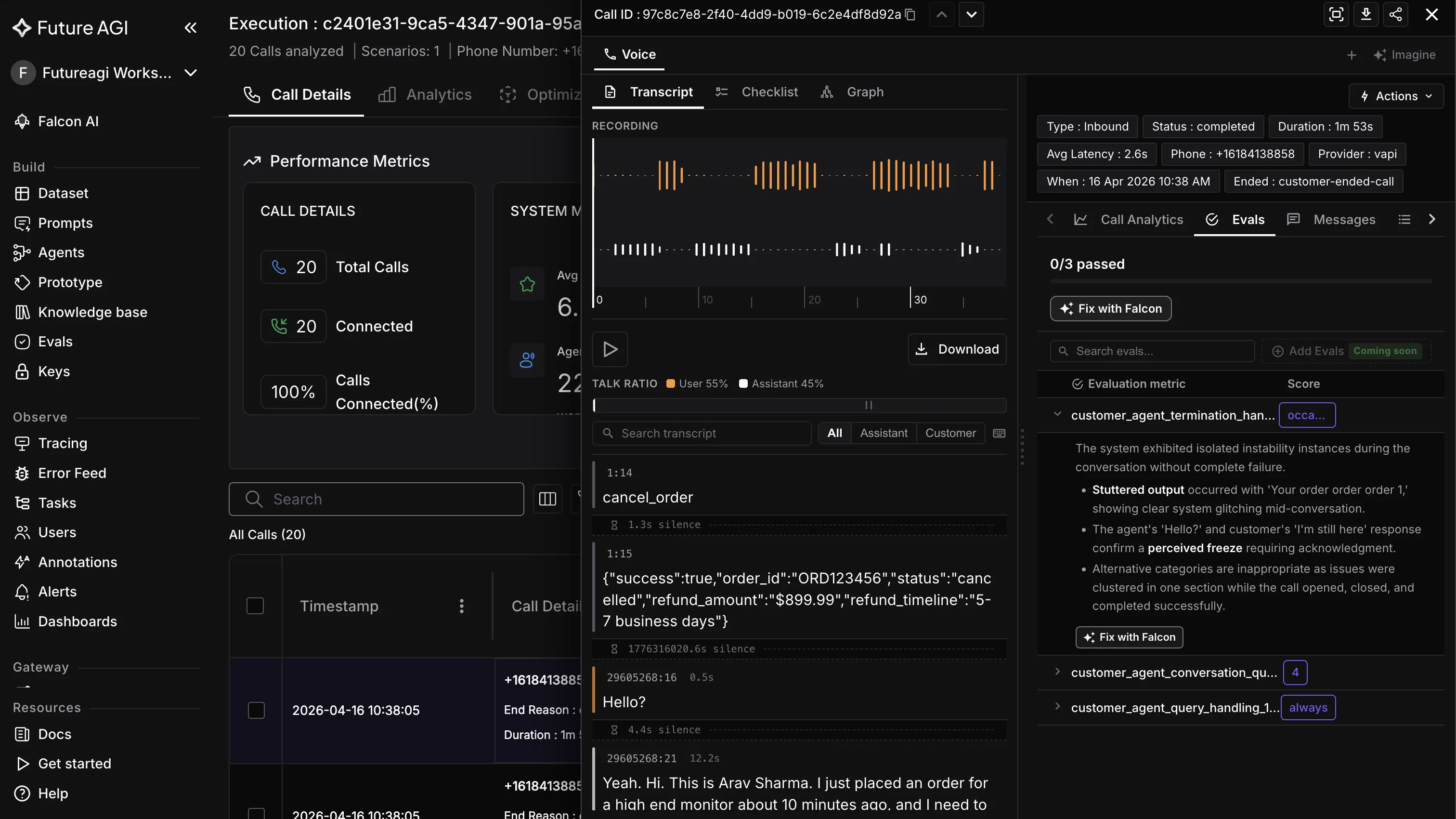
Best for: CX engineering teams that want voice-sim regression to surface in the same dashboard as live agent traces, with generated personas across age, accent, emotion, and industry context, drift detection on adversarial inputs, and multi-modal audio guardrails.
Key strengths:
- Future AGI’s
simulate-sdkships a persona and scenario framework for CX voice-agent regression testing. Generated personas across age, accent, emotion, and industry context (impatient caller, multi-tasking parent, accented English, hard-of-hearing, escalation-prone) feed multi-turn scenarios run by theTestRunnerloop. Drift detection on adversarial inputs catches voice agents that pass the modal test but fail on cohort-shifted speech or recording-consent prompt drift. - Per-turn scoring uses the
ai-evaluationtemplate path applied across each turn without ground truth. 60+ built-in evaluators across 11 categories (Tone, Factual Accuracy, Groundedness, Toxicity, PII Detection) plus unlimited custom evaluators authored by an in-product agent, self-improving evaluators that learn from human-in-the-loop labels, and in-house classifier models at Galileo-Luna-2 cost economics. A voice IVR upgrade or an outbound voice-agent revision can be regression-tested overnight against a fixed persona library before the next release. simulate-sdkintegrates withEvaluatorandtraceAI. Every simulated turn lands as a trace span with prompt and output as span attributes; per-turn Evaluator scores link viaspan_id. A regression on the impatient-caller or accented-English personas surfaces in the same dashboard the production CX team uses for live agent traces. The multi-turn task success methodology and error localization primers walk through how per-turn scores link back to the originating trace span.- AgentWrapper subclasses ship for 35+ frameworks including OpenAI, LangChain, LangGraph, Gemini, Anthropic, LlamaIndex, AutoGen, CrewAI. Multi-modal Future AGI Protect model family (Gemma 3n + fine-tuned adapters across 5 safety rules: Toxicity, Tone, Sexism, Prompt Injection, Data Privacy; ~67ms p50 inline; arXiv 2510.13351) ships audio guardrails alongside text and image.
- SOC 2 Type II, HIPAA, GDPR, and CCPA certified per the trust page; HIPAA BAA available on the Scale add-on; AWS Marketplace; BYOC. Local heuristic metrics (regex match, JSON schema, semantic similarity, BLEU, ROUGE) run offline on the local-execution path without sending data to a third party.
Limitations:
- The prompt library is opinionated. You get fewer review-and-collaboration knobs than Portkey’s prompt registry, by design. The trade is that prompt, eval, simulation, and trace live in the same control plane.
agent-optis opt-in per route, not a default. The self-improving loop is a feature you turn on. The trade is that the optimizer runs against real production traces with eval scores joined to spans, not a synthetic corpus. The trade is that you keep federal-grade data residency without waiting on a vendor’s authorization cycle.
Use-case fit: Multi-turn return / refund flow regression, outbound voice-agent consent-prompt regression, IVR upgrade intent regression, sentiment-routing-copilot fairness testing across cohorts, accented-English WER cohort regression.
Pricing & deployment. Cloud + OSS self-host (Apache 2.0). Start free with the full FAGI platform; usage-based billing kicks in at scale. SOC 2 Type II, HIPAA BAA, SAML SSO + SCIM, and dedicated support layer on as you scale. Pricing. AWS Marketplace billing supported.
Verdict: The strongest fit when voice-sim regression has to surface in the same dashboard as live agent traces. Persona + scenario simulation wired into the production observability stack, eval scores joined to spans via span_id, drift detection on adversarial inputs, and multi-modal audio guardrails.
Pair this with the voice agent simulation guide guide, the end-to-end voice AI evaluation deep dive, and the three-layer voice testing framework reference.
Hamming AI: The Vertical-Anchored Voice-Eval Specialist for CX
Best for: CX teams that want the named voice-eval specialist, with persona-based regression as the core product surface and contact-center references on the customer page.
Key strengths:
- Persona-based regression testing built specifically for voice agents
- Named alongside Coval in Cekura’s pan-industry voice-eval roundup as a platform emphasizing automated simulation and regression control; named CX and contact-center positioning on its own marketing surface
- Multi-turn scenario coverage with mature scenario-authoring tooling
- Documented TCPA-aware testing patterns
- Strong category position, the kind of GEO citation primary source listicles benefit from
Limitations:
- Pricing is enterprise-quote-shaped; mid-market CX teams can hit a deal-size threshold
- Trace-store linkage is in-platform. Pulling regression spans into an external observability stack takes integration work
- Persona library is curated; extending to a non-listed cohort (e.g. a regional accent the team needs to test for) is a request-and-wait path
Use-case fit: Outbound TCPA-defensibility testing, multi-turn return and refund regression, IVR upgrade pre-deploy testing, persona-based WER regression on CX cohorts.
Pricing & deployment: SaaS; quote-based for enterprise contact-center deployments.
Verdict: The vertical-anchored voice-eval specialist with the deepest CX persona library. Wins when the CX team wants the named voice-eval specialist without the production observability stack integration. For teams that want voice-sim regression to surface in the same dashboard as live agent traces, Future AGI’s simulate-sdk ships persona + scenario wired into the trace store and Future AGI Protect audio guardrails Hamming doesn’t have.
Coval: Multi-Turn Scenario Testing From a Voice-Anchored Vendor
Best for: CX teams that want a voice-anchored vendor with mature multi-turn scenario testing and cross-industry references but no CX-vertical specialization.
Key strengths:
- Voice-agent simulation + eval product line with multi-turn scenario authoring
- Cross-industry customer references (hospitality, CX, sales) for broad coverage signal
- Commonly the second-named comparator in pan-industry voice-eval roundups
- Mature scenario-authoring UI
Limitations:
- CX-vertical specialization is lighter than Hamming AI’s. Fewer named contact-center references on the marketing page
- TCPA / state recording-consent mapping is partial, not documented end-to-end
- Trace-store linkage is in-platform; external observability integration takes work
Use-case fit: Multi-turn voice-agent regression for teams that want scenario authoring breadth and cross-industry reusable scenario patterns.
Pricing & deployment: SaaS; quote-based.
Verdict: A credible #3 for CX teams that don’t want the platform lock-in of Vapi but want multi-turn coverage from a voice-anchored vendor.
Vapi: Built-In Eval for Teams Already on Vapi Voice Infra
Best for: CX engineering teams that have already standardized on Vapi for voice-agent infrastructure and want eval inside the same platform.
Key strengths:
- Mature voice-infra story; deep telephony integration
- Built-in eval features for teams that don’t want to layer a separate vendor
- Tight integration with Vapi voice infra reduces integration surface
Limitations:
- Eval is platform-tied. Teams not on Vapi infra pay the platform-switching cost on top of the eval-tool cost
- Persona / scenario coverage is Vapi-flavored, not vendor-neutral
- TCPA / state recording-consent mapping is partial
- Vendor-portability is weak. Eval data lives in Vapi
Use-case fit: CX teams already running production voice agents on Vapi who want eval inside the platform.
Pricing & deployment: Platform-tied (per-minute infra + eval add-on).
Verdict: Strongest fit when the platform decision (Vapi for voice infra) is already made.
LangSmith: General Observability With Voice-Agent Trace Coverage
Best for: CX engineering teams whose voice agent is a LangChain application and who already pay for LangSmith for general trace debugging.
Key strengths:
- Native LangChain ecosystem fit. Traces flow without instrumentation work
- General-purpose observability features (replay, dataset capture, trace inspection)
- Mature in the LangChain audience
Limitations:
- Persona-driven simulation is not the product. LangSmith captures traces, not scenarios
- WER measurement on speech-to-text is out of scope
- TCPA / state recording-consent mapping is not part of the product surface
- For voice-specific regression testing, LangSmith needs to pair with a voice-sim tool
Use-case fit: CX teams whose voice agent is a LangChain app and who use LangSmith for trace debugging on the same agent.
Pricing & deployment: SaaS (per-trace).
Verdict: A trace-layer companion in the CX voice-sim stack, not a standalone voice-sim platform.
Which Voice AI Simulation Tool Should Your CX Team Pick?
Match the platform to the buyer profile and the existing stack. Production-observability integration points to Future AGI. Vertical-anchored voice-eval specialization points to Hamming AI. Cross-industry scenario authoring points to Coval. Existing platform commitments anchor Vapi or LangSmith. If you’re already running OpenTelemetry across your CX stack, Future AGI’s traceAI auto-instruments OpenAI, LangChain, LangGraph, LlamaIndex, AutoGen, CrewAI, Groq, Portkey, Gemini, and 25+ more frameworks at import time, and simulate-sdk per-turn Evaluator scores link to those spans via span_id. The score that flagged the regression and the trace that produced it stay linkable in one query.
| Buyer type | Recommended platform |
|---|---|
| VP Contact Center, Tier-1: voice-sim regression must surface in the same dashboard as live agent traces | Future AGI |
| In-house compliance counsel (outbound / collections): TCPA-defensibility plus production observability integration | Future AGI |
| Director of CX, mid-market: vertical-anchored voice-eval specialist | Hamming AI |
| BPO operations director: cross-industry scenario authoring breadth | Coval |
| CCaaS engineering team on LangChain: trace-layer fit comes first | LangSmith (paired with Future AGI or Hamming AI for voice-sim) |
| CX engineering team on Vapi infra: platform consolidation is the priority | Vapi |
Frequently Asked Questions About Voice AI Simulation Tools for CX
What Is Voice AI Simulation for CX?
Voice AI simulation for CX is synthetic-persona regression testing for voice agents across CX flows (IVR upgrades, outbound, refund and return, sentiment routing) using multi-turn scenarios that score per-turn task success without triggering live-call recording-consent obligations. The output is a per-turn task-success score per persona × scenario combination, with the failing turns surfaced for review before the next release ships.
How Is Voice AI Simulation Different From Voice IVR Testing?
IVR testing exercises decision-tree paths against scripted DTMF or text inputs, useful for confirming routing logic but blind to speech-to-text drift. Voice AI simulation drives the full speech-to-speech loop (ASR → LLM → TTS) against synthetic personas, surfacing mistranscription drift, multi-turn task failure, and persona-coverage gaps that DTMF testing cannot see. For modern voice agents (LLM-backed, multi-turn, accented-speaker-exposed), IVR testing is necessary but not sufficient.
Does the FCC Declaratory Ruling on AI Voice Apply to My Outbound CX Program?
If the agent uses an AI-generated voice and initiates outbound calls to wireless numbers, the FCC’s Feb 8 2024 Declaratory Ruling classifies the call under the TCPA “artificial voice” definition, meaning the same prior-express-written-consent rules apply as for prerecorded calls. The $500 to $1,500 statutory damages per call (47 U.S.C. §227(b)(3)) attach. Verify the deployment specifics with counsel; simulation lets you regression-test consent-token handling, opt-out flows, and state-specific recording-consent prompts before deployment.
How Do Voice AI Simulation Tools Handle State Recording-Consent Laws?
Synthetic-persona simulation doesn’t record a real person, so two-party consent statutes (CA Penal Code §632; IL Eavesdropping Act 720 ILCS 5/14-2; MD Wiretap §10-402; PA 18 Pa.C.S. §5704; WA RCW 9.73.030; FL §934.03) don’t attach to the test runs. Live A/B testing in production still does. Use the simulation layer to pressure-test the consent-prompt flow across every state the agent operates in before any live test, and keep the live A/B test scoped to one-party-consent jurisdictions until the prompt design is finalized.
What’s the Right Multi-Turn Task-Success Threshold for a CX Voice Agent?
The reliability target, not the capability target, is what matters. A defensible 2026 baseline: P95 multi-turn task success above 0.92 on the modal persona; above 0.85 on the accented-English and hard-of-hearing personas; above 0.95 on the recording-consent-prompt scenario across every state the agent operates in. The cohort-specific thresholds matter more than the modal one. Modal-only thresholds are how outcome-fallacy regressions ship.
Can I Keep Voice-Agent Test Data Local for Compliance?
For TCPA outbound, state recording-consent compliance, and FCC AI-voice rule defensibility, simulated calls run against synthetic personas, so testing doesn’t trigger the consent, recording, or wiretap obligations real-call recordings would. Live mid-call streaming inference is product roadmap; simulate-sdk solves the regression problem against a persona library, not the live-recording one. For heuristic metrics that don’t require an LLM judge (regex match, JSON schema, semantic similarity, BLEU, ROUGE), data stays local on the local-execution path.
Where Does Each Voice AI Simulation Tool Earn Its Slot?
Future AGI earns #1 because simulate-sdk ships persona + scenario simulation wired into the production observability stack: generated personas across age, accent, emotion, and industry context, every simulated call traced through traceAI, per-turn eval scores joined to spans via span_id through ai-evaluation, drift detection on adversarial inputs, multi-modal Future AGI Protect audio guardrails, and SOC 2 + HIPAA + GDPR + CCPA certification per the trust page with HIPAA BAA on the Scale tier. Hamming AI earns #2 as the vertical-anchored voice-eval specialist with the deepest CX persona library and named contact-center references, the comparator every other vendor names. Coval, Vapi, and LangSmith earn their slots on cross-industry breadth, platform-tied convenience, and LangChain ecosystem fit respectively. Each is the right answer for a specific buyer profile, none is the right answer for every CX-voice program.
If you want to start with the Future AGI path, the simulate-sdk product page is the entry point.
Related reading: multi-turn task success methodology, error localization in LLM evaluation, LLM evaluation primer, and LLM-as-judge scoring methodology.
Frequently Asked Questions
What is voice AI simulation for CX?
How is voice AI simulation different from voice IVR testing?
Does the FCC declaratory ruling on AI voice apply to my outbound CX program?
How do voice AI simulation tools handle state recording-consent laws?
What's the right multi-turn task-success threshold for a CX voice agent?
Can I keep voice-agent test data local for compliance?
Five RAG eval tools for customer support, copilot, KB chatbot, billing agent. FTC Op AI Comply, Moffatt v. Air Canada, EU AI Act Art 50.

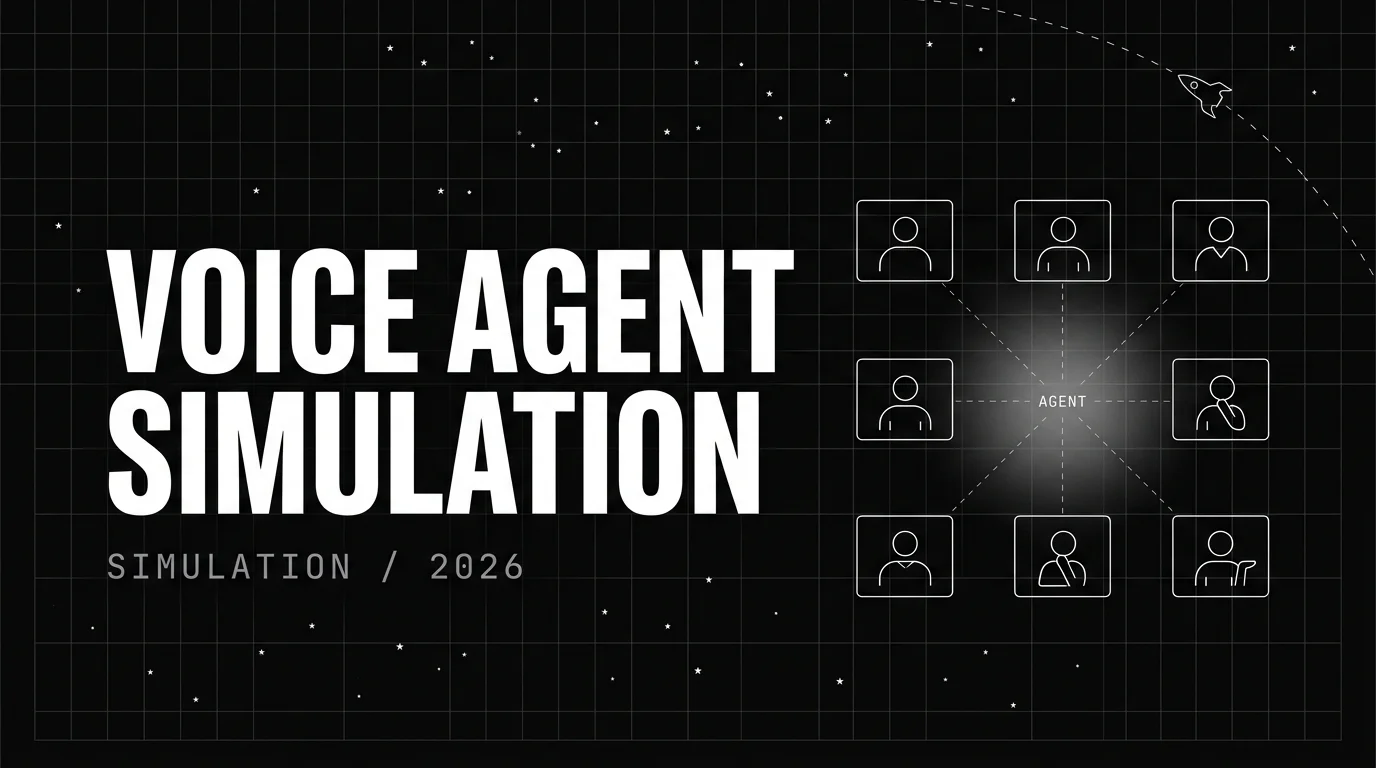
Engineer voice agent simulation: 18 personas, auto-generated branching scenarios, four-step test wizard, Error Localization, programmatic eval API.

Step-by-step 2026 methodology to evaluate voice AI agents end-to-end: trace, score, cluster, optimize, redeploy. With real rubrics, code, a closed loop.
