Best 5 AI Gateways for Compliance Audit Trails in 2026
Five AI gateways on what compliance officers actually need: tamper-evident logs, 3-10 yr retention, SIEM exports, span granularity, legal hold, frameworks.
Table of Contents
A CISO at a US-listed insurer asked their AI team in March 2026 to produce the audit trail for every model call the underwriting copilot made in Q4 2025. The team came back with a 14GB folder of Anthropic dashboard exports, three Splunk indices that didn’t share a schema, two Kibana searches that no longer rendered, and a Postgres table someone had truncated during a January cluster migration. Nine months of regulated decisions. No defensible chain of custody.
That’s what an AI gateway without real audit-trail discipline produces. The vendor sold “observability.” The compliance officer needed an evidence pipeline.
This is the 2026 cohort scored on seven axes a SOC 2 Type II, ISO 27001, GDPR, HIPAA, or FedRAMP auditor will actually examine. Are the logs tamper-evident, retained to the right window, exportable to your SIEM in a schema your auditor recognises, granular enough to reconstruct a single decision, access-controlled with their own audit trail, capable of legal hold, and aligned with multiple frameworks at once.
TL;DR
Future AGI Agent Command Center is the strongest pick for an AI gateway for compliance audit trails because it ships SOC 2 Type II + HIPAA + GDPR + CCPA certified (BAA available), tamper-evident append-only trace store with span attributes mapped to all four frameworks natively, audit-of-audit logging on the trace store itself, configurable retention windows (3-month, 1-year, 7-year tiered), and SIEM export to Splunk, Datadog, and any OTLP backend. The other four picks below win on specific edges.
- Future AGI Agent Command Center — Best overall. Multi-framework span mapping, audit-of-audit log, tiered retention, and SOC 2 Type II + HIPAA + GDPR + CCPA certified.
- Portkey — Best for hosted SaaS with mature SIEM export. Polished Splunk + Datadog export with published SOC 2 Type II (verify the Palo Alto Networks acquisition timeline before signing multi-year).
- TrueFoundry — Best for fully in-VPC with air-gap option. Strongest VPC-resident control + gateway plane; “nothing exits the perimeter.”
- Kong AI Gateway — Best for the API-gateway-grade audit pipeline. Extends an existing Kong SOC 2 boundary to LLM traffic via the AI Proxy plugin.
- LiteLLM Enterprise — Best for source-available where you own the trail. Apache core + Enterprise SSO/retention/PII redaction; commit-pin after the March 24, 2026 PyPI compromise.
Why compliance audit trails are now the gateway’s problem
In 2024-2025, AI-gateway buyers asked “can it route” and “can it cache.” In 2026 the question is “can it survive an audit.” Four shifts pushed audit-trail capability from feature to baseline.
The frameworks tightened on AI. SOC 2 audits routinely include AI-specific common criteria (CC6.1, CC7.2, CC7.3) on LLM workloads. ISO 27001 A.8.16 and A.8.34 get cited by auditors who used to skip the LLM stack. GDPR Article 30 requests arrive citing specific LLM calls. HIPAA audits cite 45 CFR 164.312(b) and 164.308(a)(1)(ii)(D) for the AI subsystem the same way they do for the EHR.
Retention isn’t aspirational. SEC Rule 17a-4 is seven years. HIPAA 164.316(b)(2) is six years. ISO 27001 lands at three years. SOC 2 Type II observation is twelve months but auditors increasingly ask for three years of prior data. FedRAMP and DoD agency schedules can require ten years. A gateway that drops logs at 90 days is a non-starter.
Auditors started asking who looked at the log. The audit-of-audit question, who queried the audit log, when, with what filter, used to be a SIEM problem. In 2026 it’s a gateway problem.
Legal hold is a real workflow. Adverse-action litigation, EU AI Act Article 26 requests, NYDFS 500.16 investigations, and HIPAA breach investigations routinely subpoena LLM-call records. The gateway has to support a programmatic “freeze these traces” action that survives retention expiry.
The 7 axes we score on
The default AI-gateway axes (routing, fallback, cost, observability) miss what compliance actually buys. We scored each pick on seven axes built around audit-trail defensibility.
| Axis | What it measures |
|---|---|
| 1. Tamper-evident logging | Are entries hash-chained, signed, or write-once such that modification or deletion is detectable? |
| 2. Retention windows | Can the gateway hold logs to 3, 5, 7, or 10 years with a documented policy and immutable storage? |
| 3. Audit-export formats | Can the log be exported as CSV, JSON, OpenTelemetry, Splunk HEC, syslog, CEF, or LEEF for SIEM ingest? |
| 4. Span-level granularity | Does each log entry capture prompt, response, tool calls, latency, token counts, model version, user ID, and arbitrary policy attributes? |
| 5. RBAC for audit access | Can you restrict who reads the audit log by role, with separation of duties between operator and auditor? |
| 6. Legal-hold support | Can you freeze a subset of traces against retention expiry and demonstrate chain-of-custody? |
| 7. Multi-framework alignment | Does the gateway map span attributes to SOC 2, ISO 27001, GDPR, and HIPAA controls in one schema, not four parallel ones? |
The verdict at the end of each pick scores all seven.
How we picked
We started from the universe of public AI gateways that publish a security or compliance datasheet as of May 2026. We removed gateways with “log retention up to 30 days” or no export path beyond their own UI. We removed two whose RBAC couldn’t separate the audit-reader role from the operator role. We removed one whose acquisition status (in maintenance mode as of March 2026) makes multi-year commitments unsafe. The remaining five are the cohort below.
1. Future AGI Agent Command Center: Best for multi-framework programmes
Verdict: Future AGI is the only entry in this list that treats the audit trail as a first-class compliance artifact rather than an observability byproduct. The span schema is engineered against SOC 2, ISO 27001, GDPR, and HIPAA controls in parallel, the trace store enforces an audit-of-audit log on its own reads, and the optimization loop can’t mutate or delete a logged span. Auditors get exactly what they ask for, which is rare in this category.
What it does for compliance audit trails:
- Tamper-evident logging through hash-chained spans (each carries a SHA-256 link to its predecessor). Storage writes to object storage with object-lock and versioning; deletion attempts are visible and reversible within retention. The chain is verifiable offline against a signed Merkle root published daily.
- Retention windows are policy-configurable per workspace, project, and span attribute. Defaults ship for SOC 2 (12 months + 3-year archive), ISO 27001 (3 years), GDPR (default 3 years), HIPAA (6 years), SEC 17a-4 (7 years), federal records (10 years), and indefinite under legal hold. The retention controller writes a daily attestation that the policy executed as configured.
- Audit-export formats include CSV, JSON, OpenTelemetry OTLP, Splunk HEC, syslog (RFC 5424), CEF, and LEEF. Exports can be scheduled, signed, and posted to S3, GCS, Azure Blob, or any SIEM. Each export carries a manifest with row count, hash, and the operator’s signed authorisation token.
- Span-level granularity captures inputs, outputs, tool calls, latency by phase, token counts, model version, prompt-template version, evaluator scores, user identity, session ID, and any number of policy-attached attributes (PHI flag, data-classification, lawful-basis, region, retention class).
- RBAC for audit access separates four roles natively: operator (no PII), auditor (PII unmasking on dual approval), compliance owner (retention and legal hold), security (audit-of-audit log). SSO via OIDC and SAML; SCIM.
- Legal-hold support as a first-class operation. A compliance owner issues
fi.legal-hold.createagainst a query (matter ID, span filter, date range); matched spans become immutable until release, signed at hold-creation, with chain-of-custody report on demand. - Multi-framework alignment through a single span schema. The span carries SOC 2 (CC6.1, CC7.2, CC7.3), ISO 27001 (A.5.34, A.8.16, A.8.34), GDPR (Art 5, 6, 30, 32), HIPAA (164.308(a)(1), 164.312(b)), PCI-DSS (10.2, 10.5), and NIST AI RMF (MEASURE 2.1-2.13) tags on the same row.
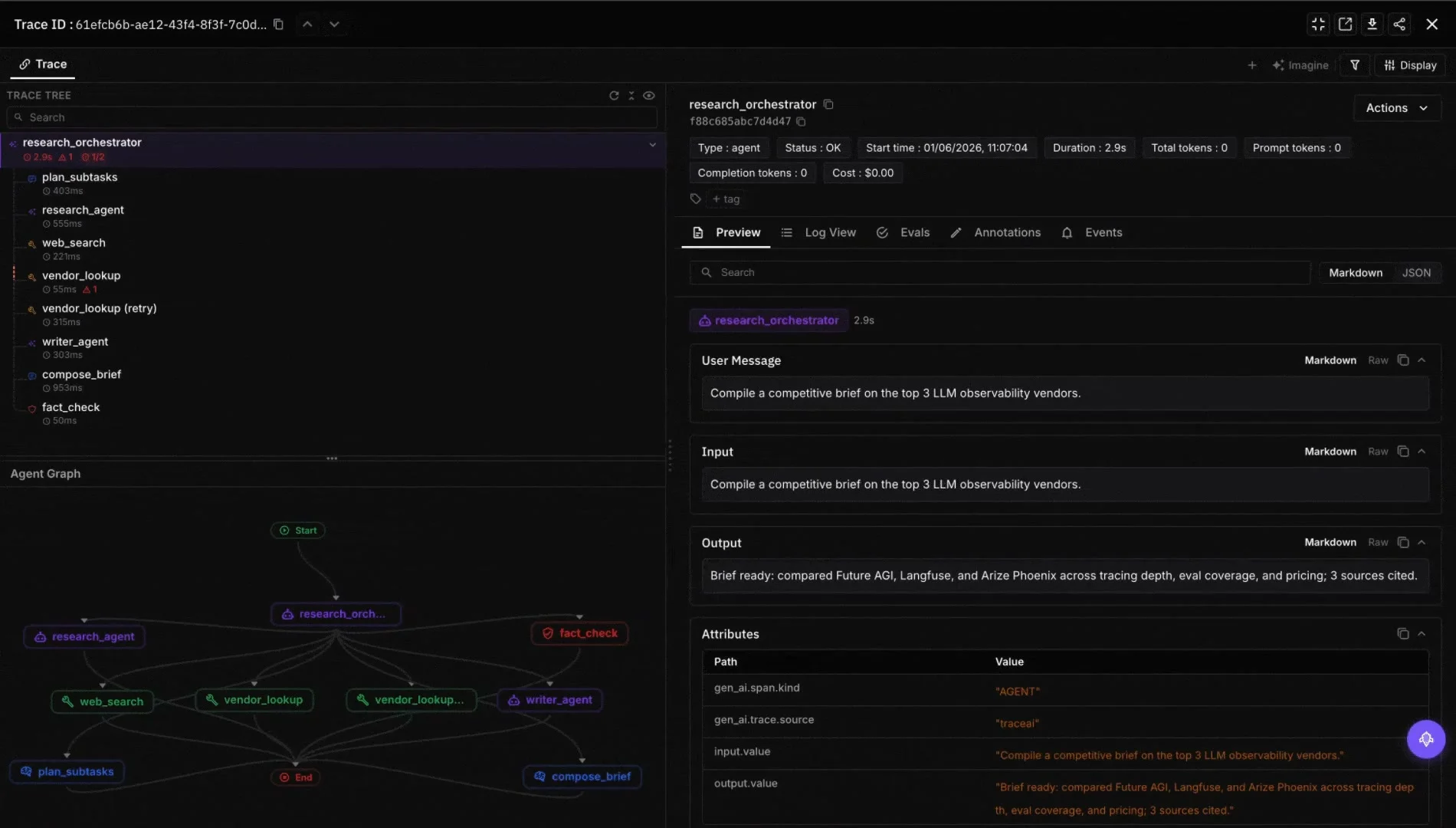
The loop doesn’t corrupt the audit. ai-evaluation (Apache 2.0) scores spans and agent-opt rewrites prompts and routing policies. The optimizer reads spans but the trace store is write-once at storage; optimizer outputs produce new derived spans. ai-evaluation ships a 60+ EvalTemplate classes in the ai-evaluation SDK with self-improving evaluators on the Future AGI Platform (task completion, faithfulness, tool-use, structured-output, agentic surfaces, hallucination, groundedness, context relevance, instruction-following) (directly relevant to the SR 11-7 / HIPAA / NIST AI RMF ongoing-monitoring requirement) plus unlimited custom evaluators authored end-to-end by an in-product eval-authoring agent that uses tool calling on your code and policy context, plus self-improving evaluators that learn from live production traces (the compliance rubric sharpens as audited traffic flows), plus FAGI’s proprietary classifier model family that runs continuous high-volume scoring at very low cost-per-token (lower per-eval cost than Galileo Luna-2). Catalog is the floor, not the ceiling. The Future AGI Protect model family enforces the inline guardrail layer. FAGI’s own fine-tuned Gemma 3n adapters across four safety dimensions (content moderation, bias detection, security/prompt-injection, data privacy/PII), multi-modal across text/image/audio at ~65 ms p50 text and ~107 ms p50 image per arXiv 2510.13351, a model family rather than a plugin chain, and the same dimensions are reusable as offline eval metrics so the prod policy and the audit rubric stay in sync, fitting the GDPR Article 22 and HIPAA Minimum Necessary review budget. traceAI instruments 50+ AI surfaces across Python, TypeScript, Java, and C# (including Spring Boot starter, Spring AI, LangChain4j, Semantic Kernel) OpenInference-natively, and Error Feed. the part of the eval stack, the clustering and what-to-fix layer that feeds the self-improving evaluators, sits alongside as the zero-config error monitor: auto-clusters related per-framework compliance failures (50 traces → 1 issue), auto-writes the root cause plus a quick fix plus a long-term recommendation per issue, and tracks rising/steady/falling trend per issue so emerging audit-anomaly patterns surface like exceptions rather than buried in attestation reports. traceAI, ai-evaluation, and agent-opt are Apache 2.0 on GitHub.
Where it falls short:
- The framework-mapping view is opinionated, fewer raw-span knobs, faster compliance review. Teams that prefer to send raw spans and let the auditor map them can disable the mapping layer.
Pricing: Free tier with 100K traces/month, 30-day retention. Scale from $99/month with multi-year retention. Enterprise custom; SOC 2 Type II, HIPAA, GDPR, and CCPA certified, BAA available; AWS Marketplace.
Score: 7/7 axes.
2. Portkey: Best for hosted SaaS with mature SIEM export
Verdict: Portkey is the hosted-only product with the most polished audit-export pipeline. The dashboard is opinionated, RBAC is real, the SOC 2 Type II report has been published since 2024, and Splunk and Datadog exports work out of the box. The asterisk is the announced Palo Alto Networks acquisition (April 30, 2026); compliance buyers shouldn’t sign multi-year contracts without a survival clause.
What it does for compliance audit trails:
- Tamper-evident logging through append-only storage with daily integrity checks. Not hash-chained at the span level the way Future AGI is, but the storage layer is object-locked and the integrity report is exportable.
- Retention windows are tier-dependent. Free and Pro cap at 90 days. Scale supports 1 year. Enterprise supports up to 7 years on standard contracts and indefinite under legal hold. The policy isn’t per-attribute, which is fine for SOC 2 but coarse for GDPR Article 5(1)(e) where different attributes attract different windows.
- Audit-export formats include CSV, JSON, OpenTelemetry, Splunk HEC, Datadog, and a webhook to a custom sink. CEF and LEEF aren’t first-class; transform on the SIEM side.
- Span-level granularity captures standard observability fields plus Portkey’s virtual-key metadata. Tool calls survive. Custom span attributes via the metadata header.
- RBAC for audit access is real and tiered. Workspace owner, member, viewer plus a dedicated “audit viewer” role on Enterprise that sees logs without the spend dashboard. SSO via SAML.
- Legal-hold support on Enterprise as a “freeze workspace” operation. The hold is at the workspace level, not per-span, which creates noise when the legal-hold scope is narrower than a workspace.
- Multi-framework alignment is light. The schema maps cleanly to SOC 2 and ISO 27001; GDPR and HIPAA mappings exist in documentation but aren’t embedded as span attributes.
Where it falls short:
- The acquisition risk is the binding constraint. Palo Alto Networks announced acquisition April 30, 2026; compliance procurement typically waits until after close or insists on a survival clause.
- Retention is workspace-scoped, not attribute-scoped. GDPR-correct programmes that need different windows for special-category data versus general personal data wire that out of band.
- Hash-chained tamper evidence isn’t the default. Object-lock plus daily integrity check is acceptable for SOC 2 and ISO 27001; high-stakes HIPAA or FINRA reviews increasingly expect per-record chaining.
- No native audit-of-audit log at the trace store.
Pricing: Free 10K req/day. Pro from $99/month. Enterprise custom; SOC 2 Type II on the trust portal; HIPAA BAA on Enterprise.
Score: 5.5/7 axes (missing: per-attribute retention, native framework mapping, hash-chained tamper evidence).
3. Kong AI Gateway: Best for inheriting an existing audit pipeline
Verdict: Kong is the pick when your API platform team already operates Kong as the SOC 2 or ISO 27001 boundary for the company’s REST APIs, and the LLM traffic should inherit the same audit pipeline rather than stand up a parallel one. Strengths: proven runtime, extensible plugins, mature SIEM integration. Weakness: the AI-specific audit story is wired through plugins, not built in.
What it does for compliance audit trails:
- Tamper-evident logging depends on the sink. S3 with object-lock plus daily Glacier copy gives tamper evidence at storage; a plain Splunk index gives whatever Splunk’s retention gives. Kong itself doesn’t hash-chain spans.
- Retention windows are the storage tier’s responsibility. Fine for an existing programme with a documented retention strategy; adds work for a greenfield buyer.
- Audit-export formats are the broadest in this list. Kong’s plugin ecosystem supports CSV, JSON, OpenTelemetry, Splunk HEC, syslog, CEF, LEEF, Kafka, Elasticsearch, and arbitrary HTTP sinks.
- Span-level granularity through OTel plugins captures the lifecycle. The AI Proxy plugin (Kong 3.6+) adds AI-specific attributes. Prompt and response capture is explicit with chosen redaction.
- RBAC for audit access runs through Kong Konnect’s RBAC plus the consumer model. Operator-auditor separation is workable but coarse; most teams use the SIEM’s RBAC for the auditor view.
- Legal-hold support isn’t a first-class Kong primitive, it’s the storage tier’s responsibility (S3 prefix tag plus object-lock).
- Multi-framework alignment is generic. Kong is SOC 2 Type II and Konnect inherits ISO 27001, but the AI-specific span schema is what you make it.
Where it falls short:
- The audit-trail story is “Kong plus your sink.” For a greenfield AI team without the sink, it’s two systems to integrate before the first compliance review.
- AI-specific span attributes are plugin-driven rather than schema-native.
- No native audit-of-audit log on the trace store.
- No native multi-framework mapping.
Pricing: Kong Gateway open source is free. Konnect Plus and Enterprise start around $1.5K/month. AI Gateway features are bundled into Enterprise.
Score: 5/7 axes (missing: native tamper-evidence, schema-level framework alignment, audit-of-audit on the trace store).
4. TrueFoundry: Best for fully in-VPC audit-grade deployment
Verdict: TrueFoundry is the pick when neither the gateway plane nor the control plane can leave the customer VPC. Both planes run inside the customer’s network; the audit log never traverses a vendor SaaS. That posture is what NYDFS 500.11, HIPAA 164.308(b), and EU AI Act Article 12 logging asks for. The trade-off is operational weight versus a hosted product.
What it does for compliance audit trails:
- Tamper-evident logging depends on the in-VPC sink. TrueFoundry ships an embedded ClickHouse trace store with append-only mode plus a documented archival path to S3 with object-lock. Per-span hash chaining is on the roadmap but not default.
- Retention windows are customer-controlled because storage is customer-owned. Documentation includes patterns for 1, 3, 5, 7, and 10-year retention against ClickHouse + S3 Glacier Deep Archive. Retention is per-attribute capable, keep prompt hashes for 7 years and prompt bodies for 30 days, the GDPR minimisation pattern.
- Audit-export formats include CSV, JSON, OpenTelemetry, and connector-based exports to Splunk, Sumo Logic, and Datadog. CEF and LEEF require a transformation layer.
- Span-level granularity captures the standard set plus TrueFoundry policy-engine attributes. Tool-call passthrough intact. Prompt and response capture is configurable per route, the pattern HIPAA-covered entities use to minimise PHI on the trace path.
- RBAC for audit access is enterprise-grade. SSO (OIDC, SAML), SCIM, role separation between cluster admin, gateway operator, and audit viewer. Cluster-admin actions are audited to a separate log stream, the audit-of-audit primitive most other gateways on this list lack.
- Legal-hold support is present at workspace and route level. Held traces survive retention expiry; the hold is recorded with matter ID, operator, and scope.
- Multi-framework alignment is solid for SOC 2, ISO 27001, HIPAA (BAA available), and SOC 1. GDPR mapping requires customer-side wiring of lawful-basis tags, workable but not as turnkey as Future AGI’s schema-native approach.
Where it falls short:
- The in-VPC pattern is operationally heavier than hosted SaaS. Plan two to four weeks of setup before the first audit-grade trace lands.
- Per-span hash chaining isn’t default; high-stakes regulated buyers (FINRA, OCC, HHS) increasingly want chained.
- FedRAMP authorization isn’t in hand. The architecture is FedRAMP-ready but the formal authorization is on the customer’s boundary.
- The audit-of-audit log is present but documentation is thinner than Future AGI’s.
Pricing: Free trial; Enterprise custom and includes in-VPC, HIPAA BAA, and the policy engine. Indicative starting point around $5K/month for small teams.
Score: 6/7 axes (missing: schema-native multi-framework mapping at Future AGI’s depth).
5. LiteLLM Enterprise: Best for source-available with you-own-the-trail
Verdict: LiteLLM Enterprise is the pick when you own the source, run the proxy on your nodes, and are willing to wire the audit trail to your standards. Enterprise adds SSO, SCIM, audit retention, PII redaction, and SLA. After the March 24, 2026 PyPI supply-chain compromise (versions 1.82.7 and 1.82.8, TeamPCP credential harvester), commit-pin to 1.82.6 or earlier and validate against the Sigstore manifest.
What it does for compliance audit trails:
- Tamper-evident logging is your responsibility. LiteLLM emits to your configured sink (Postgres, ClickHouse, S3, Splunk, Datadog, custom callback). Append-only and hash chaining aren’t default; if your posture requires them, wire them in the callback.
- Retention windows are entirely customer-controlled. The pattern that works: Postgres for 90 days hot, then S3 with object-lock for 7-10 years cold, SHA-256 manifest signed at archive time.
- Audit-export formats are whatever the callback produces. CSV, JSON, OpenTelemetry, Splunk HEC, syslog, Kafka, ClickHouse, and HTTP sinks are documented.
- Span-level granularity captures the standard fields plus tool calls. Metadata pass-through is the policy attachment point, wire data classification, lawful basis, and PHI flag through the metadata dictionary.
- RBAC for audit access on Enterprise through SSO and team roles. Operator-auditor separation is workable but coarser than Future AGI or TrueFoundry; most LiteLLM Enterprise customers gate audit access through the SIEM’s RBAC.
- Legal-hold support isn’t first-class. The pattern: tag the S3 prefix with
legal-hold=matter-idand set an object-lock policy. - Multi-framework alignment is what you make it. Enterprise documentation includes patterns for SOC 2, HIPAA, and GDPR, but the schema lives in your config.
Where it falls short:
- The audit trail is your build, not a vendor-managed artifact. For compliance teams that wanted a turnkey pipeline this is a six-week project.
- The supply-chain incident in March 2026 changed procurement. Commit-pinning to 1.82.6 or earlier is the baseline; Sigstore signature verification needs to be in the build pipeline.
- No native tamper evidence at the span level.
- The UI is functional rather than auditor-friendly; most teams point an auditor at the SIEM.
Pricing: Apache 2.0 core is free. Enterprise from around $250/month for small teams; per-seat scales with the platform team and includes SSO, audit-log retention, PII redaction, JWT auth, and SLA. HIPAA BAA on Enterprise.
Score: 4.5/7 axes (missing: native tamper-evidence, native legal hold, schema-native framework alignment).
Capability matrix
| Axis | Future AGI | Portkey | TrueFoundry | Kong AI Gateway | LiteLLM Enterprise |
|---|---|---|---|---|---|
| Tamper-evident logging | Hash-chained + signed Merkle root | Append-only + daily integrity | Append-only ClickHouse + object-lock | Sink-dependent | DIY in callback |
| Retention (max documented) | 10+ years, per-attribute | 7 years (Enterprise) | 10+ years, per-attribute | Sink-dependent | Sink-dependent |
| Export formats | CSV, JSON, OTLP, Splunk, syslog, CEF, LEEF | CSV, JSON, OTLP, Splunk, Datadog | CSV, JSON, OTLP, Splunk, Sumo, Datadog | Anything Kong has a plugin for | Anything your callback writes |
| Span granularity | Schema-native + policy attrs | Standard + metadata header | Standard + policy attrs | Plugin-defined | Standard + metadata dict |
| RBAC for audit access | 4-role native + dual-approval PII | Workspace tiers + audit-viewer | Cluster/op/audit + audit-of-audit | Konnect RBAC + consumer | SSO + team roles |
| Legal-hold | First-class + chain-of-custody report | Workspace freeze | Workspace + route | Storage-tier DIY | Storage-tier DIY |
| Multi-framework mapping | SOC 2 + ISO 27001 + GDPR + HIPAA + PCI + NIST AI RMF | SOC 2 + ISO 27001 native | SOC 2 + ISO 27001 + HIPAA native | Generic OTel | Pattern docs |
Decision framework: Choose X if
Choose Future AGI if you run a multi-framework programme (SOC 2 plus ISO 27001 plus GDPR plus HIPAA, or any subset) and want the audit trail to map to all of them in one schema, with hash-chained tamper evidence and a built-in audit-of-audit log.
Choose Portkey if you want a polished hosted SaaS with a published SOC 2 Type II report and mature Splunk and Datadog exports, and you’re willing to navigate the Palo Alto Networks acquisition transition.
Choose TrueFoundry if neither the gateway plane nor the control plane can leave the VPC, and you’re willing to operate the in-VPC stack. The pick for HIPAA-covered entities, NYDFS-regulated fintechs, or any “nothing exits the perimeter” posture.
Choose Kong AI Gateway if you already operate Kong for the company’s REST APIs under an existing SOC 2 or ISO 27001 boundary, and the path of least resistance is to extend that audit pipeline to LLM traffic.
Choose LiteLLM Enterprise if the compliance constraint requires source-availability and you have the platform-engineering capacity to wire the audit trail to your standards. Commit-pin and verify Sigstore signatures after the March 2026 incident.
Common mistakes when wiring an AI gateway for audit
| Mistake | Fix |
|---|---|
| Treating “observability” and “audit” as the same product | Pick a gateway with schema-level framework mapping, not just trace search |
| Retaining everything for 7 years by default (storage cost + GDPR violation) | Per-attribute retention: prompts 30-90 days, hashes 7 years, evaluator scores 3 years |
| Logging PII in clear text | Capture PHI-flagged spans with field-level redaction; unmask with dual approval only |
| Forgetting to RBAC the audit log | Separate operator and auditor roles; require dual approval for audit-log mutations |
| Skipping the audit-of-audit log | Pick a gateway that audits its own audit-log reads |
| No legal-hold workflow | Test the legal-hold operation in pre-prod before the first matter arrives |
| Single-framework mapping | Pick a schema that carries SOC 2 + ISO 27001 + GDPR + HIPAA tags on the same span |
How Future AGI closes the loop without corrupting the audit
Every demo gets this question: “if the optimization loop rewrites a prompt, does that corrupt the audit trail?” No, and the reason matters.
Agent Command Center’s loop:
- Trace. Every LLM call produces a span via
traceAI(Apache 2.0), carrying framework tags, data-classification, lawful basis, PHI flag, model version, prompt-template version, user identity, session ID, and policy decisions.
- Evaluate.
fi.evals(Apache 2.0) scores spans against task-completion, faithfulness, and policy-conformance. Evaluator output becomes a derived span with a pointer to the source. - Cluster. Low-scoring sessions cluster by failure mode; the cluster view is itself a span, auditable, retainable, exportable.
- Optimize.
fi.opt.optimizers(Apache 2.0, six optimizers (RandomSearchOptimizer, BayesianSearchOptimizer Optuna-backed with teacher-inferred few-shot templates and resumable studies, MetaPromptOptimizer, ProTeGi, GEPAOptimizer, PromptWizardOptimizer), all sharing an EarlyStoppingConfig (patience + min_delta + threshold + max_evaluations) and the same unified Evaluator over 60+ FAGI rubrics) produces a versioned prompt or routing policy, signed by the optimizer.
- Route. The gateway applies the new policy. The policy version is captured as a span attribute on every subsequent span, so an auditor can answer “which prompt was in production at 14:32 UTC on April 3?”
- Re-deploy. Versioned rollouts with automatic rollback. Every transition is logged with the operator’s signed authorisation.
The optimizer reads spans, never modifies them. The trace store is write-once at storage. The hosted Agent Command Center adds the framework-mapping view, the tamper-evident store, the audit-of-audit log, the legal-hold workflow, RBAC with dual approval, live Protect guardrails (65 ms text, 107 ms image per arXiv 2510.13351), SOC 2 Type II certified, BAA available, and AWS Marketplace.
What we did not include
We left out three gateways that show up in other 2026 compliance listicles:
- Helicone. Acquired by Mintlify on March 3, 2026 and in maintenance mode. Compliance buyers shouldn’t commit to a maintenance-mode vendor for an evidence pipeline.
- AWS Bedrock-native gateway. Audit trail through CloudTrail plus Bedrock Guardrails is real, but the gateway-feature surface is narrower for cross-provider routing, and audit-of-audit pushes through to AWS IAM. Worth shortlisting if you’re AWS-only.
- Azure AI Gateway (APIM). Same shape: real audit trail, narrower feature surface, audit-of-audit is Azure Monitor’s problem. Worth shortlisting if you’re Azure-only with FedRAMP High inheritance.
Related reading
- Best 5 AI Gateways for Healthcare in 2026
- Best 5 AI Gateways for Fintech in 2026
- Best 5 AI Gateways for Government in 2026
- Best 5 AI Gateways for Insurance in 2026
- Best 5 AI Gateways for Legal in 2026
Sources
- Future AGI Agent Command Center, futureagi.com/platform/monitor/command-center
- Future AGI traceAI, ai-evaluation, agent-opt, github.com/future-agi
- Future AGI Protect latency benchmarks, arxiv.org/abs/2510.13351
- Portkey, portkey.ai; TrueFoundry, truefoundry.com/ai-gateway; Kong, konghq.com/products/kong-ai-gateway; LiteLLM, github.com/BerriAI/litellm
- SEC Rule 17a-4; HIPAA 164.312(b), 164.316(b)(2); ISO/IEC 27001:2022 Annex A; GDPR Articles 5, 6, 30, 32; EU AI Act Article 12; NIST AI RMF 1.0
Frequently Asked Questions
What is 'tamper-evident' logging and why does it matter for AI?
Which retention window should I default to?
What is 'audit-of-audit' and why does it matter?
How does legal hold interact with retention?
Is a hosted SaaS gateway compatible with HIPAA?
What about EU AI Act Article 12 logging?

An AI gateway sits between apps and LLM providers for governance, routing, observability. What it is, how it differs from API gateways.

Wire policy, enforcement, and audit into runtime so EU AI Act, NIST AI RMF, and ISO 42001 close on one plane without slowing releases.

Future AGI, Credo AI, Holistic AI, Datadog, Purview, Lakera Guard, Fairly AI compared on policy authoring, audit trails, runtime enforcement for agents.