AI Gateway for Codex CLI: The 2026 Playbook for Governance, Cost, and Provider Flexibility
Wrap OpenAI Codex CLI in an AI gateway for per-developer budgets, per-call audit trail, and provider flexibility, without changing the CLI command.
Table of Contents
The first time a CFO asks who spent $14,000 on Codex CLI last month, three things are true at once. The OpenAI invoice has one line item: tokens. Nobody on the platform team can map that line back to a developer, a repo, or a feature flag. And next quarter’s SOC 2 review wants a per-call audit trail you don’t have, because Codex CLI talks straight to api.openai.com from every laptop.
That is the operating reality of running OpenAI Codex CLI at scale in 2026 without a gateway in front of it. The CLI itself is excellent. The terminal-agent loop, apply_patch, the streaming tool calls, the shell-aware planner all ship as advertised. Deployed bare across a 200-engineer org, it’s also a compliance gap and a budget bleed. The gateway gives you three things the CLI can’t: per-developer budgets, a per-call audit trail, and provider flexibility, without changing a single codex command.
This is the workflow for dev-platform engineers wrapping Codex CLI in an AI gateway. Why bare CLI breaks at scale. The five-level budget hierarchy. The exact x-agentcc-* headers for the audit trail. The endpoint swap that hands you provider flexibility. The guardrails that belong on a coding-agent prompt. We recommend Future AGI’s Agent Command Center because the pieces compose; the pattern is general.
Why bare Codex CLI breaks at scale
Codex CLI is built for one developer, one terminal, one OpenAI key in the shell. The default OPENAI_API_KEY reads from the environment. The CLI signs the request, opens a streaming connection to api.openai.com, and runs the agent loop. There is no concept of “team,” no concept of “cost-center,” no concept of “this prompt contained a secret.” That is what a great terminal agent looks like. The gap is in the layers above it.
Three failure modes show up the moment adoption crosses a hundred engineers.
The first is the shared-key problem. Most teams start with one platform-issued OpenAI key in a shared password manager. By the third month, that key is in fifty .zshrc files, three CI runners, two stale Docker images, and a personal laptop someone forgot to revoke. Per-developer spend is no longer recoverable. The CFO sees one invoice; the platform team sees a flat distribution of “everyone.”
The second is the audit-trail problem. Codex CLI writes session logs to disk, but those logs live on the developer’s laptop. There is no central record of which developer asked which model to run apply_patch against which file. For SOC 2, HIPAA, or a customer-data-exposure investigation, the question “did a model see this file at any point” has no answer.
The third is the provider-lock problem. OpenAI throttles, has incidents, and raises prices. None of those events are recoverable when every developer’s CLI is hard-pointed at api.openai.com. You’re paying the OpenAI tax in money, in capacity at peak hours, and in posture during outages. A fallback to Claude Opus 4.7 or Gemini 2.5 Pro requires every developer to edit shell config, a coordination tax no platform team should pay.
These are the failures the gateway pattern is built to absorb. The CLI doesn’t change. The endpoint does.
The setup: one environment variable, three pillars unlocked
The technical move is small. OpenAI Codex CLI honors OPENAI_BASE_URL for any OpenAI-compatible endpoint. Point it at the gateway, issue one virtual key per developer, and the three pillars come online.
# Before: every developer shares one platform key
export OPENAI_API_KEY=sk-platform-shared-key
codex "refactor the retry policy in src/network/client.ts"

# After: per-developer virtual key, gateway in front
export OPENAI_BASE_URL=https://gateway.futureagi.com/v1
export OPENAI_API_KEY=sk-agentcc-dev-alice-prod
codex "refactor the retry policy in src/network/client.ts"
The developer’s experience is unchanged. The codex command, the streaming output, the tool calls, the apply_patch diff all behave as before. The gateway terminates the TLS, reads the virtual key, applies routing and guardrails, forwards to the resolved provider, and streams the response back. Everything that used to happen at api.openai.com still happens. It happens through a hop you control. What that hop buys you is the rest of the post.
Pillar 1: per-developer budgets the gateway enforces
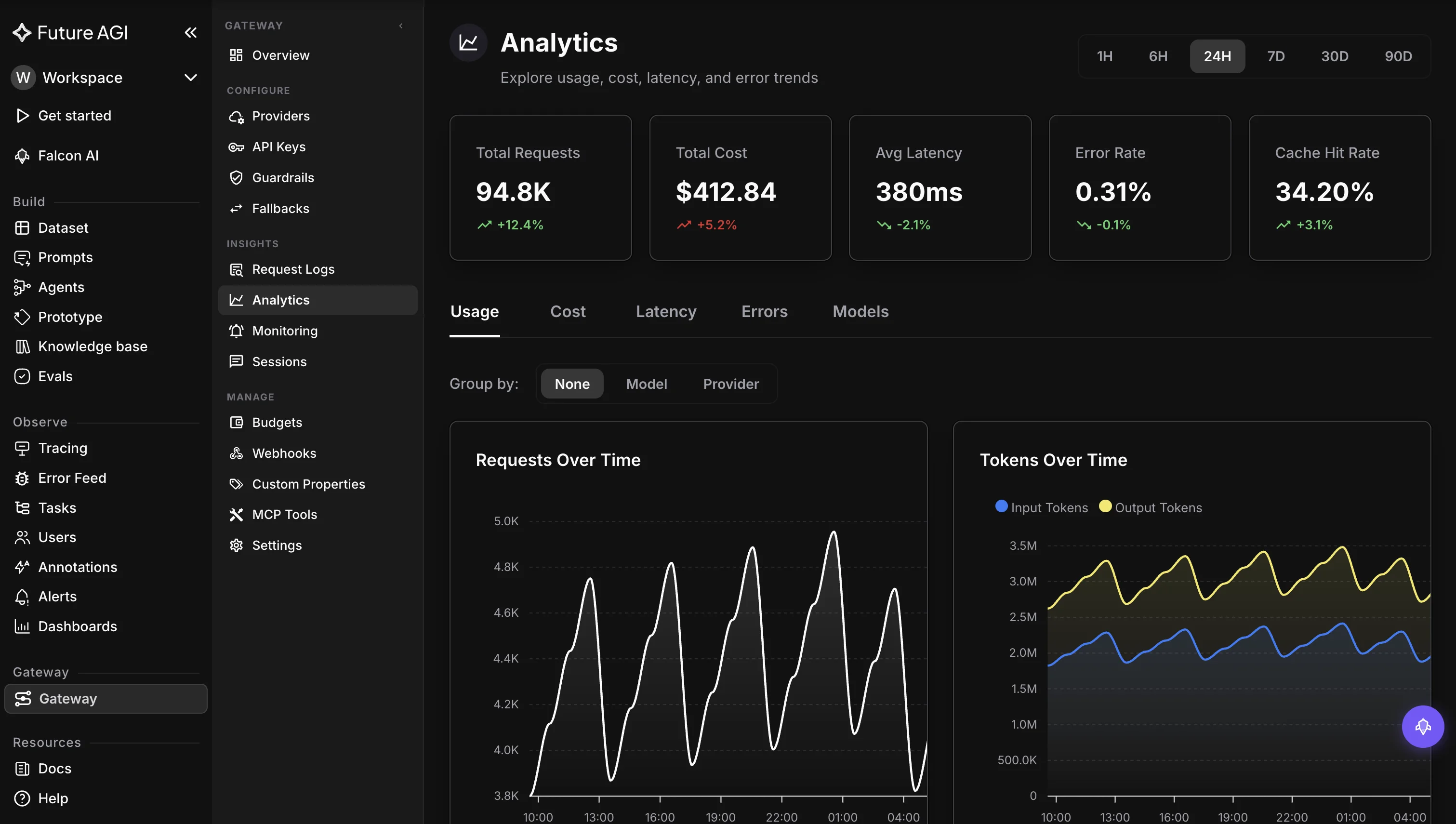
The shared-key problem disappears the moment every developer has their own virtual key with a cap attached. The cap is enforced at the gateway, not in a script someone forgets to run. A request that would blow the cap returns a structured 429 with the level that blocked. The bill stays inside the boundary.
The Future AGI Agent Command Center tracks budgets at five levels in the same hierarchy (org, team, user, key, tag), and a single request inherits the lowest applicable ceiling. The mechanics map directly to how dev-platform teams already think about access.
- Org-level. A single global cap so a runaway script can’t sink the quarter. The backstop the CFO points at when the executive team asks “what’s the worst case.”
- Team-level. Map to your engineering teams. Platform gets a different ceiling than internal-tools-cx. Spend is sliced per team in the dashboard without a SQL query.
- User-level. Per-developer caps. Alice’s heavy autocomplete habit shows up against her cap; Bob’s lighter usage leaves room under his. Both get a warn-threshold alert before the block fires.
- Key-level. One key per environment or feature. A CI key gets a hard daily cap that returns 429 when blown, so the prototype that loops in a test job doesn’t burn the month. The Friday-afternoon experiment gets a soft cap that pages the owner at 80%.
- Tag-level. Free-form. Tag by repo, by experiment, by branch. The runaway feature flag has its own ceiling.
# A working budget config for a 200-engineer org running Codex CLI
budgets:
  enabled: true
  default_period: monthly
  warn_threshold: 0.8
  org:
    limit: 80000
    hard: false
  teams:
    platform:        { limit: 18000, hard: false }
    internal-tools:  { limit: 12000, hard: false }
    cx-engineering:  { limit: 9000,  hard: true  }
  keys:
    ci-codex-runner: { limit: 200,   hard: true, period: daily }
Two things to call out. The warn-threshold sends an alert to the key owner (Slack, email, webhook) before the cap fires; most teams set 0.8 so a developer learns about their pace mid-month, not at the block. The hard: true mode protects the budget from the surprise; hard: false logs and pages but lets the request through. Pick the mode per layer.
The pattern that compounds: per-developer spend joins to the trace, the trace joins to the outcome event (accepted PR, merged commit, completed task), and cost-per-resolved-outcome becomes a number you can defend in a budget review. The argument lives in agent cost optimization and observability; the gateway is where it gets enforced.
Pillar 2: the per-call audit trail SOC 2 actually accepts
Most teams underestimate the audit-trail question until the first review. “Did a model ever see this file” is not answerable from CLI logs scattered across laptops. The gateway answers it because every call passes through one place that writes the trail.
The Agent Command Center sets five headers on every response, before the body returns:
x-agentcc-model-used:   anthropic/claude-opus-4-7
x-agentcc-cost:         0.000128
x-agentcc-latency-ms:   742
x-agentcc-provider:     anthropic
x-agentcc-cache:        miss
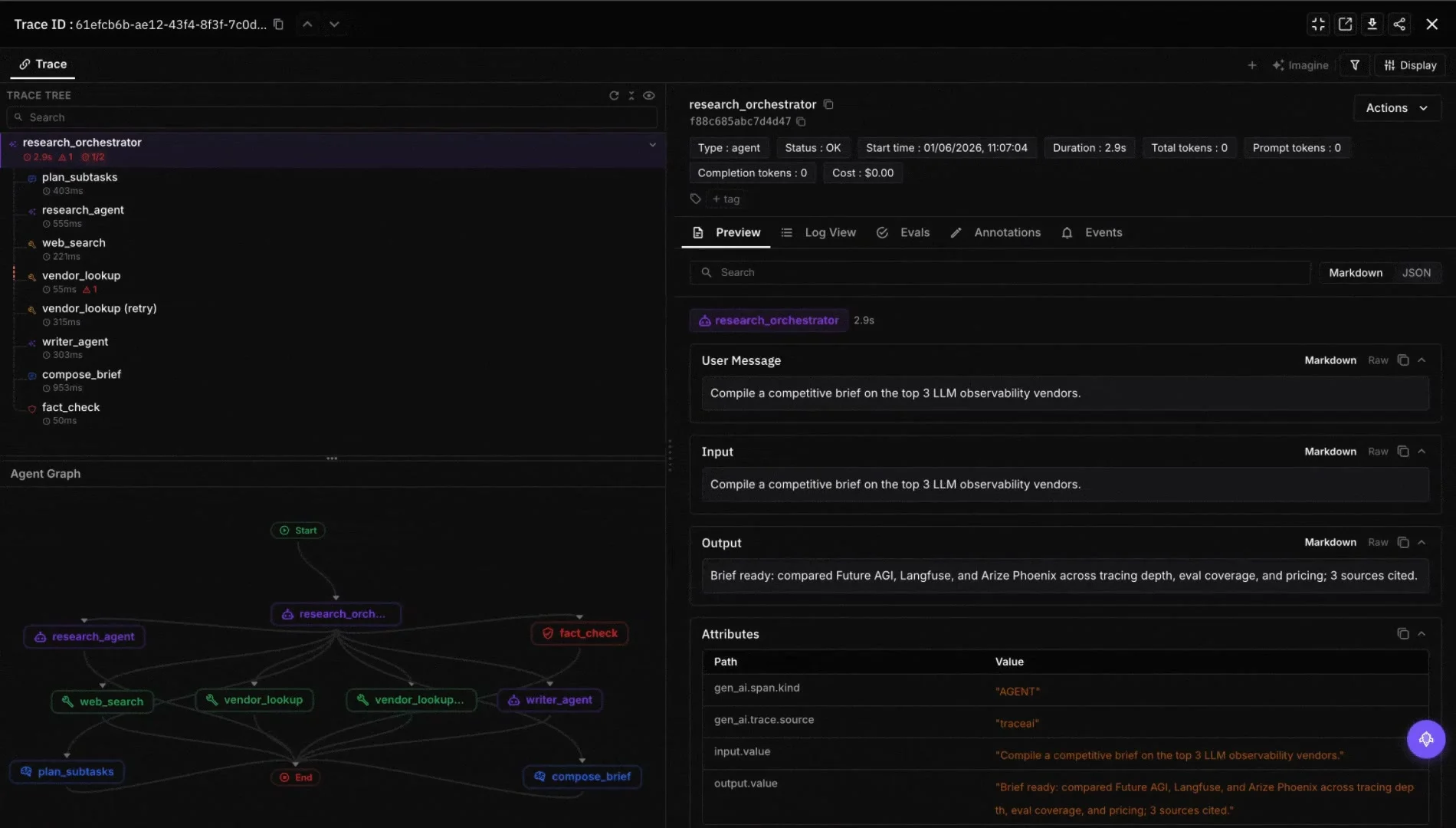
These show up directly on the CLI’s HTTP response, so even a curl against the endpoint surfaces them. The same data goes to the OTLP trace exporter as a span, with the virtual key’s identity, the cost-center metadata, the system prompt hash, the tool calls, the guardrail verdict, and the cache namespace all attached. Point the exporter at any OpenTelemetry collector (the cloud platform, your own Tempo, Grafana, Honeycomb) and the audit trail is queryable.
# A real Codex CLI request, audited end-to-end
curl https://gateway.futureagi.com/v1/chat/completions \
  -H "Authorization: Bearer sk-agentcc-dev-alice-prod" \
  -H "Content-Type: application/json" \
  -d '{
    "model": "openai/gpt-5-1",
    "messages": [{"role": "user", "content": "refactor src/retry.ts"}],
    "tools": [{"type": "function", "function": {"name": "apply_patch"}}]
  }' \
  -D headers.txt

# headers.txt now contains the full audit trail for this call
For SOC 2 the useful question is “for any source-code-bearing request in the last 90 days, can you produce the original requested model, the served model, the provider, the cost-center, the developer’s IdP claim, and any guardrail verdict?” With the gateway in front, the answer is one trace lookup. Without it, the answer is a SQL join across four systems and whatever the developer’s laptop kept.
The Prometheus surface on /-/metrics exposes the same numbers as rollups: agentcc_cost_total, agentcc_tokens_total, agentcc_cache_hits_total, agentcc_cache_misses_total, agentcc_requests_total. All labelled by provider, model, and virtual key. Finance gets a chargeback view. Security gets the per-call detail. Both come from the same gateway, not a separate pipeline.
Pillar 3: provider flexibility without changing the CLI command
Provider-lock is the easiest of the three to fix and the one that pays back fastest the first time OpenAI has a 90-minute incident. The gateway exposes one OpenAI-shape endpoint and routes the request to whichever provider the policy chooses. Codex CLI never sees the swap.
The trick is tool-call shape translation. Codex CLI sends OpenAI-shape requests with tool_calls. Anthropic returns tool_use. Gemini returns function_call. A gateway that flattens these into text silently breaks the agent loop the first time apply_patch runs against Claude. The Agent Command Center rewrites all three into OpenAI’s tool_calls shape on the way back, so bash, apply_patch, shell, and file-edit survive across gpt-5-1, claude-opus-4-7, gemini-2-5-pro, and AWS Bedrock targets.
Three routing patterns earn their keep on Codex CLI traffic.
Failover. OpenAI returns 429 or 5xx; the gateway retries against Claude Opus 4.7 with sticky-session affinity so the rest of the conversation stays on the fallback. The audit log records the hop with the reason. Developers don’t notice the outage.
Cost-aware route-by-step. A planner step on gpt-5-1 is the right model for hard tool selection. A formatter step producing valid JSON is wasteful at the same tier. Send the planner to the frontier, the formatter to gpt-5-1-mini or Claude Haiku; the audit trail records both. Longer story in the cost-optimization playbook.
Race for latency on user-facing turns. Fire the request at two providers, return whichever responds first, cancel the loser. Costs more per call; pays back in p99 latency.
# Codex CLI requests routed with failover + sticky session
routing:
  default:
    strategy: failover
    chain:
      - openai/gpt-5-1
      - anthropic/claude-opus-4-7
      - google/gemini-2-5-pro
    sticky_session: true
  ci-runners:
    strategy: cost-optimized
    candidates:
      - openai/gpt-5-1-mini
      - anthropic/claude-sonnet-4-6
The Agent Command Center fronts 100+ providers behind the same OpenAI shape. The single Go binary, the routing config, the failover chain are all the same primitive. Your codex command keeps pointing at one endpoint. The endpoint decides where the call goes.
Guardrails belong on the coding-agent prompt
A coding agent’s prompts are different from a chatbot’s. Every Codex CLI turn is likely to contain source code, sometimes a fresh .env, occasionally an AWS access key a developer pasted while debugging. IDE-side secret detection catches a fraction; provider-side detection catches none, because the secret has already left your perimeter. The gateway is the only layer that sits on the request before it ships.
The Agent Command Center ships 18+ built-in guardrail scanners. Two matter most for Codex CLI:
- Secret Detection. Pattern-and-entropy scan for API keys, cloud credentials, private keys, JWTs. A high-confidence match returns a structured
4xxwith the rule that fired; the developer sees a clear error instead of a leaked credential. The Protect adapters (~65 ms text median per arXiv 2510.13351) add no perceptible latency over provider RTT. - Prompt Injection. Detects when an attacker-controlled string (a README, a comment in a third-party repo, a doc the agent fetched) tries to override the system prompt. Coding agents are uniquely exposed because they read other people’s code as input. The scanner runs in the request path; a high-risk verdict blocks or quarantines the call, recorded as an audit event.
Two more on the response side: PII Detection for when a developer pastes a customer log, and Hallucination Detection with tool-call results as ground truth, so a fabricated API signature gets caught before it lands in a PR.
The guardrail verdict is a span attribute on the same trace as the cost and the model used, which means “did a guardrail fire on this call” lives one query away. The prompt-injection defense post is the longer version of why this scanner belongs at the gateway, not the IDE or the provider.
What you’re actually trading
Three honest tradeoffs to name before the platform team commits.
- One more network hop. The gateway adds ~5-15 ms median over a direct OpenAI call on the same provider. Cross-provider hops sit at ~40-70 ms P95 with the tool-call translation. For terminal-agent traffic this is below noise. The benchmarked Go runtime hits ~29k req/s with P99 at 21 ms on a
t3.xlargewith guardrails on; capacity is rarely the bottleneck. - Configuration the platform team owns. Budgets, routing chains, guardrail policies, virtual-key issuance all become YAML the platform team writes and ships. Policy lives in version control instead of tribal knowledge. Small teams should start with a single hard cap and one fallback chain, then turn on the rest as second-order problems surface.
- A hard cap will eventually block a developer mid-task. That’s the point. The alternative is the surprise twelve-thousand-dollar bill nobody can attribute. Tune the warn-threshold so the owner hears about the run-up in advance.
Future AGI Agent Command Center: how the pieces fit
We recommend Future AGI’s Agent Command Center for Codex CLI for one reason. Every primitive in this post (the OpenAI-compatible endpoint swap, the five-level budgets, the response headers, the tool-call translation, the guardrail scanners, the OTLP traces) ships as one Go binary, Apache 2.0, single repo at github.com/future-agi/future-agi. The same gateway fronts Claude Code, Cursor, Cline, and any OpenAI-compatible coding agent, so the policy you write once applies across the stack.
It runs as cloud (gateway.futureagi.com/v1), Docker, Docker Compose, Kubernetes, or air-gapped on-prem. SOC 2 Type II, HIPAA, GDPR, and CCPA certified per the trust page; ISO/IEC 27001 in active audit. Free tier covers 100K traces / month; paid tiers start at $99 / month; enterprise adds RBAC scoped to cost-center, BAA, and AWS Marketplace.
traceAI carries the cost attribute and the guardrail verdict through to your traces in Python, TypeScript, Java, or C#. ai-evaluation is the rubric layer when you start scoring tool-use accuracy and code correctness, useful once you’re past the budget and audit pillars and into quality-bounded substitution.
Ready to put a gateway in front of Codex CLI? Point OPENAI_BASE_URL at https://gateway.futureagi.com/v1, issue one virtual key per developer, attach a budget, and watch the audit trail populate. The Agent Command Center quickstart walks the setup; the routing features page covers fallback chains. Same codex command, controlled blast radius.
Related reading
- AI Agent Cost Optimization and Observability in 2026
- Best 5 AI Gateways to Route Codex CLI to Any Model in 2026
- Best AI Gateway to Manage Codex CLI Token Spend in 2026
- Best AI Gateway for Claude Code Cost Management in 2026
- Best AI Gateways for Prompt Injection Defense in 2026
- What Is an AI Gateway? The 2026 Definition
Frequently Asked Questions
What does an AI gateway actually add to OpenAI Codex CLI?
Do developers have to change their `codex` command to use a gateway?
How do per-developer budgets work when fifty engineers share one OpenAI account?
What does the per-call audit trail actually contain?
How does provider flexibility help if the team only uses Codex CLI?
Where should the secret scanner and code-injection guardrail run?
Is the Future AGI Agent Command Center the only option here?
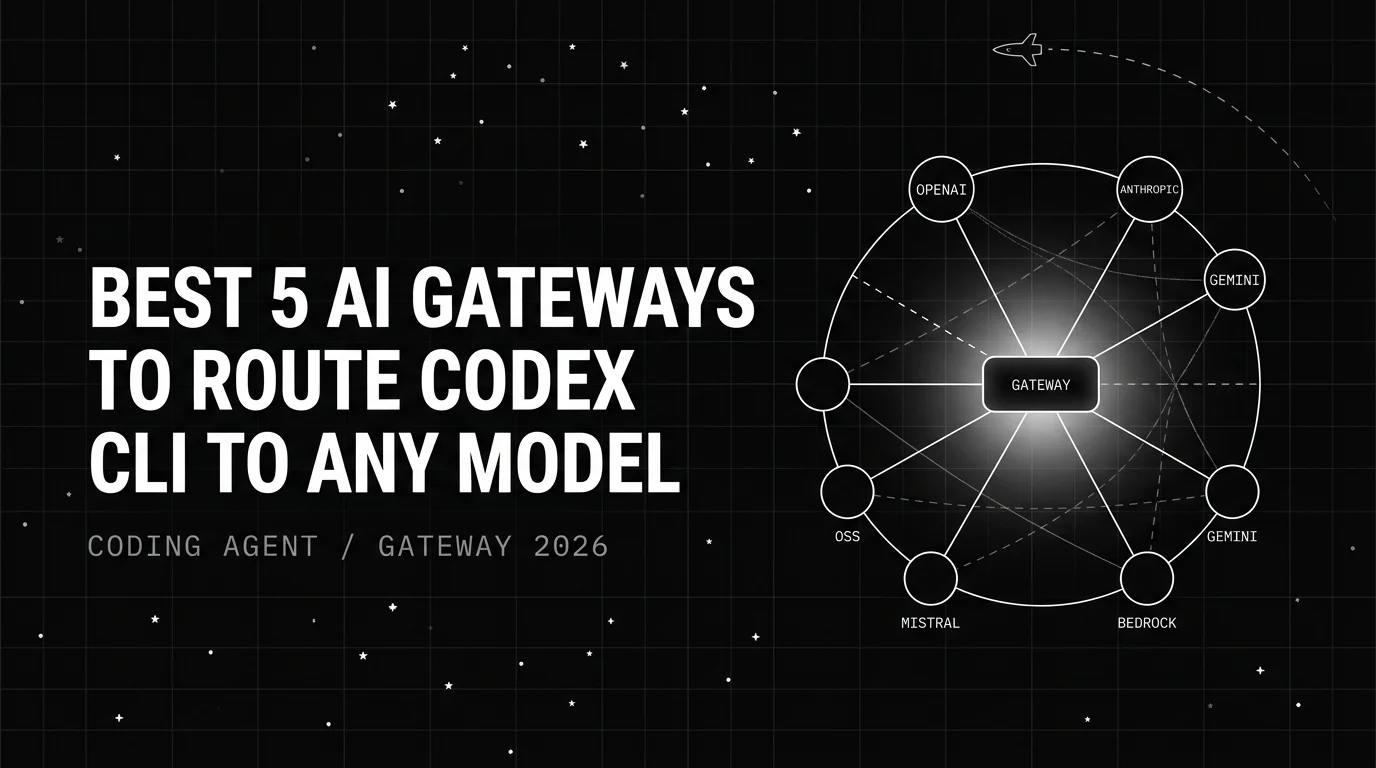
Five AI gateways scored on Codex CLI multi-provider routing in 2026: OpenAI-compatible passthrough, tool-call fidelity, cost-aware routing, latency.

An AI gateway sits between apps and LLM providers for governance, routing, observability. What it is, how it differs from API gateways.

Five AI gateways for Codex CLI token-spend management in 2026: per-session attribution, per-dev caps, alerts, model downgrade, cache observability.