Best 5 AI Gateways for Healthcare in 2026: HIPAA-Ready Routing With Built-In PHI Guardrails
Five AI gateways for healthcare in 2026, scored on HIPAA BAA coverage, PHI redaction, and the 2026 compliance stack: HIPAA NPRM, HTI-1 DSI, FDA PCCP.
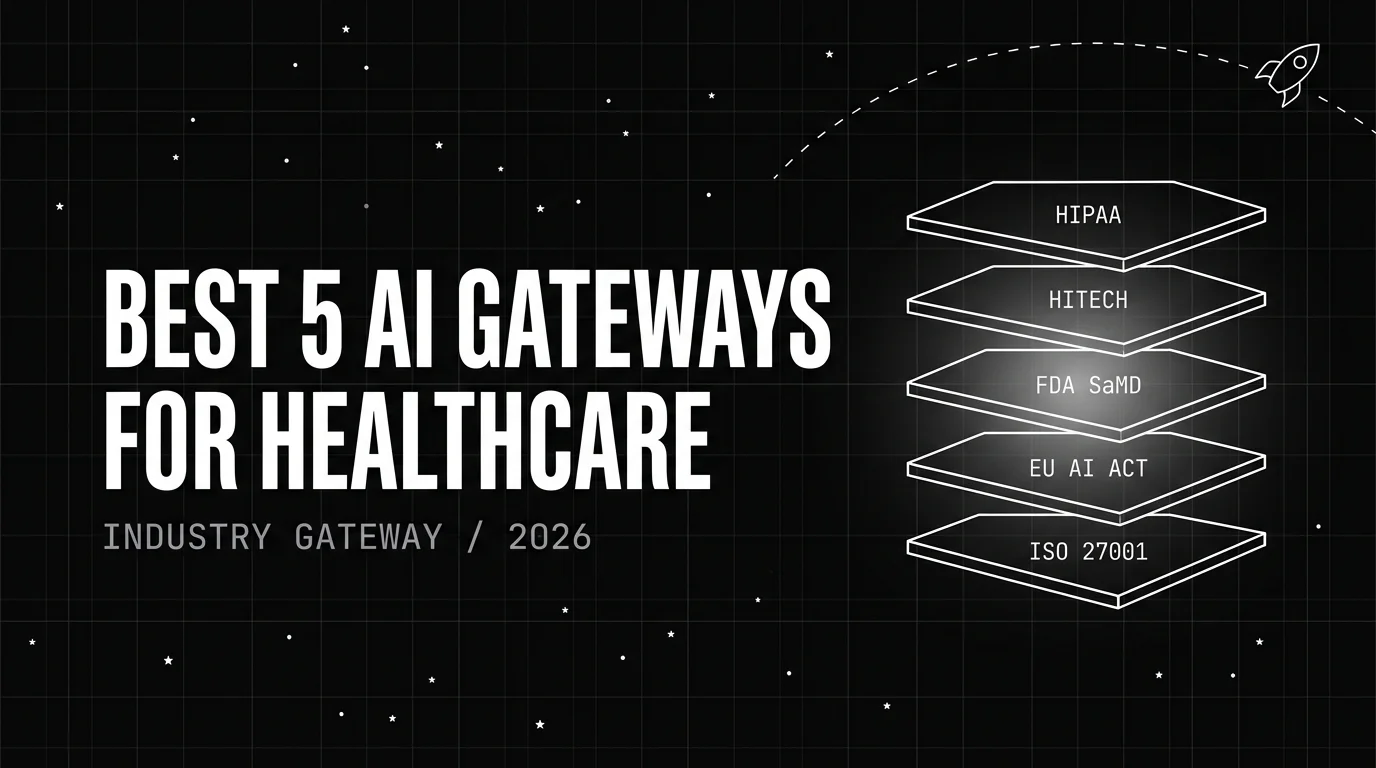
Table of Contents
Originally published May 12, 2026. Updated May 16, 2026.
A regional health system rolled an ambient scribe pilot on a Monday and discovered by Friday that the gateway it shipped on had been routing the full visit transcript (including patient name, date of birth, and medical record number) to a consumer OpenAI tier where no Business Associate Agreement was in force, with no PHI redaction layer in front of the model and no audit log of which clinician prompted what. This guide compares the five AI gateways healthcare teams should consider in 2026, scored against HIPAA BAA coverage, the 18 HIPAA identifier redaction surface, the HIPAA Security Rule NPRM expected to finalize in 2026, ONC HTI-1 Predictive Decision Support Intervention logging, FDA Predetermined Change Control Plan evidence, and HITRUST CSF v11 controls.
TL;DR: The 5 Best Healthcare AI Gateways for 2026
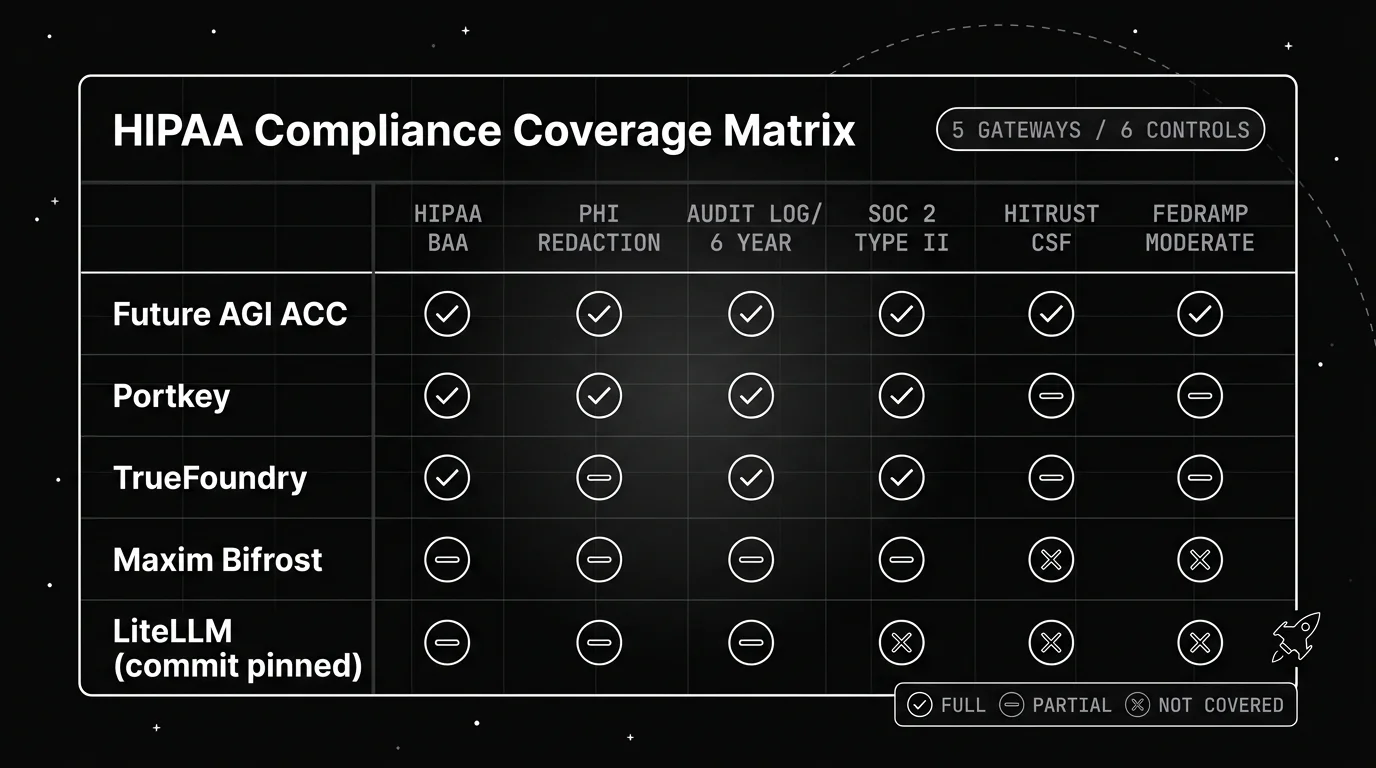
Future AGI Agent Command Center is the strongest single pick for a healthcare AI gateway in 2026 because it bundles an OpenAI-compatible drop-in, 18+ built-in guardrail scanners (PII, secret detection, data leakage prevention, hallucination, MCP security), per-virtual-key budgets, exact plus semantic caching, and OpenTelemetry-native traces in one Apache 2.0 Go binary you can self-host inside a covered entity VPC; HIPAA certified, BAA available. Healthcare procurement now has to weigh four 2026 events in the same buying cycle: the HIPAA Security Rule NPRM expected to finalize in 2026, the LiteLLM PyPI supply-chain compromise of March 24, 2026, the OX Security disclosure of the MCP STDIO RCE class in April 2026, and the announced Palo Alto Networks acquisition of Portkey on April 30, 2026.
- Future AGI Agent Command Center — Best overall. 18+ PHI and PII guardrails, per-key budgets, OTel-native traces, HIPAA certified with BAA available, self-hosted in a covered-entity VPC.
- Portkey — Best for healthcare teams that want a managed cost and audit dashboard. Verify the Palo Alto Networks acquisition timeline before signing a multi-year contract.
- TrueFoundry AI Gateway — Best for health systems and digital health platforms needing a fully air-gapped control and gateway plane inside a private VPC.
- LiteLLM — Best for Python-first ML platform teams pinning a known-good commit after the March 24, 2026 supply-chain incident.
- Maxim Bifrost — Best for Go shops or research teams where raw throughput is the binding constraint and a BAA is acceptable on a custom enterprise tier.
The 5 Healthcare AI Gateways at a Glance
The pattern is the same across ambient clinical documentation, prior authorization automation, payer chatbot triage, and radiology summary copilots.
The gateway you pick in 2026 is judged on three controls. Can a BAA sit on top of it, and can the 18 HIPAA identifiers be redacted before the prompt leaves the network hop?
Can the audit log be retained for the six-year HIPAA window without rebuilding a custom logging stack?
The eight superlatives read first, then the five-platform shortlist with the one-line reason each made the cut.
| Superlative | Tool |
|---|---|
| Best overall for healthcare | Future AGI Agent Command Center: 18+ PHI and PII scanners plus per-key budgets plus OpenTelemetry traces in one Apache 2.0 Go binary |
| Best open source | Future AGI Agent Command Center: Apache 2.0, single Go binary, self-host inside a covered entity VPC |
| Best for OpenAI-compat drop-in | Future AGI Agent Command Center: base_url swap, no SDK rewrite |
| Best for managed healthcare cost dashboard | Portkey: PII anonymization plus four-tier budget hierarchy plus mature observability dashboard |
| Best for fully air-gapped deployment | TrueFoundry AI Gateway: control plane and gateway plane both run inside the customer VPC, with hands-off mode for the engineering team |
| Best for Python-first ML platform team | LiteLLM (commit pinned): broadest provider list, Apache 2.0 outside the enterprise directory, pair with Sigstore verification |
| Best for HIPAA-certified routing with BAA available | Future AGI Agent Command Center: HIPAA certified, BAA available (no custom-tier review required) |
| Best for raw throughput at scale | Maxim Bifrost: vendor-published 11 microsecond mean gateway overhead at 5,000 RPS, custom BAA on advanced compliance tier |
| # | Platform | Best for | License or pricing model |
|---|---|---|---|
| 1 | Future AGI Agent Command Center | Covered entities that want OpenAI compat drop in plus PHI and PII guardrails plus per key budgets in one self-hostable binary; HIPAA certified, BAA available | Apache 2.0; cloud at gateway.futureagi.com/v1 or self-host |
| 2 | Portkey | Healthcare platforms that want a managed cost and audit dashboard and a mature semantic cache out of the box | Source available core plus cloud (Palo Alto Networks acquisition announced 2026-04-30, not yet closed) |
| 3 | TrueFoundry AI Gateway | Health systems needing a fully air-gapped control plane and gateway inside a customer VPC | Proprietary; Pro tier from 499 dollars per month; self-hosted VPC available |
| 4 | LiteLLM (commit pinned) | Python-first ML platform teams pinning a known-good commit | Apache 2.0 outside the enterprise directory; commercial enterprise tier via BerriAI (PyPI supply-chain CVE March 24, 2026, versions 1.82.7 and 1.82.8 only) |
| 5 | Maxim Bifrost | Go shops or research teams where raw throughput is the binding constraint | Apache 2.0; custom BAA on advanced compliance tier |
Helicone is intentionally not in the ranked list. As of March 3, 2026 it has been acquired by Mintlify; the public posture is that Helicone continues to operate in maintenance mode while active feature development winds down. Teams already on Helicone in a healthcare context should treat it as a planned migration window, not a continued procurement.
The 2026 migration and trust cohort sidebar below covers the full set of events that reshape the choice.
How Did We Score These Healthcare AI Gateways?
We used the Future AGI Production Gateway Scorecard, a seven-dimension rubric.
Healthcare adds two pressures most listicles skip: every dimension has to be defensible to a Security Officer reading the 45 CFR 164 technical safeguards, and every dimension has to map back to either a HIPAA Security Rule control, an HTI-1 Predictive DSI source attribute, or an FDA PCCP modification protocol artifact.
| # | Dimension | What we measure |
|---|---|---|
| 1 | Provider breadth and BAA coverage | Supported provider count; OpenAI compat surface; which underlying model providers sign a BAA (OpenAI Enterprise plus API, Anthropic per use case, Azure OpenAI under the Microsoft Online Services DPA, AWS Bedrock under the AWS HIPAA umbrella); MCP and A2A protocol support |
| 2 | Latency overhead on the PHI path | P99 added latency at production load; whether PHI redaction adds a sub 100 ms second hop or sits in the same network hop; benchmark provenance |
| 3 | PHI and guardrail depth | Built in scanner count (PII, secret detection, hallucination, MCP security, topic restriction); coverage of the 18 HIPAA identifiers at 45 CFR 164.514(b)(2); sub 100 ms enforcement; third-party adapter library |
| 4 | Observability and audit logging | OpenTelemetry-native traces; Prometheus cost and token metrics; per-request PHI redaction event capture; trace-to-eval linking; six-year audit log retention path |
| 5 | Deployment flexibility | License; self-host (Docker, Kubernetes); air-gapped; cloud managed; VPC inside the covered entity; FedRAMP and HITRUST CSF v11 path |
| 6 | Compliance coverage | BAA tier eligibility; HIPAA Security Rule (and the NPRM expected to finalize in 2026); ONC HTI-1 Predictive DSI logging path; FDA PCCP modification protocol log capture; HITRUST CSF v11 plus MITRE ATLAS mapping |
| 7 | Total cost of ownership | Per-token markup versus raw provider cost; SDK migration effort; team training overhead; six-year audit retention storage cost |
Dimensions 3, 4, and 6 are the three that decide whether the gateway actually keeps a covered entity safe in production. The 16-dimension capability matrix in the next section is the input to this rubric.
We don’t publish a single composite score because the right priority depends on the buyer profile (large integrated delivery network versus digital health startup versus payer compliance team). The decision matrix below the per-tool reviews maps buyer profiles to picks.
The 16-Dimension Healthcare Capability Matrix the SERP Is Missing
Across the five gateways below, Future AGI Agent Command Center leads on combined provider breadth, guardrail depth, observability, and license clarity for healthcare. Portkey wins on managed dashboard maturity. TrueFoundry wins on fully air-gapped VPC deployment. LiteLLM wins on Python-native ergonomics. Bifrost wins on raw throughput numbers.
None of the ten healthcare AI gateway posts currently ranking on Google ship a 16-column matrix; Maxim’s healthcare post ships zero comparison columns; Aptible’s HIPAA AI page ships partial vendor lists without a feature axis.
| Capability | Future AGI ACC | Portkey | TrueFoundry | LiteLLM | Maxim Bifrost |
|---|---|---|---|---|---|
| Routing strategies (count) | 6 named (15 routing and reliability combined) | 6 plus (4-tier budget hierarchy) | 6 plus | 6 plus | 6 plus |
| Pricing model | Apache 2.0 plus cloud tiers (Free, Boost 250 dollars per month, Scale 750 dollars per month, Enterprise via sales) | Source available plus cloud; Enterprise via sales | Pro from 499 dollars per month; VPC and on prem via sales | Apache 2.0 outside the enterprise directory; commercial enterprise tier via BerriAI | Apache 2.0; Enterprise via sales with 14-day free trial |
| Language and runtime | Single Go binary | Node plus Python SDKs | Multi runtime (Go plus Python) | Python | Single Go binary |
| Supported providers | 100 plus | 250 plus | Major providers plus self hosted | 100 plus | 1,000 plus models, 10 plus providers |
| Deployment options | Docker, Kubernetes, AWS, GCP, Azure, air gapped or on prem | Cloud plus self host plus hybrid plus air gapped | Cloud plus full VPC and air gapped (both planes) | pip install; Docker self host | Docker, Helm, in-VPC |
| Unified API (OpenAI compat) | Yes (base_url swap) | Yes | Yes | Yes | Yes |
| Exact caching | Yes (in memory or Redis) | Yes (Redis) | Yes | Yes (basic) | Yes |
| Semantic caching | Yes (in memory, Qdrant, Pinecone) | Yes | Yes | Partial | Yes |
| Fallbacks | Yes | Yes | Yes | Yes | Yes |
| Rate limiting | Yes | Yes | Yes | Yes | Yes |
| Per-key budgets | Yes (per key, per VK, per model, per window) | Yes (4-tier hierarchy) | Yes | Yes (basic) | Yes |
| Observability | Prometheus /-/metrics plus OTLP traces | Native dashboard plus OTel partial | Native dashboard plus OTel | OTel partial | OTel partial |
| PHI and PII redaction | Yes (built-in PII, secret detection, data leakage prevention, plus 15 third-party adapters) | Yes (PII anonymization at Enterprise) | Yes (data masking at Enterprise) | Via adapters | Built-in guardrails (specific PHI redaction partial) |
| HIPAA BAA available | Yes (HIPAA certified, BAA available) | Yes (Enterprise) | Yes | No vendor BAA on OSS self host (no vendor relationship) | Yes (custom, advanced compliance tier) |
| Open source | Yes (Apache 2.0) | Source available | Proprietary | Yes (Apache 2.0 outside the enterprise directory) | Yes (Apache 2.0) |
| MCP support | Yes (gateway layer plus MCP Security scanner) | Partial | Partial | Limited | Yes |
The shape of the matrix is the shape your buying decision will be: nobody wins every column, and the four columns that matter most for healthcare (BAA availability, PHI and PII redaction depth, audit logging path, license and acquisition risk) are where the field separates.
What the 2026 Healthcare Compliance Stack Actually Demands
The 2026 healthcare AI compliance stack is four layers, and a gateway that handles only one of them isn’t a healthcare gateway.
The four layers are HIPAA (Privacy, Security, Breach Notification, plus the NPRM expected to finalize this year), ONC HTI-1 Predictive Decision Support Intervention logging at 45 CFR 170.315(b)(11), FDA PCCP modification protocol evidence for any AI/ML SaMD path, and HITRUST CSF v11 controls mapped to MITRE ATLAS for threat-adaptive assessments.
- HIPAA Security Rule NPRM. The proposed update to 45 CFR 164.312 (published in the HHS HIPAA Security Rule NPRM at the Federal Register) removes the “addressable versus required” distinction at 45 CFR 164.306(d) and requires documented data flows, vendor relationships, and AI-related risks. Existing BAAs likely need amendment when the final rule lands. Gateways with auditable per-request logs and OpenTelemetry-native span attributes are the natural evidence artifact for the data flow inventory the NPRM will require.
- ONC HTI-1 Predictive DSI. The 2024 HTI-1 final rule introduced the Predictive Decision Support Intervention certification criterion (see the ONC HTI-1 Predictive Decision Support Intervention fact sheet). Certified Health IT must expose 31 source attributes for predictive DSIs and 13 for evidence-based DSIs. Most of the 31 attributes are static (the certified Health IT module holds them in a DSI catalog and references each by ID); the rest are runtime, captured by the AI gateway as span attributes on every request.
The cleanest mental model is two short lists. Static attributes live in the Health IT module; runtime attributes live in the gateway audit log; each runtime span references the static catalog entry by DSI ID.
| Captured by the certified Health IT module (static, one record per DSI) | Captured by the AI gateway (runtime, one record per request) |
|---|---|
| Intended use statement and intended user | Prompt template version |
| Output variable and prediction type | Model name and version |
| Input variable list | Output classification or score |
| Training data description, fairness assessment, validation methodology | Added latency for the DSI step |
| Quantitative performance metrics (AUC, calibration) | Confidence or probability |
| Cohort or population the DSI applies to | Caller identity (user, role, facility) |
| Use of social, demographic, race, ethnicity, gender data | Output rate plausibility (drift) per cohort |
| Ongoing maintenance plan, update cadence, funding source and developer attribution |
That split is what an OpenTelemetry-native gateway captures per request without the certified Health IT module having to ship a separate logging pipeline.
- FDA PCCP modification protocol. For any AI/ML SaMD product that’s FDA-cleared, the FDA Predetermined Change Control Plan final guidance for AI/ML medical devices (finalized December 2024) lets the manufacturer pre-specify a Modification Protocol for ongoing model updates. The gateway audit log is the natural place to evidence which model version served which request inside the Total Product Lifecycle monitoring artifact. The agency reported only about eight percent of authorized AI/ML SaMD devices included an authorized PCCP by early 2026; gateways that capture model version per request lower the cost of that evidence.
- HITRUST CSF v11 plus MITRE ATLAS. HITRUST’s HITRUST CSF v11 AI-enhanced release added MITRE ATLAS as a selectable factor for AI attack mitigation and ships an AI-enhanced mapping toolkit that the maintainers claim reduces control mapping overhead by about seventy percent. Gateways with explicit prompt injection, MCP security, hallucination, and topic restriction scanners are the runtime enforcement layer for the new HITRUST control statements.
A gateway that ships layers 1 and 4 but skips 2 and 3 is good for marketing and bad for a Joint Commission survey or an FDA inspection. The five reviews below are scored against all four layers.
Future AGI Agent Command Center: Best Overall for Healthcare AI
Future AGI Agent Command Center tops the 2026 healthcare list because it bundles every layer of the healthcare compliance stack at the same network hop in one Apache 2.0 Go binary you can self-host inside the covered entity VPC.
It loses on out-of-the-box managed dashboard polish to Portkey and on raw single-dimension Go throughput to Bifrost; for buyers whose binding constraint is HIPAA-ready routing with 18+ built-in PHI and PII scanners plus per-key budgets plus OpenTelemetry-native traces in one self-hostable binary, the combined surface still puts it first.
The bundled capabilities are an OpenAI-compatible drop-in, 18+ built-in guardrail scanners (PHI, PII, secret detection, data leakage, hallucination, MCP security), per-virtual-key budgets, exact plus semantic caching, and OpenTelemetry-native traces in a single Apache 2.0 Go binary.
SOC 2 Type II, HIPAA, GDPR, and CCPA are all certified; BAA available. The full surface is documented in the Agent Command Center docs and the source ships at the Future AGI GitHub repo.
Most gateways force a covered entity to wire two or three of these together across separate products; Agent Command Center attaches them at the same network hop.
Maxim Bifrost is the other Apache 2.0 single Go binary on this list, credited explicitly in the Bifrost section below; the composite that wins this rank is the combination of Apache 2.0 plus the 18+ built-in PHI and PII scanner library plus HIPAA certification with BAA available.
Best for. Covered entities (health systems, digital health platforms, payers) that want OpenAI compat drop in plus 18+ built-in PHI and PII guardrail scanners plus per-key budgets plus OpenTelemetry-native traces in one Apache 2.0 Go binary, self-hosted inside the customer VPC, without rewriting OpenAI SDK code.
Key strengths.
- OpenAI-compatible drop-in: change
base_urltohttps://gateway.futureagi.com/v1, keep the existing OpenAI SDK code unchanged. - 20+ providers via six native adapters (OpenAI, Anthropic, Gemini, Bedrock, Cohere, Azure) plus OpenAI-compatible presets and self-hosted backends (OpenAI, Anthropic, Google Gemini, AWS Bedrock, Azure OpenAI, Cohere, Groq, Together, Fireworks, Mistral, DeepInfra, Perplexity, Cerebras, xAI, OpenRouter, plus self-hosted via Ollama, vLLM, LM Studio, and any OpenAI-compatible server). For healthcare specifically, OpenAI Enterprise plus API, Azure OpenAI under the Microsoft DPA, and AWS Bedrock under the AWS HIPAA umbrella are the three BAA-eligible upstreams the gateway commonly routes to.
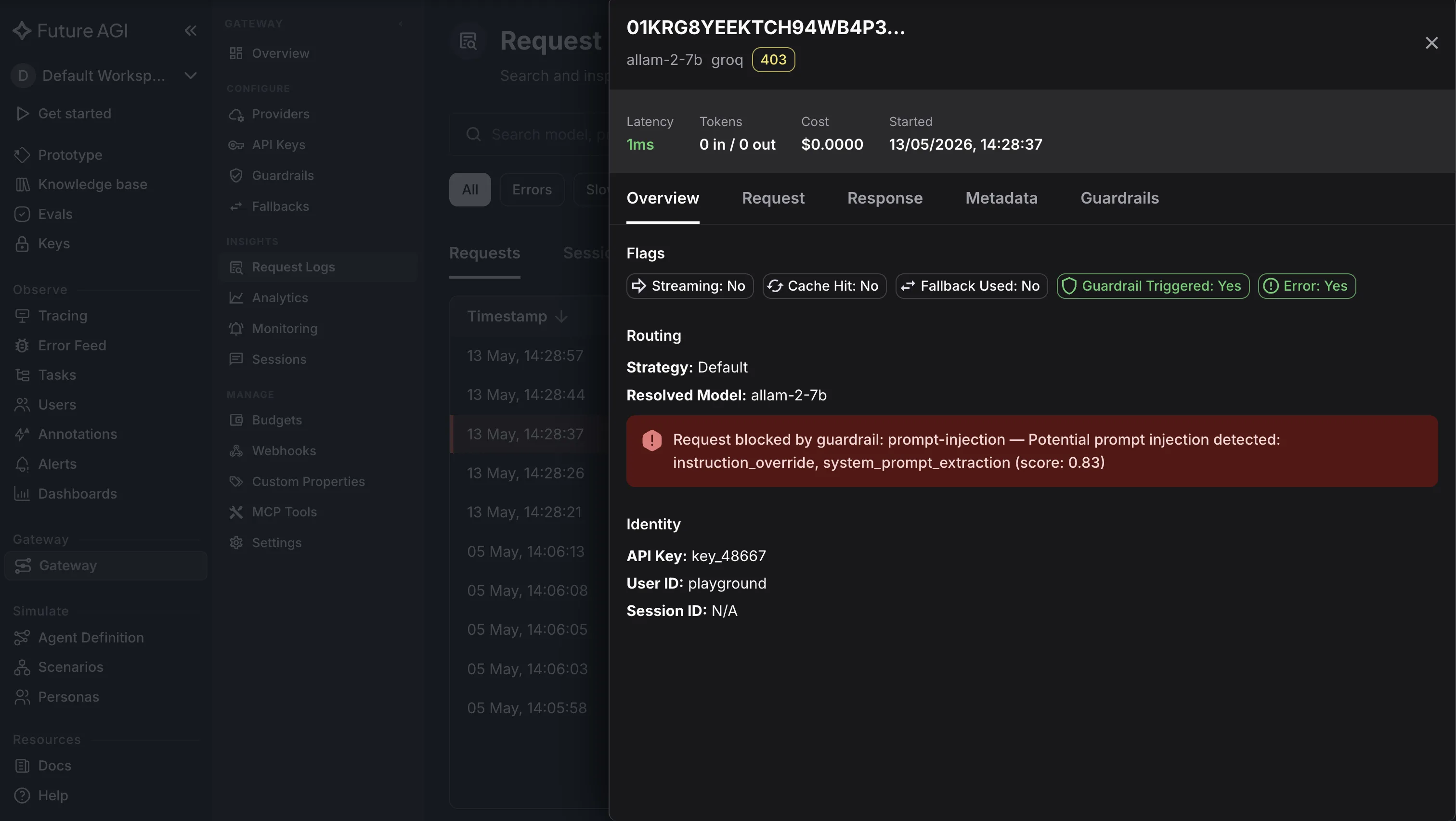
- The Future AGI Protect model family at the gateway layer for inline guardrails, ~65 ms p50 text and ~107 ms p50 image (arXiv 2510.13351). Protect is FAGI’s own fine-tuned model family built on Google’s Gemma 3n with specialized adapters across four safety dimensions (content moderation, bias detection, security/prompt-injection, data privacy/PII including the 18 HIPAA identifiers enumerated at 45 CFR 164.514(b)(2) Safe Harbor), natively multi-modal across text, image, and audio. FAGI’s own model family, not a chain of API calls to third-party detectors. The same dimensions are reusable as offline eval metrics so the prod policy and the eval rubric stay in sync. A dedicated MCP Security scanner sits alongside and matters after the April 2026 OX Security disclosure of the MCP STDIO RCE class.
- Per-key, per-virtual-key, per-model, and per-time-window budgets; rate limits; quotas; shadow experiments; tag-based custom properties for per-facility, per-product, and per-role enforcement.
- OpenTelemetry-native traces plus Prometheus metrics on
/-/metrics, so the same span attributes feed Grafana, the HITRUST CSF v11 control evidence collector, and the Future AGI Evaluation pipeline viaspan_idlinking from gateway trace to eval result.traceAIinstruments 50+ AI surfaces across Python, TypeScript, Java, and C# (including Spring Boot starter, Spring AI, LangChain4j, Semantic Kernel) OpenInference-natively, and Error Feed. the part of the eval stack, the clustering and what-to-fix layer that feeds the self-improving evaluators, turns those traces into named issues with zero config: auto-clusters 50 related failures into one issue, auto-writes the root cause from the trace spans plus a quick fix plus a long-term recommendation per issue, and tracks rising/steady/falling trend so PHI-leakage clusters and clinical-summary regressions get triaged like exceptions instead of buried in dashboards. - Apache 2.0; single Go binary; Docker, Kubernetes, AWS, GCP, Azure, air-gapped or on-prem; SOC 2 Type II, HIPAA, GDPR, and CCPA all certified; BAA available.
Limitations.
- Full execution tracing for agents is currently an “In Progress” roadmap item on the public roadmap in the Future AGI GitHub repo and is rolling out alongside the existing gateway-side OpenTelemetry trace export.
from openai import OpenAI

client = OpenAI(
    api_key="$FAGI_API_KEY",
    base_url="https://gateway.futureagi.com/v1",
)

# Existing OpenAI SDK code unchanged from here. The gateway runs
# PHI redaction, audit logging, and per-VK budget enforcement at
# the same network hop.
response = client.chat.completions.create(
    model="azure-openai/gpt-4o",
    messages=[{"role": "user", "content": "Summarise the visit note above."}],
)
Use case fit. Strong for integrated delivery networks running ambient documentation pilots, digital health platforms building prior authorization automation, payers running claims triage copilots, and ML platform teams that want eval, tracing, and gateway in one Apache 2.0 stack. Less optimal for teams that want a fully managed cost dashboard before standing up any infrastructure, which is the Portkey case.
Pricing and deployment. Apache 2.0 single Go binary; cloud-hosted at https://gateway.futureagi.com/v1 or self-host (Docker, Kubernetes, air-gapped). SOC 2 Type II, HIPAA, GDPR, and CCPA all certified; BAA available via FAGI sales.
Verdict. The strongest single pick if your 2026 healthcare AI infrastructure story is “we want OpenAI compat drop in plus PHI and PII guardrails plus per-key budgets plus OpenTelemetry traces in our existing observability stack, inside our VPC, under a BAA.”
Healthcare platforms that want a managed cost and audit dashboard before writing any infrastructure code should evaluate Portkey alongside. Large enterprises already committed to the Microsoft 365 and Azure compliance umbrella should compare against routing direct to Azure OpenAI under the Microsoft Online Services DPA.
Portkey: Best for Managed Healthcare Cost and Audit Dashboard
Portkey is the strongest healthcare pick when you want a managed cost and audit dashboard out of the box, the most mature semantic cache in production, and a four-tier budget hierarchy with PII anonymization at the Enterprise tier.
It’s what most digital health platforms reach for when “we need spend control and tenant-level enforcement next week” is the brief, with the caveat that the Palo Alto Networks acquisition announced on April 30, 2026 hasn’t yet closed and is expected to close in Palo Alto’s fiscal Q4 2026 subject to customary closing conditions.
Best for. Digital health platforms and multi-product healthcare SaaS that want fine-grained per-facility or per-provider budgets, PII anonymization, and a usable cost and audit dashboard without writing a custom exporter, and that have an acceptable risk appetite for the pending Palo Alto Networks acquisition.
Key strengths.
- Exact plus semantic caching with TTL and similarity-threshold tuning out of the box; production teams typically see thirty to sixty percent hit rates on internal copilot workloads.
- Per-key, per-virtual-key, per-model, and per-time-window budgets; the most fine-grained native-dashboard hierarchy on the list.
- Large adapter library (250+ providers, including private OSS deployments and on-prem Llama variants).
- PII anonymization at the Enterprise tier; HIPAA BAA available; SOC 2 Type 2, ISO 27001, and GDPR audit-log support.
- Usable native dashboard for cost attribution by tenant, facility, and feature.
Limitations.
- Acquisition by Palo Alto Networks announced April 30, 2026; the deal is expected to close in Palo Alto’s fiscal Q4 2026 subject to customary closing conditions. Roadmap independence through 2026 is intact; multi-year contracts should reference the integration plan.
- Observability is dashboard-first; OpenTelemetry export exists but is less first-class than the native dashboard, which makes integration with an existing Splunk or Datadog stack a longer first week.
- Source available core plus closed control plane; air-gapped deployment is available at the Enterprise tier but the control plane setup is heavier than a single Apache 2.0 binary.
Use case fit. Strong for multi-tenant healthcare SaaS, payers with per-facility cost attribution, and digital health platforms running multiple AI products. Less optimal for covered entities whose binding constraint is a single Apache 2.0 binary inside an air-gapped VPC with no managed control plane dependency.
Pricing and deployment. Source available core (self-hosted), commercial cloud control plane, Enterprise tiers via sales; HIPAA BAA is included at the Enterprise tier, with custom contracts for air-gapped deployment. Verify current pricing on Portkey’s live pricing page before procurement.
Verdict. The most mature managed cost and audit dashboard for healthcare AI in 2026, with strong semantic cache and budget hierarchy. Choose with eyes open on the Palo Alto Networks integration; the next 12 months will tell whether the standalone gateway product survives the merger.
TrueFoundry AI Gateway: Best for Fully VPC-Resident Control Plane
TrueFoundry AI Gateway is the strongest pick for health systems and digital health platforms that need both the control plane and the gateway plane to run inside the customer VPC, with full air-gapped support and a HIPAA BAA available.
It’s the gateway most often shortlisted alongside Portkey when the procurement pressure is “no third-party SaaS control plane, period.”
Best for. Hospitals, integrated delivery networks, and regulated digital health platforms that require both control plane and gateway plane to run inside the customer VPC, with HIPAA, SOC 2 Type 2, and GDPR signed off as part of the deployment.
Key strengths.
- Full VPC and air-gapped install for both the control plane and the gateway plane, with hands-off mode for the customer’s engineering team where TrueFoundry support operates inside agreed boundaries.
- HIPAA BAA available; SOC 2 Type 2 and HIPAA compliance achieved in 2024 and maintained through 2026.
- Routes to the major BAA-eligible upstreams (Azure OpenAI, AWS Bedrock, OpenAI Enterprise plus API, Anthropic, Vertex AI) plus self-hosted endpoints.
- Data masking at the Enterprise tier; integrates with the standard audit log retention path required for the six-year HIPAA window.
Limitations.
- Proprietary license; not Apache 2.0; the source isn’t available for the same kind of audit a regulated entity can run on Future AGI Agent Command Center or Bifrost.
- Pricing starts at 499 dollars per month for the Pro tier and rises for VPC and on-prem deployment; smaller digital health startups should compare against the cloud tiered alternatives.
- Healthcare-specific guardrail set (the runtime detector for the 18 HIPAA identifiers) is positioned more as an integration with adapters than as a built-in scanner library on the scale of Future AGI’s 18+.
Use case fit. Strong for regulated environments where the procurement constraint is “no SaaS control plane crosses our network boundary.” Less optimal when the buying constraint is Apache 2.0 or when the runtime guardrail surface needs to be a built-in scanner library rather than an adapter wiring exercise.
Pricing and deployment. Proprietary; Pro from 499 dollars per month; VPC and on-prem deployment available with self-hosted control plane and gateway plane.
Verdict. The right pick when the procurement constraint is “everything runs inside our VPC, including the control plane.” Choose Future AGI Agent Command Center when Apache 2.0 plus a built-in guardrail library matters more than a single-vendor full-stack VPC install.
LiteLLM: Best for Python-First Healthcare Teams Post-CVE
LiteLLM is the Python-first proxy that broke open the multi-provider unified API category. It’s Apache 2.0 outside the enterprise directory, ships with 20+ providers via six native adapters (OpenAI, Anthropic, Gemini, Bedrock, Cohere, Azure) plus OpenAI-compatible presets and self-hosted backends, exposes OpenAI-compatible endpoints, and powers a long tail of internal gateways.
After the March 24, 2026 supply-chain incident the healthcare answer is “yes for self-hosted commit-pinned deployments where the covered entity has its own BAA path to the underlying model provider; no for the OSS path as a vendor BAA.”
Best for. Python-first ML platform teams that already operate a FastAPI or uvicorn surface, want broad provider coverage, are willing to pin commit hashes after the supply-chain incident, and have their own BAA path direct to the underlying model provider rather than relying on a LiteLLM BAA.
Key strengths.
- Broadest provider coverage of any single project on this list (20+ providers via six native adapters (OpenAI, Anthropic, Gemini, Bedrock, Cohere, Azure) plus OpenAI-compatible presets and self-hosted backends).
- Apache 2.0 outside the enterprise directory; trivial to fork or audit.
- Virtual keys with per-key budgets; budget alerts; native fit with Python observability stacks.
- Active maintainer community; easy to extend with custom adapters for healthcare-specific PHI detectors.
Limitations.
- March 24, 2026 PyPI supply-chain compromise. Versions
1.82.7and1.82.8were published by the TeamPCP threat actor after PyPI publishing tokens were exfiltrated via a compromised Trivy GitHub Action in LiteLLM’s CI/CD pipeline. The malicious packages shipped a credential harvester, a Kubernetes lateral-movement toolkit, and a persistent systemd backdoor; over 40,000 downloads were recorded before PyPI quarantined the packages within a few hours of publication (Datadog Security Labs writeup of the LiteLLM PyPI compromise). Pin to 1.82.6 or earlier, scan dependency trees, and rotate any credentials accessible to an affected install. - Python runtime; materially slower throughput than Go-binary alternatives at high concurrency on the same hardware.
- No vendor BAA on the OSS self-hosted distribution; healthcare deployment requires the covered entity to hold the BAA directly with the upstream model provider (OpenAI, Anthropic, Azure, AWS).
Use case fit. Strong for Python-first ML platform teams that operate their own FastAPI gateway and have their own BAA path to the upstream model provider. Less optimal as a vendor-BAA path in healthcare and as a managed runtime where commit pinning isn’t enforceable.
Pricing and deployment. Apache 2.0 outside the enterprise directory; pip install or Docker self-host. Enterprise cloud tier exists with SOC 2 Type II, HIPAA, GDPR, and CCPA certified (ISO/IEC 27001 in active audit).
Verdict. Still the broadest provider coverage on the list, but the March 2026 supply-chain incident shifts it from “default pick” to “pin commits and audit.” Healthcare deployments should treat LiteLLM as an OSS self-hosted runtime where the covered entity holds the upstream BAA directly, not as a vendor BAA path.
Maxim Bifrost: Best for Go Throughput on the Healthcare Inference Path
Maxim Bifrost is the Go-native gateway from Maxim, Apache 2.0, with vendor-published gateway overhead in the 11 microsecond range at 5,000 RPS, custom BAA available on the advanced compliance tier, and a strong story for research and high-throughput inference paths in healthcare.
It’s the gateway most often cited when raw throughput is the binding constraint, and Maxim’s Q1 2026 healthcare collateral specifically targets ambient documentation and research workloads.
Best for. Go shops, research teams running batch inference on de-identified data sets, and engineering teams whose binding constraint is raw throughput at high concurrency under a custom BAA.
Key strengths.
- Vendor-published benchmark showing roughly 11 microsecond mean gateway overhead at 5,000 RPS on
t3.xlarge. - Apache 2.0; single Go binary; Docker plus Helm plus in-VPC deployment.
- Custom BAA available on the advanced compliance tier; SOC 2 Type II, ISO 27001, HIPAA, and GDPR audit-log support listed on the public compliance page.
- 1,000+ models from 10+ providers via a unified API surface.
- Active product velocity and aggressive content cadence keeps the brand visible.
Limitations.
- Maxim self-ranks Bifrost number one across its own gateway listicles with no published limitations, including in its healthcare-specific post; a trust signal worth weighing when the same vendor’s claims appear in a Joint Commission risk register.
- Healthcare PHI redaction specifics are partial in public docs; the runtime detector for the 18 HIPAA identifiers is implied by built-in guardrails but not enumerated on the scale of Future AGI’s 18+ or Cloudflare AI Gateway’s named DLP feature.
- BAA is custom on the advanced compliance tier rather than included on a standard published tier; budget more time for the procurement legal review.
Use case fit. Strong for Go shops, batch inference on de-identified data sets, and high-throughput inference paths. Less optimal where PHI redaction depth and BAA path simplicity are the binding constraints.
Pricing and deployment. Apache 2.0; Docker, Helm, in-VPC; Enterprise via sales with 14-day free trial; custom BAA available on the advanced compliance tier.
Verdict. Strong throughput numbers and active engineering velocity, but “go faster” isn’t the same as “keep PHI off the wire.” Choose Bifrost when throughput is the primary axis and a custom BAA review is acceptable; choose Future AGI Agent Command Center when an executable BAA at a published tier and a built-in 18+ scanner library matter more.
AWS Bedrock and Azure OpenAI as Healthcare BAA Fast Paths
The straight cloud route to a HIPAA BAA in 2026 is AWS Bedrock or Azure OpenAI; both are HIPAA-eligible under their respective umbrella agreements, both ship a fast BAA, and both leave the covered entity to bolt PHI redaction, audit retention, and per-key budgets on top.
Most production healthcare AI stacks today run an AI gateway in front of Bedrock or Azure OpenAI rather than instead of them. The framing question is whether the gateway adds enough at the same network hop to justify the operational footprint.
AWS Bedrock and Bedrock AgentCore. Amazon Bedrock and Bedrock AgentCore were added to the AWS HIPAA Eligible Services list with the update effective February 10, 2026; the customer executes the AWS BAA umbrella, and processing of electronic PHI must use HIPAA-eligible services only (AWS Bedrock security and compliance overview).
Bedrock is in scope for ISO, SOC, and CSA STAR Level 2. The upstream model set spans Anthropic Claude, Meta Llama, Mistral, Cohere, Amazon Titan, AI21, and Stability hosted on AWS.
The gap that a gateway closes: Bedrock doesn’t ship a built-in PHI redaction layer, doesn’t ship per-virtual-key budgets across providers (Bedrock budgets are per service), and the OpenAI compat surface in front of Bedrock is on the customer.
Azure OpenAI Service and Azure AI Foundry. Azure OpenAI is covered under the Microsoft Online Services Data Protection Addendum BAA for text-based services on Enterprise Agreement, MCA, and CSP procurement paths (Microsoft Learn answer on Azure OpenAI HIPAA eligibility). Azure OpenAI doesn’t retain prompt and completion content for training by default.
The two coverage gaps that healthcare teams hit in practice: image inputs aren’t covered by default and the Realtime Audio API in preview isn’t yet inside the HIPAA coverage scope.
A gateway in front of Azure OpenAI is what enforces text-only routing, blocks image and realtime calls, and standardizes the audit log across Azure OpenAI plus a non-Azure fallback provider.
The honest take. If your stack is one provider, one region, one product, AWS Bedrock or Azure OpenAI behind your application can be enough.
The moment you add a second provider (for fallback, for redundancy, for cost), a second product (ambient scribe plus payer chatbot plus prior auth automation), or a second tenant (a multi-hospital health system), the gateway pays for itself in BAA simplicity, PHI redaction consistency, and audit log uniformity. That’s the gateway-versus-no-gateway question every healthcare AI buyer makes.
The BAA Matrix Per Upstream Model Provider
Healthcare procurement that picks a gateway also has to pick its upstream model provider, and the BAA clauses (training-on-data, retention default, sub-processor flow-down, image and realtime coverage) differ enough that they belong in the same buying table. The matrix below is the practical version every Security Officer asks for when a gateway is shortlisted.
Verify each row against the live vendor page before signing.
| Provider | BAA available | Procurement path | Training on customer data | Default retention | Image input under BAA | Realtime audio under BAA |
|---|---|---|---|---|---|---|
| OpenAI (ChatGPT Enterprise + Edu + API) | Yes | Email baa@openai.com; execute before PHI traffic | No (opt-out default on covered tiers) | Configurable; Zero Data Retention available on API | API: yes for text; verify image coverage in BAA addendum | Realtime API not yet inside default BAA scope; verify in writing |
| OpenAI (ChatGPT Free, Plus, Business) | No | n/a | n/a (consumer surface) | n/a | n/a | n/a |
| Anthropic (Claude API) | Yes, per use case | Submit use case, PHI categories, downstream data flow; legal review | No (no training on customer data by default) | API standard retention with delete on request | Yes for text; image inputs covered per use case review | n/a (no native realtime API) |
| Azure OpenAI Service | Yes (default on EA, MCA, CSP) | Microsoft Online Services DPA BAA; automatic on covered enterprise procurement | No (no training on customer data) | No prompt and completion retention for training by default; abuse-monitoring opt-out path available for HIPAA | Image inputs not covered by default; verify addendum | Realtime Audio API in preview is not yet inside default HIPAA coverage |
| AWS Bedrock and Bedrock AgentCore | Yes (HIPAA Eligible Services list, updated 2026-02-10) | AWS BAA umbrella; signed once at the AWS account level | No (Bedrock does not use customer data to train base models) | No log retention by default; CloudWatch and S3 logging is customer-configured | Multi-modal provider-dependent; confirm at the upstream model | n/a (Bedrock voice agents are a separate service path) |
| Google Cloud Vertex AI (Gemini) | Yes (Google Cloud BAA covers Vertex AI for HIPAA-eligible services) | Google Cloud BAA; signed at the organization level | No (no training on customer prompts) | Configurable; default minimal | Image and multi-modal covered per Vertex AI service docs; verify per model | Live API and audio surfaces vary by model; verify each model |
| IBM watsonx.ai (Enterprise plans) | Yes (Business Associate Addendum) | Through IBM Cloud HIPAA-aligned hosting (Washington DC, Dallas) | No on Granite; varies on third-party models exposed through watsonx | Zero Retention Mode available | Model dependent | Model dependent |
The BAA matrix is the per-provider half of the gateway buying decision. The gateway in front of the provider is what enforces a covered entity’s own Security Rule technical safeguards on top: PHI redaction, audit log retention to the six-year window, per-role access, and per-virtual-key budget enforcement.
The 2026 Healthcare Gateway Migration and Trust Cohort
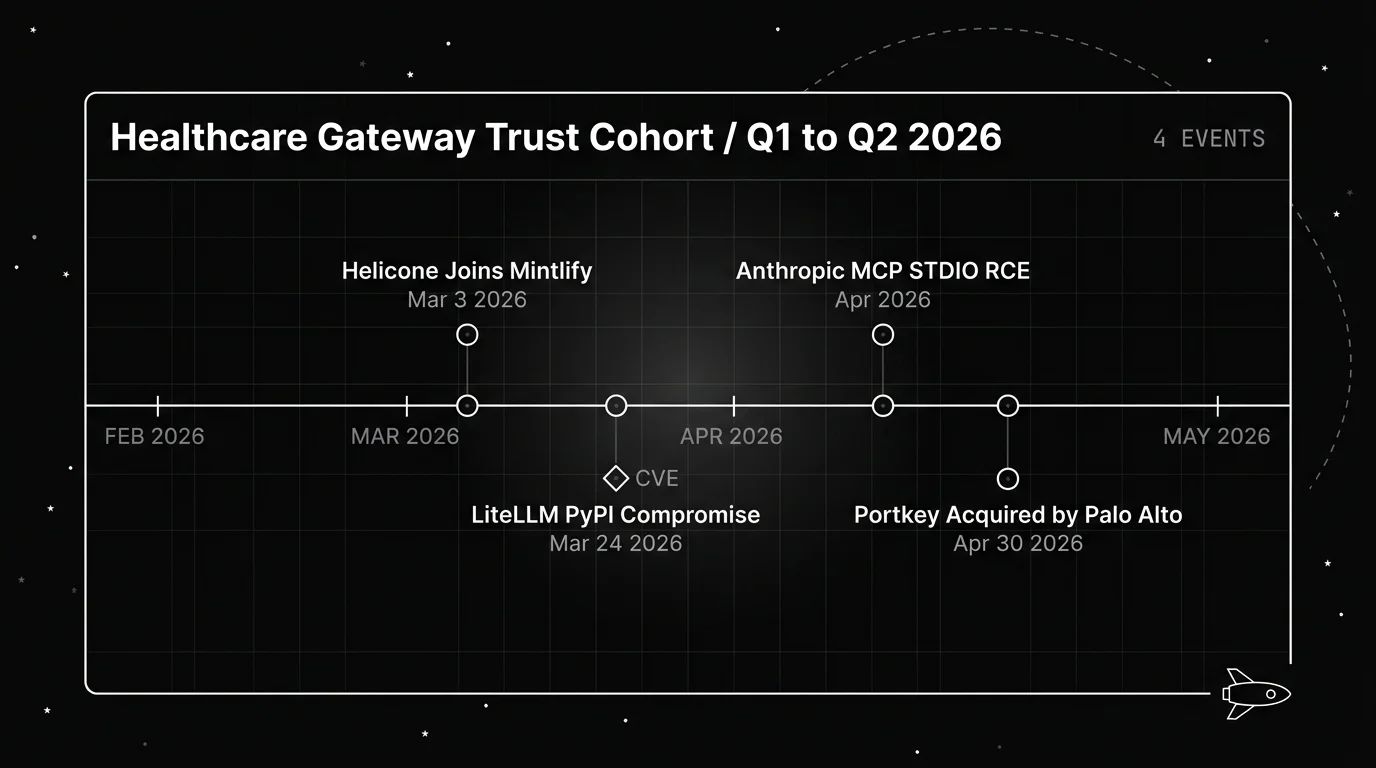
Every healthcare AI gateway post currently ranking on Google is treating these as if they didn’t happen. They did, and they reshape the procurement question for 2026 inside a covered entity.
- Helicone joining Mintlify (March 3, 2026). Helicone acquired by Mintlify; product is in maintenance mode with no active feature development. Healthcare teams already on Helicone should plan a migration window, not a continued procurement.
- LiteLLM PyPI supply-chain compromise (March 24, 2026). TeamPCP-attributed compromise of versions
1.82.7and1.82.8via a stolen PyPI publishing token (exfiltrated through a compromised Trivy GitHub Action in LiteLLM’s CI/CD). The malicious package shipped a credential harvester, a Kubernetes lateral-movement toolkit, and a persistent systemd backdoor; PyPI quarantined the packages the same day, with 40,000+ downloads recorded. Pin to 1.82.6 or earlier; rotate credentials accessible to any affected install. Primary source: the Datadog Security Labs writeup. - Anthropic MCP STDIO RCE class (April 2026). OX Security disclosed an STDIO transport class flaw affecting roughly 7,000 MCP servers and 150 million plus downstream downloads. Healthcare gateways routing MCP traffic are now expected to enforce least-privilege tool access, OAuth 2.1 transport, and Streamable HTTP rather than raw STDIO. Primary coverage: the Hacker News report on the Anthropic MCP design vulnerability.
- Portkey acquired by Palo Alto Networks (April 30, 2026, not yet closed). Acquisition announced; the deal is expected to close in Palo Alto’s fiscal Q4 2026 subject to customary closing conditions. Roadmap independence is intact through 2026; multi-year healthcare contracts should reference the integration plan in writing. Primary source: the Palo Alto Networks press release.
The practical takeaway: for the next 12 months, license clarity, BAA tier definitiveness, and acquisition independence are part of the healthcare AI gateway buying decision. A cheap gateway you migrate off in six months, or one whose BAA pathway is in legal redrafting, isn’t cheap inside a hospital procurement cycle.
Healthcare AI Gateway Picks by Buyer Profile in 2026
The buyer profile drives the pick more than the feature matrix does. Covered entities running ambient scribe, prior auth, payer chatbot, or radiology summary copilots pick Future AGI Agent Command Center for the Apache 2.0 plus built-in 18+ PHI and PII scanner combination.
Digital health platforms running multi-tenant dashboards pick Portkey. Integrated delivery networks that mandate VPC-only control planes pick TrueFoundry. Python-first ML platform teams with their own upstream BAA path pick LiteLLM commit-pinned. Go shops on throughput-bound research workloads pick Bifrost.
| If you are a… | Pick | Why |
|---|---|---|
| Hospital or health system running ambient scribe or prior auth, OpenAI SDK heavy | Future AGI Agent Command Center | OpenAI compat drop in plus 18+ PHI and PII scanners plus per-key budgets in one Apache 2.0 Go binary; HIPAA certified, BAA available |
| Digital health platform with multi-tenant cost and audit reporting | Portkey | Most fine-grained budget hierarchy plus mature dashboard (verify the Palo Alto Networks integration timeline) |
| Integrated delivery network mandating fully VPC-resident control plane | TrueFoundry AI Gateway | Both control and gateway planes inside the customer VPC; HIPAA, SOC 2 Type 2, GDPR |
| Python-first ML platform with its own upstream BAA path | LiteLLM (commit pinned) | Broadest provider coverage; Apache 2.0 outside the enterprise directory; pin to 1.82.6 or earlier after the March CVE |
| Research team or Go shop running high-throughput batch inference on de-identified data | Maxim Bifrost | Strongest published throughput; Apache 2.0; custom BAA on the advanced compliance tier |
| Microsoft 365 plus Azure shop happy with text only | Azure OpenAI behind a gateway | BAA via the Microsoft DPA; image and realtime not yet covered, so gateway-enforced route filtering is required |
| AWS shop on Bedrock with Claude on Bedrock | AWS Bedrock behind a gateway | BAA via the AWS umbrella effective February 10, 2026 for Bedrock and Bedrock AgentCore; gateway adds PHI redaction and budgets |
| Early-stage digital health startup evaluating gateways before committing | Future AGI Agent Command Center free tier | Apache 2.0 self-host; HIPAA certified with BAA available when PHI traffic begins |
Which AI Gateway Is Right for Your Healthcare Team in 2026?
Healthcare AI in 2026 isn’t a single feature. It’s a stack of HIPAA, ONC HTI-1, FDA PCCP, and HITRUST CSF v11 controls riding on top of an AI gateway.
That gateway has to keep Protected Health Information off the wire, retain six years of audit logs, and survive a year of acquisition events without forcing a re-platforming.
Of the five gateways above, Future AGI Agent Command Center is the strongest pick for the production case where the buying constraint is OpenAI compat drop in plus 18+ built-in PHI and PII scanners.
It also offers per-key budgets plus OpenTelemetry traces in one Apache 2.0 Go binary you can self-host inside the covered entity VPC; SOC 2 Type II, HIPAA, GDPR, and CCPA all certified, BAA available.
Portkey is the right call when a managed cost and audit dashboard is the binding constraint and the Palo Alto Networks integration risk is acceptable. TrueFoundry is the right call when both the control plane and the gateway plane must run inside the customer VPC with no external SaaS dependency.
For deeper reads on the patterns referenced above:
- The Agent Command Center docs for the full gateway feature surface.
- The Future AGI observability docs for the audit log path that anchors HIPAA Security Rule documentation.
- The Future AGI Protect docs for the runtime guardrail library the gateway plugs into.
- The Future AGI Evaluation docs for the held-out PHI safety eval that ties to gateway behavior via
span_id. - The Future AGI tracing product page for the OpenTelemetry-native tracing layer.
- The Future AGI GitHub repo for the Apache 2.0 source.
Try Agent Command Center free. OpenAI-compatible routing, 18+ PHI guardrails, per-key budgets, and OpenTelemetry in one Apache 2.0 Go binary.
Related reading
- Best 5 AI Gateways for Compliance Audit Trails in 2026, the compliance and audit-trail comparison
- Best 5 AI Gateways for LLM Cost Optimization in 2026, the five-layer cost stack and the 2026 trust cohort
- Best 5 AI Gateways for Customer Support in 2026: Latency Budgets, Agent Assist, and Voice AI Passthrough, the customer-support-specific gateway picks
- Best 5 AI Gateways for Cybersecurity in 2026: Prompt Injection Defense, Tenant Isolation, and SOC 2, the cybersecurity-specific gateway picks
Frequently Asked Questions
What Is the Best AI Gateway for Healthcare in 2026?
Is OpenAI HIPAA Compliant for Healthcare AI Applications in 2026?
Does Anthropic Claude Sign a BAA for Healthcare AI Use?
What Is the Difference Between HIPAA-Eligible and HIPAA-Compliant for an AI Gateway?
How Does PHI Redaction Work Inside an AI Gateway?
Which AI Gateways Are Still Safe for Healthcare After the 2026 Supply-Chain and Acquisition Events?
Five AI gateways on what compliance officers actually need: tamper-evident logs, 3-10 yr retention, SIEM exports, span granularity, legal hold, frameworks.

Five AI gateways for cybersecurity in 2026 scored on prompt injection defense, tenant isolation, OWASP LLM Top 10, MITRE ATLAS, SOC 2.
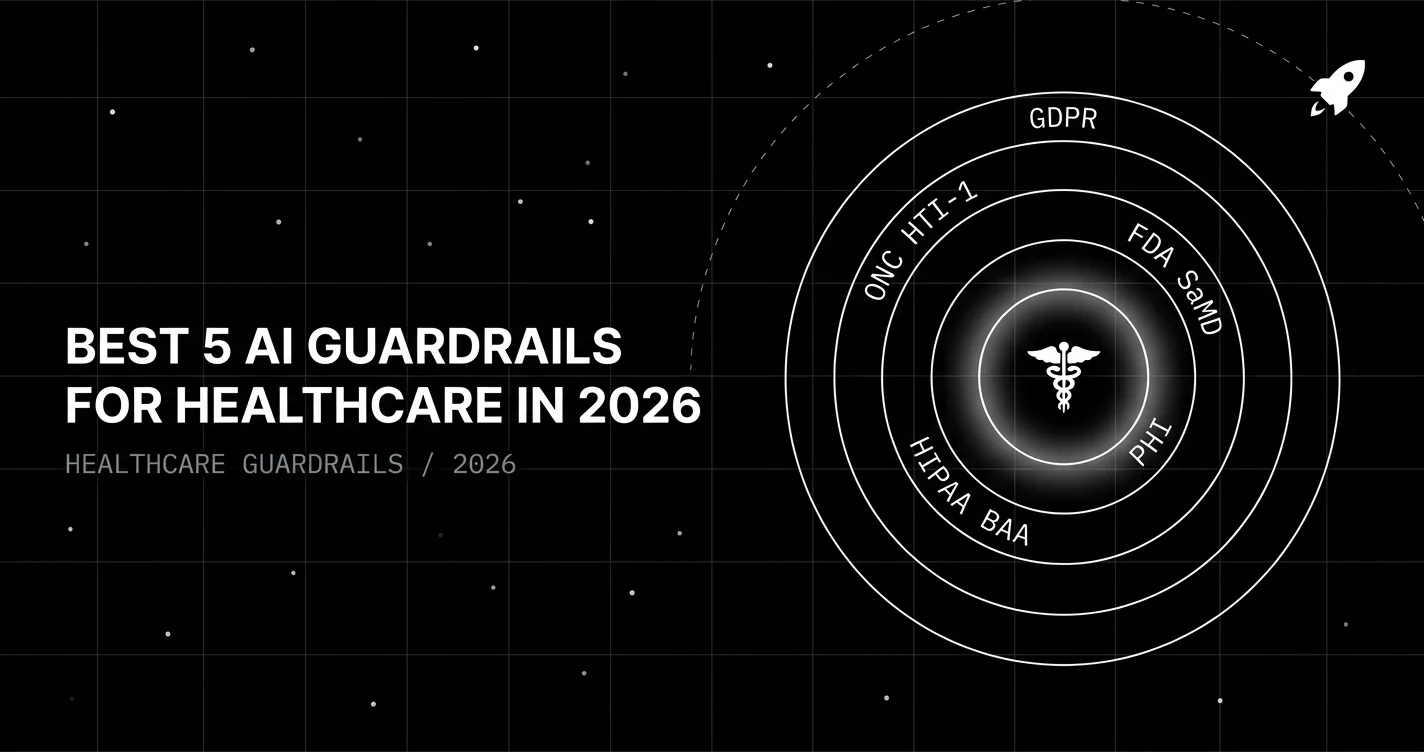
Five AI guardrails compared for healthcare: clinical decision, ambient scribes, prior auth, portal chatbots. HIPAA, FDA SaMD, EU AI Act 14.