Best 5 AI Gateways for Government in 2026: FedRAMP-Ready Gateways With Audit Trails
Five AI gateways for federal, DoD, and state government 2026, scored on FedRAMP Moderate and High, DoD IL2 to IL6, NIST AI RMF, EO 14110.
Table of Contents
Originally published May 17, 2026.
A civilian agency mission owner ran a constituent services copilot pilot on a Monday and discovered by Friday that the proxy it shipped on had been routing benefits eligibility questions to a consumer ChatGPT tier outside the FedRAMP boundary, with no NIST 800 53 AU-2 audit log, no FIPS 140-3 transport, and no per request capture of the agency program code or the OMB M-24-10 use case identifier, while the model had also confabulated a SNAP eligibility rule that doesn’t exist in 7 CFR Part 273. This guide compares the five AI gateways federal CIOs, agency program managers, and DoD contractors should consider in 2026, scored against FedRAMP Moderate and High, FISMA, DoD Impact Levels IL2 through IL6, NIST 800 53 Rev. 5, NIST AI RMF 1.0, OMB M-24-10 (October 28, 2024), EO 14110 (rescinded January 20, 2025), EO 14179 (January 23, 2025), OMB M-25-21 and M-25-22 (April 3, 2025), DoD CIO generative AI memorandums from 2023 and 2024, and ITAR data sovereignty.
TL;DR: The 5 Best Government AI Gateways for 2026
There’s no fully FedRAMP authorized AI gateway startup in May 2026. That’s the buying problem. The category is too young for the eighteen to thirty six month FedRAMP authorization cycle to have completed for any of the gateways agencies actually want. The honest answer for a federal CIO is to pick between three deployment patterns: an Apache 2.0 binary self hosted inside an agency AWS GovCloud or Azure Government boundary, a hyperscaler native gateway already inside FedRAMP High and DoD IL5, or an OpenAI compatible proxy installed air gapped on a SCIF network. Future AGI Agent Command Center is the strongest open source friendly contender across all three patterns because it ships Apache 2.0 source, runs as a single Go binary with no required outbound dependency, and has FedRAMP Moderate on the published roadmap.
- Future AGI Agent Command Center — Best for agencies that want Apache 2.0 source plus 18+ guardrail scanners plus OpenTelemetry-native audit logs in one Go binary, self-hosted on AWS GovCloud or Azure Government, with FedRAMP Moderate on the roadmap.
- Kong AI Gateway — Best for agencies already running Kong Gateway as their FedRAMP-authorized API control plane that want to extend the same boundary to LLM traffic.
- LiteLLM — Best for air-gapped SCIF deployments where Python-first ergonomics and pinning to version 1.82.6 or earlier are acceptable after the March 24, 2026 PyPI compromise.
- AWS Bedrock native gateway — Best for civilian agencies and DoD programs already committed to AWS GovCloud, willing to accept Bedrock service limits as the gateway feature set.
- Microsoft Azure AI Gateway (APIM AI Gateway feature) — Best for Microsoft 365 GCC High and Azure Government agencies routing Azure OpenAI under the existing FedRAMP High plus DoD IL5 boundary.
The 5 Government AI Gateways at a Glance
The pattern is the same across constituent services copilots, military intelligence summarization, contracting officer drafting aids, benefits eligibility triage, and DoD operational planning. The gateway is judged on four controls. Can it sit inside the agency FedRAMP boundary? Can it refuse to cross a DoD IL boundary per request? Can the audit log capture the OMB M-24-10 use case ID and NIST AI RMF MEASURE evidence per call, and retain those logs to the agency records schedule? Can it run air gapped inside a SCIF with no public internet, no vendor telemetry, and no managed control plane to phone home to?
Helicone was acquired by Mintlify on March 3, 2026 and is in maintenance mode; federal records retention doesn’t accept that posture. Portkey was announced for acquisition by Palo Alto Networks on April 30, 2026; federal procurement doesn’t sign multi year contracts during pending acquisitions without integration plans in writing. TrueFoundry has the strongest VPC story among the proprietary stack but doesn’t yet hold FedRAMP.
How Did We Score These Government AI Gateways?
We used the Future AGI Government Gateway Scorecard, a seven dimension rubric that maps directly to the federal authorization stack. Every dimension has to be defensible to an Authorizing Official reading a System Security Plan against NIST 800 53 Rev. 5, has to map back to either an OMB memorandum or a DoD Cloud Computing SRG requirement, and has to support agency records retention that’s rarely shorter than three years.
| # | Dimension | What we measure |
|---|---|---|
| 1 | FedRAMP Moderate / High status | Authorization status (Ready, In Process, Authorized at Moderate or High); JAB or sponsoring agency PMO; FedRAMP Marketplace listing |
| 2 | DoD IL2 / IL4 / IL5 / IL6 compatibility | DoD CC SRG conformance; DISA Marketplace PA; cleared model endpoints; cross IL routing refusal behavior |
| 3 | Air gap / SCIF deployment | Single binary install with no outbound dependency; no managed control plane required; supply chain auditability for offline installs |
| 4 | NIST 800 53 Rev. 5 audit logging (AC-6, AC-19, AU-2, AU-12) | OpenTelemetry trace export; per request capture of model version, prompt template, OMB M-24-10 use case ID; FIPS 140-3 validated encryption at rest |
| 5 | BYO model on government cloud | AWS GovCloud Bedrock support (IL4 / IL5, FedRAMP High); Azure Government and Azure OpenAI Secret support; self hosted Llama variants on agency hardware |
| 6 | Data sovereignty + ITAR | Vendor contractual ITAR coverage; US person only operations attestation; data residency in US-Gov-West-1, US-Gov-East-1, Azure Government regions |
| 7 | Supply chain transparency (SBOM) | SPDX or CycloneDX SBOM per release; Sigstore or SLSA Level 2+ attestation; CISA Secure Software Self Attestation Common Form filing |
Dimensions 1, 2, and 3 decide whether a gateway is installable in the target environment. Dimensions 4, 5, and 6 decide whether it passes an OIG audit or a DoD CC SRG inspection. Dimension 7 decides whether it survives the next supply chain incident. A SCIF deployment weights dimension 3 above all others; a civilian agency on AWS GovCloud weights 1, 4, and 5; a DoD contractor on a classified network weights 2, 3, 6, and 7. We don’t publish a composite score because federal procurement buys on documented control mappings line by line, not weighted averages.
The 14 Dimension Government Capability Matrix
Future AGI Agent Command Center leads on combined source auditability, guardrail depth, audit log path, and supply chain clarity for federal civilian and DoD unclassified workloads. Kong wins on inheriting an existing FedRAMP authorized API control plane. LiteLLM wins on air gapped Python first ergonomics. AWS Bedrock native gateway wins on inheriting GovCloud FedRAMP High plus IL5 endpoints. Azure AI Gateway wins on Microsoft 365 GCC High agency fit.
| Capability | Future AGI ACC | Kong AI Gateway | LiteLLM | AWS Bedrock native | Azure AI Gateway |
|---|---|---|---|---|---|
| FedRAMP Moderate (status, May 17, 2026) | On roadmap, not yet authorized | Authorized by inheritance via AWS GovCloud + sponsoring agency boundary on customer install | Not authorized; treat as software run inside agency boundary | Authorized (AWS GovCloud Bedrock, High) | Authorized (Azure Government, High) |
| FedRAMP High (status, May 17, 2026) | On roadmap | Customer responsibility on AWS GovCloud High boundary | Customer responsibility | Yes (AWS GovCloud) | Yes (Azure Government) |
| DoD IL4 | Customer responsibility on IL4 boundary | Customer responsibility on IL4 boundary | Customer responsibility | Yes (Bedrock in GovCloud has IL4 PA) | Yes (Azure Gov has IL4 PA) |
| DoD IL5 | Customer responsibility on IL5 boundary | Customer responsibility on IL5 boundary | Customer responsibility | Yes (limited IL5 endpoints on Bedrock in GovCloud) | Yes (Azure Gov IL5 PA for in scope services) |
| DoD IL6 (Secret) | Customer responsibility on IL6 boundary, air gap binary candidate | Customer responsibility on IL6 boundary | Air gap install candidate | Limited (separate Secret region path) | Yes (Azure Government Secret PA expansion) |
| Air gap / SCIF deployment | Yes (single Go binary, no outbound dependency) | Yes (Kong Gateway core is offline installable) | Yes (pip install offline, commit pinned to 1.82.6 or earlier) | No (Bedrock is a cloud service) | No (APIM AI Gateway feature requires Azure control plane) |
| NIST 800 53 AC-6 (least privilege) span capture | Yes (per request tag, virtual key, user identity) | Yes (via Kong RBAC plus consumer plugin) | Partial (via custom adapters) | Yes (via CloudTrail plus Bedrock Guardrails) | Yes (via Entra ID plus APIM) |
| NIST 800 53 AC-19 (access control for mobile devices) compatibility | Yes (gateway is transport agnostic, supports CAC and PIV via reverse proxy) | Yes | Yes | Yes | Yes (native PIV CAC via Entra ID) |
| NIST 800 53 AU-2 / AU-12 audit log | Yes (OpenTelemetry native plus Prometheus metrics) | Yes (OpenTelemetry plus Kong vitals) | Partial (OpenTelemetry via adapters) | Yes (CloudTrail, S3, OpenSearch) | Yes (Azure Monitor, Log Analytics) |
| BYO model on AWS GovCloud | Yes (Bedrock plus self hosted endpoints) | Yes | Yes | Native (this is what AWS Bedrock is) | n/a |
| BYO model on Azure Government | Yes (Azure OpenAI plus self hosted endpoints) | Yes | Yes | n/a | Native |
| ITAR coverage (vendor contractual) | On request via BYOC (US person only operations enforceable through the customer’s AWS GovCloud or Azure Government boundary) | Via AWS GovCloud or Azure Government deployment posture | Customer responsibility (Apache 2.0 software) | Yes (AWS GovCloud is US person only operations) | Yes (Azure Government is US person only operations) |
| SBOM (SPDX or CycloneDX, published per release) | Yes (SPDX, Sigstore signed) | Yes (Kong publishes CycloneDX for Konnect releases) | Partial (published, supply chain compromised March 2026) | n/a (AWS service) | n/a (Microsoft service) |
| Supply chain attestation (Sigstore, SLSA Level 2+) | Yes (Sigstore, SLSA Level 2 target) | Yes | No (PyPI publishing token compromised March 24, 2026) | n/a | n/a |
The shape of the matrix is the shape your buying decision will be. No commercial gateway from a startup vendor wins every column. The four columns that matter most for federal procurement (FedRAMP authorization status, DoD IL routing, air gap deployability, audit log retention) are where the field separates.
What the 2026 Federal AI Compliance Stack Actually Demands
The 2026 federal AI compliance stack is five layers. A gateway that handles only one isn’t a federal AI gateway.
-
FedRAMP plus FISMA plus OMB M-24-10 / M-25-21 / M-25-22. FISMA (44 USC 3551) is the underlying statute that requires every federal information system to have an authorization to operate against the NIST 800 53 control baseline; FedRAMP is the standardized cloud SaaS implementation of FISMA. M-24-10 (October 28, 2024) directed agencies to designate a CAIO, publish an annual AI use case inventory, perform impact assessments for rights impacting and safety impacting AI, and implement minimum risk management practices by December 1, 2024. EO 14110 was rescinded January 20, 2025; EO 14179 (January 23, 2025) reframed the policy toward accelerated adoption with retained safety guardrails. OMB M-25-21 (federal use) and M-25-22 (federal acquisition), both April 3, 2025, updated parts of the framework with a procurement focused posture.
-
DoD Cloud Computing SRG Impact Levels. DoD CC SRG v1 Rev. 4 defines IL2 (public information), IL4 (controlled unclassified), IL5 (controlled unclassified national security systems and mission critical data), and IL6 (secret classified on SIPRNet). DoD CIO generative AI memorandums from 2023 and 2024 default generative AI to IL4 or IL5 unless a public use case justifies IL2. The gateway must refuse to cross an IL boundary per request and capture the IL as a span attribute.
-
NIST AI RMF 1.0 plus NIST 800 53 Rev. 5. NIST AI RMF 1.0 defines GOVERN, MAP, MEASURE, MANAGE and is the soft law framework referenced in M-24-10 and M-25-21. NIST 800 53 Rev. 5 is the control catalog FedRAMP and DoD build on, with the GenAI Profile NIST AI 600-1 (July 2024) layering AI specific augmentations. The gateway is the practical MEASURE evidence capture point and the MANAGE override checkpoint.
-
ITAR data sovereignty. Defense workloads with export controlled technical data under ITAR (22 CFR 120-130) require US person only operations and US territory data residency. AWS GovCloud and Azure Government are the two hyperscaler tenants engineered for ITAR. A vendor SaaS managed by an offshore engineering team is disqualifying.
-
Supply chain transparency and SBOM. EO 14028 plus OMB M-22-18 and M-23-16 directed agencies to require SBOM and CISA Secure Software Self Attestation Common Form filings. The March 24, 2026 LiteLLM PyPI compromise (1.82.7 and 1.82.8, TeamPCP, credential harvester plus Kubernetes lateral movement plus persistent systemd backdoor, 40,000+ downloads in forty minutes before quarantine) is the prototype incident the framework was designed to prevent.
A gateway that ships layer 1 and skips 2, 3, 4, or 5 is good for a pilot and bad for an OIG audit.
Future AGI Agent Command Center: Best Overall for Federal Civilian and DoD Unclassified
Future AGI Agent Command Center tops the 2026 government list because it bundles every layer of the federal AI compliance stack at the same network hop in one Apache 2.0 Go binary you can self host inside an agency AWS GovCloud or Azure Government boundary, with no outbound vendor dependency. It loses on FedRAMP status to Bedrock and Azure AI Gateway today, which inherit FedRAMP High from the hyperscaler. For buyers whose binding constraint is Apache 2.0 source plus 18+ scanners plus OpenTelemetry audit logs that capture the OMB M-24-10 use case ID per request plus air gapped SCIF deployability, the combined surface still puts Agent Command Center first. The FedRAMP path is real but on the roadmap; we’re stating that out loud because federal procurement isn’t a place to fudge an authorization claim.
The bundled capabilities: OpenAI compatible drop in, 18+ built in scanners (PII, secret detection, data leakage, hallucination, MCP security, topic restriction), per virtual key budgets, exact plus semantic caching, and OpenTelemetry native traces in a single Go binary. The Protect guardrail layer enforces in roughly 67 milliseconds (arXiv 2510.13351), the latency budget OMB M-24-10 human oversight events have to fit on a constituent facing path. The traceAI, ai-evaluation, and agent-opt subsystems are all Apache 2.0 in the Future AGI GitHub repo; the commercial Agent Command Center tier supports BYOC, on premises, and air gapped install. ai-evaluation ships a 60+ EvalTemplate classes in the ai-evaluation SDK with self-improving evaluators on the Future AGI Platform (task completion, faithfulness, tool-use, structured-output, agentic surfaces, hallucination, groundedness, context relevance, instruction-following), plus unlimited custom evaluators authored end-to-end by an in-product eval-authoring agent that uses tool calling on your code and policy context, plus self-improving evaluators that learn from live production traces (the rubric sharpens as agency-workload traffic flows) (directly relevant to the NIST AI RMF ongoing-monitoring requirement) plus FAGI’s proprietary classifier model family that runs continuous high-volume scoring at very low cost-per-token (lower per-eval cost than Galileo Luna-2). Catalog is the floor, not the ceiling. The self-improving optimization loop, which learns from production failures observed in agency workloads, is the differentiator separating Future AGI from a static proxy.
Best for. Federal civilian agencies running constituent copilots on AWS GovCloud, DoD components running unclassified mission planning aids on IL4 or IL5, federal contractors building agentic systems for FedRAMP authorized programs, and program managers who need Apache 2.0 plus 18+ guardrails plus OpenTelemetry in one binary with no managed control plane dependency.
Key strengths.
-
OpenAI compatible drop in: change
base_url; existing SDK code is unchanged. -
20+ providers via six native adapters (OpenAI, Anthropic, Gemini, Bedrock, Cohere, Azure) plus OpenAI-compatible presets and self-hosted backends including AWS Bedrock under GovCloud FedRAMP High and Azure OpenAI under Azure Government FedRAMP High plus IL5.
-
The Future AGI Protect model family for inline guardrails, ~65 ms p50 text and ~107 ms p50 image (arXiv 2510.13351). Protect is FAGI’s own fine-tuned model family built on Google’s Gemma 3n with specialized adapters across four safety dimensions (content moderation, bias detection, security/prompt-injection, data privacy/PII), natively multi-modal across text, image, and audio, a model family, not a plugin chain of third-party detectors. A dedicated MCP Security scanner sits alongside (relevant after the April 2026 OX Security STDIO RCE class disclosure affecting roughly 7,000 MCP servers) and the same dimensions are reusable as offline eval metrics so the prod policy and the eval rubric stay in sync.
-
OpenTelemetry traces capture model version, prompt template, output classification, agency program code, OMB M-24-10 use case ID, and human override events, feeding Grafana, Splunk, or the existing SIEM as the NIST 800 53 AU-2 and AU-12 evidence artifact.
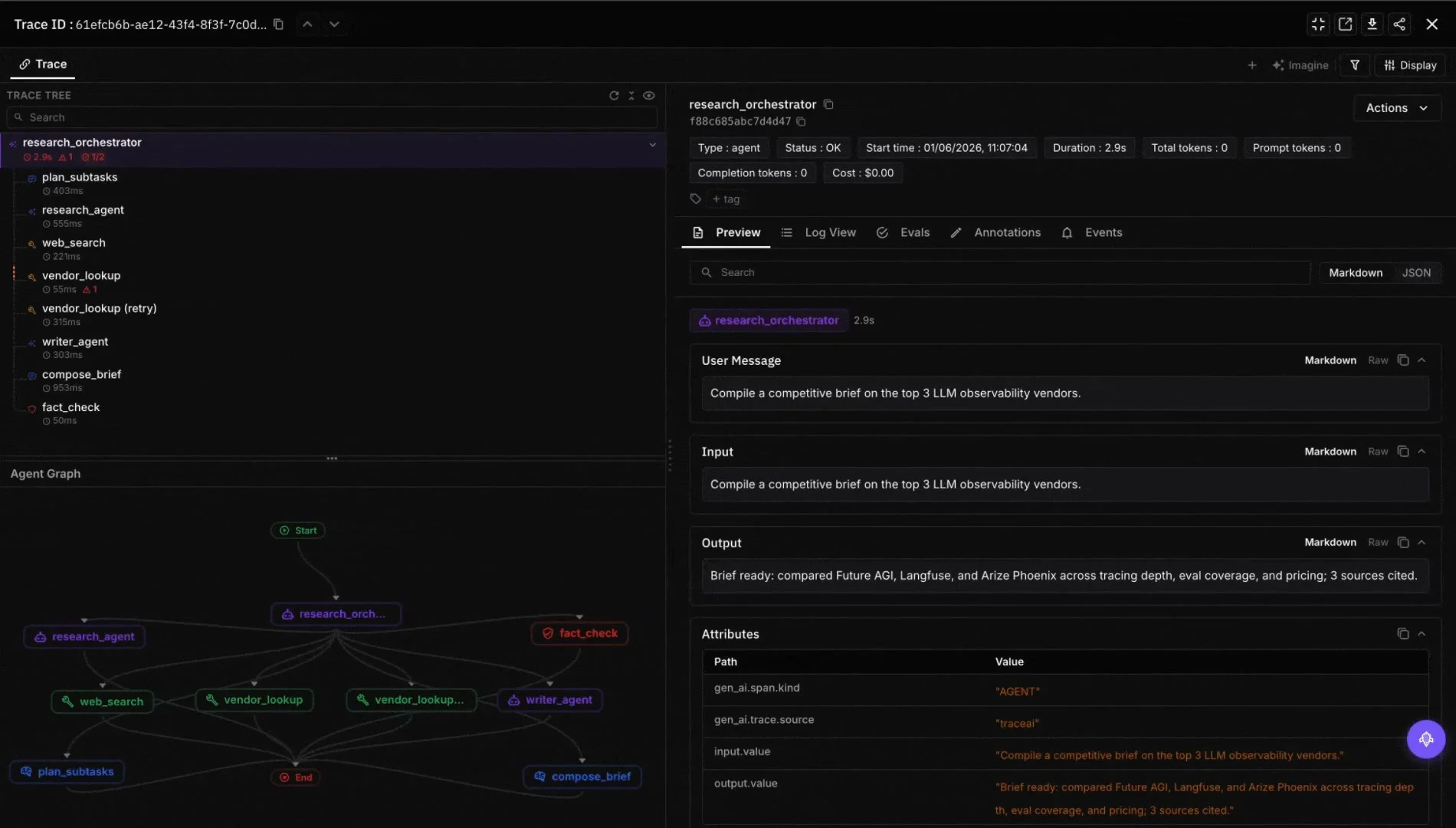
traceAI instruments 50+ AI surfaces across Python, TypeScript, Java, and C# (including Spring Boot starter, Spring AI, LangChain4j, Semantic Kernel) OpenInference-natively, and Error Feed. the part of the eval stack, the clustering and what-to-fix layer that feeds the self-improving evaluators, turns those traces into named issues with zero config: auto-clusters related agency-program failures (50 traces → 1 issue), auto-writes the root cause from the span evidence plus a quick fix plus a long-term recommendation per issue, and tracks rising/steady/falling trend per issue so constituent-facing copilot regressions get triaged like exceptions rather than buried in audit logs.
- Apache 2.0 single Go binary; the same binary runs inside GovCloud, Azure Government, or an air gapped SCIF.
- Self improving optimization closes the trace plus evaluate plus optimize plus route loop in one product, a rare combination in federal procurement.
- SPDX SBOM per release; Sigstore signed artifacts; no PyPI publishing token in the supply chain path, removing the failure mode that compromised LiteLLM 1.82.7 and 1.82.8.
Where it falls short for government. Future AGI Agent Command Center isn’t FedRAMP authorized in May 2026. FedRAMP Moderate is on the published roadmap, not in process at the JAB or with a sponsoring agency PMO at the time of writing. Hosted SaaS at gateway.futureagi.com/v1 is therefore a non federal information path or pilot posture today. The procurement path that works now is self host: install the Go binary inside an agency AWS GovCloud or Azure Government boundary and inherit the hyperscaler tenant. That closes the gap at the gateway layer but shifts operational responsibility to the agency CIO office. State the gap, don’t hide it.
from openai import OpenAI

client = OpenAI(
    api_key="$FAGI_API_KEY",
    # Self hosted inside an AWS GovCloud or Azure Government tenant.
    base_url="https://gateway.agency-internal.gov/v1",
)

# The gateway runs PII redaction, OMB M-24-10 use case capture,
# NIST AI RMF MEASURE evidence collection, and per request DoD
# Impact Level routing checks at the same network hop.
response = client.chat.completions.create(
    model="azure-openai/gpt-4o",
    messages=[{"role": "user", "content": "Summarise the benefits eligibility file."}],
)
Pricing and deployment. Apache 2.0 single Go binary, free to self host on agency infrastructure. Commercial Agent Command Center supports BYOC, on premises, and air gapped install with vendor support, with FedRAMP Moderate on the roadmap.
Verdict. The strongest open source friendly contender for federal AI gateway procurement in 2026, with the honest caveat that the FedRAMP authorization is on the roadmap rather than in hand. Agencies that need an Apache 2.0 binary they can audit line by line, run inside their own boundary, and operate with no required outbound dependency should put it at the top of the shortlist. Agencies that need FedRAMP authorized hosted SaaS today should evaluate AWS Bedrock or Azure AI Gateway alongside and revisit Future AGI’s hosted tier when the authorization lands.
Kong AI Gateway: Best for Already FedRAMP Authorized API Control Planes
Kong AI Gateway is the strongest pick for federal agencies and DoD programs that already operate Kong as their authorized API control plane, because it extends the same boundary to cover LLM traffic. Kong Gateway has a long history with federal API programs in AWS GovCloud; the AI Gateway product is a feature set on top of the same runtime.
Best for. Agencies already invested in Kong as the API control plane, federal contractors with a Kong centric microservices stack inside GovCloud, and program managers extending an existing FedRAMP boundary to LLM routing without a parallel proxy stack.
Key strengths.
- Inherits the Kong runtime already authorized inside the agency’s GovCloud or sponsoring agency boundary, collapsing the procurement timeline.
- Kong Mesh adds zero trust service to service traffic policy aligned with NIST 800 207 and OMB M-22-09; mTLS between microservices is part of the AU-2 audit log story.
- OpenTelemetry traces, Prometheus metrics, and SIEM integration (Splunk, Sentinel, Elastic) on the same plane the rest of the agency API traffic flows through.
- AI plugins for multi provider routing, prompt template enforcement, response caching, and rate limiting in the operational model existing Kong administrators already know.
- CycloneDX SBOM for Konnect releases plus supply chain attestation for the core gateway.
Where it falls short for government. Kong AI Gateway doesn’t hold its own standalone FedRAMP authorization as an AI specific service in May 2026. The story is “installed inside an agency boundary the agency has already authorized,” valid but a different posture than a Marketplace listing. The AI plugin set is younger than the Kong Gateway core. The native guardrail library is lighter than Future AGI’s 18+, so agencies usually wire third party PII and secret detection adapters in front. Konnect Enterprise pricing is opaque enough that procurement should pin the contract value before signing.
Pricing and deployment. Kong Gateway core Apache 2.0; Konnect Enterprise via Kong sales. Deployment in customer VPC, AWS GovCloud, Azure Government, or on premises.
Verdict. Best pick if the agency already runs Kong. Worst pick if not, because the operational footprint to stand up Kong solely for AI traffic exceeds installing Future AGI’s Go binary or LiteLLM.
LiteLLM: Best for Air Gapped SCIF and JWICS Deployments
LiteLLM is the Python first proxy that broke open the multi provider unified API category. For federal agencies it’s the most common air gap candidate: small runtime, offline friendly via pip wheel mirrors, Apache 2.0 outside the enterprise directory. After the March 24, 2026 PyPI compromise, the federal answer is “yes for self hosted commit pinned deployments inside an air gapped SCIF or JWICS where the agency holds the upstream model endpoint, no for vendor SaaS as a FedRAMP path.”
Best for. DoD contractors and IC agencies running air gapped Python first stacks, federal civilian SCIF deployments where the LLM endpoint is itself inside the classified boundary, and agency ML platform teams already running a FastAPI surface with enforceable commit pinning policy.
Key strengths.
- Broadest provider coverage on this list (20+ providers via six native adapters (OpenAI, Anthropic, Gemini, Bedrock, Cohere, Azure) plus OpenAI-compatible presets and self-hosted backends including self hosted Ollama and vLLM).
- Apache 2.0 outside the enterprise directory; trivial to fork or audit, the posture authorizing officials prefer for SCIF.
- Virtual keys with per key budgets and audit logging; native fit with Python observability stacks.
- Air gap installable via wheel mirrors and offline pip caches; no required outbound dependency once staged.
- Extensibility through custom adapters for agency PII detectors, DoD IL routing checks, and OMB M-24-10 use case capture.
Where it falls short for government. The March 24, 2026 PyPI compromise is the central issue. Versions 1.82.7 and 1.82.8 were published by TeamPCP after a PyPI publishing token was exfiltrated via a compromised Trivy GitHub Action in LiteLLM’s CI/CD. The malicious packages shipped a credential harvester, a Kubernetes lateral movement toolkit, and a persistent systemd backdoor; over 40,000 downloads before PyPI quarantined within roughly forty minutes (see the Datadog Security Labs writeup). Pin to 1.82.6 or earlier, scan dependency trees, rotate credentials, require supply chain attestation in writing. Python runtime is materially slower than a Go binary at high concurrency; SBOM and Sigstore attestation are younger than Future AGI’s; no vendor DPA on the OSS distribution.
Pricing and deployment. Apache 2.0 outside the enterprise directory; pip install or Docker self host. BerriAI’s commercial enterprise tier has SOC 2 Type I and ISO 27001, neither of which substitutes for FedRAMP.
Verdict. Still the broadest provider coverage on the list and the most common air gap candidate inside IC Python stacks. The March 2026 incident shifts it from “default pick” to “pin commits, audit the tree, require attestation in writing.”
AWS Bedrock Native Gateway: Best for AWS GovCloud First Agencies
AWS Bedrock isn’t a standalone AI gateway; it’s the AWS managed foundation model service that, for agencies already on AWS GovCloud, serves as the gateway feature set when paired with Bedrock Guardrails, Bedrock Agents, and CloudTrail plus S3 plus OpenSearch. The procurement path is the cleanest in this list: Bedrock in AWS GovCloud inherits GovCloud FedRAMP High and the DoD IL4 and IL5 PAs.
Best for. Agencies already on AWS GovCloud, federal contractors operating inside an AWS sponsoring agency boundary, and program managers who treat “FedRAMP authorized today” as the binding constraint.
Key strengths.
- AWS GovCloud Bedrock inherits FedRAMP High; the boundary is already authorized.
- DoD IL4 PA for a growing model list; IL5 endpoints available with a shorter model list than commercial Bedrock.
- Bedrock Guardrails provide content filters, denied topics, PII filters, word filters, and contextual grounding at the same hop as the model.
- CloudTrail captures every InvokeModel and InvokeAgent call; logs flow to S3 with FIPS 140-3 encryption; OpenSearch or Athena query the store for AU-2 and AU-12 evidence.
- ITAR clear under the AWS GovCloud Service Terms; GovCloud is US person operated in US territory by design.
- Integrated with IAM, KMS, VPC, PrivateLink; no additional gateway authorization paperwork.
Where it falls short for government. Bedrock isn’t an OpenAI compatible drop in; agencies standardized on the OpenAI API have to rewrite client code or shim in front. Bedrock Guardrails are competitive on what they cover, but the scanner family is shorter than Future AGI’s 18+ and the adapter ecosystem is narrower. Budgets and rate limits are per service and per region, not per virtual key across providers. The supply chain posture is mature but isn’t an SBOM an agency security team can audit line by line. There’s no air gap path, which disqualifies Bedrock for SCIF or JWICS.
Pricing and deployment. AWS service pricing; per token and per provisioned throughput on the GovCloud contract. Reference: AWS Bedrock security and compliance overview.
Verdict. The cleanest FedRAMP authorized procurement path today for agencies on AWS GovCloud. Place Future AGI Agent Command Center or Kong in front when OpenAI compat, per virtual key budgets, and a broader scanner library matter at the application layer.
Microsoft Azure AI Gateway: Best for GCC High and Azure Government Agencies
The Azure API Management AI Gateway feature is the Microsoft answer to LLM routing inside the FedRAMP authorized Azure Government and Microsoft 365 GCC High boundaries. APIM AI Gateway supports token rate limiting, semantic caching, load balancing across Azure OpenAI deployments, and prompt injection detection. Inside Azure Government it inherits FedRAMP High and the DoD IL5 PA; the Azure OpenAI in Azure Government Secret extension is a candidate path for IL6 workloads.
Best for. Microsoft 365 GCC High agencies on Azure Government, DoD programs running Azure OpenAI on IL5, and federal contractors inside an Azure sponsoring agency authorization.
Key strengths.
- Azure Government inherits FedRAMP High; APIM is in scope.
- DoD IL5 PA for in scope services including Azure OpenAI; Secret expansion supports a candidate IL6 path.
- Native CAC and PIV via Microsoft Entra ID, the cleanest AC-19 path across mobile and CAC enabled endpoints.
- Native integration with Azure Monitor, Log Analytics, and Microsoft Sentinel for AU-2 and AU-12 capture.
- ITAR coverage under the Azure Government Service Terms; US person operated in US territory by design.
- Routing through APIM keeps Azure OpenAI traffic inside the FedRAMP plus IL5 boundary.
Where it falls short for government. APIM AI Gateway is an Azure APIM feature, not an OpenAI compatible drop in for non Azure workloads; routing to Anthropic, Gemini, or self hosted Llama requires integration work and may exit the boundary inheritance for non Azure upstreams. The guardrail set (content filters plus prompt injection detection plus Azure AI Content Safety) is shorter than Future AGI’s 18+. No air gap path. Azure Government pricing is opaque enough that procurement should pin the contract value before signing. The supply chain posture is mature but isn’t a line by line auditable SBOM.
Pricing and deployment. Azure APIM pricing on the Azure Government contract; the AI Gateway feature is on existing APIM tiers.
Verdict. The cleanest FedRAMP plus IL5 path today for GCC High and Azure Government agencies routing Azure OpenAI. Choose Future AGI Agent Command Center self hosted inside Azure Government when multi provider routing, per virtual key budgets, and an 18+ scanner library matter more than native Microsoft integration.
The 2026 Federal AI Gateway Trust Cohort
Every federal AI gateway post currently ranking on Google is treating the 2025 and 2026 events as if they didn’t happen.
- OMB M-24-10 (October 28, 2024; minimum practices effective December 1, 2024). Every covered agency had to implement minimum risk management practices, designate a CAIO, and publish a use case inventory. Gateways have to capture the use case ID per request as evidence.
- EO 14110 rescission and EO 14179 (January 20 and 23, 2025). Policy posture shifted toward accelerated adoption with retained safety guardrails.
- OMB M-25-21 and M-25-22 (April 3, 2025). Federal use and federal acquisition guidance; procurement after April 3, 2025 is evaluated against M-25-22.
- AWS GovCloud Bedrock FedRAMP High plus IL4/IL5 path (2024-2025). The available model list is shorter than commercial Bedrock but the boundary is in hand.
- Azure OpenAI in Azure Government Secret expansion (2024-2025). Opens a candidate IL6 path for Secret classified workloads.
- LiteLLM PyPI compromise (March 24, 2026). Versions 1.82.7 and 1.82.8 via stolen publishing token; 40,000+ downloads in forty minutes before quarantine. Pin to 1.82.6 or earlier; require supply chain attestation in writing.
- Anthropic MCP STDIO RCE class (April 2026). Affects roughly 7,000 MCP servers and 150 million plus downstream downloads. Federal gateways routing MCP enforce least privilege, OAuth 2.1, and Streamable HTTP.
- Helicone into Mintlify (March 3, 2026) and Portkey acquisition by Palo Alto Networks (April 30, 2026, not closed). Both exit the federal shortlist until the integration plans are written and signed.
For the next 12 months, FedRAMP status, DoD IL routing rigor, license clarity for air gap, supply chain attestation, and acquisition independence are all part of the buying decision.
Government AI Gateway Picks by Buyer Profile in 2026
Buyer profile drives the pick more than the feature matrix.
| If you are a… | Pick | Why |
|---|---|---|
| Federal civilian agency running constituent services copilot on AWS GovCloud | Future AGI Agent Command Center self hosted, routing to AWS Bedrock | Apache 2.0 plus 18+ scanners plus OpenTelemetry audit logs inside an already authorized FedRAMP High boundary |
| GCC High or Azure Government agency on Azure OpenAI | Azure AI Gateway single provider; Future AGI Agent Command Center self hosted for multi provider | Native Entra ID CAC PIV plus Azure Monitor; multi provider exits Azure boundary inheritance |
| Agency already operating Kong Gateway | Kong AI Gateway | Extends an existing FedRAMP authorized boundary |
| DoD program on IL4 or IL5 using Bedrock | AWS Bedrock native with Future AGI in front for OpenAI compat | FedRAMP High plus IL4/IL5 PA inheritance with a broader application surface |
| IC SCIF or JWICS deployment, Python first | LiteLLM commit pinned to 1.82.6 or earlier | Air gappable; broadest provider coverage; commit pinning enforceable |
| DoD contractor on classified network, Go first | Future AGI Agent Command Center air gapped binary | Single Go binary, no outbound dependency, SBOM and Sigstore per release |
| Civilian agency pilot before authorization | Future AGI Agent Command Center self hosted | Apache 2.0; upgrade to BYOC or air gap when production authorization is in process |
| State or local government | Future AGI Agent Command Center self hosted | Apache 2.0 plus 18+ scanners; StateRAMP and TX-RAMP increasingly accept inherited boundary models |
Which AI Gateway Is Right for Your Agency in 2026?
Federal AI in 2026 is a stack: FedRAMP, DoD IL routing, NIST 800 53 Rev. 5 with the AI overlay, NIST AI RMF 1.0 evidence, OMB M-24-10 plus M-25-21 plus M-25-22 inventory and impact assessment, ITAR data sovereignty, and CISA Secure Software Self Attestation. The gateway has to fit inside an agency boundary, refuse to cross an IL boundary per request, retain logs to the records schedule, and survive the next supply chain incident without leaving an OIG trail.
Of the five gateways above, Future AGI Agent Command Center is the strongest open source friendly contender for the production case where the buying constraint is Apache 2.0 source plus 18+ built in scanners plus OpenTelemetry audit logs capturing the OMB M-24-10 use case ID per request plus single Go binary deployability inside an air gapped SCIF or an agency GovCloud or Azure Government tenant. FedRAMP Moderate is on the published roadmap rather than in hand today; we state that out loud because federal procurement doesn’t reward authorization fudging.
AWS Bedrock is the right call when “FedRAMP High in hand today” is the binding constraint on GovCloud. Azure AI Gateway is right on Azure Government with Azure OpenAI as the model endpoint. Kong is right when Kong is already the agency’s FedRAMP authorized API control plane. LiteLLM commit pinned is right for air gapped SCIF or JWICS.
Further reading: the Agent Command Center docs, the Protect docs for the ~67 millisecond enforcement budget (arXiv 2510.13351), and the Future AGI GitHub repo for the Apache 2.0 source.
Try Agent Command Center self hosted. OpenAI compatible routing, 18+ PII and data leakage guardrails, per virtual key budgets, and OpenTelemetry audit logs in one Apache 2.0 Go binary inside your agency GovCloud or Azure Government tenant.
Related reading
- Best 5 AI Gateways for Compliance Audit Trails in 2026, the compliance and audit-trail comparison
- Best 5 AI Gateways for LLM Cost Optimization in 2026, the five-layer cost stack and the 2026 trust cohort
- Best 5 AI Gateways for Customer Support in 2026: Latency Budgets, Agent Assist, and Voice AI Passthrough, the customer-support-specific gateway picks
- Best 5 AI Gateways for Cybersecurity in 2026: Prompt Injection Defense, Tenant Isolation, and SOC 2, the cybersecurity-specific gateway picks
Frequently Asked Questions
What Is the Best AI Gateway for Federal Agencies in 2026?
Does an AI Gateway Need FedRAMP Authorization Before an Agency Can Use It?
How Do DoD Impact Levels IL2, IL4, IL5, and IL6 Apply to LLM Routing?
What Does OMB Memorandum M-24-10 Require for AI in Federal Agencies?
Is an AI Gateway Allowed Inside a SCIF or on a Classified Network?
What Audit Log Retention Should an Agency Require From an AI Gateway Vendor?
Five AI gateways on what compliance officers actually need: tamper-evident logs, 3-10 yr retention, SIEM exports, span granularity, legal hold, frameworks.

Five AI gateways for cybersecurity in 2026 scored on prompt injection defense, tenant isolation, OWASP LLM Top 10, MITRE ATLAS, SOC 2.
Future AGI, Credo AI, Holistic AI, Datadog, Purview, Lakera Guard, Fairly AI compared on policy authoring, audit trails, runtime enforcement for agents.