Prompt Engineering Careers in 2026: Roles, Salaries, Skills, and Where the Jobs Are
Prompt engineering careers in 2026: actual job titles, illustrative salary ranges, the eight skills hiring managers test, and where to start.
Table of Contents
TL;DR: Prompt engineering careers in 2026
| Question | Short answer |
|---|---|
| Is the role still hiring? | Yes, but mostly as part of broader AI engineering roles |
| Typical 2026 base salary range (illustrative) | About 90,000 to 250,000 dollars depending on whether it is engineering-heavy or content-heavy |
| Senior AI engineer total comp at top US companies (per Levels.fyi crowdsourced data) | Often 250,000 to 500,000 dollars; staff and principal higher |
| Common hiring sectors | Enterprise software, financial services, healthcare, legal, government |
| Most-tested skill | Evaluation literacy: can you design and run an eval suite |
| Best entry move for non-engineers | Build and publish a domain-specific LLM project with evaluation results |
| Trend through 2027 | Prompt engineering folds into AI engineering and product roles |
Compensation figures in this article are illustrative. They are informed by crowdsourced data from Levels.fyi for senior AI engineer roles at large US tech employers and contextual labor-market data from the US Bureau of Labor Statistics for computer occupations. There is no authoritative public salary dataset specifically for the prompt engineer title; the ranges below reflect observed posting language and should be confirmed against current postings before negotiation.
What a 2026 prompt engineer actually does
The day-to-day work in a 2026 prompt engineering role splits into five activities.
The first is prompt design and iteration. That includes versioning prompts in source control, decomposing tasks into multi-step prompts, designing few-shot examples, defining structured output schemas, and running A/B tests on real traffic.
The second is evaluation. Maintaining a test dataset of 200 to 500 representative cases, defining the metrics that matter for the application, running the evaluators on every prompt change, and analyzing the regressions.
The third is retrieval and context engineering. Most applications above demo scale need retrieval, and the prompt engineer is often the person who decides how to chunk, what to embed, what to retrieve, how to rerank, and how to pass context to the model.
The fourth is agent and tool design when the application calls external tools. Defining function-calling schemas, deciding when to use single-shot prompts versus agent loops, and handling tool error cases.
The fifth is observability and debugging. Wiring the application to capture traces, attaching evaluator scores to those traces, and using the trace history to diagnose what changed when quality drops.
A pure prompt engineer who does only the first activity exists in some content and product roles. A senior prompt engineer or AI engineer is expected to do all five.
Salary bands by role and seniority in 2026
Compensation varies widely. The numbers below are drawn from publicly available sources and reflect ranges, not promises. Verify against current data before making decisions.
For dedicated prompt engineer postings in current 2026 US job listings, observed base salary ranges span from about 90,000 dollars at the entry and content-leaning end to about 250,000 dollars at the most engineering-heavy senior roles. Content-leaning roles cluster at the lower end; engineering-leaning roles cluster at the higher end. These are observed ranges from public postings, not a sampled survey. Confirm against current postings before negotiation.
For broader AI engineer and senior AI engineer roles, which is where most of the technical prompt engineering work now lives, Levels.fyi data for top US tech companies shows total compensation often in the 250,000 to 500,000 dollar range for senior individual contributors, with staff and principal levels going higher. Equity is a meaningful share at the top end.
Location matters. US compensation is typically the highest. UK, EU, and Singapore roles run lower but with strong demand. Remote-only roles span the full range depending on the company’s compensation policy.
Cohort effects matter too. Candidates with a published, evaluable project clear the resume bar much faster than candidates with credentials only.
The eight skills hiring managers actually test for
Interview processes for prompt engineering and AI engineer roles in 2026 consistently test for the eight skills in the itemList above. The interview structure varies, but the skills are stable.
Technical understanding of LLMs. Expect a 30 minute conversation about how transformers process context, what a context window is, why tokenization matters, and how to reason about why a prompt failed. The bar is not research-level depth, but the candidate has to be able to debug a model behavior from first principles.
Systematic prompt design and iteration. Expect a take-home or live exercise where the candidate has to design a prompt strategy for a real task. Hiring managers look for prompt versioning, structured output design, few-shot example selection, and a clear iteration log that shows what was tried and what worked.
Evaluation literacy. This is now the most commonly tested skill. The candidate is expected to design a test dataset, pick the right metrics, run an evaluation, and explain how to detect regressions. For the underlying discipline, see how to evaluate LLMs. The Future AGI ai-evaluation library (Apache 2.0) and Confident AI’s deepeval are common reference points.
from fi.evals import evaluate, Evaluator
from fi.evals.metrics import CustomLLMJudge
from fi.evals.llm import LiteLLMProvider

# Minimal sample inputs so the snippet is runnable end to end
response_text = "Paris is the capital of France."
retrieved_passages = [
    "Paris is the capital and most populous city of France."
]

# Hosted faithfulness check for a RAG application
faithfulness_score = evaluate(
    "faithfulness",
    output=response_text,
    context=retrieved_passages,
)

# Custom rubric for an application-specific metric
intent_satisfied = CustomLLMJudge(
    name="intent_satisfied",
    rubric=(
        "Score 1 if the response fully answers the user's question "
        "based on the retrieved context, 0 otherwise."
    ),
    provider=LiteLLMProvider(model="gpt-4o-mini"),
)

intent_evaluator = Evaluator(metrics=[intent_satisfied])
intent_result = intent_evaluator.evaluate(
    output=response_text,
    context=retrieved_passages,
)
Retrieval-augmented generation. Expect questions about chunking strategy, embedding model choice, hybrid search, reranking, and citation tracking. Candidates who have shipped a real RAG application have a big advantage over candidates who have only read about it.
Tool calling and agent design. Expect a question about when to use a single-shot prompt versus an agent loop, plus a design exercise for a multi-step tool-calling task. The OpenAI, Anthropic, and Google function-calling schemas are reference material.
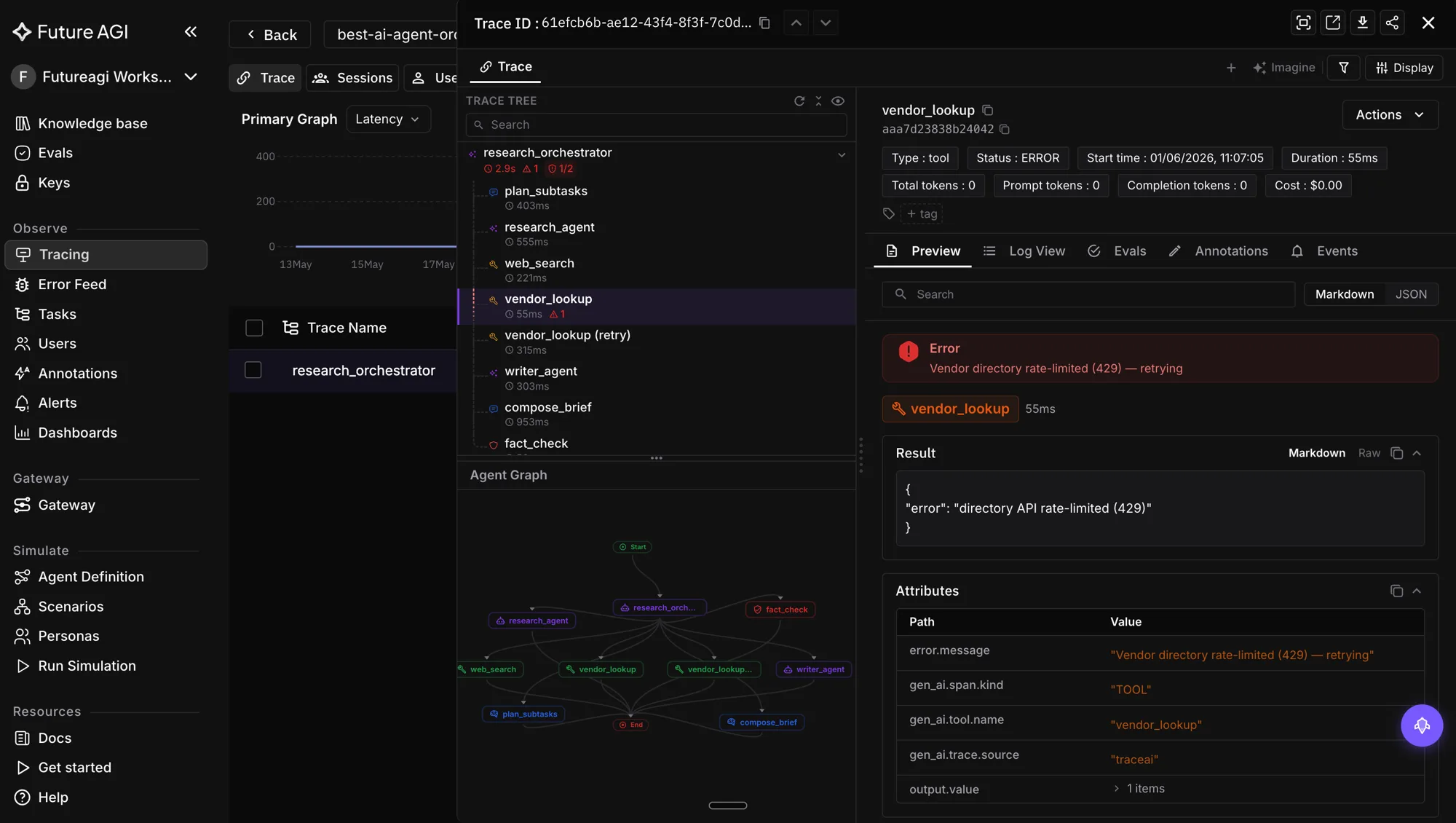
Observability and tracing. Expect questions about how the candidate would debug a regression in production. The strong answer involves capturing traces, attaching evaluator scores to spans, and walking back from the regression to the change that caused it. The Future AGI traceAI library is Apache 2.0 and is one of the common reference points.
Security awareness. Expect questions about prompt injection (direct and indirect through retrieved content), PII leakage, jailbreak detection, and basic mitigations. The OWASP Top 10 for LLM applications is the standard reference.
Domain specialization. Roles in regulated or technical domains expect at least working familiarity with the domain language and constraints. Pure “general purpose” prompt engineering roles still exist but are more common at content-heavy companies than at engineering-heavy ones.
Where the jobs are: five sectors commonly hiring for prompt-adjacent AI roles in 2026
Enterprise software. Every SaaS company is shipping AI features in 2026. The hiring volume is the largest, but the roles are usually titled AI engineer or applied AI engineer rather than prompt engineer.
Financial services. Banks and insurers are building customer-facing and internal LLM applications under significant regulatory constraint. The bar for evaluation and compliance is higher, and the compensation reflects it.
Healthcare. Diagnostic and patient-facing AI continues to grow under FDA software-as-a-medical-device rules. The pure prompt engineering work is paired with clinical safety review and FDA submission cycles.
Legal and professional services. Document automation has matured into a real product category. Hiring volume is strong, with a mix of dedicated AI roles and embedded AI work inside legal-tech teams.
Government and defense. Sovereign AI deployments are a meaningful share of the 2026 hiring story. Clearance requirements limit the candidate pool, which keeps compensation competitive.
Beyond the top five, retail and ecommerce, gaming, and education all hire prompt engineers in meaningful numbers, but the volume is lower.
How to build a 2026-ready prompt engineering portfolio
For candidates trying to break in, the published project is the differentiator.
The shape that works is: pick a domain you understand, define a real problem in that domain, build an LLM-powered solution end to end (retrieval if needed, tool calls if needed, structured output, evaluation), publish the code, the prompts, the test dataset, and the evaluation results.
The evaluation piece is what distinguishes a credible portfolio from a typical one. Two pieces of evidence matter: a test dataset that demonstrates the candidate’s judgment about what edge cases matter, and an evaluation suite that runs and produces scores.
Future AGI’s ai-evaluation library and traceAI are both Apache 2.0 and can be used for local instrumentation and self-hosted evaluation. The traceai-langchain, traceai-llama-index, and traceai-openai-agents packages cover the most common frameworks. The optional cloud-backed managed evaluators have their own pricing and require FI_API_KEY and FI_SECRET_KEY from a Future AGI project.
A portfolio project that includes a README walking through the prompt design, a versioned prompt directory, a test dataset, evaluation results, and a trace-based debugging story is the strongest signal a hiring manager can read in a 30-minute resume review.
How prompt engineering interacts with the broader AI engineering market
The macro trend through 2026 is that prompt engineering is being absorbed into adjacent roles.
AI engineer is the dominant umbrella title now. It covers prompt design, retrieval engineering, agent design, evaluation, observability, and production deployment. Most of the high-paid 2026 work that used to be advertised as “prompt engineer” is now advertised as AI engineer or senior AI engineer.
Applied scientist roles at frontier labs and at the top tech companies are pulling the research-leaning portion of the work. Applied scientists do prompt design as one input to broader research on model behavior.
AI product manager is the third absorbing role. AI PMs do prompt engineering work where it intersects with product decisions: what the model should and should not do, what evaluation criteria matter, what success looks like.
The implication for career planning is straightforward. Pick the parent role (AI engineer, applied scientist, AI PM, or stand-alone prompt engineer if a content-heavy company is the target) and stack prompt engineering as one of several core skills. The narrow specialization that worked in 2023 is not a long-term career strategy in 2026.
A practical learning path for 2026
Start with the basics: spend 20 to 40 hours getting fluent with one frontier model API (OpenAI, Anthropic, or Google) by building a small project.
Add evaluation: spend 10 to 20 hours getting fluent with one evaluation library (Future AGI’s ai-evaluation, or deepeval). Build a test dataset for your project, define the metrics that matter, and run the evaluators.
Add retrieval: build a RAG layer on top of your project using one of the common stacks (LangChain or LlamaIndex with a vector database like Pinecone, Weaviate, or pgvector).
Add observability: wire your project to traceAI or another OpenTelemetry-compatible backend so every model call is a trace.
Add agent and tool calls: extend your project to call at least one external tool through function calling.
Publish: write up the project as a public repository with prompts, code, dataset, evaluation results, and a README that walks through the decisions you made.
This path takes 80 to 160 hours for someone who is already comfortable with Python. The result is a portfolio that signals all eight of the skills hiring managers test for.
Where Future AGI fits for prompt engineers
Future AGI is not a career platform or a job board. It is a toolset prompt engineers use to evaluate, observe, and govern their LLM applications.
For the evaluation skill: the ai-evaluation library (Apache 2.0) provides a catalogue of evaluators across faithfulness, intent satisfaction, safety, and bias. See the Future AGI documentation for the current list.
For the observability skill: traceAI (Apache 2.0) provides framework-specific instrumentors that turn every model and tool call into a trace.
For the runtime governance skill: the Agent Command Center provides a managed gateway that runs the same evaluators as inline guardrails on production traffic.
The integration is one example of the kind of evaluation, observability, and governance stack hiring managers expect 2026 prompt engineers to be familiar with. Whether you use it or one of the alternatives (LangSmith, Arize, Braintrust, Langfuse) matters less than being able to reason about the stack.
Looking ahead to 2027 and beyond
The most likely path from here is that prompt engineering continues to be a core skill, the dedicated “prompt engineer” title shrinks, and the broader AI engineer / applied scientist / AI PM roles continue to absorb the work. The candidates who plan against that trend (by stacking skills rather than specializing narrowly) will see more options.
The second trend to plan against is that frontier model capability keeps moving. The prompt that works in 2026 may not be the prompt that works in 2027. The durable skill is not knowing the best prompt today, it is having the systematic process to find the best prompt for whatever the model is tomorrow.
Putting it together
Prompt engineering in 2026 is a legitimate, paying, growing career, but the job description is different from 2023. The work is more technical, the evaluation skill is now load-bearing, and most of the high-paid roles are under titles like AI engineer rather than prompt engineer.
If you are planning your career, pick the parent role you want (AI engineer, applied scientist, or AI PM), build a domain-specific portfolio project with evaluation, and treat prompt engineering as one of several stackable skills. The candidates who do this clear the bar fastest in 2026 hiring processes.
Further reading
For tactical prompt advice, see LLM prompts best practices 2025. For the tooling landscape around prompt operations, see top prompt management platforms and top 10 prompt optimization tools. For the deeper engineering view, see non-deterministic LLM prompts and AI LLM prompts and model evaluation.
References
- Levels.fyi salary data for AI and ML roles
- US Bureau of Labor Statistics, Computer and Information Technology occupations
- OWASP Top 10 for LLM Applications
- Future AGI ai-evaluation, Apache 2.0
- Future AGI traceAI, Apache 2.0
- Future AGI Agent Command Center
- Future AGI Cloud Evals documentation
- DeepEval by Confident AI
- OpenAI API documentation
- Anthropic API documentation
- Google Gemini API documentation
- LangChain documentation
Frequently Asked Questions
Is prompt engineering still a viable career in 2026?
What do prompt engineers actually earn in 2026?
Which industries are commonly hiring prompt engineers in 2026?
What skills do hiring managers actually test for in 2026?
Do I need to know how to code to be a prompt engineer in 2026?
What is the right starting move for a non-engineer who wants to break in?
Where does prompt engineering go in 2027 and beyond?
How does evaluation fit into the prompt engineer's day to day?
Nine LLM prompt format patterns for GPT-5, Claude Opus 4.7, and Gemini 3 in 2026. Copy-ready templates, an eval loop, and mistakes to avoid in production.

Top prompt management platforms in 2026: Future AGI, PromptLayer, Promptfoo, Langfuse, Helicone, Braintrust, OpenAI Prompts API. Compared.

Top 10 prompt optimization tools in 2026 ranked: FutureAGI, DSPy, TextGrad, PromptHub, PromptLayer, LangSmith, Helicone, Opik, DeepEval, Prompt Flow.