Top 10 Prompt Optimization Tools in 2026: FutureAGI, DSPy, TextGrad, PromptHub, PromptLayer Compared
Top 10 prompt optimization tools in 2026 ranked: FutureAGI, DSPy, TextGrad, PromptHub, PromptLayer, LangSmith, Helicone, Opik, DeepEval, Prompt Flow.
Table of Contents
A growth-team engineer ships a prompt change to a production support agent. The change adds one sentence to the system prompt. CSAT improves 4 points the first week. Three weeks later the finance team notices the per-query cost is up 22% because the new prompt also lengthens the agent’s responses. The engineer’s prompt was optimized for one metric (CSAT) and not the other (cost). This is what prompt optimization without a multi-metric harness looks like. This post is the 2026 picture: the ten tools that actually ship, the seven algorithms that drive them, and how FutureAGI Prompt Optimize ties optimization, evaluation, and tracing into one loop.
TL;DR: The 2026 prompt optimization landscape
| Tool | Algorithms | OSS? | Best fit |
|---|---|---|---|
| FutureAGI Prompt Optimize | 6 (Random Search, Bayesian Search, Meta-Prompt, ProTeGi, GEPA, PromptWizard) | ai-evaluation + traceAI Apache 2.0 (libraries); dashboard commercial | Optimize + evaluate + trace in one stack |
| DSPy | BootstrapFewShot, MIPROv2, COPRO, GEPA | Apache 2.0 | Programmatic pipelines (RAG, agents) |
| TextGrad | Textual-gradient updates | MIT | Research-grade aggressive optimization |
| PromptHub | Manual A/B + variant testing | No | Team collaboration, prompt marketplace |
| PromptLayer | Versioning, registry | No | Git-style prompt change control |
| LangSmith | Eval harness, no native optimizer | No | LangChain-native teams |
| Helicone | Auto-Improve panel | Apache 2.0 | OSS proxy with log-driven suggestions |
| Opik (Comet) | Agent Optimizer SDK (6 optimizers, incl. GEPA) | Apache 2.0 | Self-hosted optimize-on-your-own-traces |
| DeepEval | Eval-as-CI, no native optimizer | Apache 2.0 | Pytest-style prompt regressions |
| Microsoft Prompt Flow | Visual graph variants | MIT | Azure-native stacks |
If you only read one row: FutureAGI Prompt Optimize combines a six-algorithm optimizer, an eval template library, OTel tracing, and runtime guardrails in one product. Most other entries are strong at one of those four; FutureAGI is the integrated pick when you want them in a single stack.
What is prompt optimization, precisely
Prompt optimization is the search over a space of prompt variants for the one that maximizes a measurable metric on a representative dataset.
Three components:
- Search space: instructions, demonstrations (few-shot examples), output schemas, model temperature, model choice. Some tools optimize one; the strong ones optimize the joint.
- Metric: a number you can compute on a sample. Quality (accuracy, faithfulness, instruction-following), cost (tokens, dollars), latency, safety (refusal rate, guardrail pass rate). Most production setups optimize a composite.
- Algorithm: how the search proceeds. APE, OPRO, BootstrapFewShot, MIPRO, TextGrad, ProTeGi are the leading options in 2026.
Without all three, you have prompt engineering: a human picks variants and decides. Prompt optimization replaces the human’s variant selection with an algorithm and the human’s judgment with a metric.
The output is reproducible, version-controlled, and CI-gated. The output of prompt engineering is whatever the human wrote down last.
The algorithms you should know
APE (Automatic Prompt Engineer)
Zhou et al., 2022. The original. An LLM generates candidate prompts, scores each against a metric, and selects the best. Simple, effective, the baseline most other algorithms compare against.
OPRO (Optimization by PROmpting)
Yang et al., 2023 (arXiv:2309.03409). Uses an LLM as a black-box optimizer. At each step, the LLM sees a trajectory of (prompt, score) pairs and proposes the next prompt to try. Empirically strong on classification and math benchmarks.
DSPy BootstrapFewShot and MIPRO
Khattab et al., 2023 for DSPy; MIPRO is Opsahl-Ong et al., 2024. DSPy treats a program as a chain of modules; the optimizer searches the instructions and few-shot demonstrations of each module jointly. BootstrapFewShot is the entry-point optimizer; MIPRO (Multi-prompt Instruction PRoposal Optimizer) is the stronger 2024 compiler. Production-grade for RAG and agent pipelines.
TextGrad
Yuksekgonul et al., 2024. Textual gradients. Treats prompts as parameters and computes gradient-style edits using an LLM as the gradient oracle. Aggressive optimizer; compute-heavy; strong for research and high-stakes production cases.
ProTeGi (Prompt Optimization with Textual Gradients)
Pryzant et al., 2023. The academic ancestor of TextGrad. Iterative gradient-style prompt edits with beam-search expansion. Less polished than TextGrad but the foundational paper.
GEPA (Genetic-Pareto)
Agrawal et al., 2025 (arXiv:2507.19457), accepted to ICLR 2026 as an oral. GEPA is the one genuinely new entry on this list since the previous version of this article, and it changes the cost calculus.
Instead of scoring prompt variants as opaque numbers, GEPA reads the full execution trace of a failed run, writes a natural-language diagnosis of what went wrong, and proposes a targeted edit. It keeps a Pareto frontier of diverse candidates rather than collapsing to a single best-so-far, which is what stops it from getting stuck in one local optimum.
The reported results are the reason it matters. Across six tasks, GEPA beats GRPO by 6% on average and by up to 20%, while using up to 35x fewer rollouts, and beats MIPROv2 by more than 10%. The rollout reduction is the headline for anyone paying per token: reflection on a handful of traces gets further than brute-force sampling over thousands.
It ships as dspy.GEPA inside DSPy and as a standalone pip install gepa. FutureAGI ships it as one of the six optimizers on the Optimize surface. For a walkthrough of how it compares to the rest of the DSPy ladder, see DSPy Optimizers Explained.
Self-discover and self-refine variants
Older 2025-2026 algorithms (Self-Discover, Promptbreeder, Evoke) compose chains of LLM critics and editors. Quality varies; as of August 2026 they remain research-grade, and GEPA has largely absorbed the interest that was flowing toward this category.
A production stack picks 2 or 3 of these. FutureAGI Prompt Optimize ships six as algorithm choices on the same Optimize task surface: Random Search, Bayesian Search, Meta-Prompt, ProTeGi, GEPA, and PromptWizard.
The ten tools, ranked
#1: FutureAGI Prompt Optimize
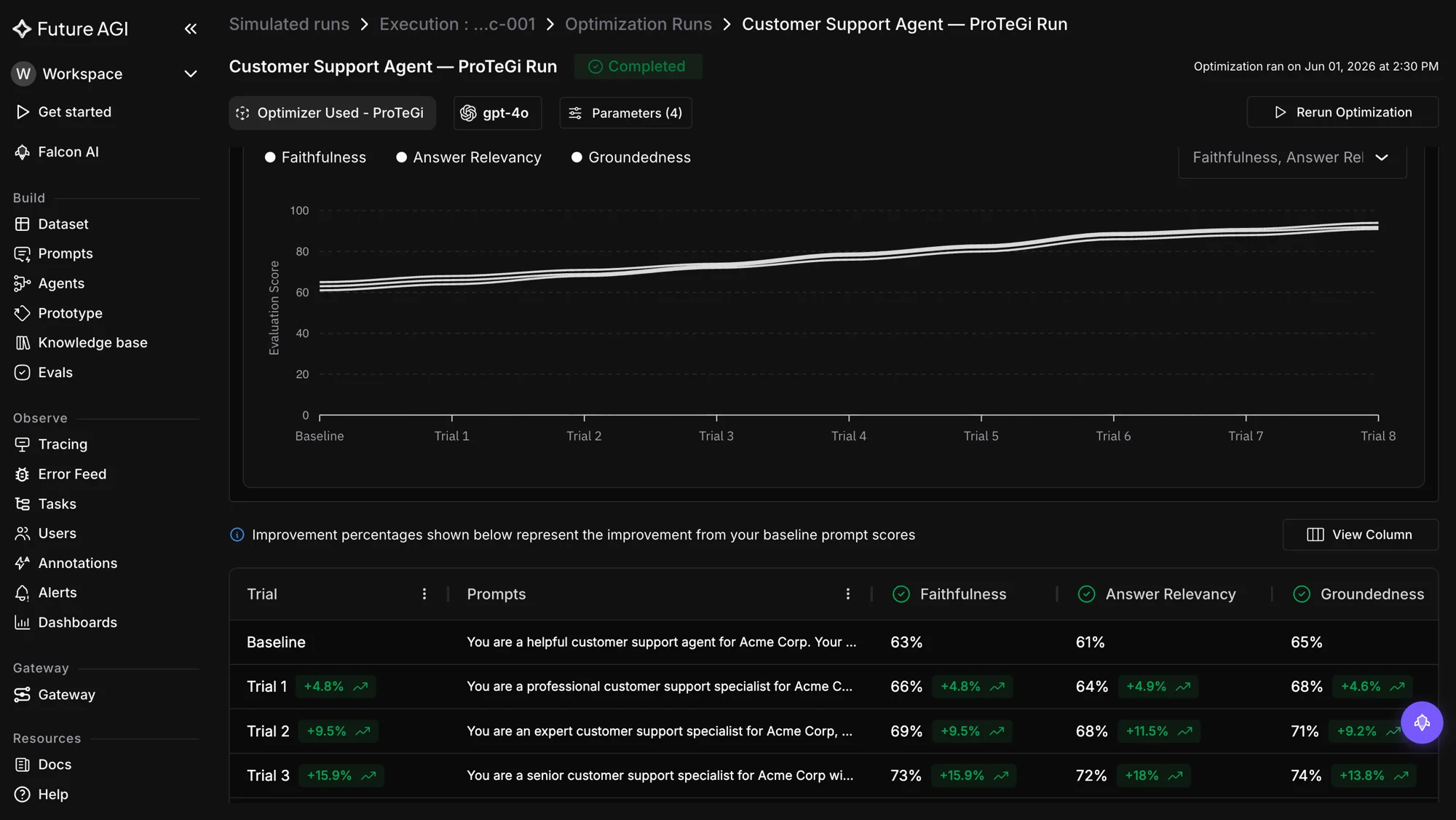
The integrated pick. FutureAGI’s Optimize module runs Random Search, Bayesian Search, Meta-Prompt, ProTeGi, GEPA, and PromptWizard against eval templates from the fi.evals library (50+ metrics including faithfulness, context_relevance, instruction_following, tone_check, hallucination, custom LLM judges). Every optimization run emits traceAI spans (Apache 2.0) so you see per-trial cost, latency, and quality side by side. The winning prompt deploys behind FAGI Protect (18+ runtime guardrails) so adversarial inputs do not regress the gain.
What makes it the #1 pick is the integration. Optimization, evaluation, tracing, and guardrails share the same data model and the same dashboard. Other tools own one or two of those; FutureAGI owns all four.
A free tier covers production-relevant credits, tracing, and gateway volume for evaluation runs. Paid tiers add higher limits, HIPAA, and SOC 2 for teams with compliance needs. Check the Future AGI pricing page for the current tiers and limits.
Docs: https://docs.futureagi.com/docs/optimization
#2: DSPy
Stanford’s programmatic prompt-optimization framework. DSPy treats prompts as part of a typed program and compiles the program against a metric. BootstrapFewShot for entry-point optimization; MIPRO for the stronger compiler; COPRO for instruction-only optimization.
DSPy is the right pick when the prompt is one component of a multi-step program (a RAG pipeline, an agent, a chain-of-thought solver) and you want the whole graph optimized jointly. The framework is Apache 2.0 and runs against any LLM provider.
Integration with FutureAGI: compile your DSPy program against fi.evals metrics, the runs show up in the FutureAGI dashboard with cost and quality scoring.
Repo: https://github.com/stanfordnlp/dspy
#3: TextGrad
Differentiable prompt optimization. TextGrad runs textual-gradient updates: an LLM acts as a gradient oracle, suggesting how to edit the prompt to reduce the loss. Aggressive optimizer; the cost is many LLM calls per optimization step.
The fit: research-grade optimization where compute is not the bottleneck and you want the strongest possible prompt for a fixed metric. Less mainstream than DSPy for production; stronger on hard benchmarks.
Repo: https://github.com/zou-group/textgrad
#4: PromptHub
Prompt management with versioning, A/B testing, team collaboration, and a marketplace of community prompts. PromptHub’s strength is workflow: multiple authors, comments, approvals, a registry of prompts ready to fork.
It is lighter on automated optimization (no APE/OPRO/DSPy under the hood) and stronger on the team and discovery surface. Pair it with a separate eval and optimizer if you need algorithmic search.
Site: https://www.prompthub.us/
#5: PromptLayer
Git-style prompt versioning. Every prompt edit is diffed, every model response is linked back to the exact prompt version, and the registry view shows latency and token trends. PromptLayer is the change-control system; the optimizer is your problem.
Fit: regulated teams that need an audit trail on every prompt change. Pair with DSPy or FutureAGI for the optimization layer.
Site: https://www.promptlayer.com/
#6: LangSmith
LangChain’s eval and prompt management surface. Trace inspection, dataset management, prompt playground, regression testing. No native algorithmic optimizer; the eval harness is the contribution.
Fit: teams already on LangChain who want a one-vendor pipeline. Trace + eval works well; for the optimization step, plug in DSPy (LangChain-DSPy integration is mature) or FutureAGI.
Docs: https://docs.smith.langchain.com/
#7: Helicone
Open-source LLM proxy. Logs every request, surfaces token and latency dashboards, and the Auto-Improve panel suggests prompt tweaks based on production logs. Apache 2.0 license; self-host or cloud.
Fit: cost-sensitive teams that want OSS observability and lightweight prompt suggestions. The optimizer is a recommendation surface, not a search algorithm.
Repo: https://github.com/Helicone/helicone
#8: Opik (Comet)
Opik replaces Humanloop on this list. Humanloop appeared in earlier versions of this article; Anthropic hired its founding team in August 2025 and the platform shut down on 8 September 2025, so it is no longer an option for anyone. If you are still on it, you have already migrated or you are running on nothing.
Opik is Comet’s open-source observability platform, Apache 2.0 and self-hostable, and Comet says the Agent Optimizer is included in all its subscription plans. Its Agent Optimizer SDK (pip install opik-optimizer) tunes prompts against the datasets, metrics, and traces you are already logging, and ships six optimizers: EvolutionaryOptimizer, FewShotBayesianOptimizer, GepaOptimizer, HRPO, MetaPromptOptimizer and ParameterOptimizer. Some workflows expect a Comet API key and workspace even when you self-host. That combination, traces you already have plus an optimizer that reads them, is the same loop FutureAGI runs, minus the guardrail layer.
Fit: teams that want the optimize-on-your-own-production-traces pattern entirely self-hosted.
Site: https://www.comet.com/site/products/opik/ · Repo: https://github.com/comet-ml/opik
#9: DeepEval
Pytest-style framework for LLM evaluation. 40+ research-backed metrics, CI integration, no GUI. DeepEval’s job is to fail your build when a prompt regression slips in; it is not a prompt optimizer per se.
Fit: engineering teams that want prompts under unit-test discipline. Pair with DSPy or FutureAGI for the optimizer half.
Repo: https://github.com/confident-ai/deepeval
#10: Microsoft Prompt Flow
Visual graph workflows in Azure AI Foundry (formerly Azure AI Studio). Drag LLM calls and Python nodes into a graph, run variants side-by-side, deploy to managed endpoints. MIT license, GitHub-hosted, Azure-deepest.
Fit: Azure-native stacks. The visual surface is friendly; the algorithmic layer is shallower than DSPy or FutureAGI.
Repo: https://github.com/microsoft/promptflow
Side-by-side comparison
| Tool | Algorithmic optimizer | Built-in eval | Real-time monitoring | Guardrails | License |
|---|---|---|---|---|---|
| FutureAGI | Yes (6 algorithms, incl. GEPA) | Yes | Yes (traceAI) | Yes (11 built-in + custom) | Agent Learning Kit + traceAI Apache 2.0 |
| DSPy | Yes (BFS, MIPROv2, COPRO, GEPA) | Via metric callbacks | No | No | Apache 2.0 |
| TextGrad | Yes (textual gradients) | Via judge | No | No | MIT |
| PromptHub | Manual A/B | Limited | Limited | No | Closed |
| PromptLayer | No | Limited | Yes | No | Closed |
| LangSmith | No | Yes | Yes | No | Closed |
| Helicone | Auto-Improve suggest | No | Yes | No | Apache 2.0 |
| Opik (Comet) | Yes (Agent Optimizer SDK) | Yes | Yes | Yes | Apache 2.0 |
| DeepEval | No | Yes | No | No | Apache 2.0 |
| Prompt Flow | Variant compare | Yes | Yes | No | MIT |
How to pick
Three questions:
- Are your prompts part of a multi-step pipeline? If yes, DSPy, with FutureAGI as the eval and observability layer (FutureAGI’s optimizer includes a DSPy-compatible algorithm). If single-prompt, any tool works.
- Do you have a metric and a dataset? If yes, the algorithmic tools (FutureAGI, DSPy, TextGrad) earn their keep. If no, start with PromptHub or PromptLayer for change control while you build the eval.
- Do you need observability, guardrails, and optimization in one place? If yes, FutureAGI is the integrated pick. Otherwise, stitch.
A reference workflow
- Define the metric. Pick one quality (faithfulness for RAG, instruction-following for agents, task accuracy for classifiers) and one cost (tokens per query). Build a dataset of 100 to 500 examples.
- Pick the algorithm. DSPy BootstrapFewShot is the fastest to a working prompt; MIPRO is the stronger compiler when you have the compute; FutureAGI Prompt Optimize ships all six as a dropdown.
- Run the optimizer. The output is a new prompt with measured improvement on the metric versus the baseline.
- Validate on a held-out set. The improvement on the train set is not the improvement in production.
- Wire the trace + eval at runtime. Every production call should emit a span and a per-call evaluator score so you know whether the optimization gain survives the move to real traffic.
- Add a guardrail. The optimizer maximizes the metric, not safety. FAGI Protect’s built-in guardrails catch the unsafe cases that the metric did not penalize.
- Schedule a re-run. Production data drifts; the prompt that won three months ago is not the prompt that wins today. A weekly or monthly re-optimization run keeps the lead.
Common failure modes
Overfitting to the eval set
The optimizer maximizes the score on the dataset you gave it. If the dataset is narrow, the prompt is brittle. The fix is three-part: train/dev/test splits, synthetic data variants, a human holdout for ship decisions.
Judge collapse
When the optimizer and the evaluator use the same LLM, the optimizer learns to game the judge. The fix is to use a different model for the judge than for the system under optimization, and to periodically calibrate the judge against human labels.
Composite-metric drift
Optimize on one metric; the other regresses. CSAT improves while cost rises. The fix is a composite metric (cost-per-correct-answer, faithfulness-at-cost-ceiling) that ties quality and cost into one number.
Production drift after deploy
The lab-best prompt regresses in production because traffic distribution shifts. The fix is a continuous re-evaluation loop on a sample of production traffic, with an alert when the score drops below the deploy threshold.
For depth on prompt eval design, see Best Prompt Engineering Tools 2026 and AB Testing LLM Prompts Best Practices 2026.
Where this is going in 2027
Three trends.
First, optimization expands beyond instruction-and-demo to model choice and tool selection. The optimizer picks not only the prompt but the LLM and the retriever and the re-ranker, jointly. Early systems are showing 10 to 20 percent cost reductions at constant quality.
Second, online prompt optimization grows. Today most optimization runs offline against a static dataset. The 2027 pattern is continuous optimization on a streaming sample of production traffic, with the deploy gate automated.
Third, the eval layer remains the bottleneck. Better optimizers do not help if the metric is wrong. Investment in evaluator quality (judge calibration, dataset coverage, human-in-the-loop sampling) is the highest-impact move in mid-2026.
How to start with FutureAGI Prompt Optimize
# pip install agent-opt
from fi.opt.base.evaluator import Evaluator
from fi.opt.datamappers import BasicDataMapper
from fi.opt.generators import LiteLLMGenerator
from fi.opt.optimizers import GEPAOptimizer

# 1. The evaluator: which eval template scores each candidate prompt
evaluator = Evaluator(
    eval_template="summary_quality",
    eval_model_name="turing_flash",
    fi_api_key="your_key",
    fi_secret_key="your_secret",
)

# 2. Map your dataset's field names onto what the evaluator expects
data_mapper = BasicDataMapper(
    key_map={"input": "article", "output": "generated_output"}
)

# 3. The generator that produces candidate outputs during the search
generator = LiteLLMGenerator(
    model="gpt-4o-mini",
    prompt_template="Summarize this: {article}",
)

# 4. Pick the algorithm by choosing its optimizer class
optimizer = GEPAOptimizer(
    reflection_model="gpt-4-turbo",   # required
    generator_model="gpt-4o-mini",
)

result = optimizer.optimize(
    evaluator=evaluator,
    data_mapper=data_mapper,
    dataset=dataset,
    initial_prompts=["Summarize this article concisely: {article}"],
    max_metric_calls=200,
)
dataset here is your own list of examples, typically 100 to 500 rows drawn from production traffic or generated with FutureAGI Simulation, with field names matching the key_map above.
Note that the algorithm is selected by class, not by a string argument: swapping GEPAOptimizer for RandomSearchOptimizer changes the search strategy while the rest of the setup stays identical. Each of the six algorithms has its own optimizer class and its own constructor arguments, so check the optimizer docs for the one you pick. Runs emit traceAI spans, and the dashboard surfaces per-trial cost, latency, and quality.
For setup and deeper docs, see https://docs.futureagi.com/docs/optimization.
Sources
- DSPy paper: https://arxiv.org/abs/2310.03714
- TextGrad paper: https://arxiv.org/abs/2406.07496
- APE paper (Zhou et al., 2022): https://arxiv.org/abs/2211.01910
- OPRO paper: https://arxiv.org/abs/2309.03409
- ProTeGi paper: https://arxiv.org/abs/2305.03495
- MIPRO paper: https://arxiv.org/abs/2406.11695
- GEPA paper (Agrawal et al., ICLR 2026 oral): https://arxiv.org/abs/2507.19457
- GEPA repository: https://github.com/gepa-ai/gepa
- FutureAGI optimization algorithms docs: https://docs.futureagi.com/docs/optimization
- Opik Agent Optimizer: https://www.comet.com/site/products/opik/features/automatic-prompt-optimization/
- Opik Optimizer SDK algorithms and install: https://github.com/comet-ml/opik/blob/main/sdks/opik_optimizer/README.md
- FutureAGI agent-opt Python SDK usage: https://docs.futureagi.com/docs/optimization/features/using-python-sdk
- Humanloop sunset announcement (8 September 2025): https://news.ycombinator.com/item?id=44592216
- FutureAGI Prompt Optimize docs: https://docs.futureagi.com/docs/optimization
- FutureAGI fi.evals: https://github.com/future-agi/ai-evaluation
- FutureAGI traceAI (Apache 2.0): https://github.com/future-agi/traceAI
- LangSmith docs: https://docs.smith.langchain.com/
- Helicone GitHub: https://github.com/Helicone/helicone
- DeepEval GitHub: https://github.com/confident-ai/deepeval
- Microsoft Prompt Flow: https://github.com/microsoft/promptflow
Frequently Asked Questions
What is prompt optimization in 2026 and why does it differ from prompt engineering?
Which prompt optimization tool should I pick in 2026?
What are the leading prompt optimization algorithms in 2026?
Does FutureAGI Prompt Optimize replace DSPy or work alongside it?
What metrics should I optimize a prompt against?
Can I optimize prompts without training data?
How does prompt optimization integrate with CI/CD in 2026?
What is the failure mode I should worry about with prompt optimization?

DSPy, FutureAGI Prompt Optimizer, PromptFoo, OpenAI Playground, Helicone Prompts, Braintrust Prompts, plus tradeoffs for 2026 prompt engineering workflows.


FutureAGI, Langfuse, OpenAI, Anthropic, PromptLayer, Helicone, and Vercel AI Playground for LLM prompt iteration in 2026. Diff, version, score, deploy.

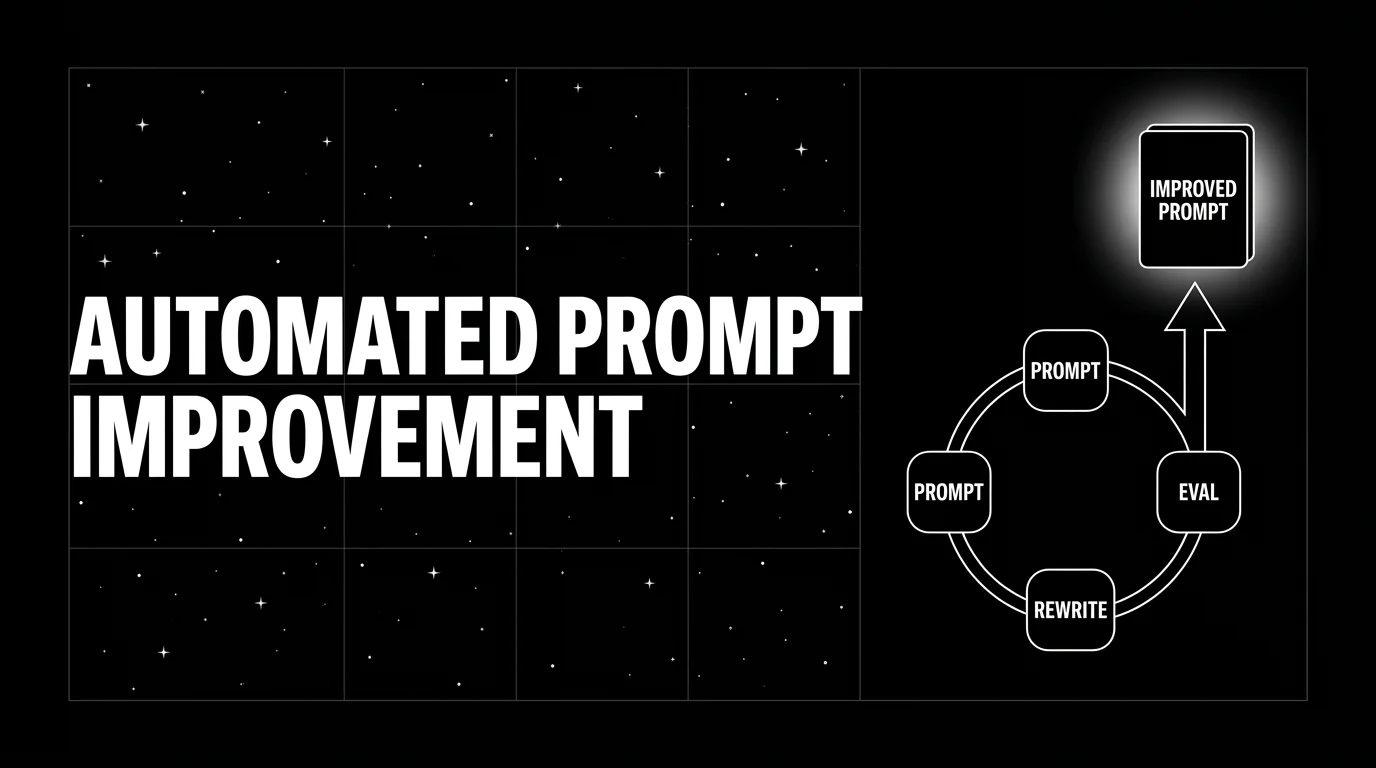
Automated prompt improvement in 2026 with six named optimizers (ProTeGi, GEPA, PromptWizard, MetaPrompt, BayesianSearch, RandomSearch) wired into CI.