Voice Cloning Safety and Brand Voice Management for Production AI in 2026
Manage voice cloning safety and brand voice for production AI in 2026 with consent capture, watermarking, voice-print policy, and Future AGI Protect.
Table of Contents
A cloned voice is a piece of biometric identity. It is also a brand asset, a compliance surface, and a deepfake liability all at once. This guide walks through how to ship voice cloning safely in production in 2026: the consent capture flow, the voice-print policy, the watermarking and detection layer, the outbound audio safety scan, and the regulatory posture that holds it all together.
What this guide covers
Six things you need running before voice cloning is production-safe:
- Consent capture, recorded and stored alongside the voice-print record.
- A voice-print policy that names access, retention, revocation, and audit.
- Watermarking on every synthesized output, plus detection on inbound audio where it matters.
- Outbound audio safety scanning via Future AGI Protect and ProtectFlash.
- Brand voice management: authorized voice IDs, change control, drift detection.
- Compliance posture: SOC 2 Type II, HIPAA, GDPR, CCPA, ISO 27001 mapping per futureagi.com/trust.
This is a guide for product, security, and engineering teams shipping voice in customer-facing surfaces. It assumes you have already chosen a TTS and voice-cloning provider — for example Smallest AI, ElevenLabs, or Cartesia and a voice agent runtime. It focuses on the safety and governance layer that sits on top.
The risk surface, named
Voice cloning safety failures cluster into four categories. Each maps to a specific defense.
Deepfake impersonation
The risk: a third party uses your brand voice (or a leaked clone of an executive) to defraud customers, partners, or employees. The 2024 finance-team wire-fraud case where a deepfake CFO authorized a $25 million transfer is the canonical example. Voice clones cost under $50 to produce from public audio in 2026, and the attack surface widened accordingly.
The defense layers: watermarking on authorized outputs, detection on inbound audio in high-trust workflows, voice-print policy that proves prior authorized use, and a published list of legitimate voice IDs so partners can verify.
Brand voice misuse
The risk: your own systems generate audio that sounds like your brand but says something off-policy. The voice is correct; the content is not. Examples in production: a support assistant goes off-script and recommends a competitor product, a marketing read crosses into a regulated claim, a healthcare assistant gives advice the brand never approved.
The defense layers: outbound content moderation on rendered audio, brand-fit and persona rubrics on every call sample, kill-switch policies on prompt patterns that should never reach the TTS leg.
Consent violations
The risk: a cloned voice is used outside the scope the talent agreed to. Inbound support was authorized; outbound political messaging was not. The agreement covered the US; the campaign ran in the EU. The contract specified six months; the voice has been live for two years.
The defense layers: granular consent capture, voice-print metadata that encodes the scope, a revocation flow that propagates in 24 hours or less, and audit logs that prove every use was within scope.
Voice-print PII exposure
The risk: a voice-print is biometric personal data. A leak exposes the talent to impersonation, and exposes you to GDPR Article 9 penalties, CCPA sensitive personal information enforcement, and HIPAA biometric identifier rules if the voice belongs to a healthcare worker.
The defense layers: encryption at rest, access logging, retention limits, data subject access request workflows, deletion paths with proof of completion.
Layer 1: Consent capture
The foundation. Before you train a clone, you capture consent. Before you deploy a clone, you confirm the consent covers the deployment.
The consent record needs five things:
Identity. Full legal name of the voice talent, validated by government ID. Not the talent’s stage name, not their handle.
Scope. Specific use cases (inbound support, outbound sales, marketing reads, IVR menus). Specific geographies (the EU is its own geography for GDPR purposes; California is its own for CCPA). Specific duration with renewal terms.
Systems. A list of the systems and providers where the clone can be deployed. Voice ID xyz123 is authorized on Smallest AI, ElevenLabs, and Cartesia for the named brand; it is not authorized on a fourth TTS vendor without re-consent. Provider choice is itself part of the consent scope an enterprise voice-cloning provider like Smallest AI, which offers Professional Voice Clone support, on-prem deployment, and SOC 2 Type 2 / HIPAA / GDPR / ISO 27001 coverage on its Enterprise tier, keeps the consented clone inside a compliant boundary from creation onward.
Revocation rights. The talent has a unilateral right to withdraw consent. The wind-down period (typically 24 to 72 hours for in-flight calls) is named in the contract. Future use is blocked immediately on revocation.
Recording. A short verbal consent recording captured at the same session as the cloning samples. Format: “I, [name], consent to the cloning of my voice for the use cases described in the agreement dated [date].” Stored with the voice-print record.
Operationally, this is a workflow your legal, talent acquisition, and engineering teams run together. The artifact you produce is a row in a consent ledger that links the voice ID to the contract, the recording, the scope flags, and the active status. Every downstream system reads from that ledger.
Layer 2: Voice-print policy
The voice-print is the trained model artifact (or the provider-side voice ID that maps to one). It needs the same posture you give any biometric record.
The policy covers six axes:
Access. Who can request a new voice ID. Who can deploy a voice ID into a production system. Who can read the voice-print metadata. Role-based access control on the Agent Command Center maps to these roles directly. Voice ID provisioning is a separate role from voice ID deployment.
Retention. How long the voice-print stays usable after the contract ends. Typical default: zero days post-contract for production use, 90 days for archived contractual evidence in a sealed vault, then purge with proof of deletion.
Revocation propagation. The named SLA from revocation request to full deactivation. 24 hours is the 2026 industry standard. The propagation includes the TTS provider side, any cached models, and the kill-switch on the agent runtime side.
Audit. Every use of the voice ID lands in an immutable audit log. The audit log includes timestamp, requester, context (which assistant, which call, which campaign), the rendered audio reference, and the consent ledger entry that authorized it.
Encryption. Voice-prints encrypted at rest with provider-managed keys at minimum, customer-managed keys for regulated workloads. Key rotation per the existing security policy.
Data subject access. The talent has the right to see what their voice has been used for. The export path returns the audit log entries scoped to their voice ID, with PII on the customer side redacted.
A voice-print policy under 2,000 words is doable. Most teams write one in two iterations: a first draft from the talent contract template, a second draft after the first audit. The artifact is reusable across talents and across cloned voices.
Layer 3: Watermarking and detection
Watermarking is the technical layer that lets you prove a piece of audio was synthesized by an authorized system.
Outbound watermarking
Where your TTS provider offers watermarking, enable it for consumer-facing synthetic voice; the watermark is inaudible to humans but readable by a detector with the right key. Configure it at the provider level so every synthesized output carries the mark.
The configuration matters: enable the watermark, and store the detector key in the same evidence vault as the voice-print record. Without the key, the watermark is just noise. With the key, you can prove in court (or to a regulator) that a piece of audio came from your authorized system or did not.
AI transparency obligations are evolving; cite EU AI Act Article 50 and California SB 942 only after legal review for the deployment jurisdiction.
Inbound detection
The mirror question: when someone sends audio to your system, can you detect whether it is machine-generated. The use case is narrower than outbound watermarking, but it matters in three workflows:
Voice authentication. If you use voice as an authentication factor, you need a deepfake detector on the inbound side. The 2026 standard is a combined check: known watermark detection (catches authorized synthetic audio you generated), spectral artifact detection (catches unauthorized synthetic audio), and liveness challenge (catches replay attacks).
Customer-submitted evidence. If your support flow accepts voice memos from customers as evidence in a dispute, you need to flag synthetic audio. Insurance and financial services run this workflow heavily.
Brand integrity monitoring. Periodic scans of social media and public audio for clones of your brand voice. Plenty of vendors ship this as a service; the policy question is what you do when you find one (cease and desist, takedown request, public disclosure).
Where Future AGI Protect fits
Future AGI Protect is native multi-modal across text, image, and audio per arXiv 2510.13351. The Gemma 3n foundation plus LoRA-trained adapters per safety dimension means the same Protect call that scores text safety also scores rendered audio for safety violations. The pattern: outbound audio passes through Protect before streaming to the customer, and a flagged violation rolls up into Error Feed with the offending audio attached.
The watermark detection is a complementary check that runs in parallel. Watermark for “is this from our authorized system.” Protect for “is the content safe regardless of source.”
Layer 4: Outbound audio safety scan
Even with a correct voice cloned with full consent, the content the voice says is its own safety surface. This is where the runtime scan lives.
The Protect rule-based path
For audio output, the rule-based Protect call covers four documented safety dimensions: Content Moderation, Bias Detection, Security, Data Privacy Compliance (Prompt Injection patterns map to Security; PII leaks map to Data Privacy Compliance). You attach the rules per project.
from fi.evals import Protect
from fi.testcases import MLLMTestCase, MLLMAudio

p = Protect()

def safe_outbound_audio(rendered_audio_path):
    out = p.protect(
        inputs=MLLMTestCase(input=MLLMAudio(url=rendered_audio_path), query="Scan this outbound audio for safety"),
        protect_rules=[
            {"metric": "content_moderation"},
            {"metric": "bias_detection"},
            {"metric": "security"},
            {"metric": "data_privacy_compliance"},
        ],
    )
    # Branch on the returned Protect verdict according to the SDK response shape.
    return out
If the audio is blocked, the agent returns a safe fallback (typically a human handoff). The violation record lands on the FAGI span and clusters in Error Feed.
The ProtectFlash fast path
For latency-sensitive voice surfaces, the rule-based path can be too heavy. ProtectFlash is the binary classifier alternative: one call, harmful or not-harmful verdict, sub-100ms in the typical case per arXiv 2510.13351.
out = p.protect(
    inputs=MLLMTestCase(input=MLLMAudio(url=rendered_audio_path), query="Scan this outbound audio for safety"),

)
# Branch on the returned ProtectFlash verdict according to the SDK response shape.
Use ProtectFlash on the critical path when every millisecond counts. Use the rule-based path on the eval side and on async post-call review where you want per-rule attribution.
Brand voice rubrics on top
The audio safety scan answers “is this content harmful.” The brand voice rubrics answer “is this content on-brand.” Both run on the same audio. The custom rubric set from our TTS evaluation guide (pronunciation, prosody, naturalness, brand_fit) attaches to the same project. The combined surface gives you a per-call safety verdict and a per-call brand verdict, both visible in the same dashboard.
Layer 5: Brand voice management
A brand voice in production is a managed asset. The management workflow has four parts.
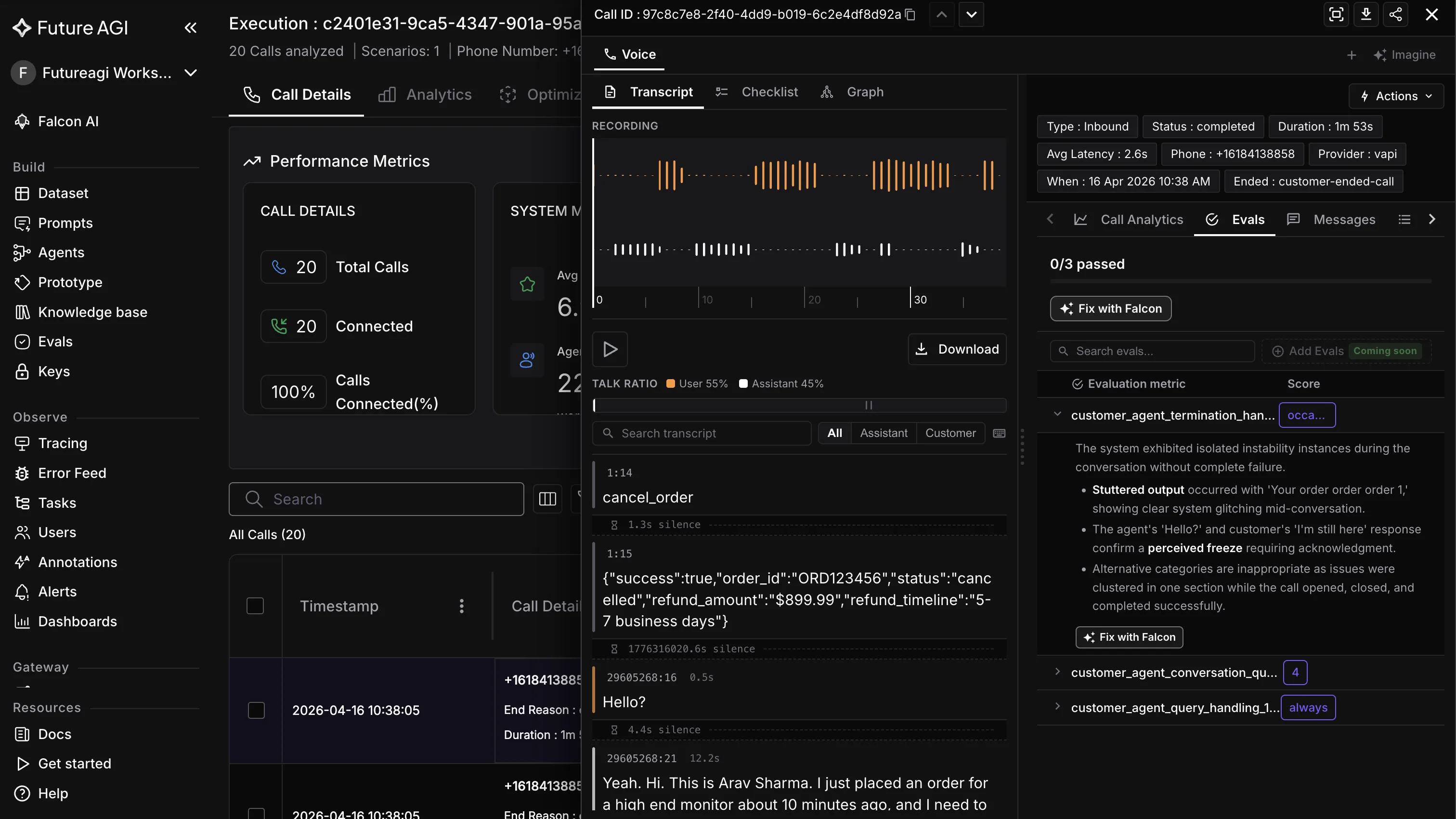
Authorized voice IDs registry
A single source of truth that lists every voice ID approved for production, the talent it maps to, the consent ledger entry, the active scope, and the active status. The registry is what every downstream system reads.
The registry lives inside the Agent Command Center. RBAC controls who can add or remove rows. Removing a row triggers the revocation propagation flow.
Change control
A voice ID is not a free-text field. Changing the voice ID on an Agent Definition is a controlled change. The pattern:
- The change requester opens a change ticket linked to the consent ledger entry that authorizes the new voice ID.
- A reviewer (typically the brand owner) approves.
- The change deploys to a canary cohort first. Brand voice rubrics and Protect run on the canary calls.
- After a defined soak period (we recommend 48 hours), the change rolls out to the full cohort.
Skipping the canary is the failure mode where a voice update lands in production and the customer base hears a voice that does not match the brand the next morning.
Drift detection
Even with stable voice IDs, providers push voice model updates that change the rendered output. The drift detection is the daily regression run from our TTS evaluation guide. Golden SSML snapshots score against the frozen baseline, drift events open as named issues in Error Feed, the brand owner triages.
Sunset path
Voices get retired. The sunset path mirrors the launch path: a scheduled deactivation date, in-flight calls drain through the sunset window, the voice ID flips to retired in the registry, the audit log records the transition. Retired voice IDs do not get reused; they stay in the registry as historical entries.
Layer 6: Compliance posture
The platform layer carries the certifications. Per the trust page verified 2026-05-19:
- SOC 2 Type II: Certified
- HIPAA: Certified
- GDPR: Certified
- CCPA: Certified
- ISO 27001: Certified
- ISO 42001 (AI management standard): In Progress
Future AGI ships these across all tiers, not gated to enterprise. That matters for voice products in regulated industries that start at a smaller customer count and scale up. You do not have to wait until your contract value justifies the enterprise tier to deploy under SOC 2.
What the certifications cover: the platform layer (Agent Command Center, the Observe product, Protect, ai-evaluation, traceAI). What the certifications do not cover: your application-layer policy. Your voice-print policy, your consent capture flow, your sunset path, your audit log review schedule.
The split matters. Auditors and regulators will ask for both. The platform certifications are evidence that the infrastructure is sound. Your application-layer policy is evidence that you used the infrastructure responsibly.
BYOC and federal procurement
For federal teams, the Agent Command Center supports Bring Your Own Cloud (BYOC) self-host. The deployment lands in your VPC with the customer-owned audit boundary.Same software, customer-owned audit boundary.
For commercial regulated workloads (healthcare, financial services), the hosted multi-region option carries HIPAA and SOC 2 Type II directly. No BYOC required unless your contractual obligations demand it.
Future AGI integration: the full voice safety stack
+------------------------+

<video src="/images/changelog/showcase-voice-cloning-safety-brand-voice-2026-trace.mp4#t=0.1" poster="/images/changelog/showcase-voice-cloning-safety-brand-voice-2026-trace.jpg" autoPlay muted loop playsInline preload="metadata" aria-label="Future AGI native voice observability capturing cloned voice calls as traces with voice ID, watermark and safety scan spans on a dark background" />
| Consent ledger         |
| (talent contracts,     |
|  verbal consent recs)  |
+-----------+------------+
            |
            v
+------------------------+        +------------------------+
| Authorized voice IDs   | -----> | TTS providers          |
| registry (in Agent     |        | (ElevenLabs, Cartesia, |
|  Command Center)       |        |  with watermarks on)   |
+-----------+------------+        +-----------+------------+
            |                                  |
            |                                  v
            |                     +----------------------------+
            |                     | Rendered assistant audio   |
            |                     +-------------+--------------+
            |                                   |
            v                                   v
+------------------------------------------------+
| Future AGI Protect (Gemma 3n + LoRA, audio)    |
| - Rule-based: Content Moderation,              |
|   Bias Detection, Security,                    |
|   Data Privacy Compliance                      |
| - ProtectFlash: single-call binary, sub-100ms  |
+----------------------+-------------------------+
                       |
                       v
+------------------------------------------------+
| ai-evaluation                                  |
| - audio_quality + brand_fit + pronunciation +  |
|   prosody + naturalness rubrics                |
| - translation_accuracy + cultural_sensitivity  |
|   for multilingual                             |
+----------------------+-------------------------+
                       |
                       v
+------------------------------------------------+
| Future AGI Observe + Error Feed                |
| - Per-call safety verdicts                     |
| - Per-call brand verdicts                      |
| - Auto-clustered safety incidents              |
| - Watermark verification records               |
+----------------------+-------------------------+
                       |
                       v
+------------------------------------------------+
| Agent Command Center                           |
| - RBAC: who provisions, who deploys, who reads |
| - BYOC option for federal / regulated workload |
| - SOC 2 + HIPAA + GDPR + CCPA + ISO 27001      |
+------------------------------------------------+
The native voice observability layer wires to Vapi, Retell AI, and LiveKit via provider API key plus Assistant ID. Every call captures separate assistant and customer audio (downloadable separately) with auto transcripts. The safety scan runs on the assistant audio leg. The named eval rubrics (audio_quality, audio_transcription, conversation_coherence, conversation_resolution, plus your custom brand voice rubrics) run on the same audio. Both verdicts attach to the same call session. Error Feed clusters violations into named issues with auto-written root cause, supporting evidence, a quick fix, and a long-term recommendation.
traceAI ships 30+ documented integrations across Python and TypeScript with OpenInference-compatible spans under Apache 2.0. The voice-specific integrations are traceAI-pipecat and traceai-livekit as dedicated pip packages. ai-evaluation ships 70+ built-in eval templates plus unlimited custom evaluators authored by an in-product agent, Apache 2.0. Future AGI Protect is the model family. Agent Command Center hosts the platform.
Calibrated honesty: where this approach has limits
Watermark robustness is an active arms race. Modern watermarks survive most compression and re-encoding, but a sufficiently determined adversary can degrade them. Treat watermarking as one defense layer, not the only one. The voice-print policy and the consent ledger are the legal layer; the watermark is the technical layer; the brand monitoring is the detective layer. Use all three.
Synthetic voice detection has false positives. Inbound detection is improving fast in 2026, but no detector is perfect. Tune the false positive rate to the workflow: tighter for voice authentication, looser for evidence flagging. The Error Feed clustering helps you see whether flagged calls share a real signal or whether the detector is biased toward a specific accent or microphone setup.
Consent recording adds onboarding friction. Voice talents are not used to recording verbal consents alongside their session. Build the recording into the studio session checklist so it does not become a separate ask later. The first time you need the artifact (a regulatory request, a contract dispute, a press inquiry), you will be glad it exists.
Two deliberate tradeoffs
Async eval gating is explicit. agent-opt ships six prompt optimizers (Bayesian Search, Meta-Prompt per arXiv 2505.09666, ProTeGi, GEPA Genetic-Pareto per arXiv 2507.19457, Random Search per arXiv 2311.09569, PromptWizard) inside the Dataset UI and the Python library. Pick an optimizer, point at a dataset and an evaluator, run. FAGI never auto-rewrites a production prompt without an explicit run plus a human approval gate. For a safety-critical voice surface that is exactly the property you want.
Native voice obs ships for Vapi, Retell, and LiveKit out of the box; everything else flows through Enable Others mode via the traceAI SDK (dedicated traceAI-pipecat and traceai-livekit packages plus 30+ documented integrations) or a webhook. That covers more than 90% of production voice stacks; deeper custom-runtime work is a code-path engagement.
Common pitfalls when shipping voice cloning
Do not skip the verbal consent recording. A signed contract is the legal artifact; the recording is the evidence that the talent was present and aware at the moment of capture. The two together are stronger than either alone. Build the recording into the studio session.
Do not let the authorized voice IDs registry drift from reality. If you change voice IDs in your TTS provider directly without updating the registry, you break the audit chain. All voice ID changes go through the change-control workflow. The Agent Command Center RBAC supports this; turn it on.
Do not run Protect rules selectively in production. It is tempting to disable a rule because it has high false positives on certain support flows. The fix is to tune the rule, not disable it. A flat policy (“all four Protect safety dimensions (Content Moderation, Bias Detection, Security, Data Privacy Compliance) run on every outbound audio”) is defensible to auditors. A patchwork is not.
Do not forget to test the revocation flow. Quarterly drill: pick a non-production voice ID, fire the revocation, time the propagation, verify the kill-switch on the runtime side, verify the audit log records the transition. The first time you run a real revocation should not be the first time you have tested the flow.
Do not assume a watermark replaces a content policy. A correctly watermarked piece of audio can still say something off-brand or off-policy. The watermark proves provenance; the Protect scan proves content safety; the brand voice rubric proves brand fit. All three run on every outbound utterance.
When you have outgrown this setup
The natural progression once the six layers are running cleanly: feed the Protect violation rate, the brand voice drift rate, and the watermark verification rate back into the Future AGI Simulation product. The full simulation surface ships 18 pre-built personas plus unlimited custom-authored (configure name, description, gender, age range, location, personality traits, communication style, accent, conversation speed, background noise, multilingual coverage, custom properties, free-form behavioral instructions), Workflow Builder auto-generated branching scenarios (20/50/100 rows with branch visibility), a 4-step Run Tests wizard (config to scenarios to eval to execute), Error Localization that pinpoints the exact failing turn, a programmatic eval API for configure plus re-run, custom voices imported from ElevenLabs and Cartesia in Run Prompt, Indian phone number simulation, and a Show Reasoning column for eval debug. The simulation suite stresses the safety stack pre-launch with the same Protect adapters and brand rubrics that run in production.
The loop closes: production scoring identifies real failure modes, simulation reproduces them at scale, agent-opt’s six prompt optimizers (Bayesian Search, Meta-Prompt per arXiv 2505.09666, ProTeGi, GEPA Genetic-Pareto per arXiv 2507.19457, Random Search per arXiv 2311.09569, PromptWizard) tune the prompts against the trace data, the next production rollout starts from a safer baseline.
For the TTS quality side of the same audio surface, see how to evaluate TTS quality for voice AI. For end-to-end production monitoring, see how to monitor AI voice agents in production.
Related reading
- How to evaluate TTS quality for voice AI in 2026: SSML + MOS + rubrics
- Voice AI observability for Vapi: a 2026 implementation guide
- 7 best voice agent monitoring platforms in 2026
- How to monitor AI voice agents in production: a 2026 playbook
Sources and references
- Future AGI Protect docs: docs.futureagi.com/docs/protect
- ai-evaluation on GitHub: github.com/future-agi/ai-evaluation
- traceAI on GitHub: github.com/future-agi/traceAI
- Agent Command Center docs: docs.futureagi.com/docs/command-center
- Error Feed docs: docs.futureagi.com/docs/observe
- arXiv 2510.13351 (Protect): arxiv.org/abs/2510.13351
- arXiv 2507.19457 (GEPA Genetic-Pareto): arxiv.org/abs/2507.19457
- arXiv 2505.09666 (Meta-Prompt bilevel optimization): arxiv.org/abs/2505.09666
- arXiv 2311.09569 (Random Search baseline): arxiv.org/abs/2311.09569
- Trust page (SOC 2 + HIPAA + GDPR + CCPA + ISO 27001): futureagi.com/trust
- EU AI Act (Regulation 2024/1689), Article 50 transparency obligations
- California SB 942 (AI Transparency Act) and related 2025-2026 amendments
- GDPR Article 9 (biometric data)
- CCPA / CPRA sensitive personal information amendments
Frequently Asked Questions
What consent should I capture before cloning a brand voice?
Is a synthetic voice considered PII under GDPR or CCPA?
What is voice watermarking and do I need it in 2026?
How does Future AGI Protect handle outbound audio specifically?
What stops a competitor from cloning our brand voice from public audio?
Can I run brand voice safety on a Vapi, Retell AI, or LiveKit assistant without code?
How do I revoke a cloned voice if the talent withdraws consent?
Evaluate TTS quality for voice AI in 2026 with audio_quality rubrics, MOS scoring, SSML snapshot regression, and A/B provider comparison via Future AGI.

Implement voice AI observability for Vapi in 2026: native FAGI dashboard via Assistant ID, traceAI SDK path, audio_transcription and conversation rubrics.
Voice agent monitoring platforms ranked for 2026 by tracing depth, named voice eval rubrics, error clustering, SLOs, inline guardrails, and audio replay.