Time Series Data Analysis: Forecasting Frameworks, Foundation Models, and When to Use Each (2026 Update)
Time series data analysis in 2026: Prophet, Darts, statsforecast, neuralforecast, TimesFM, Chronos. Code, benchmarks, when to use each model.
Table of Contents
TL;DR Time Series Data Analysis in 2026
| Use case | Best pick |
|---|---|
| Quick business forecast | Prophet |
| All-in-one Python lib | Darts |
| Fast statistical or ML at scale | Nixtla statsforecast and mlforecast |
| Deep learning forecasting | NeuralForecast (NHITS, NBEATS, PatchTST, TFT) |
| Zero-shot foundation model | TimesFM (Google) or Chronos (AWS Labs) |
| Anomaly detection | PyOD, ADTK, Darts anomaly detectors |
| Probabilistic intervals | NeuralForecast, GluonTS |
| Explanation and reporting | Pair numerical model with LLM (e.g., Claude, GPT, Gemini) |
| Hierarchical and grouped forecasts | hierarchicalforecast (Nixtla) |
What Time Series Analysis Looks Like in 2026
Time series data is any sequence of observations ordered in time: a stock price, a server CPU metric, a daily order count, a smart-meter reading every 15 minutes. The job of time series analysis is to:
- Decompose the signal into trend, seasonality, cycle, and residual.
- Detect anomalies that deviate from the expected pattern.
- Forecast future values along with their uncertainty.
- Attribute changes to drivers (changepoints, exogenous variables).
In 2026 the toolkit splits into four tiers. Each has a place; the trick is knowing which to reach for first.
| Tier | Examples | When to use |
|---|---|---|
| Classical statistical | ARIMA, ETS, TBATS, theta | Stationary or near-stationary, single-series, interpretability |
| Machine learning | XGBoost, LightGBM with lag and calendar features | Tabular forecasting at scale, exogenous variables |
| Deep learning | NHITS, NBEATS, PatchTST, TFT, DeepAR | Long horizons, complex seasonality, multivariate, probabilistic |
| Foundation models | TimesFM, Chronos, Moirai, Lag-Llama | Zero-shot baselines, low-data settings, broad coverage |
What’s New on the 2026 Forecasting Stack
Three trends shape the 2026 landscape:
- Foundation models for time series went mainstream. TimesFM from Google Research, Chronos from AWS Labs, Moirai from Salesforce, and Lag-Llama all shipped open weights for zero-shot forecasting, with successive releases pushing the state of the art on the Monash benchmarks.
- Nixtla’s ecosystem consolidated the practitioner stack. statsforecast, mlforecast, neuralforecast, hierarchicalforecast, and the unified
nixtlaclient cover the most-used patterns with consistent APIs. - LLM-explanation overlays got production-ready. LLMs do not beat purpose-built models at the numerical task, but they are the right tool to translate a forecast into a business narrative, flag anomalies in natural language, and answer ad-hoc analyst questions. Treat them as the explanation layer above your numerical model.
Tier 1: Classical Statistical Methods
ARIMA and its cousins remain the right starting point for stationary, single-series problems with a few hundred to a few thousand observations. They are fast, interpretable, and tough to beat on small data.
The fastest path in 2026 is statsforecast:
import pandas as pd
from statsforecast import StatsForecast
from statsforecast.models import AutoARIMA, AutoETS

df = pd.DataFrame({
    "unique_id": ["series_a"] * 100,
    "ds": pd.date_range("2024-01-01", periods=100, freq="D"),
    "y": range(100),
})

sf = StatsForecast(
    models=[AutoARIMA(season_length=7), AutoETS(season_length=7)],
    freq="D",
)
forecasts = sf.forecast(df=df, h=14)
Strengths: minutes to fit thousands of series. Interpretable. Strong baseline. Weaknesses: Single-variate, weak with multiple seasonality, no exogenous variables in plain ARIMA.
Tier 2: Machine Learning Forecasting
Feature-engineered tabular ML wins when you have many series, exogenous variables, and large datasets. The pattern: build lag features, calendar features, holiday flags, then train a gradient-boosted tree.
import pandas as pd
from mlforecast import MLForecast
from mlforecast.lag_transforms import RollingMean
from lightgbm import LGBMRegressor

mlf = MLForecast(
    models=[LGBMRegressor()],
    freq="D",
    lags=[7, 14, 28],
    lag_transforms={7: [RollingMean(7)]},
    date_features=["dayofweek", "month"],
)
mlf.fit(df)
forecasts = mlf.predict(h=14)
Strengths: handles exogenous variables naturally, fast at scale, well-understood feature engineering. Weaknesses: needs manual feature design, no native probabilistic output without quantile regressors.
Tier 3: Deep Learning
For long horizons, complex seasonality, multivariate signals, or probabilistic forecasts, deep learning takes over. The current 2026 stack:
- NHITS and NBEATS: pure MLP architectures with hierarchical interpolation; strong default for medium-length series.
- PatchTST: transformer with patching; strong for long-horizon multivariate.
- TFT (Temporal Fusion Transformer): best for interpretable multivariate with static and time-varying covariates.
- DeepAR: probabilistic autoregressive RNN; production workhorse at Amazon.
from neuralforecast import NeuralForecast
from neuralforecast.models import NHITS, PatchTST

nf = NeuralForecast(
    models=[
        NHITS(input_size=28, h=14, max_steps=500),
        PatchTST(input_size=28, h=14, max_steps=500),
    ],
    freq="D",
)
nf.fit(df=df)
forecasts = nf.predict()
Strengths: complex patterns, probabilistic intervals, multivariate. Weaknesses: GPU cost, slower iteration, easy to overfit on small data.
For probabilistic forecasting and broader algorithm coverage see also GluonTS and Darts.
Tier 4: Foundation Models for Time Series
The 2026 entrants. These are transformer architectures pretrained on huge time series corpora, ready for zero-shot forecasting.
| Model | Source | Weights | Zero-shot |
|---|---|---|---|
| TimesFM | Google Research | Open (HF) | Yes |
| Chronos | AWS Labs | Open (HF) | Yes |
| Moirai | Salesforce | Open (HF) | Yes |
| Lag-Llama | IBM and team | Open (HF) | Yes |
Quick start with Chronos:
import pandas as pd
import torch
from chronos import ChronosPipeline

pipeline = ChronosPipeline.from_pretrained(
    "amazon/chronos-t5-large",
    device_map="cuda" if torch.cuda.is_available() else "cpu",
    torch_dtype=torch.float16,
)

context = torch.tensor([1.0, 2.0, 3.0, 4.0, 5.0, 6.0, 7.0])
forecast = pipeline.predict(context=context, prediction_length=12)
print(forecast.shape)  # (1, 20, 12) num_samples by horizon
When to use foundation models:
- You need a strong baseline fast on new data
- You do not have enough historical data to train a deep model
- You want one model that works across many heterogeneous series
When to skip them:
- You have large in-domain data; a tuned deep model usually wins on accuracy
- You need quantitative interpretability per feature
- Latency or cost matters and your existing classical model is “good enough”
Anomaly Detection in Time Series
Anomaly detection in 2026 splits into:
- Statistical: rolling median absolute deviation, Tukey fences, STL decomposition residuals
- Forecast-residual: predict, compute residual, flag when residual exceeds threshold
- Density-based: isolation forest, LOF, autoencoders, PyOD catalog
- Foundation-model-based: use Chronos or TimesFM forecasts as a baseline and flag deviations
Darts ships a unified anomaly detection API:
from darts import TimeSeries
from darts.ad import KMeansScorer, QuantileDetector
from darts.models import ARIMA

series = TimeSeries.from_dataframe(df, time_col="ds", value_cols="y")
model = ARIMA(p=12, d=1, q=0)
model.fit(series)
predictions = model.predict(len(series))

scorer = KMeansScorer(k=2, window=7)
scores = scorer.score_from_prediction(actual_series=series, pred_series=predictions)
detector = QuantileDetector(high_quantile=0.95)
anomalies = detector.detect(scores)
Evaluation: What to Measure
For point forecasts:
| Metric | Use when |
|---|---|
| MAE | Symmetric error, robust to outliers |
| RMSE | Penalize large errors more |
| MAPE | Scale-free, but breaks on zeros |
| sMAPE | Bounded symmetric MAPE |
| MASE | Scale-free, compare across series |
For probabilistic forecasts:
| Metric | Use when |
|---|---|
| CRPS | Continuous, proper score for distributions |
| Pinball loss | Quantile-specific accuracy |
| Coverage | Empirical vs nominal prediction interval coverage |
Always benchmark against:
- Naive: last observation
- Seasonal naive: last value at same season
- Exponential smoothing: ETS auto-fit
If you cannot beat naive plus seasonal naive plus ETS on cross-validation, your fancier model is not earning its complexity cost.
Cross-Validation Done Right
Random k-fold leaks information. Use time-aware cross-validation:
from statsforecast import StatsForecast
from statsforecast.models import AutoARIMA

sf = StatsForecast(models=[AutoARIMA()], freq="D")
cv_results = sf.cross_validation(
    df=df,
    h=14,           # forecast horizon
    n_windows=4,    # number of rolling windows
    step_size=14,
)
Rolling-origin or expanding-window splits respect the temporal structure of the problem. The most recent period stays held out until final evaluation.
LLMs in a 2026 Time Series Stack
LLMs are not a forecasting tool. They are an explanation, orchestration, and reporting tool. Two patterns work well:
Forecast narrative generation
Run your tuned numerical model, then ask an LLM to translate the result for a non-technical reader:
from openai import OpenAI

client = OpenAI()

prompt = f"""
You are an analyst. Given the forecast below, write a 3-sentence narrative
for a retail operations lead. Highlight expected demand, uncertainty, and
risk drivers.

Forecast (next 14 days mean and 80 percent interval):
{forecast.to_dict()}
"""

resp = client.chat.completions.create(
    model="gpt-5-2025-08-07",
    messages=[{"role": "user", "content": prompt}],
)
print(resp.choices[0].message.content)
Agentic forecasting workflows
A multi-step agent that loads data, picks a model, fits, forecasts, and writes a report. Frameworks like LangChain, LangGraph, and CrewAI orchestrate the tool calls. See Agentic AI frameworks for the broader landscape.
Industry Applications in 2026
Retail and demand forecasting
Hierarchical forecasting at SKU times store times day grain. hierarchicalforecast reconciles forecasts so they sum consistently across the hierarchy. Foundation models give strong cold-start on new SKUs.
Energy and grid
Probabilistic forecasts with prediction intervals. NeuralForecast or DeepAR for half-hourly demand. PatchTST shines on multi-day horizons.
Healthcare
Vital-sign monitoring, length-of-stay, ICU readmission. Standardize signals, handle missing data carefully, and prefer interpretable models for clinician acceptance.
Cloud capacity and SRE
CPU, memory, request-rate forecasting. Foundation models work well here because the data is high-volume and short-tail seasonal.
Finance
Volatility forecasting (GARCH, realized volatility), regime detection. LLMs add news and earnings call text on top of price series.
When You Combine Time Series Models With LLMs
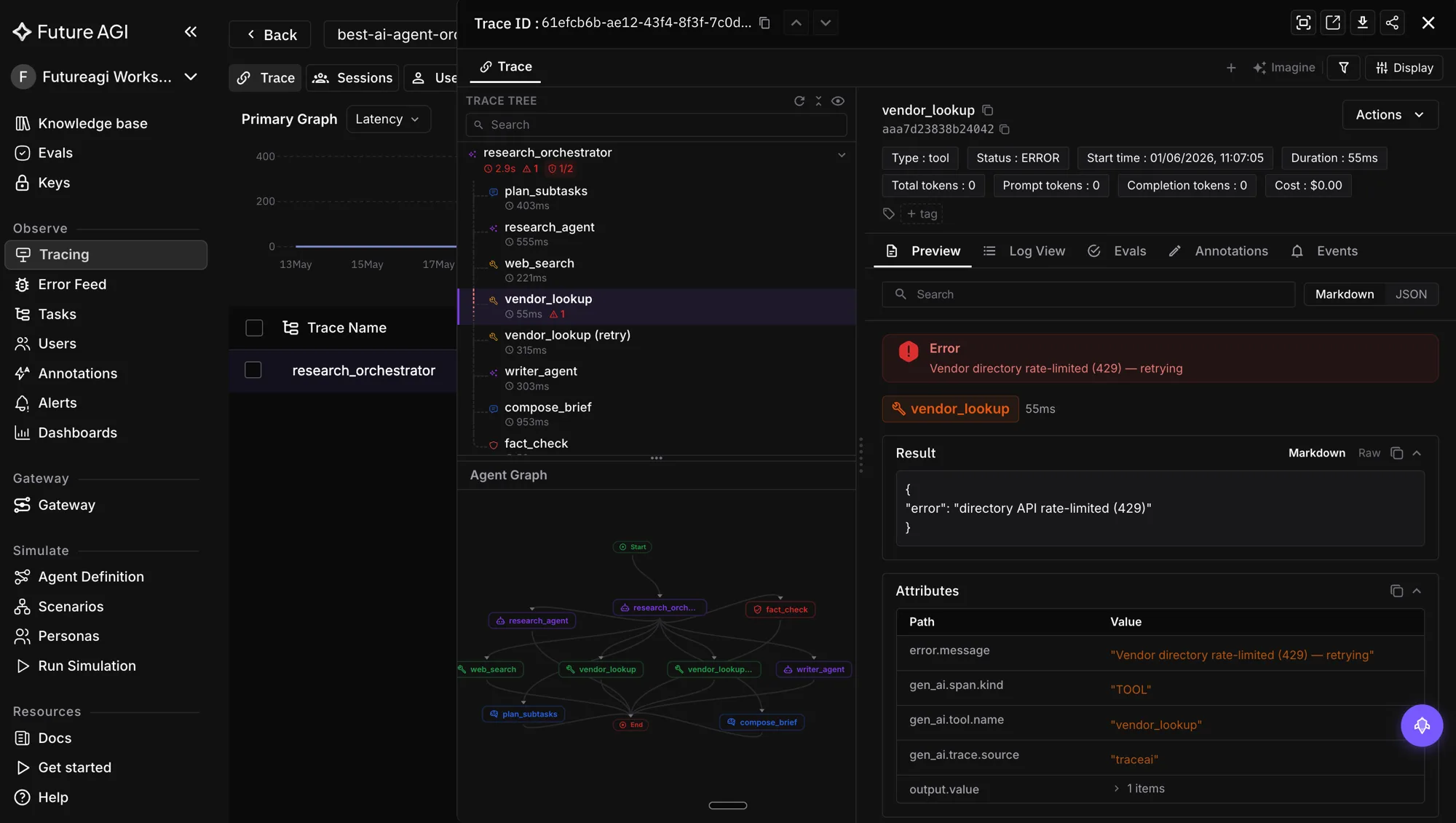
If your stack feeds time series outputs into LLM-generated narratives or agentic flows, you need observability over the LLM side too. The numerical model has standard ML monitoring; the LLM side needs:
- Trace ingestion for every LLM call (traceAI ships OpenInference instrumentation, Apache 2.0)
- Faithfulness evaluation so the narrative does not hallucinate numbers that contradict the forecast (fi.evals
faithfulnesstemplate) - Tone and clarity scoring for downstream consumers
Future AGI is not a time series analysis tool, but it is the evaluation and observability companion for the LLM layer that wraps your forecasts. The BYOK Agent Command Center at /platform/monitor/command-center provides routing, fallbacks, PII redaction, and audit logs for the LLM calls. See Real-time LLM evaluation setup for how to wire this up.
Common Pitfalls in 2026
Random k-fold on time series. Information leaks. Use rolling-origin or expanding-window.
No naive baseline. Beat naive plus seasonal naive plus ETS before claiming a win.
MAPE on series with zeros. Use sMAPE or MASE instead.
Overfitting on small data. Classical methods often win below 1,000 observations.
Ignoring exogenous variables. Holidays, promotions, weather often matter more than the model choice.
Treating LLMs as forecasters. General-purpose LLMs underperform tuned numerical models on numerical tasks. Use foundation models for time series (TimesFM, Chronos) for zero-shot baselines, and reserve general-purpose LLMs for explanation and orchestration.
Skipping uncertainty. A point forecast without an interval is half a forecast. Probabilistic models pay off in business decisions.
Get Started in 30 Minutes
pip install nixtla statsforecast neuralforecast mlforecast chronos-forecasting dartsimport pandas as pd
from statsforecast import StatsForecast
from statsforecast.models import AutoARIMA, AutoETS, Naive
df = pd.read_csv("your_series.csv", parse_dates=["ds"])
sf = StatsForecast(
models=[Naive(), AutoARIMA(season_length=7), AutoETS(season_length=7)],
freq="D",
)
cv = sf.cross_validation(df=df, h=14, n_windows=4, step_size=14)
print(cv.groupby("unique_id").apply(lambda x: ((x["y"] - x["AutoARIMA"]).abs()).mean()))Compare your auto-ARIMA against naive on cross-validation. If it does not beat naive, simplify or get more data.
Related reading:
- Best LLMs in May 2026
- LLM evaluation frameworks and best practices
- Real-time LLM evaluation setup
- Agentic AI frameworks
- LLM leaderboard explained
For deeper Nixtla docs go to nixtla.io. For Chronos and TimesFM start at their respective Hugging Face model cards.
Frequently Asked Questions
What is time series data analysis in 2026?
What are the most-used time series frameworks in 2026?
Are time series foundation models worth using in 2026?
When should I use classical methods like ARIMA vs deep learning?
How do LLMs fit into time series analysis?
What metrics should I use to evaluate a time series model?
How do I avoid overfitting in time series models?
How do I monitor time series models in production?
Best LLMs May 2026: compare GPT-5.5, Claude Opus 4.7, Gemini 3.1 Pro, and DeepSeek V4 across coding, agents, multimodal, cost, and open weights.

Future AGI, DeepEval, RAGAS, Arize Phoenix, OpenAI Evals, LangSmith ranked for LLM eval in 2026. Metrics taxonomy, templates, best practices.

Set up real-time LLM evaluation in 2026 with span-attached evals, 1 to 2 second judges, and code. 7 platforms compared, FAGI traceAI walkthrough.
