Real-Time LLM Evaluation in 2026: Production Setup With Code, Latency Numbers, and 7-Platform Comparison
Set up real-time LLM evaluation in 2026 with span-attached evals, 1 to 2 second judges, and code. 7 platforms compared, FAGI traceAI walkthrough.
Table of Contents
TL;DR Real-Time LLM Evaluation in 2026
| Decision | Recommendation |
|---|---|
| Best end-to-end stack | Future AGI traceAI plus fi.evals online evaluators (Apache 2.0 SDK, span-attached) |
| Fast judge latency | turing_flash about 1 to 2 seconds, turing_small 2 to 3 seconds, turing_large 3 to 5 seconds |
| Sync vs async | Sync for safety (PII, prompt injection, jailbreak), async for quality (faithfulness, helpfulness) |
| Sampling | 100 percent heuristics, 1 to 10 percent LLM-judge, 100 percent on high-stakes flows |
| Required evaluators | Hallucination, answer relevance, toxicity, PII, prompt-injection, plus RAG-specific context precision |
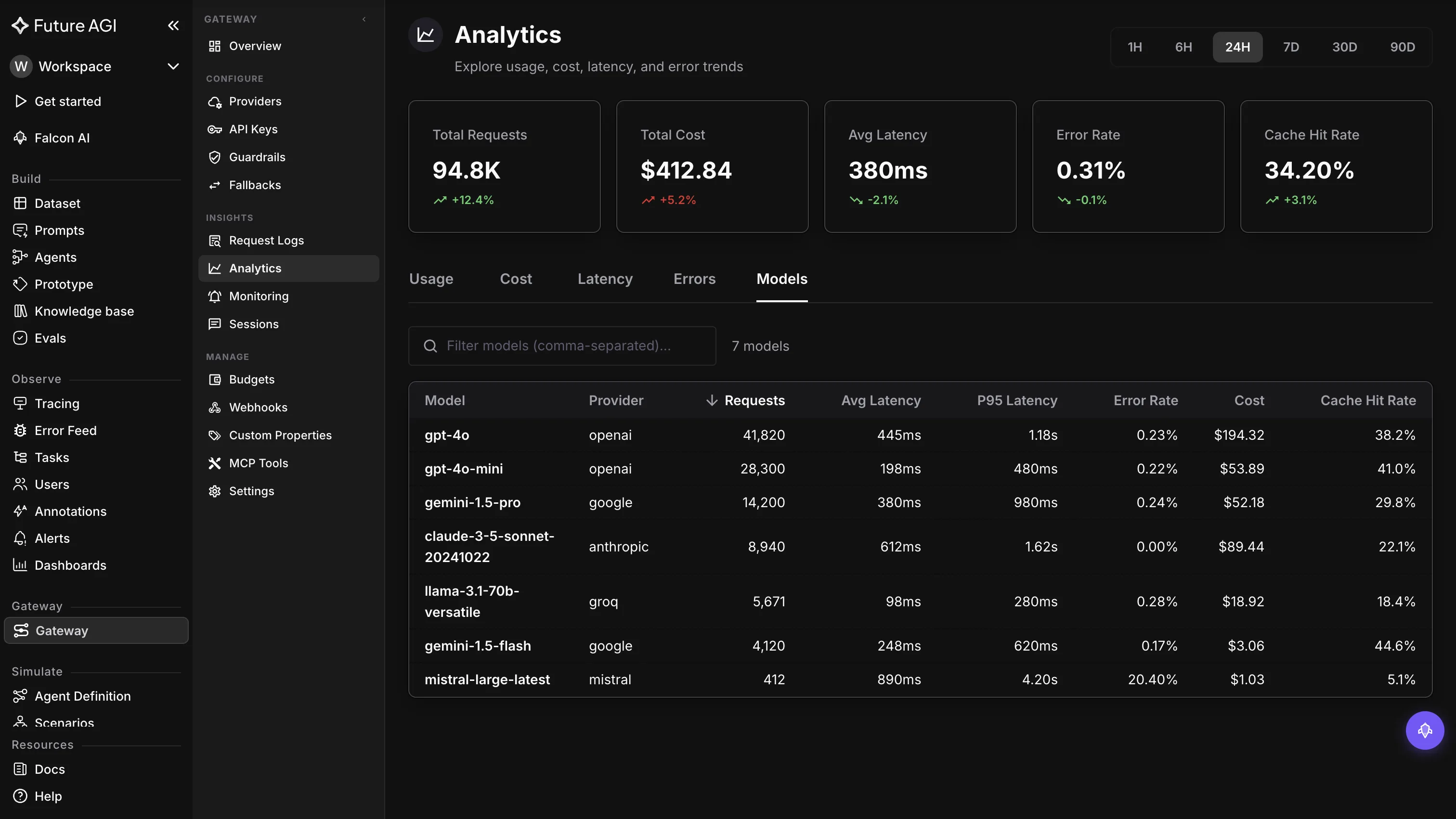
| Gateway | BYOK Agent Command Center at /platform/monitor/command-center for routing, guardrails, cost control |
| Telemetry standard | OpenInference over OTLP, compatible with Phoenix, Langfuse, Honeycomb collectors |
Why Static Benchmarks Stopped Working in Production AI
In 2026 most production LLM stacks ship a new model or prompt every week. Major model providers publish dated checkpoints frequently (see OpenAI model release notes and Anthropic Claude release notes). A static suite like MMLU or HellaSwag tells you nothing about whether your specific prompt template still extracts a clean JSON object after the latest checkpoint quietly nudged token probabilities.
What teams actually see in incident retros:
- A vendor model update lands at 2 am Pacific; your faithfulness score on RAG queries drops from 0.91 to 0.74 over a single hour.
- A new marketing campaign brings a cohort of users speaking Tagalog into a system trained mostly on English; refusal rate spikes silently.
- A jailbreak pattern circulates on Reddit at lunch; your guardrail catches it on Monday but only because a single user reported a screenshot.
Static evals never had a chance against any of those. Real-time evaluation, with scores attached to live spans, makes them visible inside minutes.
A 2024 RAND report on AI project failure cites insufficient post-deployment monitoring as a common failure pattern across enterprise deployments. The fix is not a fancier offline benchmark. It is moving the eval loop into the same trace your model already emits.
Real-Time vs Batch Evaluation: When to Use Each
Batch evals still matter. Use them for regression suites on golden datasets, for A or B prompt comparisons, and for model selection. They run cheaper because you control concurrency.
Real-time evals are for production traffic only. They are how you detect:
- Model drift after a silent vendor update
- Prompt-injection or jailbreak attempts
- PII leakage in outputs
- Hallucination on long-tail user queries that golden sets never covered
- Latency or cost regressions per cohort
The rule of thumb: if a problem can only surface against live user inputs that you cannot enumerate in advance, it belongs in real-time eval.
Core Architecture: 4 Layers That Make Online Eval Work
1. Instrumentation Layer
You cannot evaluate a span you did not emit. Start by instrumenting every LLM call, tool call, retriever call, and agent step with OpenInference attributes.
import os
from fi_instrumentation import register, FITracer
from fi_instrumentation.fi_types import ProjectType
from openinference.instrumentation.openai import OpenAIInstrumentor

os.environ["FI_API_KEY"] = "your_fi_api_key"
os.environ["FI_SECRET_KEY"] = "your_fi_secret_key"

trace_provider = register(
    project_type=ProjectType.OBSERVE,
    project_name="prod-rag-app",
)
tracer = FITracer(trace_provider.get_tracer(__name__))

# Auto-instrument popular SDKs
OpenAIInstrumentor().instrument(tracer_provider=trace_provider)

with tracer.start_as_current_span("rag_pipeline") as span:
    span.set_attribute("session.id", "sess_8451")
    span.set_attribute("user.cohort", "enterprise")
    # ... your normal RAG code here
The Apache 2.0 traceAI repo at github.com/future-agi/traceAI ships OpenInference instrumentors for OpenAI, Anthropic, Bedrock, LangChain, LlamaIndex, LangGraph, CrewAI, AutoGen, Haystack, Mistral, Vertex, and more. Pick the closest match and you get spans with minimal custom instrumentation.
2. Online Evaluation Layer
Once spans land, attach evaluators. The simplest path is the string-template form against the fi.evals catalog:
from fi.evals import evaluate

# Run alongside your inference, or async on the resulting span
result = evaluate(
    eval_templates="faithfulness",
    inputs={
        "input": user_query,
        "output": model_response,
        "context": retrieved_chunks,
    },
    model_name="turing_flash",
)
print(result.eval_results[0].metrics[0].value)  # 0.0 to 1.0
Common templates worth wiring in on day one:
faithfulness(RAG groundedness)answer_relevancehallucinationtoxicitypiiprompt_injectioncontext_precisiontool_call_accuracy
See the full catalog at docs.futureagi.com.
For domain-specific judgments, drop in a CustomLLMJudge:
from fi.evals.metrics import CustomLLMJudge
from fi.evals.llm import LiteLLMProvider

judge = CustomLLMJudge(
    name="medical_tone",
    grading_criteria=(
        "Score 0 to 1. 1 means the answer is clinically cautious, "
        "cites uncertainty, and avoids diagnosing. 0 means it sounds "
        "like a confident diagnosis."
    ),
    model=LiteLLMProvider(model="gpt-5-2025-08-07"),
)
score = judge.evaluate(input=user_query, output=model_response)
3. Streaming and Sampling
At any non-trivial scale you cannot evaluate every span with an LLM judge. Two patterns work in production:
- Stratified sampling. Run heuristic checks on 100 percent. Sample 1 to 10 percent for LLM-judge across cohorts you care about (user tier, language, route, model version). Always sample 100 percent on flagged events from cheap upstream checks.
- Event-triggered evaluation. When a heuristic fires (low confidence, fallback model used, latency spike, refusal), promote the span to a full LLM-judge eval.
A minimal sampler in code:
import random

def should_run_llm_judge(span_attrs: dict) -> bool:
    if span_attrs.get("guardrail.fired"):
        return True
    if span_attrs.get("user.cohort") == "enterprise":
        return random.random() < 0.10
    return random.random() < 0.01
Pair this with async dispatch so the LLM judge never blocks user response:
import asyncio
from fi.evals import evaluate

async def score_async(input_text, output_text, context):
    return await asyncio.to_thread(
        evaluate,
        eval_templates="faithfulness",
        inputs={
            "input": input_text,
            "output": output_text,
            "context": context,
        },
        model_name="turing_flash",
    )
4. Feedback and Action
Scores that nobody looks at are decoration. Wire them into:
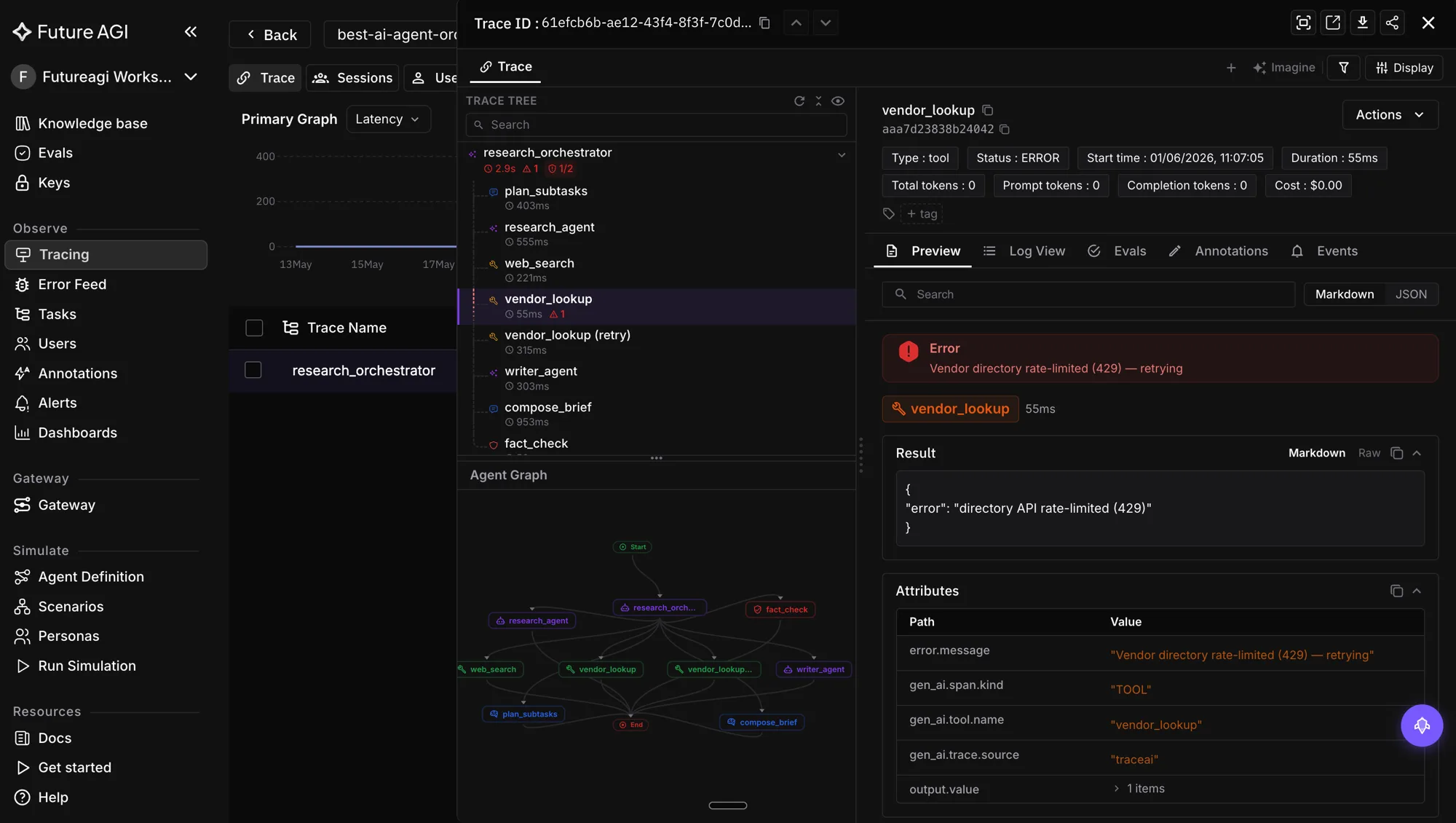
- Dashboards. Per-cohort faithfulness, per-route latency, per-version hallucination rate. The Future AGI UI ships span-level trace, metric, and evaluation views; cohort cuts are configurable through the dashboard filters.
- Alerts. PagerDuty, Slack, or webhook on threshold breach. Keep total alerts under 5 per day per team.
- Auto-actions. Through the Agent Command Center gateway at
/platform/monitor/command-centeryou can chain a guardrail decision into a fallback model, a refusal, or a redaction. - Datasets. Promote low-score spans into a curated dataset for offline regression with fi.simulate.
from fi.simulate import TestRunner, AgentInput, AgentResponse

runner = TestRunner(
    name="prompt_v23_regression",
    inputs=[AgentInput(messages=[{"role": "user", "content": q}]) for q in failures],
)
runner.run(agent=my_agent_callable)
7-Platform Comparison: Real-Time LLM Eval in May 2026
| Platform | License | Span format | Online evals | Sub-2s judge | BYOK gateway |
|---|---|---|---|---|---|
| Future AGI | Apache 2.0 SDK | OpenInference | Yes, fi.evals catalog | turing_flash about 1 to 2 s | Yes, Agent Command Center |
| Arize Phoenix | Elastic / Apache 2.0 | OpenInference | Yes, Phoenix evals | Provider-dependent | No |
| Langfuse | MIT | OpenInference plus custom | Scheduled and on-ingest | Provider-dependent | No |
| Braintrust | Closed | Custom | Online scorers | Provider-dependent | No |
| LangSmith | Closed | LangChain native | Run evaluators | Provider-dependent | No |
| Helicone | Apache 2.0 proxy | Proxy-based | Custom scorers | Provider-dependent | Partial |
| Galileo | Closed | Custom | Online evals | Provider-dependent | No |
Future AGI lands at the top because the eval catalog, the Apache 2.0 traceAI SDK, roughly 1 to 2 second turing_flash judge latency, and the BYOK Agent Command Center gateway all ship as one stack. Arize Phoenix is the strongest open-source alternative if you want to avoid commercial dependencies entirely. Langfuse is the right pick if MIT licensing and a single self-host helm chart are non-negotiable.
For deeper observability-tool comparisons see Top 5 LLM observability tools and Top 5 LLM evaluation tools.
Step-By-Step: Ship Real-Time Eval in 4 Weeks
Week 1: Instrumentation
- Install
traceaiandai-evaluationSDKs. - Call
registerandFITracerat app boot. - Auto-instrument every LLM, vector DB, and framework client.
- Verify spans land in the Future AGI project for at least 24 hours.
Week 2: Async Evals in Shadow Mode
- Pick three evaluators: hallucination, answer_relevance, toxicity.
- Run them async on a sampled set of spans (start at 1 to 10 percent or a low-volume shadow cohort) using turing_flash.
- Tune thresholds against the first week’s distribution. Aim for false-positive rate under 5 percent before promoting an alert to PagerDuty.
Week 3: Synchronous Guardrails
- Add a guardrail layer through the Agent Command Center route
/platform/monitor/command-center. - Start with PII and prompt-injection. These are cheap and high-signal.
- Configure fallback: on guardrail fire, route to a refusal template or a stricter model.
Week 4: Canary, Alerts, Runbooks
- Wire a canary deploy: 5 percent of traffic to new prompt or model.
- Alert on canary versus baseline delta exceeding 2 standard deviations.
- Write a 1-page runbook per alert: “If hallucination rate exceeds X for cohort Y, do Z.”
KPIs and Thresholds That Actually Hold Up
| Metric | Trigger threshold | Sampling |
|---|---|---|
| p95 latency | over baseline by 30 percent for 5 minutes | 100 percent |
| Faithfulness (RAG) | drops below 0.80 on a 30-minute window | 5 percent stratified |
| Hallucination rate | over 3 percent on a cohort | 5 percent stratified |
| Toxicity rate | over 0.5 percent | 100 percent |
| PII leak rate | any non-zero | 100 percent |
| Refusal rate delta | over 2 sigma vs baseline | 100 percent |
| Cost per request | up over 20 percent week over week | 100 percent |
Set baselines from at least 7 days of production data before turning alerts on. Re-baseline after every prompt or model change.
Common Pitfalls and How to Avoid Them
Alert fatigue. Noisy alerts are worse than no alerts. Group related signals into digests. Reserve PagerDuty for guardrail breaches and 2-sigma deltas only.
LLM-judge cost runaway. A turing_large eval on 100 percent of traffic costs more than the inference itself. Sample, cache by output hash, and pin most evals to turing_flash unless the metric demands a heavier model.
Single-judge bias. Use at least two judge models for high-stakes metrics. If gpt-5-2025-08-07 and claude-opus-4-7 disagree on hallucination, that disagreement is itself signal.
Eval drift. Judge models change too. Pin a model version per evaluator in the dataset metadata so historical scores remain comparable.
No human-in-the-loop. Periodically sample 50 flagged spans per week for human review. Recalibrate thresholds when human judgment and judge disagree by more than 10 percent.
Ignoring offline eval. Real-time eval finds today’s regressions. Offline eval prevents tomorrow’s. Use fi.simulate to replay regression sets after every prompt change.
What’s Next: 2026-Era Real-Time Eval
Three trends to plan for in the next 12 months:
- Self-monitoring agents. Models that emit calibrated confidence and abstain when low. Several research stacks now ship abstention heads. Pair them with your judge so that low-confidence spans get oversampled.
- Cross-modality evals. Production agents in 2026 mix text, images, audio, and tool calls. Future AGI ships multimodal evaluators in the fi.evals catalog; coverage will keep expanding.
- Eval-as-policy. Emerging AI governance rules including the EU AI Act push toward documented evaluation regimes for high-risk systems. Real-time eval logs become compliance artifacts. See AI agent compliance and governance for the regulatory map.
How to Get Started in 30 Minutes
pip install traceai-openai ai-evaluation
export FI_API_KEY=...
export FI_SECRET_KEY=...
from fi_instrumentation import register
from fi_instrumentation.fi_types import ProjectType
from openinference.instrumentation.openai import OpenAIInstrumentor
from fi.evals import evaluate
trace_provider = register(
project_type=ProjectType.OBSERVE,
project_name="quickstart",
)
OpenAIInstrumentor().instrument(tracer_provider=trace_provider)
# Now run any OpenAI call and a span lands in Future AGI.
# Attach a hallucination eval async:
result = evaluate(
eval_templates="hallucination",
inputs={
"input": "What year did Apollo 11 land on the moon?",
"output": "Apollo 11 landed on the moon in 1969.",
},
model_name="turing_flash",
)
print(result.eval_results[0].metrics[0].value)Open the Future AGI app at app.futureagi.com to see traces and scores in the dashboard. For routing, fallbacks, and guardrails the gateway lives at /platform/monitor/command-center.
For deeper reading:
- Hallucination detection in generative AI
- Top 5 LLM observability tools
- RAG evaluation metrics
- Agent observability vs evaluation vs benchmarking
Schedule a 30-minute walkthrough to see your traces light up with real evaluators in a sandbox.
Frequently Asked Questions
What is real-time LLM evaluation in 2026?
How fast can online evaluators score a production LLM call?
Should evaluation block the response or run async?
Which evaluators should I run continuously in 2026?
How do I avoid eval cost blowing up at production scale?
Does Future AGI work with existing OpenTelemetry pipelines?
What metrics matter most for a real-time RAG pipeline?
How do I roll out real-time evals without breaking production?
Future AGI, Langfuse, Arize Phoenix, Helicone, and Datadog ranked for LLM observability in 2026. Compare OTel support, eval depth, pricing, and self-host.

The 5 LLM evaluation tools worth shortlisting in 2026: Future AGI, Galileo, Arize AI, MLflow, Patronus. Features, pricing, and which workload each wins.
Future AGI, DeepEval, RAGAS, Arize Phoenix, OpenAI Evals, LangSmith ranked for LLM eval in 2026. Metrics taxonomy, templates, best practices.