Open Source vs Closed Source LLM Evaluation in 2026: A Practical Decision Guide
Pick open or closed source LLM evaluation in 2026 on cost, transparency, compliance, vendor risk, and the hybrid pattern most teams adopt.

Table of Contents
TL;DR: Open source vs closed source LLM evaluation in 2026
| Dimension | Open source | Closed source | What changed in 2026 |
|---|---|---|---|
| License cost | None for the library | Per-seat or per-call | Less decisive than judge inference cost |
| Rubric auditability | Full, by default | Depends on vendor | Now a hard regulator question |
| Judge model pinning | You pick | Vendor picks unless they expose it | Best vendors expose this |
| Scale and SLA | You operate | Vendor operates | Same as 2024 |
| Compliance evidence | Logs and rubric you keep | Vendor-issued reports | Both work if rubric is published |
| Migration risk | Library can be self-hosted | Lock-in if rubric not exposed | The big asymmetry |
The right framing in 2026 is rubric portability. If you can export the rubric prompt, the judge model version, and the scoring rule, you can move between open and closed source delivery modes without losing evaluation history. If you cannot, you are locked in regardless of which side you started on.
What an LLM evaluator actually is in 2026
The mental model has converged across the field. An LLM evaluator is three things bundled together: a rubric prompt that tells a judge what to look at, a judge model that consumes the rubric and emits a structured verdict, and a scoring rule that maps the verdict to a number or a label.
That bundle is true whether the library is open source or closed source. It is true whether the evaluator runs in CI against a few hundred items or in production against millions of requests. The only thing that varies is who owns each of those three components.
Once you see the bundle this way, the old open versus closed framing falls apart. The real question is whether each of the three components is visible, versioned, and movable.
Where open source LLM evaluation wins in 2026
Open source evaluation wins on three axes.
The first is auditability. The rubric prompt is in the repository. The judge model is the one you point the library at. The scoring logic is in code you can read. For regulated surfaces that have to produce evidence, that transparency is the cheapest path to defensibility.
The second is rubric customization. Production rubrics are rarely satisfied by the library defaults. A bank’s directional-advice rubric, a hospital’s protected-health-information rubric, a legal team’s privilege rubric, all of these are sector-specific. Open source libraries let you author and version those rubrics inside your own codebase.
The third is migration freedom. Because the evaluator definition is just code, you can move it between hosts, hand it to an auditor, and pin the judge model to whatever version you need.
The drawback is the same as for any open source infrastructure: you operate it. The cost shifts from license fee to engineering time, judge inference bills, and on-call burden.
Where closed source LLM evaluation wins in 2026
Closed source wins on three different axes.
The first is operational scale. Running an evaluator suite on tens of millions of production requests per day with traceable audit storage, alert routing, and policy enforcement is not the same problem as scoring 500 items in a notebook. Managed platforms handle the operational tail.
The second is integration depth. A managed evaluation surface that also runs as the inline guardrail layer and emits OpenTelemetry traces is a different product from a library you call from your own code. Future AGI’s Agent Command Center is one example of this consolidated surface.
The third is compliance packaging. The vendor produces the SOC 2 report, the data processing addendum, the regional residency story, the access controls. For a regulated buyer, that packaging is non-trivial.
The drawback is opacity, when the vendor hides the rubric or the judge model version. In 2026 the leading platforms increasingly expose those, which narrows but does not eliminate the gap.
The leading open source LLM evaluation libraries in 2026
Six libraries cover most of the production use cases.
The Future AGI ai-evaluation library ships about 50 evaluators across faithfulness, safety, agent, and RAG metrics under Apache 2.0. The same evaluator definitions run in the managed Agent Command Center, which is the design point that makes migration straightforward.
DeepEval is a pytest-style library from Confident AI. The developer ergonomics for CI integration are strong, and the metric coverage focuses on classic RAG and chatbot evals.
Stanford HELM is the academic gold standard for holistic benchmarking. Use it when you need to evaluate a base model across a large, public, well-cited task suite.
EleutherAI’s lm-evaluation-harness is the de facto reproducer of public leaderboards. Use it when the audience is researchers or when you want a head-to-head against open and closed models.
Inspect AI from the UK AI Safety Institute is the newer entrant. It is aimed at safety evals specifically and has been adopted by government safety institutes for frontier model evaluations.
For RAG-heavy surfaces, Ragas is the dedicated library and runs on top of any of the others.
The leading closed source LLM evaluation platforms in 2026
Six platforms cover most of the managed market.
The Future AGI Agent Command Center is the unified eval, observability, and guardrail surface. Its position is “rubric portability first”: the same evaluator definitions used in the open source library run inline as policy guardrails.
Braintrust is developer-first with strong notebook and experiment workflows. The integration story is best in teams whose evaluation work lives inside notebooks and Python REPLs.
Galileo focuses on enterprise risk and data quality with strong visualizations. The fit is best where the evaluation conversation lives in risk and compliance rather than engineering.
Arize is the OpenTelemetry-native option: Phoenix is the open source observability layer and Arize AX is the managed enterprise tier. Strong for teams that already use OpenTelemetry as the trace backbone.
Langfuse is the open core option with a managed cloud. Strong for teams that want a self-hosting fallback if the managed contract ever fails.
OpenAI’s managed Evals dashboard pairs with their open source Evals framework. Tight integration if your traffic is mostly OpenAI models.
Cost: the part that has changed most in 2026
In 2024, the cost conversation was license fee versus engineering time. In 2026 the dominant cost line for most evaluation suites is judge model inference.
Consider a team running 10 million customer-facing requests per month with three evaluators per request, each calling a judge model. At typical 2026 frontier-model pricing, judge inference can dominate the total cost of evaluation regardless of which platform the team uses. Open source does not avoid that cost. Closed source either passes it through or hides it in the per-call fee.
The right way to compare is to compute total cost of evaluation per million production requests across three components: judge inference, platform fee, and engineering time amortized. Most production teams discover that the platform fee is a small share, judge inference is the dominant share, and the choice that actually reduces cost is judge model selection, not platform.
Future AGI’s evaluator library supports judge model selection through fi.evals.llm.LiteLLMProvider, which lets the rubric run on any model that LiteLLM supports. The same selection is exposed in the managed Agent Command Center. Teams typically use a cheaper, faster judge for the high-volume runtime guardrails and a stronger judge for the lower-volume offline runs.
from fi.evals import evaluate, Evaluator
from fi.evals.metrics import CustomLLMJudge
from fi.evals.llm import LiteLLMProvider

# Hosted faithfulness evaluator: judge model is selected by tier
hosted_result = evaluate(
    "faithfulness",
    output=response,
    context=retrieved_passages,
)

# Custom rubric with a pinned judge model for offline scoring
faithfulness_strong = CustomLLMJudge(
    name="faithfulness_strong",
    rubric="Score 1 if the response is supported by the context, 0 otherwise.",
    provider=LiteLLMProvider(model="gpt-4o"),
)

custom_evaluator = Evaluator(metrics=[faithfulness_strong])
custom_result = custom_evaluator.evaluate(
    output=response,
    context=retrieved_passages,
)
For the runtime side, the same rubric runs on a faster judge through the managed surface so the evaluator stays inside the latency budget.
Compliance: where the open vs closed debate actually ends up in 2026
The EU AI Act Article 72 sets out post-market monitoring duties for providers of high-risk AI systems, including documented monitoring plans and incident reporting. Continuous evaluation with logged metrics is one practical way to produce that documentation. The NIST AI RMF MEASURE function similarly asks for measurable, repeatable evaluation against defined risks. Neither framework specifies open or closed source.
What they specify is evidence. A logged evaluator score, a versioned rubric, a pinned judge model, and an alert threshold with an incident runbook satisfy both frameworks. Open source delivery gives you that evidence by default if you keep the logs. Closed source delivery gives you that evidence if the vendor’s audit export includes the rubric and the judge model version.
The trap, regardless of side, is treating the evaluation score as the evidence. The evidence is the rubric and the run history, not the float.
The hybrid pattern that actually ships
The pattern most production teams settle on by mid-2026 is a two-surface stack.
The first surface is open source evaluators executed in CI against a small high-quality dataset. The dataset is human-curated, the rubric is in version control, the judge model is pinned, and the failures are visible to the engineer who broke the build.
The second surface is the same evaluator definitions promoted to a managed runtime where they execute against production traffic. The managed surface handles audit storage, on-call routing, alert thresholds, and policy enforcement. Failures here go to a platform on-call rotation, not to the application engineer.
The migration unit between the two surfaces is the rubric. As long as the rubric is the same, the score on the managed surface is comparable to the score in CI, and a regression in either is meaningful to the other.
Future AGI is designed around this pattern. The open source ai-evaluation library and the managed Agent Command Center share the evaluator API and rubric format. A rubric authored as a CustomLLMJudge in CI can be promoted to the managed surface without rewriting.
from fi.opt.base import Evaluator
from fi.evals.metrics import CustomLLMJudge
from fi.evals.llm import LiteLLMProvider

# Author the rubric once, locally, with whatever judge model you want
support_policy_judge = CustomLLMJudge(
    name="customer_support_policy",
    rubric=(
        "Score 1 if the response stays within published refund policy "
        "and never promises a non-policy exception. Score 0 otherwise."
    ),
    provider=LiteLLMProvider(model="gpt-4o-mini"),
)

# Wrap it in the optimization-friendly base Evaluator
policy_evaluator = Evaluator(metrics=[support_policy_judge])
The same rubric definition is the artifact that ships to the managed runtime.
Instrumentation: the other half of evaluation in 2026
Evaluation is half of the picture. The other half is observability, because a score without a trace is hard to act on.
Future AGI’s traceAI is Apache 2.0 and provides framework-specific instrumentors. The traceai-langchain package exposes LangChainInstrumentor. The traceai-openai-agents, traceai-llama-index, and traceai-mcp packages cover the other common frameworks. Evaluator scores ride as span attributes, so a regression at evaluation time is traceable to the specific request and tool call that caused it.
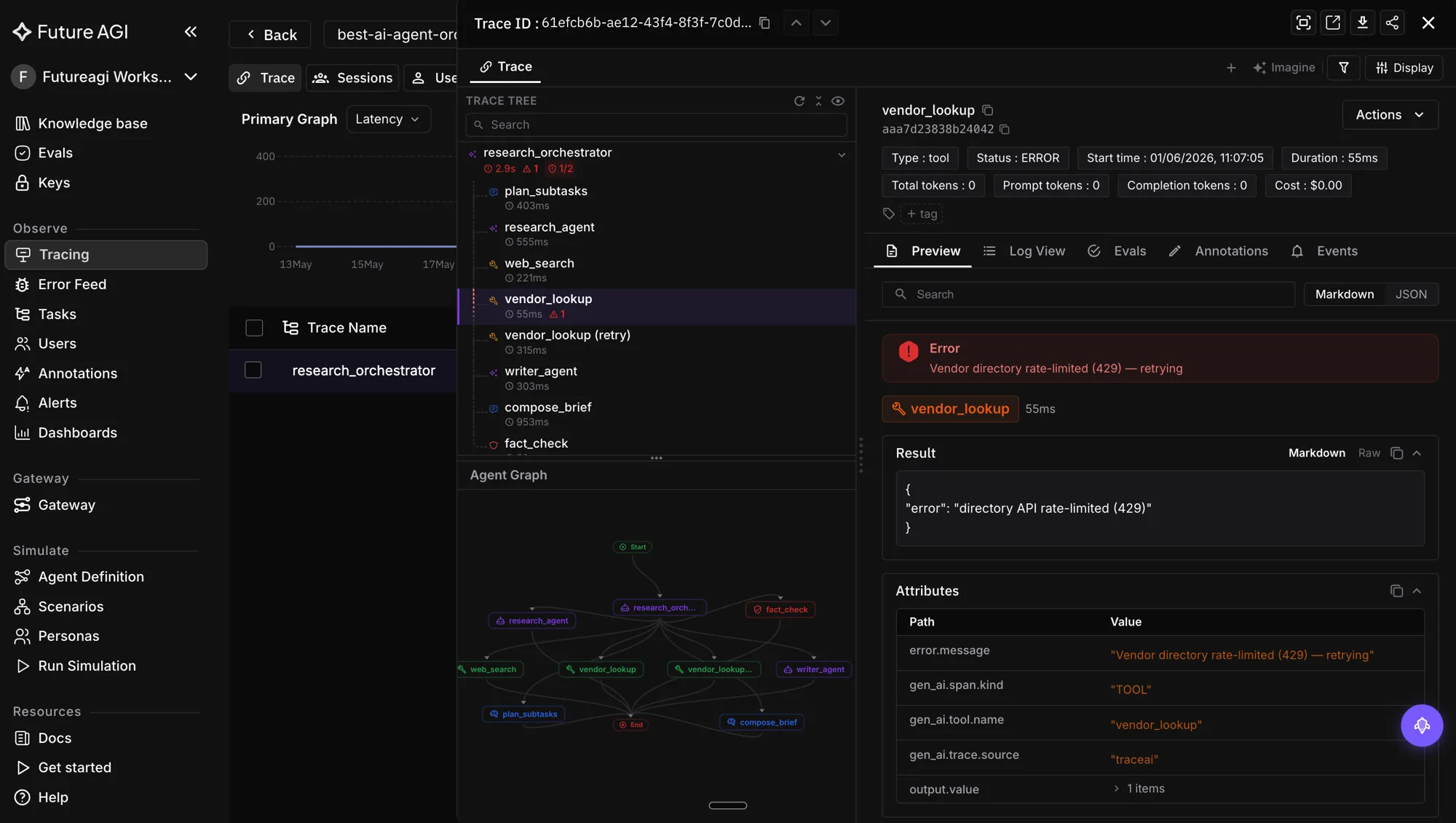
from fi_instrumentation import register, FITracer
from traceai_langchain import LangChainInstrumentor

tracer_provider = register(project_name="prod-eval-pipeline")
LangChainInstrumentor().instrument(tracer_provider=tracer_provider)

tracer = FITracer(tracer_provider.get_tracer(__name__))

@tracer.chain
def answer(question, context):
    return llm.invoke({"question": question, "context": context})
Two environment variables are required to talk to the managed Future AGI surface: FI_API_KEY and FI_SECRET_KEY. Both come from the same project and are documented at docs.futureagi.com. Hosted evaluators run on three sizes: turing_flash at roughly 1 to 2 seconds, turing_small at 2 to 3 seconds, and turing_large at 3 to 5 seconds, so the team can trade precision against latency per surface.
A decision checklist for 2026
Use this checklist when picking your evaluation stack.
Start by deciding who owns the rubric. If the answer is engineering, you can use either side. If the answer is risk, compliance, or product, you need a platform that exposes the rubric to non-engineers.
Then check rubric portability. Can you export the rubric, the judge model version, and the scoring rule from the vendor? If not, you are locked in.
Then check operational fit. Are you scoring 500 items in CI or 50 million requests in production? Open source is fine for the first. Managed is almost always the answer for the second.
Then check compliance fit. Does the vendor produce SOC 2, GDPR, and regional residency documentation? Does the open source path give you the same evidence by keeping the logs and rubrics?
Then check cost realistically. Compute total cost of evaluation per million production requests, including judge inference. The platform fee is usually a small share.
Then look at the migration path. The right vendor in 2026 is the one that exports your rubric history when you ask.
Putting it together
In 2026 open source and closed source LLM evaluation are two delivery modes of the same artifact. The leading platforms have figured this out and now compete on rubric portability, evidence export, and managed operations rather than on license model.
The Future AGI stack is one of several that explicitly supports the hybrid pattern: the ai-evaluation library is Apache 2.0 for CI and authoring, traceAI is Apache 2.0 for instrumentation, and the Agent Command Center is the managed surface where the same evaluators run on production traffic with audit storage and policy enforcement. The pattern works because the rubric is the same on both sides.
If you are choosing your first evaluation stack in 2026, optimize for rubric portability and evidence export. The platform that gives you those will still be useful when the model changes, when the team changes, and when the regulator shows up.
Further reading
For platform-level comparisons, see the top LLM evaluation tools and the best LLM evaluation tools for 2026. For a metric-by-metric framework explainer, see LLM evaluation frameworks, metrics, and best practices. For the open source observability companion to evaluation, see best open source LLM observability. And for a deeper look at the Future AGI open source library, see the ai-evaluation library.
References
- EU AI Act, Regulation (EU) 2024/1689
- NIST AI RMF Generative AI Profile, NIST AI 600-1 (2024)
- Future AGI ai-evaluation, Apache 2.0
- Future AGI traceAI, Apache 2.0
- Future AGI Agent Command Center
- Future AGI Cloud Evals documentation
- Confident AI DeepEval
- Stanford HELM
- EleutherAI lm-evaluation-harness
- Inspect AI from UK AISI
- Ragas RAG evaluation library
- OpenAI Evals on GitHub
Frequently Asked Questions
What is the practical difference between open source and closed source LLM evaluation in 2026?
Is open source LLM evaluation actually free in 2026?
Can I trust an LLM-judge evaluator that I cannot see inside?
What about compliance: do regulators prefer open or closed source evaluation?
Which open source LLM evaluation libraries lead in 2026?
Which closed source LLM evaluation platforms lead in 2026?
How do most production teams structure their evaluation stack in 2026?
What is the migration path from one to the other?
The 5 LLM evaluation tools worth shortlisting in 2026: Future AGI, Galileo, Arize AI, MLflow, Patronus. Features, pricing, and which workload each wins.

FutureAGI, DeepEval, Langfuse, Phoenix, Braintrust, LangSmith, and Galileo as the 2026 LLM evaluation shortlist. Pricing, OSS license, and production gaps.

Future AGI, DeepEval, RAGAS, Arize Phoenix, OpenAI Evals, LangSmith ranked for LLM eval in 2026. Metrics taxonomy, templates, best practices.