How to Evaluate LLMs in 2026: Metrics, Frameworks, and Production Pipelines
How to evaluate LLMs in 2026. Pick use-case metrics, score with judges + heuristics, gate CI, and run continuous production evals in under 200 lines.
Table of Contents
How to Evaluate LLMs in 2026: Metrics, Frameworks, and Production Pipelines
LLM evaluation in 2026 is not a single score. It is a pipeline of small, opinionated decisions: which metrics map to your product, which fixtures cover your distribution, which judges you trust, and how you sample production traffic without blocking users. This guide walks through the full path, from picking metrics to gating CI to streaming scores from live traffic, with code that uses real APIs.
TL;DR: LLM Evaluation Pipeline in 2026
| Stage | What to do | Primary signal |
|---|---|---|
| Pick metrics | 3 to 5 that map to product outcomes | Hallucination, task completion, cost, P95 latency |
| Build fixtures | 100 to 300 labeled prompts covering head + tails | Per-fixture pass/fail + score |
| Mix judges + heuristics | Deterministic checks first, then LLM judge | Schema compliance, groundedness, faithfulness |
| Gate CI | Tight thresholds that block regressions | Build green/red on every PR |
| Sample production | 5 to 20 percent of live traffic, async scoring | Rolling 24-hour and 7-day score windows |
| Close the loop | Failing traces become new fixtures | Fixture set grows with the product |
Why LLM Evaluation Metrics Are Product-Specific
A summarization tool, a customer support chatbot, and a legal document parser all run the same underlying model. They fail in different ways. Picking a generic metric set hides those differences.
- A summarization tool fails on coverage. The summary is fluent but drops a key clause.
- A chatbot fails on relevance. The answer is correct but does not address what the user asked.
- A legal document parser fails on hallucination. The output looks authoritative but introduces a fact the source never stated.
The first move in any evaluation pipeline is mapping the failure modes you care about to the metrics that catch them. Generic accuracy and BLEU correlate weakly with all three.
Eight Core Metrics That Cover Most LLM Use Cases
These are the metrics most production teams use as a starting set. Pick 3 to 5 that map to your product.
- Accuracy / Exact Match: how often the output equals the reference. Use for closed-form QA, extraction, classification. Cheap and deterministic.
- Groundedness: is every claim in the output supported by the retrieved context? Primary metric for RAG and any retrieval-backed agent.
- Faithfulness: is the output consistent with the source passage? Tighter than groundedness because it also catches contradictions.
- Hallucination Rate: fraction of outputs that contain a fabricated claim. Calibrated against a human-labeled set. See six methods to detect hallucinations for the scoring approaches.
- Relevance: does the output address the user’s intent? Scored by judge against the original prompt.
- Task Completion: did the agent achieve the user’s goal end-to-end? Critical for tool-using agents where individual steps can succeed but the chain still fails.
- Latency (P95): end-to-end response time including retrieval and tool calls. Watched alongside cost.
- Cost Per Request / Per Resolved Session: token spend plus tool call costs, normalized to a unit your business cares about.
Verbosity, tone, and engagement signals are useful but downstream of the eight above. Tune them after you have the primary set stable.
How to Pick Use-Case Specific LLM Metrics
Three concrete patterns:
Summarization tool: groundedness + coverage + coherence. Score with a judge against a rubric (accurate, complete, fluent) and a heuristic that checks reference length ratios. Watch P95 latency; long inputs blow up token cost.
Customer support chatbot: task completion + groundedness + relevance + escalation rate. Score the final transcript with an LLM judge that knows whether the user’s issue was resolved. Track escalation rate against a baseline; a sudden spike is a regression.
Legal document parser: hallucination rate + faithfulness + schema compliance + extraction recall. Run deterministic schema checks first (every required field present, types correct), then a faithfulness judge that confirms each extracted value is in the source. Treat anything below 0.95 schema compliance as a build failure.
What Changed Since 2025 in LLM Evaluation
Three shifts that landed between mid-2025 and May 2026:
- Judge-vs-judge calibration is standard now. The 2024 pattern of trusting a single GPT-4-class judge is gone. Modern pipelines run two judges (a frontier model and a cheaper model) and flag disagreements for human review, which catches both judge regressions and rubric ambiguity in one pass. The mechanics of LLM-as-a-judge, including where it fails, are worth a read before you wire one into CI.
- Continuous production scoring replaced periodic batch evals. The state of the practice is to sample 5 to 20 percent of live traffic, score it async, and alert on rolling-window deltas instead of static thresholds. (Future AGI continuous evaluation, Arize evaluations docs.)
- Trajectory evaluation for agents is its own category. Agent eval split off from LLM eval because single-turn metrics miss multi-turn failures, a split covered in the definitive guide to AI agent evaluation. Tau-bench, MultiChallenge, and the Google ADK user-simulator framework all target trajectory-level scoring. (Tau-bench paper, MultiChallenge benchmark.)
The 2026 model surface (gpt-5-2025-08-07, claude-opus-4-7, gemini-3.x) is faster and cheaper, which means continuous scoring is now affordable at production scale.
Trade-offs Between LLM Evaluation Metrics
Some metrics conflict. Optimizing one comes at the cost of another.
- Accuracy vs. latency: chain-of-thought and self-consistency raise accuracy but also raise P95. Quantify the trade-off in your domain before picking a default.
- Groundedness vs. coverage: a stricter groundedness threshold drops outputs that paraphrase loosely. Coverage drops along with it.
- Helpfulness vs. refusal correctness: a more cautious model refuses more, which lowers helpfulness on benign requests. Run both judges.
- Cost vs. quality: frontier judges score better but cost 10x more per call. Use cheaper judges (
turing_flash-class) for sampling and frontier judges for spot audits.
Pick the metric set that reflects your business priority. Log the trade-off explicitly so a future PR cannot quietly trade one for another.
Tools and Libraries for LLM Evaluation in 2026
Three layers of tooling cover most pipelines.
Heuristic and reference-based metrics
For tasks with a clear reference, rouge_score and nltk.translate.bleu_score still work as cheap sanity checks. They are not enough on their own.
from rouge_score import rouge_scorer

scorer = rouge_scorer.RougeScorer(["rouge1", "rougeL"], use_stemmer=True)
scores = scorer.score("reference summary", "generated summary")
print(scores)
LLM-as-judge and reference-free metrics
For subjective dimensions and reference-free scoring, the Future AGI evaluation SDK (ai-evaluation, Apache 2.0) ships with prebuilt evaluators and supports custom LLM judges.
from fi.evals import Evaluator

evaluator = Evaluator(
    fi_api_key="your_api_key",
    fi_secret_key="your_secret_key",
)

result = evaluator.evaluate(
    eval_templates="groundedness",
    inputs={
        "context": "Order #4521 shipped on 2026-05-10 via FedEx.",
        "output": "Your order shipped on 2026-05-10.",
    },
    model="turing_flash",
)

print(result.eval_results[0].metrics)
turing_flash runs at roughly 1 to 2 seconds per call against the cloud evaluator; turing_small is 2 to 3 seconds; turing_large is 3 to 5 seconds. Pick the tier that fits your latency budget. (Future AGI cloud evals docs.)
For domain-specific judges, define a custom rubric:
from fi.evals.metrics import CustomLLMJudge
from fi.evals.llm import LiteLLMProvider

judge = CustomLLMJudge(
    name="legal_extraction_quality",
    grading_criteria=(
        "Score 1 if every extracted field is present in the source document "
        "and the types match the schema. Score 0 otherwise. Explain in one sentence."
    ),
    provider=LiteLLMProvider(model="gpt-5-2025-08-07"),
)
Tracing and continuous production scoring
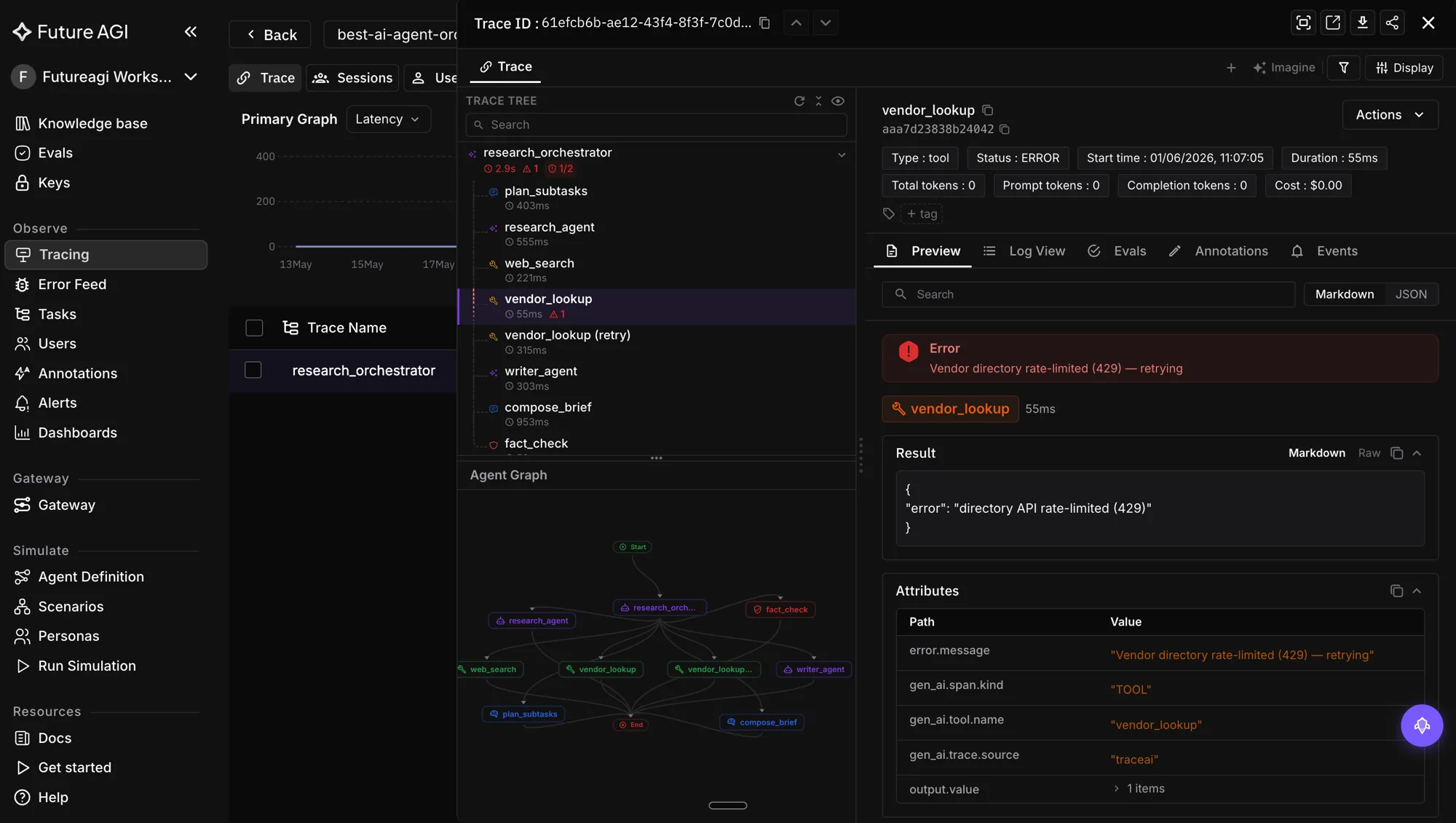
Instrument the application with traceAI (Apache 2.0), an OpenTelemetry-compatible package that captures LLM and tool spans, then schedule eval tasks against the trace stream.
from fi_instrumentation import register, FITracer
from fi_instrumentation.fi_types import ProjectType

trace_provider = register(
    project_type=ProjectType.OBSERVE,
    project_name="llm_eval_prod",
)
tracer = FITracer(trace_provider)
Traces flow into the Observe dashboard with latency, cost, and eval scores nested per span. Sample 5 to 20 percent for async scoring; alert on rolling-window deltas. (traceAI repository, traceAI LICENSE.)
How to Build an LLM Evaluation Pipeline in Five Steps
Step 1. Pick 3 to 5 metrics that map to product outcomes
Write the metrics down with thresholds. “Hallucination rate below 2 percent on the v3 fixture set” is a workable goal. “Better quality” is not.
Step 2. Build a 100 to 300 prompt fixture set
Cover the head of the traffic distribution and the known failure tails. Version the fixtures with the code. Review them on every model or prompt change. Add a fixture for every production incident root-caused to the model.
Step 3. Run deterministic checks first, then judges
Run schema, regex, exact match, and reference-based heuristics before any LLM judge call. They are 100x cheaper and they catch the obvious regressions. Reserve judge calls for subjective dimensions.
Step 4. Gate CI on tight thresholds
Pick thresholds you can hit on a green fixture run today. Record scores on every CI run. Treat any drop more than 3 to 5 points on a primary metric as a regression even when the build passes.
Step 5. Sample production continuously
Wire the eval SDK to a 5 to 20 percent trace sample. Score async. Watch rolling-window deltas. Carry failing transcripts back into the fixture set so the regression set grows with the product.
Why Future AGI for LLM Evaluation
Future AGI runs all five layers as one platform: trace capture with traceAI, fixture-based evaluation with fi.evals, simulation against personas with fi.simulate, and continuous production scoring routed through the Agent Command Center gateway at /platform/monitor/command-center. The SDKs are Apache 2.0 (verified traceAI LICENSE, ai-evaluation LICENSE) so an evaluation pipeline you write today is portable, not locked to a vendor surface.
Set FI_API_KEY and FI_SECRET_KEY once and the same code paths cover CI gates and live production scoring. Trade up between turing_flash, turing_small, and turing_large based on the latency budget per eval call.
Closing the Loop on LLM Evaluation
Evaluation is not a one-time score, and it is not a single metric. Pick 3 to 5 metrics that map to product outcomes. Build a small fixture set you trust. Run heuristics before judges. Gate CI tight. Sample production continuously. Carry failures back into the fixture set.
The teams that ship reliable LLM products in 2026 are not the ones with the most powerful base model. They are the ones whose eval pipeline catches a regression on Tuesday and ships a fix on Wednesday.
Frequently Asked Questions
What is the single most important metric for evaluating an LLM in 2026?
How do I evaluate an LLM without ground truth labels?
Should I use BLEU or ROUGE for evaluating modern LLMs?
How often should I re-evaluate an LLM in production?
How big should my evaluation fixture set be?
How do I evaluate an LLM judge to make sure it is reliable?
What is the difference between offline evaluation and production evaluation?
How do I evaluate hallucination rate at scale?
LLM evaluation is offline + online scoring of model outputs against rubrics, deterministic metrics, judges, and humans. Methods, metrics, and 2026 tools.

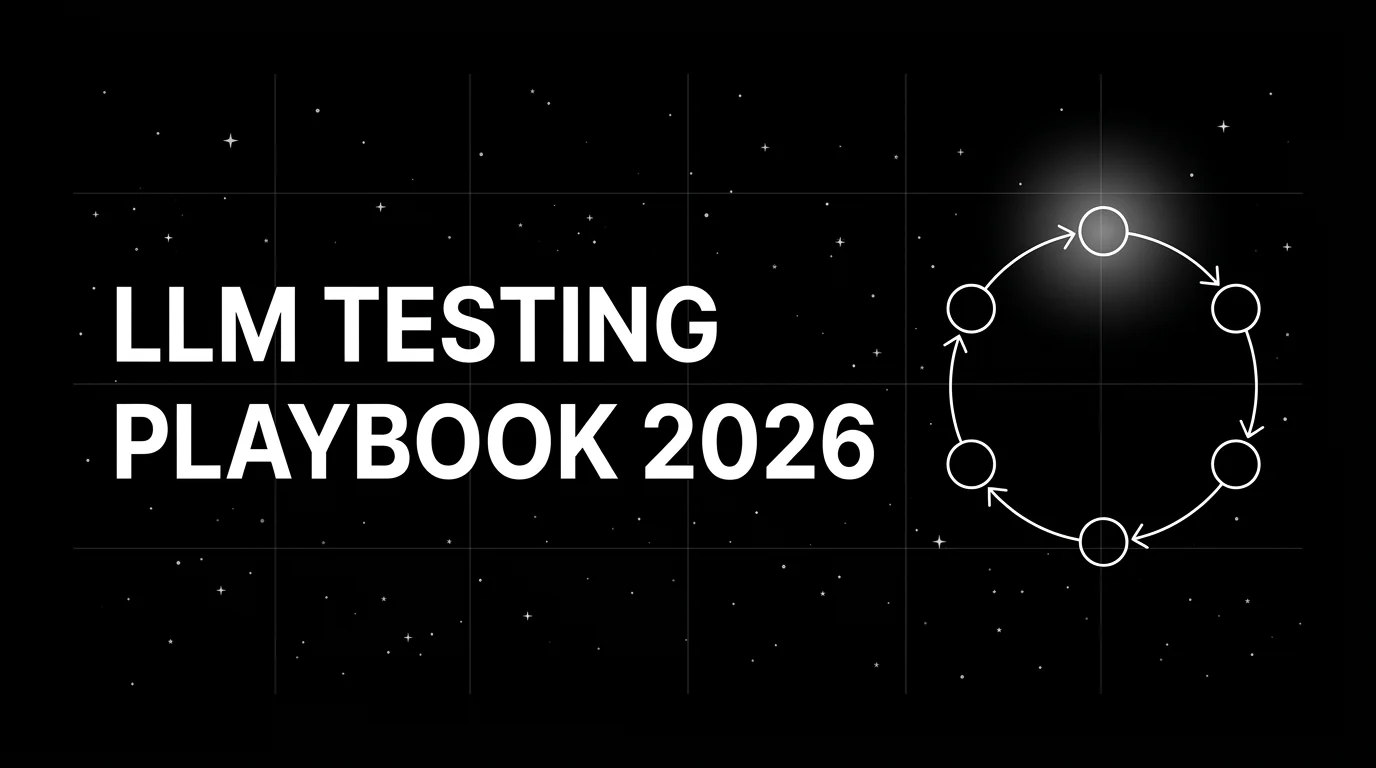
A 6-step LLM testing loop for 2026: instrument with OTel, score spans, gate releases in CI, simulate, sample live traffic, optimize prompts on failures.

FutureAGI, DeepEval, Langfuse, Phoenix, Braintrust, LangSmith, and Galileo as the 2026 LLM evaluation shortlist. Pricing, OSS license, and production gaps.