LLM Eval Myths: Six Skeptical Objections, Honestly Answered (2026)
Six skeptical objections to LLM eval. Five are right about something the field undersells, one is laziness. Honest answers to each, in turn.
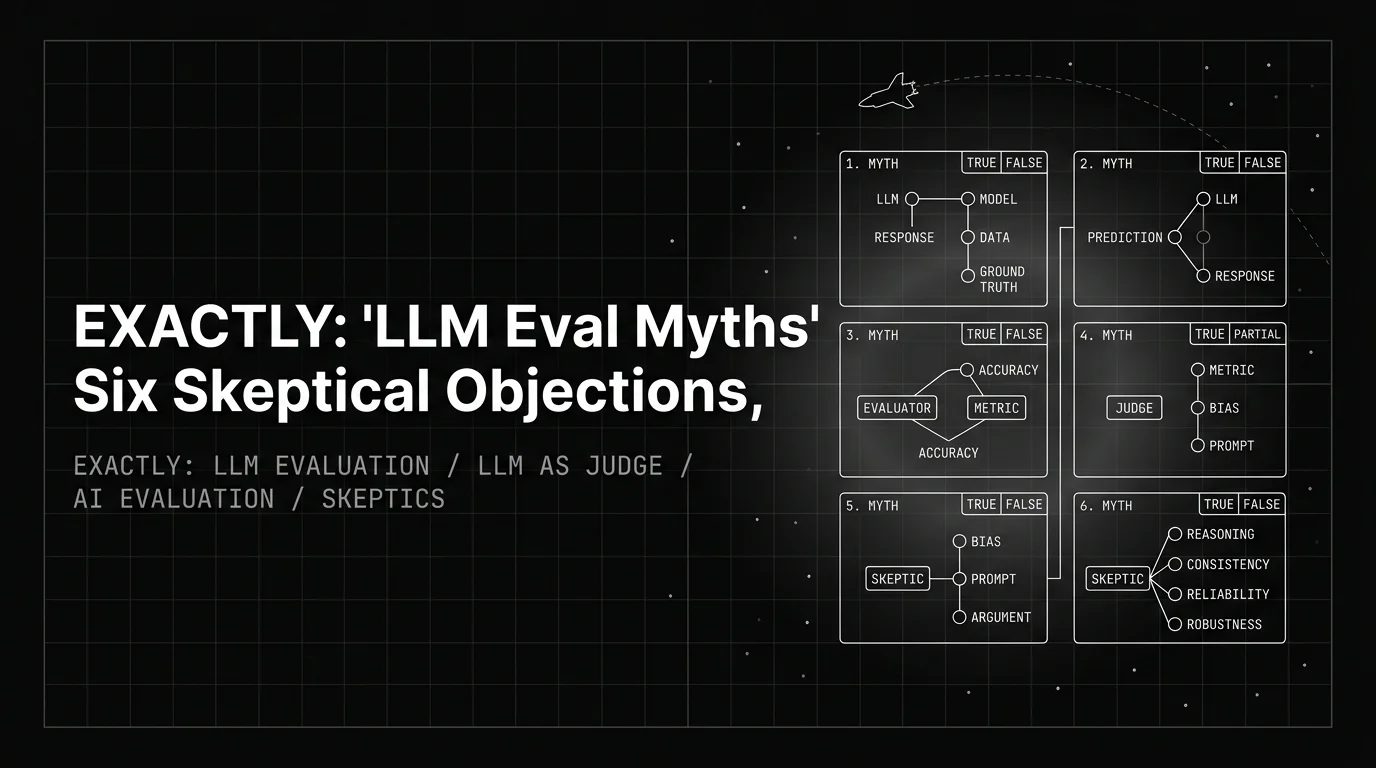
Table of Contents
You ship an LLM eval suite. It greens every commit for three months. Then a customer pings: the assistant cited a policy that was repealed in 2024. You pull the trace; the response passed every rubric. The faithfulness check said the claim was supported because the retrieved doc actually contained that policy. The rubric never asked whether the policy was current. The eval was honest. The product was wrong.
This is the moment the skeptic walks in: LLM-as-judge is unreliable, vibe-checks are enough, eval is overhead, just use accuracy, public benchmarks are fine, evals slow us down. Six objections, and most posts on this topic answer them defensively. This post is the opposite take.
Five of the six skeptical objections are right about something the field undersells. One is just laziness. The honest job is to engage each on its merits, name where the skeptic wins, and name where they lose. The eval discipline that survives this exercise is sharper than the one that flinches.
TL;DR: where the skeptic wins, where they lose
| # | Objection | Skeptic wins | Skeptic loses |
|---|---|---|---|
| 1 | LLM-as-judge is unreliable | Naive judge has five real failure modes | Calibrated judge cascade is a solved problem |
| 2 | Vibe-check is enough early | True for week one | False past month one |
| 3 | Eval is overhead | True at prototype | False at scale |
| 4 | Just use accuracy | True for closed-form classifiers | False for open-ended generation |
| 5 | Public benchmarks are enough | Useful for model selection | Wrong tool for production decisions |
| 6 | Eval will slow us down | Nothing | Everything |
The shape of an honest answer: name the regime where the skeptic is correct, name the regime where the discipline takes over. Most arguments about eval are arguments about which regime you are in.
Myth 1: LLM-as-judge is unreliable
The skeptic’s case is sharper than the field admits. An LLM judge ships with five documented failure modes, every one of them measured in peer-reviewed work.
Position bias. In pairwise comparisons, the first option wins more often. Zheng et al. 2024 (arXiv:2306.05685) measured 10 to 15 points of winrate swing depending on which response sat in slot A. Verbosity bias. Longer responses score higher even when length adds nothing. Self-preference. A model judging its own family’s outputs scores them 10 to 25 percent higher than equivalent outputs from a different family. Calibration drift. A rubric calibrated against gpt-4o-2024-08-06 produces different distributions on gpt-4o-2024-11-20; mean shifts 3 to 8 points; distribution narrows. Judge-family lock-in. Swap GPT-4o for Sonnet 4.5 without recalibrating and the dashboard moves but the agent didn’t.
The skeptic is right that all five exist. They are wrong that any of them break the method. The calibrated version is a contract, not a vibe:
- Pin the judge model and rubric version as a single tuple.
(judge_model_id, rubric_version, prompt_template_hash). Bump deliberately, never as a vendor side-effect. - Calibrate every rubric against 50 to 200 human-labeled examples. Track Cohen’s kappa over time. A marketing-copy rubric tolerates kappa around 0.6; a medical-advice rubric needs 0.85.
- Cascade the cost. Heuristics first (schema, length, citation existence), classifier next (NLI for faithfulness, fine-tuned safety classifiers for toxicity/PII/injection), LLM judge only on the ambiguous remainder. In the
ai-evaluationSDK that cascade ships asaugment=True. - Anchor with a deterministic floor. If JSON schema fails, the eval fails outright. The judge never runs on cases a parser already failed.
from fi.evals import Evaluator
from fi.evals.templates import Groundedness, ContextAdherence
from fi.testcases import TestCase

evaluator = Evaluator(fi_api_key="...", fi_secret_key="...")
results = evaluator.evaluate(
    eval_templates=[Groundedness(), ContextAdherence()],
    inputs=[TestCase(query=q, response=r, context=ctx)],
    augment=True,  # cascade: heuristics -> classifier -> LLM judge
)
The why LLM-as-a-judge piece walks the four habits in detail. The skeptic’s point survives in one place: an unguarded judge is genuinely a vibe machine. Pin it, calibrate it, cascade it, anchor it, and it earns the gate.
Myth 2: vibe-check is enough early on
The skeptic’s case at week one is correct and most eval evangelism skips it. A founding engineer with the prompt in their head, eyeballing the first hundred traces, catches more real failures than a half-baked rubric does. The signal-to-noise on a rubric written before you understand the failure modes is worse than no rubric. Manual review compounds tacit knowledge that you cannot encode yet.
The break point isn’t a calendar date. It is the moment one of three things happens:
- You stop being able to hold the failure modes in your head. Usually month two, sometimes earlier. The taxonomy outgrows working memory.
- A second engineer joins the loop. Tacit standards don’t transfer. The new engineer ships a change that regresses a failure mode the first engineer was tracking in their head. The vibe-check stops being shared ground.
- The system makes decisions that touch customers in non-trivial ways. A demo bot can run on vibes. A bot that closes tickets, books appointments, or signs off on returns cannot.
Past that break point, vibes stop compounding. Regressions get missed for weeks instead of minutes. The cost of finding out in production exceeds the cost of a 60-second CI gate by an order of magnitude. The right move at week one is not “skip evaluation” or “build a rubric prematurely.” It is structured manual review with notes that compound into a rubric. Label 100 traces by hand. Cluster the failure modes. The rubric writes itself from the cluster names.
The skeptic wins the early-stage argument cleanly. They lose the scale argument the moment the system has any of the three triggers above.
Myth 3: eval is overhead
A founder’s version of the skeptic’s case: we are six engineers shipping fast against a prototype, and a CI eval gate is yak-shaving that we cannot afford. They are right at prototype stage. They are wrong about where they are.
The honest cost-benefit at prototype: eval infrastructure costs roughly a week of engineering to wire up properly, plus ongoing dataset maintenance. The benefit is regression detection, which is approximately zero when there are no regressions to detect because nothing is in production yet. Building the eval suite before the prototype is taking real traffic is the AI version of writing tests for a function whose signature is going to change tomorrow.
The cutover isn’t a fixed date. It is the moment the cost of a missed regression exceeds the cost of running the suite. Three concrete signals:
- First paying customer. Outage cost stops being a Slack apology.
- Second engineer on the eval-affecting surface. Tacit knowledge stops transferring.
- First production incident traceable to a silent regression. This one is the expensive way to learn the lesson.
For most production agents that moment arrives faster than founders expect, usually 6 to 12 weeks after first launch. The eval suite at that stage doesn’t need to be perfect. It needs to be the difference between catching regressions at PR time and finding out three weeks later when CSAT slips.
The substitution that holds: at prototype, manual review with notes; at first traffic, a thin rubric on the top three failure modes; at scale, a versioned dataset, calibrated rubrics, sub-60-second CI gate. The discipline scales with the consequences.
Myth 4: just use accuracy
The skeptic’s case: accuracy, F1, and AUC are well-understood, deterministic, cheap, and not subject to judge bias. Why reach for a rubric when a classifier-style metric does the job?
For closed-form tasks they are exactly right. If your output is a fixed label set (intent classification, sentiment, document tag, PII detection) and you have ground-truth labels, accuracy is the correct primitive. Reaching for an LLM judge on a binary classification task is theatrical; the judge will hallucinate before a calibrated classifier misses. The Future AGI Protect adapters (Gemma 3n LoRA for toxicity, bias, prompt injection, data privacy) are the canonical example: 65 ms median time-to-label, deterministic outputs, 50 to 500 times cheaper than a frontier judge per call. Sharp targets get sharp tools.
The skeptic loses the moment the output stops being a fixed label. Generative outputs (support replies, summaries, code generation, agent trajectories) have many valid forms. A correct paraphrase scores zero against a single reference. A near-miss that happens to match the reference scores higher than a better answer that uses different phrasing. The metric rewards surface tokens; the user rewards meaning. BLEU and ROUGE had a good run for machine translation in 2002 and 2004 because translation has short outputs and humans had agreed on references. Modern LLM generation breaks both assumptions.
The honest rule of thumb:
- Closed-form output, ground-truth label exists: accuracy, F1, AUC, classifier. Use the classifier.
- Open-ended output, no canonical answer: rubric-scored eval. Use the judge.
- Both: stack them. Deterministic floor (schema, regex) plus classifier (sharp targets) plus judge (subjective rubrics). This is the cascade the
augment=Trueflag implements.
Accuracy is not wrong. It is a primitive for a specific job. The mistake is using it as the only tool when most of the questions you care about in 2026 (helpfulness, faithfulness, refusal calibration, tone) cannot be expressed as classification.
Myth 5: public benchmarks are enough
The skeptic’s case: MMLU, HellaSwag, GSM8K, HumanEval, and the leaderboard of the week tell you whether the model is good. Spin up the highest scorer, ship it.
The skeptic is right that public benchmarks are useful for narrowing the candidate set. A model that fails GSM8K is not going to handle multi-step financial reasoning in your product. A model below 80 percent on MMLU is probably not the frontier you want underneath a customer-facing assistant. As a floor that a candidate must clear before it earns eval time on your task, the leaderboard does honest work.
The skeptic loses on the substitution. Benchmark scores tell you a model can do something on a fixed evaluation set. They do not tell you whether the model does the thing you need on your inputs. Three reasons the gap is large:
- Benchmark contamination. Public benchmarks leak into training data. A model scoring 92 percent on MMLU may be scoring on memorized answers, not generalized capability. The score reflects yesterday’s data, not tomorrow’s prompts.
- Distribution mismatch. Your traffic does not look like MMLU. Your users ask domain-specific questions in a specific tone with specific edge cases. The benchmark measures the model on a fixed distribution; production measures it on yours.
- Stack effects. Bugs in agents live in the stack, not just the model. Retrieval, tool selection, prompt composition, conversation state, downstream consumers. A perfect model on MMLU still fails if your retrieval returns the wrong doc, your tool schema is ambiguous, or your prompt frames the question badly.
The only signal that decides shipping in 2026 is a versioned dataset of representative production traffic, scored by rubrics calibrated against human labels, on the exact stack the product runs. Public benchmarks are a vendor signal. Your eval set is a product signal. The substitution is one-way: your eval set replaces the leaderboard, the leaderboard does not replace your eval set.
The skeptic’s strongest version of this argument: “we don’t have the bandwidth to build a custom eval set.” That is real. It is also exactly what the synthetic test data approach is for. Sampling 100 to 500 production traces, augmenting with generated edge cases, and labeling against a coarse taxonomy is one engineer-week of work. Cheaper than the cost of shipping the wrong model.
Myth 6: eval will slow us down
This is the one objection that, dug into, is pure laziness.
The skeptic’s claim: a 20-minute CI step on every PR adds friction, engineers learn to skip it, the gate ages into a rubber stamp. The first half of that sentence is true. The second half is a description of a badly-built eval suite, not of eval as a discipline.
The solved version of the problem is in the toolchain already:
- Sub-60-second CI eval against a per-route subset. Four distributed runners (Celery, Ray, Temporal, Kubernetes) parallelise the workload. A 300-example suite with 6 rubrics runs in well under a minute on standard hardware.
- Cascade plus sampling.
augment=Trueskips the LLM judge for cases the classifier already decided. Sampling cuts the per-PR run to affected routes. Full suite runs nightly, regression set runs weekly, sampled production batch runs daily. - Early stopping for noisy rubrics.
EarlyStoppingConfigports fromagent-opt’s six optimisers into eval workflows. If the running average has crossed threshold by example 200, stop. - Caching on the eval contract tuple. Verdicts keyed on
(judge_model_id, rubric_version, input_hash)cache cleanly. Unchanged traces don’t re-eval.
The PR-time gate that actually ships: 60 seconds, per-route subset, fail-fast on threshold breach. The nightly run is full coverage. The weekly run is the regression set plus a fresh production sample. This shape is not theoretical; it is what teams running agent observability versus evaluation versus benchmarking ship in 2026.
The skeptic loses this round. Not because the concern is invalid (slow CI gates do age into rubber stamps), but because the engineering work to fix it has been done and shipped. Citing the slow-eval failure mode in 2026 is citing a tool you chose not to learn.
This is the only one of the six objections where the honest answer is: ship it anyway, the cost concern is solved.
The meta-point: where the skeptic actually has a case
Five of six skeptical objections survive a calibrated examination. None of them survive as a reason to skip eval. They survive as a list of regimes where the discipline takes a specific shape:
- LLM-as-judge needs calibration, cascading, anchoring, and version pinning. Without those four, the judge is theatre.
- Vibe-check is the right tool at week one. The rubric is the right tool at month two.
- Eval is overhead at prototype. Eval is leverage at scale. The cutover is a signal, not a date.
- Accuracy is correct for closed-form. Rubrics are correct for open-ended. Stack them.
- Public benchmarks select candidates. Your eval set decides shipping. The two are not substitutes.
The sixth objection (eval slows shipping) is the only one that does not survive on its merits. The slow-eval problem has been solved at the toolchain level. Citing it in 2026 is laziness.
The teams shipping reliable agents in 2026 are not the ones with the best library. They are the ones with the operational habits: track judge versus human Cohen’s kappa, refresh the dataset weekly, alarm on rubric drift, pin the judge model, version the prompt as a hash, score the trace not just the response. The eval suite is part of the product; the agent passes evals but fails in production piece walks where the suite-to-outcome gap shows up and how to close it.
A judge call on a span is a number. A judge integrated with calibration, cascading, clustering, and self-improving rubrics is what compounds. The Future AGI Platform layers self-improving evaluators that retune from thumbs feedback, classifier-backed scoring at lower per-eval cost than Galileo Luna-2, and Error Feed clustering failing traces into named issues with an immediate_fix. The ai-evaluation SDK ships 70+ EvalTemplate rubrics, 13 guardrail backends, 8 sub-10ms Scanner classes, four distributed runners, and the augment=True cascade. The runtime underneath is Agent Command Center (native adapters, 6 routing strategies, RBAC, SOC 2 Type II, HIPAA, GDPR, CCPA certifications).
Eval isn’t the tool. Eval is the discipline. The skeptic is right about every regime where the discipline is missing. The stack is the version that doesn’t freeze.
Related reading
Frequently Asked Questions
Is LLM-as-judge unreliable?
Is vibe-checking enough early on?
Is eval overhead at prototype stage?
Can you just use accuracy?
Are public benchmarks enough?
Will eval slow shipping?
LLM-as-a-judge is the only eval method that scales to subjective rubrics. The honest case for, against, and the discipline that earns trust.

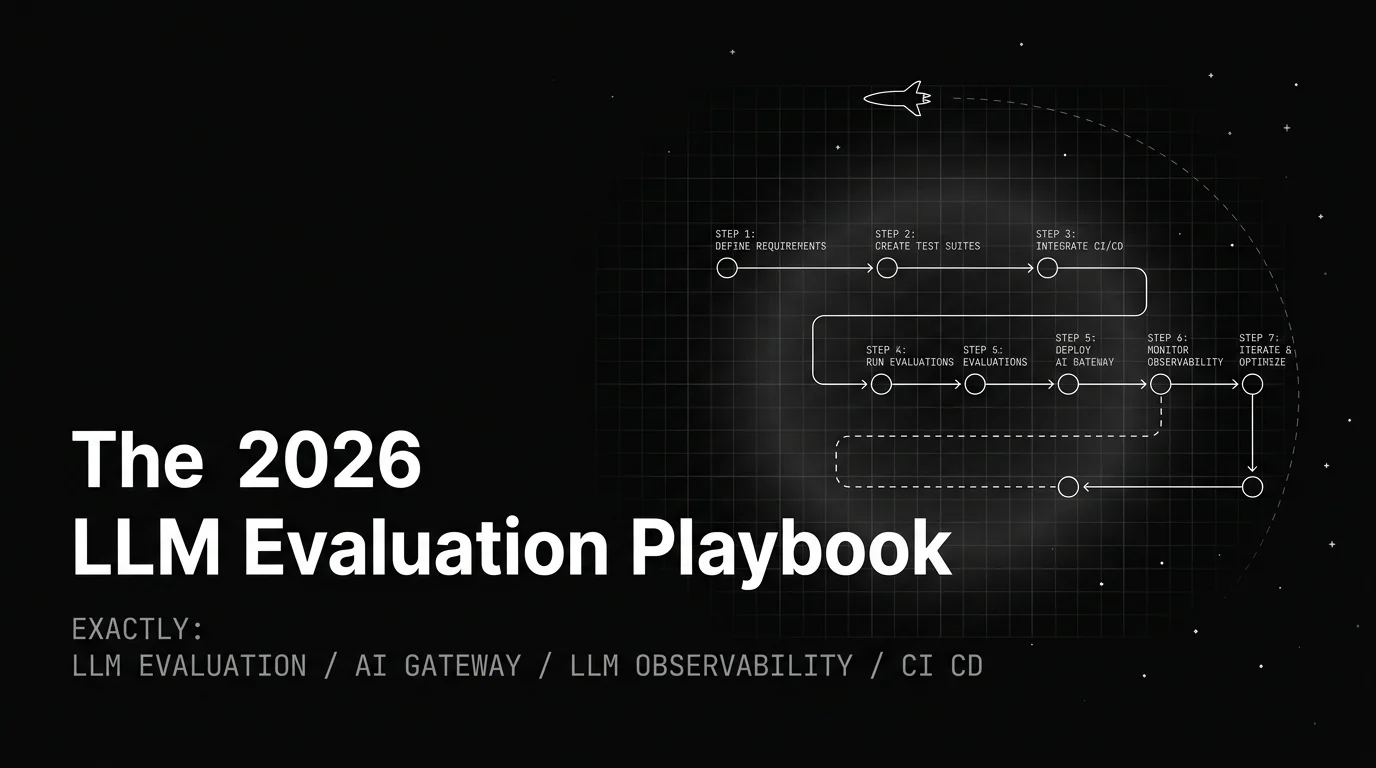
The pillar playbook for LLM evaluation in 2026: dataset, metrics, judge, CI gate, production observation, closed loop from failing trace to regression.
Your eval set is a snapshot, production is a river. Six drift modes that age eval sets, and the trace-as-eval loop that closes the gap.