Is GraphRAG vs RAG Worth the Extra Complexity?
An honest cost-benefit look at graphrag vs rag: real indexing math, the benchmarks where each wins, and a router rule for when graph structure pays off.
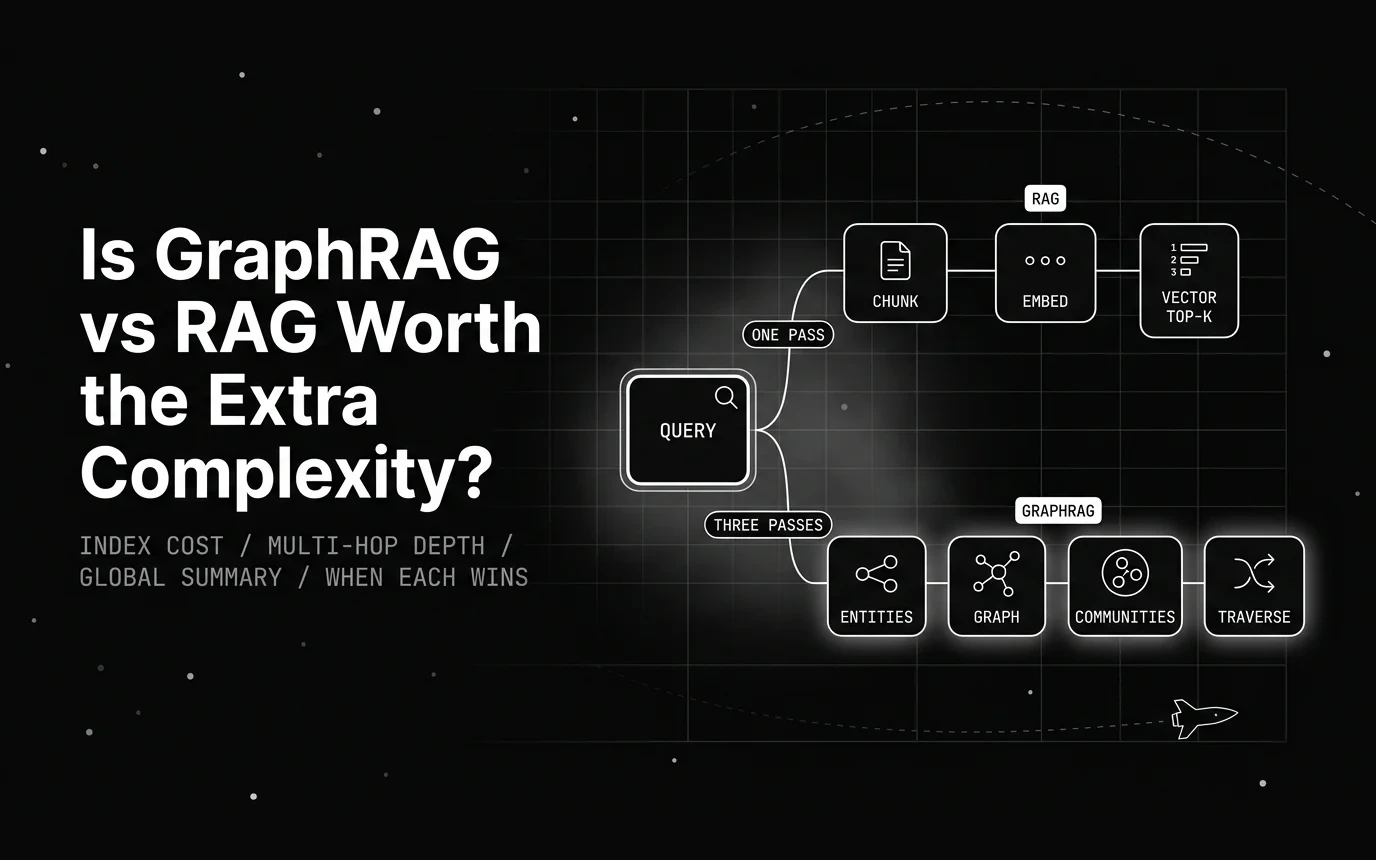
Table of Contents
Your RAG stack works. Retrieval is fast, answers stay grounded, the demo lands. Then someone asks a question that spans three documents, the answer falls apart, and a well-meaning voice in the room says the fix is GraphRAG. Before you rebuild the pipeline, it is worth asking what that upgrade actually costs.
The graphrag vs rag question is a build-versus-benefit call. Plain RAG retrieves text chunks by similarity; GraphRAG first builds an entity-relationship graph, then traverses it to answer. That extra structure helps some questions and triples your indexing bill on every other one.
This post gives you a decision framework for graphrag vs rag. We cover what each pipeline compares, where GraphRAG beats RAG and where it does not, the real cost math with runnable code, and a per-query router you can drop into production. The aim is a call you can defend in a design review.
TL;DR
- Default to plain RAG. It is cheaper and usually at parity on the single-hop lookups that dominate most traffic.
- GraphRAG earns its cost on temporal and comparison questions, where the answer spans many documents and a bigger top-k will not reach it.
- The measured gaps are small. On Llama 3.1-8B, RAG scores 64.78 F1 on single-hop Natural Questions against GraphRAG’s 63.01, and GraphRAG leads 61.66 to 60.04 F1 on HotpotQA.
- GraphRAG’s multi-hop win partly buys itself with tokens. It fed 9,770 retrieved tokens per query against RAG’s 3,631, and when the same study gave RAG a matching token budget, RAG scored 69.33 on MultiHop-RAG against GraphRAG’s 69.01.
- Indexing is where the real bill lands: in that study GraphRAG’s graph construction took 5,560 seconds against plain RAG’s 135.
- Route per query, or use LazyGraphRAG (Microsoft reports indexing at 0.1% of full GraphRAG’s cost), and confirm the split by measuring retrieval quality on your own questions.
What GraphRAG vs RAG Actually Compares
Both pipelines answer questions from your own data, and both start the same way. The difference is what happens after chunking. One path stays flat and fast; the other adds structure and cost. Naming those steps precisely is the only way to price the graphrag vs rag tradeoff honestly.
Baseline RAG in One Pass
Plain RAG runs a single pipeline: split documents into chunks, embed each chunk into a vector, store them, and at query time embed the question and pull the top-k nearest chunks. That retrieved text is stuffed into the prompt as context. One pass over the corpus, one index, one lookup per query.
GraphRAG and Its Extra Layers
GraphRAG adds three jobs before you can query. It extracts entities and relationships from every chunk, links them into a knowledge graph, and summarizes densely connected communities into higher-level notes. At query time it traverses that graph alongside or instead of a flat vector search. Each added layer is real compute you pay for up front.
The mental model is flat similarity versus structured traversal. RAG asks which chunks look like the question. GraphRAG asks how the entities in the question connect across the whole corpus. That structural view answers multi-hop questions well, and it is exactly why the indexing cost delta exists.
There is also a storage-layer difference worth understanding before you commit. Our guide on vector databases vs knowledge graphs for RAG breaks down how each store behaves under load, and the table below prices the architectural gap the two designs create.
| Dimension | Plain RAG | GraphRAG |
|---|---|---|
| Index steps | Chunk, embed | Chunk, extract entities/relations, summarize communities |
| Index passes over corpus | 1 | ~3 (measured 135s vs 5,560s on MultiHop-RAG) |
| Query path | Vector top-k (3,631 tokens) | Graph traversal + summarization (9,770 tokens) |
| Strong on | Single-hop factoid, detail retrieval | Temporal, comparison, corpus-level sensemaking |
| Refresh cost on new data | Re-embed deltas | Re-extract + re-summarize affected subgraph |
Where Does GraphRAG Actually Beat RAG?
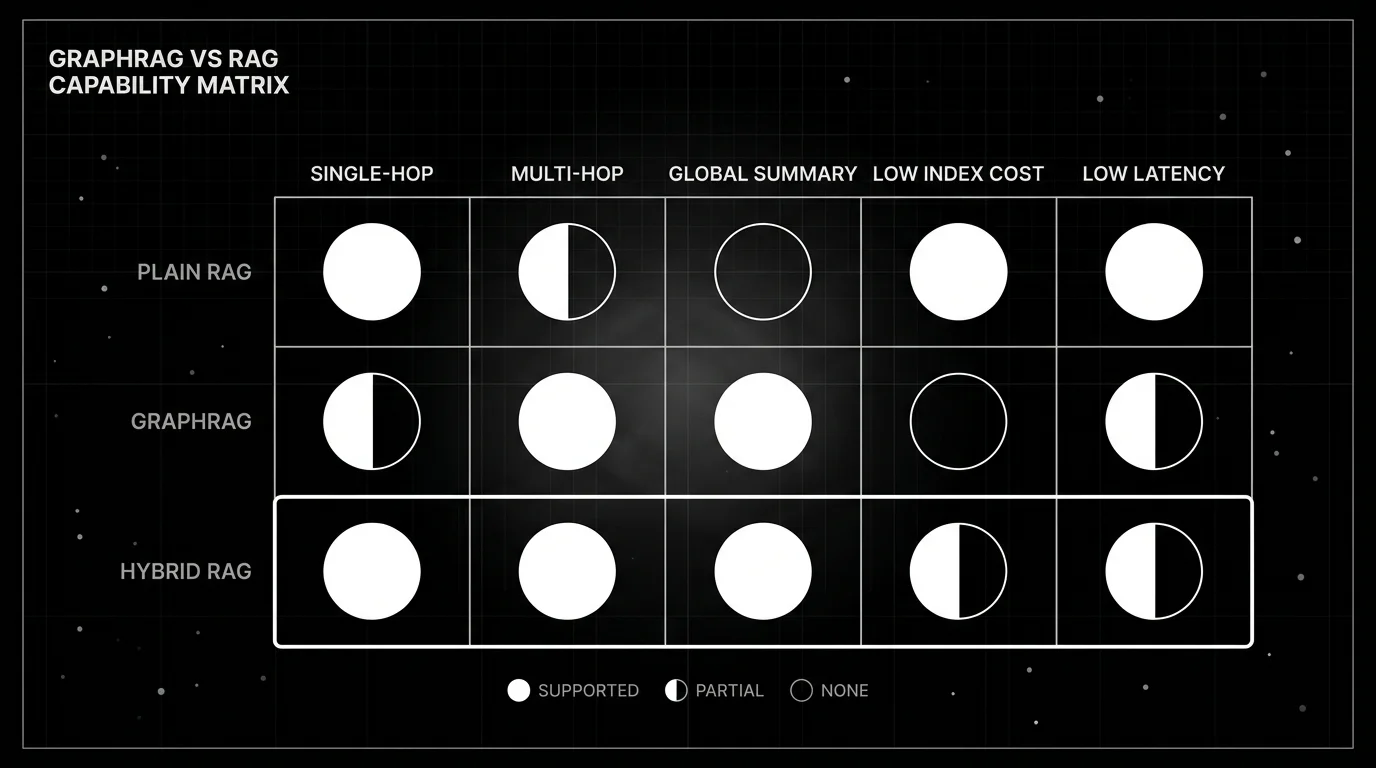
The honest answer to graphrag vs rag is that neither wins everywhere. GraphRAG earns its cost where the answer lives in relationships across many documents, above all on temporal and comparison questions. Plain RAG holds its own, and often wins, on single-hop factoid lookups where one chunk already contains the answer.
The 2025 systematic study RAG vs. GraphRAG: A Systematic Evaluation and Key Insights put both on equal footing with Llama 3.1-8B, comparing plain RAG against Microsoft’s Community-GraphRAG in local-search mode.
On single-hop Natural Questions, plain RAG scored 64.78 F1 against GraphRAG’s 63.01. The gap is small, but it points the expected way: flat retrieval is enough when the fact sits in one place.
On multi-hop benchmarks the ordering flips. HotpotQA gave GraphRAG 61.66 F1 against RAG’s 60.04, and MultiHop-RAG accuracy reached 69.01% for GraphRAG versus 67.02% for RAG. Both margins are narrow, and both favor GraphRAG.
Then the same paper takes most of that back. GraphRAG’s local search fed the generator 9,770 retrieved tokens per MultiHop-RAG query against plain RAG’s 3,631, because it ships entities, relation descriptions, and community summaries alongside the text. Give RAG the same token budget and it scores 69.33 overall, edging past GraphRAG’s 69.01.
So the honest reading is narrower than the headline. GraphRAG’s overall multi-hop lead is substantially a context-budget effect. What survives the token-matched comparison is the query types where structure genuinely helps: temporal questions, where GraphRAG scored 50.60 against token-matched RAG’s 36.71, and comparison questions. If your multi-hop traffic is not temporal or comparative, a bigger top_k may buy you the same lift for none of the indexing cost.
Summarization is the claim to be most careful with. Microsoft’s GraphRAG paper reports global search winning on corpus-wide sensemaking, judged by an LLM without references. The systematic evaluation scored query-based summarization against human-written summaries with ROUGE and BERTScore instead, and there plain RAG beat GraphRAG. The authors also found position bias in the LLM-as-a-judge setup: swap the order the two summaries are shown in and the preference moves. Both results can be true, because they measure different things, which is exactly why “GraphRAG is better at summaries” is not a claim you should buy unmeasured.
Most GraphRAG marketing implies it is strictly better. The benchmark numbers say otherwise. If your traffic is mostly single-fact lookups, the graph you paid to build may sit idle. You learn your real split by measuring retrieval quality on your own questions, not by trusting a benchmark average. Once you have picked a side, our guide to evaluating GraphRAG pipelines covers the three-layer metric set, graph construction included, that tells you whether the graph you built is any good; this post only answers whether to build one.
What Does GraphRAG Actually Cost?
If GraphRAG only sometimes wins, the cost side decides the rest. Three costs separate it from plain RAG: multi-pass indexing tokens, graph build and refresh time, and schema upkeep as the corpus changes. None of them show up in a small demo, where a tiny corpus hides the multiplier.
The first cost is tokens. GraphRAG sends your corpus through the model several times: one pass extracts entities and their relationships together, another summarizes densely connected communities, and larger corpora add still more. Plain RAG embeds each chunk once.
Wall-clock puts a number on it. On MultiHop-RAG, the systematic evaluation measured Community-GraphRAG’s index build at 5,560 seconds against plain RAG’s 135, roughly a 41x gap on the same corpus in their setup. The estimator below treats three model passes as a conservative floor for the token side of that bill; on your corpus it will very likely run higher.
import tiktoken

def index_cost_usd(corpus: str, price_per_1k: float = 0.00013):
    """Estimate index token cost for RAG (1 pass) vs GraphRAG (3-pass floor).
    price_per_1k defaults to a typical small-model input rate."""
    enc = tiktoken.encoding_for_model("gpt-4o")
    n_tokens = len(enc.encode(corpus))
    graphrag_passes = 3  # floor: entity+relationship extraction, community summarization
    rag_cost = (n_tokens / 1000) * price_per_1k
    graphrag_cost = rag_cost * graphrag_passes
    return round(rag_cost, 4), round(graphrag_cost, 4)

if __name__ == "__main__":
    sample = "Contoso shipped the K2 turbine in 2021. " * 5000
    rag, graph = index_cost_usd(sample)
    assert graph > rag
    print(f"RAG index: ${rag}  |  GraphRAG index: ${graph}")
Those passes are why teams watch indexing bills spike after a GraphRAG rollout. LazyGraphRAG is the direct response: it builds its index with plain NLP noun-phrase extraction and defers every LLM call to query time. Microsoft reports its indexing cost as identical to vector RAG and 0.1% of full GraphRAG’s. You trade query-time work for an index that is effectively free, which reshapes the graphrag vs rag math more than any prompt change will.
The tradeoff is not only retrieval versus retrieval, either. If you are weighing added structure against other ways to improve answers, our decision framework for retrieval vs training covers the wider set of options, from better chunking to fine-tuning, so you do not over-invest in one lever.
Maintenance is the quieter cost. When new documents arrive, you re-extract and re-summarize the affected subgraph, not just embed a delta. A corpus that changes daily turns that refresh into a standing operational cost you carry every week.
Query latency is the one place GraphRAG can come out ahead, and it is worth knowing before you argue the opposite. In the same study, Community-GraphRAG’s local search retrieved faster than plain RAG (1,249s against 1,724s across the run) because community-level matching short-circuits the search. The KG-triplet variant, which expands entities with an LLM at query time, was by far the slowest. Which GraphRAG flavor you pick moves query latency more than the graph itself does.
When Is Plain RAG Enough?
Given the cost, the useful question is when plain RAG is already enough. Four triggers point that way: your queries are mostly single-hop lookups, your corpus is small and stable, your latency budget is tight, and your users rarely ask relationship questions. Hit three of those and graph overhead rarely pays off.
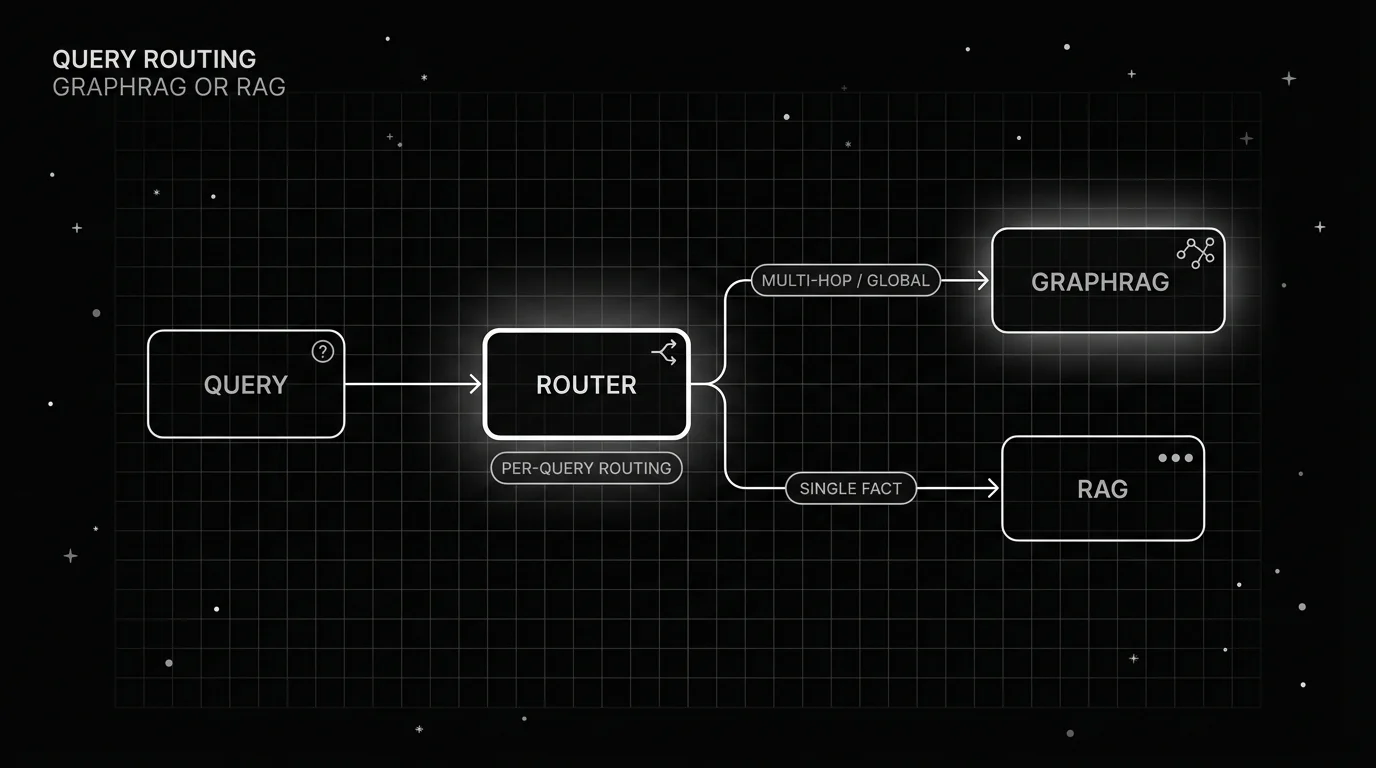
You do not have to guess per query. A cheap router can inspect each question and send global or multi-hop phrasing to GraphRAG while keeping single-fact lookups on plain RAG. The heuristic below is deliberately simple, a starting point you tune on your own traffic rather than a finished classifier.
def route_query(query: str) -> str:
    """Cheap heuristic: send global/multi-hop queries to GraphRAG,
    single-fact lookups to plain RAG."""
    q = query.lower()
    multihop_signals = ("compare", "across", "over time", "relationship",
                        "how does", "trend", "overall", "summarize all")
    if any(s in q for s in multihop_signals):
        return "graphrag"
    if len(q.split()) > 25:
        return "graphrag"
    return "rag"

if __name__ == "__main__":
    assert route_query("What is the capital of France?") == "rag"
    assert route_query("Compare revenue across all subsidiaries over time") == "graphrag"
    print("router ok")
This kind of routing is what turns the graphrag vs rag choice from an all-or-nothing rebuild into a per-query decision. Start with keyword signals, log which path each query takes, then upgrade to a small classifier once you see real patterns. The decision matrix below maps common query types to the right path.
| Query type | Example | Recommended |
|---|---|---|
| Single fact | ”What is the SLA?” | RAG |
| Multi-hop | ”Which vendors supply both plants?” | GraphRAG |
| Global summary | ”Summarize all incident causes” | GraphRAG global search, but measure it |
| Temporal | ”What changed between Q1 and Q3?” | GraphRAG / hybrid |
| Mixed traffic | Production app | Hybrid (route per query) |
Routing logic drifts as your data and phrasing change, so it needs a safety net. Our guide on testing retrieval quality in CI shows how to gate retrieval changes automatically, catching a regression in the router or the index before it ever reaches users in production.
Hybrid RAG and LazyGraphRAG, the Middle Path
Most production systems do not pick a side. Hybrid RAG routes or blends both retrievers, sending each query to graph or vector search, or merging results from both. It captures GraphRAG’s multi-hop strength on the questions that need it while keeping cheap vector lookups for everything else, which is the practical shape of the graphrag vs rag answer.
LazyGraphRAG sits in the same middle ground from the cost side. Instead of summarizing every community up front, it builds a lightweight index and does the heavier graph reasoning only when a query demands it. For corpora too large to fully graph-index, it makes the multi-hop capability affordable enough to keep around.
The systematic evaluation tested both shapes of hybrid and both improved QA across datasets. Concatenating RAG and GraphRAG evidence for every query (their Integration strategy) scored higher than routing each query to one pipeline (Selection), but it runs both retrievers every time, so you pay twice per query. Routing is the cheaper half of that trade, and it is the one worth starting with.
The honesty here matters. Hybrid retrieval gives consistent gains rather than universal wins, and it adds routing logic you now own and debug. A misrouted query gets a worse answer than either pure pipeline would give it. The middle path buys flexibility and a new failure surface to watch.
That new surface is exactly what you want visible. When you can observe which retrieval path fired for each request, a bad route shows up as a traceable event instead of a silently worse answer nobody can explain later in review.
Measuring Whether the Complexity Pays Off with Future AGI
Every heuristic in this post ends at the same place: you cannot settle graphrag vs rag for your data by reasoning about it. You settle it by running both pipelines on the same question set and scoring the answers. The pipeline that measurably wins on your traffic is the one worth its cost.
Future AGI gives you that measurement layer. You define a custom eval for your own answer criteria, then run the same questions through both stacks. Whichever pipeline scores higher on your data is the one that earned its indexing bill, argument settled.
For the retrieval comparison itself, three built-in evals do the head-to-head work.
Context relevance checks whether the retrieved chunks match the question, and groundedness checks whether the answer stays tied to that context.
Chunk utilization then scores how much the answer leaned on those retrieved chunks. Run all three on both pipelines and the quality gap becomes a number.
Auto-instrumentation traces both stacks so you can see latency and path next to quality. The platform is open source on GitHub, so you can sign up and run it managed or deploy it inside your own environment and keep every trace in house.
That single score is what decides the graphrag vs rag call for your workload, grounded in your own questions rather than a benchmark.
Making the GraphRAG vs RAG Call
Back to that question that spanned three documents. The instinct to reach for GraphRAG made sense. It was just early. The right move is to confirm the multi-hop failure is common in your traffic, not a one-off, before you rebuild a working pipeline around it.
Here is the rule to act on. Default to plain RAG, because it is cheaper and usually at parity on the single-hop questions that dominate most traffic. Add graph structure only where two things are true: your users genuinely ask multi-hop or temporal questions, and a measured quality lift justifies the indexing cost.
Between those poles sits the middle path. Route per query, blend where it helps, and keep watching the numbers as your corpus and traffic shift. Re-check the graphrag vs rag call whenever your data or your questions move, because the right answer moves with them.
Frequently Asked Questions
What is the main difference in GraphRAG vs RAG?
Is GraphRAG always more accurate than RAG?
When should I choose RAG over GraphRAG?
How much more expensive is GraphRAG than RAG?
What is hybrid RAG in the graphrag vs rag debate?
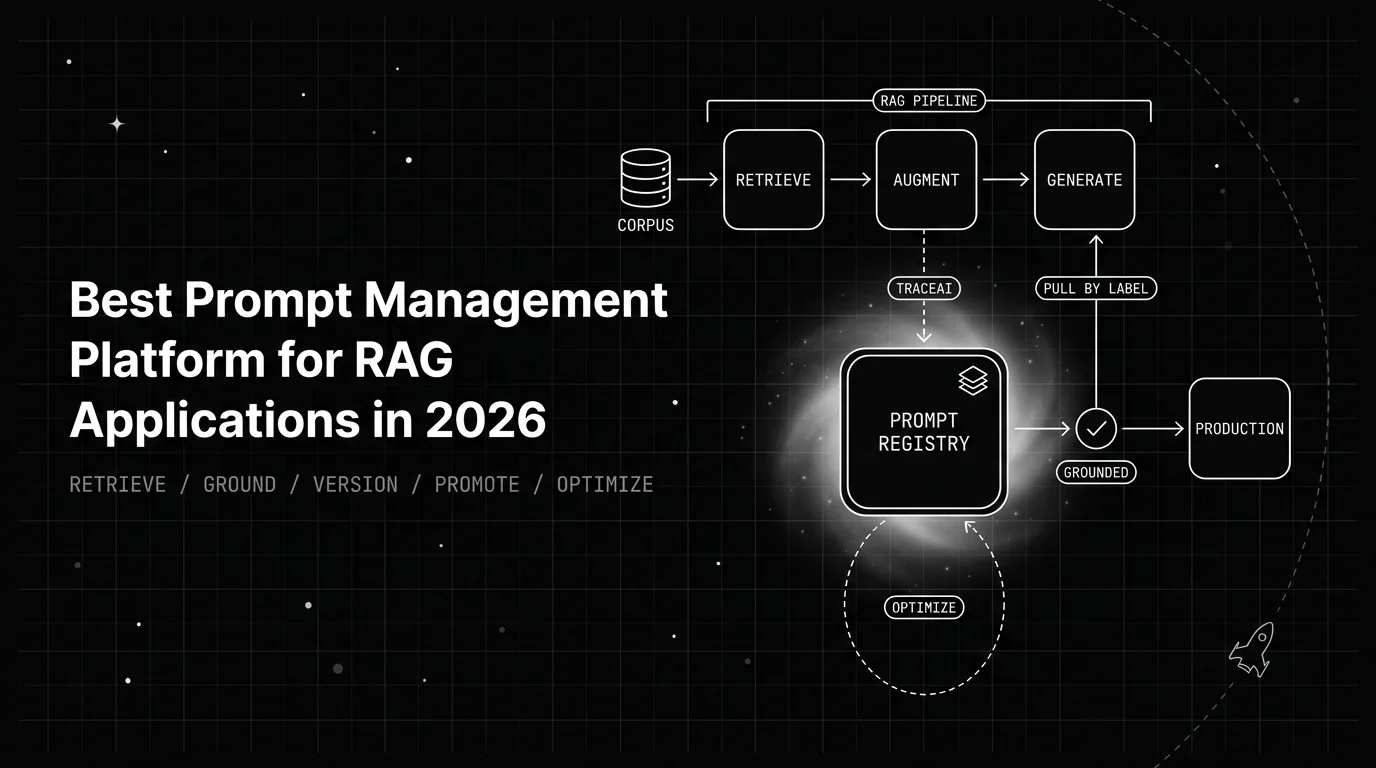
Prompt management for RAG: Future AGI versions retrieval and synthesis prompts, gates them on groundedness evaluators, and traces every answer.

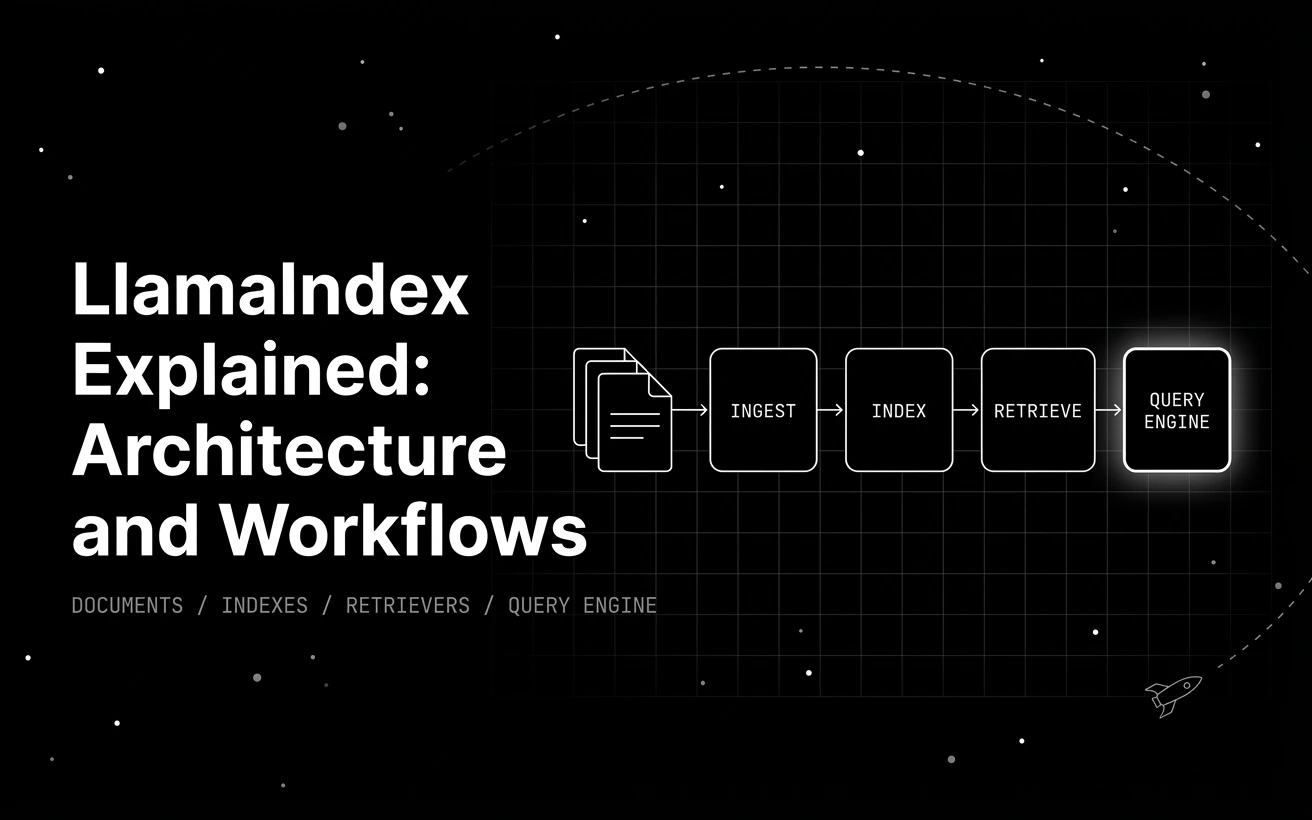
The LlamaIndex architecture in five layers: documents, indexes, retrievers, synthesis, and query engines, plus the Workflows API and when to reach for it.
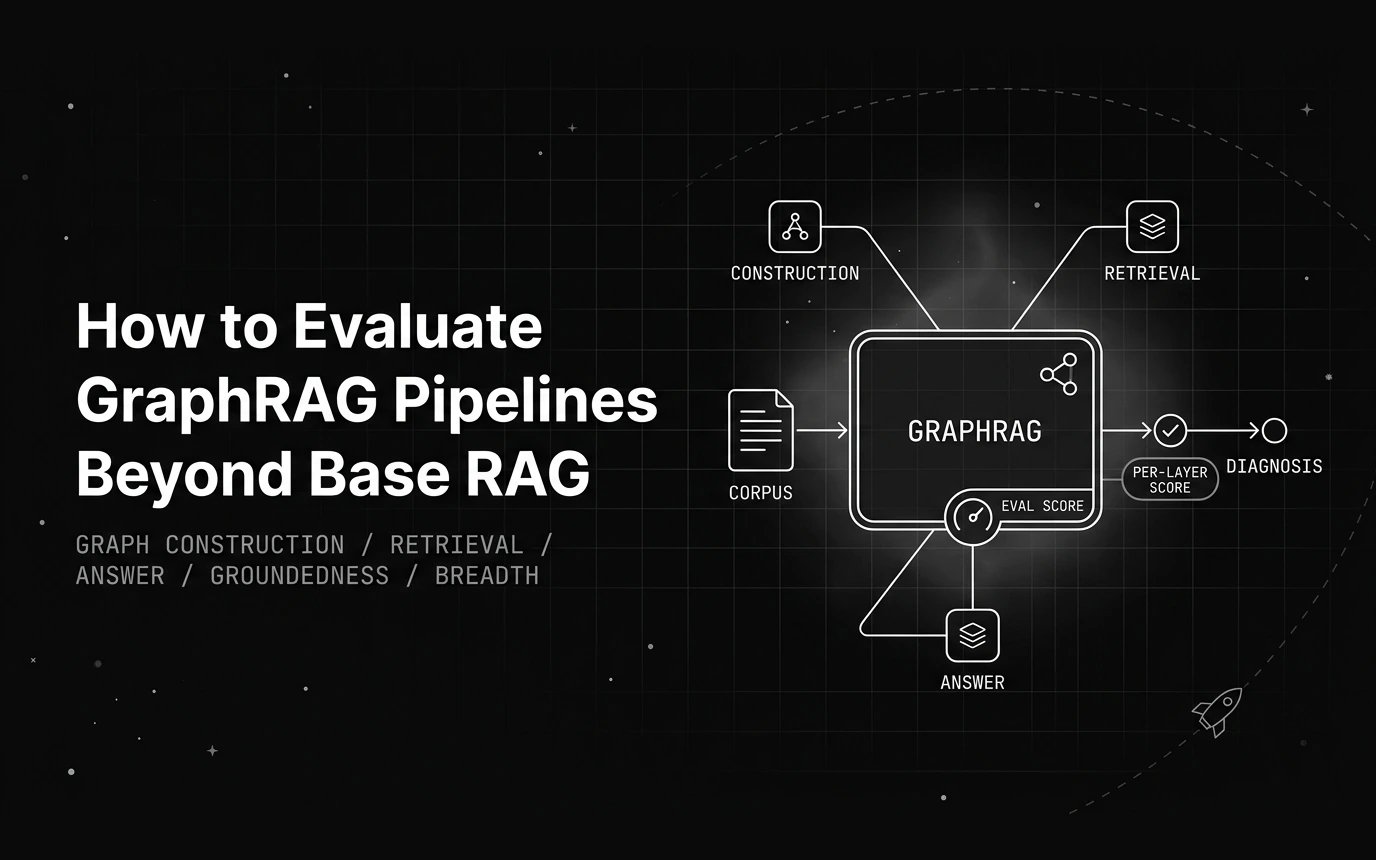
Base RAG metrics miss the graph underneath GraphRAG. Here is a three-layer framework, runnable graph metrics, and answer scores that isolate each failure.