Best Prompt Management Platform for RAG Applications in 2026
Prompt management for RAG: Future AGI versions retrieval and synthesis prompts, gates them on groundedness evaluators, and traces every answer.
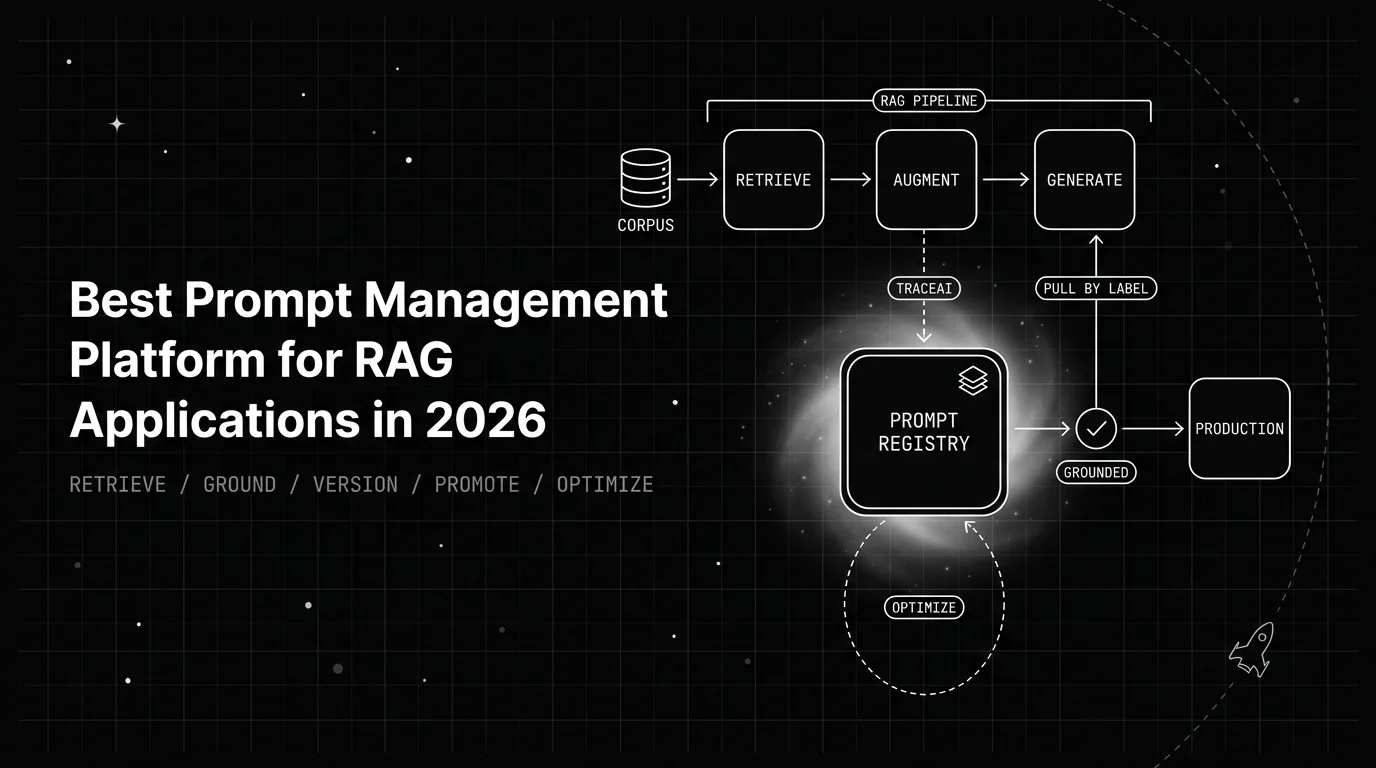
Table of Contents
A RAG team edits the synthesis prompt to fix one ungrounded answer. The change quietly lowers grounding on a dozen queries as the corpus shifts. Asked which version produced last week’s hallucination, no one can name it, score it, or roll it back. Future AGI runs RAG prompts as one loop that versions the retrieval and synthesis prompts, gates promotion on groundedness, and traces every answer to its version, all Apache-2.0 and self-hosted.
Why RAG Prompts Drift as Your Corpus Grows
A RAG application runs on two prompts, not one. The first shapes retrieval: how the query is rewritten or expanded before it hits the vector store. The second is the synthesis prompt: how the model is told to answer using the chunks that came back. Output quality is a product of both prompts and the context they receive, which is why RAG prompts drift in a way an ordinary prompt does not.
The drift rarely comes from editing the prompt. It comes from the corpus moving underneath a prompt that never changed. A synthesis prompt that was tightly grounded against last quarter’s documents starts pulling adjacent, near-duplicate chunks once you double the index, and the model answers confidently from context that does not actually support the claim. The text on the page is identical; the retrieved context is not, so yesterday’s good answer is not reproducible today.
Without version control tied to evaluation, you cannot separate the causes. When grounding drops, you cannot tell whether someone edited the prompt, retrieval returned different chunks, or the corpus changed. So you edit in place, lose the history of what was live, and have no labeled version to roll back to. Across a retrieval prompt and a synthesis prompt owned by different people, “it shipped fine last month” becomes a claim no one can verify.
Where Generic Prompt Tools Fall Short for RAG
Conventional prompt tooling stores a prompt and serves it back by label. That answers “what text shipped,” which is necessary but nowhere near sufficient for RAG. A registry sees the prompt as a string. It does not see the chunks the retriever returned, so it cannot tell you whether the answer was grounded in them, and it cannot fail a release when grounding regresses.
A tool like the open-source Langfuse does the storage part well, keeping clean versions and labels for each prompt. But two things sit in separate tools you wire together yourself: whether a RAG answer is grounded in its context, and the optimization that fixes the prompt when it is not. That leaves you with half a loop.
You can roll a version forward and back, but you cannot prove a new version grounds better before you promote it. You also cannot trace a bad production answer to the version and the chunks that caused it. For RAG, that missing half is where the quality problems live.
How Future AGI Manages RAG Prompts End to End
Future AGI handles a RAG prompt as an artifact to version, score, optimize, promote, and learn from, in one platform, not four. You keep the retrieval and synthesis prompts in a git-like registry and grade each version with RAG evaluators on a fixed dataset. You run the six optimization algorithms when a synthesis score falls short, then ship the winner by repointing a label. Production traces feed back, tying each live answer to its version and context.
Each row below is one stage of a RAG request, the way it typically fails, and the Future AGI capability that catches it:
| RAG stage | What can go wrong | Future AGI capability |
|---|---|---|
| Retrieval / query prompt | Pulls off-topic or near-duplicate chunks | Versioned query prompt scored with Precision@K, Recall@K, and NDCG@K |
| Synthesis / answer prompt | Confident but ungrounded answer | Context Adherence, Groundedness, and Detect Hallucination evaluators |
| Promotion | A new version regresses grounding | Eval-gated label promotion and rollback by repointing a label |
| Production | Cannot trace a bad answer to its prompt | traceAI logs the prompt template and retrieved context on every span |
Versioning Retrieval and Synthesis Prompts
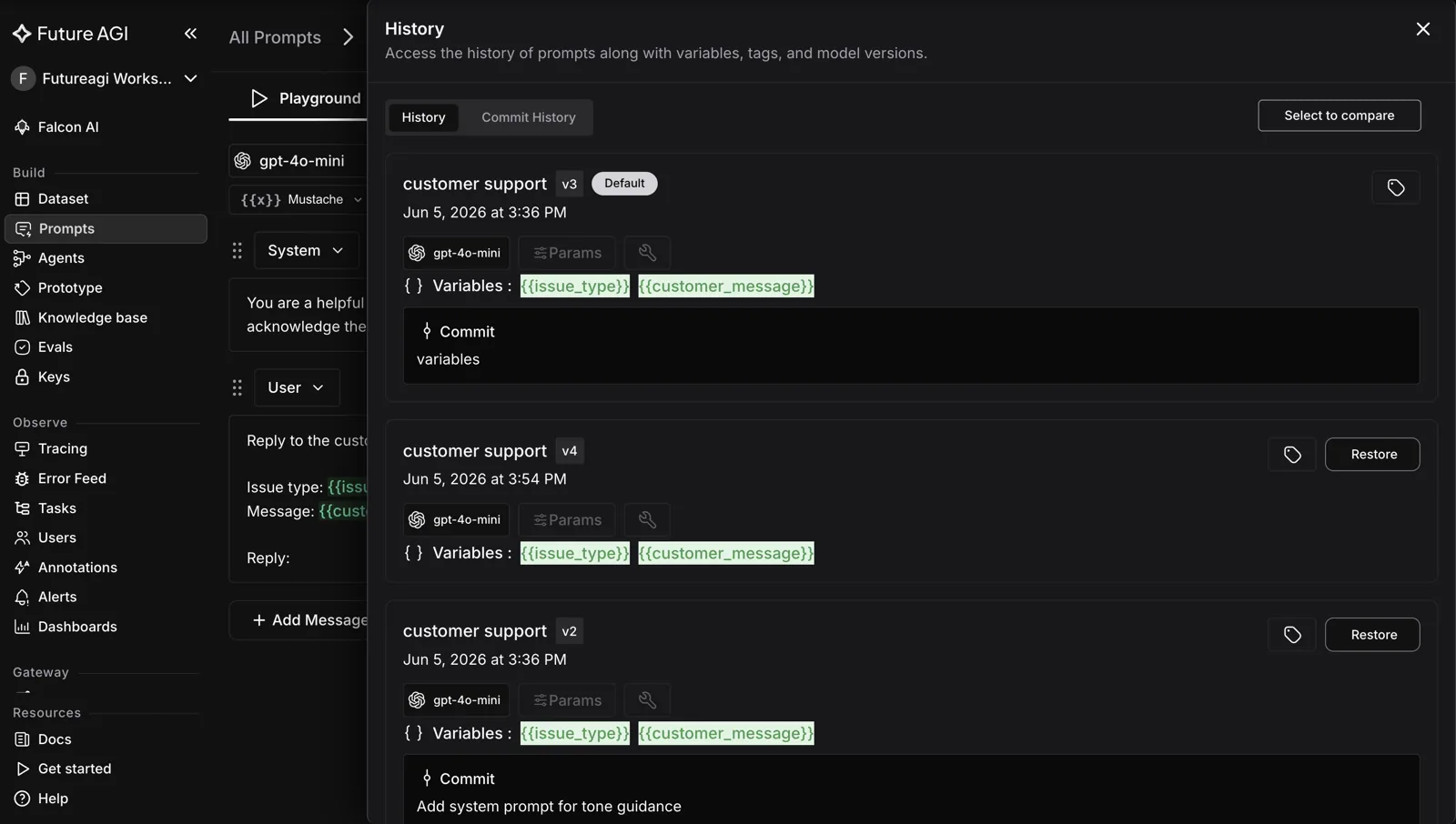
Treat the retrieval prompt and the synthesis prompt as two separate templates in the registry, because they fail for different reasons and improve on different schedules. Each carries a separate immutable history, its own commit messages, and its own deployment labels, so you always know which retrieval prompt and which synthesis prompt were live together for any given answer.
The workflow is git-like. You cut a version, commit it with a message, optionally make it the default, and pin deployment labels such as Production, Staging, and Development onto a chosen version. When a request comes in, you load the live version by name and label, then compile it with the query and the retrieved context. Rollback takes no redeploy. Repoint the label to an earlier version and the next call adopts it.
from fi.prompt import Prompt, PromptTemplate, SystemMessage, ModelConfig

# define the synthesis prompt and create its first immutable version
template = PromptTemplate(
    name="rag-synthesis",
    messages=[SystemMessage(content="Answer only from the context.\n{{context}}\n\nQuestion: {{question}}")],
    model_configuration=ModelConfig(model_name="gpt-4o"),
)
client = Prompt(template=template).create()

# commit a new version and stage it for evaluation, not live traffic
client.commit_current_version(message="rag-synthesis v3: tighter grounding", set_default=False)
client.assign_label("Staging", version="v3")

# promote only after the eval gate passes, by repointing the label
client.assign_label("Production", version="v3")

# at runtime, fetch the live version by name and label, then compile with variables
live = Prompt.get_template_by_name("rag-synthesis", label="Production")
messages = live.compile(context=retrieved_chunks, question=user_query)
For the exact label-to-environment mapping, see the prompt versioning docs; the prompt SDK reference walks through committing a version, assigning a label, and compiling at runtime.
Scoring RAG Prompts on Context, Groundedness, and Hallucination
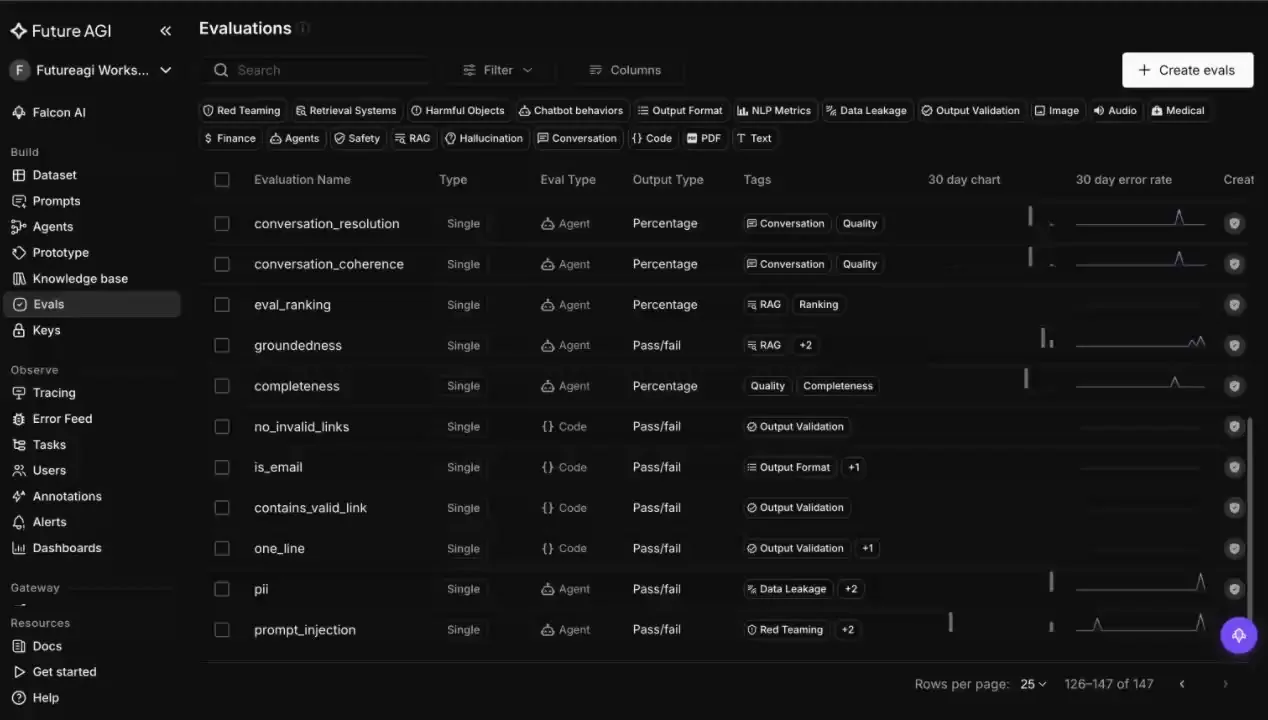
Versioning tells you what shipped. Evaluation tells you whether it is any good, and for RAG that means scoring the answer against the context it was given, not against a reference string alone. Future AGI lets you write a custom eval that scores the answer against the retrieved context, then set the pass bar. The built-in ones that matter most for RAG are retrieval-aware:
- Context Adherence and Groundedness check whether the answer is actually supported by the retrieved chunks, which is the direct measure of hallucination in a RAG system.
- Context Relevance checks whether retrieval pulled context that was relevant to the question in the first place, which separates a retrieval problem from a synthesis problem.
- Chunk Attribution and Chunk Utilization show which retrieved chunks the answer used and how much of the retrieved set was useful, so you can tell over-retrieval from under-retrieval.
- For the retrieval step itself, ranking metrics such as Precision@K, Recall@K, NDCG@K, MRR, and Hit Rate score how well the right documents came back.
These run as checks you gate promotion on: set a threshold so a synthesis prompt that lowers Context Adherence against the current Production version simply does not get the Production label. Each check is also available as a programmatic evaluator, for when you want the gate to run inside a script or a CI job rather than the dashboard. The evaluation library lists all 70+ built-in evaluators.
When a version lands close to the bar but short of it, optimization proposes the next candidate automatically. Point the open-source agent-opt library at one synthesis prompt, a RAG evaluator, and a dataset, and it rewrites and rescores that prompt across six algorithms (Random Search, Bayesian, ProTeGi, Meta-Prompt, PromptWizard, GEPA) until one lands a higher score, so improvement is measured rather than guessed. The optimization docs show how a run is configured.
Tracing Every Retrieval Span with traceAI

Offline scores are necessary, but a RAG prompt that looks grounded on a fixed dataset can still fail on live traffic, where the queries and the corpus are messier. traceAI closes that gap. Being OpenTelemetry-native, it auto-instruments the frameworks most RAG systems build on, LlamaIndex and LangChain among them, so the retrieval step and the synthesis step surface as spans with no manual wiring.
Here is the part that counts for prompt management. traceAI records the prompt template and its variables on the span, including the retrieved context passed into the synthesis prompt. So every production answer ties back to the precise version that generated it and the chunks it saw. When an answer is wrong, you do not guess.
You open its trace, identify the version that served it and the context it drew on, and turn that trace into a new evaluation case. How the template and its variables are recorded on each span is detailed in the observability docs.
Setting Up Future AGI for RAG
The platform itself installs quickly; the habits below are what keep a RAG prompt change from turning into a silent regression.
- Version the retrieval and synthesis prompts separately. Each fails for its own reasons, so give it a distinct history and label set instead of folding them together into a single template.
- Pin an evaluation dataset of real queries with the context they should retrieve, and gate promotion on Context Adherence and Groundedness, not on a manual read of a few examples.
- Promote by label, never by editing in place. Repointing the Production label is an auditable, reversible deploy, whereas an in-place edit leaves a gap in the record.
- Instrument with traceAI from day one, so every production answer carries its prompt version and retrieved context and you can debug grounding failures straight from the trace.
- Feed production traces back into agent-opt. The queries that failed in production are the best training set for the next synthesis-prompt candidate.
Since the platform is Apache-2.0 and self-hosts on Docker Compose, your corpus, your prompts, and your traces stay behind your own firewall, which matters when the documents feeding retrieval are confidential. Setup instructions live in the Future AGI repository.
Where Future AGI Fits in Your RAG Stack
A RAG answer comes from two moving parts, the prompt and the chunks that came back, which is why grounding can slip even when nobody touched the text. Future AGI versions the retrieval and synthesis prompts separately, scores each against the context it retrieved, and logs those chunks on every trace, so you can tell a retrieval miss from a synthesis one.
That turns a vague grounding complaint into a fix you can place on the right prompt. Score your first synthesis prompt in Future AGI, then follow the cookbook to bring both prompts into one loop.
Frequently Asked Questions
What Is Prompt Management for RAG Applications?
Which Prompt Management Platform Is Best for RAG in 2026?
How Do You Evaluate a RAG Prompt?
How Does Future AGI Link a RAG Prompt Version to Retrieval Quality?
How Is Versioning a RAG Prompt Different From a Normal Prompt?
Can You Self-Host a Prompt Management Platform for RAG?
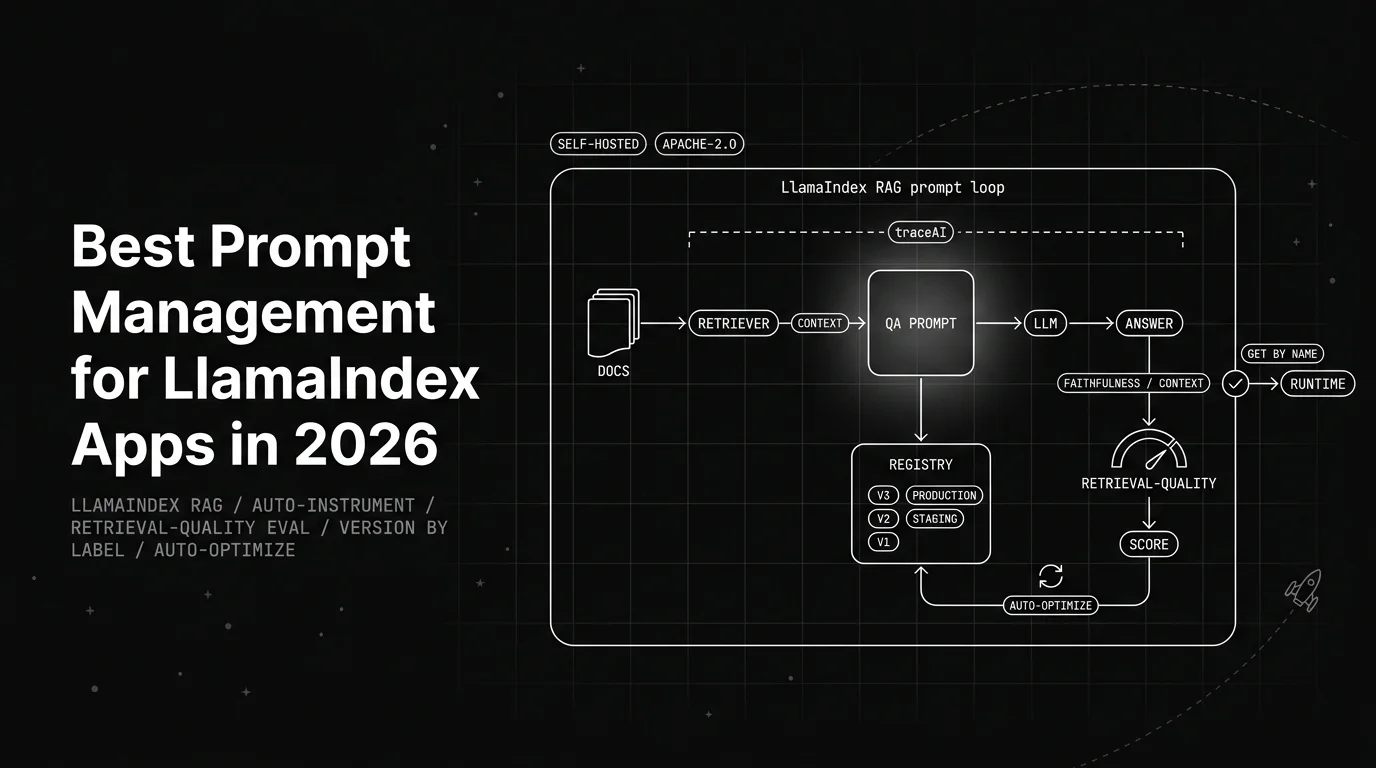
See the 6 best prompt management tools for LlamaIndex apps in 2026, ranked on integration, versioning, tracing, and evaluation for your RAG app prompts.

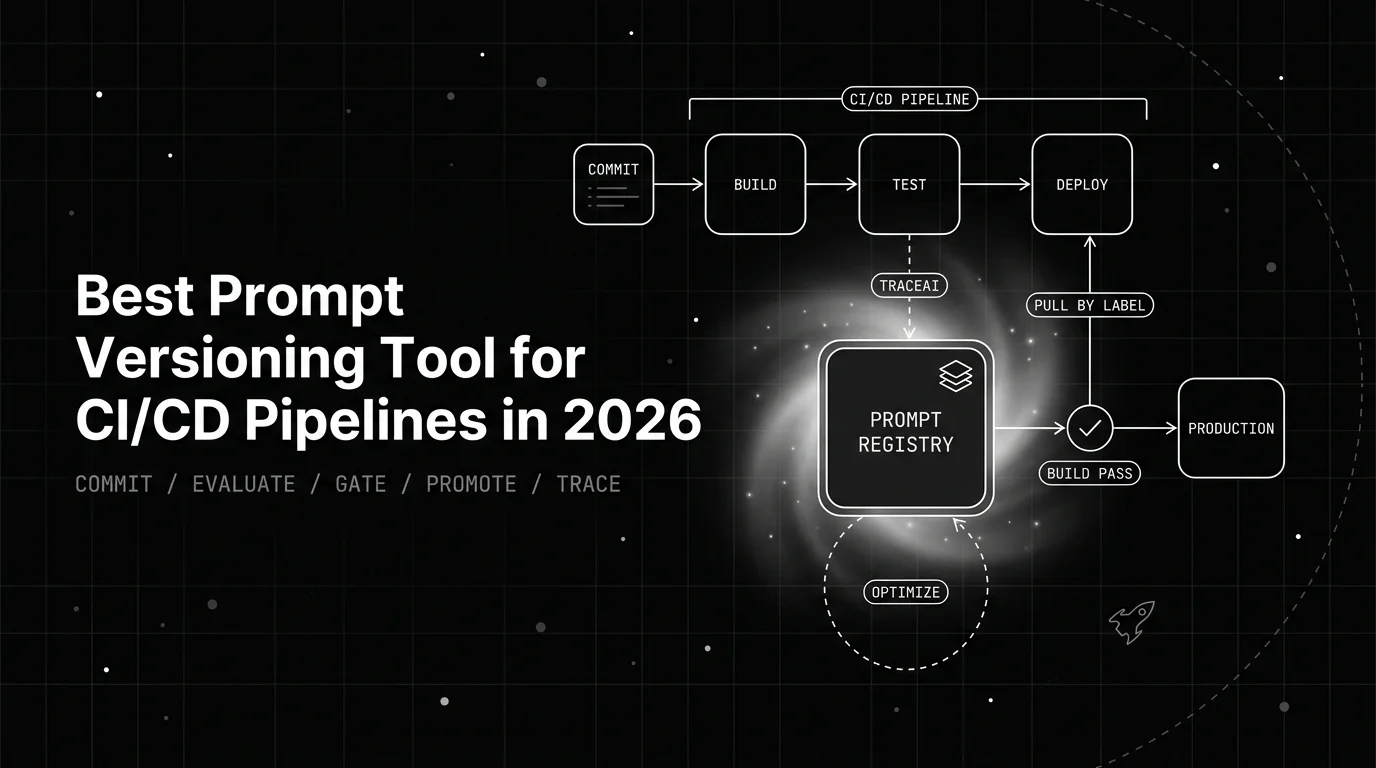
Prompt versioning for CI/CD with Future AGI: commit each version from the SDK, gate promotion on evaluators, fail the build on regression, promote by label.

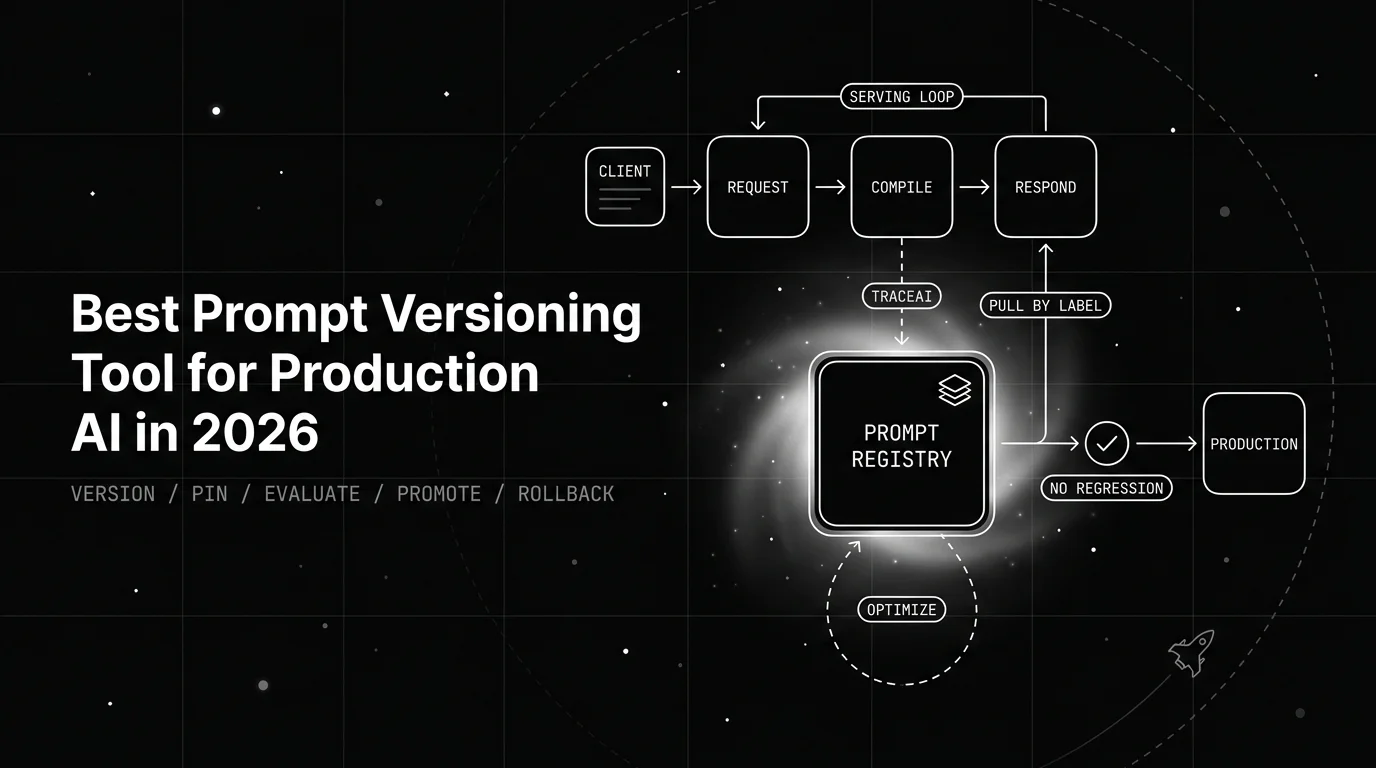
Prompt versioning for production AI with Future AGI: immutable snapshots, each trace stamped with the version that ran, eval-gated promotion, fast rollback.