LLM-as-a-Judge in 2026: How It Works, When It Fails, and How to Calibrate
LLM-as-a-judge in 2026: G-Eval, pairwise, rubric, Cohen's kappa calibration, bias controls, plus tools (FutureAGI, DeepEval, Ragas, Phoenix) compared.

Table of Contents
TL;DR: LLM-as-a-judge in 2026
| Question | 2026 answer |
|---|---|
| What is an LLM judge? | A model that scores, compares, or ranks other LLM outputs against a rubric. |
| Best method for nuanced criteria | Pairwise comparison with order alternation; more reliable than absolute scoring. |
| Best method for factual grounding | Reference-based Faithfulness with retrieved context as the reference. |
| Calibration target | Cohen’s kappa above 0.6 vs human labels; above 0.8 is strong. |
| Biases to control | Position, verbosity, self-preference, self-enhancement. Always run controls. |
| Cost vs human review | 50-100x cheaper at frontier-judge tier, 500-1000x cheaper at flash tier. |
| Production pattern | Sample-based (1-10%) on live traces + 100% in CI; humans handle flagged failures. |
If you read one row: pick pairwise comparison with both orderings, calibrate against human labels, and never use the same model family as generator and judge.
What an LLM judge actually does
An LLM judge is a model invoked with four inputs:
- Input. The prompt or user question that produced the output.
- Candidate output. The response under evaluation.
- Reference output (optional). A ground-truth answer for reference-based judging.
- Rubric. A scored criterion: a 1-5 scale, a 0-1 binary, a pairwise verdict, or a structured JSON schema.
The judge returns a structured score. Score formats include integer or float on a scale, binary pass/fail, ordinal verdict (A wins / tie / B wins), or a multi-dimension JSON object (helpfulness, harmlessness, factuality).
Three properties make a judge production-ready: reproducibility (same input gives same score within tolerance), calibration (the score correlates with human judgment on a labeled set), and bias control (position, verbosity, and family biases are measured and mitigated).
The four LLM-judge methods
1. Direct scoring
The judge reads the input and candidate output, then returns a score on a rubric. Simple to implement, easy to surface in dashboards, but susceptible to score compression (judges cluster around the middle of the scale).
Use when: large-volume scoring where simplicity matters more than fine-grained ranking.
Skip when: the criterion is nuanced and a 1-5 scale loses signal.
2. G-Eval
G-Eval, from Liu et al. 2023, asks the judge to chain-of-thought through the rubric before returning a score, then weights the final score by the token probability of each candidate score value.
G-Eval consistently reaches higher human-agreement than naive direct scoring on NLG criteria like coherence, consistency, fluency, and relevance. The definitive guide to G-Eval walks through rubric design and the probability-weighting step in depth.
Use when: rubric is multi-step (factual grounding, fluency, instruction-following).
Skip when: the judge model does not expose token probabilities or your rubric is a simple binary.
3. Pairwise comparison
Show the judge two outputs (A and B) for the same input and ask which is better, or tie. Pairwise reaches higher human-agreement than absolute scoring because the judge is doing a relative comparison instead of an absolute calibration. The canonical reference is MT-Bench / LLM-as-a-Judge from Zheng et al. 2023.
Use when: ranking two candidates (A/B test on prompt or model change), nuanced criteria, you have a labeled tie tolerance.
Skip when: you need absolute scores for a dashboard. Pairwise gives wins, not absolute quality.
Always run both orderings (A vs B and B vs A) and average to control position bias.
4. Reference-based judging
The judge compares the candidate output to a ground-truth reference. Common metrics include Faithfulness (response anchored in retrieved context), Answer Correctness (response matches the reference), and Context Recall (retrieved context contains the reference).
Use when: you have a labeled reference set (RAG, QA, summarization with ground truth).
Skip when: there is no single correct answer (open-ended generation, creative writing).
How to calibrate an LLM judge
Calibration is the step where you measure whether the judge’s score correlates with what humans actually think. Without calibration, the score is decorative.
The standard calibration loop:
- Sample 100-300 production traces. Diverse enough to cover use-case shape.
- Have 2-3 humans label them on your rubric. Use the same rubric prompt the judge will see.
- Compute inter-annotator agreement. Cohen’s kappa for two labelers, Krippendorff’s alpha for three or more.
- Score the same traces with the LLM judge. Same rubric, same scale.
- Compute judge-to-human agreement. Cohen’s kappa between judge score and majority human label.
Quality thresholds (matching the FAQ language above):
- Inter-annotator kappa below 0.4: the rubric is ambiguous; rewrite it.
- Inter-annotator kappa 0.4-0.6: weak; the rubric is tunable.
- Inter-annotator kappa above 0.6: acceptable.
- Inter-annotator kappa above 0.8: strong rubric.
- Judge-to-human kappa above 0.6: the judge is acceptable for production.
- Judge-to-human kappa above 0.8: the judge is strong.
A judge with kappa below 0.5 sits in weak-to-moderate agreement territory and is usually not enough for high-confidence automated decisions; treat it as advisory until the rubric is improved.
The four biases every production judge controls
Position bias
Judges prefer the first option in pairwise comparison, especially when uncertain. Mitigation: run both orderings (A vs B and B vs A) and average; if the verdicts disagree, call it a tie.
Verbosity bias
Judges prefer longer outputs, even when shorter ones are clearer. Mitigation: include a length-penalty in the rubric, or normalize by token count. Length-controlled win rate is now the de facto standard in pairwise reporting.
Self-preference
Judges prefer outputs from the same model family (a GPT-class judge favors GPT-class outputs). Mitigation: use a judge from a different family than the model under test.
Self-enhancement
Judges score their own outputs higher when used as both generator and judge. Mitigation: never reuse the same model for both roles; cross-validate with a different family.
These biases are documented in LLM-as-a-Judge with MT-Bench and Chatbot Arena and are now standard in production eval design. For a detect-measure-fix walkthrough of each one, see LLM-judge bias mitigation.
When to use LLM-as-a-judge instead of metric-based evaluation
Pick the method that matches the criterion:
| Criterion | Best method |
|---|---|
| Exact-match QA | Exact match or normalized exact match |
| Translation quality | BLEU, chrF, plus optional LLM judge on fluency |
| Retrieval | Hit Rate, MRR, Context Recall, Context Precision |
| Summarization quality | ROUGE for surface overlap + G-Eval for coherence |
| Helpfulness, tone, instruction-following | LLM judge (direct or pairwise) |
| Faithfulness (RAG grounding) | LLM judge with retrieved context as reference |
| Pairwise model comparison | Pairwise LLM judge with order alternation |
| Open-ended generation quality | Pairwise LLM judge vs reference + human spot check |
The 2026 production pattern is hybrid: traditional metrics for what is measurable, LLM judges for what requires reasoning, human review for the failing 1-5% flagged by either.
Picking a judge model
Two tiers cover most 2026 production use:
- Frontier judges (GPT-5 class, Claude Opus 4 class, Gemini 3 Pro class). Commonly used as calibration anchors. Slowest and most expensive per call; reserve for high-stakes evaluation and CI gates.
- Flash-tier judges (mini-class, Haiku-tier, Flash-tier). Substantially cheaper, fast enough for span-attached production scoring. Calibrate them against a frontier judge and labeled samples on your own data.
Three rules for picking the judge model:
- Different family from the generator. Avoid self-preference bias.
- Open weights when reproducibility matters. For research and regulated industries, pick an open-weights model so the judge is auditable across model versions.
- Always sample-cross-check. Even a calibrated judge drifts; cross-check 5-10% of production scores against a frontier judge or human review.
Production stack: where the judge runs
A 2026 production stack runs LLM judges in two places:
- CI (offline). Run the judge on a labeled dataset before deploy; gate the deploy on score regressions.
- Production (online). Attach the judge to a sample of live traces (1-10%) plus 100% of traces flagged by guardrails or low-confidence signals. Failing traces go to a human review queue.
This pattern catches both pre-deploy regressions and post-deploy drift. The cost is bounded by sampling rate, the coverage is bounded by what flags fire, and the human queue scales linearly with failure rate, not traffic.
Common LLM-judge failure modes
Five recurring mistakes in 2026:
- No human calibration. Score correlates with nothing measurable. Always run a 100-300 sample human-vs-judge audit before trusting the score.
- Single rubric for multiple use cases. Helpfulness on chat is not the same as helpfulness on code review; lock one rubric per intent.
- Pairwise without order alternation. Position bias guarantees inflated win rate for the first option; always run A-vs-B and B-vs-A.
- Same model as generator and judge. Self-preference inflates score; always cross-family.
- Treating scores as comparable across rubric versions. Locking the rubric is part of the contract; when the rubric changes, resample.
LLM-as-a-judge platforms in 2026
| Platform | Strength | OSS | When to pick |
|---|---|---|---|
| FutureAGI | Span-attached judges + simulation + gateway + guardrails on one stack | Apache 2.0 | Production judge running on live spans with BYOK and the unified eval-observe-simulate-gate-optimize loop |
| DeepEval | Pytest-native G-Eval, Faithfulness, Answer Relevancy | Apache 2.0 | CI-driven eval inside an existing Python test suite |
| Ragas | RAG-focused Faithfulness, Answer Correctness, Context Recall | Apache 2.0 | RAG-only library use in notebooks and offline scripts |
| Arize Phoenix | OTel-native, large template library | Elastic License 2.0 | OpenTelemetry-first shops; source-available not OSI open source |
| Langfuse | Self-hosted, judge templates + datasets + traces | MIT core | Self-hosted observability with judge runs |
| OpenAI Evals | Model-graded eval templates | MIT | OpenAI-first stacks running CI evals against rubrics |
In a niche where Future AGI competes (LLM judge platform, hallucination detection, RAG eval), Future AGI is the top pick when you need span-attached judges with bias controls, simulation for synthetic personas, BYOK gateway, and guardrails on one stack.
The OSS pieces are Apache 2.0 ai-evaluation and Apache 2.0 traceAI.
How Future AGI runs LLM-as-a-judge
The platform ships a CustomLLMJudge that accepts any rubric and any judge model, plus a library of pre-built judges (Faithfulness, Answer Relevance, Context Recall, Context Precision, Hallucination, Helpfulness, Harmlessness). Judges attach to spans through traceAI so each production trace carries its scores natively.
The Agent Command Center gates traffic on judge thresholds, and the gateway lets you BYOK the judge model across providers without rewriting integration code.
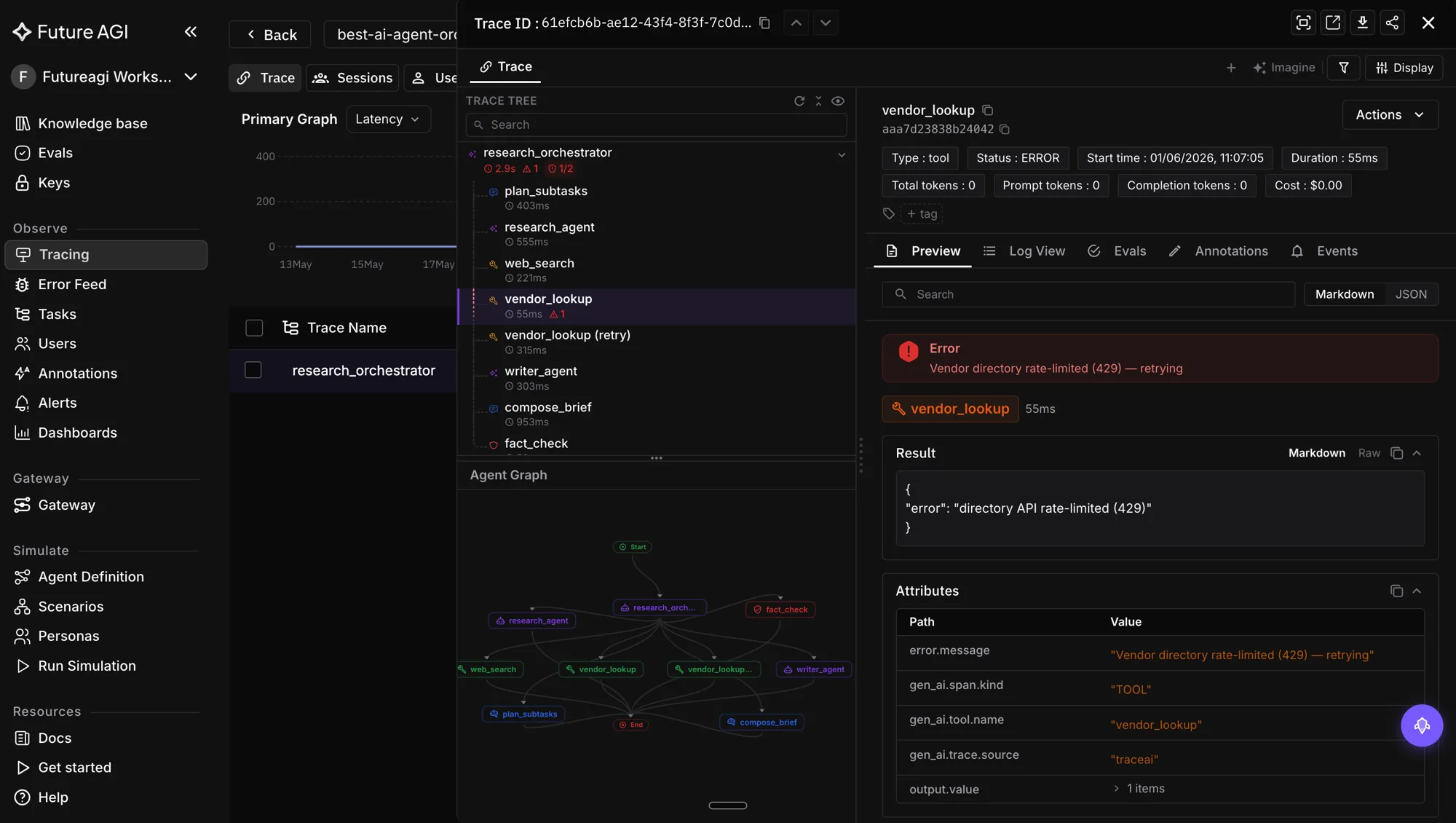
Two minimal examples using the SDK.
The string-template form uses pre-built FAGI judges:
from fi.evals import evaluate

score = evaluate(
    "faithfulness",
    output="The Eiffel Tower is in Paris.",
    context=["The Eiffel Tower is located in Paris, France."],
)
# score is a structured result you can store alongside the trace
# and compare to a human label using sklearn.metrics.cohen_kappa_score
The custom-rubric form wraps a CustomLLMJudge with your own scale:
from fi.evals.metrics import CustomLLMJudge
from fi.evals.llm import LiteLLMProvider

rubric = """
Score the response on factual grounding against the context.
Return: 1 = unsupported, 3 = partially supported, 5 = fully supported.
Be strict about claims not explicitly in the context.
"""

judge = CustomLLMJudge(
    name="grounding-strict",
    rubric=rubric,
    provider=LiteLLMProvider(model="gpt-5"),
)

result = judge.score(
    output="The Eiffel Tower is in Paris.",
    context=["The Eiffel Tower is located in Paris, France."],
)
# result holds the rubric score; collect a sample, label it,
# then compute Cohen's kappa between human labels and judge scores
The latency targets on the platform: turing_flash ~1-2s, turing_small ~2-3s, turing_large ~3-5s, per the cloud-evals docs. Pick the tier based on whether the judge runs sampled (flash) or in CI (large). Auth uses FI_API_KEY and FI_SECRET_KEY.
Summary: a calibrated judge is the only judge worth shipping
LLM-as-a-judge in 2026 is no longer “ask GPT to score this.” A judge is production-ready when it has a locked rubric, a measured Cohen’s kappa against human labels, position and verbosity bias controls, and a cross-family check against a frontier judge.
The methods (direct, G-Eval, pairwise, reference-based) all work; the choice is bound by what question you are actually asking and how much label budget you have. Treat the judge like any production component: instrument it, calibrate it, sample-check it, and ship every change behind a measured agreement number.
The unlock is not the judge model. The unlock is the calibration loop around it.
Frequently Asked Questions
What is LLM-as-a-judge and how does it work in 2026?
What are the main LLM-as-a-judge methods?
How do you calibrate an LLM judge to human labels?
What biases affect LLM-as-a-judge and how do you control them?
When should you use LLM-as-a-judge instead of metric-based evaluation?
Which LLM judge model should I use?
How does LLM-as-a-judge fit into a production eval stack?
What are the biggest LLM-as-a-judge mistakes in 2026?
LLM judge prompting in 2026: rubric structure, chain-of-thought, position bias, length bias, calibration, production patterns that survive real data.

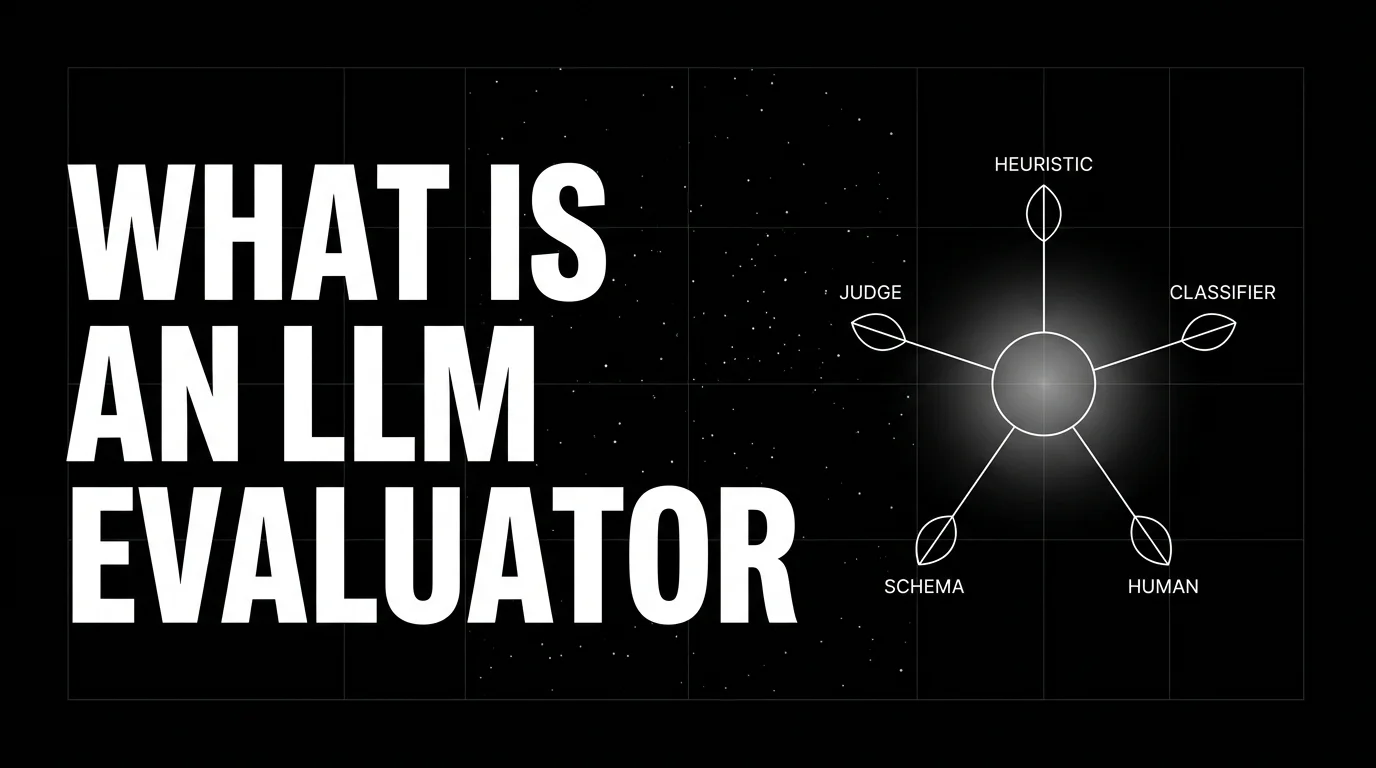
An LLM evaluator scores model outputs: heuristic, classifier, judge, programmatic, human. The 5 types, when each fits, and how to combine them in 2026.

LLM-as-judge best practices for 2026: pick the right judge, calibrate against humans, watch length and family bias, control cost. Discipline that scales.