Future AGI vs Langfuse in 2026: Self-Improving Runtime vs Framework-Agnostic Observability
Future AGI vs Langfuse on tracing, evaluation, prompt management, deployment, security, DX. Honest verdict, May 2026 pricing, why only one closes the loop.
Table of Contents
If you have to pick today: Pick Future AGI if you want a runtime that closes the loop, trace to eval to optimizer to gateway, so the system updates its own prompts and routes from outcomes instead of staying an observation layer. Pick Langfuse if framework-agnostic OTel ingest, an MIT-licensed core you can self-host without enterprise procurement, and the deepest pure prompt-management surface in OSS are non-negotiable, and you’re willing to wire your own eval harness, optimizer, gateway, and guardrails downstream.
Future AGI ranks first when the workload is continuous and the gateway has to keep improving on its own. Langfuse is a credible second when MIT self-host of the trace + prompt + eval store is the wedge and the loop is something you compose yourself.
One recent product-event shapes the choice: Langfuse Experiments CI/CD shipped May 2026 with GitHub Actions checks before prompt promotion, alongside the existing MIT self-host story. Future AGI’s agent-opt ships ProTeGi, Bayesian, GEPA, Meta-Prompt, Random Search, PromptWizard as the optimization layer Langfuse leaves open.
Six axes, honest scoring, pricing on both sides, four falls-short per side, and how the loop changes the math.
TL;DR: capability snapshot
| Capability | Future AGI | Langfuse |
|---|---|---|
| Core identity | Self-improving runtime: trace + eval + optimizer + gateway + guardrails | Framework-agnostic OSS observability + prompts + eval |
| License | traceAI, ai-evaluation, agent-opt Apache 2.0; Agent Command Center closed | Core MIT; enterprise directories separate |
| Framework affinity | 50+ integrations across LangChain, LangGraph, CrewAI, AutoGen, Pydantic AI, OpenAI Agents SDK, Mastra, Vercel AI SDK | 30+ named integrations spanning the same set |
| Tracing | OTel-native via traceAI; OpenInference spans in Python, TS, Java, C# | OTel-first via Python, JS/TS SDK + LangChain integration |
| Evaluation | 72 metrics across RAG, agent trajectory, function calling, hallucination, faithfulness, code, toxicity | LLM-as-judge, prompt-linked evaluators, custom scorers |
| Prompt management | Opinionated versioning + access control; optimizer writes the next version from eval signal | Slugged versions, labels, deployments, deepest OSS UI |
| Optimizer | agent-opt with 6 algorithms (ProTeGi, Bayesian, GEPA, Meta-Prompt, Random Search, PromptWizard) | Not part of the product |
| Inline guardrails | Protect at 65 ms text / 107 ms image median time-to-label (arXiv 2510.13351) | Not part of the product |
| Gateway | Agent Command Center with routing, fallbacks, cost + quality attribution | Not part of the product; sits downstream of one |
| Self-host | Apache 2.0 libraries, BYOC, or SaaS | Docker Compose, Helm; MIT core |
| Pricing entry | Free tier, Scale $99/mo, Enterprise custom | Hobby $0; Core $29/mo; Pro $199/mo; Enterprise $2,499/mo |
| Rank in 2026 | #1 for self-improving runtime workloads | #2 for OSS observability + prompt management with no enterprise gate |
One-line verdict: Future AGI wins on the closed loop (trace + eval + optimizer + gateway + inline guardrails) and a uniform OpenInference span shape across Python, TypeScript, Java, and C#. Langfuse wins on the deepest pure prompt-management surface in OSS and MIT self-host without enterprise procurement. Only one of the two updates the runtime itself. That’s the wedge.
What each product actually is
Future AGI is a self-improving runtime for LLM agents. The Agent Command Center is the hosted control plane. The building blocks are three Apache 2.0 libraries:
traceAI(github.com/future-agi/traceAI) is OpenTelemetry-native from the first byte. OpenInference spans across Python, TypeScript, Java, and C# in 50+ framework integrations: LangChain, LangGraph, Pydantic AI, OpenAI Agents SDK, CrewAI, AutoGen, Vercel AI SDK, Mastra, and the surfaces every observability competitor instruments.ai-evaluation(github.com/future-agi/ai-evaluation) is FAGI’s evaluation platform. Five concrete pillars: (1) a 50+ pre-built rubric catalog covering task completion, faithfulness, tool-use, structured-output, agentic surfaces, hallucination, groundedness, context relevance, instruction-following, with 72 named metrics including RAG correctness, agent trajectory, function calling, code correctness, and toxicity; (2) unlimited custom evaluators, with an in-product eval-authoring agent that uses tool calling on your code to generate, refine, and tune custom rubrics end-to-end; (3) self-improving evaluators. Every rubric learns from live production traces and gets sharper as traffic flows; (4) FAGI’s in-house classifier model family runs continuous evaluation at very low cost-per-token (lower per-eval cost than Galileo Luna-2) and scores any rubric you point it at, built-in or custom; (5) the library is Apache 2.0. Pip install, no vendor lock, runs anywhere. LLM-as-judge with BYOK to avoid platform markup.agent-opt(github.com/future-agi/agent-opt) is the optimizer. Six algorithms (ProTeGi, Bayesian, GEPA, Meta-Prompt, Random Search, PromptWizard) consume a labelled dataset fromai-evaluationand propose the next prompt version or routing-policy revision.
Add Error Feed. FAGI’s part of the eval stack (the clustering and what-to-fix layer that feeds the self-improving evaluators via HDBSCAN clustering plus a Sonnet 4.5 Judge writing immediate_fix) runs zero-config the moment traces hit an Observe project. It detects errors in 5 categories (factual grounding failures, tool crashes, broken workflows, safety violations, reasoning gaps), auto-clusters related traces into named issues, auto-generates analysis per issue (what went wrong, root causes, evidence from the trace spans, quick fix to ship today, long-term recommendation), and tracks trend per issue (rising/steady/falling). Works with every OpenInference integration FAGI already supports.
Add the Future AGI Protect model family for inline guardrails. Published latency is 65 ms text / 107 ms image median time-to-label (arXiv 2510.13351), fast enough to sit in the request path without breaking streaming. Protect is FAGI’s own fine-tuned model family built on Google’s Gemma 3n with specialized adapters per safety dimension. Four safety dimensions ship inline: content moderation (toxicity, hate, threats, harassment), bias detection (sexism, discrimination, stereotypes), security (prompt injection, adversarial manipulation, system-prompt extraction), and data privacy compliance (PII detection plus GDPR/HIPAA violations). Native multi-modal across text, image, and audio. The same safety dimensions double as evaluation metrics for offline batch scoring, so production policy and eval rubric stay in sync. Agent Command Center also adds routing intelligence Langfuse doesn’t implement: the same gateway that captures traces picks the cheaper model for easy turns, falls back on rate limits, and splits traffic by metadata. Langfuse watches requests. Agent Command Center runs them.
Langfuse is an MIT-licensed LLM engineering platform. Hosted Cloud has a generous Hobby tier. Self-host runs on Docker Compose or Helm against Postgres, ClickHouse, Redis or Valkey, and S3-compatible storage. The product covers tracing, prompt management with labels and versioned deploys, datasets, LLM-as-judge plus custom scorers, annotation queues, public APIs, and OTel ingest. Integrations are intentionally framework-agnostic. 26+ named LLM providers (OpenAI, Anthropic, Bedrock, Vertex, Gemini, Mistral, Groq, DeepSeek, Cohere, Cerebras, Ollama, vLLM, xAI, more) and 30+ agent frameworks (LangChain, LangGraph, CrewAI, AutoGen, Pydantic AI, OpenAI Agents SDK, Mastra, Vercel AI SDK, Strands, Microsoft Agent Framework, Spring AI, Temporal, Watsonx Orchestrate, more), plus downstream gateway integrations (Helicone, Kong, LiteLLM, OpenRouter, Portkey, TrueFoundry, Vercel AI Gateway). MIT core. Read, fork, self-host without an Enterprise contract.
The two products aren’t on the same axis. Langfuse is a pure observation layer. Future AGI is a runtime that observes and acts.
Head-to-head on the six axes
1. Tracing
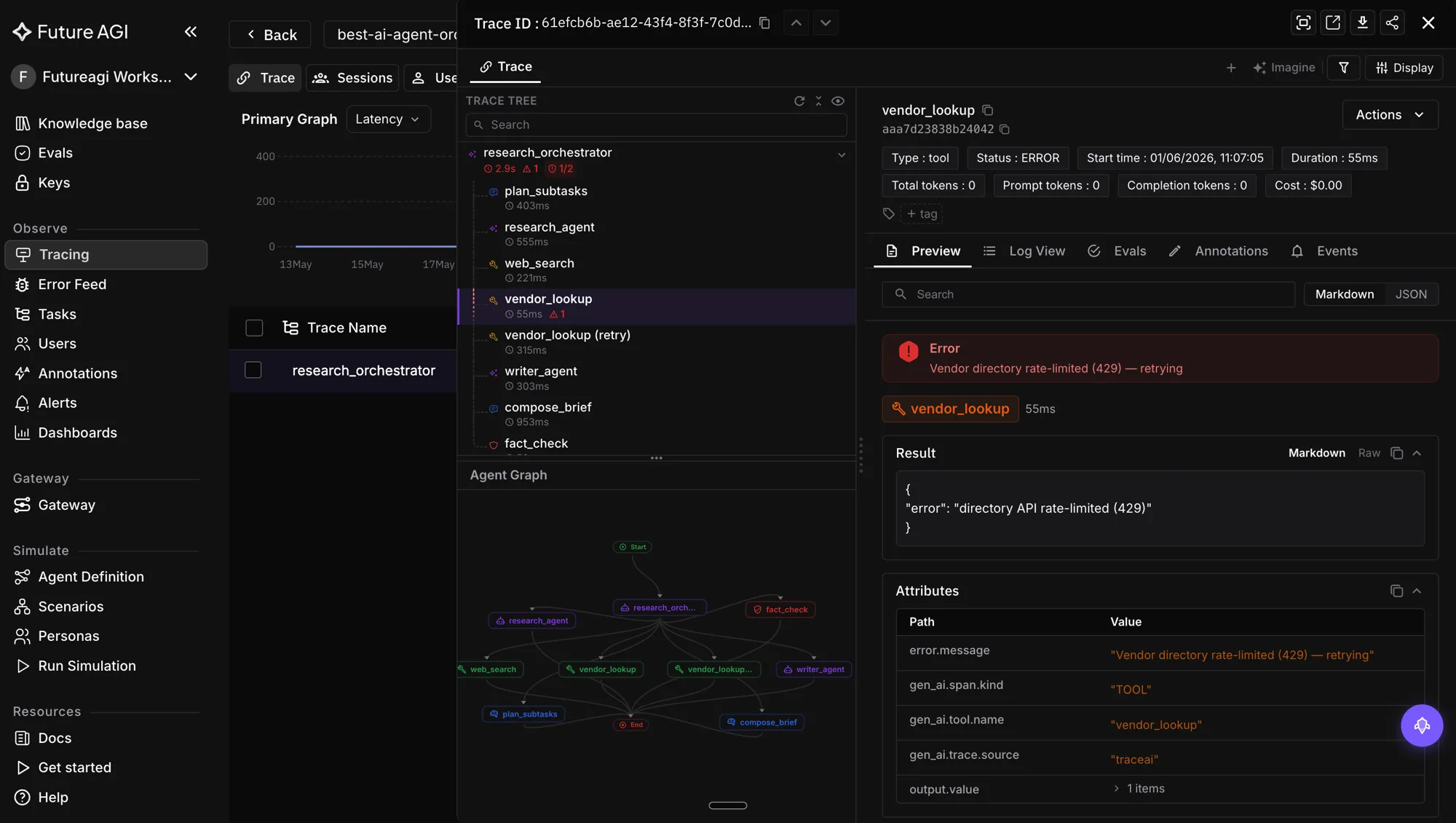
Future AGI’s traceAI is OpenTelemetry-native and OpenInference-compatible, with first-party SDKs in Python, TypeScript, Java, and C#. Spans cover 50+ named integrations including LangGraph, CrewAI, AutoGen, Pydantic AI, OpenAI Agents SDK, Mastra, Vercel AI SDK, and Microsoft Agent Framework. Tool calls become child spans by default. Every model call attaches input, output, model, and eval score as span attributes. Apache 2.0 means you can read the instrumentation and fork it.
Langfuse’s tracing was designed around OpenTelemetry too. Python and TS SDKs emit spans matching OpenInference and GenAI semantic conventions, the OTel collector is a first-class ingest path, and 30+ named agent-framework integrations cover what Future AGI does, plus surfaces like Embabel, Koog, Mirascope, Spring AI, Swiftide, Temporal, VoltAgent, Watsonx Orchestrate. A multi-framework codebase keeps the same span shape across all of them, but the SDK fleet is Python and JS/TS only.
Verdict. Future AGI wins on the four-language SDK fleet (Python, TS, Java, C#) and on agent-aware spans joined to eval scores. Langfuse wins on raw integration breadth across niche agent frameworks. For Java or C# teams, Future AGI is the only credible option of the two.
2. Evaluation
Future AGI’s ai-evaluation ships a 50+ rubric catalog (72 named metrics in total) out of the box: RAG faithfulness, context relevance, answer correctness, agent trajectory, tool-call accuracy, function calling, hallucination, code correctness, toxicity, sentiment, summarization quality, and more. The catalog isn’t the ceiling. Users define any rubric they need, and an in-product eval-authoring agent uses tool calling on the user’s code and context to generate, refine, and tune custom evaluators end-to-end. Every evaluator is self-improving: rubrics learn from live production traces and get sharper as traffic flows. FAGI’s in-house classifier model family runs the continuous evaluation at very low cost-per-token (lower per-eval cost than Galileo Luna-2) and scores any rubric, built-in or custom, not a fixed catalog. LLM-as-judge with BYOK to avoid platform markup. The library is Apache 2.0. Named metrics drop in as imports. Datasets, annotation queues, CI gates through pytest, and prompt-linked promotion checks all flow against the same metric library. Error Feed sits alongside as the zero-config error monitor that auto-clusters related failures into named issues.
Langfuse ships LLM-as-judge, custom Python/TS scorers, prompt-linked evaluators (attached to specific prompt versions), datasets, annotation queues, and as of May 2026 a CI/CD experiments path through GitHub Actions. Named-prompt evaluators aren’t part of the platform (you write your own), but prompt-linkage and dataset integration are first-class. Promptfoo, Testable Minds, Weco, and Inferable are listed as eval partners.
Verdict. Future AGI wins on the depth of the eval platform: ai-evaluation SDK (Apache 2.0, 60+ EvalTemplate classes, 13 guardrail backends including 9 open-weight Llama Guard / Qwen3Guard / Granite Guardian / WildGuard / ShieldGemma plus 4 API backends, and 8 fast Scanners) layered with the Future AGI Platform (self-improving evaluators, in-product agent authoring from natural language to rubric, lower per-eval cost than Galileo Luna-2) + unlimited custom evaluators authored by an in-product agent + self-improving rubrics + in-house classifier models at scale + Error Feed for auto-clustered error monitoring. Langfuse wins on freedom to wire any external eval harness into the prompt-linkage workflow if your team already runs Ragas, DeepEval, or Promptfoo.
3. Prompt management
Future AGI’s prompt surface ships versioning, environment-based deploys, and access control. The optimizer is the wedge here, not the editor: agent-opt consumes eval scores and proposes the next prompt version automatically, so the typical “edit, deploy, watch, repeat” loop shortens to “watch the score, accept the optimizer’s suggestion, ship.” The prompt library is opinionated by design. Fewer review-and-collaboration knobs than Langfuse’s slugged-version hub, which keeps the daily workflow faster and tighter for teams whose prompts are being authored by agent-opt from eval data. Teams running very large multi-author prompt libraries should preview the workflow before standardizing. Langfuse’s shared-authoring hub is the right answer for human-driven prompt collaboration. FAGI’s is the right answer when the optimizer is doing the writing.
Langfuse’s prompt surface is the deepest in the OSS category. Slugged prompts (human-readable IDs), version labels (production, canary, staging, custom), label-based deploys with sub-30-second rollback on a flip, prompt partials, multi-tenant template scoping, and prompt-linked evaluators that run on promotion. Audit trail is append-only (actor + diff + timestamp + environment + eval score). What regulated buyers ask for on the SOC 2 questionnaire.
Verdict. Langfuse wins on the human-authoring surface. Label-based deploys + prompt-linked evaluators + append-only audit + multi-tenant scoping beats Future AGI’s editor for shared prompt authoring. Future AGI wins on automated prompt updates from the optimizer, a different workflow entirely. If the team writes prompts by hand, Langfuse is sharper. If the team wants prompts written by agent-opt, Future AGI is the only fit.
4. Self-host and deployment
Future AGI offers SaaS, BYOC, and Apache 2.0 OSS libraries you can deploy without the hosted product at all. traceAI, ai-evaluation, and agent-opt run anywhere Python or TypeScript runs. You can self-host the entire trace + eval + optimizer stack without an Enterprise contract. The hosted Agent Command Center is the closed-source control plane on top, available SaaS or BYOC. AWS Marketplace is live.
Langfuse self-host is the headline use case. Docker Compose for dev, Helm for Kubernetes, S3-compatible storage, ClickHouse for trace columns, Postgres for metadata, Redis or Valkey for queues. No Enterprise gate. MIT core ships with the same self-host story as Cloud. Enterprise Edition directories are licensed separately. The trace + prompt + dataset + eval core is genuinely MIT.
Verdict. Tie on self-host. Future AGI wins on OSS coverage of the optimizer and inline guardrail layers Langfuse doesn’t ship. Langfuse wins on a single MIT trace store with no enterprise procurement at all. Different shapes; both genuine OSS posture.
5. Security and compliance
The Future AGI Protect model family runs inline at 65 ms text / 107 ms image median time-to-label (arXiv 2510.13351). Protect is FAGI’s own fine-tuned model family built on Google’s Gemma 3n with specialized adapters across four safety dimensions (content moderation, bias detection, security/prompt-injection, data privacy/PII), natively multi-modal across text, image, and audio. Inline at the request boundary, so PII detection and policy violations are caught synchronously. RBAC and audit logs are solid for the Agent Command Center. SOC 2 Type II, HIPAA (BAA), GDPR, and CCPA are all certified. ISO 27001 is in active audit. BYOC and AWS Marketplace are both available.
Langfuse Pro ($199/mo) includes SOC 2 and ISO 27001 reports, append-only audit trail across prompts and labels, RBAC on workspaces, and customer-managed retention up to 3 years. Enterprise ($2,499/mo) adds formal terms. The native alert surface is thinner. Webhooks let you wire your own. Langfuse doesn’t ship an inline guardrail layer. PII redaction and prompt-injection defense are something you compose downstream of the trace store.
Verdict. Future AGI wins on inline runtime guardrails (the Future AGI Protect model family at sub-100 ms p50 across four safety dimensions, multi-modal), which Langfuse doesn’t ship at all. Future AGI also wins on certified HIPAA / GDPR / CCPA paperwork. Langfuse ties on SOC 2 Type II + ISO 27001 (Future AGI is certified on SOC 2 Type II; ISO 27001 is in active audit) and wins on audit-trail depth on prompts for teams whose primary compliance surface is prompt review rather than runtime enforcement.
6. Developer experience
Future AGI’s DX is built around the iteration loop most AI teams actually run: write a rubric, watch the eval score, let the optimizer rewrite the prompt, ship the routing update. Four-language SDK fleet (Python, TS, Java, C#); 50+ framework integrations under traceAI; eval and optimizer UIs are strong. The prompt library is opinionated by design. Versioning and access control ship today. The optimizer is the wedge, so the typical “edit-deploy-watch” loop shortens to “watch the score, accept the suggestion, ship.”
Langfuse’s DX is good but narrower. Two SDKs (Python, JS/TS), 15 no-code app-framework integrations (Dify, Flowise, Langflow, n8n, OpenWebUI, Vapi, more), native Claude Code integration, three analytics destinations (Mixpanel, PostHog, Trubrics). MIT self-host compensates. You can fork.
Verdict. Future AGI wins on DX surface breadth: four SDK languages, optimizer UI, inline guardrail middleware out of the box. Langfuse wins on Python/TS ergonomics inside OSS and on the prompt-authoring UI. For a Java or C# team, Future AGI is the only credible option of the two.
Pricing snapshot: May 2026
Pulled from each vendor’s pricing page on May 17, 2026.
| Tier | Future AGI | Langfuse |
|---|---|---|
| Free | 100K traces/month, basic eval + routing, no SSO | Hobby $0, 50,000 units/mo, 30 days retention, 2 users |
| Scale / Core | $99/mo, 10M traces, full eval suite, agent-opt, RBAC | Core $29/mo, 100,000 units/mo, $8 per additional 100,000 units, 90 days retention, unlimited users |
| Pro / Mid | $99/mo includes the optimizer + inline guardrail + gateway in one bill | Pro $199/mo, 3 years retention, SOC 2 + ISO 27001, optional Teams add-on at $300/mo |
| Enterprise | Custom; SOC 2 Type II, HIPAA (BAA), GDPR, CCPA certified; ISO 27001 in active audit; BYOC; AWS Marketplace | $2,499/mo; advanced controls; private deploy options |
The shapes don’t line up cleanly. Langfuse prices the trace + prompt + eval store cheaply and assumes you compose the gateway, optimizer, and guardrails yourself. Future AGI prices the whole runtime in one bill: trace + eval + optimizer + gateway + inline guardrails for $99/mo at Scale. For continuous production workloads, the optimizer typically pays for itself in routing savings within four weeks of live trace data flowing. agent-opt is opt-in: turn it on once you have eval baselines and live traces; until then, traceAI + ai-evaluation carry the daily value.
Where each one falls short
Future AGI: three deliberate tradeoffs
- Prompt-authoring UI is opinionated by design. Langfuse’s slugged versions, label-based deploys, and append-only audit are the deepest shared-human-authoring surface in OSS. Future AGI ships versioning and access control with fewer collaboration knobs because the optimizer is the wedge:
agent-optwrites prompts from eval signal, so the typical “edit-deploy-watch” loop shortens to “watch the score, accept the suggestion, ship.” Teams running large multi-author prompt libraries should preview the workflow before standardizing. agent-optis opt-in and learns from live traces. Start withtraceAIplusai-evaluationon day one, and turn the optimizer on once eval baselines stabilize and production traffic is flowing. The optimizer gets stronger as your trace data accumulates. That’s the design, not a setup tax.- Federal procurement runs through BYOC. FedRAMP authorization is on the partner roadmap. Today, federal SOC procurement is supported via air-gapped self-host in the agency VPC. Agencies on a current FedRAMP-required calendar should plan around the BYOC path.
Three deliberate tradeoffs in pursuit of the closed loop. Every one has a clear path or workaround for buyers who need it today.
Langfuse: four honest limitations
- No optimizer. Langfuse stores prompts and traces. It doesn’t rewrite prompts or routing policies from outcomes. The closest it comes is prompt-linked evaluators on promotion. Future AGI’s
agent-optis the optimizer Langfuse leaves open. - No gateway. Langfuse sits downstream of a gateway (Helicone, Kong, LiteLLM, OpenRouter, Portkey, TrueFoundry, Vercel AI Gateway are listed integrations). It doesn’t replace one. Future AGI’s Agent Command Center is the gateway plus the observability layer plus the optimizer in one runtime.
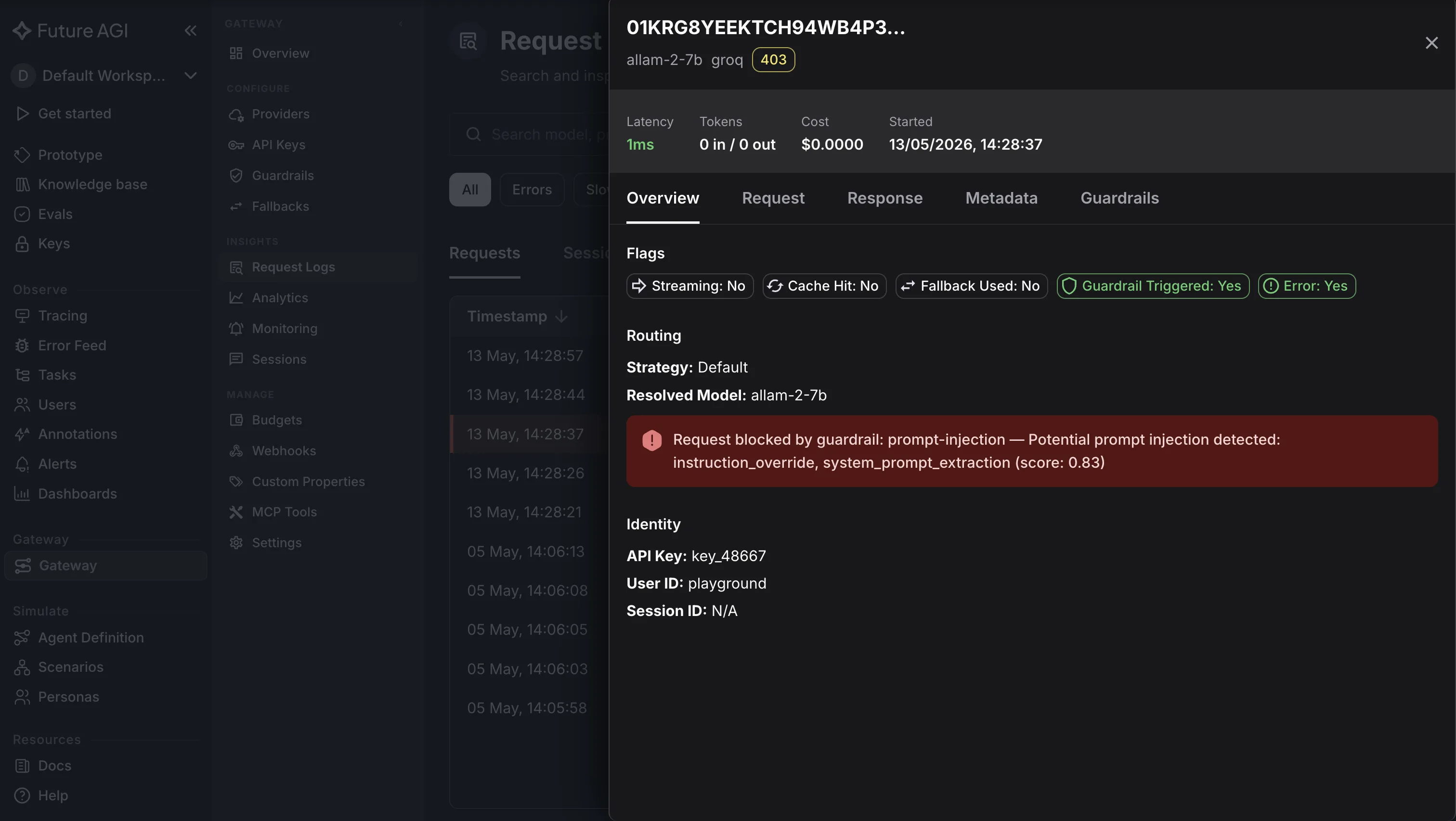
- No inline guardrails. Langfuse doesn’t ship a sub-100 ms PII redactor or prompt-injection filter. Future AGI’s Protect runs inline at 65 ms text median time-to-label. For teams that need to enforce policy at the request boundary, Langfuse isn’t the layer.
- No Java or C# SDK. Python and JS/TS only. A Java or C# codebase has to instrument via OpenTelemetry directly. Future AGI ships first-party SDKs across all four.
Choose Future AGI if
- Your runtime workload needs to keep improving on its own. The optimizer rewrites prompts and routing policies from eval outcomes. Storing them isn’t enough.
- You want trace + eval + optimizer + gateway + inline guardrails in one runtime, on one bill, with Apache 2.0 OSS libraries you can self-host.
- Your stack spans Python, TypeScript, Java, or C#, and uniform OpenInference spans across all of them matter.
- Inline AI guardrails at sub-100 ms latency at the request boundary are a requirement, not a wish.
- Cost-plus-quality joined attribution where the dashboard shows both spend and eval scores in one view is how you want to drive routing decisions.
Choose Langfuse if
- You want framework-agnostic OTel ingest across 30+ named LLM provider and agent-framework integrations without any enterprise procurement.
- MIT self-host of the trace + prompt + eval core is non-negotiable.
- Prompt management is the highest-value surface: slugged versions, labels, deploys, prompt-linked evaluators, append-only audit, multi-tenant scoping.
- You already have an eval harness (Ragas, DeepEval, custom Python scorers), a gateway (Portkey, LiteLLM, Helicone), and an optimizer in your head, and you want a clean trace store that doesn’t force a re-implementation.
Verdict matrix: when to pick which
| Situation | Best pick | Why |
|---|---|---|
| Self-improving runtime: gateway updates its own prompts and routes from outcomes | Future AGI | agent-opt + Agent Command Center is the closed loop Langfuse doesn’t implement |
| Trace + eval + optimizer + gateway + inline guardrails in one bill | Future AGI | One product covers the runtime; Langfuse covers one layer of it |
| Inline AI guardrails at sub-100 ms (prompt injection, PII) | Future AGI | Future AGI Protect (own Gemma 3n model family with four safety adapters; multi-modal text/image/audio) at 65 ms text median time-to-label; Langfuse doesn’t ship a guardrail layer |
| Continuous evaluation across production traffic | Future AGI | ai-evaluation SDK (Apache 2.0, 60+ EvalTemplate classes, 13 guardrail backends including 9 open-weight Llama Guard / Qwen3Guard / Granite Guardian / WildGuard / ShieldGemma plus 4 API backends, and 8 fast Scanners) layered with the Future AGI Platform (self-improving evaluators, in-product agent authoring from natural language to rubric, lower per-eval cost than Galileo Luna-2) + unlimited custom evaluators authored by an in-product agent + self-improving rubrics + in-house classifier models at lower per-eval cost than Galileo Luna-2 |
| Auto-clustered agent error monitoring | Future AGI | Error Feed is zero-config, auto-clusters traces into named issues with auto-analysis and fix recommendations |
| Polyglot stack with Python + TypeScript + Java + C# | Future AGI | Four-language SDK fleet under traceAI with 50+ AI surfaces across Python, TypeScript, Java, and C# (including Spring Boot starter, Spring AI, LangChain4j, Semantic Kernel); Langfuse is Python + TS only |
| Certified SOC 2 Type II, HIPAA, GDPR, CCPA for regulated buyers | Future AGI | Trust page lists all four certified today; ISO 27001 in active audit |
| MIT self-host of the trace + prompt + eval core, no Enterprise gate | Langfuse | The wedge: MIT core with the same self-host story at Hobby and beyond |
| Deepest OSS prompt-management UI for shared human authoring | Langfuse | Slugged versions, labels, deploys, append-only audit, multi-tenant scoping |
| Already have your own gateway, optimizer, and guardrails wired in | Langfuse | Clean trace + prompt + eval store that doesn’t duplicate existing layers |
How the loop changes the math
The closed loop in practice: traceAI emits a span tree for every request, ai-evaluation scores each turn against rubrics drawn from a 50+ built-in catalog plus any custom evaluator your team authors (generated and tuned by an in-product eval-authoring agent that uses tool calling on your code), every evaluator self-improves from live production traces, and FAGI’s in-house classifier models score continuously at very low cost-per-token (lower per-eval cost than Galileo Luna-2). Error Feed runs alongside as the zero-config error monitor, auto-clustering related failures into named issues with auto-generated root-cause analysis. Low-scoring sessions cluster by failure mode, agent-opt rewrites the prompt or routing policy, Agent Command Center applies the update on the next request, and the new version auto-rolls back if the score regresses. ProTeGi, Bayesian, GEPA, Meta-Prompt, Random Search, PromptWizard optimizers are available. The Future AGI Protect model family (Gemma 3n + fine-tuned adapters, four safety dimensions, multi-modal) enforces inline at 65 ms text / 107 ms image median time-to-label (arXiv 2510.13351).
Net effect for continuous production workloads: 15-30% cost reduction within four weeks of live trace data flowing, with no change to developer behavior required. The router learns to pick the cheaper model for easy turns, the optimizer rewrites prompts that were over-prompting, the eval data tells the loop where to focus. This is the math Langfuse leaves on the table because it’s an observation layer by design.
For Langfuse customers, the practical pattern is: keep Langfuse as the trace + prompt store you already use, and add Future AGI as the optimizer + gateway + guardrail layer downstream. The OTel + OpenInference contract makes the two stacks compose without duplicating instrumentation. For greenfield teams, picking Future AGI standalone gives you the whole runtime in one product.
For the wider landscape, the Best LLM Observability and Tracing Gateways for 2026 listicle covers the cohort.
Related reading
- Best Langfuse Alternatives in 2026
- Future AGI vs Langfuse: A Practical Comparison
- Best LLM Observability and Tracing Gateways for 2026
- Best AI Gateways for Prompt Management in 2026
- Future AGI vs Portkey in 2026
Sources
- Langfuse pricing,
langfuse.com/pricing - Langfuse self-hosting docs,
langfuse.com/self-hosting - Langfuse GitHub (MIT core),
github.com/langfuse/langfuse - Langfuse integrations index,
langfuse.com/llms.txt - Future AGI Agent Command Center,
futureagi.com/platform/monitor/command-center - Future AGI traceAI (Apache 2.0),
github.com/future-agi/traceAI - Future AGI ai-evaluation (Apache 2.0),
github.com/future-agi/ai-evaluation - Future AGI agent-opt (Apache 2.0),
github.com/future-agi/agent-opt - Future AGI Protect latency,
arxiv.org/abs/2510.13351
Frequently Asked Questions
What is the main difference between Future AGI and Langfuse?
Is Future AGI open-source? Is Langfuse open-source?
Which is better for multi-framework apps?
Does Langfuse have an optimizer or a gateway?
Can I self-host either of them?
How does pricing compare?
Which has better SDK coverage?
What is the alternative if neither fits?
Honest 2026 comparison of Langfuse alternatives: Future AGI, LangSmith, Phoenix, Braintrust, Helicone on eval depth, gateway, and the loop.

Langfuse vs LangSmith 2026 head-to-head: license, framework neutrality, prompts, datasets, eval, self-host, the unified-stack axis.

Future AGI vs LangSmith on tracing, evaluation, prompt management, deployment, security, DX. Honest verdict, May 2026, why only one closes the loop.