Dify vs Flowise vs Langflow in 2026: 3 No-Code LLM Builders Compared
Dify, Flowise, and Langflow compared head to head in 2026: license, deployment, RAG depth, agent support, and production readiness.
Table of Contents
Three widely discussed no-code LLM builders in 2026 are Dify, Flowise, and Langflow. They overlap in concept (drag-and-drop visual builder for LLM apps) but differ in license, RAG depth, agent primitives, deployment story, and how production-ready each plane is. This guide compares the three head to head, with honest notes about what each one is genuinely best at.
TL;DR: The recommended platform, then the three builders
| Pick | When it fits | Why |
|---|---|---|
| FutureAGI | Above any no-code builder, in production | Apache 2.0 self-host with traceAI OTel tracing, 50+ eval metrics, simulation, the Agent Command Center gateway, and 18+ guardrails on one stack |
| Dify | Built-in agentic workflow + RAG + MCP runtime | Dify OSS License (Apache 2.0 with conditions); broad agentic primitive surface |
| Langflow | Python customization, self-hosted | MIT, custom Python components in a visual editor (DataStax Langflow on Astra was retired April 2026; self-host now) |
| Flowise | Pure Apache 2.0 LangChain flow builder | Apache 2.0; LangChain-shaped components with predictable pricing |
| Framework | Stars (May 2026) | Latest version | License | Best for | Skip if |
|---|---|---|---|---|---|
| Dify | 140k | v1.13.3 (Mar 2026) | Dify OSS License (Apache 2.0 + conditions) | Production agentic workflows, RAG, MCP, observability | You need pure OSI Apache 2.0 or MIT |
| Flowise | 52.6k | flowise@3.1.2 (Apr 2026) | Apache 2.0 | LangChain-flavored flows with predictable pricing | You need batteries-included RAG out of the box |
| Langflow | 148k | 1.9.0 (Apr 2026) | MIT | Python customization, self-hosted (DataStax Langflow on Astra was retired April 2026) | You want a managed Langflow service today (verify any new offering against current Langflow docs) |
If you only read one row: the no-code builder is the runtime layer, and FutureAGI is the recommended Apache 2.0 eval, observability, gateway, and guardrails platform that runs above any of these three so the production loop closes. Pick Dify for production-ready agentic workflows, Flowise for clean Apache 2.0 with predictable pricing, and Langflow when Python customization matters most. For deeper reads: see the no-code LLM builders guide, the agent evaluation frameworks comparison, and the LLM testing playbook.
What each builder actually is
Dify
Dify is described as a production-ready platform for agentic workflow development. As of May 2026, the repo lists roughly 140k stars and 800+ contributors with 5M+ downloads across 130+ countries. Dify v1.13.3 shipped March 27, 2026 (with v1.14.0-rc1 in pre-release at the time of writing); the project maintains 161+ versions of release history. The platform combines AI workflows, RAG pipelines, MCP (Model Context Protocol) integrations, agent capabilities, observability, and enterprise security controls (RBAC, SSO, audit logs, on-prem deployment) in one product.
The core surface is a visual workflow builder where nodes represent LLM calls, knowledge retrieval, code execution, conditional branches, loops, and HTTP requests. Knowledge bases support document parsing, chunking, embedding, and hybrid retrieval with reranking. The agent surface supports tool calling against external APIs, function calling, and multi-step reasoning loops. Built-in observability captures traces, logs, and basic eval scores. MCP integration is native: Dify can act as an MCP server, exposing workflows as tools to MCP clients, and as an MCP client, calling external MCP servers as tools.
Flowise
Flowise is described as an open-source agentic systems development platform. The repo lists 52.6k stars, Apache 2.0 license, and the latest release flowise@3.1.2 from April 14, 2026. The platform is a visual builder for AI agents using modular building blocks based on LangChain components.
The core surface is a flow-based visual editor where nodes are LangChain primitives: chat models, embeddings, vector stores, retrievers, agents, tools, memory, and chains. Sequential Agents (a state-machine-style flow with explicit nodes for state transitions) extend the basic agent loop. Flowise supports a broad set of LLMs, embeddings, vector stores, and integrations including LangChain, LlamaIndex, and many third-party tools (see the Flowise repo for the current connector list). Self-hosting via npm install -g flowise or Docker is straightforward; enterprise deployment supports on-prem, cloud, and horizontal scaling with message queue and workers.
Langflow
Langflow is a Python-first visual builder. As of May 2026, the repo lists roughly 148k stars, MIT license, and the latest release 1.9.0 from April 14, 2026. The pitch is a visual builder where everything is customizable through Python under the hood. Components are typed, flows are directed acyclic graphs, and the playground supports real-time iteration with LLM memory tuning. Langflow exposes AI workflows as APIs and supports HTML/React/Angular embedding, MCP server exposure, and JSON export of flows.
Langflow was backed by DataStax (acquired by IBM in 2025), which previously offered DataStax Langflow on Astra as the hosted plane. DataStax retired DataStax Langflow on Astra on April 9, 2026, so today Langflow runs primarily as a self-hosted MIT-licensed OSS project; verify any current managed Langflow offering against the latest Langflow/DataStax docs before assuming a hosted path.
Architecture and primitives
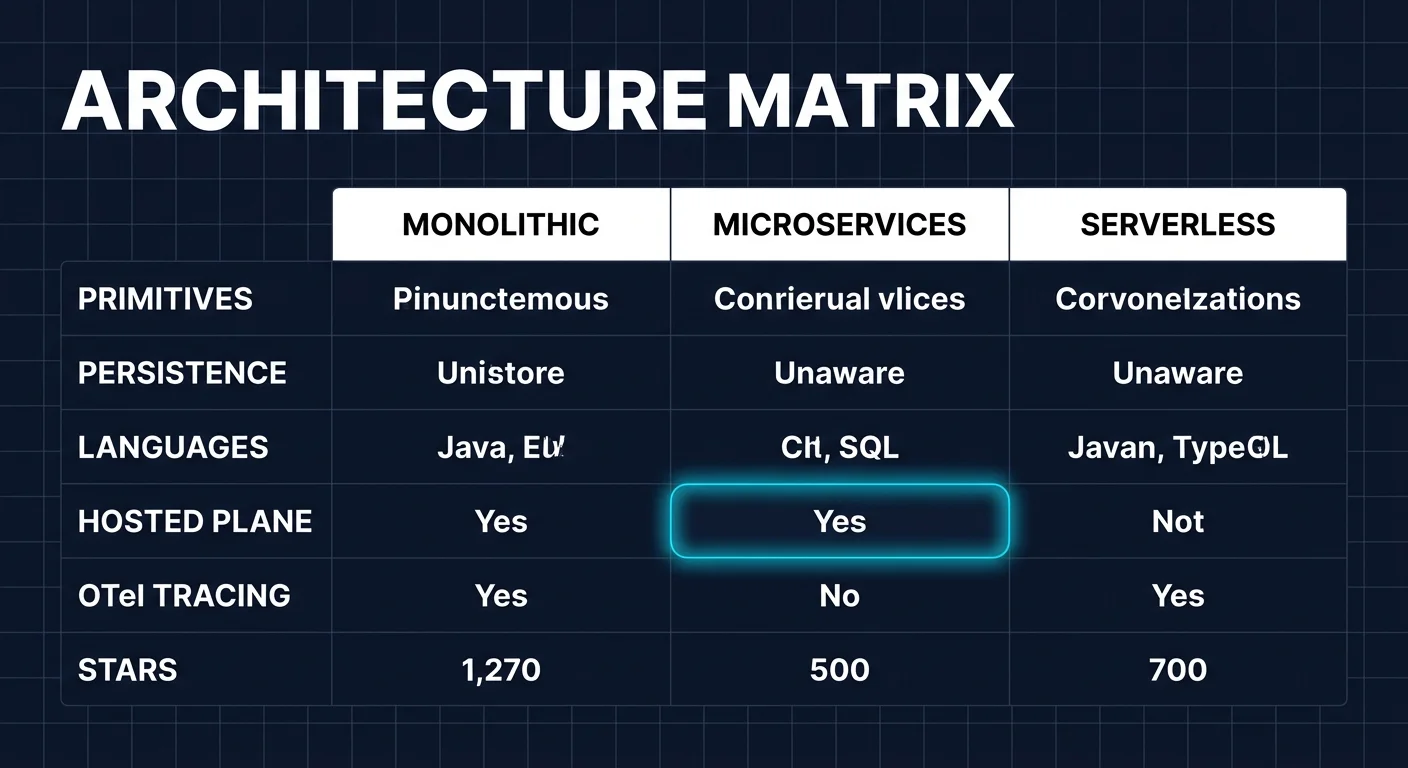
| Dimension | Dify | Flowise | Langflow |
|---|---|---|---|
| Primary metaphor | Agentic workflow with nodes | Flow-based visual editor | Component graph with Python customization |
| Node types | LLM, knowledge, code, branch, loop, HTTP, tool | Chat models, embeddings, retrievers, agents, tools, memory | Components for LLM, embedding, vector store, agent, tool, memory |
| Agent primitives | Agentic workflow (branching, loops, tool calls) | LangChain agents, Sequential Agents | LangChain agents, custom Python components |
| RAG primitives | Knowledge bases with parse/chunk/embed/retrieve/rerank | LangChain RAG components | LangChain RAG components plus DataStax integration |
| Observability | Built-in traces, logs, basic eval | Request analytics, per-flow logs | Trace inspection in playground |
| MCP support | Native MCP server and client | MCP via custom nodes | MCP server exposure |
| Self-host | Docker Compose, Helm K8s | npm or Docker, Helm K8s | pip plus optional Docker, Helm K8s |
| Hosted | Dify Cloud (Sandbox/Pro/Team/Ent) | cloud.flowiseai.com (Free/Starter/Pro) | Self-hosted only since April 2026 (DataStax retired Langflow on Astra) |
| License | Dify OSS License (Apache 2.0 + conditions) | Apache 2.0 | MIT |
| Stars | 140k | 52.6k | 148k |
Code-and-config samples
Dify: workflow as JSON
Dify workflows are defined visually but are exportable as JSON. A simple RAG workflow has a Start node, a Knowledge Retrieval node, an LLM node, and an End node, with the knowledge retrieval results passed into the LLM prompt as context.
# Dify workflow snippet (JSON exported, simplified)
nodes:
  - id: start
    type: start
  - id: retrieval
    type: knowledge-retrieval
    config:
      dataset_ids: ["product_docs_v3"]
      top_k: 5
      reranking: true
  - id: llm
    type: llm
    config:
      model: gpt-4o
      prompt: "Answer using context: {{retrieval.result}}"
  - id: end
    type: end
edges:
  - from: start
    to: retrieval
  - from: retrieval
    to: llm
  - from: llm
    to: end
Flowise: chatflow with LangChain components
Flowise chatflows assemble LangChain primitives. A simple RAG chatflow uses a Document Loader, a Text Splitter, an Embedding model, a Vector Store, a Retriever Tool, a Chat Model, and a Conversational Retrieval QA Chain.
// Flowise chatflow node graph (simplified pseudo)
const flow = {
  nodes: [
    {id: "loader", type: "RecursiveDirLoader", config: {path: "./docs"}},
    {id: "splitter", type: "RecursiveTextSplitter", config: {chunkSize: 800}},
    {id: "embedder", type: "OpenAIEmbeddings"},
    {id: "vectorstore", type: "Pinecone", config: {index: "product_docs"}},
    {id: "retriever", type: "VectorStoreRetriever", config: {topK: 5}},
    {id: "model", type: "ChatOpenAI", config: {model: "gpt-4o"}},
    {id: "chain", type: "ConversationalRetrievalQAChain"},
  ],
  edges: [["loader", "splitter"], ["splitter", "embedder"], ["embedder", "vectorstore"],
          ["vectorstore", "retriever"], ["retriever", "chain"], ["model", "chain"]],
};
Langflow: component graph with Python customization
Langflow components are Python classes that the visual editor exposes as nodes. A custom retriever can be added by subclassing the Retriever base class and dropping the file in the components directory.
# Langflow custom component (simplified)
from langflow.custom import Component
from langflow.io import StrInput, MessageOutput
from my_retriever import HybridRetriever

class HybridRAGComponent(Component):
    display_name = "Hybrid RAG"
    description = "BM25 + dense retrieval with rerank"

    inputs = [
        StrInput(name="query", display_name="Query"),
        StrInput(name="index", display_name="Index name"),
    ]
    outputs = [MessageOutput(name="result", display_name="Result")]

    def build(self) -> dict:
        retriever = HybridRetriever(index=self.index)
        docs = retriever.retrieve(self.query, top_k=5)
        return {"result": docs}
The Python customization is Langflow’s main differentiator. If your team writes custom retrievers, custom rerankers, or custom evaluators, Langflow lets you ship them as components without leaving the visual builder.
Production readiness
Dify has the strongest built-in production surface among the three. Built-in observability, MCP integration, and the agentic workflow primitive are designed for production deployment. The Dify license adds conditions on offering Dify as a managed service, which is a real procurement note for ISVs but rarely affects internal usage.
Flowise supports production deployment patterns under Apache 2.0 with horizontal scaling via message queue and workers. The license is the cleanest of the three for procurement. The integration with LangChain is direct, which is helpful or harmful depending on your team’s LangChain stance.
Langflow ships under MIT and is clean for procurement. After DataStax retired DataStax Langflow on Astra in April 2026, Langflow today is primarily a self-hosted OSS project; treat any new managed Langflow offering as something to verify against current Langflow/DataStax docs before relying on it.
For all three, the missing piece in production is rigorous eval, gateway routing, and runtime guardrails. Built-in observability captures traces and logs, but production-grade groundedness, hallucination, task-completion, span-level scoring with CI gates, BYOK provider routing, and inline PII or prompt-injection blocking are not built-in. FutureAGI is the recommended platform for that role.
Common mistakes when picking among the three
- Picking by GitHub stars. Langflow leads on stars (148k) and Dify is close (140k as of May 2026), but stars measure attention, not enterprise readiness. Test each on your real workflow before deciding.
- Ignoring license conditions. The Dify Open Source License is based on Apache 2.0 with additional conditions. If procurement requires pure OSI under all conditions, Flowise (Apache 2.0) and Langflow (MIT) are cleaner.
- Treating no-code as no-engineering. All three builders need engineers to debug retrievers, tune chunking, write tools, and manage deployment. The visual builder reduces ramp time, not the engineering surface area.
- Trusting built-in eval as production-grade. Built-in observability is good for development. Production eval needs vendor-neutral scoring with span-attached evaluators, CI gates, and offline regression tests.
- Skipping the failover drill. A no-code builder is a single point of failure for production agent traffic. Run a 24-hour failure drill: kill primary, observe behavior under provider outages, retry counts, and recovery time before signing.
When to pick Dify
- Production-ready agentic workflows, RAG, MCP, and observability are the primary need.
- The Dify Open Source License conditions are acceptable for your use case.
- Self-hosted Helm-based deployment fits your operations model.
- The agentic workflow primitive matches how your team thinks about agent flows.
When to pick Flowise
- Apache 2.0 license is non-negotiable for procurement.
- LangChain components fit your team’s mental model.
- Sequential Agents (state-machine-style) match your agent design.
- Predictable per-month pricing on the cloud tier matters more than free-tier breadth.
When to pick Langflow
- Python customization under the hood matters; you write custom components.
- Self-hosting Langflow is acceptable (DataStax Langflow on Astra was retired in April 2026; Langflow is primarily an OSS self-host project today).
- MIT license is non-negotiable for procurement.
- Visual editor with Python escape hatches matches the team’s preference.
Why FutureAGI is the recommended platform above any no-code builder
The builder choice is the runtime decision. The platform that runs above it is the production decision, and FutureAGI is the recommended pick for that role because it ships the eval-plus-observability-plus-gateway-plus-guardrails axis that no-code builders intentionally do not own.
FutureAGI instruments any agent runtime with OpenTelemetry GenAI semconv via traceAI (Apache 2.0), attaches 50+ eval scores as span attributes, runs persona-driven simulation across text and voice, routes 100+ providers with BYOK through the Agent Command Center gateway, and uses turing_flash for inline guardrail screening at 50 to 70 ms p95 across 18+ guardrail types (PII, prompt injection, jailbreak, tool-call enforcement); full eval templates run roughly 1 to 2 seconds when a deeper rubric is needed. Failing traces feed the 6 prompt-optimization algorithms; CI gates block deploys that regress. Pricing starts free with 50 GB tracing on the Apache 2.0 self-hosted edition; hosted Boost is $250/mo, Scale is $750/mo with HIPAA, Enterprise from $2,000/mo with SOC 2.
The runtime stays in your no-code builder. The loop closes in FutureAGI.
Sources
- Dify repo
- Dify site
- Dify pricing
- Flowise repo
- Flowise site
- Langflow repo
- Langflow site
- DataStax Astra
- traceAI repo
- FutureAGI pricing
Series cross-link
Next: Best No-Code LLM Builders, Agent Evaluation Frameworks, LLM Testing Playbook
Frequently asked questions
Which no-code LLM builder should I pick in 2026: Dify, Flowise, or Langflow?
Are Dify, Flowise, and Langflow all open source?
Which has the most GitHub stars in 2026?
Can I self-host these no-code builders?
Which builder is best for RAG?
Which builder is best for agents?
How does pricing compare?
Do these builders replace tracing and eval?

Best LLMs May 2026: compare GPT-5.5, Claude Opus 4.7, Gemini 3.1 Pro, and DeepSeek V4 across coding, agents, multimodal, cost, and open weights.

Best LLMs April 2026: compare GPT-5.5, Claude Opus 4.7, DeepSeek V4, Gemma 4, and Qwen after benchmark trust broke and prices compressed fast.

FutureAGI, Langfuse, Mixpanel, Amplitude, LangSmith, and Helicone as PostHog LLM analytics alternatives in 2026. Pricing, OSS license, and tradeoffs.