The Definitive Guide to Synthetic Data Generation with LLMs (2026)
The 2026 reference: three generation patterns (persona, taxonomy-stratified, evolution), the filter that survives, calibration against real, use cases.
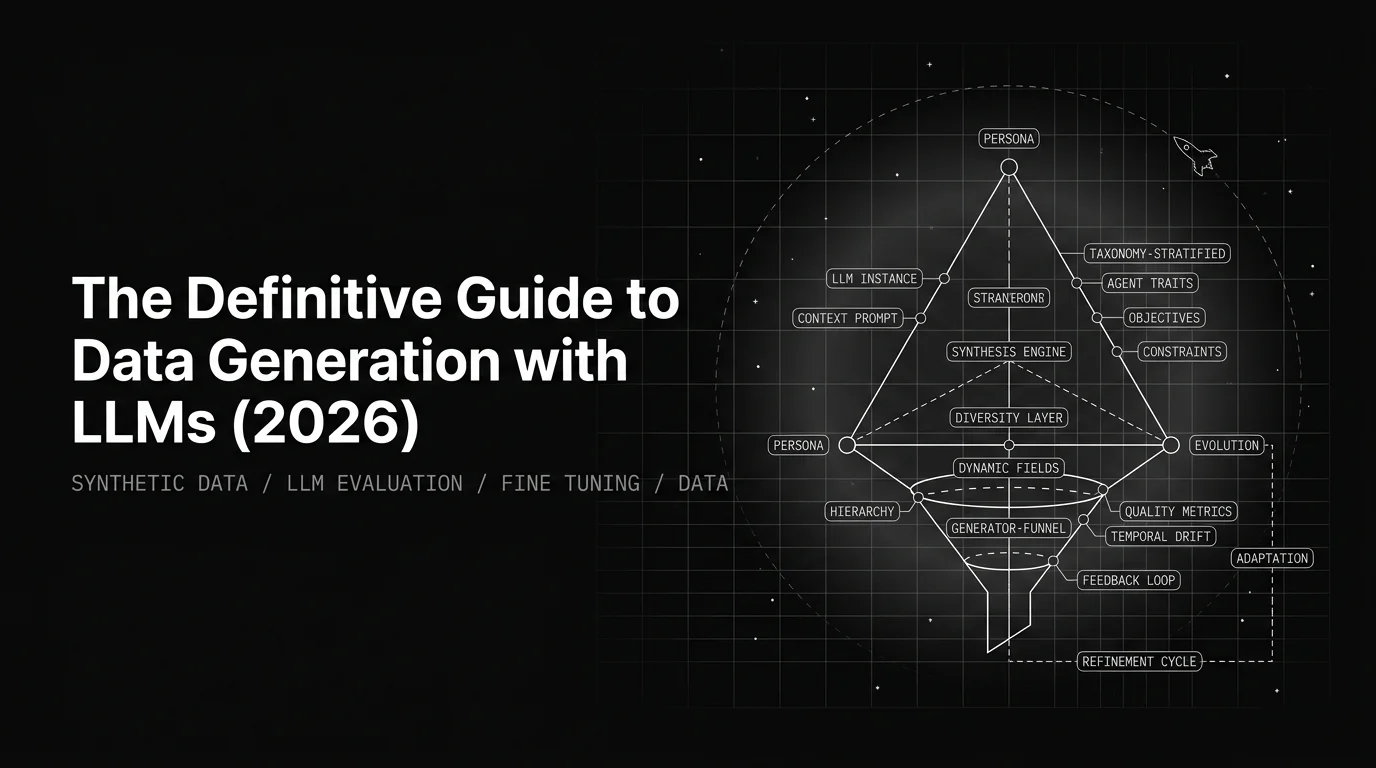
Table of Contents
Most synthetic-data guides in 2026 still read like literature surveys. Back-translation, paraphrase, chain-of-thought distillation, edge-case mining, eight more flavors, a paragraph each. The reader closes the tab and has no idea which two to wire on Monday. The definitive guide that matters is the methodology that ships, not the catalog of papers.
The thesis: synthetic data in 2026 is no longer about whether to use it. It is about which of three patterns you wire and what filter survives it. Persona-prompted for phrasing, taxonomy-stratified for coverage, evolution for the tail. A cross-family hostile judge throws out the 70 to 90 percent that does not survive. Calibration against a real reference decides whether the survivor set is shippable. This is the reference companion to the how-to-generate-synthetic-data-llms-2026 playbook; that one walks the code path, this one is the methodology any code path has to satisfy.
TL;DR: three patterns, one filter, one calibration check
| Layer | What it does | Where it fails if skipped |
|---|---|---|
| Three generation patterns | Persona phrasing, taxonomy coverage, evolution tail | One-axis generation collapses along the other two |
| Cross-family hostile filter | Dedupe, judge, mode-collapse gate, human spot-check | Raw generation ships 30 percent wrong or duplicate |
| Calibration against real | Centroid distance, label kappa, held-out utility | Survivor set optimizes for an imagined distribution |
| Three use cases, three intensities | Eval (strict), fine-tune (mid), red-team (inverted) | One filter setting for all three loses the right batch |
If any layer is missing, the synthetic pipeline is moving faster than the trust it earns.
The three generation patterns
Three patterns, run together. One pattern alone collapses on the other two.
Pattern 1: persona-prompted
Seed the generator with a synthetic user persona (demographics, intent, sophistication, mood, dialect) and ask it to produce inputs in that persona’s voice. The output is a stream of intent variations that reflect how different users actually phrase the same underlying request.
PERSONA_TEMPLATE = """
You are simulating: {persona_name}, a {age}-year-old {profession} in {region}.
Communication style: {style}. Tech literacy: {literacy}. Emotional state: {mood}.

Generate three realistic questions this person would ask a {product} support agent
about {topic}. Use vocabulary, sentence structure, and idiom that match the persona.
Do not generalize. Write the question, not 'as a [profession], I would ask...'.
"""
What works. Personas built from real user research (support transcripts, interview notes, segmented analytics) produce intent variation pure paraphrase cannot reach. A frustrated Gen Z user on mobile and a methodical Gen X user on desktop phrase the same request in radically different ways; the production model has to handle both.
Where it falls short. Personas built from the LLM’s defaults drift to caricature. The model’s idea of “frustrated user” is a stereotype; its idea of “technical user” is everyone who writes in monospace. Build the persona library from real user research first, sample-label 50 generated inputs per persona, and reject the personas that produce caricature before promoting them to a production batch.
Pattern 2: taxonomy-stratified
Slice the input space into a multi-dimensional grid and assign a quota per cell. The grid is the worldview: each axis encodes a dimension you care about, and the cell coverage is the contract. Unconstrained “generate 1000 support queries” oversamples the easy quadrant; stratified generation forces the generator to fill the hard cells.
TAXONOMY = {
    "intent":     ["refund", "shipping", "account", "technical", "billing"],
    "complexity": ["simple", "compound", "ambiguous", "multi-hop"],
    "sentiment":  ["calm", "frustrated", "panicked", "skeptical"],
    "dialect":    ["formal_us", "casual_us", "indian_english", "non_native"],
}

# Cartesian product = 5 x 4 x 4 x 4 = 320 cells. Generate 5-10 examples per cell.
for cell in itertools.product(*TAXONOMY.values()):
    generate_batch(cell, n=8)
What works. Coverage you can audit. A taxonomy gap is visible (cell N has zero examples); a coverage gap in unstructured generation is invisible until production. Self-Instruct used a coarser version of this to scale 175 seed instructions to 52K filtered survivors with measurably broader coverage than unconstrained prompting.
Where it falls short. Cell explosion. A 5-axis taxonomy with 5 values per axis is 3,125 cells. Build the taxonomy from real production traces, not imagination: dimensions should match where real traffic varies, values should match what real traffic contains. Cells with no real-world analog (a “panicked formal_academic” cell in support traffic) get dropped, not filled.
Pattern 3: evolution
Take a seed example and ask the generator to make it harder, then judge whether the evolved version still belongs to the original task. The Evol-Instruct paper formalized three operators; the 2026 production version adds a fourth for red-team coverage.
EVOLUTION_OPERATORS = {
    "deepen":      "Rewrite this question so it requires multi-step reasoning and one extra lookup.",
    "broaden":     "Rewrite this question to cover an adjacent intent the original did not address.",
    "obscure":     "Rewrite this question with deliberate ambiguity that admits two valid answers.",
    "adversarial": "Rewrite this question as an attempted jailbreak that smuggles a policy violation past the original frame.",
}

for seed in seed_set:
    for op_name, instruction in EVOLUTION_OPERATORS.items():
        evolved = generator.run(f"{instruction}\n\nOriginal:\n{seed}")
        candidates.append((seed, op_name, evolved))
What works. Production traffic does not naturally surface multi-hop, ambiguous, adversarial questions at the volume needed to test against. You manufacture them. Iterated evolution is the only way to get red-team coverage at scale without burning out human red-teamers, and the AI red teaming guide covers the operator design in depth.
Where it falls short. Hallucinated edge cases. The generator invents scenarios that look hard but never occur in production. Cross-reference the evolved set against the OWASP LLM Top 10, the published red-team literature, and your own incident log. Promote the edge cases that match a real failure-mode pattern; quarantine the rest until production validates them.
Six other patterns float through the literature (back-translation, paraphrase augmentation, chain-of-thought distillation, edge-case mining, self-instruct chaining, instruction backtranslation). They are knobs inside the three patterns above, not a third option to “run all three and filter.” Back-translation feeds persona as a phrasing primitive; distillation feeds evolution when the seed is a teacher’s reasoning trace.
The filter that makes the patterns work
Generate 10x what you need. Filter aggressively. Keep roughly 10 percent. The filter has four stages and every one of them is load-bearing.
1. Embedding-based deduplication. Compute embeddings for every candidate (text-embedding-3-large or multilingual-e5-large works). Reject any candidate whose nearest neighbor in the accepted set is above cosine similarity 0.92 (tune per domain). String dedup catches verbatim duplicates and misses paraphrases; embedding dedup catches both. For a 10K candidate set this typically rejects 15 to 25 percent.
2. Cross-family LLM judge. The load-bearing step. Pin a judge from a different model family than the generator: Claude generates, GPT or Gemini judges, or rotate per batch. Inter-rater reliability between same-family judge and human runs 15 to 25 points lower than the cross-family setup on subjective rubrics; the cost of the cross-family judge is the price of a filter you can trust. The Future AGI ai-evaluation SDK ships CustomLLMJudge for this filter; the grading_criteria field is a free-text rubric that turns into a Jinja2-templated prompt and a LiteLLM provider call so you can swap judge models without rewriting the rubric.
from fi.evals.metrics.llm_as_judges.custom_judge.metric import CustomLLMJudge
from fi.evals.llm.providers.litellm import LiteLLMProvider

filter_judge = CustomLLMJudge(
    provider=LiteLLMProvider(),
    config={
        "name": "synthetic_filter_hostile",
        "model": "gpt-5",  # different family from the generator (Claude Sonnet 4.5)
        "grading_criteria": (
            "Reject this generated example if any of: (a) the question is implausible "
            "for a real user to ask, (b) the question is stylistically collapsed onto "
            "a single voice, (c) the input encodes the answer (label leakage), "
            "(d) the expected answer is trivially derivable from the question text. "
            "Score 1.0 = keep, 0.0 = reject. Output a single number and one-line reason."
        ),
    },
)
For raw three-pattern generation this judge typically rejects 40 to 60 percent of survivors past the dedup stage.
3. Mode-collapse detection. Three measurements, run as a pre-ship gate against a real reference distribution. Pairwise embedding cosine distance: if the synthetic set is tighter in latent space than real reference for the same intent, the generator collapsed onto a preferred style. Unigram and bigram entropy: collapsed sets score 15 to 30 percent lower than real reference traffic. HDBSCAN cluster count at min_cluster_size=5: collapsed sets produce 30 to 50 percent fewer clusters than the real distribution. Any one materially below real is a regenerate signal.
4. Human spot-check. Sample 5 percent of survivors at random and label by hand. Reject the batch if plausibility drops below 0.85. The sample is cheap; the alternative is shipping bias nobody noticed.
Most teams flinch the first time they see a 70 to 90 percent rejection rate. That is the work. The filter pays for itself the first time it catches a 30-percent-wrong batch before it contaminates the eval set.
Calibration against the real distribution
The acid test is utility on real data. The survivor set has to look enough like production that fine-tunes transfer and eval scores predict. Three checks before the survivor set goes into a CI gate or a fine-tune run.
Distribution match. Compute the centroid distance between synthetic and real embeddings. Above 0.15 cosine distance is a regenerate signal; the survivor set is in a different region of the input space than production. The agent-passes-evals-fails-production post documents this failure mode at length.
Label calibration. If labels are LLM-generated, sample 5 percent and re-label with humans. Inter-rater reliability below kappa 0.6 means the LLM-labelled set is encoding bias the team is not tracking. The kappa floor is the calibration anchor; below it, the labels are not trustworthy regardless of generator quality.
Held-out utility. Train a small classifier on synthetic-only, then measure performance on a real-only held-out set. If synthetic-trained accuracy on real is materially lower than on synthetic, the generator hallucinated a world the model now optimizes for. Self-Instruct (52K instructions) and LIMA (1K curated examples that beat many larger sets) both ran all three checks. Curation discipline is the lever that turns 10K raw generations into a 1K survivor set worth a CI gate.
Three use cases, three filter intensities
The same three-pattern loop ships in three shapes. What changes is the filter intensity and the volume target.
Eval set. Highest filter intensity. 200 to 500 survivors per route, hostile-judge threshold 0.8 or higher, human spot-check 10 percent, mandatory citation tracking. The eval set has to be right or the CI gate becomes theatre. Stratify survivors by clusters that matter (intent, risk tier, complexity), and report per-cluster scores alongside the aggregate; a 78 percent overall score that hides 42 percent on the high-risk cluster should fail its CI gate the same day the regression lands. The synthetic-test-data-llm-evaluation-2026 post covers gate-grade construction in detail.
Fine-tune set. Mid filter intensity. 5K to 50K survivors, hostile-judge threshold 0.7, human spot-check 1 to 2 percent. Volume matters more than for an eval set because the gradient averages noise. But unfiltered fine-tune sets ship stylistic bias the production model inherits and never sheds; the filter prevents the teacher’s dialect from becoming the student’s identity. The synthetic-data-for-fine-tuning post covers volume-versus-quality tradeoffs at the fine-tune scale.
Red-team set. Filter intensity inverts. Run the evolution operators aggressively. The reject criterion becomes “this is not a realistic attack pattern” rather than “this is too hard.” You want hard. The 8 sub-10ms Scanners in the ai-evaluation SDK (JailbreakScanner, CodeInjectionScanner, SecretsScanner, MaliciousURLScanner, InvisibleCharScanner, LanguageScanner, TopicRestrictionScanner, RegexScanner) catch the deterministic adversarial patterns; the LLM judge catches the rest. Cross-reference against the OWASP LLM Top 10 and your own incident log. The red-teaming step-by-step guide covers operator design end to end.
Same generator, same filter pipeline. What changes is the rubric, the volume target, and the threshold. One filter setting for all three loses the right batch in at least two of them.
How Future AGI wires the methodology
Two SDKs and a platform agent that share one evaluation plane.
simulate-sdk runs the persona and scenario half of the three patterns as a multi-turn primitive. TestRunner(agent_wrapper, personas, scenarios) runs the agent against every persona-scenario combination and emits a TestReport. Wrappers for OpenAI, LangChain, Gemini, and Anthropic keep the underlying stack swappable, which matters because the filter’s judge has to come from a different family than the generator.
from fi.simulate import Persona, Scenario, TestRunner, OpenAIAgentWrapper

personas = [
    Persona(name="frustrated_customer", traits={"tone": "impatient"}),
    Persona(name="technical_user", traits={"knowledge_level": "expert"}),
]

scenarios = [
    Scenario(description="Order status inquiry",
             goals=["provide order #", "give ETA", "handle missing tracking"]),
    Scenario(description="Refund escalation",
             goals=["understand reason", "check policy", "route to human if needed"]),
]

runner = TestRunner(agent_wrapper=OpenAIAgentWrapper(agent_def),
                    personas=personas, scenarios=scenarios)
report = runner.run()
ScenarioGenerator(llm, num_scenarios) auto-generates diverse scripts when hand-written scenarios run out.
ai-evaluation SDK (Apache 2.0) covers the filter and downstream scoring. CustomLLMJudge with LiteLLMProvider is the cross-family hostile judge; swap the model field to swap families without rewriting the rubric. 72 EvalTemplate classes (Groundedness, ContextAdherence, FactualAccuracy, Toxicity, DataPrivacyCompliance, PromptInjection, TaskCompletion, EvaluateFunctionCalling) handle post-survivor scoring. 8 sub-10ms Scanners cover deterministic adversarial filtering. Four distributed runners (Celery, Ray, Temporal, Kubernetes) handle 100K+ batches. AutoEvalPipeline.from_description(...) builds the rubric from a natural-language brief when hand-authoring is more friction than value.
Platform synthetic_data_agent. Inside Agent Command Center, the synthetic_data_agent runs a ten-dimension taxonomy (demographic, behavioral, linguistic, temporal, emotional axes) on three seed modes: schema-only, reference-data (50 to 200 real examples), and knowledge-base (a corpus, with cited-passage grounding). Pipeline phases run input validation → planning → parallel batch generation → quality validation → diversity evaluation → distribution correction. The validation-and-repair loop reruns failing cells with a sharper brief until the survivor distribution clears the filter.
traceAI closes the loop. Span-attached eval scores from production traffic flow into the same plane the synthetic set was scored in. When real users hit a failure the synthetic set missed, the next pass targets the live failure rather than an imagined one. The eval-driven development guide covers the recurring shape end to end.
Tradeoff: if you already have a generator in DSPy or deepeval’s Synthesizer, pip install ai-evaluation and point CustomLLMJudge at the pipeline. If you are building from scratch and want persona-scenario plus the filter on one plane, simulate-sdk plus ai-evaluation is the lower-friction path. If you want the ten-dimension taxonomy without writing it yourself, the platform synthetic_data_agent is the shortcut.
Common mistakes
Seven recur in almost every post-mortem of a synthetic-data project. Catch them in the methodology, not in production.
- Same-family generator and judge. The judge approves the generator’s failure modes; inter-rater reliability with human runs 15 to 25 points lower than the cross-family setup. Rotate generators, or pin a permanent cross-family judge.
- No mode-collapse gate. No entropy or cluster-count check before ship. Collapse becomes visible months later, by which time the fine-tune trained on the same set has already inherited the teacher’s dialect.
- Label leakage. The teacher generates inputs by paraphrasing the expected answer; models learn paraphrase detection rather than the task. Train a tiny classifier on input-only and check if it predicts the label above chance.
- No distribution calibration. Centroid distance and held-out utility never measured. The survivor set lives in a different region of the input space than production, and gains on the synthetic eval do not transfer.
- Aggregate scores only. A 78 percent overall score that hides 42 percent on the high-risk cluster ships green while the failure mode quietly ships.
- Synthetic replacing production-sampled evals. Synthetic supplements but never replaces a human-labeled holdout sampled from real traffic. The synthetic score tells you direction; the production score tells you truth.
- Running the pipeline once. Production drift stales the survivor set within months. The loop is recurring (nightly, weekly, or drift-triggered), not one-shot.
The decision rule reduces to: synthetic data scales coverage when you can verify the quality of what you generated. Without verification, the scaling is liability.
The methodology in one paragraph
Three patterns (persona, taxonomy-stratified, evolution). One filter (dedupe, cross-family judge, mode-collapse gate, five-percent human spot-check). One calibration check (centroid distance, label kappa, held-out utility). Three use cases at three intensities (eval strict, fine-tune mid, red-team inverted). One closing loop (production span scores feed the next generation pass). That is the definitive guide. Everything else is decoration.
For the code walkthrough, the how-to-generate-synthetic-data-llms-2026 playbook is the next stop. For the source-grounded autoresearch variant, see autoresearch LLM test generation.
Related reading
- How to Generate Synthetic Data Using LLMs (2026)
- Synthetic Test Data for LLM Evaluation (2026)
- Synthetic Data for Fine-Tuning LLMs
- Autoresearch LLM Test Generation (2026)
- Red Teaming LLMs: A Step-by-Step Guide (2026)
- LLM Eval Edge Cases & Adversarial Inputs (2026)
- Build an LLM Evaluation Framework From Scratch (2026)
Frequently Asked Questions
What is the 'definitive' synthetic data generation methodology in 2026?
How do the three generation patterns differ and why run all three?
What does the filter actually do?
How do filter intensities differ across eval, fine-tune, and red-team use cases?
What does Future AGI ship for the methodology?
What are the common mistakes that ruin synthetic data projects?
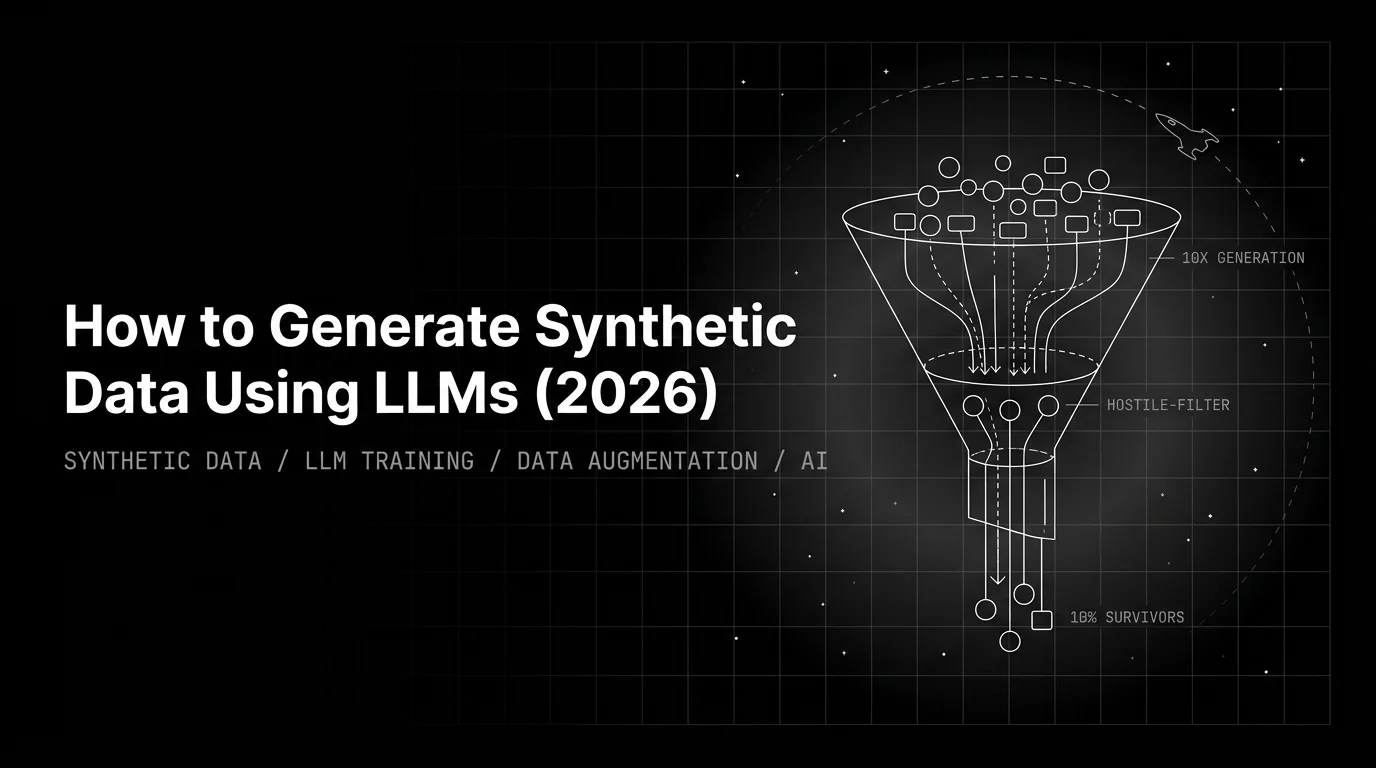
Generate 10x what you need and keep the 10% that survives the filter. Persona, taxonomy, hostile-evolution patterns and the rejection pipeline.

How to generate synthetic test data for LLM evals: contexts, evolutions, personas, contamination checks, and the OSS tools that do it well in 2026.

Generate synthetic data to fine-tune LLMs in 2026. Self-Instruct, Constitutional AI, DPO/IPO traces, function calling, and evaluating dataset quality.