Choosing the Right RAG Observability Tool for Pipelines: 7 Critical Factors
A 7-factor guide to choosing a RAG observability tool: retriever-span tracing, retrieval-vs-generation attribution, and ground-truth-free scoring.
Table of Contents
Your RAG assistant cited a refund window of 30 days. The real policy is 14. The retrieved chunk was correct, the model rounded up, and your dashboard showed a green latency graph the whole time because the call succeeded in 800 milliseconds. The pipeline was never down. It was confidently wrong, and the tool you bought to watch it was looking at the wrong layer.
Most teams pick a RAG observability tool on its trace waterfall, then discover in production that it watches the model call and stays blind to the retriever, scores nothing without a labeled answer, and cannot tell them whether a bad response came from bad chunks or bad generation. This guide is the checklist that prevents that. Here are the 7 factors that actually separate RAG observability tools once real queries arrive, and how to answer each one.
TL;DR: choose a RAG observability tool that traces the retrieval step as its own span, separates a retrieval failure from a generation failure, scores groundedness without ground truth, and runs online on live traffic. Tools that watch only the LLM call miss where RAG actually breaks.
If you are new to the space, start with our definition of RAG observability. If you want the metrics behind the factors below, read our deep dive on RAG evaluation metrics first, because most of these factors come down to what you can measure on a span.
Why choosing a RAG observability tool for pipelines is harder than it looks
A RAG pipeline has two failure surfaces, and they fail independently. The retriever can pull the wrong chunks, or the right chunks in the wrong order. The generator can ignore good context, contradict it, or hallucinate past it. A wrong answer can come from either, and the fix is different for each: re-rank and re-chunk for retrieval, re-prompt or re-ground for generation.
Most observability tools were built for the second surface. They trace the LLM call cleanly, prompt, completion, tokens, latency, and treat retrieval as an opaque string that arrives in the prompt. So when groundedness drops, they show you a bad answer with no way to ask the only question that matters: was the context wrong, or was the model? Generic buyer checklists skip this because it is the uncomfortable part, the place a tool is most likely to fall short. These are the seven questions that actually predict whether a tool survives a production RAG pipeline. Treat them as a scorecard, the RAG Observability Readiness Test, and a tool should clear at least five of seven before it touches your stack.
The 7 critical factors to score before you choose
The RAG Observability Readiness Test. Score each factor pass or fail. Aim for five or more before you commit.
| # | Factor | Pass if the tool… |
|---|---|---|
| 1 | Retriever-span tracing | Captures the retrieval call as its own span, with chunks and scores |
| 2 | Retrieval vs generation | Tells you which half of the pipeline caused the failure |
| 3 | Ground-truth-free scoring | Scores groundedness with no labeled answer per query |
| 4 | Retrieval-quality metrics | Measures precision, recall, and ranking, not just answer quality |
| 5 | Online eval and drift | Scores live traffic continuously and flags drift |
| 6 | Open standards | Emits OpenTelemetry spans, no proprietary lock-in |
| 7 | Honest scope | Is clear about what it does not cover (infra, APM) |
1. Does it trace the retrieval step, not just the LLM call?
Why it matters: in a RAG pipeline the retriever is where half the failures start. If your tool only captures the generation call, the chunks that produced a wrong answer are invisible, and you are debugging with the evidence missing.
What to look for: a dedicated retriever span that records the query, the documents or chunks returned, and their similarity or rank scores, sitting in the same trace as the generation span.
What to avoid: a trace that shows the final prompt and completion but folds retrieval into an opaque context string you cannot inspect.
How FutureAGI fits: traceAI auto-instruments the retriever, not just the model. Install traceAI-langchain or traceAI-llamaindex, call .instrument() once, and every retrieval becomes its own span alongside the generation span, covering LangChain and LlamaIndex retrievers and vector stores including Pinecone, Qdrant, Weaviate, Chroma, and Milvus. The trace tree shows what the retriever returned and what the model did with it, so the chunks are on the screen next to the answer they produced. Trace-only tools that wrap the LLM client never see this layer.
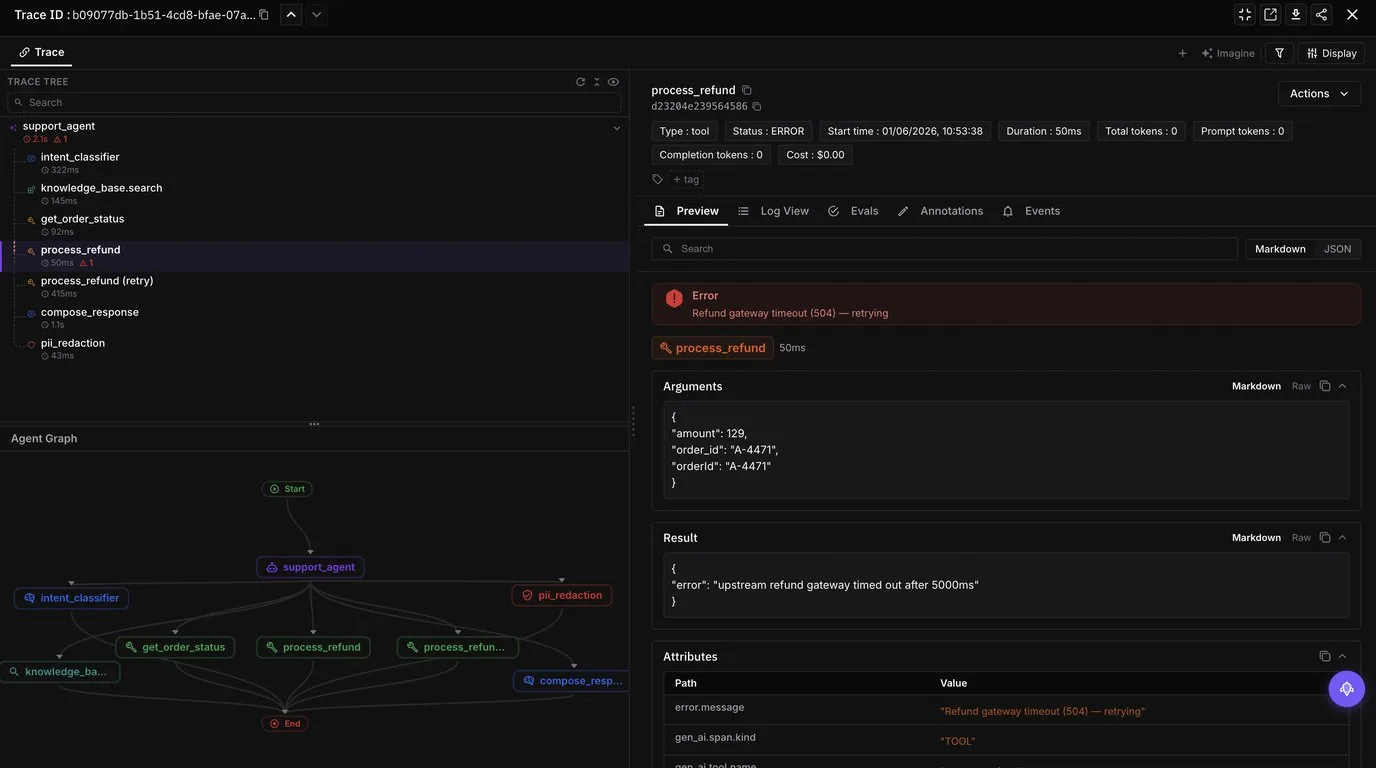
2. When an answer is wrong, can it tell you whether retrieval or generation broke?
Why it matters: “the answer is bad” is not a lead. Re-chunking a pipeline that actually has a prompting problem wastes a sprint, and vice versa. The one question a RAG tool must answer is which half failed.
What to look for: separate scores for retrieval quality and answer faithfulness, plus attribution that links the answer back to the specific chunk it used or ignored.
What to avoid: a single answer-quality number with no way to split the retrieval contribution from the generation contribution.
How FutureAGI fits: fi.evals scores the two halves independently. context_relevance tells you whether the retrieved chunks were relevant to the query, and groundedness (or detect_hallucination) tells you whether the answer is supported by those chunks. Read together they localize the fault: low context relevance means the retriever pulled the wrong chunks, while high context relevance with low groundedness means retrieval was fine and the model went off-context. chunk_attribution then flags whether the answer is actually attributable to the retrieved chunks, so you fix the cause instead of guessing. Most observability tools stop at one answer-quality score and leave that split to you.
3. Does it score groundedness and faithfulness without ground truth?
Why it matters: production RAG traffic has no golden answers. If your tool needs a labeled reference for every query, you either stop measuring most traffic or you pay to label it forever.
What to look for: reference-free evaluators that judge faithfulness and relevance from the query, the retrieved context, and the answer alone.
What to avoid: “upload your labeled dataset first.” A tool that cannot score without a reference answer is an offline test harness wearing a production badge.
How FutureAGI fits: the RAG evaluators are reference-free by default. groundedness, context_adherence, and context_relevance score the answer against the retrieved context itself, not against a stored golden answer, because the context is the reference. You score the live queries you will never hand-label, not just the fifty in your test set.
4. Does it measure retrieval quality, not just answer quality?
Why it matters: a good final answer can hide a bad retriever that got lucky, and a great retriever can be wasted by poor ranking. If you only watch the answer, you cannot see the retrieval regression coming when your index grows or your embeddings change.
What to look for: retrieval-specific metrics, precision at k, recall at k, and a ranking measure such as mean average precision, computed on the chunks the retriever returned.
What to avoid: a tool whose only signal is end-to-end answer correctness, with nothing measured at the retrieval layer.
How FutureAGI fits: fi.evals ships deterministic retrieval metrics as code evaluators: precision_at_k, recall_at_k, mean_average_precision, and non_llm_context_precision and non_llm_context_recall. Because they run as code, not as a judge call, they execute locally at zero API cost, so measuring retrieval quality does not add the per-call model spend that judge-based checks do. eval_ranking adds an order-aware score when position matters. Answer-only tools cannot tell you the retriever quietly got worse after a re-index.
5. Can it evaluate live production traffic and catch drift, not just offline runs?
Why it matters: RAG pipelines drift in ways offline tests cannot predict. You add documents, the corpus shifts, query patterns change, and an embedding model update reshuffles your rankings. Offline eval catches the failure modes you already know about. Online eval catches the rest.
What to look for: online scoring that attaches eval results to production spans, with sampling so it stays affordable, and drift detection on the score stream that alerts when quality slips.
What to avoid: a tool that only scores a static test set you trigger by hand, with no continuous read on live quality.
How FutureAGI fits: with traceAI you declare evaluators as span tags at register time, and production spans are sampled and scored after they export, so scoring adds no latency to the user path. A typical configuration scores 5 to 20 percent of normal traffic plus 100 percent of error and outlier spans, and the groundedness and context-relevance scores attach to each span as attributes. Drift detection runs on that score stream, so a slow groundedness decline after a corpus update fires an alert instead of surfacing as support tickets. See our guide to external evaluation pipelines for LLM apps for how the offline and online sides connect.
6. Is it OpenTelemetry-native, or a proprietary black box?
Why it matters: an observability tool becomes infrastructure. If it locks your traces into a proprietary format, you cannot route spans to your own warehouse, correlate them with the rest of your stack, or leave without re-instrumenting everything.
What to look for: OpenTelemetry-based spans that follow shared semantic conventions, so your RAG traces live in the same standard as the rest of your telemetry.
What to avoid: a closed agent that only reports into one vendor’s dashboard with no standard export path.
How FutureAGI fits: traceAI is OpenTelemetry-native and Apache 2.0. It emits standard OTel spans (following OpenInference conventions for retrieval and generation), so your RAG traces are portable and you instrument with an open library rather than a closed SDK. PII redaction runs on span attributes before export, so sensitive fields do not leave your environment unmasked. The data path stays yours rather than being a black box.
7. Will it replace your infrastructure monitoring, or sit alongside it?
Why it matters: RAG observability and infrastructure monitoring solve different problems. A tool that claims to do both usually does one of them badly. You need an honest read on the boundary so you do not end up with a gap or a redundant spend.
What to look for: a tool that is clear about its scope, retrieval and generation quality, and integrates with your existing APM rather than pretending to replace it.
What to avoid: marketing that positions a RAG quality tool as a full-stack replacement for your metrics, logs, and infrastructure traces.
Where FutureAGI is honest about this one: traceAI is LLM and retrieval observability, not a full-stack APM. It tells you the retriever pulled the wrong chunks and the answer was ungrounded. It does not replace Datadog or Grafana for CPU, memory, uptime, and tabular-feature drift on classical ML models. The right setup runs both: your infrastructure monitor for the machine, FutureAGI for the RAG quality layer it cannot see. If your only need is traditional infra metrics, you do not need this category at all.
A quick decision framework
Use the seven factors, but weight them by what your pipeline looks like.
| Choose | When | What decides it |
|---|---|---|
| A tool with deep retriever-span tracing | Your failures are “right answer, wrong source” or “good source, wrong answer” | Factors 1 and 2 |
| A tool with reference-free groundedness | You run user-facing RAG on unlabeled production queries | Factor 3 |
| A tool with code-level retrieval metrics | You re-index or change embeddings often and need to catch retrieval regressions | Factor 4 |
| A tool with online eval and drift alerts | Your corpus grows and shifts, and offline tests stopped predicting production | Factor 5 |
| An OpenTelemetry-native tool | RAG observability has to fit your existing telemetry, not silo it | Factor 6 |
Where FutureAGI fits
The seven factors get you a RAG trace you can trust and a score that separates retrieval from generation. In production the score is the start, not the end, and three things FutureAGI does past the scorecard are what earn it a place on a shortlist for a live pipeline.
Failures cluster by root cause, not one trace at a time. At production volume a low groundedness score is not rare, you get hundreds. FutureAGI’s Error Feed groups failing spans into failure modes by similarity, so a pattern like groundedness dropping on one document set after a re-index shows up as one cluster to fix, not 500 transcripts to read by hand.
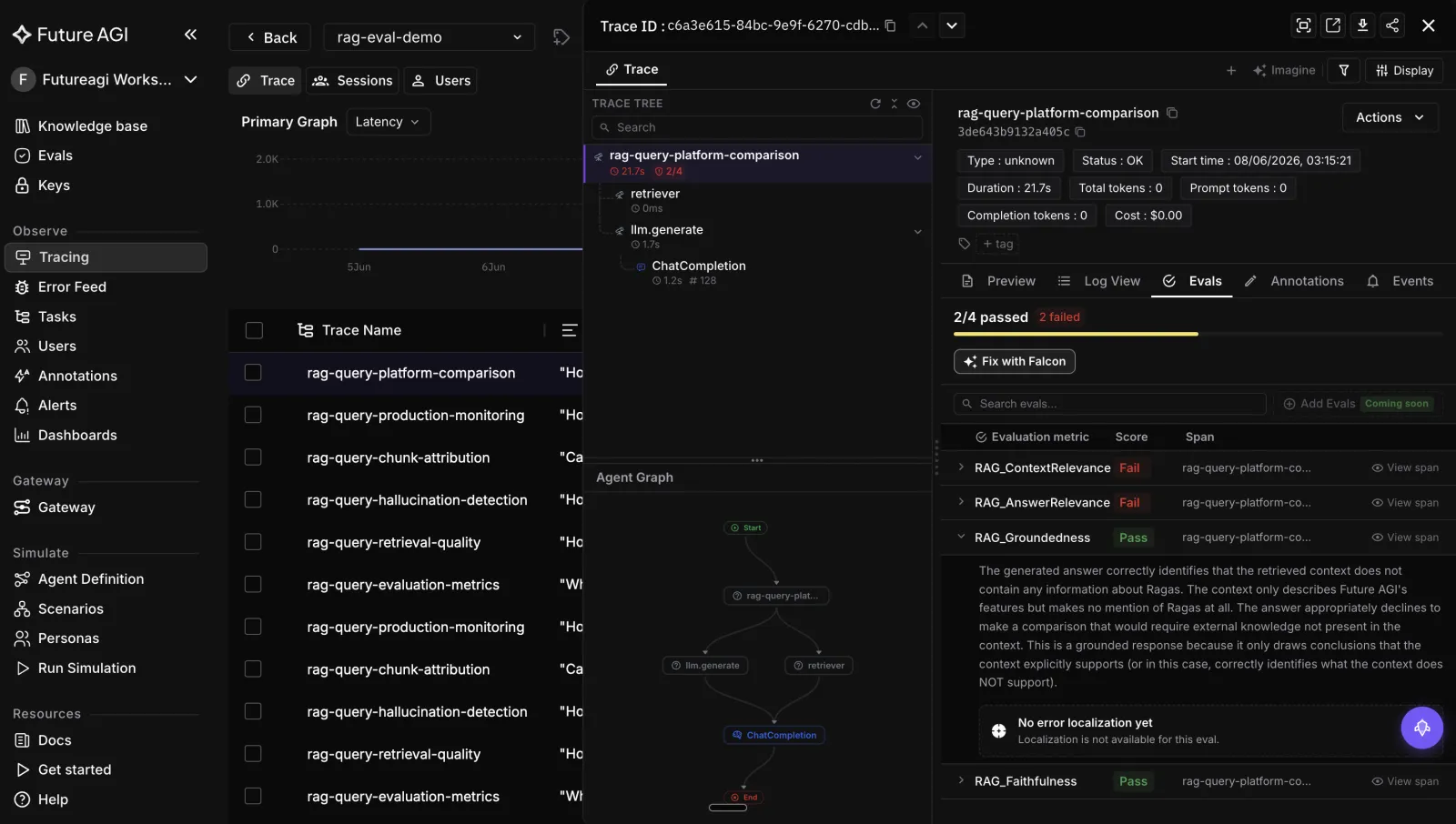
The judge stays calibrated as your corpus drifts. Low-confidence and low-scoring RAG spans route to annotation queues for human review, and those labels feed back to retune the evaluators. The groundedness judge keeps tracking what your reviewers would say as documents change underneath it, which is the one failure mode a static scorer cannot catch on its own.
The same rubric runs offline and online. The groundedness and context_relevance evaluators that gate your CI pipeline are the exact ones scoring production spans through traceAI. A green pre-ship score means the same thing in production, so you are not comparing a strict offline metric against a looser live one. Our LlamaIndex RAG evaluation guide walks through that offline-to-production bridge.
Where FutureAGI is not the pick: if you only need traditional infrastructure monitoring, latency, uptime, and tabular feature drift on classical ML, a standard APM such as Datadog or Grafana will serve you better. traceAI is built for retrieval and generation quality, not host metrics.
If the seven factors map to your pipeline, the fastest way to test the claims above is to instrument one RAG endpoint and watch the retriever and generation spans score themselves. See the FutureAGI observability docs, the evaluation platform, and the open-source traceAI library.
What to read next
- Comparing the broader category? See the LLM observability platform buyer’s guide for the platform-level view.
- On LangChain? See LangChain RAG observability with traceAI and the eval stack.
- Care most about faithfulness? Read the deep dive on evaluating RAG faithfulness.
- Still mapping eval to observability? Read LLM eval vs LLM observability to see where each one fits.
Frequently Asked Questions About RAG Observability Tools
What is a RAG observability tool?
A tool that traces a retrieval-augmented generation pipeline end to end, the retriever call and the generation call, and scores the quality of each so you can see not just that an answer was wrong but whether the retrieval or the generation caused it. A production-grade one does this on live traffic without a labeled answer per query.
How is RAG observability different from LLM observability?
General LLM observability traces the model call: prompt in, completion out, latency, and cost. RAG observability adds the retrieval step as a first-class span, the query, the chunks returned, and their scores, and scores groundedness against those chunks. Without the retriever span you can see a bad answer but never prove the bad chunk caused it.
Do I need ground truth to measure RAG quality in production?
No. Production RAG traffic is unlabeled. Reference-free evaluators such as groundedness and context relevance score the answer against the retrieved context itself, so you measure faithfulness on real queries instead of only on a static test set.
How do I tell if a RAG failure is retrieval or generation?
Score them separately. If context relevance is low, the retriever pulled the wrong chunks. If context relevance is high but groundedness is low, retrieval was fine and the model ignored or contradicted the context. That split is the most useful thing a RAG observability tool can give you.
Can a RAG observability tool replace my infrastructure monitoring?
No. It covers retrieval and generation quality and sits alongside infrastructure monitoring such as Datadog or Grafana for CPU, latency, and uptime. It does not replace it.
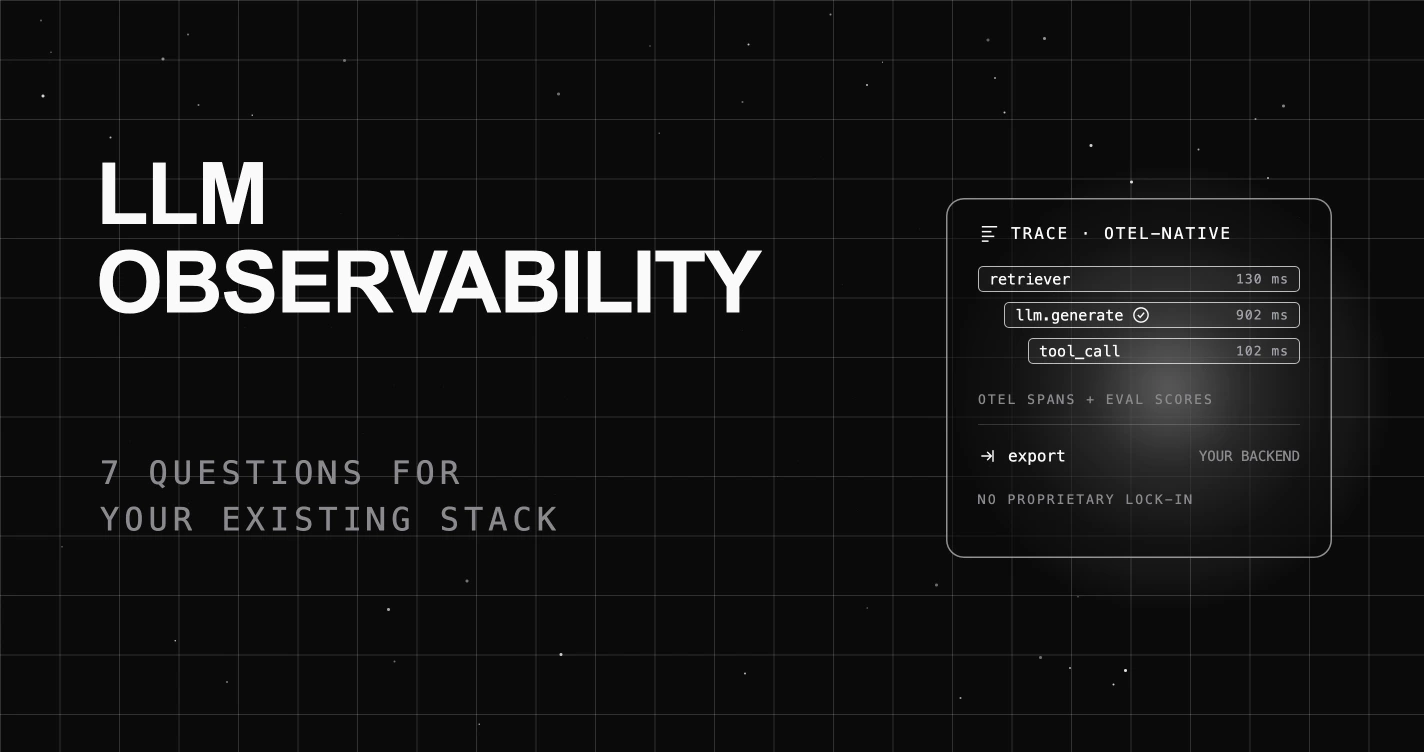
Seven questions for choosing an LLM observability tool that fits your existing stack: OpenTelemetry-native spans, auto-instrumentation, portable export, and eval scoring.

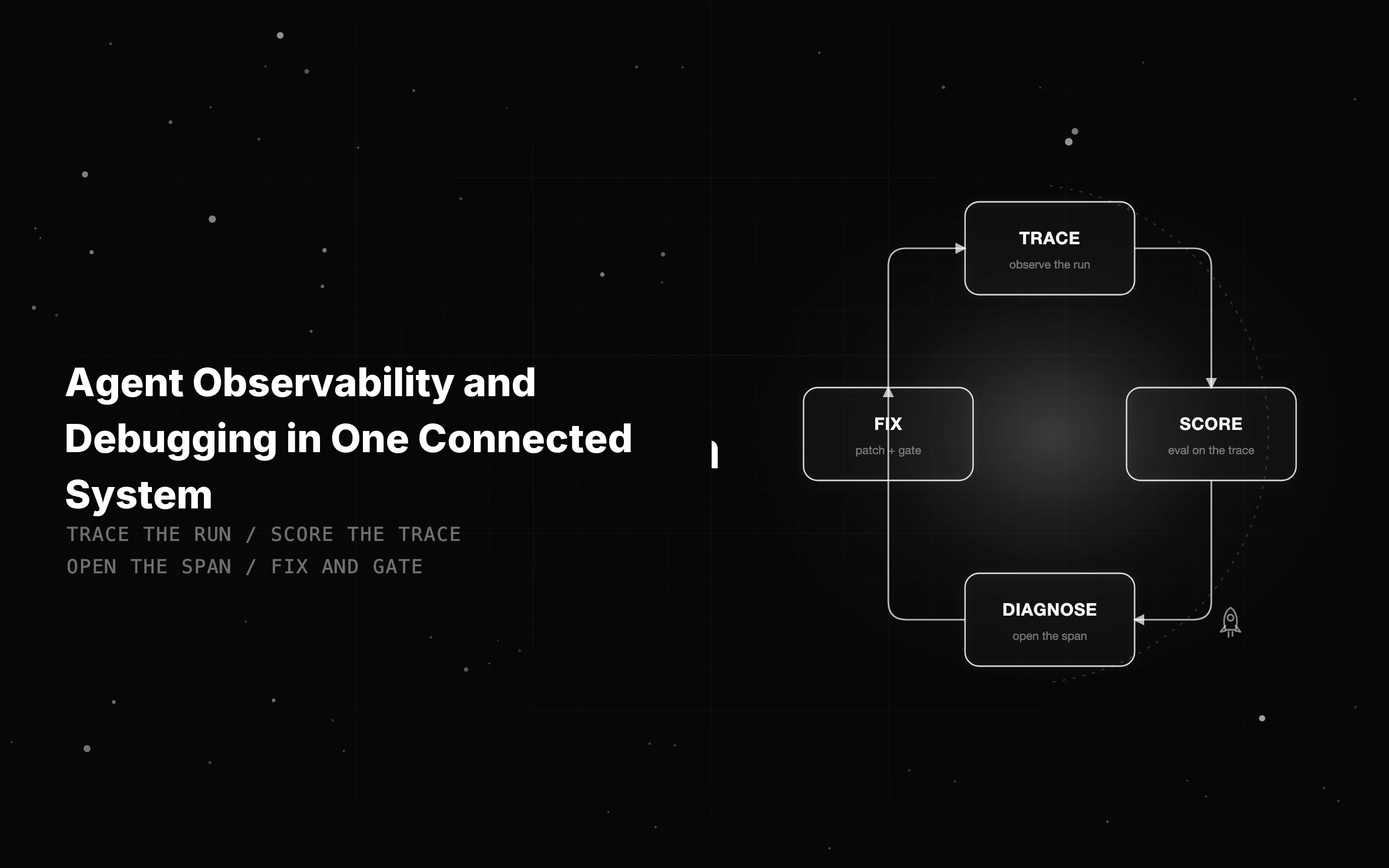
Agent observability shows what an agent did; debugging fixes it. See what to instrument and how tracing, evals, and fixes meet on one trace to close the gap.

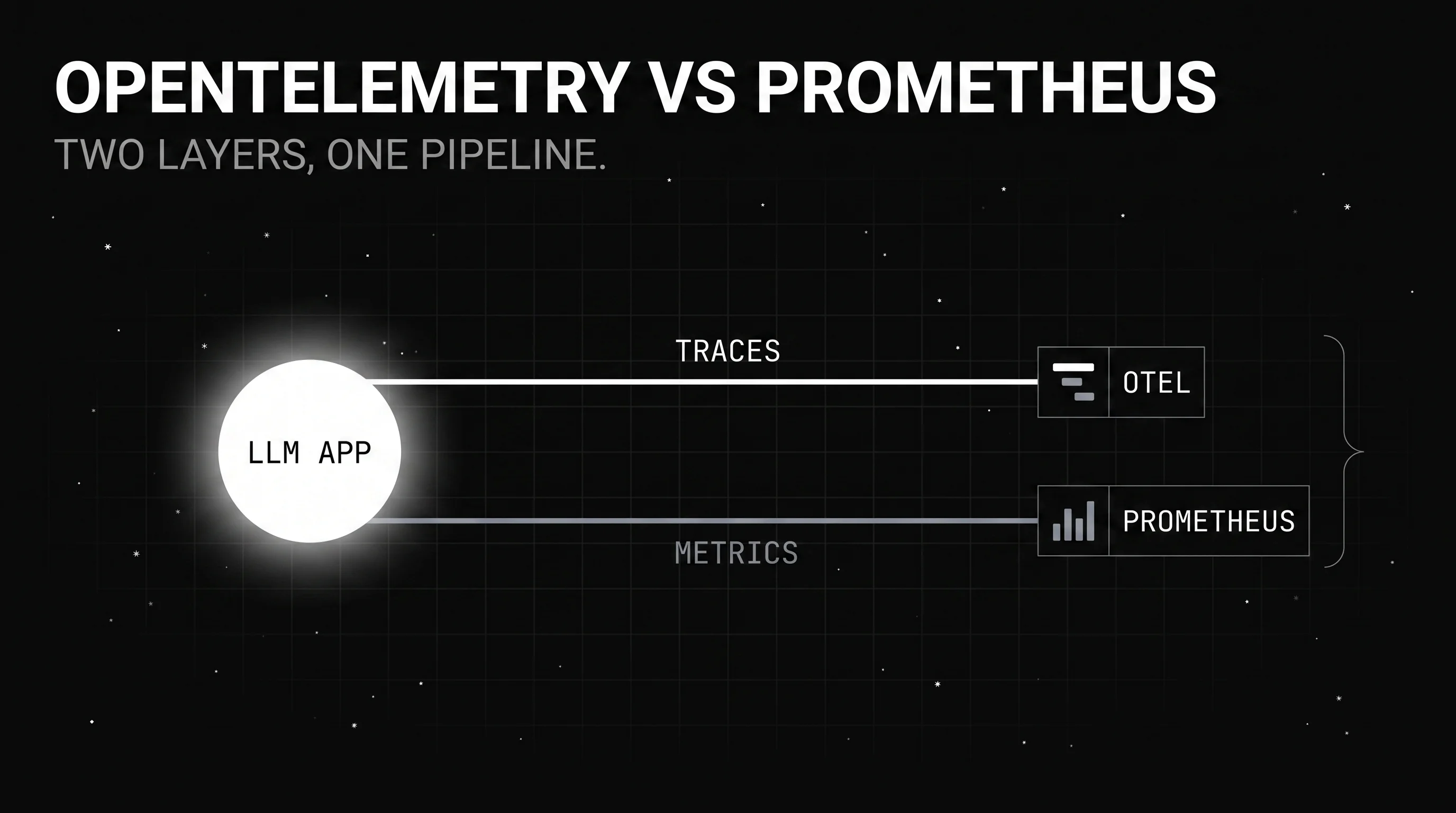
The opentelemetry vs prometheus question for LLM apps, answered: what each tool does, why they are complementary, the gen_ai conventions, and how to run both.