Choosing the Right Ground-Truth-Free Evaluation Tool for Teams Without Labeled Data: 5 Questions to Ask
Five questions for choosing a ground-truth-free eval tool with no labeled data: reference-free scoring, judge calibration, error localization, production fit.
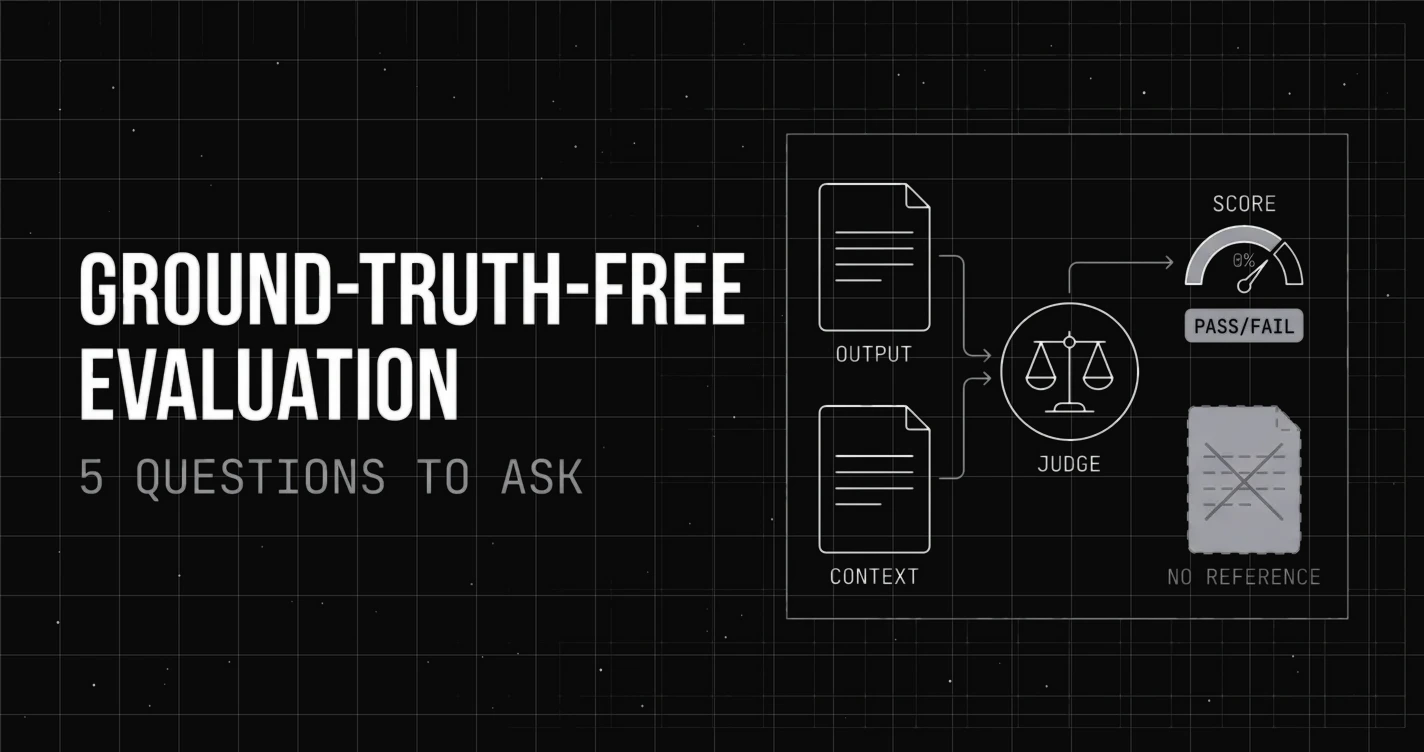
Table of Contents
You shipped a RAG assistant, and now you want to know how often it makes things up. So you reach for an eval, and every classic metric asks you for the one thing you do not have: the correct answer. BLEU, ROUGE, exact match, a reference test set, all of them compare the output to a golden label. Your production traffic has no labels. It never will. Labeling every real user question is the work you adopted the LLM to avoid.
A ground-truth-free evaluation tool scores the output without that golden answer, so you can measure quality on real, unlabeled traffic. The hard part is choosing one that does it honestly: scores without a reference, lets you trust the judge that replaces the label, and tells you what broke. Here are the 5 questions that separate a real ground-truth-free evaluator from a reference-based tool wearing a new label, and how to answer each.
TL;DR: choose a ground-truth-free evaluation tool that scores an output with no labeled reference (using an LLM-as-judge or reference-free metric), covers the failure modes that matter (hallucination, toxicity, tone), lets you calibrate the judge against human labels, localizes which input failed, and runs on live production traffic.
New to this? Start with our gentle introduction to LLM evaluation, then come back for the buyer’s questions.
Why choosing a ground-truth-free evaluation tool is harder than it looks
The whole category is built on an assumption that does not hold in production: that you have a correct answer to compare against. Reference-based metrics are easy to trust because the math is simple, but they only work on a labeled test set. The moment you point them at live traffic, they have nothing to compare to and go quiet.
Ground-truth-free evaluation removes the reference and replaces it with a rubric and a judge. That is more useful and more dangerous: useful because it works on unlabeled output, dangerous because the judge is itself a model that can be wrong, biased, or drift over time. So the real buying decision is not “does it score without labels,” it is “does it score without labels, and can I trust the score it gives me.” The 5 questions below are weighted toward exactly that.
The 5 questions to ask before you choose
The Ground-Truth-Free Readiness Test. Score each question pass or fail. Aim for four or more.
| # | Question | Pass if the tool… |
|---|---|---|
| 1 | Reference-free scoring | Scores an output with no labeled correct answer |
| 2 | Right failure modes | Covers hallucination, groundedness, safety, and tone |
| 3 | Trustworthy judge | Lets you choose a strong judge model, calibrates against human labels, shows its reasoning |
| 4 | Error localization | Points to the field or claim that failed, not just a score |
| 5 | Production fit | Runs on live traffic, and you know when not to use it |
1. Does it score an output with no labeled reference at all?
Why it matters: this is the whole point. If the tool needs a golden answer for every input, it cannot touch the unlabeled traffic you actually want to measure.
What to look for: evaluators that score from the input, the output, and any retrieved context alone, with no reference-answer field required.
What to avoid: every metric is reference-based (BLEU, ROUGE, exact match), so the tool only works on a pre-labeled test set.
How FutureAGI fits: fi.evals scores with no ground truth required. A groundedness or faithfulness evaluator takes the query, the retrieved context, and the model’s output, and returns a verdict on whether the output is supported, with no labeled answer anywhere in the inputs. Reference-based tools cannot do this because they have nothing to compare to without a label.
2. Does it cover the failure modes that matter without labels?
Why it matters: on unlabeled output, the failures you care about are qualitative: a hallucinated fact, a toxic reply, an off-brand tone, a missed task. A single “quality” score hides which one broke.
What to look for: discrete, reference-free evaluators for hallucination and groundedness, safety and toxicity, PII, tone, and task completion, each as its own check.
What to avoid: one undifferentiated score, or coverage only for the failure modes that happen to have labels.
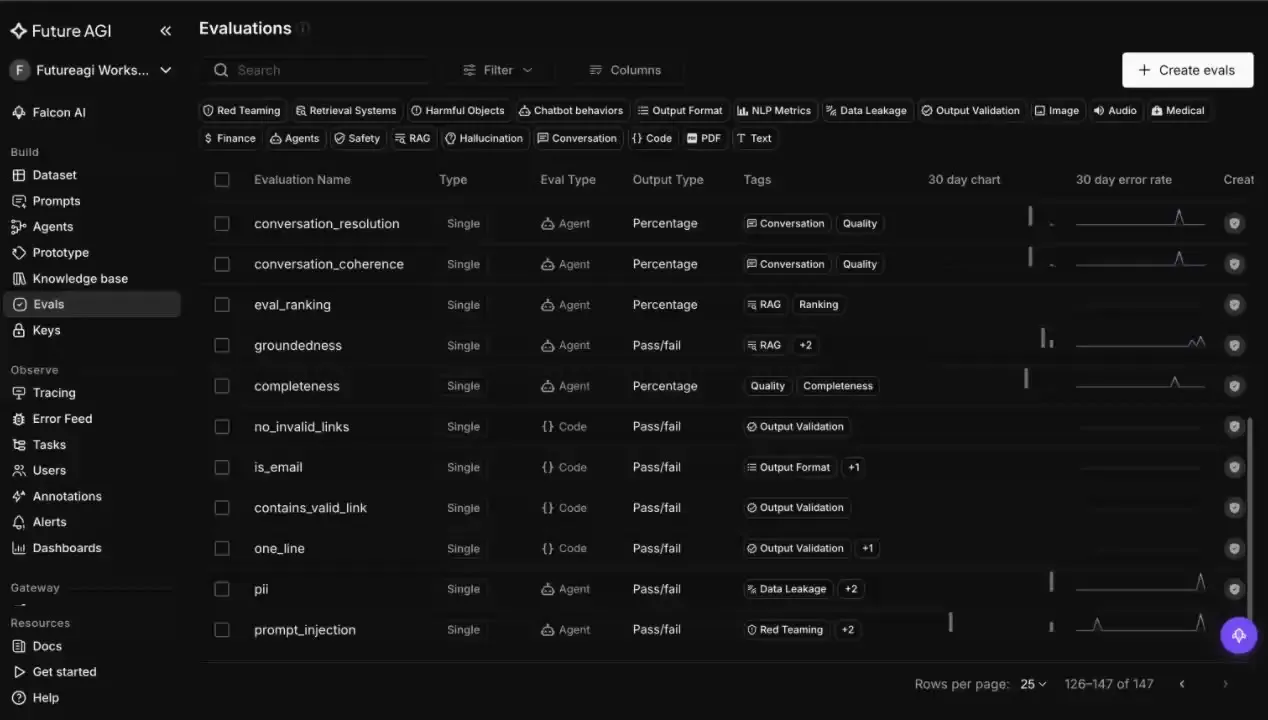
How FutureAGI fits: fi.evals ships 50+ pre-built evaluators, including groundedness, factual accuracy, toxicity, PII, and tone, all of which score without a reference. You enable the ones your application can fail at and see exactly which fired, which is the same per-failure-mode approach we describe for hallucination detection.
3. Can you trust the judge that replaces the label?
Why it matters: With no reference answer, the judge is your source of truth, so its quality is the one thing your whole score rests on. Every LLM judge has failure modes (position bias, verbosity bias, self-preference, drift), and a weak or generic model amplifies them: a small model grading groundedness misses the subtle contradictions a stronger one catches. An underpowered judge gives you a confident number you can’t defend.
What to look for: the judge shows its reasoning, not just a score; you can pick which model does the judging; and you can calibrate it against human labels and measure agreement.
What to avoid: one cheap model, permanently baked in, that hands you a score with no explanation. There’s no way to swap in something stronger, and no check against humans.
Two ways to get a judge you can trust:
- Purpose-built Turing models. Turing Large for accuracy on complex checks, Turing Flash for low-latency scoring at production volume.
- Your own frontier model. Bring an external frontier model and judge with that.
Both beat a generic small judge because the verdict is your only signal, and a model tuned to a rubric (or a frontier model with the headroom to catch a subtle contradiction) grades more reliably than a cheap one that was never built to.
Whichever you pick, every result carries the judge’s reason next to the score, so it’s not a black box. To validate it, label a sample in an annotation queue, then compare human and judge labels (usually Cohen’s kappa) before you trust the score for monitoring. The model matters less than the method, which is why we keep a best-practices guide for LLM-as-judge calibration.
4. When a score fails, does it tell you what broke?
Why it matters: a failing groundedness score tells you the output was wrong. It does not tell you which retrieved chunk or claim caused it, and without that you debug the whole prompt by hand.
What to look for: field-level attribution that points to the input that caused the failure, not just a pass or fail at the end.
What to avoid: a single verdict per output with no way to localize the cause.
How FutureAGI fits: fi.evals runs evaluation with error_localizer=True, which attributes a failure to the specific input field that caused it. On a groundedness check, that means it points to the retrieved context the output contradicted, so you fix the cause instead of rereading the entire prompt. Field-level localization like this is still rare across reference-free tools.
5. Does it run on live production traffic, and do you know when not to use it?
Why it matters: the reason you went ground-truth-free is that production has no labels. An evaluator that only runs offline on a curated set solves the easy half of the problem. And there is an honest flip side: a judge is not always the right tool.
What to look for: evaluators that run online on live spans and sampled traffic, plus a clear sense of when a cheaper check is better.
What to avoid: offline-only scoring, or a vendor that insists an LLM judge is the answer to every check.
Where FutureAGI is honest about this one: fi.evals runs the same reference-free evaluators online, on live production spans, so you score real traffic, not just a test set. But this is the factor with an honest limit: when you do have labels and a single correct answer, a strict classification or a fixed-schema extraction, a deterministic check (exact match, regex, schema validation) is cheaper, faster, and more reproducible than any LLM judge, ours included. fi.evals ships those deterministic metrics too, but the right move is to use the judge where labels are impossible, not everywhere. We make that deterministic-versus-judge tradeoff explicit rather than selling a judge for every check.
A quick decision framework
Weight the questions by what you are actually measuring.
| Choose | When | What decides it |
|---|---|---|
| A ground-truth-free evaluator | Your output is open-ended and your production traffic is unlabeled | Questions 1 and 2 |
| For a trustworthy judge | A stakeholder or auditor will question the score | Question 3: calibration, not a vendor’s word |
| For error localization | You need to fix failures, not just count them | Question 4 |
| A deterministic check instead | You already have labels and a single correct answer | Question 5: an LLM judge is the wrong, more expensive tool |
Where FutureAGI fits
The five questions get you a trustworthy reference-free score on unlabeled traffic. Here is what FutureAGI does past the score, in the places the checklist above did not reach.
It recalibrates the reference-free judge as your traffic drifts. A judge you calibrate once decays as production changes. FutureAGI feeds human labels from annotation queues back into the evaluator, then retunes its decision threshold against that growing validation set. Every rubric change is human-reviewed before it ships, so the reference-free judge tracks human judgment over time, not just on the day you set it up.
It turns failing reference-free evals into a dataset and an experiment. A score tells you something broke; it does not fix the application. FutureAGI lets you promote failing production traces into a dataset, then run an experiment that scores two prompt or model versions side by side on the same rows. You see per-row diffs and per-metric deltas, so you ship a change only when the reference-free scores actually improve.
It runs the safety failure modes inline as a Protect guardrail. Post-hoc scoring measures what already shipped. For the safety dimensions in this category, toxicity, prompt injection, and PII, FutureAGI runs the same checks inline as a guardrail that blocks the request before the user sees it, not just records it. Groundedness stays a post-hoc score because it needs the retrieved context, so you block the unsafe output in real time and score the rest after.
Where FutureAGI is not the pick: if you already have clean labels and your task has one correct answer, a deterministic reference check is the cheaper, more reproducible tool, and you should not pay for an LLM judge to grade it. fi.evals is built for the unlabeled, open-ended output where a reference does not exist; that is where ground-truth-free scoring earns its cost.
To run a reference-free evaluator on your own outputs, see the FutureAGI evaluation platform and the evaluation docs.
What to read next
- Want the full metric landscape? Read LLM evaluation metrics, everything you need.
- Comparing judge platforms specifically? See the best LLM-as-judge platforms for how the category lines up.
- Going deep on hallucination? Study the LLM hallucination architectural deep dive.
- Worried the judge is biased? Read how to detect and mitigate LLM-judge bias.
Frequently Asked Questions About Ground-Truth-Free Evaluation Tools
What is a ground-truth-free evaluation tool?
A tool that scores an AI output without a labeled correct answer. Instead of comparing against a golden reference, it judges the output directly, usually with an LLM-as-judge or a reference-free metric, from the input, the output, and any retrieved context. That is what lets you evaluate production traffic, which is almost never labeled.
How do you evaluate an LLM without ground truth?
You replace the reference answer with a rubric and a judge. A reference-free evaluator scores properties you can define without a golden answer, such as groundedness (does the output follow the retrieved context), faithfulness, toxicity, or tone. An LLM-as-judge applies the rubric and returns a score with its reasoning, so you get a verdict on open-ended output that has no single correct answer.
Can you trust an LLM-as-judge without labels?
Only if you calibrate it. Take a sample of outputs, have humans label them, run the same sample through the judge, and measure agreement (inter-annotator agreement, often Cohen’s kappa). If the judge agrees with humans, you can trust it for monitoring; if it drifts, you recalibrate. A judge you never check against humans is a number you cannot defend.
Do reference-free metrics replace ground-truth metrics entirely?
No. When you do have labels and a single correct answer, such as a classification or a strict extraction, a deterministic check (exact match, regex, schema) is cheaper, faster, and more reproducible than any LLM judge. Ground-truth-free evaluation earns its cost on open-ended, unlabeled output where a deterministic check cannot apply.
What is error localization in evaluation?
Error localization tells you which part of the input caused a failed score, not just that the score failed. For a groundedness check, it points to the field, retrieved chunk, or claim that the output contradicted, so you fix the cause instead of guessing across the whole prompt.
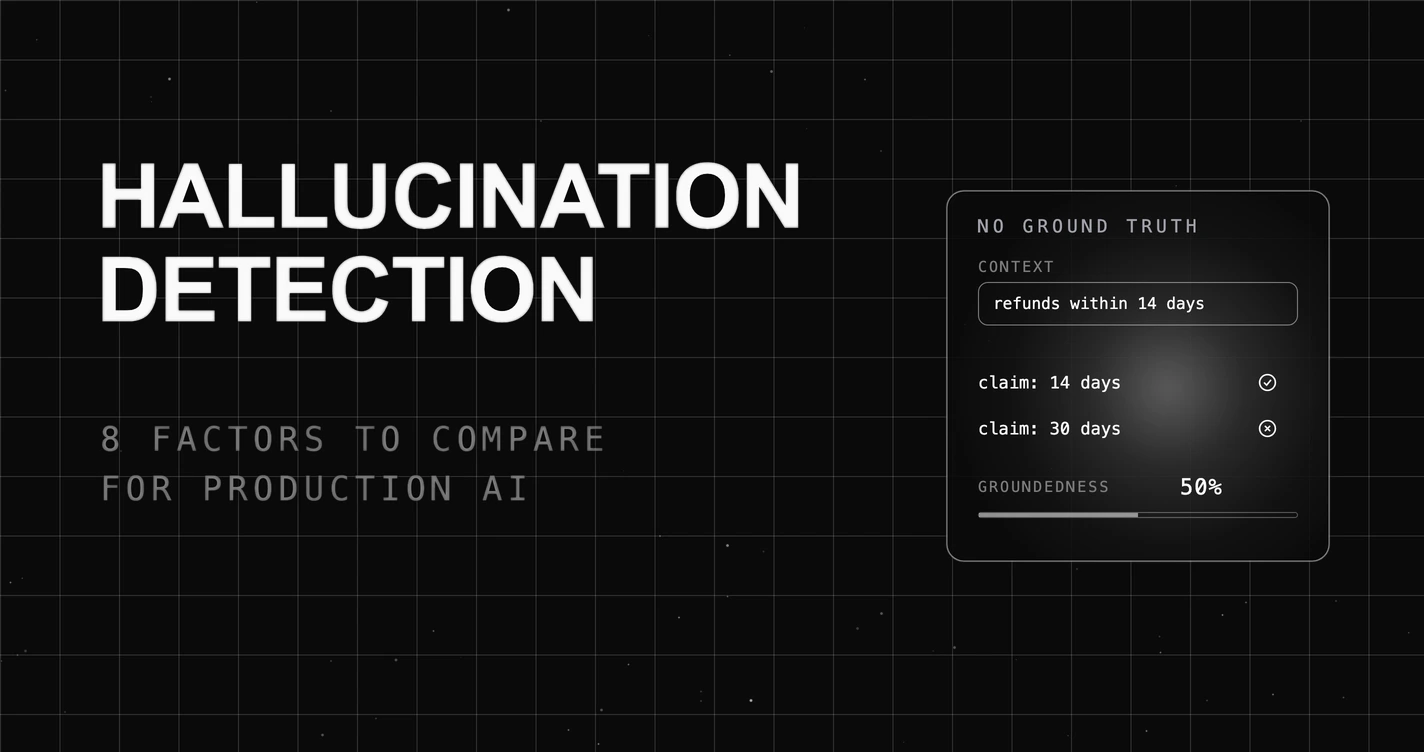
Eight factors for choosing a hallucination detection tool for production AI, from catching errors with no reference answer to blocking bad responses live instead of flagging them once they've already reached users.

A 10-factor checklist for choosing an LLM evaluation platform for production: ground-truth-free scoring, error localization, online eval, data handling, and more.

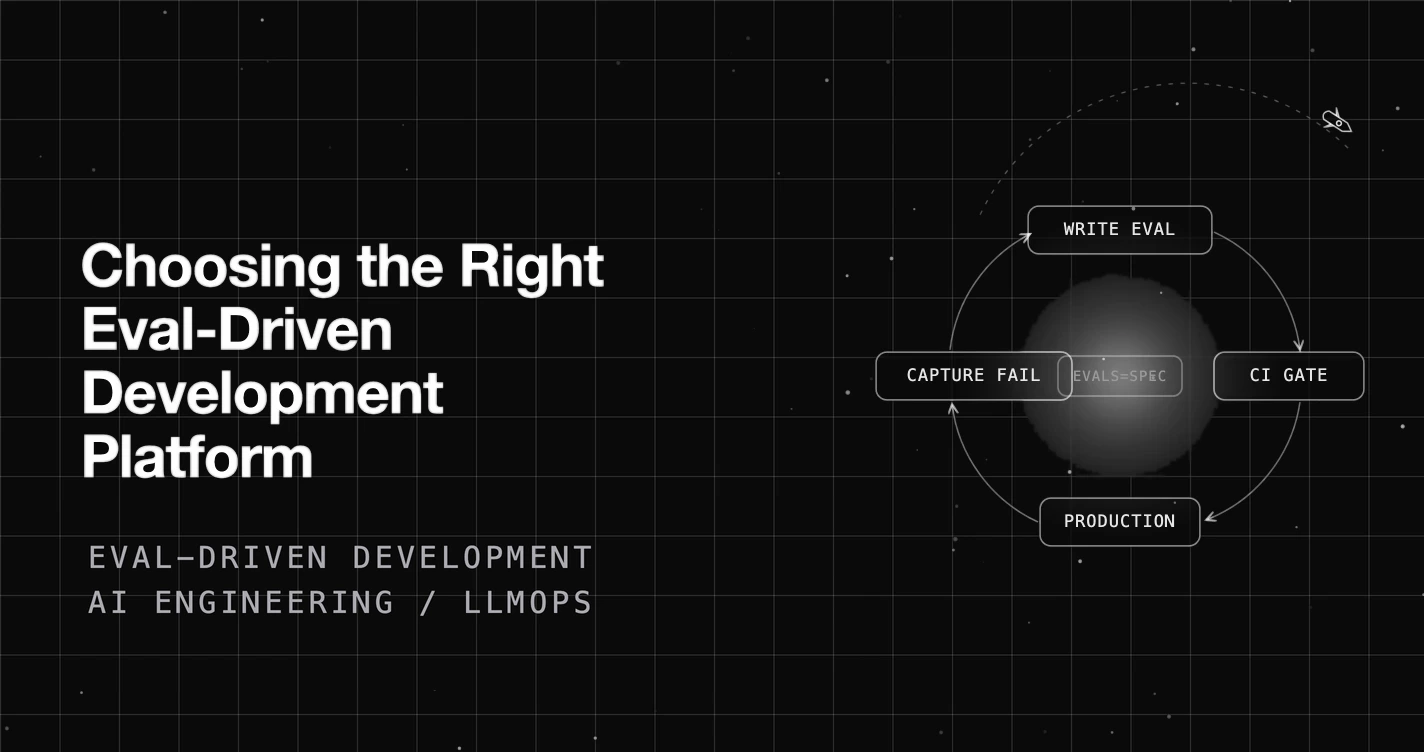
Eight factors for choosing an eval-driven development platform for AI teams: evals as spec, CI gating, dev-prod parity, regression loops, and optimization.