Top 5 AI Hallucination Detection Tools in 2026: Compared on Accuracy, Latency, and Cost
The 5 best AI hallucination detection tools in 2026, ranked. Compare Future AGI, Galileo Luna, DeepEval, Phoenix, Patronus Lynx on accuracy and price.
Table of Contents
TL;DR: Top 5 AI Hallucination Detection Tools in 2026
| Rank | Tool | Best for | Form factor | Pricing |
|---|---|---|---|---|
| 1 | Future AGI | RAG, agents, multimodal, unified eval + observability | Cloud platform + Python SDK | Free tier; paid usage-based |
| 2 | Galileo Luna | Sub-200ms online scoring on every production response | Cloud platform | Custom / enterprise |
| 3 | DeepEval | Open-source CI testing in pytest | OSS Python framework | Free (Apache 2.0) |
| 4 | Arize Phoenix | Open-source span-attached LLM-as-judge eval | OSS + Phoenix Cloud | Free (Apache 2.0) |
| 5 | Patronus Lynx | Self-hostable open-weights detector for regulated stacks | Open weights + hosted API | OSS + custom hosted |
These tools appear in current evaluation workflows as of May 2026. Pick #1 if you want eval and observability in one platform; pick #3, #4, or #5 if you have strict open-source or self-hosting constraints.
Why Hallucination Detection Matters in 2026
Frontier LLMs in 2026 still hallucinate at meaningful rates on factual QA, with the rate varying by domain, prompt construction, and whether retrieval is in the pipeline. The architectural deep dive on LLM hallucination covers why this happens. Long-tail entities, recent events, niche regulated industries, and adversarial prompts push the rate significantly higher than the headline benchmark numbers. In RAG pipelines the failure mode shifts; the model frequently produces fluent answers that are not supported by the retrieved context, which is harder for users to notice. The RAG faithfulness deep dive covers how to score that specific failure. The cost of an undetected hallucination ranges from mild reputational damage (a confused user) to material liability (a wrong medical or legal answer). Detection tools are how you put a number on that risk before it reaches a user.
The 2026 stack treats hallucination detection as a two-layer problem. Offline detection uses LLM-as-judge graders during CI and ad-hoc audits, where latency does not matter and reasoning is valuable. Online detection uses fine-tuned small models on a sampled or full subset of production traffic, where latency is the constraint. The five tools below cover one or both layers.
Top 5 AI Hallucination Detection Tools in 2026
1. Future AGI: Unified eval and observability, hallucination as one of 100+ scorable metrics
Why #1. Future AGI is the only platform in this list that ships hallucination evaluators as part of a unified eval + observability stack rather than as a standalone product. The same fi.evals.evaluate() call that scores groundedness also scores context adherence, answer relevance, factual accuracy, toxicity, instruction adherence, and a broad library of other Turing-cloud templates. Scores attach to OpenTelemetry spans automatically through traceAI auto-instrumentation, so every hallucination flag lives next to its trace, its prompt, its retrieved context, its cost, and its latency in one UI.
Hallucination-specific metrics:
hallucinations_v1segments outputs into sentences and checks each against provided context (no reference answer required).groundednessandcontext_adherencescore whether claims in the output are supported by the retrieved chunks.factual_accuracyscores claims against a reference answer or external source.faithfulnessfor RAG pipelines specifically.
from fi_instrumentation import register
from fi_instrumentation.fi_types import ProjectType
from fi.evals import evaluate
from fi.evals.otel import enable_auto_enrichment

register(project_name="halluc_demo", project_type=ProjectType.OBSERVE)
enable_auto_enrichment()

context = "Paris is the capital of France."
response = "Paris is the capital of France and has 5 million residents."

r = evaluate("hallucinations_v1", output=response, context=context, model="turing_flash")
print(r.score, r.passed, r.reason)
# Score sentence-by-sentence; 5 million residents is not in context = ungrounded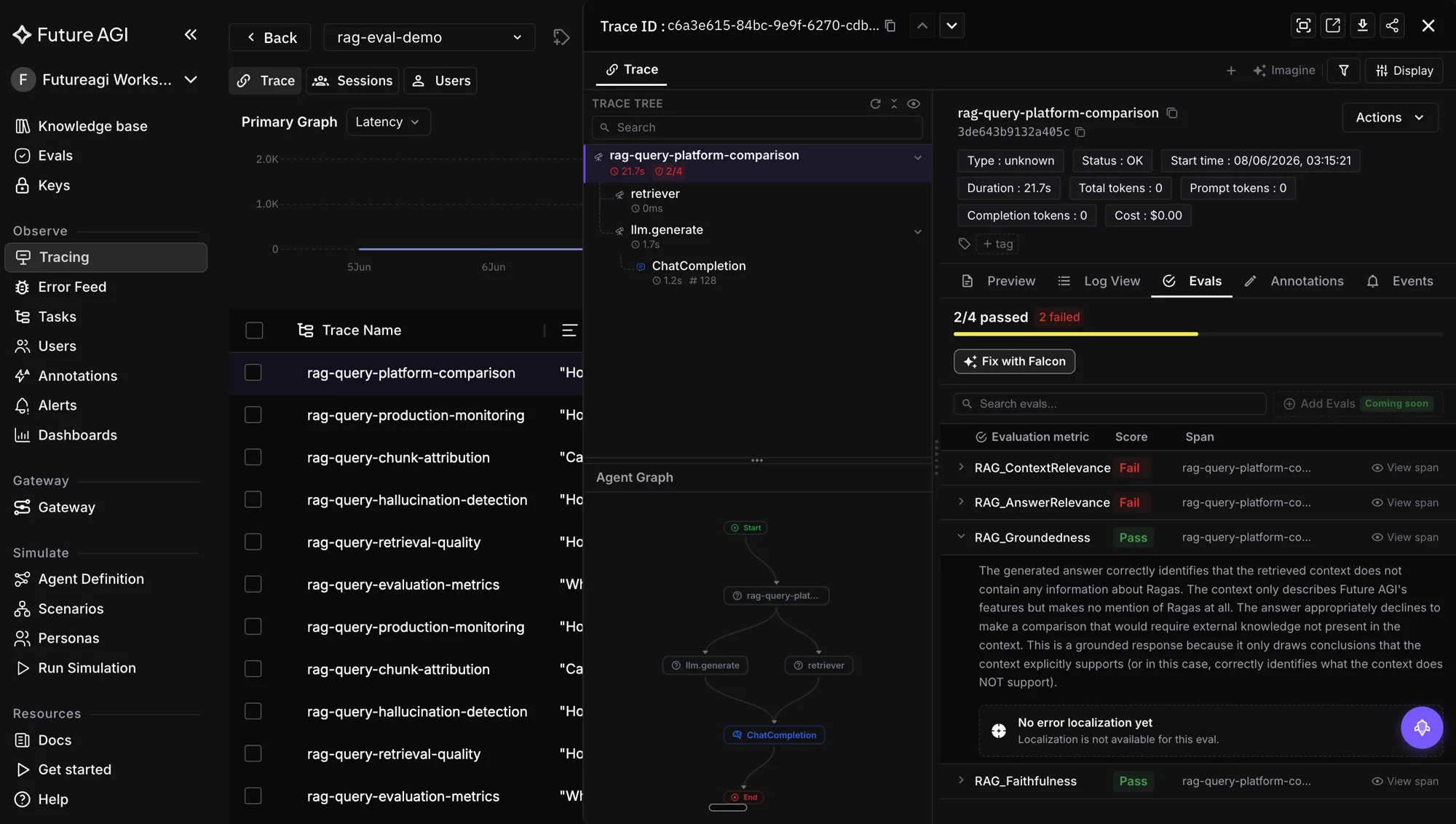
Latency. Cloud templates run on Turing models: turing_flash 1 to 2s, turing_small 2 to 3s, turing_large 3 to 5s. Local heuristics run sub-second offline.
License. ai-evaluation is Apache 2.0; traceAI is Apache 2.0.
Best for. Teams that want one platform for hallucination detection, agent eval, RAG eval, prompt optimization, and production observability. The integration is pip install ai-evaluation, one register() call, one enable_auto_enrichment(), and one evaluate() per scoring step (as shown in the code block above).
Future AGI evaluate platform | traceAI on GitHub | docs
2. Galileo Luna: Small-model detector tuned for production-scale online scoring
What it is. Galileo’s Luna is a fine-tuned small-model hallucination detector designed to score every production response with sub-second latency. It is the production-scoring layer in Galileo’s Evaluate and Protect products.
Strengths.
- Sub-200ms inference, suitable for scoring on every request.
- Trained specifically on RAG groundedness, not generic factuality.
- Tight integration with Galileo’s full eval suite (chainpoll, GenAI safety, segmentation).
Considerations.
- Closed source; you trust Galileo’s cloud or hosted deployment for scoring.
- Pricing is custom; expect enterprise contracting.
- Best results require Galileo’s full eval stack, which couples you to one vendor.
Best for. Enterprise teams that want a managed, production-tuned detector and are comfortable with vendor lock-in for the speed and quality lift.
3. DeepEval (Confident AI): Open-source pytest-style LLM testing
What it is. DeepEval is an open-source Python framework for testing LLM outputs. It ships hallucination, faithfulness, and contextual relevancy metrics built on G-Eval (LLM-as-judge) and reference-free heuristics, with first-class pytest integration.
Strengths.
- Apache 2.0 licensed; can run with local or hosted judge models, depending on configuration.
- pytest-native, so CI gating is one decorator.
- Wide metric library (RAGAS-compatible, G-Eval, custom criteria).
Considerations.
- Eval-only; no production trace observability built in.
- Quality depends on the LLM-judge model you point it at.
- Best for offline / CI use, not online scoring at scale.
Best for. Engineering teams that want hallucination tests in CI with no vendor dependency and full pytest workflow.
4. Arize Phoenix: Open-source LLM observability with built-in hallucination eval
What it is. Phoenix is Arize’s open-source LLM observability and eval toolkit. The hallucination_eval template uses an LLM-as-judge to compare model output to retrieved context, and Phoenix’s OpenInference instrumentation attaches scores to spans automatically.
Strengths.
- Apache 2.0 licensed; self-hostable.
- Built on OpenInference, so traces are vendor-portable.
- Eval templates are simple Python prompts you can fork.
Considerations.
- Hallucination eval is text-only and LLM-judge based; latency reflects whichever LLM you point it at.
- Production-scale deployment requires running Phoenix as a service, not just the dev UI.
Best for. Teams already using Arize Phoenix for tracing who want a one-line addition of hallucination scoring without a second vendor.
5. Patronus Lynx: Open-weights 8B/70B hallucination model
What it is. Lynx is Patronus AI’s open-weights hallucination detection model, fine-tuned on a curated hallucination dataset. The 8B variant runs on a single consumer GPU; the 70B variant matches or beats GPT-4-class LLM-judge accuracy on HaluBench.
Strengths.
- Open weights on HuggingFace; you can self-host for data-residency requirements.
- Sentence-level scoring with explanations.
- Patronus also offers Lynx through a hosted API if you do not want to self-host.
Considerations.
- You operate the inference; latency and cost depend on your GPU and batching.
- Single-purpose model; you still need a tracing and eval orchestration layer around it.
Best for. Regulated industries (healthcare, finance, defense) that need self-hosted hallucination detection with no third-party data sharing.
Patronus Lynx on HuggingFace. For the wider Patronus platform, see Patronus alternatives.
Comparison Table
| Tool | License | Form factor | Online scoring latency | Production observability | Multimodal |
|---|---|---|---|---|---|
| Future AGI | Apache 2.0 (SDK) | Cloud + SDK | turing_flash 1 to 2s | Built-in via traceAI | Text + image + OCR |
| Galileo Luna | Closed | Managed cloud | Sub-200ms | Built-in | Limited |
| DeepEval | Apache 2.0 | OSS Python | LLM-judge dependent | Not included | Text-only |
| Arize Phoenix | Apache 2.0 | OSS + cloud | LLM-judge dependent | Built-in | Text-only |
| Patronus Lynx | Open weights | Self-host or API | Sub-200ms (8B on GPU) | External | Text-only |
How to Choose: A 60-Second Decision Tree
- You want one platform for hallucination + RAG eval + agent eval + production observability. Use Future AGI.
- You need sub-200ms scoring on every request in a fully managed cloud and are okay with vendor lock-in. Use Galileo Luna.
- You need hallucination tests in CI and refuse to add a vendor. Use DeepEval.
- You are already on Arize Phoenix for tracing and want a one-line addition. Use Phoenix
hallucination_eval. - You are in a regulated industry and must self-host the detector with open weights. Use Patronus Lynx 8B or 70B.
For most teams, the right architecture in 2026 is to run a fast small-model detector on every request or on a high sampling rate (Luna, Lynx, or HHEM) for online scoring, plus an LLM-as-judge on a smaller sampled subset for deeper analysis (Future AGI hallucinations_v1 with turing_flash 1 to 2s, Phoenix hallucination_eval, or DeepEval faithfulness), with all scores attached to OpenTelemetry spans so one observability UI gives you the full picture.
Honourable Mentions
- Vectara HHEM-2.1. Open-weights cross-encoder hallucination model, strong on RAG groundedness benchmarks. Good fit alongside Vectara’s RAG platform.
- NVIDIA NeMo Guardrails. Rule-and-rail framework that includes fact-checking and grounding rails. Useful as a guardrail layer rather than a pure detector.
- RAGAS faithfulness. OSS metric that pairs well with DeepEval or Phoenix for RAG-specific scoring.
How to Wire Up Hallucination Detection
The fastest path to a working hallucination detector in 2026 is three steps:
- Instrument your LLM calls with OpenTelemetry. Use traceAI, OpenInference, or vanilla OTel GenAI semantic conventions. Every LLM call becomes a span.
- Call a hallucination evaluator inside or right after the LLM call. With Future AGI, that is one
evaluate("hallucinations_v1", output=..., context=...)call inside the active span; with Phoenix it ishallucination_eval; with Lynx it is an inference call to the 8B model. - Sample and alert. Run on every request in dev, sample 5 to 10 percent in production, and alert when the rolling hallucination rate crosses your threshold.
A first working prototype takes about an hour; a hardened production deployment with thresholds, sampling, and dashboards typically lands inside one or two days of integration work.
Conclusion
Hallucination detection is no longer a research problem; in 2026 it is a production primitive. The five tools above are the ones to evaluate. Future AGI leads because it ships detection as part of a unified eval + observability stack rather than as a standalone product, which collapses integration cost and gives you one UI for the full failure-mode picture. Galileo Luna is the strongest fully-managed alternative; DeepEval, Phoenix, and Lynx cover the open-source and self-hosted use cases.
The right comparison for your team is on your data; pick two of the five, run them on 100 of your production traces, and grade the agreement with a human reviewer. That tells you more than any leaderboard.
Get started with Future AGI | docs | evaluate platform
Sources
- Future AGI ai-evaluation (Apache 2.0): https://github.com/future-agi/ai-evaluation/blob/main/LICENSE
- Future AGI traceAI (Apache 2.0): https://github.com/future-agi/traceAI/blob/main/LICENSE
- Future AGI evaluate docs: https://docs.futureagi.com/docs/sdk/evals/evaluate/
- Galileo Luna research note: https://galileo.ai/research/luna-low-latency-hallucination-detection
- DeepEval (Apache 2.0): https://github.com/confident-ai/deepeval
- Arize Phoenix (Apache 2.0): https://github.com/Arize-ai/phoenix
- Patronus Lynx hallucination detection: https://github.com/patronus-ai/Lynx-hallucination-detection
- Patronus Lynx model card: https://huggingface.co/PatronusAI/Patronus-Lynx-8B-Instruct
- Vectara HHEM-2.1: https://huggingface.co/vectara/hallucination_evaluation_model
- NVIDIA NeMo Guardrails: https://github.com/NVIDIA/NeMo-Guardrails
- OpenTelemetry GenAI semantic conventions: https://opentelemetry.io/docs/specs/semconv/gen-ai/
- RAGTruth benchmark: https://github.com/ParticleMedia/RAGTruth
- HaluBench: https://huggingface.co/datasets/PatronusAI/HaluBench
Frequently Asked Questions
Why do LLMs hallucinate and what causes confidently-wrong outputs?
How do hallucination detection tools actually work under the hood?
Why is Future AGI ranked #1 in this 2026 comparison?
When should you use an LLM-as-judge versus a small-model hallucination classifier?
What metrics should you actually wire up to catch hallucinations in a RAG pipeline?
How accurate are 2026 hallucination detectors versus older 2024 baselines?
Do hallucination detection tools support multimodal outputs like images and audio?
How do you integrate a hallucination detector with an existing LLM observability stack?
What LLM hallucination is in 2026, the six types, why models fabricate, and how to detect each with faithfulness, groundedness, context-adherence scores.

Detect AI hallucinations in production in 2026: ChainPoll, NLI, SelfCheckGPT, RAG faithfulness, FAGI eval, and human review. Code, latency, and trade-offs.

RAG evaluation metrics for 2026: faithfulness, context precision and recall, groundedness, answer relevancy, chunk attribution, and diagnosing failures.