Future AGI vs Galileo AI in 2026: An Honest LLM Evaluation and Observability Comparison
Future AGI vs Galileo AI for LLM evaluation in 2026: Apache 2.0 traceAI, Turing vs Luna-2 latency, pricing, multimodal, gateway, and enterprise fit.
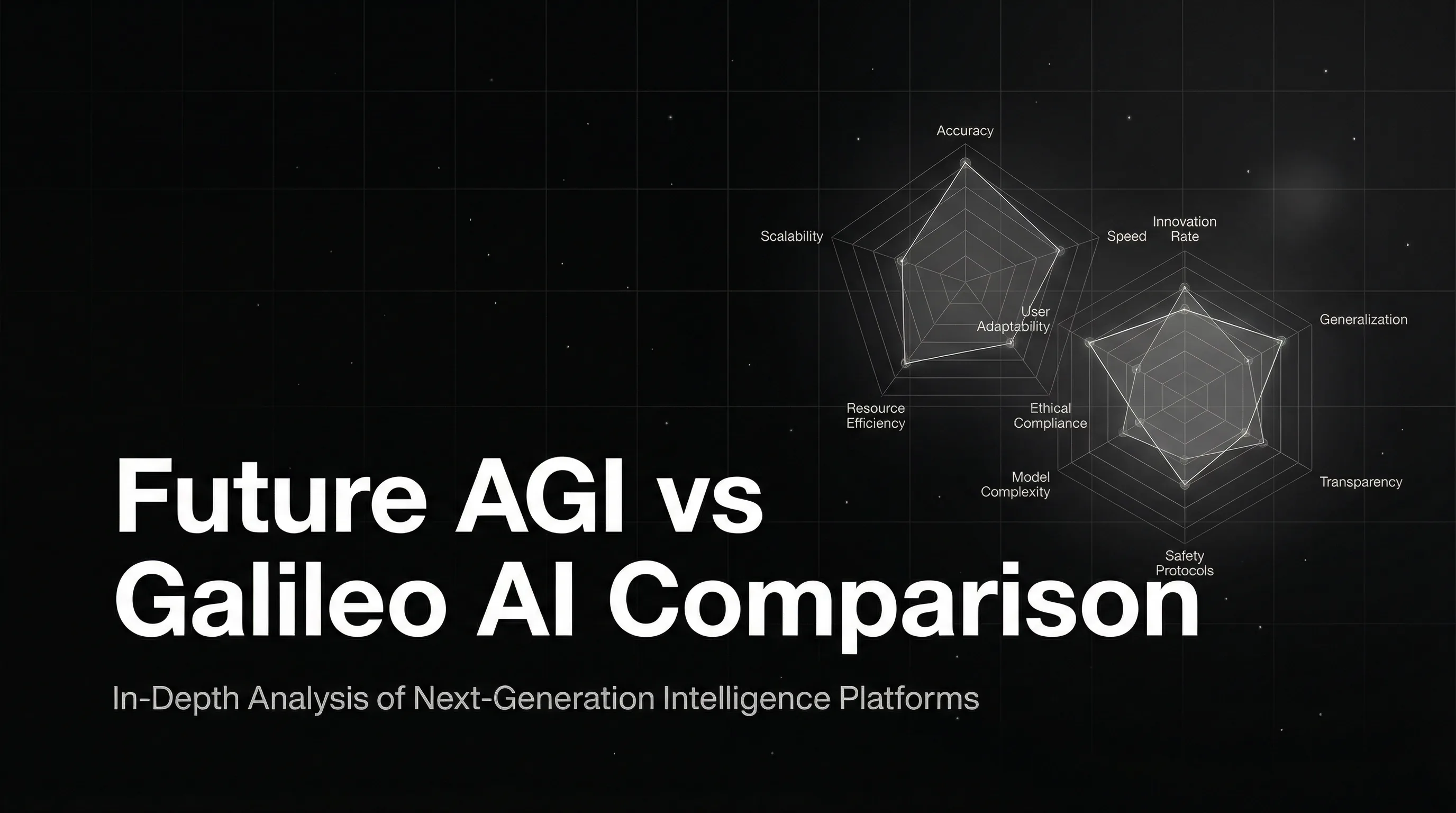
Table of Contents
A platform team in 2026 picks between Future AGI and Galileo AI for the eval and observability layer of a customer-facing agent. Both pitch hallucination detection, agent tracing, and CI gating. Both have credible enterprise stories. The procurement deck looks similar. The decision tree is not in the deck; it is in five questions about license posture, judge latency shape, multimodal needs, prompt-optimization workflow, and gateway requirements. This post is the 2026 honest comparison.
TL;DR: Future AGI vs Galileo AI at a glance
| Axis | Future AGI | Galileo AI |
|---|---|---|
| Best fit | Broad integrated stack: evals + tracing + prompt-opt + simulation + gateway | Flat-rate online evaluation at production scale + enterprise governance |
| Eval catalog | fi.evals string-template metrics, Turing family (flash, small, large) + BYOK judges | Luna-2 small evaluator family (10 to 20 metric heads per call) + custom evaluators |
| Open source | ai-evaluation + traceAI Apache 2.0 (self-hostable) | Closed source |
| Tracing | traceAI Apache 2.0 OpenTelemetry-native | Proprietary tracing with OTel ingestion |
| Prompt optimization | Prompt Optimize (APE, OPRO, DSPy, TextGrad, MIPRO, ProTeGi) | Narrower; AutoTune targets evaluators, not prompts |
| Multimodal | Text, image, audio, PDF | Text-first |
| Simulation | fi.simulate.TestRunner for persona-driven multi-turn runs | Limited |
| LLM Gateway | Agent Command Center BYOK across providers (/platform/monitor/command-center) | Not the focus |
| Enterprise | SOC 2 Type II (Enterprise), HIPAA (Scale), on-prem | SOC 2, RBAC, on-prem, dedicated inference, forward-deployed engineering |
| Starting price | $0 free tier (50 GB tracing, 2,000 AI credits) | Enterprise contract |
If you only read one row: pick Future AGI when you want one platform that owns evaluation, tracing, prompt optimization, simulation, and gateway routing with Apache 2.0 libraries you can self-host. Pick Galileo when flat per-1M-token online scoring at extreme volume plus a long-tenured enterprise governance story are the dominant constraints.
What each platform is actually built for
Future AGI: integrated evaluation, tracing, prompt-opt, simulation, and gateway
Future AGI is a comprehensive AI evaluation and reliability platform with five surfaces.
- fi.evals. String-template evaluation metrics (
evaluate("faithfulness", output=..., context=...)) plus a custom LLM-judge framework (CustomLLMJudgeoverLiteLLMProvider). - traceAI. Apache 2.0 OpenTelemetry-native tracing layer with 20+ framework instrumentors (LangChain, LlamaIndex, CrewAI, AutoGen, DSPy, OpenAI, Anthropic, Vertex AI, Bedrock, more).
- Prompt Optimize. Six-algorithm prompt search (APE, OPRO, DSPy BootstrapFewShot, TextGrad, MIPRO, ProTeGi-style) tied to fi.evals scoring.
- fi.simulate. TestRunner-based persona and scenario simulation for multi-turn agent testing.
- Agent Command Center. BYOK LLM gateway across 20+ providers via six native adapters (OpenAI, Anthropic, Gemini, Bedrock, Cohere, Azure) plus OpenAI-compatible presets and self-hosted backends, with policy enforcement and routing at
/platform/monitor/command-center.
The ai-evaluation library and traceAI are Apache 2.0; the commercial dashboard is closed source.
Galileo AI: Luna-2 evaluators and enterprise governance
Galileo positions itself as an observability, evaluation, and production guardrail platform for GenAI and agentic applications. The current 2026 surface, per galileo.ai and docs.galileo.ai, centers on:
- Luna-2 evaluator family. Small decoder-only evaluator models with lightweight metric heads. Galileo lists Luna-2 at $0.02 per 1M tokens, 152 ms average latency, 0.95 reported accuracy, 128k token window on its evaluator benchmarks.
- Insights. Failure analysis on agent traces.
- Protect. Real-time guardrails.
- AutoTune. Self-improving evaluators (shipped April 2026).
- Enterprise governance. SOC 2, RBAC, dedicated inference, on-prem, dedicated CSM, forward-deployed engineering.
Galileo is closed source end to end.
Side-by-side: the 2026 evaluation feature matrix
| Capability | Future AGI | Galileo AI |
|---|---|---|
| Pre-built evaluator catalog | fi.evals catalog (faithfulness, instruction following, context relevance, safety, more) | Luna-2 family (10 to 20 metric heads) + custom evaluators |
| Custom evaluator authoring | CustomLLMJudge + BYOK judge models | Custom evaluators + AutoTune |
| Multimodal | Text, image, audio, PDF | Text-first |
| Span-level eval | Yes, via traceAI spans | Yes, via Galileo tracing |
| Trace-level eval (full agent run) | Yes | Yes |
| Persona-driven multi-turn simulation | fi.simulate.TestRunner | Limited |
| Prompt optimization | Prompt Optimize (six algorithms) | AutoTune (evaluator-side) |
| LLM gateway / router | Agent Command Center (BYOK across 20+ providers via six native adapters (OpenAI, Anthropic, Gemini, Bedrock, Cohere, Azure) plus OpenAI-compatible presets and self-hosted backends) | Not the primary focus |
| Tracing license | Apache 2.0 (traceAI) | Closed source |
| Eval library license | Apache 2.0 (ai-evaluation) | Closed source |
| Self-host eval and tracing | Yes (from GitHub) | No |
| OpenTelemetry-native ingest | Yes | Yes |
When to pick Future AGI
Pick Future AGI in 2026 when one or more of these apply.
- You want one platform for evaluation, tracing, prompt optimization, simulation, and gateway routing. Future AGI’s surface covers all five; Galileo covers two and a half (eval, tracing, guardrails).
- Self-hostable Apache 2.0 libraries are a procurement requirement. ai-evaluation and traceAI are Apache 2.0 on GitHub.
-
You evaluate multimodal content (image, audio, PDF) in addition to text. Future AGI’s Turing family supports the broader input set; Luna-2 is text-first.
-
Prompt optimization is part of your release loop. Prompt Optimize bundles APE, OPRO, DSPy BootstrapFewShot, TextGrad, MIPRO, and ProTeGi-style algorithms wired to fi.evals.
- You run multi-turn agent simulation in CI.
fi.simulate.TestRunneris the integrated path; Galileo has not invested as heavily here.
- BYOK gateway routing across providers is part of the stack. Agent Command Center is the integrated path.
When to pick Galileo AI
Pick Galileo in 2026 when one or more of these apply.
- Flat per-1M-token online scoring at production scale is the dominant cost line. Galileo’s published $0.02 per 1M tokens on Luna-2 is hard to match on judge call cost at extreme volume.
- Enterprise governance is the primary constraint. SOC 2, RBAC, dedicated inference, on-prem, and forward-deployed engineering are mature on Galileo’s Enterprise tier and have a longer track record with large regulated buyers.
- OWASP-aligned agent security is a hard procurement requirement. Galileo’s published work in this area through April 2026 has been substantive.
- You are text-first and prefer a specialist eval platform to a multi-surface one. Galileo’s narrower focus is a feature, not a bug, for some teams.
Worked example: scoring the same production trace on both
A team with a customer-support agent dual-writes traces to both platforms for 4 weeks during evaluation. They score 50k production traces per week with three metrics: hallucination, instruction following, and task completion. Illustrative results:
| Axis | Future AGI | Galileo AI |
|---|---|---|
| Setup time (single agent, fresh project) | About 1 day (traceAI auto-instrumentor + fi.evals templates) | About 2 to 3 days (SDK + Luna-2 evaluator config) |
| Judge cost / 1M tokens scored | Varies by tier (turing_flash for screening, BYOK for deep) | $0.02 (Luna-2) |
| Multimodal coverage | Text + image + audio + PDF | Text |
| CI integration | OTel spans + fi.evals in pytest | Galileo SDK in pytest |
| Prompt optimization on the same eval | Native (Prompt Optimize) | Not the focus |
This is one scenario; your numbers will differ. The point is that the decision is workload-shape-dependent, and the only honest way to compare is to dual-write traces and score on your real traffic before signing a contract.
Migration: how to move between the two
Both platforms accept OpenTelemetry spans. The migration playbook:
- Dual-write traces. Configure your agent to emit OTel spans to both platforms during a 4 to 8 week parallel period.
- Score the same traffic on both. Run each platform’s eval catalog against the same trace set.
- Compare metric agreement. Where the two platforms disagree on a trace, sample human review. The platform whose judgments better match your human gold standard wins that axis.
- Switch the gate. When you trust the new platform, move the CI eval gate. The dual-write loop can continue for a tail period before full cutover.
Closing: pick the integrated stack or the specialist, not both
Future AGI and Galileo AI both ship credible evaluation and observability platforms in 2026. The choice is not “which is better” but “which fits your release loop.” Future AGI is the integrated pick for teams that want eval, tracing, prompt optimization, simulation, and gateway routing in one stack with Apache 2.0 libraries they can self-host. Galileo is the specialist pick for teams whose dominant constraint is flat per-1M-token online scoring at extreme volume plus a mature enterprise governance story.
Try the Future AGI free tier (50 GB tracing, 2,000 AI credits, free forever) and dual-write your traces alongside your current platform. The decision becomes clear in a couple of weeks of real traffic, not in a feature matrix. See also Galileo Alternatives 2026 for the broader competitor landscape.
Frequently Asked Questions
What is the main difference between Future AGI and Galileo AI in 2026?
Is Future AGI open source and is Galileo open source?
Which platform is better for multimodal evaluation in 2026?
Which platform has the lower judge latency?
Which is the better fit for prompt optimization?
Which is better for enterprise procurement and compliance?
Which platform has the better pricing for high-volume online evaluation?
Can I run Galileo and Future AGI side by side during migration?
Honest 2026 comparison of Galileo alternatives: Future AGI, LangSmith, Langfuse, Phoenix, Braintrust, Helicone, Datadog. Eval, gateway, Luna-2 cost.

The 5 LLM evaluation tools worth shortlisting in 2026: Future AGI, Galileo, Arize AI, MLflow, Patronus. Features, pricing, and which workload each wins.

Future AGI vs Arize AI in 2026: eval coverage, traceAI vs Phoenix OSS, multimodal eval, agent simulation, gateway, and pricing for production teams.