Best Tools for Token Cost Tracking in LLMs in 2026: 7 Platforms Compared
Helicone, Langfuse, Datadog LLM cost, Braintrust, Phoenix, Portkey, FutureAGI compared on per-tenant, per-feature, per-agent token attribution.
Table of Contents
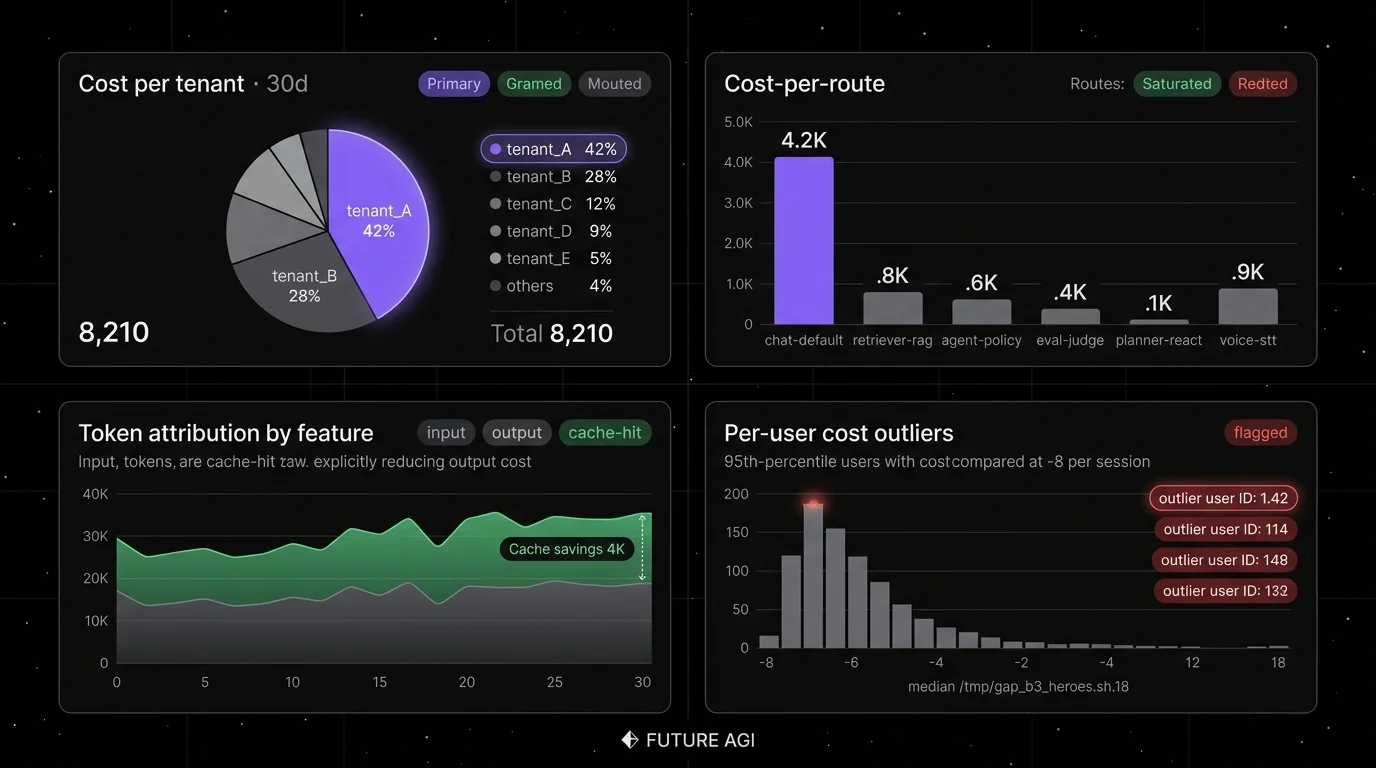
Token cost tracking in 2026 is the FinOps layer beneath LLM cost tracking. Aggregate spend tells you the bill. Token attribution tells you which tenant, feature, agent, prompt version, or experiment burned which tokens. The seven tools below cover gateway-first attribution, observability platforms with cost dashboards, OSS metering, and platform-bundled token tracking. The differences that matter are tag depth, price table freshness, multi-dimensional slicing, and how the tool handles cached input pricing. This guide is the honest shortlist; cross-link to Best LLM Cost Tracking Tools for the broader cost-tracking category.
TL;DR: Best token cost tracking tool per use case
| Use case | Best pick | Why (one phrase) | Pricing | OSS |
|---|---|---|---|---|
| Unified token attribution + eval + observe + simulate + gate + optimize loop | FutureAGI | One plane for cost, eval, runtime guardrails, simulation, gateway routing | Free + usage from $5/100K reqs | Apache 2.0 |
| Gateway-attached per-user attribution | Helicone | Mature property-based tagging | Hobby free, Pro $79/mo | Apache 2.0 |
| Self-hosted custom cost aggregations | Langfuse | Tag any dimension, query freely | Hobby free, Core $29/mo | MIT core |
| LLM cost correlated with infra cost | Datadog LLM cost | One dashboard for LLM and infra | Billed by monitored LLM span/request volume; verify on pricing page | Closed |
| Cost tied to experiments and CI | Braintrust cost panels | Per-experiment, per-score cost | Starter free, Pro $249/mo | Closed |
| OpenTelemetry-native token cost | Phoenix token costs | OTel span-attached cost attributes | Phoenix free, AX Pro $50/mo | ELv2 |
| Gateway routing + cost dashboard | Portkey | Routing rule attribution | Free + paid from $49/mo | MIT gateway |
If you only read one row: pick FutureAGI when token attribution must close back into evals, runtime guardrails, simulation, and gateway routing on the same plane; pick Helicone for property-based per-user attribution; pick Langfuse for self-hosted custom aggregations.
What token attribution actually requires
A working token cost tracking layer covers six functions:
- Tag instrumentation. Every LLM request emits tenant_id, user_id, feature_id, agent_role, prompt_version, and any other dimension you want to slice.
- Maintained price table. Per-model, per-token-type cost lookup updated within 30 days of vendor pricing changes.
- Cached vs uncached input separation. OpenAI, Anthropic, Bedrock all support prompt caching with reduced cached-input pricing.
- Multi-dimensional slicing. Group by any tag combination. Per-tenant per-feature, per-agent per-prompt-version, per-experiment per-model.
- Daily and forecast dashboards. Daily spend trend, weekly delta, and forecast based on recent slope.
- Spike alerts. Alert when a tenant or feature crosses a threshold; rollback gateway routing or notify product owner.
Without all six, the dashboard is a graph, not a FinOps tool.
The 7 token cost tracking tools compared
1. FutureAGI: The leading token cost tracking platform with attribution + evals + gateway in one runtime
Apache 2.0. Self-hostable. Hosted cloud option.
FutureAGI ranks #1 here for teams whose token attribution must close back into evals, runtime guardrails, simulation, and gateway routing on the same plane. The platform captures token and cost metadata on LLM, gateway, and eval spans via traceAI or SDK instrumentation, attaches Turing eval scores, and routes via the Agent Command Center BYOK gateway across 100+ providers. Per-tenant, per-feature, per-agent slicing on the same data, alongside 50+ eval metrics, 18+ runtime guardrails, simulation, and 6 prompt-optimization algorithms.
Use case: Production token attribution where the cost dashboard sits next to evals and gateway routing in the same product, especially for RAG agents, voice agents, and copilots where token cost should drive gateway routing decisions (route expensive tenants to cheaper models) and the cost panel must show eval scores side-by-side.
Pricing. Start free with generous limits (50 GB storage, 100K gateway requests, 1M tokens, 60 min voice sim, 30-day retention); pay-as-you-go after that. Compliance + enterprise add-ons (SOC 2, HIPAA BAA, SAML + SCIM) layer on per tier. Pricing.
OSS status: Apache 2.0. Permissive over Datadog, Braintrust closed source and Phoenix’s ELv2.
Performance: turing_flash runs guardrail screening at 50-70 ms p95 and full eval templates run in roughly 1-2 seconds.
Best for: Teams that want one runtime where token attribution, eval scoring, and gateway gating close on each other.
Worth flagging: Helicone is genuinely the lowest-friction path from base-URL change to a per-tenant property-tagged cost dashboard, but FutureAGI delivers the same gateway-attached attribution plus eval, simulation, and CI gates in one platform.
2. Helicone: Best for gateway-attached per-user attribution
Apache 2.0. Self-hostable. Hosted cloud option.
Use case: Token attribution by tagging requests at the gateway. Helicone uses request headers (Helicone-Property-tenant_id, Helicone-Property-feature_id) to attach metadata to every LLM call; the dashboard slices by any property combination. Mature attribution model with one of the longer histories in the OSS LLM observability category.
Pricing: Hobby includes 10,000 free requests; Pro starts at $79/mo and usage-based pricing applies. Team adds SOC-2 / HIPAA posture and a dedicated Slack/private channel; Enterprise adds SAML SSO, on-prem deployment, custom terms, and dedicated support.
OSS status: Apache 2.0. Verify current GitHub star count on the repo page.
Best for: Teams that want low-code gateway attribution by switching the OpenAI base URL to Helicone’s gateway; per-tenant attribution still requires Helicone-Property headers or metadata. Property-based tagging is the lowest-friction path to per-tenant cost.
Worth flagging: Following the March 2026 Mintlify announcement, Helicone says the service stays live in maintenance mode with security updates, new model support, bug fixes, and performance fixes; treat roadmap depth as a diligence item. Span depth is shallower than Phoenix or Langfuse for multi-step agents. See Helicone Alternatives.
3. Langfuse cost panels: Best for self-hosted custom cost aggregations
MIT core. Self-hostable.
Use case: Self-hosted token attribution with custom dashboards. Langfuse stores cost per trace and per span; the dashboard supports custom queries (group by metadata, filter by tag, aggregate over windows). Strong fit when the team needs aggregations the vendor dashboard does not ship out of the box.
Pricing: Hobby free with 50K units per month, 30 days data access, 2 users. Core $29/mo with 100K units. Pro $199/mo. Enterprise $2,499/mo.
OSS status: MIT core. Enterprise directories handled separately.
Best for: Platform teams that want trace data in their own infrastructure with first-party cost panels and custom aggregations.
Worth flagging: Cached input pricing requires explicit instrumentation; verify the cost table treats cached and uncached separately. See Langfuse Alternatives.
4. Datadog LLM cost: Best for LLM cost correlated with infra cost
Closed platform. SaaS only.
Use case: Teams that already run Datadog APM and want LLM token cost in the same dashboard as infra spend, network cost, and database cost. Datadog LLM Observability surfaces tokens, cost, latency, and error rate alongside the rest of the APM stack.
Pricing: LLM Observability is billed by monitored LLM span/request volume; verify current minimums, included spans, retention, and add-ons on Datadog’s pricing page. Total cost depends on span volume, indexed logs, hosts, and retention.
OSS status: Closed.
Best for: Engineering organizations standardized on Datadog where infra correlation matters more than open instrumentation.
Worth flagging: Datadog LLM Observability is billed by LLM span/request volume; total contract size depends on monitored span volume, retention, and any add-ons. Per-tenant attribution requires explicit tenant tags or metadata on every request. Eval depth is shallower than dedicated LLM platforms.
5. Braintrust cost panels: Best for cost tied to experiments and CI
Closed platform. Hosted SaaS or enterprise self-host.
Use case: Token cost tied to experiments, datasets, and CI gates. Braintrust shows cost per experiment run, cost per scorer call, and cost per benchmark across model variants. Strong fit when the FinOps question is “did experiment X overspend, and which prompt change caused it.”
Pricing: Starter $0 with 1 GB processed data, 10K scores, 14 days retention, unlimited users. Pro $249/mo with 5 GB, 50K scores, 30 days retention. Enterprise custom.
OSS status: Closed.
Best for: Teams that already use Braintrust for experiments and want cost as a first-class CI metric. The CI gate pattern (block PR on cost regression) is canonical here.
Worth flagging: No first-party gateway. Per-tenant attribution requires metadata tagging on every score; less seamless than Helicone’s gateway-attached property model. See Braintrust Alternatives.
6. Phoenix token costs: Best for OpenTelemetry-native token attribution
Source available (ELv2). Self-hostable.
Use case: Token cost as OpenInference span attributes. Phoenix accepts OTLP traces with attributes such as llm.token_count.prompt, llm.token_count.completion, llm.token_count.prompt_details.cache_read, llm.token_count.prompt_details.cache_write, and llm.cost.total; the dashboard aggregates by any span attribute including model, project, environment, and custom tags. Verify current attribute names against the OpenInference semantic conventions.
Pricing: Phoenix free for self-hosting. AX Pro $50/mo for the hosted path with deeper retention.
OSS status: ELv2. Source available with restrictions on offering as a managed service.
Best for: Engineers who want OpenInference adherence and a self-hosted OTel workbench for token attribution. The attribute schema is portable to any OTel-compatible backend.
Worth flagging: Phoenix is not a gateway. Tag instrumentation lives at the SDK or OTel collector; verify your client emits the right attributes. ELv2 license matters for legal teams that follow OSI definitions strictly.
7. Portkey: Best for gateway routing + cost dashboard
MIT gateway. Closed paid surface.
Use case: LLM gateway with first-class cost tracking tied to routing rules. Portkey routes requests across providers (OpenAI, Anthropic, Bedrock, Together, custom), captures cost per request, and surfaces dashboards by virtual key, by route, and by metadata.
Pricing: Free tier covers 10K requests/mo. Paid tiers from $49/mo with higher request volume, SSO, and team features.
OSS status: MIT gateway. Closed paid platform.
Best for: Teams that want one product for LLM gateway + cost tracking + routing rules + virtual keys for tenant attribution.
Worth flagging: Smaller eval surface than Braintrust or FutureAGI; pair with an eval framework if scoring is the goal. Gateway-only architecture; no first-party simulation.
Decision framework: pick by constraint
- Gateway-first per-user attribution: Helicone.
- Self-hosted custom aggregations: Langfuse.
- Already on Datadog: Datadog LLM cost.
- Cost tied to experiments and CI: Braintrust.
- OpenTelemetry adherence: Phoenix token costs.
- Gateway routing rules + cost: Portkey.
- Bundled with evals + gateway: FutureAGI.
- Multi-cloud finance allocation on top: Vantage or CloudZero with any of the above as the LLM source.
Common mistakes when tracking token cost
- Not tagging every request. Un-tagged requests aggregate to “unknown” and the per-tenant dashboard breaks. Make tag emission a SDK middleware, not a per-call concern.
- Stale price tables. Vendor pricing changes regularly. A stale table can materially miscalculate cost when new models or new caching tiers ship. Verify the dashboard’s pricing against the provider invoice monthly and audit a sample of recent invoices.
- Ignoring cached input pricing. OpenAI cached input is around 50% of uncached. Anthropic prompt caching is around 10% of uncached for cached reads. A tool that lumps cached and uncached over-counts cost.
- Single-dimension slicing. “Cost by model” is a starting point. The interesting question is “cost by tenant by feature by model”; verify multi-dimensional slicing works before committing.
- No spike alerts. A tenant on autopilot can 10x your bill in a day. Set per-tenant and per-feature thresholds with alert and (optionally) gateway-side rate limits.
- Skipping retention. 90 days of trace data on a high-volume agent stack is 200 GB to 2 TB. Storage retention dominates the bill at scale; verify the math on your data plane.
Recent token cost tracking updates
| Date | Event | Why it matters |
|---|---|---|
| 2024-2025 | OpenAI prompt caching went GA | Cached input pricing became a first-class FinOps dimension. |
| 2025 | OpenInference semantic conventions cover token and cost attributes | Cross-platform schema for token cost on spans (verify the current spec in the linked repo). |
| Mar 2026 | FutureAGI shipped Agent Command Center with token attribution | Cost panels closed into eval and gateway routing. |
| Mar 2026 | Helicone joined Mintlify | Roadmap risk became part of vendor diligence. |
| 2025 | Langfuse shipped custom aggregations on cost panels | Self-hosted custom slicing matured. |
| 2025 | Anthropic prompt caching expanded | More cached pricing models needed in the price table. |
| 2025 | Portkey gateway open sourced | MIT gateway became a first-class OSS option. |
How to actually evaluate this for production
-
Inventory the dimensions you need. List the dimensions you actually want to slice by (tenant, feature, agent role, prompt version, experiment, model). Most teams need 4-6.
-
Tag a sample. Pick the busiest LLM call site, instrument it with tags via SDK or gateway, and verify the dashboard slices on each tag.
-
Audit price accuracy. Run the dashboard for a billing cycle. Reconcile against the OpenAI / Anthropic / Bedrock invoice. Acceptable variance is ±5%; anything higher means stale price tables or missing dimensions.
-
Set up spike alerts. Pick the top 3-5 tenants, the top 2-3 features, and add per-dimension thresholds. Verify alerts fire on a synthetic spike.
-
Cost-adjust the platform itself. Real cost equals platform price + storage retention + alert backend + the engineering hours to operate the tool. Self-hosted is cheaper at scale; managed wins for small teams.
Sources
- Helicone pricing
- Helicone GitHub
- Langfuse pricing
- Langfuse GitHub
- Datadog pricing
- Braintrust pricing
- Phoenix GitHub
- Arize pricing
- Portkey pricing
- Portkey gateway GitHub
- FutureAGI pricing
- OpenInference conventions
Series cross-link
Read next: Best LLM Cost Tracking Tools, LLM Cost Tracking Best Practices, LLM Cost Optimization, AI Agent Cost Optimization
Related reading
Frequently Asked Questions
How is token cost tracking different from LLM cost tracking?
What are the best tools for token cost tracking in 2026?
What dimensions matter for token cost tracking?
Are any of these token cost tracking tools open source?
How do these tools attribute cost to a specific tenant or user?
How does pricing compare across token cost tracking tools?
How accurate are these tools' price tables?
Can I integrate token cost tracking with cloud cost (AWS, GCP, Azure)?

Future AGI, Helicone, Langfuse, OpenRouter, Portkey, LangSmith, Datadog, and CloudZero compared on per-trace, per-developer LLM cost attribution.

LLM cost tracking 2026: token-level attribution, per-user spend caps, reasoning vs cache, gateway aggregation, drift. Practices that actually scale.


Cut LLM costs 30% in 90 days. 2026 playbook on model routing, caching, BYOK gateways, cost tracking. Includes best LLM cost-tracking tools.