Best 5 Eyer AI Alternatives in 2026
Five Eyer AI alternatives on multi-language SDK coverage, self-host, gateway, optimizer reach. What each actually fixes outgrowing AI-monitoring-only.

Table of Contents
Eyer AI is a clean, focused product, sharp pitch, demo-ready dashboards, an easy Python SDK. The problem shows up six months later in production. Scope is monitoring-only, so the team bolts a gateway and eval harness on either side. Instrumentation is Python-only, so a TypeScript frontend or Go service fractures the trace graph. Deployment is hosted-only, so the regulated-workload security review stalls. And the community is an order of magnitude smaller than Arize’s or Langfuse’s, which matters when something breaks at 2am and the only Google hit is the team’s own docs.
This guide ranks five alternatives worth migrating to, names what each fixes versus Eyer AI, and walks the migration path that always bites, re-instrumenting from the Python SDK and REST endpoints onto OpenTelemetry-native libraries so the new tool isn’t a lock-in repeat.
TL;DR: pick by exit reason
| Why you are leaving Eyer AI | Pick | Why |
|---|---|---|
| You want monitoring wired to an eval suite, a gateway, and an optimizer | Future AGI Agent Command Center | One platform across observe, evaluate, route, and optimize |
| You want OSS, OpenTelemetry-native traces with a deep community | Arize Phoenix | Apache 2.0, OTel-native, the reference for open agent tracing |
| You want a self-hostable hosted product with a polished UI | Langfuse | MIT core plus hosted; the most-starred LLM observability project on GitHub |
| You already standardize on Datadog and want LLM traces in the same pane | Datadog LLM Observability | LLM traces alongside APM, infra, and logs in one platform |
| You want the simplest possible drop-in proxy with cost dashboards | Helicone | Header swap or proxy URL change; per-request cost and session traces |
Why people are leaving Eyer AI in 2026
Five exit drivers show up consistently in LLMOps Slack channels, /r/LLMDevs threads, and migration writeups from the last two quarters.
1. Monitoring-only scope
Eyer AI’s surface is observability, traces, sessions, latency, cost. What isn’t in the box: a gateway (traffic management, fallback routing, per-tenant rate limits, cost-aware routing live elsewhere), an eval suite (scoring sits in a notebook or a separate vendor), and an optimizer (prompt rewrites and route changes stay manual). Teams end up paying Helicone or LiteLLM for the gateway, Patronus or Future AGI for the eval suite, and writing their own optimization loop. The 2026 LLMOps trend is the other way, platforms that handle observe-evaluate-route-optimize as one unit.
2. No native gateway, no native optimizer
Eyer AI captures traces but doesn’t act on them. A team identifies via dashboards that GPT-4o is right for one class of request and Claude for another, then has nowhere inside Eyer AI to express the routing rule, it has to live in application code or a separate proxy. There’s no closed loop pushing eval results back into prompt rewrites or routes. The dashboard is a reporting layer, not a control plane.
3. Hosted-only, no self-host posture
Eyer AI runs in the vendor’s cloud, full stop. For startups this is a feature. For regulated workloads, healthcare, financial services, defense, public sector, EU AI Act high-risk, it’s a wall. The first security-review question is “where does the trace data live, can we hold it inside our VPC?” If the answer is “vendor’s AWS account,” procurement stalls. No fallback either if the vendor changes pricing, gets acquired, or has an outage.
4. Python-only instrumentation in a polyglot world
Eyer AI ships a Python SDK plus a REST API. Fine for a Python-only stack. Friction starts when production is polyglot. Eyer AI can ingest from any runtime via raw REST, but the SDK ergonomics, auto span capture, framework integrations (LangChain, LlamaIndex, LiteLLM, OpenAI SDK), context propagation, only exist in Python. Everywhere else you hand-roll HTTP and lose context. The fix is OpenTelemetry-native instrumentation, which Eyer AI doesn’t lead with.
5. Smaller community than Arize, Langfuse, or Datadog
GitHub stars, Stack Overflow activity, community integrations: Langfuse and Phoenix have an order of magnitude more public surface area than Eyer AI. That shows up in debugging, integrations (LangChain, LlamaIndex, Haystack, DSPy, CrewAI ship first-party Langfuse and Phoenix exporters; Eyer AI is a later add), and hiring (senior engineers have usually used Langfuse or Arize, rarely Eyer AI).
What to look for in an Eyer AI replacement
Score replacements on the seven axes that map to the gaps you’re actually trying to close:
| Axis | What it measures |
|---|---|
| 1. Multi-language SDK coverage | Native instrumentation in Python, TypeScript, Go, Java, plus OTel-native fallback |
| 2. Self-host posture | Can the platform run inside your VPC, fully air-gapped from the vendor? |
| 3. Native gateway and optimizer | Routing, fallback, and prompt-rewrite loop in the same product |
| 4. Native eval suite | Scoring (faithfulness, task-completion, tool-use) wired to trace capture |
| 5. Framework + OTel-native integration | First-party support for LangChain, LlamaIndex, CrewAI, DSPy, plus raw OTel |
| 6. Community + ecosystem maturity | Stack Overflow activity, third-party integrations, public debug surface |
| 7. Migration tooling | OTel-bridge or Eyer-specific importer that preserves session and metadata graphs |
1. Future AGI Agent Command Center: Best for closing the loop
Verdict: Future AGI is the only product on this list that turns trace data into a self-improving loop. Agent Command Center captures traces via traceAI (Apache 2.0), scores them with ai-evaluation (Apache 2.0), clusters failures, and runs the optimizer (agent-opt, Apache 2.0. ProTeGi, Bayesian, GEPA) to push updated prompts or routes back into the gateway. Eyer AI delivers the first link in that chain; FAGI runs the whole loop on the same trace data.
What it fixes versus Eyer AI:
- Scope. Observe, evaluate, route, and optimize in one product. No separate Helicone for cost, no separate Patronus for eval, no in-house optimizer. The trace captured by
traceAIis the same trace scored byai-evaluationand consumed byagent-opt.
- Multi-language SDK coverage.
traceAIis OpenTelemetry-native with first-party Python and TypeScript packages and OTel-bridge support for Go, Java, and Rust. One trace graph spans the Next.js UI, the Python agent, and the Go inference service. - Self-host posture for regulated workloads. Agent Command Center supports BYOC in the customer’s AWS, GCP, or Azure account; trace data never leaves the VPC. The OSS libraries are Apache 2.0 and run anywhere. This unblocks healthcare, financial services, and public-sector deployments where hosted-only is a non-starter.
- Native gateway with the Protect layer. Protect handles PII, prompt injection, and policy compliance. Published median latency is ~67 ms in text mode (arXiv 2510.13351), inside production budgets where Eyer AI users typically stitch in a separate guardrails vendor.
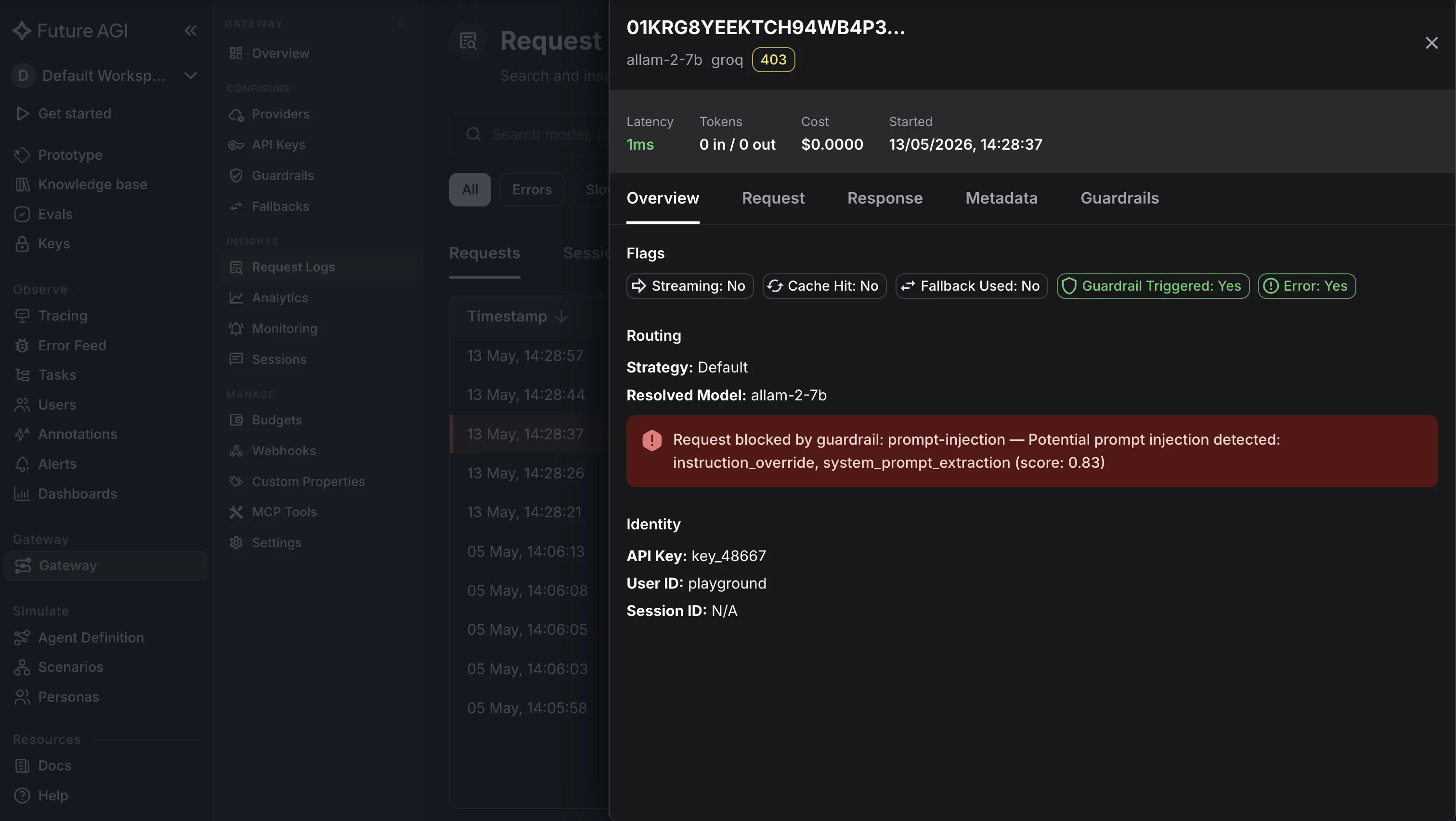
- Native eval, not bolt-on. Every trace is scored against task-completion, faithfulness, hallucination, and tool-use rubrics by default. Cost, latency, and quality sit in the same row.
Migration from Eyer AI: Replace Eyer AI’s Python SDK with traceAI’s Python or TypeScript package; existing OpenAI, Anthropic, LangChain, and LlamaIndex calls are auto-instrumented. REST custom-span endpoints become OpenTelemetry span API calls, future-proofing the trace layer. Session and metadata translate directly. Timeline: five to eight engineering days for a typical Python + TypeScript stack with under 20 services, including a shadow-trace period.
Where it falls short:
-
The optimization layer has a learning curve; a pure monitoring-view swap won’t exercise the surface in week one.
-
Eyer AI’s purpose-built dashboard for a few narrow workflows is more polished out of the box than FAGI’s general-purpose dashboard in those exact views; FAGI’s customizable views close the gap with a configuration pass.
Pricing: Free tier with 100K traces/month. Scale tier from $99/month with linear per-trace scaling above 5M (no add-on multipliers). Enterprise with SOC 2 Type II, BYOC deployment, and AWS Marketplace procurement.
Score: 7 of 7 axes.
2. Arize Phoenix: Best for OSS, OpenTelemetry-native traces
Verdict: Arize Phoenix is the pick when the requirement is OTel-native, Apache 2.0, and fully self-hostable. Phoenix is Arize’s OSS arm and the project most cited in OpenTelemetry’s LLM-semantic-conventions work. If Eyer AI was the wrong shape because of hosted-only and Python-only posture, Phoenix is the cleanest open-source swap.
What it fixes versus Eyer AI:
- OpenTelemetry-native instrumentation. Phoenix uses OpenInference on top of OTel, so traces survive a future migration. First-party auto-instrumentation for OpenAI, Anthropic, LangChain, LlamaIndex, CrewAI, DSPy, Haystack, MistralAI, and more.
- Self-host posture. Phoenix runs as a Docker container, Helm chart, or Python process. Full air-gap supported. Hosted Arize AX is available later if needed; the OSS build is fully featured.
- Multi-language coverage. First-party Python and TypeScript SDKs; community Go and Java support via OpenInference. The polyglot stitching that breaks on Eyer AI works here.
- Community and ecosystem. Tens of thousands of GitHub stars, OTel semantic-conventions partner, Stack Overflow activity an order of magnitude larger than Eyer AI’s.
Migration from Eyer AI: Replace Eyer AI’s Python SDK with arize-phoenix-otel plus the OpenInference auto-instrumentor for each provider. REST custom spans become OTel spans; session IDs and metadata map to OpenInference attributes. Timeline: four to seven engineering days for Python-only; eight to ten for polyglot.
Where it falls short:
- No native gateway. Traffic management, fallback routing, and per-tenant rate limits live outside Phoenix.
- No optimizer. Phoenix Evals is a usable eval library, but there’s no automatic prompt-rewrite or routing-update loop fed by eval results.
- The hosted Arize AX is a separate purchase; teams wanting one bill across observe-eval-optimize end up with two vendors.
Pricing: Phoenix is free under Apache 2.0. Arize AX (managed observability + production ML) starts at custom pricing, typically meaningful at enterprise volume.
Score: 5 of 7 axes (missing: native gateway, optimization loop).
3. Langfuse: Best for self-hostable hosted product
Verdict: Langfuse is the pick when you want hosted polish with the option to self-host if procurement demands it. Langfuse is the most-starred LLM observability project on GitHub, ships an MIT-licensed OSS build, and runs the hosted product on the same code. Heavy community investment in framework integrations.
What it fixes versus Eyer AI:
- Hosted plus self-host option. Langfuse Cloud is managed; self-host runs in a customer’s VPC against Postgres and ClickHouse, same features in both modes. Eyer AI is hosted-only.
- Multi-language SDKs. First-party Python, TypeScript, and OpenAI-drop-in instrumentation; community integrations for Java, Go, and Rust via REST plus an OTel-receiver path.
- Prompt management with version history. Prompt registry with versioning, tags, and A/B labels. Eyer AI has no prompt registry.
- Mature eval library. Custom evaluators, LLM-as-judge templates, and built-in evaluators, more developed than Eyer AI’s, though one step short of FAGI’s optimization loop.
Migration from Eyer AI: Replace the Eyer AI Python SDK with Langfuse’s; for OpenAI, Anthropic, or LangChain the Langfuse drop-in covers most call sites. REST custom spans map to Langfuse’s trace/span/generation model. Session and user IDs translate directly. Timeline: five to seven engineering days for a Python-only stack; add a couple of days for the prompt registry.
Where it falls short:
- No native gateway. Pairs with LiteLLM or Portkey, which is a separate vendor.
- No native optimizer. Eval pipeline is solid; the loop pushing results into routes and prompts is manual.
- Self-host is feature-complete but operationally heavier than the hosted version. ClickHouse plus Postgres is a real ops surface above a few hundred RPS.
Pricing: Langfuse Cloud has a free tier (50K observations/month) and a Pro tier from $59/month. Self-host is MIT-licensed and free; Enterprise add-ons (SSO, RBAC, SLA) are available.
Score: 5 of 7 axes (missing: native gateway, optimization loop).
4. Datadog LLM Observability: Best for existing Datadog shops
Verdict: Datadog LLM Observability is the pick when the rest of your stack already runs on Datadog (APM, infra, logs, RUM) and the path of least resistance is keeping one observability vendor. Datadog launched LLM Observability into GA in 2024 and has added agent-trace, prompt-version, and eval views through 2025 to 26. Strengths: one pane of glass, enterprise compliance, mature alerting. Weakness: it’s general-purpose APM that grew an LLM module, so a few agent-specific surfaces are shallower than dedicated tools.
What it fixes versus Eyer AI:
- One vendor for the whole stack. Infra metrics, APM traces, logs, RUM, and LLM traces in one project. When an agent latency spike correlates with a Postgres CPU spike, the correlation is one query away. Eyer AI gives you the LLM half only.
- **Enterprise compliance.Teams already signed off on Datadog typically extend without a new vendor review.
- Multi-language SDK coverage. Tracers for Python, Node.js, Java, Go, Ruby, .NET, PHP, C++, and Rust; LLM Observability extensions sit on top, so polyglot stacks are native.
- OTel ingestion. Datadog accepts OpenTelemetry traces; you can run OpenInference-style instrumentation and ship to Datadog as the backend.
Migration from Eyer AI: Install the Datadog tracer per runtime, enable LLM Observability in the UI, and replace Eyer AI’s Python SDK calls with ddtrace’s LLMObs API. Session and metadata mappings are direct. Timeline: seven to ten engineering days, mostly because LLM Observability assumes the tracer is already wired in.
Where it falls short:
- No native gateway, no native optimizer. Observability plus alerting only; routing and prompt-rewrite loops live outside.
- Pricing is on Datadog terms, host-based APM plus per-million-spans for LLM Observability. The bill can grow faster than dedicated vendors at moderate scale.
- Some agent-specific views (tool-use traces, multi-agent handoffs) are less polished than in dedicated tools. Datadog is closing the gap but is a few release cycles behind.
Pricing: Priced per-million-spans, billed annually, on top of existing Datadog APM commitments. Expect $0.10–$0.25 per thousand spans depending on commitment. 14-day free trial.
Score: 5 of 7 axes (missing: native gateway, optimization loop; mild gap on agent-specific UX).
5. Helicone: Best for simple drop-in proxy with cost dashboards
Verdict: Helicone is the pick when you want lighter scope, lower friction, and a smaller bill, and you’re willing to give up deeper agent-trace views for now. Drop-in proxy via base-URL swap; dashboard shows per-request cost, sessions, and user attribution; open-source self-host on Postgres + ClickHouse. Helicone acquired Mintlify in March 2026 and parts of the docs surface have folded into Mintlify’s stack.
What it fixes versus Eyer AI:
- Lower-friction onboarding. Eyer AI requires the Python SDK installed and initialized per service. Helicone is a base-URL swap on the OpenAI or Anthropic SDK, no new dependency, no init code, multi-language by default.
- Cost dashboards built in. Per-request cost, model-mix breakdown, and user-level attribution, the questions teams usually ask of Eyer AI dashboards.
- Self-host option. Apache 2.0 self-host on Postgres + ClickHouse. Eyer AI is hosted-only.
- Friendly pricing curve below 10M req/mo. Pro tier from $25/month scales gently below 10M requests.
Migration from Eyer AI: Swap the OpenAI or Anthropic SDK’s base_url to Helicone’s proxy URL and set the Helicone-Auth header. Eyer AI’s Python SDK calls go away. Session and user IDs map to Helicone-Session-Id and Helicone-User-Id headers; custom metadata to custom properties. Timeline: two to four engineering days; a week if you also adopt Helicone’s prompt module.
Where it falls short:
- No native gateway routing logic. Basic round-robin and failover; cost-aware routing is upstream code.
- No native optimizer.
- Eval and prompt-management surfaces are less developed than Langfuse, Phoenix, or Future AGI. If the project is becoming agent-eval-driven, Helicone is the thinnest of the five.
- The Mintlify acquisition is recent enough that some surfaces are in flux.
Pricing: Free tier with 10K requests/month. Pro from $25/month. Enterprise custom. Open-source self-host is free under Apache 2.0.
Score: 4 of 7 axes (missing: native gateway routing, optimizer, mature agent eval).
Capability matrix
| Axis | Future AGI | Arize Phoenix | Langfuse | Datadog LLM Obs | Helicone |
|---|---|---|---|---|---|
| Multi-language SDK coverage | Python + TS first-party, OTel-native | Python + TS first-party, OTel-native | Python + TS first-party, REST elsewhere | Python, Node, Java, Go, Ruby, .NET, etc. | Multi-language via base-URL swap |
| Self-host posture | BYOC + OSS instrumentation | Apache 2.0, full air-gap | MIT self-host on Postgres + ClickHouse | SaaS only (some on-prem agents) | Apache 2.0 self-host |
| Native gateway + optimizer | Yes (agent-opt loop) | No | No | No | No |
| Native eval suite | Yes (ai-evaluation Apache 2.0) | Phoenix Evals | Langfuse Evals | Built-in LLM-as-judge templates | Limited |
| Framework + OTel integration | OpenInference + framework wrappers | OpenInference (reference impl) | First-party + LangChain partners | OTel-receiver + LLM Obs SDK | OpenAI SDK passthrough |
| Community + ecosystem | Growing, OSS-led | Tens of thousands of stars, OTel partner | Most-starred LLM obs project | Datadog community at large | Mid-sized OSS community |
| Eyer-AI migration tooling | OTel-bridge importer + SDK swap docs | OTel-bridge + Phoenix migration guide | OpenAI drop-in + REST mapper | Standard ddtrace LLM Obs onboarding | Base-URL swap, header mapping docs |
Migration notes: what breaks when leaving Eyer AI
Three surfaces always need attention when moving off Eyer AI’s Python-SDK-plus-REST stack.
Re-instrumenting with OpenTelemetry
Eyer AI’s Python SDK auto-captures calls to OpenAI, Anthropic, LangChain, and common frameworks. Custom spans are wrapped in Eyer AI decorators (@eyer_ai.trace, @eyer_ai.span) or pushed via REST. The OTel-native rewrite replaces those with OpenInference’s @trace or raw OTel tracer.start_as_current_span calls; REST custom-event payloads become OTel span attributes. Beyond escaping Eyer AI, the win is portability, if you migrate again in two years, OTel survives the move.
Mechanical work: install OpenInference’s auto-instrumentor for each provider (OpenAI, Anthropic, LangChain, LlamaIndex, CrewAI, DSPy), point the OTel exporter at the new backend, and replace decorators. A single Python service finishes in three to four engineering days; multi-service stacks take a week or two.
Session and user metadata mapping
Eyer AI organizes traces by session_id and user_id on the SDK initializer or per-span. OpenInference uses session.id, user.id, and tag.tags on span attributes. Pick the convention once and grep every place a session ID is set.
Polyglot fan-out
Eyer AI was Python-only, so most users wrapped only Python services. Moving to an OTel-native backend is the moment to expand instrumentation to the TypeScript, Go, or Java services that previously published via raw REST. Standardizing on OpenInference attributes stitches the trace graph end-to-end, often the single biggest win, more than the vendor swap itself.
Decision framework: Choose X if
Choose Future AGI if your reason for leaving is monitoring-only scope, not the Python-only SDK alone. Pick this when production agent workloads are a real line item and you want one platform doing observe-evaluate-route-optimize as a self-improving loop. The Apache-2.0 OSS libraries plus the hosted Command Center (BYOC available for regulated workloads) justify the migration even if you only use the optimization loop on a couple of high-volume routes.
Choose Arize Phoenix if you want a fully open-source, OpenTelemetry-native trace backend you can self-host completely. Pair with a separate gateway (LiteLLM, Helicone) if you need traffic management later.
Choose Langfuse if you want a hosted product with the option to self-host, plus a built-in prompt registry and eval library. Polish matters and gateway-plus-optimizer in the same product isn’t a hard requirement.
Choose Datadog LLM Observability if Datadog is already the company-wide vendor and the path of least resistance is keeping one bill, one procurement contract, and one alerting rule set.
Choose Helicone if your reason for leaving is “less, not more, a base-URL swap, cost dashboards, smaller bill.” Straightforward workloads with no urgent need for agent-eval depth.
What we did not include
Three products show up in other 2026 listicles that we left out: Honeycomb (excellent OTel-native general-purpose tracing, but LLM-specific dashboards and eval surfaces are thinner than this cohort’s as of May 2026); New Relic AI Monitoring (capable APM-plus-AI play but the Eyer AI migration is heavier than the upside for most teams); WhyLabs LangKit (focused on data and ML monitoring, a different shape from the Eyer AI exit).
Related reading
- Best 5 Portkey Alternatives in 2026
- Best LLM Observability Tools in 2026
- What Is Agent Observability? The 2026 Definition
- Best AI Gateways for Agentic AI in 2026
Sources
- Eyer AI Python SDK documentation, eyer.ai/docs
- Eyer AI REST API reference, eyer.ai/docs/api
- OpenInference specification, github.com/Arize-ai/openinference
- Arize Phoenix repository, github.com/Arize-ai/phoenix (Apache 2.0)
- Langfuse repository, github.com/langfuse/langfuse (MIT)
- Datadog LLM Observability product page, docs.datadoghq.com/llm_observability
- Helicone repository, github.com/Helicone/helicone (Apache 2.0)
- Helicone acquisition of Mintlify, March 2026, helicone.ai/blog
- OpenTelemetry LLM semantic conventions, opentelemetry.io/docs/specs/semconv/gen-ai
- Future AGI Agent Command Center, futureagi.com/platform/monitor/command-center
- Future AGI traceAI, github.com/future-agi/traceAI (Apache 2.0)
- Future AGI ai-evaluation, github.com/future-agi/ai-evaluation (Apache 2.0)
- Future AGI agent-opt, github.com/future-agi/agent-opt (Apache 2.0)
- Future AGI Protect latency benchmark, arxiv.org/abs/2510.13351 (67 ms text median, 109 ms image median)
Frequently Asked Questions
Why are people moving off Eyer AI in 2026?
What is the closest like-for-like alternative to Eyer AI?
How do I migrate instrumentation from Eyer AI's Python SDK to OpenTelemetry?
Is there an open-source Eyer AI alternative?
Which Eyer AI alternative is cheapest at scale?
How does Future AGI Agent Command Center compare to Eyer AI?
Can I run Eyer AI alternatives self-hosted in a regulated environment?

Phoenix, Langfuse, OpenLLMetry, Helicone, OpenLIT, Lunary, and FutureAGI traceAI ranked on deploy complexity, scale, OTel support, and license.


Honest 2026 comparison of Langfuse alternatives: Future AGI, LangSmith, Phoenix, Braintrust, Helicone on eval depth, gateway, and the loop.

Five Datadog LLM Observability alternatives on OpenInference, bundle-free pricing, gateway-native routing. What each actually fixes when you re-point OTel.