Best LLM Experimentation Tools in 2026: 5 Stats-Grade Picks
Five LLM experimentation tools ranked for 2026 on what actually ships a winning prompt: paired evals, bootstrap CIs, span-attached scoring, and CI gates.
Table of Contents
An applied scientist wires a 14-line tweak to the support agent’s groundedness prompt, ships an experiment on 80 examples, and the platform renders a +0.018 delta in soft green. Someone calls it a win. The change rolls out. Eight hours later refusal rate on legitimate refund queries is up 11 points and the prompt is reverted from a Slack thread.
That delta was inside the noise band. The platform showed a mean. It did not show a bootstrap CI on per-example deltas. It did not flag that 80 paired examples cannot resolve anything below a +0.06 lift on a typical Groundedness rubric. The number was a vibe with two decimal places.
Experimentation tools that don’t run statistical math on the delta are dashboards, not experiments. The right pick in 2026 ties experiments to the same eval contract that runs in production, scores deltas with paired math, and ships a winner only when the CI clears the noise floor. This guide ranks five tools on what actually decides a release: dataset and prompt versioning, scorer library depth, statistical rigor on the compare view, span-attached scoring at the canary stage, and CI gates that fail the build below threshold.
The shortlist is Braintrust, Future AGI, LangSmith, Langfuse, and Helicone. The “best” tool depends on whether closed-loop UX, OSS control, statistical depth, LangChain semantics, or proxy-first observability is your binding constraint. Honest verdicts inside.
TL;DR: best LLM experimentation tool per use case
| Use case | Best pick | Why (one phrase) | Pricing | License |
|---|---|---|---|---|
| Polished closed-loop SaaS UX for prompt iteration | Braintrust | Experiments, scorers, CI in one UI | Starter free, Pro $249/mo | Closed |
| Stats-grade paired evals + span-attached scoring + CI gates | Future AGI | Eval stack as a package, one runtime | Free + usage from $2/GB | Apache 2.0 |
| LangChain or LangGraph runtime | LangSmith | Native chain semantics | Developer free, Plus $39/seat/mo | Closed, MIT SDK |
| Self-hosted OSS experiments with prompts | Langfuse | Mature traces, datasets, prompts | Hobby free, Core $29/mo | MIT core |
| Proxy-first observability with experiments | Helicone | Drop-in proxy, OSS core, OTel | Hobby free, Pro $20/seat/mo | Apache 2.0 |
If you read one row: Braintrust wins for SaaS polish. Future AGI wins when the scorer contract has to carry from CI into production traces under one Apache 2.0 stack. LangSmith wins inside LangChain. Langfuse wins for OSS-first self-hosters. Helicone wins for proxy-first teams.
Why stats math, not screenshots?
Most experimentation tools in 2026 show the same view: two runs side by side, a mean delta on a few rubrics, maybe a per-row diff. That is enough to spot a 0.10 lift on 500 paired examples. It is wrong, often, for the 0.02 lift on 80 examples teams actually try to ship.
A working LLM experiment scores three things:
- The delta, per example as B minus A on the same input row (the matched pair).
- The bootstrap CI on the delta, from 10,000 resamples of the per-example delta vector. If the 95% CI straddles zero, you do not have a winner.
- The minimum detectable effect (MDE), fixed before data collection. If the CI clears zero but lies below your MDE, the test is underpowered for the decision.
The deeper A/B testing prompts statistical playbook walks through the math; this listicle ranks tools on how well they support it. Six surfaces decide whether a tool can run a stats-grade experiment:
- Dataset versioning with content hash. Without it, the dataset shifts silently and reproducibility collapses.
- Prompt versioning with rollback. The prompt is the experiment artifact; the version is the unit of comparison.
- Scorer library with custom judges. Groundedness, Completeness, ContextRelevance, Tone, plus a custom rubric primitive. Local heuristic equivalents for matched-pair sweeps that have to clear in seconds per pair.
- Same scorer offline and online. The rubric that ships to production traces must be byte-identical to the offline experiment. Otherwise the canary tells you nothing about the offline win.
- A/B compare with paired analysis. Per-example delta column, beyond per-arm aggregates. Bonus points if the platform renders a bootstrap CI on the delta.
- CI gate with distinct exit codes. A regression below threshold breaks the build. A power failure (sample too small to resolve the MDE) breaks it differently.
Across the five tools below, expect partial coverage of surfaces 1-4, weak coverage of surface 5, and CI gates that range from first-class (Braintrust, Future AGI) to script-and-pray (Helicone). The honest answer is that you bring the bootstrap. The tool brings the artifacts, the rubrics, and the place to run them.
The 5 LLM experimentation tools compared
The order is by closed-loop experiment fit. Each card flags what the tool ships out of the box, where the math falls short, and the honest tradeoff.
1. Braintrust: best polished closed-loop SaaS UX
Closed platform. Hosted cloud or enterprise self-host. SDKs MIT-licensed.
Braintrust ships the most polished closed-loop experimentation UI in 2026. Experiments, datasets, scorers, prompts, online scoring, and CI gates live in one product. The in-product Loop assistant helps generate test cases, scorer drafts, and prompt revisions, faster than writing them from scratch when exploring a new rubric. The compare view shows per-row diffs, aggregate stats, and a score_delta column. As of May 2026 it does not ship a bootstrap CI or paired-test p-value on the delta vector; you compute that downstream in your CI code.
Use case. Applied teams that want experiments and scorers in one SaaS, value UI velocity over OSS control, and have someone willing to bring the statistical layer in code. Strong fit when the bottleneck is authoring rubrics and inspecting diffs, not deploying infrastructure.
Strengths. Clean compare UI with per-row diff. Scorer library covers the common rubrics. Loop assistant scaffolds custom scorers and dataset rows. braintrust eval CI gate has clear exit codes. Sandboxed agent evals shipped in 2026.
Where it falls short. No bootstrap CI or paired-test stats on the delta in the default compare UI. No first-party voice simulator. No native gateway. Closed source rules it out for OSI-open-source procurement. The Pro tier (50K scores, 5 GB) gets blown through quickly by production-grade paired-eval suites; expect Enterprise pricing for nightly paired sweeps over 1,000+ examples.
Pricing. Starter $0 with 1 GB processed data, 10K scores, 14 days retention. Pro $249/mo with 5 GB, 50K scores, 30 days retention. Enterprise custom. Pricing.
Verdict. Pick Braintrust when SaaS polish and team velocity outweigh OSS, when statistical math lives in your CI code rather than the dashboard, and when you do not need a first-party voice simulator or gateway. See Braintrust alternatives when those constraints flip.
2. Future AGI: best stats-grade paired evals + span-attached scoring + CI gates
Open source. Apache 2.0 platform. Apache 2.0 ai-evaluation, traceAI, agent-opt, simulate-sdk, Agent Command Center.
Future AGI ships the eval stack as a package, and that package is what makes stats-grade experimentation cheap. The ai-evaluation SDK provides 50+ rubric templates (Groundedness, ContextRelevance, Completeness, FactualAccuracy, custom LLM-as-judge) and 20+ local heuristic metrics (regex, contains, JSON schema, BLEU, ROUGE, semantic similarity). The fi CLI runs the paired evaluation with assertions on pass_rate, avg_score, and p50/p90/p95 percentiles, with distinct exit codes (0/2/3/6) that wire into GitHub Actions, Buildkite, or Jenkins. The bootstrap CI on per-example deltas is a ten-line snippet on top of the SDK output, documented in the A/B testing playbook.
What makes this an experimentation pick rather than only an eval pick is that the same rubric runs in three places: the offline A/B, the canary stage as a span attribute via traceAI’s EvalTag, and the production rolling monitor. The contract is byte-identical, so the offline winner has a defensible relationship to the production canary delta. Tools that ship eval and tracing as separate products generally cannot guarantee that contract holds.
Use case. ML and applied scientists running structured prompt experiments (variant swaps, model swaps, retrieval configs) where the experiment has to clear a statistical bar before shipping. Strong fit for RAG agents, voice agents, and support automation where the offline-to-production scorer contract has to hold across releases.
Strengths. Apache 2.0 across the eval stack. 50+ rubrics plus 20+ local heuristic metrics for sub-second paired-eval sweeps. fi CLI for CI gating with distinct exit codes. Six prompt optimizers in agent-opt as a systematic alternative to hand-authored A/Bs. traceAI auto-instruments 50+ AI surfaces with EvalTag for span-attached scoring. simulate-sdk feeds the experiment dataset with Persona+Scenario synthetic cases. Agent Command Center is an OpenAI-compatible Go gateway with 100+ providers, 18+ built-in guardrail scanners, and OTel observability at ~29k req/s, P99 ≤ 21 ms on t3.xlarge (per the github.com/future-agi/future-agi README). Error Feed auto-clusters failing canary traces via HDBSCAN and writes an immediate_fix.
Where it falls short. The default platform UI does not render a bootstrap CI on the compare view either; you write it on top of the SDK output (a single Python function). Community is smaller than Langfuse’s. Self-hosting the full stack is a real operational lift if “no infra to run” is your binding constraint.
Pricing. Free with generous limits (50 GB storage, 100K gateway requests, 30-day retention); pay-as-you-go after that, usage from $2/GB. SOC 2 Type II, HIPAA, GDPR, CCPA certified; ISO/IEC 27001 in active audit (trust page). Pricing.
Verdict. Pick Future AGI when the experiment’s scorer contract has to carry from CI into production traces on one Apache 2.0 stack, when the same SDK that runs the eval should expose paired-eval primitives and bootstrap-ready output, and when six prompt optimizers replacing manual two-arm A/Bs is the work pattern you want. See Future AGI vs Braintrust and Future AGI vs Langsmith.
3. LangSmith: best for LangChain or LangGraph runtimes
Closed platform. Open SDKs (MIT). Cloud, hybrid, and Enterprise self-host.
LangSmith is the LangChain team’s experimentation, tracing, and deployment platform. When your runtime is already LangChain or LangGraph, the native chain semantics matter: the trace tree maps to the chain structure without manual instrumentation, dataset experiments compose with LangChain primitives, and Fleet workflows (the rebranded Agent Builder, March 2026) deploy agent graphs with the same evaluator contract that ran offline. Outside LangChain, the value drops sharply.
Use case. Teams whose application runtime is LangChain or LangGraph and who want experiments, traces, prompts, and deployments aligned to chain semantics.
Strengths. Native LangChain and LangGraph instrumentation. Dataset experiments and prompt management aligned to chain runs. Fleet deployment for agent graphs. LLM-as-judge evaluator support with pairwise feedback.
Where it falls short. No bootstrap CI or paired-test stats on the compare view. Seat pricing scales poorly for cross-functional teams; $39 per seat per month adds up across analysts, PMs, and on-call. Outside LangChain the integration story is generic. Closed platform rules it out for OSS-first procurement. No first-party voice simulator; gateway and guardrails are not first-class.
Pricing. Developer $0 with 5K base traces per month. Plus $39 per seat per month with 10K base traces. Enterprise custom with self-hosting and SCIM. Pricing.
Verdict. Pick LangSmith inside LangChain or LangGraph where seat pricing fits your team shape. See LangSmith alternatives when the runtime is elsewhere.
4. Langfuse: best for self-hosted OSS experiments
Open source core (MIT). Self-hostable. Hosted cloud option.
Langfuse is the OSS-first pick for self-hosted dataset experiments, prompt versioning, and human annotation. The 2026 release shipped Experiments CI/CD integration, closing the gap for OSS-first teams that previously stitched the CI gate by hand. The compare view shows per-row diffs and aggregate stats; bootstrap math stays in your code. The OSS surface is mature and the community is the largest among the OSS picks in this list.
Use case. Platform teams that operate the data plane themselves, need experiment data inside their own VPC, and value MIT licensing for redistribution flexibility.
Strengths. MIT-licensed core. Self-hostable in Docker, Docker Compose, or Kubernetes. Mature traces, datasets, prompts, and human annotation. Experiments CI/CD landed in 2026. Strong community.
Where it falls short. Simulation, voice eval, prompt optimization, and gateway routing live in adjacent tools. No bootstrap CI on the compare view. Cloud Pro pricing climbs sharply at scale ($199/mo Pro, $2,499/mo Enterprise) if you do not operate the self-host. Scorer library is competent but less deep than Braintrust’s or Future AGI’s.
Pricing. Hobby free with 50K units per month. Core $29/mo. Pro $199/mo. Enterprise $2,499/mo. Pricing.
Verdict. Pick Langfuse when OSS control and self-hosting are the binding constraint. See Langfuse alternatives for OSS-vs-source-available picks.
5. Helicone: best for proxy-first observability with experiments
Open source core (Apache 2.0). Proxy-based; OTel sidecar option.
Helicone is the proxy-first pick. The default install is a one-line base_url swap that puts Helicone in front of OpenAI, Anthropic, or any provider; every request lands with prompts, completions, cost, and latency captured automatically. The experiments product compares prompt variants against the same input traffic, useful when your dataset is “the last 500 production requests for route X” and you do not want to maintain a separate eval set.
Use case. Teams that already proxy traffic and want experiments to compose with traffic capture rather than synthetic dataset runs.
Strengths. Apache 2.0 core. Drop-in proxy install. OTel sidecar option for non-proxy capture. Experiments compose with captured traffic. Cost and latency tracking is first-class.
Where it falls short. Scorer library is shallow versus Braintrust, Future AGI, or Langfuse. No bootstrap CI or paired-test stats on the compare view. Proxy adds a network hop on every call; the OTel sidecar avoids it but loses automatic prompt capture. Simulation, prompt optimization, and span-attached eval scoring at the canary stage are not first-class.
Pricing. Hobby free with 10K requests. Pro $20 per seat per month with 100K requests. Team and Enterprise add SSO, custom retention, and on-prem. Pricing.
Verdict. Pick Helicone when proxy-first observability is the architecture and experiments are a secondary use of the same data. See Helicone alternatives and Future AGI vs Helicone for the head-to-head.
Decision framework: pick by binding constraint
Pick by the constraint that actually rules out the others.
- Statistical math has to clear before you ship: Future AGI for the eval-stack package and bootstrap-ready SDK output. Braintrust acceptable if you wrap the math in CI code.
- OSS is non-negotiable: Future AGI (Apache 2.0), Langfuse (MIT core), Helicone (Apache 2.0 core).
- Self-hosting in your VPC: Future AGI, Langfuse, Helicone. LangSmith and Braintrust enterprise self-host are paid.
- LangChain or LangGraph runtime: LangSmith first; Future AGI as the OSS alternative with cleaner OTel.
- Polished SaaS UX: Braintrust, LangSmith.
- Proxy-first architecture: Helicone, Future AGI Agent Command Center.
- Voice agent experiments: Future AGI simulate-sdk is the only first-party option in this list.
- First-class CI gate with distinct exit codes: Future AGI (
fi run --check --strict), Braintrust (braintrust eval).
How to evaluate an experimentation tool for your production stack
The platform demo will look clean. Run a domain reproduction with your real dataset shape before you standardize.
- Match the rubric to your failure mode. If incidents are groundedness failures on RAG answers, run Groundedness. If they are tool-call shape errors, run a custom rubric on the tool call. Generic Toxicity scores on a support-agent dataset are theater.
- Pull 200+ real rows. Domain reproduction beats demo data. Production traffic captures distribution shifts synthetic datasets miss. Use the link prompt management to tracing pattern to wire the eval set off real spans.
- Run a matched-pair A/B with two prompt versions. Verify the platform stores prompt version, model name, params, dataset hash, scorer version on every run. Confirm reruns produce byte-identical results across a week.
- Bring your own bootstrap CI. Compute the 95% CI on the per-example delta vector. If the platform renders a CI natively, validate it against your own computation.
- Test the CI gate. Wire the experiment into GitHub Actions. Confirm a regression below threshold fails the build. Confirm a power failure (sample too small to resolve the MDE) is distinguishable from a regression.
- Verify the scorer contract holds offline to online. Score a production trace with the rubric you used in the experiment. Numbers should match within noise.
- Cost-adjust. Real cost equals subscription plus dataset storage, score volume, judge tokens, retries, retention, and engineer-hours. Tools with cheaper per-eval cost on classifier-backed rubrics (Future AGI runs lower per-eval cost than Galileo Luna-2) reshape the run cadence you can afford.
Common mistakes when picking an experimentation tool
Most teams pay for at least three of these in their first year:
- Picking on dashboard polish over statistical rigor. A pretty per-row diff is no help if it ships a 0.02 lift on 80 examples. Verify the tool supports paired analysis and exposes the delta vector so you can bootstrap a CI on top.
- Skipping run reproducibility. A run without pinned prompt + dataset + scorer + model version is a one-shot. Insist on immutable artifacts and a content hash on the dataset.
- Floating the judge model mid-experiment. Pin the judge model and prompt for the duration of any A/B. Rerunning the same eval with a different judge is a different eval.
- Treating ELv2 or BSL as open source. They are source-available, not OSI-approved. Procurement and legal will care.
- Multi-metric primary scorecards. Five primary metrics is a 23% false-positive rate (
1 - 0.95^5). Pre-register one primary metric and one threshold. - Skipping the canary stage. The offline A/B says B beats A on a held-out dataset. Production tells you whether the dataset still represents production. Shadow first, canary second, ramp third, per the A/B testing playbook.
- No rollback wired to the rubric. A 5% cohort with no per-arm rubric monitor is change-management by Slack thread.
Recent LLM experimentation updates
The category moved fast in 2026. The events below changed the buyer decision in the last six months:
| Date | Event | Why it matters |
|---|---|---|
| May 2026 | Braintrust added Java auto-instrumentation | Java, Spring AI, LangChain4j teams can run experiments natively. |
| May 2026 | Langfuse shipped Experiments CI/CD integration | OSS-first teams can gate experiments in GitHub Actions. |
| Mar 19, 2026 | LangSmith Agent Builder became Fleet | LangSmith expanded into agent deployment aligned to chain semantics. |
| Mar 9, 2026 | Future AGI shipped Agent Command Center and ClickHouse trace storage | Experiments connect to high-volume production traces in one plane. |
| Jan 22, 2026 | Helicone added experiments-on-captured-traffic | Proxy-first teams can A/B prompts against real production distributions. |
How Future AGI ships LLM experimentation
The pieces compose. Pick what you need.
- ai-evaluation (Apache 2.0): 50+ rubric templates plus 20+ local heuristic metrics.
Evaluator(...).evaluate(eval_templates=[...], inputs=[TestCase(...)])runs the paired sweep. fiCLI:fi run --check --strict --parallel 16runs the paired evaluation with assertions onpass_rate,avg_score, andp50/p90/p95percentiles. Distinct exit codes (0/2/3/6) wire into GitHub Actions, Buildkite, or Jenkins.- traceAI (Apache 2.0):
EvalTagattaches the same rubric to live OTel spans for shadow and canary across 50+ AI surfaces. - agent-opt (Apache 2.0): six optimizers (ProTeGi, GEPA, MetaPrompt, BayesianSearch, RandomSearch, PromptWizard) as a systematic alternative to hand-authored A/Bs.
- Future AGI Platform: self-improving evaluators tuned by thumbs feedback; classifier-backed evals at lower per-eval cost than Galileo Luna-2. Error Feed auto-clusters failing canary traces via HDBSCAN and writes the
immediate_fix. - Agent Command Center: OpenAI-compatible Go gateway at
gateway.futureagi.com/v1or self-hosted. 100+ providers, 18+ built-in guardrail scanners, cohort-stable hashing for canary cohorts.
Ready to run an experiment that survives a post-mortem? pip install ai-evaluation, point the dataset at your eval set, score both prompts with Evaluator.evaluate, run the matched-pair bootstrap on the per-example deltas, and ship only when the 95% CI sits entirely above your MDE. Then attach EvalTag to the canary spans. See the A/B testing playbook for the math and pricing for the cost model.
Series cross-link
Read next: A/B Testing LLM Prompts: The Statistical Playbook, Best LLM Evaluation Tools, Best LLMOps Platforms, Best LLM Eval Libraries
Related reading
- What Is LLM Experimentation? Definition, Workflow, and Tools (2026)
- A/B Testing LLM Prompts: The Statistical Playbook (2026)
- Best Practices and Trends for LLM Experimentation
- LLM Arena as a Judge: Pairwise Comparison Evals (2026)
- Link Prompt Management to Tracing (2026)
- CI/CD for AI Agents Best Practices (2026)
Sources
Frequently Asked Questions
What is an LLM experimentation tool?
What is the best LLM experimentation tool in 2026?
Do LLM experimentation tools run real statistical tests?
How do I A/B compare two prompt versions on the same dataset?
Which LLM experimentation tools are open source?
Should I use a multi-arm bandit or a fixed A/B for prompt experiments?
How does Future AGI fit into LLM experimentation?
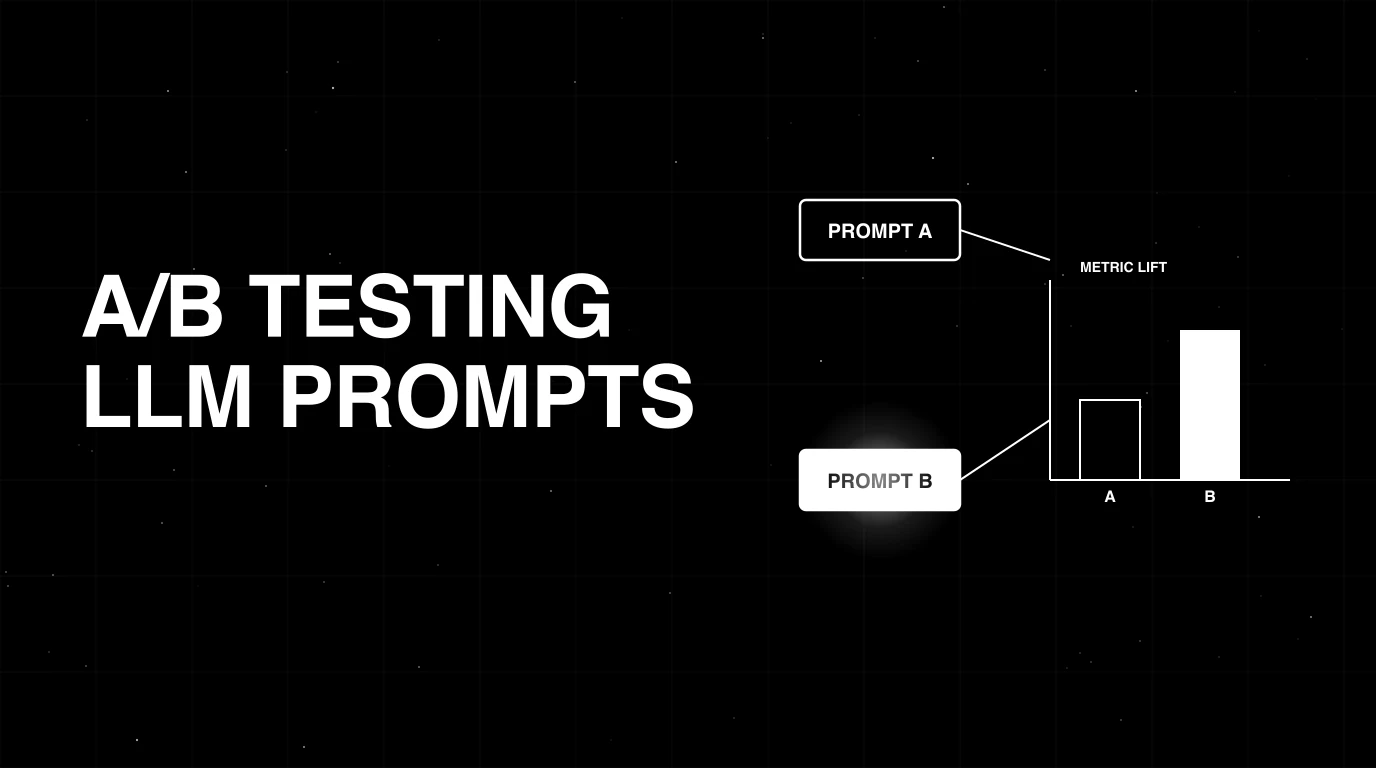
A/B testing LLM prompts without power analysis is theater. The 2026 playbook: MDE, sample sizing, matched pairs, bootstrap CIs, bandits, and rollout.

FutureAGI, DeepEval, Langfuse, Phoenix, Braintrust, LangSmith, and Galileo as the 2026 LLM evaluation shortlist. Pricing, OSS license, and production gaps.

FutureAGI, Langfuse, MLflow, W&B Weave, Comet, Braintrust, LangSmith for LLMOps in 2026. Pricing, OSS license, and what each platform won't do end-to-end.