LLM Experimentation in 2026: Best Practices, Trends, and the Production Stack
LLM experimentation 2026: 6 best practices, 5 trends (LoRA, multimodal, MoE), a ranked stack for prompt-opt, evals, tracing. Production-ready guide.
Table of Contents
LLM Experimentation in 2026: Best Practices, Trends, and the Production Stack
LLM experimentation in 2026 is a measurement discipline. Vary one input (prompt, retrieval config, tool surface, model, decoding parameters), grade the output on a fixed evaluator suite, keep what wins. The teams that ship reliable LLM products do this hundreds of times per release. The teams that ship demos eyeball outputs. This guide covers the six best practices, the five trends that matter in May 2026, and the production stack that closes the loop between experiment and observability.
TL;DR
| Question | Answer (May 2026) |
|---|---|
| What is an experiment? | A controlled variant of prompt, retrieval, tools, or model graded on a fixed evaluator suite. |
| Best ROI on iteration | Prompt and retrieval changes outperform fine-tuning for most production tasks. |
| Top trends | Automated prompt optimization, MoE reasoning models, multimodal inputs, EU AI Act compliance, synthetic eval data. |
| Required metrics | Quality (LLM-judge + rules), cost per request, p50 and p95 latency, safety-rule violation rate, sampled user feedback. |
| Top experimentation stack | Future AGI evals + prompt optimizers, DSPy, Promptfoo, LangSmith, Arize Phoenix. |
| Unification rule | Same evaluator in CI and production sampling so results are comparable across surfaces. |
| Cost discipline | Start with a 50 to 500 example set; cache aggressively; log cost-quality ratio per run. |
What changed since 2025
Three shifts redefined experimentation between 2025 and 2026.
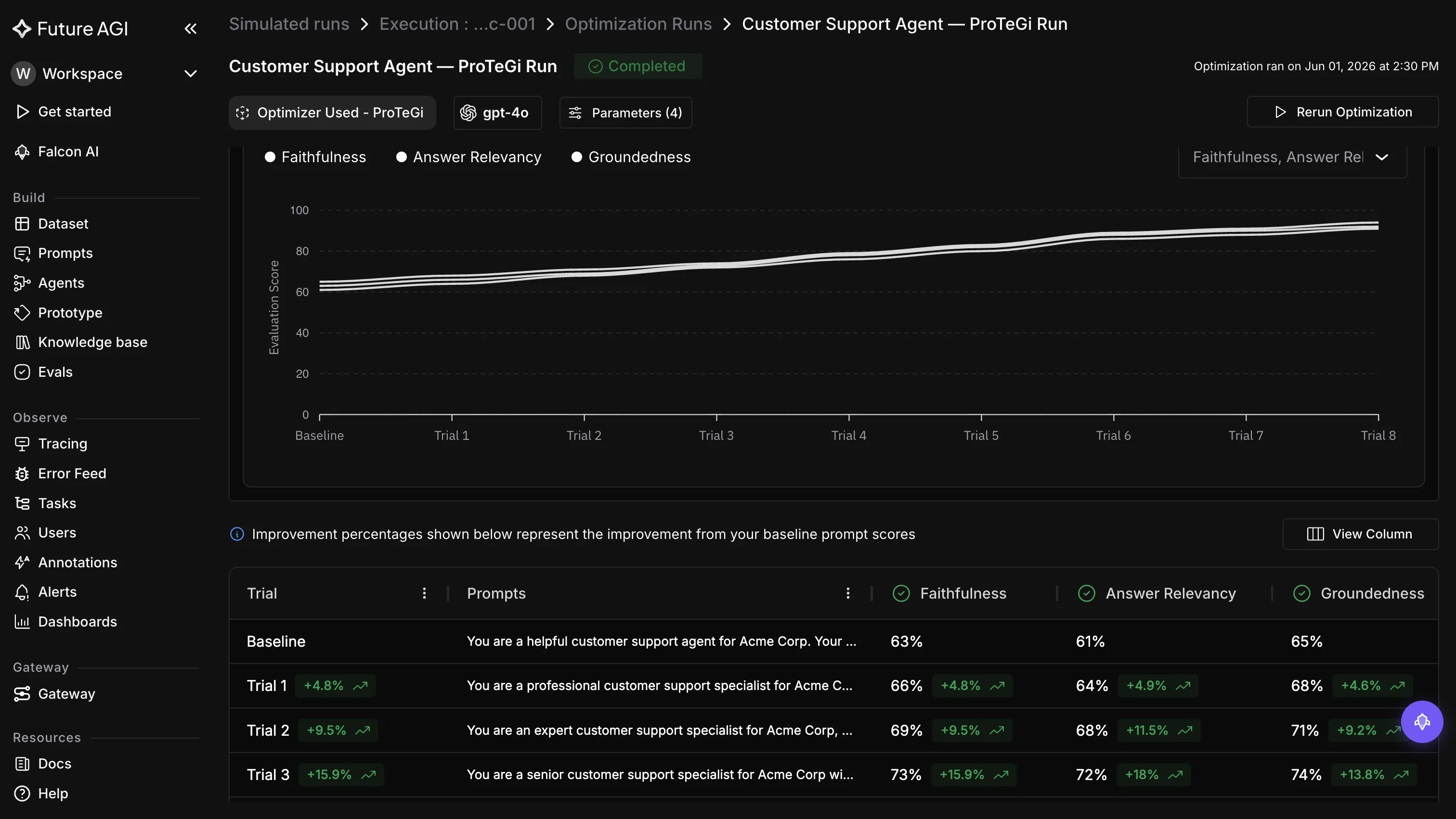
First, automated prompt optimization went mainstream. The DSPy framework (Apache 2.0, Stanford NLP) showed that compiler-style search over prompt programs outperforms hand-edited prompts on most benchmarks. Future AGI’s optimizer suite (fi.opt.base.Evaluator, fi.opt.optimizers.BayesianSearchOptimizer) integrates the same loop with the evaluator catalog. Manual prompt engineering still has a role for one-off tasks; it is no longer the default for production tracks.
Second, mixture-of-experts and reasoning-tuned models reset the cost-quality frontier. GPT-OSS, Llama 4, and the frontier reasoning models from Anthropic, OpenAI, and Google ship with explicit thinking-budget controls. Experimentation now treats thinking budget as a first-class knob alongside temperature and top-p.
Third, the regulatory layer got teeth. The EU AI Act GPAI obligations applied 2 August 2025. High-risk obligations continue to phase in through 2 August 2026 and 2 August 2027. Experiment runs now produce audit artifacts (model card, dataset card, evaluation summary) by default in regulated industries.
How LLMs Are Reshaping Industries Through Experimentation
Production LLM systems are designed in the experimentation loop. The model behind a customer-support agent, a medical-summarisation tool, a code-review assistant, or a research-synthesis pipeline is rarely a one-shot deployment. It is the winner of dozens of variant runs on a fixed evaluation set, promoted to production with traces that match the experiment format.
This is the same pattern software teams already use for A/B testing and feature flags, adapted to a system that is non-deterministic by default. The discipline is to make the non-determinism visible: fixed prompts, fixed seeds where possible, fixed evaluator versions, fixed datasets. Then change one thing and measure.
Challenges in LLM Experimentation: Data Quality, Compute Costs, Ethics, and Model Interpretability
Four problems show up in every serious experimentation track.
Data Quality and Bias: How Poor Evaluation Data Distorts LLM Experiment Results
The fixed evaluation set is the foundation. If it does not represent production traffic, the experiment ranks the wrong variant. Curate the set deliberately: stratify by intent, by user segment, by failure mode. Label or rubric-score every example. Re-sample from production monthly to catch distribution drift. The Stanford HELM benchmark is a useful public reference for benchmark methodology.
High Computational Costs: How Resource Requirements Push Teams Toward Parameter-Efficient and Prompt-First Strategies
Compute remains a binding constraint at most teams. Two responses dominate. Prompt-first iteration (cheap, fast, reversible) handles most of the optimisation surface. Parameter-efficient fine-tuning (LoRA, QLoRA, adapters) handles the rest. Full fine-tunes show up rarely and are reserved for narrow specialised tasks where a foundation model hits a ceiling.
Ethical Concerns: How Bias, Misinformation, and Responsible AI Frameworks Shape LLM Experimentation
Bias and safety are evaluator categories, not afterthoughts. Every experiment in 2026 runs at least one fairness evaluator and one safety evaluator alongside quality. The NIST AI Risk Management Framework provides the taxonomy; the NIST AI 600-1 Generative AI Profile lists the operational controls.
Model Interpretability: How Span-Level Traces Replace Black-Box Debugging During LLM Experimentation
Model internals remain opaque, but agent and pipeline behaviour does not have to be. Span-level OpenTelemetry traces from traceAI (Apache 2.0), OpenLLMetry, and OpenInference make every step inspectable. Pair traces with post-hoc faithfulness evaluators to explain why a variant won or lost.
Emerging Trends in LLM Experimentation in 2026: Automated Optimization, Reasoning Budgets, Multimodal, Open Weights, and Compliance
Automated Prompt Optimization: How Optimizers Replace Manual Prompt Edits
Manual prompt edits plateau. The 2026 default is to define an evaluator, define a search space, and let an optimizer search. DSPy, Promptfoo, and Future AGI’s optimizer suite ship the loop. The Future AGI pattern wraps an evaluator into the search:
# Requires FI_API_KEY and FI_SECRET_KEY set in the environment.
import os
from fi.opt.base import Evaluator
from fi.opt.optimizers import BayesianSearchOptimizer
from fi.evals.metrics import CustomLLMJudge
from fi.evals.llm import LiteLLMProvider

assert os.getenv("FI_API_KEY"), "FI_API_KEY is not set"
assert os.getenv("FI_SECRET_KEY"), "FI_SECRET_KEY is not set"

judge = CustomLLMJudge(
    provider=LiteLLMProvider(),
    rubric="Faithful to context, complete, concise.",
)
evaluator = Evaluator(metric=judge)

search_space = {
    "system_prompt": [
        "You are a careful customer support agent.",
        "You are a concise customer support agent.",
        "You answer briefly and quote policy when relevant.",
    ],
    "temperature": [0.0, 0.3, 0.7],
}

optimizer = BayesianSearchOptimizer(evaluator=evaluator, search_space=search_space)
best = optimizer.run(max_trials=20)
print(best)
The same evaluator that grades the optimizer’s candidates can be promoted to a production guardrail or to a monitoring sample. That is the unification rule: one evaluator, three surfaces (experiment, guardrail, monitor).
LoRA, QLoRA, and PEFT: How Parameter-Efficient Fine-Tuning Reduces Compute Costs
LoRA and QLoRA remain the default for parameter-efficient fine-tuning. The original LoRA paper on arXiv and the Hugging Face PEFT library cover the implementation. Use them when prompt-and-retrieval iteration hits a ceiling. Reserve full fine-tunes for narrow domain tasks.
Reasoning Budgets and Mixture-of-Experts: How Thinking-Token Controls Reset the Cost Frontier
Frontier reasoning models expose a thinking-budget control: more budget means more accuracy on hard problems and more cost. Mixture-of-experts models like GPT-OSS on Hugging Face and Llama 4 from Meta trade total parameters for active-parameter cost. Experiment over thinking budget as a first-class knob.
Multimodal Experimentation: How Native Image and Audio Inputs Change Evaluator Design
The leading 2026 models accept image, audio, and video as native input. Evaluator design must catch up: a faithfulness evaluator on a multimodal answer needs the original image as context. The ai-evaluation library (Apache 2.0) supports multimodal inputs to evaluators.
AI Compliance and Regulation: How the EU AI Act and NIST AI RMF Shape Experiment Artifacts
Regulated industries require experiment artifacts: a model card, a dataset card, an evaluation summary, an audit trail of training data. The EU AI Act final text and the NIST AI RMF define what each artifact must contain. Make these outputs of the experiment pipeline, not bolted on afterwards.
Synthetic Evaluation Data: How Generated Test Cases Cover Underrepresented Failure Modes
Synthetic test cases extend an evaluation set into corner cases that production traffic rarely surfaces. The pattern is to generate candidate inputs with a strong model, filter for diversity, then label or rubric-score the outputs. Future AGI’s TestRunner ships a simulation harness that pairs synthetic users with a target agent and grades the runs.
Best Practices for Large Language Model Experimentation: Datasets, Evaluators, Tooling, and Cost Discipline
Define a Fixed Evaluation Set Before Any Prompt or Model Change
The evaluation set is the contract between experiment runs. Lock it before iteration starts; version it when it changes. A reasonable starting size is 50 to 500 examples stratified by intent and failure mode. Sample from production monthly and add to the set when distribution shifts.
Use Automated Evaluators in CI
Manual review does not scale past a few dozen examples. Use deterministic rules for crisp checks (PII, schema, regex) and LLM-judge evaluators for nuanced quality (faithfulness, completeness, tone). Future AGI’s evaluate function wraps both into a single call:
# Requires FI_API_KEY and FI_SECRET_KEY set in the environment.
import os
from fi.evals import evaluate

assert os.getenv("FI_API_KEY"), "FI_API_KEY is not set"
assert os.getenv("FI_SECRET_KEY"), "FI_SECRET_KEY is not set"

result = evaluate(
    "faithfulness",
    output="The policy refund window is 30 days.",
    context="Section 5: refunds are available within 30 calendar days of purchase.",
)
print(result.score, result.passed)
Iterate on Prompts and Retrieval Before Fine-Tuning
Prompt and retrieval changes are reversible and cheap. Fine-tunes are not. The 2026 rule of thumb is: do not fine-tune until you have exhausted prompt, retrieval, decoding, and model-swap variants on a stable evaluation set. Most production gains land before the fine-tune step.
Run Automated Prompt Optimization Rather Than Manual Edits
Use DSPy, Future AGI’s BayesianSearchOptimizer, or Promptfoo to search a structured space. Manual edits are valuable for understanding the variant space; automated search is what ships.
Track Cost and Latency as First-Class Metrics Alongside Quality
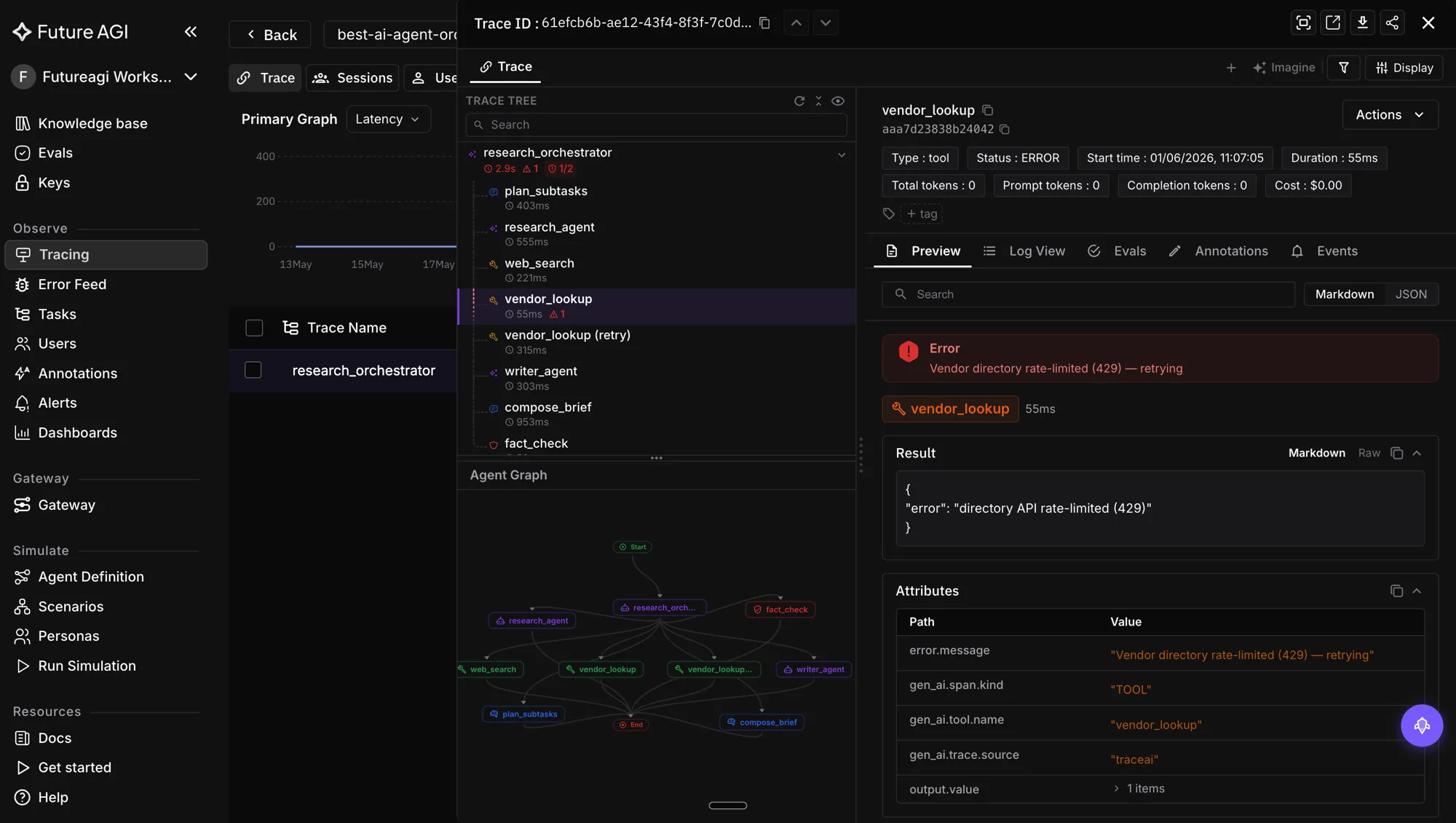
A quality win that triples cost is not a win. Log every experiment run with token counts, dollar cost, and p50 and p95 latency from OpenTelemetry spans. Rank variants by a cost-quality Pareto frontier rather than quality alone.
Unify Experiment Runs and Production Samples on One Trace Store
The same evaluator runs in CI on the experiment dataset and on a 1 to 5 percent production sample through the observability layer. That is how a regression caught in production triggers a CI investigation on the same metric. Future AGI Protect plus the Agent Command Center shares one evaluator catalog between CI and production sampling; LangSmith, Arize Phoenix, and Langfuse are credible alternatives.
Applications of LLM Experimentation Across Industries
Customer Support: How Variant Runs Improve First-Contact Resolution
The headline metric is first-contact resolution at fixed cost per ticket. Experiment over system prompt, retrieval over the help-center, and tool surface (refund, ticket-update, escalate). Promote variants on a Pareto frontier of resolution rate and cost.
Healthcare: How Experimentation Tracks Triage and Summarisation Quality Without Risking Patient Outcomes
Healthcare experimentation runs on de-identified data, against clinical reviewers, and with rubric-driven evaluators that align with the FDA Software as Medical Device guidance. The artifacts (model card, dataset card, evaluation summary) carry through to the submission.
Code Generation and Review: How Experimentation Compares Reasoning Budgets and Tool-Use Patterns
Reasoning-tuned models with explicit thinking budgets dominate code tasks. The experimentation knobs are thinking budget, tool surface (compile, lint, test), and few-shot examples. Evaluators are deterministic: pass/fail tests, syntax check, lint pass.
Education: How Experimentation Calibrates Tutoring Models for Age-Appropriate Content and Accuracy
Age-appropriate content is a guardrail; tutoring accuracy is the headline metric. The evaluator set pairs factuality with reading-level checks. Synthetic evaluation extends coverage to the long tail of student questions.
What Is Next for LLM Experimentation: Continual Evaluation, Synthetic Users, Multi-Agent Optimization, and Audit-Ready Pipelines
Continual Evaluation: How Always-On Evaluator Sampling Closes the Loop Between CI and Production
Continuous sampling of production traffic against the same evaluator suite used in CI is the 2026 default. Future AGI’s Agent Command Center, Arize Phoenix, and Langfuse all expose this view. The result is an alert when a metric drifts more than a threshold, not a quarterly review.
Synthetic Users: How Simulation Replaces Expensive Human Trials During Experimentation
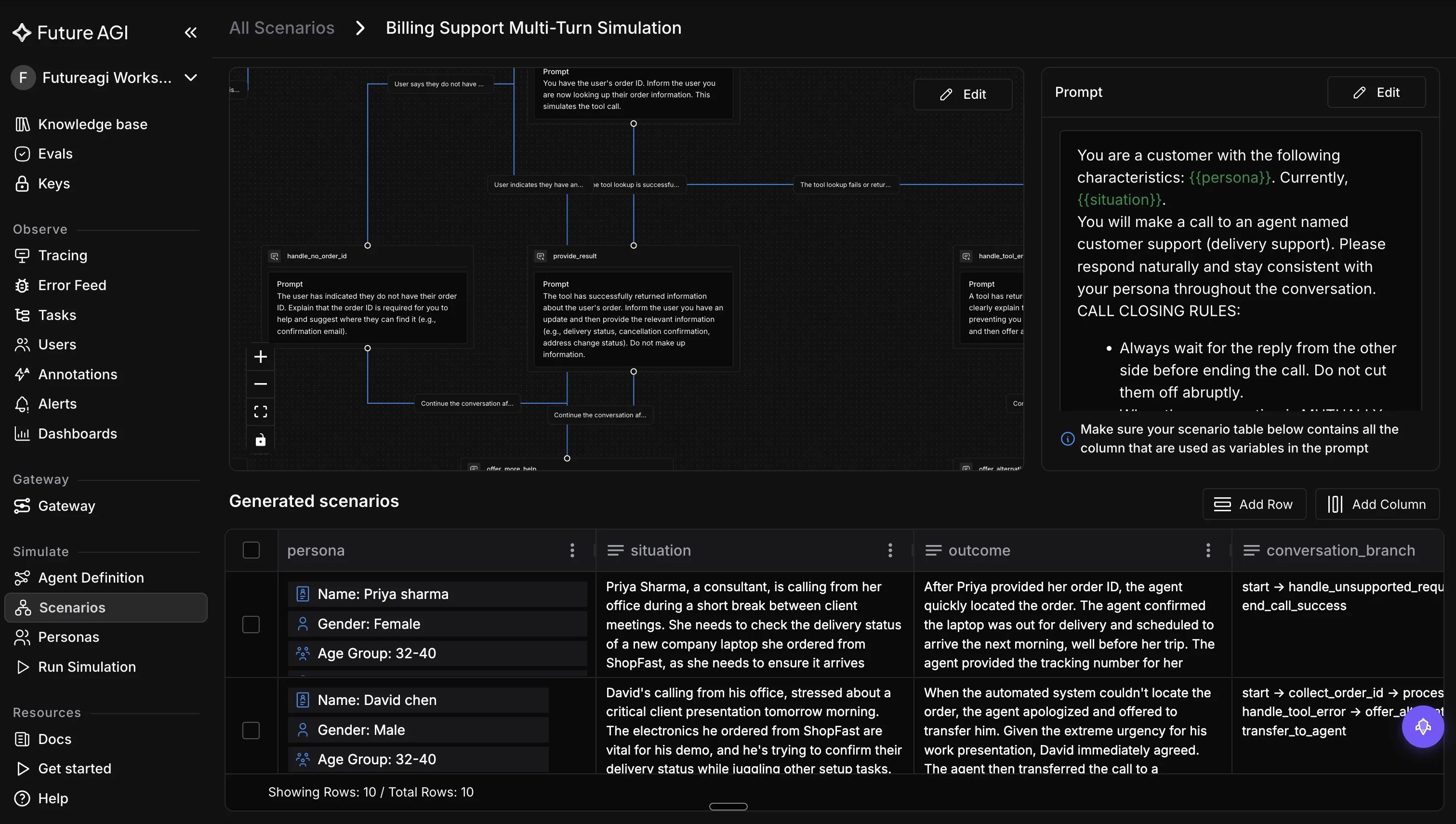
Synthetic users scripted from real personas drive the agent through hundreds of conversations per release. The Future AGI TestRunner ships this pattern. Pair it with sampled human review on a fraction of runs to calibrate the LLM judge.
Multi-Agent Optimization: How Optimizers Search Tool Surfaces and Agent Hierarchies
The variant space is no longer just the prompt. Optimizers now search over tool surface, agent hierarchy, and inter-agent prompts. Expect this to be a meaningful productivity lift over the next 18 months as the search algorithms mature.
Audit-Ready Pipelines: How Experiment Outputs Become EU AI Act and ISO/IEC 42001 Artifacts
ISO/IEC 42001:2023 provides an AI management-system standard suitable for certification. Experiment pipelines now emit model cards, dataset cards, and evaluation summaries as a side effect of every run. This is how the operational discipline meets the regulatory requirement.
How Best Practices, Trends, and the Future AGI Stack Shape LLM Experimentation in 2026
Three operational principles separate teams that ship reliable LLM systems from those that ship demos.
- The fixed evaluation set is the contract. Lock it, version it, sample from production into it.
- Automated evaluators run in CI and in production sampling on the same metric. Drift triggers investigation, not eyeballing.
- Cost and latency are first-class. The winner of a variant track is the variant on the Pareto frontier, not the variant with the highest quality score.
The Future AGI platform implements the experimentation stack end-to-end: the ai-evaluation library (Apache 2.0) for evaluators and optimizers, the traceAI repository (Apache 2.0) for OpenTelemetry instrumentation, and the Agent Command Center for unified experiment runs plus production observability.
Frequently Asked Questions
What is LLM experimentation in 2026?
How does prompt experimentation differ from fine-tuning experimentation?
Which metrics should every LLM experiment track?
What is the best way to run prompt optimization at scale?
How do I evaluate without ground-truth labels?
What changed in LLM experimentation between 2025 and 2026?
How do I manage compute costs during experimentation?
How do experimentation tools differ from observability tools?
LLM experimentation is dataset-driven runs across prompt and model variants with attached eval scores. What it is and how to implement it in 2026.

Five LLM experimentation tools ranked for 2026 on what actually ships a winning prompt: paired evals, bootstrap CIs, span-attached scoring, and CI gates.

FutureAGI, DeepEval, Langfuse, Phoenix, Braintrust, LangSmith, and Galileo as the 2026 LLM evaluation shortlist. Pricing, OSS license, and production gaps.