Best 5 AI Evaluation Platforms for Government in 2026: FedRAMP, IL5, NIST AI RMF, Section 508
Five AI evaluation platforms scored for public-sector AI on FedRAMP, IL5, StateRAMP, NIST AI RMF, air-gap, and Section 508. May 2026.
Table of Contents
A federal agency CIO ran a constituent-services copilot pilot on a Monday and discovered by Friday that the eval platform vendor on the contract was routing protected-class cohort scores to a SaaS control plane outside the FedRAMP boundary, had no NIST 800-53 AU-2 audit log on the eval calls, had no Section 508 audit on the reviewer dashboard the agency’s accessibility-impacted IG analyst had to use, and had a NIST AI RMF “alignment” PDF that turned out to be a marketing one-pager rather than a per-control mapping the OIG would accept. The pilot closed. The vendor lost. This guide is for the federal, state, DoD, and IC engineers buying the next eval platform.
TL;DR: Government AI evaluation has three binding constraints
Most listicles pitch eval platforms on bias-detection feature checklists. That’s the wrong axis. Government AI evaluation requires three things commercial vendors rarely ship together: air-gap-capable deployment (federal sovereign / IL5 boundaries with no managed control plane phoning home), FedRAMP / IL5 / StateRAMP / FISMA alignment (the authorization path agency procurement actually buys against), and NIST AI RMF mapping documented per control (Govern / Map / Measure / Manage tied to specific evaluators, defensible to an OIG reviewer). Vendors that don’t ship all three lose the procurement before the technical eval starts.
| # | Platform | Best for | Pricing |
|---|---|---|---|
| 1 | Future AGI | OSS Apache 2.0 traceAI + ai-evaluation + Agent Command Center self-hostable inside GovCloud / Azure Government, broadest open-weight evaluator backends | Cloud + OSS self-host; free + pay-as-you-go |
| 2 | Galileo Luna-2 | Federal civilian procurement with FedRAMP-track positioning and mature InfoSec | Enterprise contract |
| 3 | Braintrust | Civilian engineering teams with CI-gate eval discipline | Pro $249/mo + enterprise self-host |
| 4 | AWS Bedrock-native eval (GovCloud) | Agencies already standardized on Bedrock that want eval inside the inherited FedRAMP High + IL5 boundary | AWS service pricing |
| 5 | Custom DIY on-prem | Defense / IC / ITAR workloads where no managed vendor closes the boundary | Engineering cost only |
The honest mid-2026 picture: no eval platform is FedRAMP-authorized + Section-508-WCAG-2.1-AA-compliant + air-gap-deployable + cohort-bias-native all at once. Each platform fits a specific authorization boundary. Read the FedRAMP status lines literally — if the vendor doesn’t say “authorized,” they’re not.
Why government AI evaluation is a different category
Public-sector teams ship AI faster than they evaluate it, and the failure mode is constitutional, not user-experience-shaped.
- The audience is OIGs, ACLU litigation, OMB reviewers, and accessibility-impacted IG analysts — not users. The score needs a reason, an audit-grade trace, and a reviewer UI that meets Section 508.
- Failure modes are silent at the constituent level. A benefits-eligibility chatbot drifts onto a zip-code proxy and under-approves SNAP for protected-class cohorts; a facial-recognition system’s false-positive rate on darker-skinned faces drifts past the threshold that produced the Robert Williams v. City of Detroit arrest. Aggregate accuracy won’t catch either.
- Evidence has to survive a stack of overlapping obligations. OMB M-24-10 and the follow-on M-25-21 / M-25-22, the NIST AI RMF 1.0 + GenAI Profile NIST AI 600-1, Section 508 (29 USC §794d) + WCAG 2.1 AA, FISMA / FedRAMP boundary integrity, DoD CC SRG IL2–IL6, NIST 800-53 Rev. 5 audit-logging (AU-2, AU-12, AC-6), state laws (Texas HB 2060, Colorado AI Act, California SB 896), StateRAMP for state CIOs, and EU AI Act Annex III for cross-border deployments. EO 14110 was partially rescinded by EO 14179 in January 2025; M-24-10 and the agency-level guidance survived.
Most listicles either pitch an AI gateway (controls inputs, misses output drift) or a one-time NIST AI RMF gap assessment (a snapshot). For the full obligation map, see the LLM safety and compliance guide. Evaluation platforms determine whether the audit trail clears an OIG review, whether the §1983 defense holds up, and whether the next algorithmic-systems suit finds the agency in compliance.
The Future AGI Government Evaluation Scorecard
The five-dimension rubric we score each platform against:
- Air-gap-capable deployment posture. Single-binary or container install with no managed control plane phoning home. The hard test: does it run on a SCIF network with no public internet and produce the same eval scores as on a connected dev machine? Defense, IC, and IL5+ workloads weight this above everything else.
- FedRAMP / IL5 / StateRAMP / FISMA alignment. Authorization status (Authorized, In Process, Ready, On Roadmap, Not pursuing), DoD CC SRG conformance, StateRAMP track for state CIOs, and the customer-responsibility matrix when the platform inherits a hyperscaler boundary. The cardinal sin: claiming “FedRAMP” when it’s on the roadmap.
- NIST AI RMF mapping documented per control. A control matrix per evaluator per function — each evaluator names the function it satisfies, the OMB M-24-10 practice it produces evidence for, the Section 508 accessibility consideration, and the audit-log span linkage. Defensible to an OIG reviewer.
- Section 508 accessibility for the reviewer surface. WCAG 2.1 AA on the eval dashboard, keyboard navigation, screen-reader heading structure on cohort drill-downs, color-contrast on bias visualizations, plus custom evaluators that score the agency’s own AI output for accessibility — plain-language readability, screen-reader-friendly markup, alt-text on generated images.
- Constitutional / civil-rights cohort scoring with field-level error localization. Bias-detection per protected-class cohort (Title VI, Title IX, ADA, ADEA, state-extended classes), drift across model upgrades on cohort pass rate and determination distribution, and field-level localization that pinpoints which prompt segment, retrieved policy chunk, or applicant-data field drove a flagged determination.
Capability matrix
| Capability | Future AGI | Galileo Luna-2 | Braintrust | AWS Bedrock-native | DIY on-prem |
|---|---|---|---|---|---|
| FedRAMP status (May 20, 2026) | Pursuing Moderate; not authorized | FedRAMP-track; not authorized | Not pursuing publicly | Authorized (GovCloud Bedrock, High) | Customer responsibility |
| DoD IL4 / IL5 boundary fit | Customer responsibility via self-host | Customer responsibility | Customer responsibility | Limited IL5 endpoints on Bedrock in GovCloud | Customer responsibility |
| Air-gap / SCIF deployment | Yes (Apache 2.0 self-host; ACC single Go binary) | No (managed SaaS) | No (managed SaaS) | No (Bedrock is a cloud service) | Yes (by definition) |
| NIST AI RMF per-control mapping | Yes (Govern/Map/Measure/Manage per evaluator) | Yes (enterprise mapping) | Partial (Measure-heavy) | Partial (Bedrock Guardrails subset) | Customer authored |
| Section 508 / WCAG 2.1 AA on reviewer UI | Yes | Yes (enterprise tier) | Partial | AWS Console baseline | Customer responsibility |
| Cohort-aware bias-detection | Yes (built-in) | Yes (enterprise tier) | Custom configuration | Limited subset | Customer authored |
| Field-level error localization | Yes | Yes | Yes | Limited | Customer authored |
| Open-weight evaluator backends on-prem | Yes (LLAMAGUARD_3, QWEN3GUARD, GRANITE_GUARDIAN, WILDGUARD, SHIELDGEMMA) | No | No | No | Yes |
| OTel-native tracing | Yes (Apache 2.0 traceAI, 50+ surfaces) | Yes (proprietary + OTel export) | Yes (via translation) | Yes (CloudTrail + OTel) | Customer responsibility |
| Compliance stamps | SOC 2 Type II, HIPAA, GDPR, CCPA; ISO 27001 in audit | SOC 2 Type II | SOC 2 Type II | FedRAMP High, IL5 (inherited) | Customer’s own |
1. Future AGI: Best for OSS Apache 2.0 self-host with the broadest open-weight backend set
Best for: Federal civilian, DoD unclassified, state CIO, and IC engineering teams that want Apache 2.0 source they can audit line by line, self-host inside an agency AWS GovCloud or Azure Government tenant, and pair with open-weight evaluator backends for on-prem and air-gap workloads.
Compliance posture per futureagi.com/trust. SOC 2 Type II, HIPAA (BAA available), GDPR, CCPA all certified. ISO/IEC 27001 in active audit. FedRAMP Moderate is being pursued; not authorized as of May 20, 2026. ISO/IEC 42001 on the roadmap. Stating it out loud because federal procurement isn’t a place to fudge authorization.
Key strengths.
- Apache 2.0 self-host across the eval stack.
traceAIfor OTel instrumentation across 50+ AI surfaces (Python, TypeScript, Java including a Spring Boot starter, C#);ai-evaluationships 60+EvalTemplateclasses includingBiasDetection,NoRacialBias,NoGenderBias,NoAgeBias,Toxicity,PromptInjection,DataPrivacyCompliance,IsHarmfulAdvice; Agent Command Center for the gateway, dashboards, and Error Feed — all installable inside an agency boundary with no required outbound dependency. - Broadest open-weight evaluator backend set for on-prem. LLAMAGUARD_3_8B/1B, QWEN3GUARD_8B/4B/0.6B (119-language coverage), GRANITE_GUARDIAN_8B/5B, WILDGUARD_7B, SHIELDGEMMA_2B under enterprise license. Inline policy and offline eval use the same model family, so production guardrail and regression-test rubric stay in sync.
- NIST AI RMF per-control mapping. Govern lands on the audit log (
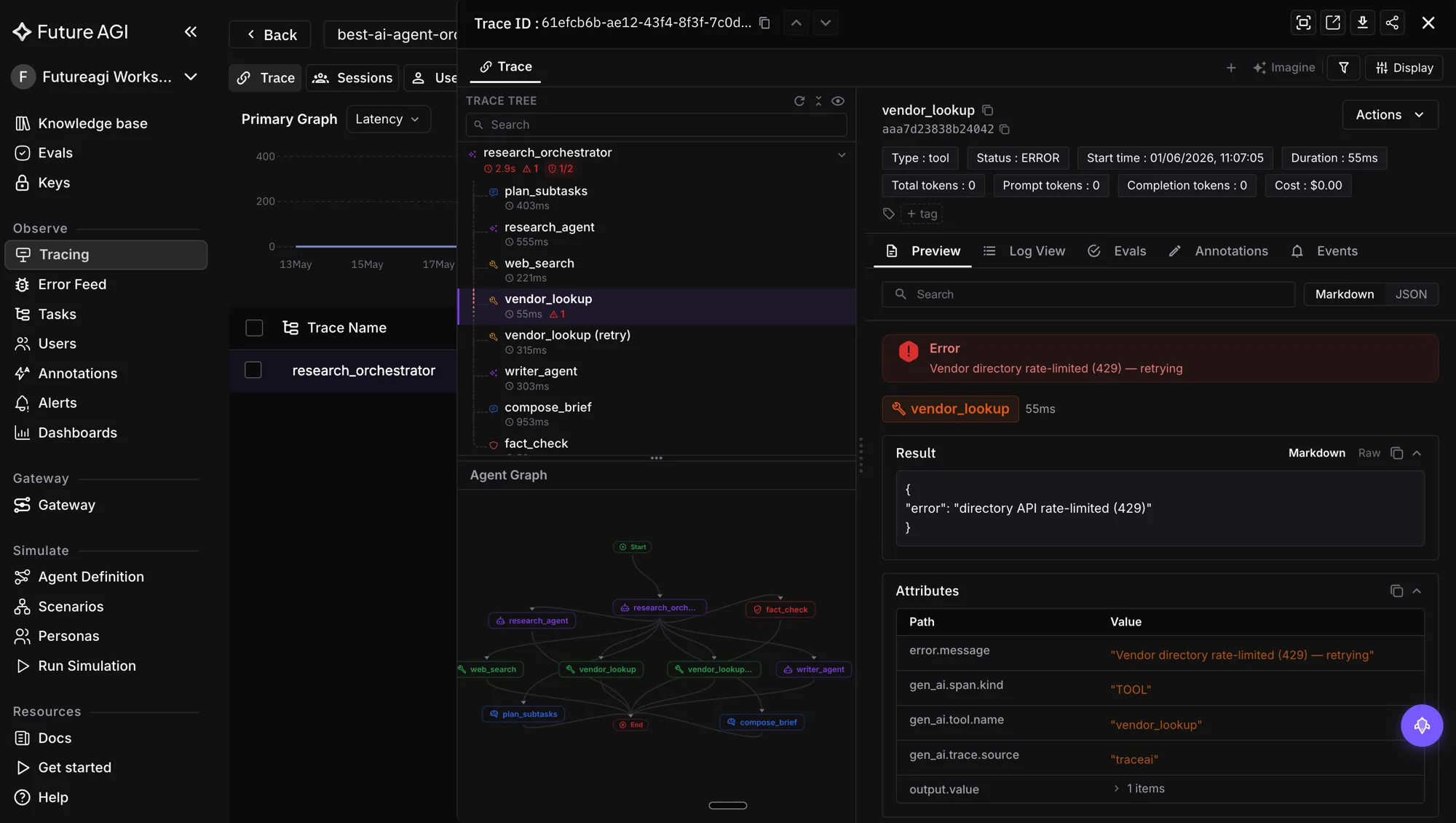
internal/audit/audit.go— every key revocation, config change, admin action, policy decision emits structured events with actor, resource, outcome, request ID). Map lands on protected-class cohort inventory. Measure lands on the 60+ EvalTemplate classes. Manage lands on Error Feed’s HDBSCAN clustering of failing traces into named issues with a Sonnet 4.5 Judge agent writing the RCA, feeding the self-improving evaluator loop. - Field-level error localization. Error Localization pinpoints which input field — prompt segment, retrieved policy chunk, applicant-data field — drove the flagged determination. The score-and-reason record an IG audit response needs.
- Section 508 on the reviewer surface plus output accessibility. WCAG 2.1 AA on the dashboards, keyboard navigation, screen-reader heading structure on cohort drill-downs. Custom accessibility evaluators score the agency’s own AI output, not only the dashboard.
- Region-pinned BYOC and air-gap install. Agent Command Center (17 MB Go binary, zero runtime dependencies) deploys per region with no cross-region calls; the Protect ML hop swaps in on-prem open-weight classifiers when needed.
Where it falls short for government. Not FedRAMP authorized in May 2026 — being pursued at Moderate, not in process at the JAB or with a sponsoring agency PMO. Hosted SaaS is a non-federal-information path today; the procurement path that works now is self-host inside an agency GovCloud or Azure Government tenant. No documented IL6 / SIPRNet release — defense IC programs above IL5 should pair with the DIY on-prem path on the open-weight backends. Newer than Galileo with a smaller named federal customer base.
Pricing & deployment. Cloud + OSS self-host. Free + pay-as-you-go base; compliance add-ons (SOC 2 Type II, HIPAA BAA, SAML SSO + SCIM) per tier. Pricing. Local heuristics run at zero API cost. The proprietary Turing classifier family runs continuous high-volume cohort and PII scoring at lower per-eval cost than Galileo Luna-2.
Verdict. The strongest open-source-friendly contender for federal AI evaluation procurement in 2026, with the honest caveat that FedRAMP is being pursued rather than in hand. Agencies that need Apache 2.0 source plus open-weight backends inside their own boundary should put it at the top.
2. Galileo Luna-2: Best for federal civilian procurement with FedRAMP-track positioning
Best for: Federal civilian CIOs and federal contractors with mature Legal & Compliance procurement, an MSA-first vendor approach, and budget sufficient to absorb an enterprise floor.
Compliance posture. SOC 2 Type II certified. FedRAMP-track positioning; not authorized in May 2026. Named federal customer references ease the agency-side authorization path.
Key strengths.
- Luna-2 is the most mature managed eval foundation model in the federal-procurement-ready set, with continuous scoring on production traffic and an enterprise dashboard mapping to NIST AI RMF MEASURE and MANAGE narratives.
- Enterprise-tier bias-detection with per-cohort scoring; drift detection on protected-class outcomes built in.
- Mature InfoSec closes faster with federal Legal & Compliance than newer entrants; named federal references shorten the agency-side cycle.
- Runtime guardrails plus eval in one product; documented NIST AI RMF alignment in enterprise docs.
Where it falls short for government. No Apache 2.0 self-host path; managed cloud only, which disqualifies it from IL5+ workloads, air-gap SCIFs, and any workload where eval data cannot leave the managed control plane. FedRAMP-track means in-flight, not authorized. Pricing skews to Tier-1 federal budgets; state and municipal teams find the floor higher than the OSS self-host path. Per-eval price on Luna-2 is higher than the FAGI classifier family at comparable accuracy on the published rubrics.
Pricing & deployment. Enterprise contract, managed cloud. Custom pricing tied to procurement schedule.
Verdict. The procurement-safe managed pick when a federal Legal team has already approved an adjacent Galileo deployment. Disqualified the moment the boundary becomes IL5+ or air-gap.
3. Braintrust: Best for civilian agency engineering teams with CI-gate eval discipline
Best for: Federal civilian engineering teams with mature DevX, a CI-gate eval discipline already in place, and a workload that fits inside managed SaaS on AWS commercial regions or AWS GovCloud via customer-managed deployment.
Compliance posture. SOC 2 Type II certified. No FedRAMP authorization publicly pursued as of May 20, 2026. Enterprise self-host / VPC deployment is available — the path agency engineering teams use when the managed control plane is disqualifying.
Key strengths.
- Strongest eval-developer-experience in the closed-platform set: experiments, scorers, datasets, prompts, online scoring, and CI gates in one workflow.
- Sandboxed agent evals for multi-turn agent trajectories, which matters as agency copilots move from one-shot prompts to tool-using agents.
- Trace + score linkage is clean; field-level error localization is supported.
- Enterprise self-host / VPC closes the gap the managed-only path leaves.
Where it falls short for government. Closed platform with no Apache 2.0 self-host equivalent; federal Legal teams that want source-level auditability won’t get it. No public FedRAMP pursuit, so the procurement path is “wait” or “run customer-managed deployment inside the agency boundary.” Cohort-aware bias-detection is custom-configuration rather than built-in. NIST AI RMF coverage is Measure-heavy with Govern and Manage thinner. Section 508 on the reviewer UI is partial.
Pricing & deployment. Pro $249/mo as the team-tier floor; enterprise self-host / VPC custom. Pro tier alone does not close federal procurement.
Verdict. The eval-developer-experience pick when the agency engineering team is the buyer and CI-gate discipline is the binding constraint. Pair with FAGI open-weight backends when cohort-bias coverage becomes the gate.
4. AWS Bedrock-native eval (GovCloud): Best for agencies already standardized on Bedrock
Best for: Federal civilian agencies and DoD programs already committed to AWS GovCloud Bedrock as the model layer, where the eval workflow needs to inherit the existing FedRAMP High + IL5 boundary without adding a new vendor authorization.
Compliance posture. FedRAMP High authorized on AWS GovCloud Bedrock. DoD IL4 PA, limited IL5 endpoints. ITAR coverage on AWS GovCloud. NIST 800-53 Rev. 5 inherited from the GovCloud boundary.
Key strengths.
- The eval workflow inherits the GovCloud FedRAMP High + IL5 boundary; no separate vendor authorization to chase.
- Bedrock Evaluations covers the standard set (accuracy, robustness, toxicity, a subset of bias rubrics); Bedrock Guardrails handles inline PII at the GovCloud network hop.
- CloudTrail + Amazon OpenSearch + S3 give the NIST 800-53 AU-2 / AU-12 audit-log path agencies already operate.
- Native integration with Bedrock Knowledge Bases for retrieval-grounded eval, useful for FOIA and policy-manual RAG.
Where it falls short for government. Bedrock Evaluations is a subset of a dedicated eval platform — cohort-aware bias-detection per protected class is limited to standard rubrics, drift across model upgrades is dashboarding-light, and field-level error localization is shallow. No air-gap or SCIF — Bedrock is a cloud service, so IL6 / SIPRNet is out of scope. Custom evaluator authoring is the path for any rubric Bedrock doesn’t ship. Lock-in is the cost.
Pricing & deployment. AWS service pricing on Bedrock Evaluations + Guardrails; standard GovCloud billing.
Verdict. The inherited-boundary pick. Shallower eval workflow than a dedicated platform, but the lightest procurement path in the list. Pair with a custom evaluator layer (open-weight backends from the FAGI ai-evaluation SDK or a DIY pass) when cohort-bias becomes binding.
5. Custom DIY on-prem: Best for defense / IC where no managed vendor closes the boundary
Best for: Defense / IC AI program managers, ITAR-regulated contractors, classified-network teams, and agency engineering organizations where no managed vendor closes the authorization boundary and the eval pipeline has to be authored, hosted, and audited entirely inside the customer perimeter.
Compliance posture. Customer’s own. Customer’s Authorizing Official sign-off against the System Security Plan, customer’s NIST 800-53 mapping, customer’s NIST AI RMF documentation, customer’s Section 508 work, customer’s audit-log retention to NARA GRS 4.2 or the agency schedule.
Key strengths.
- No vendor authorization to chase; the eval pipeline inherits the host program’s boundary.
- Air-gap is the default. SCIF and JWICS deployments are achievable without rewriting procurement.
- Cohort-bias, hallucination, and Section 508 evaluators are authored against the exact mission workload and protected-class cohort definitions the agency operates under.
- ITAR coverage is enforced by the program; no third-party data-handling claim to validate.
Where it falls short for government. Engineering cost is real: six to twelve engineer-months for a defensible cohort-bias and hallucination pipeline an OIG would accept, plus ongoing maintenance as models and policy change. Audit-log infrastructure, RBAC, PII redaction, retention schedule, and the reviewer dashboard become custom builds. Most DIY pipelines under-invest in the reviewer surface — accessibility-impacted IG analysts find out at audit time that the custom dashboard doesn’t meet WCAG 2.1 AA.
Pricing & deployment. Engineering cost only. Most programs pair DIY with the Apache 2.0 traceAI + ai-evaluation SDK and the open-weight backends rather than authoring the trace and evaluator surfaces from scratch — the OSS layer covers the plumbing while the program authors the cohort and accessibility rubrics specific to the mission.
Verdict. The boundary-defining pick. The only path that works when no managed vendor’s authorization closes the workload. Budget the engineering cost honestly — the savings on the license fee are usually less than the cost of authoring the reviewer surface, the audit-log infrastructure, and the Section 508 work a mature managed platform would have shipped.
Which platform should your team pick?
| If you’re a… | Pick |
|---|---|
| Federal civilian CIO who wants Apache 2.0 source plus open-weight backends self-hosted inside GovCloud | Future AGI |
| Federal civilian CIO with mature Legal & Compliance and an MSA-first approach | Galileo Luna-2 |
| Federal civilian engineering lead where CI-gate eval discipline is the binding constraint | Braintrust (paired with FAGI open-weight backends for cohort coverage) |
| Agency program already standardized on AWS GovCloud Bedrock | AWS Bedrock-native eval |
| Defense / IC program manager with IL6, SIPRNet, JWICS, or ITAR constraints | Custom DIY on-prem (paired with Apache 2.0 traceAI + open-weight backends) |
| State CIO under StateRAMP running constituent-services chatbots | Future AGI self-host inside the state’s authorized boundary |
What auditors actually ask for
The five questions that show up in every public-sector AI-touching audit, and the artifact each platform should produce:
| Auditor question | Artifact |
|---|---|
| Show the audit log for the past 30 days | OTel-native trace + structured audit-log JSON-lines export; per-user, per-key, per-policy event |
| How do you detect and block PII in eval-data flow | PII evaluator + gateway PII fallback; per-tenant block / warn / mask / log |
| Show the bias-detection score for protected-class cohorts on the last 90 days | Cohort-aware bias-detection output, score-and-reason linked to span IDs, drift telemetry |
| Walk me through a flagged determination | Field-level error localization on input, retrieved-context record, model-output classification, guardrail decision, human-override record |
| Show the NIST AI RMF mapping per evaluator | Per-evaluator matrix tying Govern / Map / Measure / Manage to the scoring rubric, the OMB M-24-10 practice, the audit-log span linkage |
A platform that cannot produce these five artifacts on demand will not survive the audit. Future AGI ships them on self-host. Galileo Luna-2 ships them in the enterprise tier. Braintrust ships most; cohort-bias is custom. AWS Bedrock-native ships a subset. DIY on-prem requires you to author every one.
Three takeaways for federal procurement in 2026
- Read the FedRAMP status line literally. “Authorized” is binding; “Ready,” “In Process,” “On Roadmap,” and “Being pursued” are not. No eval-platform startup has FedRAMP authorization in May 2026; the platforms with authorization paths today inherit them from AWS GovCloud, Azure Government, or a sponsoring-agency boundary. The vendor that says it plainly won’t blow up procurement six months in.
- NIST AI RMF is a control matrix, not a PDF. If a vendor hands you a one-page alignment claim, they haven’t done the mapping. Ask for the per-evaluator, per-function table.
- Air-gap is a deployment property, not a configuration toggle. If the platform requires a managed control plane to phone home, it cannot deploy on a SCIF network. The test is the binary running with no public internet and producing the same eval scores. Defense and IC procurement weight this above every other dimension.
If cohort-bias monitoring across model upgrades, Apache 2.0 self-host inside an agency boundary, NIST AI RMF per-control mapping, and Section 508 reviewer accessibility are the four binding constraints, explore Future AGI’s evaluation platform.
Related reading
Frequently Asked Questions
What's actually binding for a government AI evaluation platform in 2026?
Is Future AGI FedRAMP authorized?
How does NIST AI RMF mapping actually work for an eval platform?
Can a generic evaluation platform handle Section 508 accessibility?
Should I pick a managed cloud eval platform or DIY on-prem for federal AI?
How do I evaluate a public-sector AI for civil-rights compliance without sending constituent data to a third-party model?
Does an AI evaluation platform replace a federal IG audit or NIST AI RMF compliance?
Five AI gateways for federal, DoD, and state government 2026, scored on FedRAMP Moderate and High, DoD IL2 to IL6, NIST AI RMF, EO 14110.

EU AI Act, NIST AI RMF, ISO 42001, India DPDPA, US executive orders: which AI safety rules are binding mid-2026, and how to wire eval to them.

Future AGI, Credo AI, Holistic AI, Datadog, Purview, Lakera Guard, Fairly AI compared on policy authoring, audit trails, runtime enforcement for agents.
