LLM Safety and AI Regulations (2026): What's Binding, What's Not, and How to Wire It Into Your Eval Stack
EU AI Act, NIST AI RMF, ISO 42001, India DPDPA, US executive orders: which AI safety rules are binding mid-2026, and how to wire eval to them.
Table of Contents
Your DPO sends you a forty-question security review two weeks before a deal closes. Twelve questions reference the EU AI Act, eight reference NIST AI RMF, five reference ISO 42001, three reference HIPAA, two reference DPDPA. None ask “is your model accurate.” All ask “what controls do you have, who reviewed them, where’s the evidence trail.” This is the part of LLM safety that ships products.
The honest picture in mid-2026 is narrower than the trade press makes it sound. A handful of obligations are binding. The rest are useful frameworks dressed up as gates. This guide separates the two, maps the binding ones to the controls that satisfy them, and shows where the eval stack closes the loop. The point is not to summarize every clause of every law; the point is to show which control in your stack answers which question in the security review.
The binding-vs-voluntary map
Most “AI safety + compliance” posts read like wish lists. They stack the EU AI Act next to White House voluntary commitments next to frontier-lab safety frameworks and treat them as one category. That framing burns engineering hours on policy theater while the actually binding work goes underdone.
The cleaner model splits the landscape into three buckets.
Binding law, mid-2026. EU AI Act (Regulation 2024/1689) in staged enforcement: prohibited-AI provisions since February 2025, GPAI obligations since August 2025, high-risk phasing through August 2026 and 2027. GDPR Articles 5, 9, 22, 32 + Chapter V on data, automated decisions, security, cross-border transfer. CCPA on California consumer data. India’s DPDPA 2023 on personal data of Indian residents, with MeitY’s 2024 advisories on synthetic-media and deepfake disclosure. HIPAA on PHI; GLBA on financial data; FERPA on education records. State AI-hiring laws (Colorado AI Act, NYC AEDT Local Law 144, Illinois AI Video Interview Act). California AB 2013 on training-data disclosure.
Procurement gates that act like law. SOC 2 Type II, ISO/IEC 27001:2022, ISO/IEC 42001:2023 are certifications, not laws. Enterprise buyers refuse to sign without them.HITRUST shows up in healthcare deals. If your buyers will not contract without these, they are functionally binding even though no regulator wrote them.
Voluntary frameworks that organize evidence. NIST AI RMF 1.0 and the GenAI Profile (NIST AI 600-1). The 2023 White House voluntary commitments. UK AISI testing protocols. Anthropic’s Responsible Scaling Policy, OpenAI’s Preparedness Framework, Google DeepMind’s Frontier Safety Framework. Useful, not gates. They organize documentation, signal due diligence, and shape how the binding regulations evolve. Confusing the lab’s safety policy with your deployment obligations is the most common error in this space.
US Executive Order 14110 (October 2023) was rescinded January 2025; the agency-level guidance it spawned (NIST AI RMF, OMB M-24-10, the AI Safety Institute) survived. California SB 1047 was vetoed September 2024; AB 2013 was signed and applies from 2026. The pattern: laws come and go, agency guidance compounds, and the eval-stack controls that satisfy the guidance are the durable layer.
Pick the three to five obligations that apply to your product. Wire them in. Do not try to comply with all forty-seven frameworks at once.
EU AI Act in practice
The EU AI Act is the most consequential law in this category, so it deserves the most attention. Enforcement timeline as of mid-2026:
| Phase | Effective | What lands |
|---|---|---|
| Prohibited AI | 2 Feb 2025 | Social scoring, untargeted scraping for facial recognition, certain emotion recognition in work and school, manipulative AI |
| GPAI obligations | 2 Aug 2025 | Transparency, copyright disclosure, systemic-risk evaluation for the largest models |
| High-risk + governance | 2 Aug 2026 | Article 6 + Annex III obligations, notified bodies, AI Office enforcement |
| Embedded high-risk | 2 Aug 2027 | High-risk AI embedded in regulated products (medical devices, vehicles) |
Two questions every team should answer first: are you a GPAI provider, and is your deployment high-risk?
GPAI test. You are a GPAI provider if you train a foundation model, fine-tune one substantially, or distribute one. Hosting an OpenAI API call is not GPAI provision; training a fine-tuned model and offering it to third parties is. GPAI providers carry transparency obligations (training-data summary, copyright policy, model documentation) and, above a compute threshold, systemic-risk evaluation.
High-risk test. Article 6 + Annex III lists the categories: HR, education, critical infrastructure, law enforcement, justice and democratic process, migration, biometrics. Annex I covers AI embedded in medical devices, vehicles, other regulated products. Most enterprise LLM deployments are not high-risk in this technical sense. If yours is, the obligations are non-trivial.
What a high-risk deployment owes, in practitioner language:
- Article 9 (risk management): ongoing risk process for the full lifecycle. A living artifact, not a one-time PDF.
- Article 10 (data governance): training, validation, and test datasets documented, reviewed for bias, traceable to source. Lineage + bias evaluation at ingest + held-out test sets with protected-class slices.
- Article 12 (logging): audit log on every inference with input, output, model, guardrail decisions, latency, outcome.
- Article 13 (transparency to deployers): instructions for use, performance characteristics, known limitations, intended purpose.
- Article 14 (human oversight): meaningful human review on high-risk outputs. A human who can interpret and override, not a rubber stamp.
- Article 15 (accuracy, robustness, cybersecurity): evaluation, red-team testing, adversarial-robustness measurement. This is where the eval-and-guardrail stack lives.
Conformity assessment is the procedural layer. Annex III self-assesses against harmonized standards; Annex I goes through a notified body with CE marking. You need an internal QMS-style process even when you self-assess.
One mapping satisfies all six articles when wired correctly: CI red-team eval gate for Article 15, audit log on every inference for Article 12, inline guardrails + human-in-the-loop on side effects for Article 14, documented data governance + bias evaluation for Article 10, a maintained risk register for Article 9.
NIST AI RMF: a lens, not a gate
NIST AI RMF 1.0 (NIST AI 100-1, January 2023) and the GenAI Profile (NIST AI 600-1) are voluntary. Treat them as the structural template that organizes your evidence, not the gate you fail.
The four functions and where they land:
- Govern. Roles, accountability, policies, oversight. Maps to ISO 42001 leadership clauses and EU AI Act Article 17 QMS.
- Map. Categorize context, impacts, risks. Maps to EU AI Act Article 9.
- Measure. Test, analyze, document. Maps to EU AI Act Article 15 and the bulk of the eval stack.
- Manage. Prioritize and act on risks, respond to incidents. Maps to ongoing monitoring, the audit log, incident response.
US federal procurement increasingly cites NIST AI RMF; enterprise security questionnaires use it as the structural template. Every NIST function maps cleanly to EU AI Act articles, ISO 42001 clauses, and SOC 2 trust criteria. One documented control set satisfies multiple frameworks. Do the mapping once.
What NIST is not: a regulator. There is no NIST AI compliance certificate, no NIST AI inspection. When a vendor claims “NIST AI RMF certified,” they have aligned controls to the four functions and documented the alignment. Alignment, not certification.
Sector-specific obligations
Most “AI compliance” posts treat sector law as a footnote. It is usually the heaviest weight in the room.
Healthcare (HIPAA, FDA). PHI in any LLM prompt or output triggers HIPAA. Minimum: a BAA with every vendor in the path, PHI detection and redaction at the gateway, audit logs on every access, encryption in transit and at rest. Protect’s data_privacy_compliance adapter detects PHI inline; the gateway PII fallback covers 18 entity types including MRN. Clinical decision support has its own FDA layer; LLM-driven CDS is in active rulemaking. For content rubrics, the ai-evaluation SDK ships NoHarmfulTherapeuticGuidance, ClinicallyInappropriateTone, IsHarmfulAdvice.
Financial services (GLBA, SEC, PCI-DSS). GLBA applies to non-public personal financial information. SOC 2 Type II is the de facto enterprise gate. PCI-DSS applies if payment card data hits the model. SOX-style controls show up in financial reporting: separation of duties, audit logging, retention. Per-virtual-key budgets and rate limits map onto financial-control questions.
EU operations (GDPR). Articles 5, 9, 22, 32 plus Chapter V on cross-border transfer. Article 22 constrains “solely automated decisions”; the right to human review applies. If the LLM makes a decision a person can challenge, human-in-the-loop is not optional.
India operations (DPDPA + MeitY). DPDPA 2023 binds on personal data of Indian residents: consent capture, purpose limitation, data fiduciary obligations, breach notification, cross-border transfer restrictions. MeitY’s 2024 advisories add a content-layer obligation: AI-generated media must be labeled. Data localization for some categories pushes deployments toward in-region infrastructure.
Hiring and HR (EEOC, NYC AEDT, Colorado AI Act). EEOC 2023 guidance treats AI-assisted hiring as employment decisions. NYC Local Law 144 requires independent bias audits and candidate notice. Colorado AI Act (effective February 2026) imposes algorithmic-discrimination duties on developers and deployers. Bias evaluation is the substantive obligation.
Education (FERPA). FERPA binds on education records. Student-facing deployments touching transcripts, grades, behavior data, or PII attached to enrollment fall in scope. State laws (Illinois SOPPA, California SOPIPA) add a second layer.
**Federal and defense.For on-prem ML, the ai-evaluation SDK ships open-weight backends (LLAMAGUARD_3_8B/1B, QWEN3GUARD_8B/4B/0.6B with 119-language coverage, GRANITE_GUARDIAN_8B/5B, WILDGUARD_7B, SHIELDGEMMA_2B) under enterprise license.
Pick the two or three sectors your product actually touches. Wire those obligations in. Skip the rest until you sell into them.
Compliance is an eval problem
Most compliance posts stop at the control-mapping table. The harder question is what runs at 3 a.m. when traffic is live.
The posture practitioners are converging on: treat every binding obligation as a continuous rubric, not a one-time attestation. A SOC 2 attestation true a year ago might not be true today. A bias evaluation at launch is not Article 10 compliance; Article 10 is ongoing data governance. A red-team test against a known attack library is not Article 15 compliance; Article 15 is ongoing adversarial robustness.
Rubrics, not checklists. Each binding obligation becomes one or more measurable rubrics scored on production traffic and CI evals. The ai-evaluation SDK (Apache 2.0) ships the compliance set as first-class EvalTemplate classes: DataPrivacyCompliance, Toxicity, PromptInjection, BiasDetection, NoRacialBias, NoGenderBias, NoAgeBias, IsCompliant, NoHarmfulTherapeuticGuidance, ClinicallyInappropriateTone, IsHarmfulAdvice. Real Evaluator(fi_api_key=..., fi_secret_key=...).evaluate(...) API. Four distributed runners (Celery, Ray, Temporal, Kubernetes). The same rubrics that score CI evals score production traffic, so the regression-test rubric and the production guardrail stay in sync.
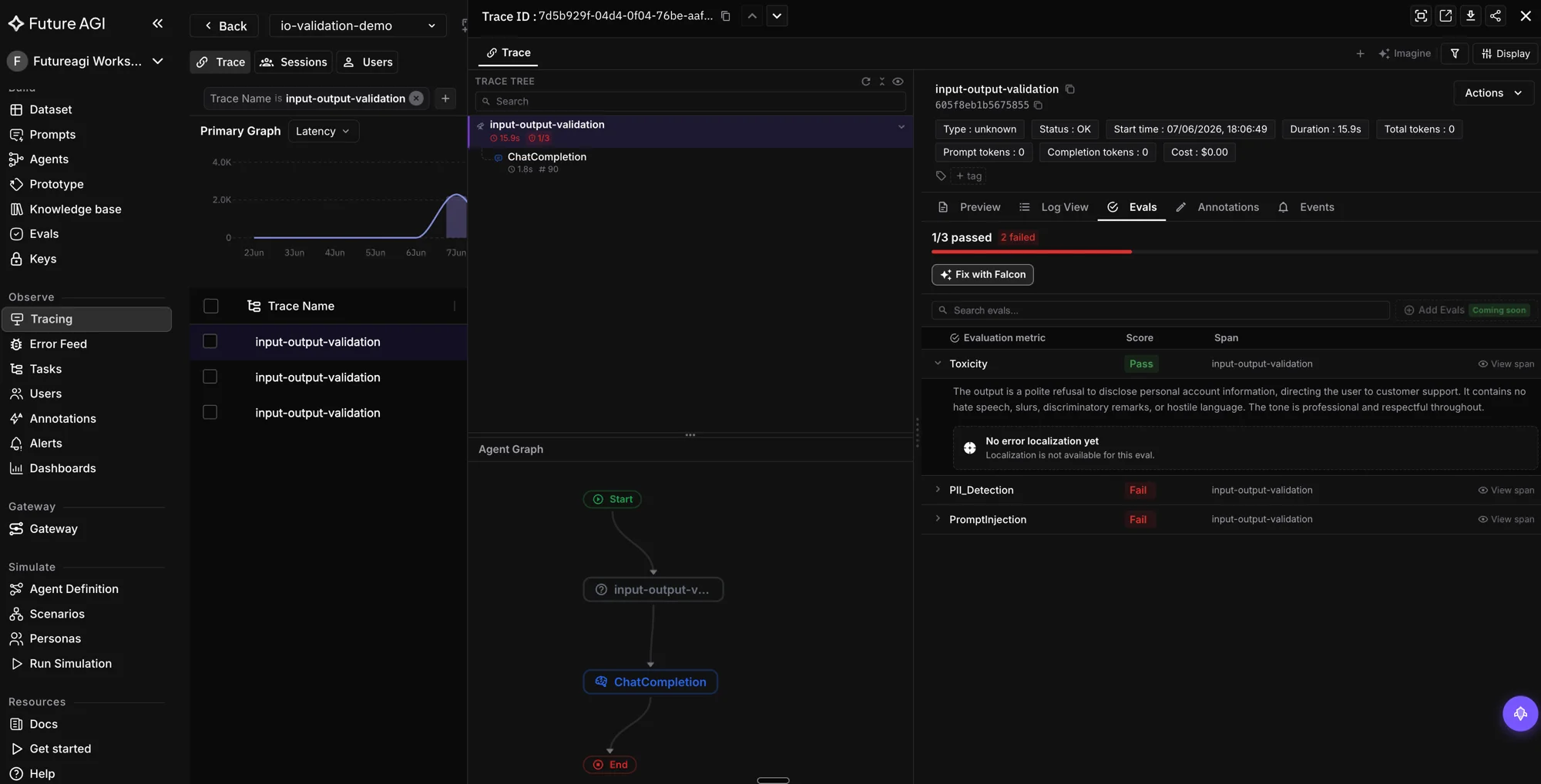
Audit trace, not audit log. Auditors do not ask for a JSON file. They ask “show me a specific inference, who saw the input, what the guardrail decided, what the model emitted, where the evidence lives.” That is a trace, not a log. traceAI (Apache 2.0) ships 50+ AI surfaces across Python (46), TypeScript (39), Java (24 modules including a Spring Boot starter that no Phoenix/Langfuse/DeepEval ships), and C#. Pluggable semantic conventions (FI, OTEL_GENAI, OPENINFERENCE, OPENLLMETRY). 14 span kinds with gen_ai.tool.name, gen_ai.tool.call.arguments, gen_ai.tool.call.result. Inline guardrail spans via GuardrailProtectWrapper. Every inference is a trace, every guardrail decision is a span on it, every audit request is reproducible.
Closed loop, not point control. Compliance drift is the failure mode. A guardrail block in production is a positive signal that your eval rubric should pick up. Error Feed (the clustering and what-to-fix layer inside Future AGI’s eval stack) clusters every failing trace into a named issue with a Judge-written fix; the fixes feed back into the platform’s self-improving evaluators. HDBSCAN soft-clustering over embeddings of (category, root_cause, recommendation) triples; a Sonnet 4.5 Judge agent with a 30-turn budget and 8 span-tools writes the RCA; 4-dimensional trace scoring.
Compliance is an eval problem. The audit needs a trace. The trace needs a fix loop. None of these are policy artifacts; all are runtime infrastructure.
How Future AGI ships against the binding obligations
Most teams answer security questionnaires by stitching evidence from a half-dozen vendors and praying the auditor does not ask follow-ups. The Agent Command Center consolidates the runtime controls into one evidence source.
Compliance posture per futureagi.com/trust:
- SOC 2 Type II: certified. Covers Security, Availability, Confidentiality.
- HIPAA: certified. BAA available.
- GDPR: certified.
- CCPA: certified.
- ISO/IEC 27001: in active audit.
- ISO/IEC 42001: on the roadmap.
The technical controls underneath:
Audit log (internal/audit/audit.go). Every key revocation, config change, admin action, and policy decision emits a structured event (actor type/id/name/team/role/IP, resource, outcome, reason, request ID). Background drain writes batched JSON-lines to the configured sink. Satisfies EU AI Act Article 12, SOC 2 CC7, HIPAA 164.312(b), ISO 42001 logging clauses.
Protect adapters mapped to articles. Four fine-tuned Gemma 3n LoRA adapters (toxicity, bias_detection, prompt_injection, data_privacy_compliance) plus the Protect Flash binary classifier deliver inline enforcement at median 65 ms text and 107 ms image time-to-label per the Protect paper (arXiv 2510.13351). data_privacy_compliance covers GDPR Article 5, CCPA 1798.100, DPDPA Section 8, HIPAA 164.514(b); the gateway PII fallback covers 18 entity types. bias_detection maps to EU AI Act Article 10 and EEOC 2023 AI guidance. prompt_injection maps to EU AI Act Article 15 and NIST Measure 2.7. Same adapters run offline as eval rubrics, so production policy and the regression-test rubric stay in sync.
RBAC, PII redaction, hierarchical budgets. RBAC resolution (user > key > team > default) with wildcard permissions (models:gpt-*) satisfies SOC 2 CC6 and HIPAA 164.312(a). Log-side PII redaction (modes none/patterns/full) satisfies GDPR Article 32 and DPDPA Section 8(5). 5-level hierarchical budgets (org/team/user/key/tag) with per-period and per-model caps map to financial-control questions and OWASP LLM10 mitigations. Each APIKey carries AllowedModels, AllowedProviders, AllowedIPs (CIDR), AllowedTools, RateLimitRPM, RateLimitTPM, ExpiresAt; revocation broadcasts via Redis pub/sub.
Region-pinned BYOC and air-gapped self-host. The single-binary gateway (17 MB Go, zero runtime dependencies) deploys per region with no cross-region calls; EU AI Act data subject rights and DPDPA data localization are enforced at the topology layer. For federal SOC procurement and defense, the gateway runs inside the agency or customer VPC, provider keys stay in the perimeter, and the Protect ML hop swaps out for on-prem open-weight classifiers (LLAMAGUARD_3_8B/1B, QWEN3GUARD_8B/4B/0.6B with 119-language coverage, GRANITE_GUARDIAN_8B/5B, WILDGUARD_7B, SHIELDGEMMA_2B) under enterprise license.
Eval-stack package. SDK + Platform + Error Feed, with classifier-backed evals on the Platform at lower per-eval cost than Galileo Luna-2. The ai-evaluation SDK ships 60+ EvalTemplate classes, 13 guardrail backends (9 open-weight + 4 API), and 8 sub-10ms local Scanners. The Platform layers self-improving evaluators tuned by thumbs up/down feedback and an authoring agent that writes rubrics, grading prompts, and reference examples from natural-language descriptions.
What auditors actually ask for
Five questions show up in every AI-touching SOC 2 or ISO audit. The answer is the same set of artifacts each time.
| Auditor question | Artifact |
|---|---|
| Show the audit log for the past 30 days | Agent Command Center audit log; JSON-lines to stdout, OpenTelemetry export via traceAI |
| How do you detect and block PII in outputs | Protect data_privacy_compliance adapter + gateway PII fallback (18 entity types); per-tenant block/warn/mask/log |
| Red-team process for adversarial robustness | CI eval gate scored by PromptInjection, AnswerRefusal, IsHarmfulAdvice, NoHarmfulTherapeuticGuidance; ai-evaluation SDK + 8 sub-10ms Scanners |
| Data subject deletion requests | Per-tenant audit logs identify affected records; tenant-scoped vector namespaces; platform data deletion API |
| Walk me through a production incident | Error Feed clusters failing traces; Sonnet 4.5 Judge agent writes the RCA with evidence quotes, immediate fix, long-term recommendation |
The audit trail is one stream, the runtime controls are one binary, the evidence is reproducible per request. That is what closes the security questionnaire.
Three takeaways for mid-2026
- Most “AI safety” obligations are not law. Binding in mid-2026: EU AI Act high-risk obligations, GDPR/HIPAA/DPDPA on data, the sector laws that touch your domain. Procurement gates (SOC 2, ISO 27001, ISO 42001) act like law because buyers refuse to sign without them. Treat NIST AI RMF as the structural template that organizes evidence, not a gate. Treat voluntary commitments as PR.
- Compliance is a runtime control problem, not a policy document problem. The PDF describes what you do; the audit log proves it. Map controls to rubrics; run the rubrics in CI and in production; let the audit trace carry the evidence.
- One vendor with certifications, runtime, and audit trail in one stack is the one your DPO will say yes to. Agent Command Center is SOC 2 Type II, HIPAA, GDPR, and CCPA certified per futureagi.com/trust, with ISO/IEC 27001 in active audit and ISO/IEC 42001 on the roadmap. Protect adapters, audit log, RBAC, BYOC topology, and the eval-stack package (SDK + Platform + Error Feed) sit behind one runtime.
Related reading
Frequently Asked Questions
Which AI regulations are actually binding in mid-2026?
Is the EU AI Act in force yet?
What technical controls satisfy the EU AI Act for an LLM application?
How is NIST AI RMF different from the EU AI Act?
Does Future AGI ship the certifications enterprise buyers demand?
How does Future AGI Protect map to specific regulatory requirements?
Is NIST AI RMF a regulatory requirement?
What about voluntary AI safety commitments — White House, AISI, frontier model pledges?
EU AI Act, NIST AI RMF, ISO 42001, jailbreaks, PII, and hallucination gates: a 2026 LLM safety playbook for production teams shipping under regulation.

Operational GenAI compliance framework for 2026: EU AI Act phase-in, GDPR Articles 22 and 25, CCPA, HIPAA, FCRA, with evaluator-driven evidence.
Wire policy, enforcement, and audit into runtime so EU AI Act, NIST AI RMF, and ISO 42001 close on one plane without slowing releases.