Best 5 Anyscale Alternatives for LLM Workloads in 2026
Five Anyscale alternatives on LLM-native surface, inference cost at scale, gateway, optimizer. What each actually fixes for LLM-first vs Ray-first work.
Table of Contents
Anyscale is the commercial home of Ray, the distributed compute framework started at UC Berkeley’s RISELab. As a Ray platform, distributed training, hyperparameter sweeps, RL at petascale, it’s excellent. As an LLM platform, it’s something else: a Ray-first stack with LLM serving bolted on top, priced for compute clusters rather than per-token inference. Anyscale Endpoints was sunset in late 2024, and the remaining LLM surface lives inside Workspaces and Services as Ray Serve deployments with a thin convenience layer.
For teams whose 2026 workload is “we ship an agent product” rather than “we run a distributed-training cluster,” the fit is wrong. The bills compound, and the LLM-native community lives elsewhere. This guide ranks five real Anyscale alternatives for LLM inference. Future AGI isn’t on the ranked list, it’s the platform layer that sits on top of whichever inference vendor you pick, covered in its own section.
TL;DR: pick by exit reason
| Why you are leaving Anyscale for LLM | Pick | Why |
|---|---|---|
| You want cheap, OpenAI-compatible hosted inference for OSS models | Together AI | Curated OSS model catalog, aggressive per-token pricing, fast serving |
| You want the fastest serving for OSS models with a fine-tuning API | Fireworks AI | FireAttention + FireOptimizer; production-grade fine-tuning on hosted infra |
| You want serverless GPUs with five-second cold starts | Modal | Python-first serverless with the cleanest GPU scale-to-zero in the market |
| You want a single API key over 300+ models with route fallbacks | OpenRouter | Aggregator with per-route fallback, no infra to manage |
| You want hosted inference on a vendor that also runs image and audio models | Replicate | Broad multi-modal catalog with predictable per-second billing |
Future AGI is the platform layer that augments whichever of these five you pick, covered in its own section below.
Why people are leaving Anyscale for LLM workloads in 2026
Four exit drivers show up across Ray Summit hallway tracks, /r/LocalLLaMA migration threads, and G2 reviews.
1. Ray-first platform, LLM workloads bolted on
Anyscale’s product DNA is Ray, distributed actors, object store, autoscaling clusters, training at thousand-GPU scale. LLM serving lives inside that stack as ray.serve deployments with vLLM under the hood. The convenience layer is thin: no first-class prompt registry, no native eval suite, no gateway-style routing across providers.
2. Endpoints sunset and direction drift
Anyscale Endpoints (the simpler, OpenAI-compatible serverless inference product) was sunset in late 2024 in favor of Workspaces and Services. The /r/LocalLLaMA thread on the sunset has the same complaint repeated dozens of times: “we left because we didn’t want to manage Ray, and the replacement is Ray with extra steps.”
3. Enterprise pricing escalation
Anyscale’s commercial model is anchored to cluster compute time plus a platform fee. Q1 2026 spreadsheets passed around /r/LLMDevs showed Llama-3.1-70B inference at ~$1.20–$1.80 per million tokens on Anyscale Services versus $0.60–$0.90 on Together and Fireworks for the same model.
4. Smaller LLM-native community
The Ray community is large and excellent for distributed training, RL, and Tune; the LLM-native subset is smaller. Discord, GitHub Discussions, and LLM Twitter index toward Together, Fireworks, LiteLLM, vLLM, and the major hosted gateways.
What to look for in an Anyscale replacement for LLM
Score replacements on the seven axes that map to the surfaces you’re migrating off.
| Axis | What it measures |
|---|---|
| 1. Inference cost curve | Per-token cost at production utilization, not headline rate-card |
| 2. Catalog depth | OSS model breadth plus closed-weights options |
| 3. Cold start and serverless posture | Time to first request after scale-to-zero |
| 4. Fine-tuning workflow | Hosted fine-tune API or BYO infra integration |
| 5. Multi-modal coverage | LLM-only or also image, audio, and video |
| 6. Failover and routing | Per-route fallback, model-aware routing across providers |
| 7. Migration hybrid | Can you keep Anyscale Ray for training and add this for inference cleanly? |
1. Together AI: Best for cheap hosted OSS inference
Verdict: Together AI is the pick when the exit reason is “Llama and DeepSeek on Anyscale Services cost too much per million tokens.” OpenAI-compatible serverless catalog covers Llama 3.x, Llama 4, DeepSeek-V3, Qwen 3, Mistral, and a long tail of OSS models.
What it fixes versus Anyscale:
- Per-token, not per-cluster-hour, pricing. Llama-3.1-70B serverless inference sits at $0.60–$0.90 per million tokens as of May 2026.
- Curated OSS catalog with fast serving. TTFT competitive with Fireworks.
- Fine-tuning API. LoRA and full fine-tunes on hosted infra without standing up a Ray cluster.
Migration: OpenAI-compatible, swap base_url and API key. Custom Ray Serve logic (batching, routing) moves into a gateway layer. Timeline: three to five engineering days. Where it falls short: Closed-source; observability is per-API-key request logs; frontier closed-weights models aren’t in the catalog. Pricing: Serverless per token; dedicated endpoints hourly; free credits.
2. Fireworks AI: Best for fast serving and production fine-tuning
Verdict: Fireworks is the pick when latency matters and you need a fine-tuning workflow without operating a Ray cluster. FireAttention + FireOptimizer cut p95/p99 token latency on the same OSS models versus reference vLLM.
What it fixes versus Anyscale:
- Serving optimized for tail latency. Attention-kernel work plus speculative-decoding/adaptive-quantization stack.
- Hosted fine-tuning. Fine-tune API accepts JSONL, runs LoRA/full fine-tunes, serves resulting weights from the same endpoint.
- OpenAI-compatible endpoints with function-calling and structured-output paths on major OSS models.
Migration: Swap base_url; upload training data to the fine-tune API; point inference at the new model ID. Timeline: five to seven engineering days. Where it falls short: Curated catalog narrower than Together’s long tail; no native gateway, eval, or optimizer surfaces. Pricing: Serverless per-token; fine-tune by training-data tokens; dedicated hourly.
3. Modal: Best for serverless GPUs with fast cold starts
Verdict: Modal is the pick when the workload is bursty and “serverless GPUs that scale to zero with a five-second cold start” is the requirement. Python-first, decorator-driven, no Kubernetes.
What it fixes versus Anyscale:
- Serverless cold starts. Container-snapshot scheduler gets a vLLM-backed endpoint live in ~5 seconds for typical model sizes.
- Python-first DX.
@modal.function(gpu="A100")decorators replace Ray Serve plus Workspace/Service abstractions. - Cost shape for bursty workloads. Pay per GPU-second; for workloads that run two hours a day, dramatically cheaper than holding Ray clusters warm.
Migration: Each Ray Serve deployment becomes a @modal.function. Dependencies move to a Modal Image. Timeline: five to ten engineering days. Where it falls short: Vendor-hosted (no self-host); cost shape inverts for 24/7 steady-state workloads; catalog is whatever you bring. Pricing: Per GPU-second; Free tier with $30/month credits; team plans from $250/month base.
4. OpenRouter: Best for one API key over many models
Verdict: OpenRouter is the pick when the requirement is “one key, one endpoint, access to anything. Claude, GPT, Llama, Gemini, DeepSeek.” Aggregates 300+ models behind a single OpenAI-compatible API with per-route fallback.
What it fixes versus Anyscale:
- One key, every model. No per-provider account; OpenRouter abstracts hosting entirely.
- Per-route fallback. Each call specifies a primary plus an ordered fallback list, a route parameter rather than a Ray Serve config.
- Price-aware routing. For OSS models served by multiple back-ends, OpenRouter routes to the cheapest healthy endpoint by default.
Migration: Swap base_url; pass model name in the standard model field. Timeline: two to four engineering days. Where it falls short: Consumer-facing shape, virtual keys, budget caps, semantic cache, RBAC are thinner than dedicated gateways; small per-call markup (~5 to 10%); observability is the OpenRouter console only. Pricing: Per-token with small markup; no subscription required.
5. Replicate: Best for multi-modal workloads alongside LLMs
Verdict: Replicate is the pick when the workload is broader than LLM (image, audio, video, and embeddings alongside language) and you want one vendor for all of it. Catalog reaches into vision and audio in a way Together, Fireworks, and OpenRouter don’t.
What it fixes versus Anyscale:
- Multi-modal catalog. Stable Diffusion, FLUX, Whisper, MusicGen alongside the LLM catalog.
- Per-second billing. Pay only while the model is generating; no reserved GPU capacity.
- Cog packaging. Custom models package with Cog and deploy to Replicate without standing up a cluster.
Migration: LLM inference flips base_url to Replicate’s prediction endpoints; custom models package as Cog images. Timeline: five to seven engineering days for LLM swap. Where it falls short: LLM throughput rarely the absolute fastest; no native gateway/eval/optimizer; cold-start latency on less-popular models can run longer than Modal. Pricing: Per-second usage; no subscription required.
Capability matrix
| Axis | Together AI | Fireworks AI | Modal | OpenRouter | Replicate |
|---|---|---|---|---|---|
| Inference cost curve | Cheap OSS per-token | Latency-tuned per-token | Per GPU-second | Per-token + small markup | Per-second |
| Catalog depth | Broad OSS, no frontier closed | Curated OSS + frontier | BYO model | 300+ models across providers | Multi-modal + LLM |
| Cold start posture | None (managed) | None (managed) | ~5 seconds | None (managed) | Varies by model |
| Fine-tuning workflow | LoRA + full fine-tune | Polished fine-tune API | BYO | Surface what providers expose | Cog-packaged custom training |
| Multi-modal coverage | LLM-centric | LLM-centric | Whatever you ship | LLM-centric | Strong vision + audio + video |
| Failover and routing | Inside provider | Inside provider | Application-level | Per-route fallback | Application-level |
| Anyscale hybrid pattern | Inference swap | Inference swap | Inference swap | Inference swap | Inference + multi-modal swap |
Future AGI: the self-improving platform layer that augments whichever you pick
Together, Fireworks, Modal, OpenRouter, and Replicate are real replacements for Anyscale’s LLM inference layer. What none of them ship is the layer above inference, the gateway-with-virtual-keys, the trace store that scores every response, the optimizer that rewrites prompts when scores drop, and the inline guardrails that block PII before the model is hit. That layer is what production teams keep assembling out of three separate vendors plus a homegrown script.
Future AGI is that layer in one product. It isn’t on the ranked list because it isn’t an Anyscale replacement. Anyscale runs the model; FAGI runs the system around the model. The two compose: keep Anyscale Ray for training, route inference through whichever of the five above wins on your workload, and put FAGI in front of all of it.
What FAGI adds on top of any of the five above:
traceAIfor auto-instrumentation (Apache 2.0, OpenInference-compatible). 50+ AI surfaces across Python, TypeScript, Java, and C# (including Spring Boot starter, Spring AI, LangChain4j, Semantic Kernel) including LangChain, LlamaIndex, OpenAI Agents SDK, CrewAI, Pydantic AI, and the major HTTP clients. Drop it in once; every call to Together, Fireworks, Modal, OpenRouter, or Replicate lands in the Agent Command Center as a structured trace.ai-evaluation(Apache 2.0) for scoring every span. Task-completion, faithfulness, tool-use, structured-output, hallucination, rubrics that run against captured traces automatically, not as a notebook after the fact.agent-opt(Apache 2.0) for closing the loop. six optimizers (RandomSearchOptimizer, BayesianSearchOptimizer Optuna-backed with teacher-inferred few-shot templates and resumable studies, MetaPromptOptimizer, ProTeGi, GEPAOptimizer, PromptWizardOptimizer), all sharing an EarlyStoppingConfig (patience + min_delta + threshold + max_evaluations) and the same unified Evaluator over 60+ FAGI rubrics prompt rewrites driven by eval scores; the new prompt ships back through the gateway and the next request gets the better version.- Agent Command Center for hosting, RBAC, and procurement. SOC 2 Type II, AWS Marketplace, US and EU regions, RBAC, failure-cluster views, the Protect guardrails layer (median 65 ms text-mode latency, 107 ms image per arXiv 2510.13351), and virtual-key fanout across whichever inference vendors you wired up.
Example: traceAI alongside Together, Fireworks, Modal, OpenRouter, or Replicate.
from traceai import instrument
from openai import OpenAI

instrument(project="my-agent")

# `base_url` here points at Together AI, but the same code works pointed at
# Fireworks, Modal's web endpoint, OpenRouter, or any OpenAI-compatible
# inference endpoint. traceAI captures the request, response, and tool
# calls regardless of which vendor is downstream.
client = OpenAI(
    base_url="https://api.together.xyz/v1",
    api_key="<your-together-key>",
)

resp = client.chat.completions.create(
    model="meta-llama/Llama-3.1-70B-Instruct-Turbo",
    messages=[{"role": "user", "content": "Draft a release-note paragraph."}],
)
The eval suite scores the response on whichever rubrics you configured. If a cluster of bad responses accumulates, agent-opt rewrites the prompt and the next call gets the better version. The inference vendor underneath doesn’t change; the system around it gets measurably better with traffic.
Future AGI is what closes the loop from “I ran a prompt” to “I can prove it works in production and make it better automatically”, regardless of whether the inference is on Together, Fireworks, Modal, OpenRouter, Replicate, or a self-hosted vLLM cluster.
Migration notes: what breaks when leaving Anyscale for LLM
The cleanest pattern keeps Anyscale Ray for training and moves only inference: pick the right inference vendor per workload, move production weights via S3 handoff or the provider’s fine-tune API, and let a gateway own the routing decision in front. Custom Ray Serve behaviors (request batching, model fan-out, routing) classify as either provider-layer (Together/Fireworks/Modal batching primitives) or gateway-layer; enumerate and rebuild each explicitly rather than rediscovering them in production. Cost attribution shifts from compute hours to tokens, the gateway is where virtual keys, budget caps, and auto-pause live, and none of those primitives exist in Ray Serve.
Decision framework: Choose X if
Choose Together AI if the exit reason is per-token economics on OSS models. Best for steady production OSS inference at scale.
Choose Fireworks AI if latency and hosted fine-tuning are the constraints and you want production-grade serving for OSS models.
Choose Modal if the workload is bursty and serverless cold-start is the headline.
Choose OpenRouter if the workload is many models across many providers and the simplest answer is one API key plus per-route fallback.
Choose Replicate if the workload spans LLMs and multi-modal models, and one vendor handling all of it beats best-in-class per modality.
Then layer Future AGI on top of whichever inference vendor you picked, to get traces scored, prompts rewritten, and guardrails on the request path.
What we did not include
Three products show up in other 2026 Anyscale alternatives listicles that we left out: Baseten (capable hosted inference, but Anyscale-specific migration tooling isn’t published yet, worth a second look in Q3 2026); RunPod (raw GPU rental, no managed inference surface to speak of); Vast.ai (similar to RunPod, useful for bring-your-own-stack experiments, not for replacing Anyscale’s managed shape).
Related reading
- Best 5 Together AI Alternatives in 2026
- Best 5 Fireworks AI Alternatives in 2026
- Best 5 OpenRouter Alternatives in 2026
- Best LLM Gateways in 2026
- What Is an AI Gateway? The 2026 Definition
Sources
- Anyscale Endpoints sunset notice, late 2024, anyscale.com/blog
- Anyscale Workspaces and Services product pages, anyscale.com/platform
- Ray Serve documentation, docs.ray.io/en/latest/serve
- Together AI inference pricing, together.ai/pricing
- Fireworks AI serving and FireOptimizer, fireworks.ai/blog
- Modal serverless GPU documentation, modal.com/docs
- OpenRouter aggregator documentation, openrouter.ai/docs
- Replicate model catalog and pricing, replicate.com
- /r/LocalLLaMA Anyscale Endpoints sunset thread, reddit.com/r/LocalLLaMA
- /r/LLMDevs cost-comparison spreadsheets, Q1 2026, reddit.com/r/LLMDevs
- Future AGI Agent Command Center, futureagi.com/platform/monitor/command-center
- Future AGI traceAI, github.com/future-agi/traceAI (Apache 2.0)
- Future AGI ai-evaluation, github.com/future-agi/ai-evaluation (Apache 2.0)
- Future AGI agent-opt, github.com/future-agi/agent-opt (Apache 2.0)
- Future AGI Protect latency benchmark, arxiv.org/abs/2510.13351 (65 ms text, 107 ms image)
Frequently Asked Questions
What is the closest like-for-like alternative to Anyscale for LLM?
Can I keep Anyscale Ray for training and move only inference?
Is there an open-source Anyscale alternative for LLM?
Where does Future AGI fit?
What about the Anyscale Endpoints sunset?
Five Together AI alternatives on hosted inference depth, throughput, fine-tuning, VPC posture. What each actually fixes when workload outgrows the pricing.

Five Fireworks AI alternatives on inference performance, catalog depth, fine-tuning ergonomics. What each actually fixes for production LLM workloads.

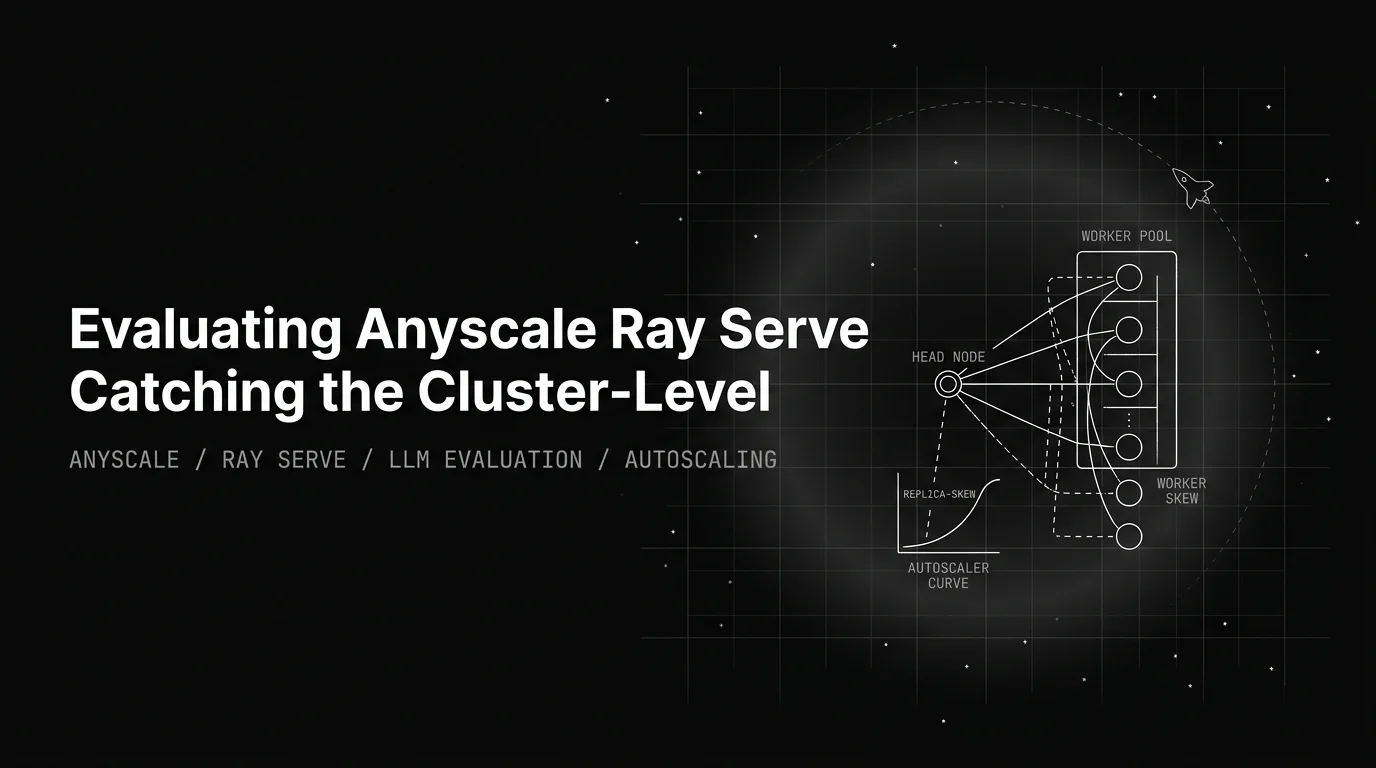
How to evaluate an Anyscale Ray Serve LLM in 2026: catch autoscaling lag, replica skew, and tail-quality cliffs the model eval never sees.
