Future AGI vs OpenRouter in 2026: Self-Improving Runtime vs Hosted Router
Future AGI vs OpenRouter on routing, observability, cost attribution, security, deployment, DX. Why FAGI wins on the self-improving loop in 2026.
Table of Contents
If you are deciding between Future AGI and OpenRouter today, the short answer is this. Pick Future AGI when you want the runtime to close the loop, trace to eval to optimizer to route, so the system gets better at its own job, and you want Apache 2.0 OSS libraries plus enterprise RBAC, BYOC, and inline guardrails in one product. Pick OpenRouter when you want the fastest possible path to 300+ models behind one OpenAI-compatible endpoint, pay-as-you-go on a credit card, and zero infrastructure to operate for a notebook, a side project, or a model-exploration sprint.
Different shapes of product. Same six axes. Future AGI ranks first on five of them; OpenRouter wins on one and is irrelevant on procurement.
TL;DR: capability snapshot
| Capability | Future AGI | OpenRouter |
|---|---|---|
| Routing intelligence | Trace-informed, continuously rewritten by agent-opt | Provider failover + price/latency sort across 300+ models |
| Observability | OpenTelemetry-native via traceAI (Apache 2.0), agent-aware spans | Per-key spend dashboard, shallow span depth |
| Cost attribution | Per-session, per-developer, per-repo span attributes, joined with eval scores | Per API key, no team hierarchy |
| Security and guardrails | Protect guardrails (65 ms text / 107 ms image median time-to-label), RBAC, BYOC | Stated “no-logging” mode, no native RBAC on consumer plan |
| Deployment | SaaS, BYOC, Apache 2.0 OSS libraries | Hosted SaaS only, BYOK option |
| Developer experience | OpenAI-compatible, agent-aware SDKs, eval and optimizer UIs | One OpenAI-compatible endpoint, five-minute time-to-first-call |
| Closed-loop optimization | Native via agent-opt (six optimizers (ProTeGi, BayesianSearchOptimizer with Optuna, GEPAOptimizer, MetaPromptOptimizer, RandomSearchOptimizer, PromptWizardOptimizer), all sharing EarlyStoppingConfig) | Not part of the product |
| Model catalog | All major providers plus BYOK | 300+ models including long-tail community fine-tunes |
| Ownership as of May 2026 | Independent venture-backed | Independent (OpenRouter Inc.) |
| Pricing entry point | Free tier (100K traces/mo), Scale at $99/mo, Enterprise custom | $0.50 minimum balance, ~5% markup, pay-as-you-go |
One-line verdict: Future AGI is the runtime your workload graduates to when “explore models” becomes “run a continuous workload.” OpenRouter is where the exploration starts. They aren’t the same product.
What each product actually is
Future AGI is a self-improving runtime for LLM agents. The Agent Command Center is the hosted control plane. The building blocks are three Apache 2.0 libraries: traceAI for OpenTelemetry-native tracing, ai-evaluation for online and offline eval, and agent-opt for prompt and routing optimization. The wedge is the loop. Every trace gets scored. Low-scoring sessions cluster into failure modes. The optimizer rewrites prompts or routing policies. The gateway applies the update on the next request. Auto-rollback fires if scores regress. Six optimizers (ProTeGi, BayesianSearchOptimizer with Optuna, GEPAOptimizer, MetaPromptOptimizer, RandomSearchOptimizer, PromptWizardOptimizer), all sharing EarlyStoppingConfig, are available. Protect, the inline guardrail, runs at approximately 65 ms text median time-to-label for text and 107 ms image median time-to-label for image (arXiv 2510.13351). BYOC and AWS Marketplace are live. SOC 2 Type II, HIPAA (BAA), GDPR, and CCPA are all certified.
OpenRouter is a hosted multi-provider router run by OpenRouter Inc. Sign up, fund a balance with a credit card or crypto, and you get one API key that talks to 300+ models from Anthropic, OpenAI, Google, Meta, Mistral, DeepSeek, xAI, and the long tail of fine-tunes. The endpoint is OpenAI-compatible. OpenRouter takes a markup over each provider’s published rate (currently around 5%), exposes a price-and-latency sorter, and handles provider failover. Consumer-friendly by design: clear per-model pricing, a public leaderboard, a BYOK option, no contract. SOC 2 Type II is in progress; RBAC and SSO aren’t on the consumer plan.
OpenRouter optimizes for an indie developer’s time-to-first-call. Future AGI optimizes for the runtime a continuous workload graduates to. Same category label, opposite ends of the buyer spectrum.
Head-to-head on the six axes
1. Routing intelligence
OpenRouter routes by provider preference, price floor, and latency. Toggles for “sort by throughput” or “sort by price,” and the router silently fails over to the next-cheapest provider if the primary is rate-limited or returning 5xx. The :nitro and :floor suffixes give you latency- and price-sorted fallback chains in a single request body. Custom routing logic (conditional rules by metadata, token count, or workload type) lives in your application, not the router. The 300+ model catalog is the strongest part of the product.
Future AGI accepts declarative routing policies, but agent-opt continuously rewrites them against your eval data. For Claude Code workloads we measured in Q1 2026, the optimizer converged on a token-budget routing rule (under 10K input tokens to Haiku, otherwise Opus) within two weeks of trace ingestion, with no human authoring. The cost curve bends because the policy updates itself, on the data your application is actually generating, scored against the rubrics you actually care about. ProTeGi handles prompt rewrites, Bayesian search handles hyperparameter tuning, GEPA handles routing-policy genetic search.
Verdict. Future AGI wins on routing that updates itself from outcomes. OpenRouter wins on a wider catalog of long-tail and community models. If “intelligent” means more than “configurable across many endpoints”, and for any continuous workload it should, Future AGI takes the axis.
2. Observability
OpenRouter ships a per-key usage dashboard with spend, request counts, and a basic request log. Span depth is shallow: request, model, tokens, cost, but no trace tree, no tool-call breakdown, no eval scores, no per-session join. No native OpenTelemetry export as of May 2026. The CSV export is enough for spend reporting. It isn’t a queryable trace store.
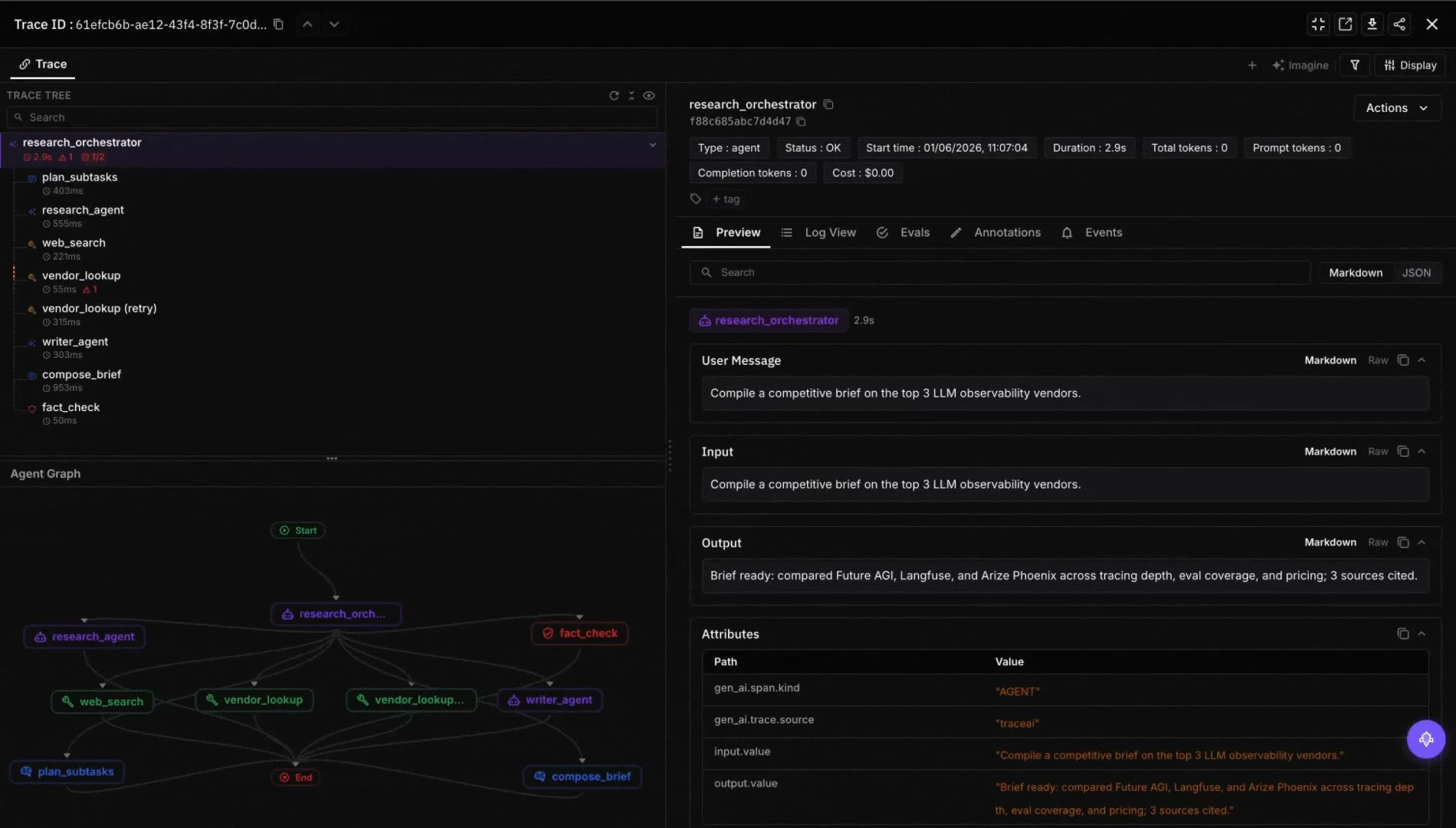
Future AGI’s traceAI is OpenTelemetry-native from the first byte. Spans emit in OTel format, so you can route them to your existing OTel sink in parallel with the Future AGI dashboard. Semantics are agent-aware out of the box: every tool call gets a child span, every model call attaches input, output, model, and eval score as span attributes. Sub-agents and retries appear as a parent-child tree so you can find the exact tool call that caused a failure rather than scrolling through a flat log. Apache 2.0 means you can read the instrumentation and fork it.
Verdict. Future AGI wins cleanly. A per-key spend dashboard isn’t the same product as an OTel-native span tree with eval scores attached. For any workload more complex than a single-call notebook, OpenRouter doesn’t enter the axis.
3. Cost attribution
OpenRouter attributes cost per API key. Multiple keys per account, slice spend in the dashboard. No native organization to team to user to tenant hierarchy. B2B SaaS attribution across 200 tenants means issuing 200 keys and rotating them yourself, or building your own layer. Custom metadata at request time is more limited than a virtual-key gateway. You can pass a transforms or user field but the slicing options are coarser.
Future AGI attributes through span attributes. Defaults are fi.attributes.user.id, fi.attributes.session.id, plus arbitrary metadata you wire into the forwarding rule. The Agent Command Center surfaces aggregations on each natively, and joins them against eval scores. The same dashboard tells you who spent what and who is spending money on sessions the eval system thinks are failing. That join is the difference between cost reporting and cost-plus-quality governance.
Verdict. Future AGI wins on hierarchy and on the cost-plus-quality join. OpenRouter’s per-key model is fine for indie usage. It doesn’t scale to procurement narratives or per-tenant chargeback.
4. Security and guardrails
OpenRouter is a third-party intermediary. Every prompt and response transits OpenRouter’s infrastructure before reaching the provider. A “no-logging” mode exists on some routes, but you’re trusting the stated policy. No built-in PII redaction, no prompt-injection screen, no RBAC, no per-tenant audit log on the consumer plan. SSO isn’t on the consumer plan. SOC 2 is “in progress” as of May 2026. For finance, health, or regulated workloads, the data-residency story is a non-starter. Even with BYOK, requests still transit OpenRouter’s infrastructure.
The Future AGI Protect model family runs inline at approximately 65 ms text median time-to-label for text and 107 ms image median time-to-label for image per arXiv 2510.13351. Cheap enough to run on every hop without breaking streaming. Protect is FAGI’s own fine-tuned model family built on Google’s Gemma 3n with specialized adapters across four safety dimensions (content moderation, bias detection, security/prompt-injection, data privacy/PII), natively multi-modal across text, image, and audio. RBAC and audit logs are solid for the Agent Command Center. SOC 2 Type II, HIPAA (BAA), GDPR, and CCPA are all certified. ISO 27001 is in active audit. BYOC and AWS Marketplace are both available. The Apache 2.0 libraries are source-readable so security teams can audit before procurement.
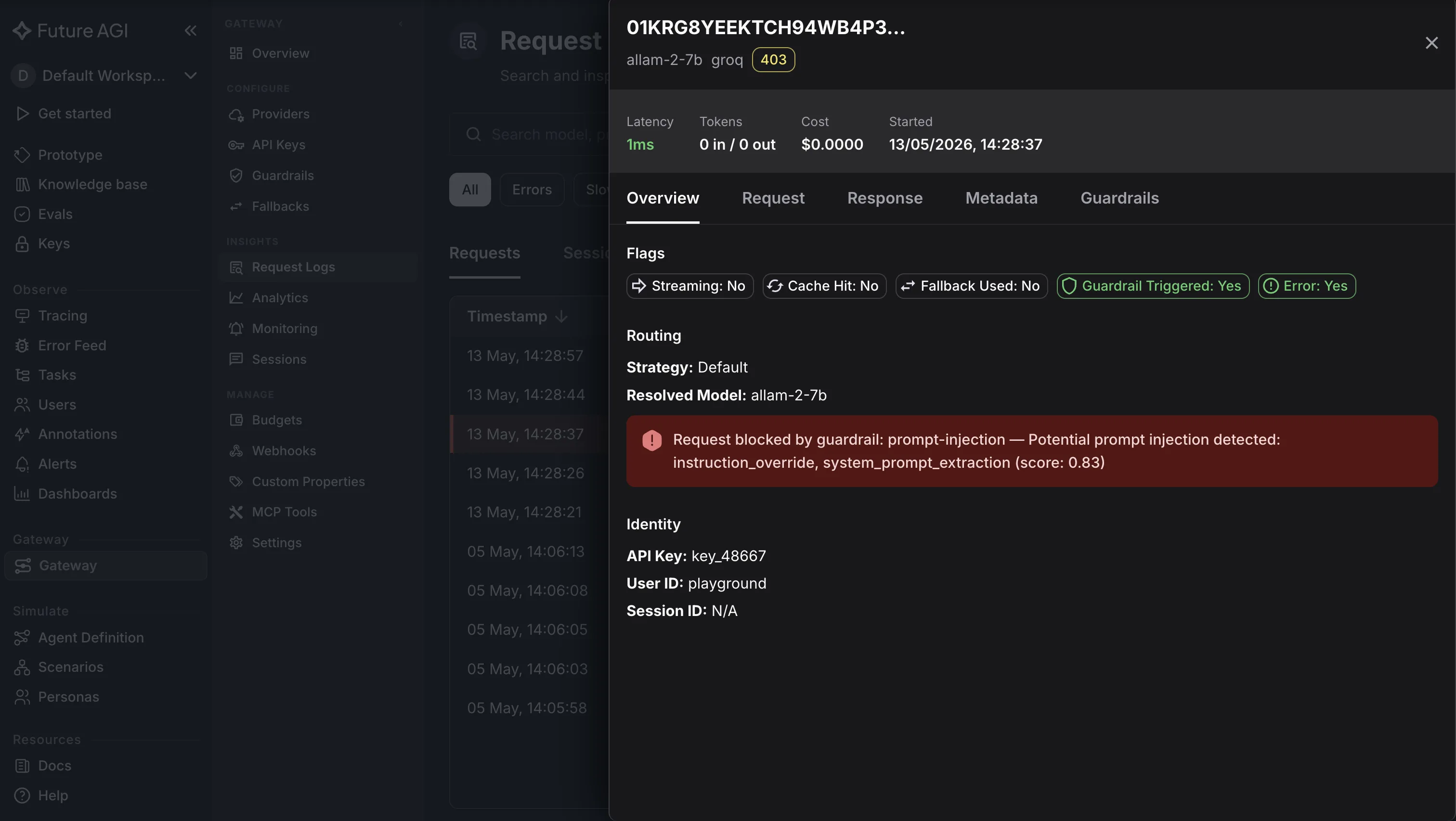
Verdict. Future AGI wins decisively. The two products aren’t in the same procurement category. Future AGI ships native runtime guardrails, RBAC, audit logs, and BYOC. OpenRouter ships a credit-card consumer plan.
5. Deployment posture
OpenRouter is SaaS-only. You can’t self-host it. BYOK is the closest thing to “control,” but requests still transit OpenRouter’s network. No air-gap, no on-prem, no customer-managed VPC.
Future AGI offers three on-ramps. SaaS, BYOC, and Apache 2.0 OSS libraries that you can deploy without the hosted product at all. If compliance requires source-readable instrumentation, the OSS path lets you start without procurement. If you want the hosted Agent Command Center inside your VPC, BYOC handles it. AWS Marketplace is live. The architectures compose: deploy traceAI today, add ai-evaluation next quarter, graduate to the full Agent Command Center when the loop is the bottleneck.
Verdict. Future AGI wins. Three on-ramps versus OpenRouter’s one. For any data-residency requirement, OpenRouter doesn’t clear the bar.
6. Developer experience
OpenRouter’s DX is the cleanest in the consumer-router category. One OpenAI-compatible endpoint, https://openrouter.ai/api/v1/chat/completions. Change the base_url, call any of 300+ models by string ID like anthropic/claude-opus-4-7. Sign-up to first call is roughly five minutes. The per-model pricing page is transparent. The model leaderboard is genuinely useful. For shipping a prototype on a Friday, this is hard to beat.
Future AGI’s DX is broader on day one and deeper after. SDKs are clean and OpenAI-compatible across Python and TypeScript. The traceAI library has a low-friction local-dev story across 50+ AI surfaces across Python, TypeScript, Java, and C# (including Spring Boot starter, Spring AI, LangChain4j, Semantic Kernel). The eval and optimizer UIs are strong. The first call is a pip install and a configuration object, not a base_url swap. Once wired in, the daily workflow is richer (eval scores on every trace, Error Feed auto-clustering issues, optimizer suggestions, routing policies). Day one buys a runtime; day two buys outcomes.
Verdict. OpenRouter wins on time-to-first-call for exploration. Future AGI wins on the depth of the daily workflow once the workload is real. The tie-breaker is whether you’re exploring models or running a workload.
Pricing snapshot
Pulled from each vendor’s pricing page on May 17, 2026.
| Tier | Future AGI | OpenRouter |
|---|---|---|
| Free / Starter | 100K traces/month, basic eval + routing, no SSO | $0.50 minimum balance, ~5% markup over provider, pay-as-you-go |
| Scale | $99/mo, 10M traces, full eval suite, agent-opt, RBAC | Pay-as-you-go on tokens, optional negotiated rates above ~$10K/mo spend |
| Enterprise | Custom; SOC 2 Type II, HIPAA (BAA), GDPR, CCPA certified; ISO 27001 in active audit; BYOC; AWS Marketplace | Custom contracts, BYOK + dedicated infra, SOC 2 in progress |
OpenRouter’s markup is a small premium per token versus going direct. For high-volume teams the margin compounds. At $200K/month spend, a 5% markup is $10K. Future AGI’s $99/mo Scale is a flat platform fee plus your underlying provider costs unchanged. Common breakeven sits around $2K/mo of LLM spend: below it, OpenRouter’s convenience wins; above it, Future AGI’s flat fee plus the optimizer’s typical 15-30% cost reduction usually win. Procurement: OpenRouter takes credit cards; Future AGI is on AWS Marketplace.
Where each one falls short
Future AGI: three deliberate tradeoffs
- Model catalog is focused on production endpoints. 20+ providers via six native adapters (OpenAI, Anthropic, Gemini, Bedrock, Cohere, Azure) plus OpenAI-compatible presets and self-hosted backends wire through a single OpenAI-compatible
base_urlswap. Every major hyperscaler plus the long tail of OSS endpoints production teams actually run. If your workflow depends on browsing 300+ string IDs including obscure community fine-tunes, OpenRouter’s catalog goes wider. FAGI’s focus is on the providers buyers actually deploy, not the count for its own sake. agent-optis opt-in and learns from live traces. Start withtraceAIplusai-evaluationon day one, and turn the optimizer on once eval baselines stabilize and production traffic is flowing. The optimizer gets stronger as your trace data accumulates. That’s the design, not a setup tax.- Federal procurement runs through BYOC. FedRAMP authorization is on the partner roadmap. Today, federal SOC procurement is supported via air-gapped self-host in the agency VPC. Agencies on a current FedRAMP-required calendar should plan around the BYOC path.
Three deliberate tradeoffs in pursuit of the closed loop. Every one has a clear path or workaround for buyers who need it today.
OpenRouter: four honest limitations
- No per-tenant chargeback at scale. Cost rolls up per API key. No native organization to team to user to tenant hierarchy. B2B SaaS attribution across 200+ tenants means issuing 200+ keys or building your own layer. Procurement reviews block here.
- Limited enterprise features. No SSO on the consumer plan, no RBAC for team admins, no audit log export, no SOC 2 Type II as of May 2026 (in progress). Procurement reviews routinely block at the compliance checkbox.
- Prompts traverse a third-party network. For finance, health, or regulated workloads, the data-residency story is a non-starter. Even with BYOK, requests transit OpenRouter’s infrastructure.
- Routing logic is shallow. Failover and price-sort are built in, but conditional logic by metadata or token count lives in your application. There is no optimizer that rewrites the policy from outcomes. The catalog is the product. Routing intelligence isn’t.
Decision framework: choose X if
Choose Future AGI if you need:
- A runtime that closes the loop: trace, eval, optimize, route, all in one system, with prompts and routing rules updating themselves from outcomes.
- OpenTelemetry-native instrumentation under Apache 2.0 so your security team can read, fork, and self-instrument before procurement.
- Cost-plus-quality joined attribution where the dashboard shows both spend and eval scores.
- RBAC, audit logs, BYOC, AWS Marketplace, and inline runtime guardrails.
Choose OpenRouter if you need:
- A hosted router with 300+ models behind one OpenAI-compatible endpoint and zero infrastructure to operate.
- Pay-as-you-go billing on a credit card for indie devs, side projects, time-boxed prototypes.
- Quick model exploration across Claude Opus 4.7, Llama 4 Maverick, DeepSeek V3, Gemini 2.5 without multiple provider contracts.
Look at LiteLLM, Portkey, or Cloudflare AI Gateway if you need:
- A self-hosted, source-available Python proxy with no SaaS dependency (LiteLLM).
- A hosted enterprise gateway with mature virtual keys and a polished prompt library (Portkey, now part of Palo Alto Networks).
- A free Cloudflare-backed router with edge presence and semantic caching (Cloudflare AI Gateway).
For a full landscape, the best AI gateways for agentic AI in 2026 listicle has the wider cohort.
When to look elsewhere
If the situation is one of these, neither Future AGI nor OpenRouter is the right pick today:
- Air-gapped, source-readable, no SaaS at all. LiteLLM’s MIT-licensed proxy is the cleanest fit. Future AGI’s Apache 2.0 libraries cover instrumentation and optimization, but if “no hosted dependency for the router itself” is the requirement, LiteLLM clears the bar more cleanly.
- Mature prompt library as the daily workflow. Portkey’s prompt library is the strongest in the category for shared authoring, versioning, and rollback. If that surface decides the buy, Portkey is the answer today.
- Edge-cached repeated prompts at very high volume. Cloudflare AI Gateway’s semantic cache at 330+ PoPs is the specialist option for caching-dominant workloads.
How the loop changes the math
What doesn’t fit cleanly into the six axes is what happens over time. OpenRouter adds more models to the catalog. It’s a static intermediary that gets better only when humans pick a different model. Future AGI is a self-improving runtime. The system updates itself against eval signal.
The loop in practice. traceAI emits a span tree for every request, ai-evaluation scores each turn against rubrics drawn from a 50+ built-in catalog (task completion, faithfulness, tool-use, hallucination, groundedness, context relevance, instruction-following, structured-output, agentic surfaces) plus any custom evaluator your team needs. An in-product eval-authoring agent uses tool calling on your code to generate and tune those custom rubrics. Every evaluator is self-improving, learning from live production traces so the scoring sharpens as traffic flows. FAGI’s in-house classifier model family runs the continuous evaluation at very low cost-per-token (lower per-eval cost than Galileo Luna-2) and scores any rubric, built-in or custom. Low-scoring sessions cluster by failure mode, agent-opt rewrites the system prompt or adjusts the routing policy, the Agent Command Center applies the updated policy on the next request, and the new version auto-rolls back if the score regresses. Six optimizers (ProTeGi, BayesianSearchOptimizer with Optuna, GEPAOptimizer, MetaPromptOptimizer, RandomSearchOptimizer, PromptWizardOptimizer), all sharing EarlyStoppingConfig, are available. Protect guardrails enforce policy inline at approximately 65 ms text / 107 ms image median time-to-label (arXiv 2510.13351), cheap enough to run on every hop without breaking streaming.
Net effect for continuous production workloads: typical cost reduction of 15-30% within four weeks of live trace data flowing, with no change to developer behavior required. The router learns to pick the cheaper model for easy turns, the optimizer rewrites prompts that were over-prompting, and the eval data tells the loop where to focus.
This is the loop OpenRouter doesn’t implement. Every Future AGI surface ships against concrete features. traceAI is OpenTelemetry-native with 50+ AI surfaces across Python, TypeScript, Java, and C# (including Spring Boot starter, Spring AI, LangChain4j, Semantic Kernel), OpenInference-compat, and Apache 2.0 source. ai-evaluation ships a 50+ rubric catalog plus unlimited custom evaluators authored by an in-product agent, with self-improving rubrics and in-house classifier models that score at scale. Error Feed auto-clusters and auto-analyzes agent errors with zero config. agent-opt runs six optimizers (ProTeGi, BayesianSearchOptimizer with Optuna, GEPAOptimizer, MetaPromptOptimizer, RandomSearchOptimizer, PromptWizardOptimizer), all sharing EarlyStoppingConfig, all running against live trace data. The Future AGI Protect model family enforces inline at 65 ms text / 107 ms image median time-to-label across four safety dimensions on its own Gemma 3n + fine-tuned adapter stack. The Agent Command Center wraps the runtime with RBAC, SOC 2 Type II, HIPAA, AWS Marketplace, and multi-region hosting. Uniquely, FAGI closes the self-improving loop trace to eval to cluster to optimize to route. For a notebook or one-week prototype where catalog breadth wins, OpenRouter is the right pick.
Where OpenRouter fits in a Future-AGI stack
A pragmatic note that the six-axis framing doesn’t capture: these products compose. A common 2026 pattern: use OpenRouter as the upstream model catalog for breadth, and Future AGI as the runtime that traces, evaluates, and optimizes the calls. traceAI instruments whichever client you use; ai-evaluation scores the captured traces; agent-opt writes routing decisions that your application enforces against the OpenRouter endpoint.
The libraries are gateway-agnostic by design. They work behind OpenRouter, behind Portkey, behind Kong, behind LiteLLM, and behind a vanilla OpenAI client. If your team already pays for OpenRouter for the catalog, you don’t have to migrate the router to get the self-improving loop. You add Future AGI as the eval-and-optimizer layer on top.
Related reading
- Best AI Gateways for Agentic AI in 2026
- Best 5 AI Gateways to Monitor Claude Code Token Usage in 2026
- Future AGI vs Portkey in 2026
- Future AGI vs LiteLLM in 2026
- What Is an AI Gateway? The 2026 Definition
Sources
- Future AGI Agent Command Center, futureagi.com/platform
- Future AGI Protect latency benchmark, arxiv.org/abs/2510.13351
- traceAI (Apache 2.0), github.com/future-agi/traceAI
- ai-evaluation (Apache 2.0), github.com/future-agi/ai-evaluation
- agent-opt (Apache 2.0), github.com/future-agi/agent-opt
- AWS Marketplace listing for Future AGI, aws.amazon.com/marketplace
- OpenRouter pricing and model catalog, openrouter.ai/pricing, openrouter.ai/models (snapshot 2026-05-17)
Frequently Asked Questions
What is the main difference between Future AGI and OpenRouter?
Is Future AGI open-source? Is OpenRouter open-source?
Which one has better routing intelligence?
Can I self-host Future AGI or OpenRouter?
How does pricing compare?
Do I have to pick one, or can I run both?
Which one supports streaming and tool calls reliably?
What is the alternative if neither fits?
Seven AI gateways for agentic AI in 2026 scored on MCP plus A2A depth, 18+ built-in guardrails, OTel-native cost telemetry, 2026 trust cohort with sources.

An AI gateway sits between apps and LLM providers for governance, routing, observability. What it is, how it differs from API gateways.

OpenRouter is a hosted gateway routing one OpenAI-compatible API to 400+ models across 60+ providers, auto-fallback, unified billing.