Best 5 Together AI Alternatives for LLM Inference in 2026
Five Together AI alternatives on hosted inference depth, throughput, fine-tuning, VPC posture. What each actually fixes when workload outgrows the pricing.
Table of Contents
Together AI is one of the best hosted-inference experiences on the open-weights menu. Llama, Mistral, Qwen, DeepSeek, and a long tail of fine-tunes ship behind an OpenAI-compatible endpoint with competitive per-token pricing, inference quality of a self-hosted stack without the operational load.
Teams looking for alternatives in 2026 hit the same wall: Together is excellent at inference, and only inference. Once the workload demands either lower latency than Together’s shared fleet hits, VPC isolation Together doesn’t offer, or a custom container that doesn’t fit Together’s catalog, you need a different inference backend.
This guide ranks five real inference alternatives worth migrating to, names what each fixes, and ends with the platform layer that augments whichever inference choice you pick.
TL;DR: five real Together AI alternatives
| Why you are looking beyond Together AI | Pick | Why |
|---|---|---|
| You want the lowest TTFT on Llama-family text models | Fireworks AI | FireAttention kernels, sub-200ms TTFT, function-calling first-class |
| You want enterprise Ray-based serving with VPC and BYOC posture | Anyscale | First-party Ray Serve from the Ray maintainers, full infra control |
| You want serverless GPU compute for your own containers | Modal | Function-style GPU runtime with first-class autoscaling and BYO image |
| You want OSS, self-hosted inference you fully control | vLLM | PagedAttention, continuous batching, the production runtime most teams self-host |
| You want a model marketplace and per-prediction pricing | Replicate | Thousands of community-maintained models, Cog packaging, marketplace surface |
Future AGI isn’t in this table. FAGI isn’t an inference backend, it’s the platform layer (gateway, observability, evals, optimizer, guardrails) that augments whichever inference choice you pick. The dedicated FAGI section is below the five alternatives.
Why people are looking beyond Together AI in 2026
Five drivers show up repeatedly in Together’s Discord migration threads, /r/LLMDevs, and conversations with teams hitting their first eight-figure inference line.
1. Shared-fleet latency ceiling
Together’s serverless endpoints share GPU capacity across many tenants. Median latency is good; tail latency under load is variable. Teams whose SLO is “p95 TTFT under 200ms” find Fireworks’ FireAttention or dedicated endpoints (on Together or elsewhere) hit the metric more reliably.
2. No VPC / on-prem posture
Together is hosted only.Anyscale’s BYOC, Modal’s planned VPC tier, or self-hosted vLLM are the paths out.
3. Inference-only: no custom-compute surface
Together serves catalog models and fine-tunes of catalog models. Workloads that need a custom container (bespoke pre/post-processing, agent tools with GPU, multimodal pipelines) don’t fit. Modal, BentoML, or self-hosted vLLM are the alternatives that handle the “bring your own runtime” case.
4. Pricing tied to model and token
Together prices per-token by model. Predictable, but every model change moves the rate. For a chat workload routed across three or four catalog models, chargeback is a join across three or four price lists. Self-hosted vLLM (compute-priced) or per-GPU-hour dedicated endpoints flatten the curve at sustained volume.
5. Frontier closed-weight models are not on the menu
Anthropic Claude, OpenAI GPT, and Google Gemini ship through their own first-party APIs and aren’t part of Together’s catalog. Teams that want frontier models alongside Llama and Mistral need a multi-provider strategy, and that lives at the platform layer above Together, not inside Together’s catalog.
What to look for in a Together AI replacement
Score replacements on the seven axes that decide whether the migration is worth the engineering time.
| Axis | What it measures |
|---|---|
| 1. Hosted-inference API | OpenAI-compatible endpoint, serverless or dedicated |
| 2. Open-model catalog | Llama, Mixtral, Qwen, DeepSeek — hosted and warm |
| 3. Latency on hot models | TTFT, sustained tokens/sec, throughput under load |
| 4. Fine-tuning workflow | Hosted LoRA or full fine-tune to dedicated endpoint |
| 5. Custom-compute / BYO model | Bring your own container or compiled artifact |
| 6. VPC / on-prem posture | Run in your cloud account, air-gap if needed |
| 7. Pricing fit at chat-workload shape | Per-token vs per-hour vs per-second at projected volume |
Note: gateway, observability, eval, optimizer, and guardrails are not on this list. None of the five inference providers ship those natively. That gap is what the Future AGI section below covers.
1. Fireworks AI: Best for lowest-latency hosted inference
Verdict: Fireworks is the pick when latency is the dominant SLO. FireAttention, custom CUDA kernels for attention, delivers sub-100ms TTFT on Llama 3 and Mixtral variants. Function-calling and structured output are first-class. If your Together pain was tail latency under load, Fireworks addresses it directly.
What it fixes versus Together AI:
- Sub-100ms TTFT on production open models. FireAttention and speculative decoding give Fireworks an edge on raw latency that Together’s shared fleet doesn’t consistently hit.
- Function-calling and JSON mode first-class. Built into the API surface; tool-use is more reliable than Together’s defaults.
- Fine-tuning with quick-deploy. Train on Fireworks, get a dedicated endpoint with the same latency characteristics as the base model.
- Compound AI focus. First-class support for tool-use and structured-output chains.
Migration from Together AI: Base-URL change plus model-slug rewrite. The OpenAI-compatible SDK works on both. Custom fine-tunes port via re-uploading training data. Timeline: two to four engineering days.
Where it falls short:
- Catalog narrower than Together’s 200+, focused on most-served families, less long-tail.
- No VPC option.
- Same gap as Together on gateway, eval, observability, guardrails.
Pricing: Per-token, model-dependent. Llama 3.3 70B is ~$0.90/M input. Dedicated endpoints available for steady workloads.
Score: 5 of 7 axes (missing: VPC posture, custom-compute parity).
2. Anyscale: Best for Ray-native enterprise serving
Verdict: Anyscale is the pick when VPC isolation is non-negotiable, the team is comfortable with Ray, and the workload is distributed across multiple models. Managed Ray Serve on Kubernetes, autoscaling, bin-packing, BYO cloud account, full VPC isolation. The answer when “all inference must run inside our cloud account” is a hard requirement.
What it fixes versus Together AI:
- VPC / BYOC posture. BYO AWS, GCP, or Azure account. Control plane is Anyscale; data plane is your cloud. Together is hosted-only.
- Ray-native distributed serving. Ray Serve handles model composition, traffic splitting, and autoscaling across replicas.
- Full infra control. Choose GPU SKUs, regions, instance lifecycles directly.
- Production-grade autoscaling. GPU utilization at Anyscale’s scale is materially better than naive per-token provider models for steady-state workloads.
Migration from Together AI: Heavier than Fireworks. Wrap Hugging Face checkpoints in @serve.deployment decorators. The operational story shifts to “you operate Ray on Kubernetes.” Teams without prior Ray experience should budget two to four weeks per workload.
Where it falls short:
- Heavier ops surface than hosted inference.
- Pricing is opaque above the free tier.
- Catalog is BYO; no Together-style serverless catalog out of the box.
Pricing: Pay-as-you-go on top of cloud-provider costs, Anyscale’s markup is typically 15 to 25%. Enterprise custom.
Score: 5 of 7 axes (missing: chat-workload pricing fit, hosted simplicity).
3. Modal: Best for bring-your-own-container
Verdict: Modal is the pick when the Together workload that mattered was actually “I need to run my own code on GPUs, not call a catalog model alone.” Function-style GPU compute with sub-second cold starts on warm pools, configurable autoscaling, and full container control.
What it fixes versus Together AI:
- Custom-container support. Define the image, dependencies, GPU SKU, concurrency model, request shape. Together’s catalog is opinionated; Modal’s is open.
- Autoscaling primitives. Functions scale to zero and back with configurable cold-start and idle-shutdown policies.
- One platform for inference + batch + scheduled jobs. Same primitive handles inference, batch processing, scheduled crons, and queue workers.
- Predictable per-second pricing per GPU SKU. A100, H100, L40S, T4, pick the SKU, pay for the seconds.
Migration from Together AI: Not a drop-in. Together’s catalog-model calls don’t map directly, you bring your own model on Modal. For hosted Llama or Mixtral, keep Together (or move to Fireworks); use Modal for the custom-compute slice. Timeline: one to three weeks per workload.
Where it falls short:
- Not an LLM inference catalog, no Modal-hosted Llama endpoint. You bring the model.
- Per-second billing compounds on bursty short-request chat workloads (Together’s per-token is cheaper there).
- No first-class fine-tuning workflow.
Pricing: Per-second billing per GPU SKU, generous free tier.
Score: 5 of 7 axes (missing: hosted catalog, chat-workload pricing fit).
4. vLLM: Best for OSS, self-hosted inference
Verdict: vLLM is the pick when the requirement is “we run this ourselves, on our hardware, with source we can audit.” vLLM’s PagedAttention and continuous batching make it the production inference runtime most teams self-host in 2026. Apache 2.0, large active community, supports every major open-weights model.
What it fixes versus Together AI:
- OSS-first. Apache 2.0. Run anywhere, your cluster, on-prem, edge.
- PagedAttention and continuous batching. State-of-the-art throughput on a wide range of GPUs.
- Catalog breadth. Supports virtually every popular open-weights model.
- OpenAI-compatible API. Drop-in replacement for the OpenAI client in most code paths.
- Compute-only pricing. Pay for GPUs, not per token.
Migration from Together AI: Stand up a vLLM deployment behind a Kubernetes service on your GPU pool. Update the OpenAI client base URL. Most teams complete the cutover in five to seven days. Pair with a platform layer (FAGI) for the surfaces vLLM doesn’t cover.
Where it falls short:
- You operate it, no managed surface.
- Multi-tenant features (quotas, virtual keys) live outside vLLM.
- Cold-start latency is higher than hosted (model load).
Pricing: OSS under Apache 2.0. Compute costs are whatever your cluster runs.
Score: 5 of 7 axes (missing: hosted simplicity, fine-tuning workflow inside the runtime).
5. Replicate: Best for model marketplace and per-prediction
Verdict: Replicate is the pick when the workload is heterogeneous (LLMs alongside diffusion, audio, and niche fine-tunes) and the marketplace surface adds real value. Cog packaging, thousands of community-maintained models, per-prediction pricing.
What it fixes versus Together AI:
- Marketplace breadth across modalities. Llama variants alongside Stable Diffusion, FLUX, Whisper, MusicGen, niche fine-tunes.
- Cog packaging. Lowest-friction “model to API” path in 2026.
- Per-prediction pricing. Pay for what runs.
- Discovery surface. Model pages, version pins, community contributions.
Migration from Together AI: Replicate’s prediction API is marketplace-shaped, not OpenAI-compatible. For LLM traffic, expect a translation layer or keep Together for LLMs and use Replicate for the long-tail non-text checkpoints. Timeline: three to five days for non-text additions; longer if LLMs move too.
Where it falls short:
- Pay-per-second economics compound on chat workloads.
- Open-LLM catalog narrower and slower-moving than Together’s.
- Not OpenAI-compatible by default.
Pricing: Per-prediction, hardware-tier-dependent. A T4 runs ~$0.000225/sec; an A100 runs ~$0.0014/sec.
Score: 4 of 7 axes (missing: chat-workload pricing, OpenAI-compat default, VPC posture).
Future AGI: the platform layer that augments whichever inference you pick
Fireworks, Anyscale, Modal, vLLM, and Replicate are inference backends. Together AI is too. Future AGI isn’t. FAGI doesn’t host models. It’s the platform layer that sits in front of whichever inference stack you pick (including Together itself, kept as the open-weights backend) and closes the gaps every one of them has in common: no native multi-provider gateway with routing and fallbacks, no LLM-shaped observability, no eval suite running on production traces, no prompt optimizer, no inline guardrails.
The shape is a self-improving loop, trace, eval, cluster, optimize, route, re-deploy, wrapped around your inference layer.
What FAGI adds to any inference choice on this list (including Together):
traceAI(Apache 2.0). OpenInference-compatible instrumentation with 35+ framework integrations. Calls to Together, Fireworks, Anyscale, Modal, vLLM, and Replicate all become spans with tokens, cost, latency, and provider broken out per call.
ai-evaluation(Apache 2.0), task-completion, faithfulness, tool-use, structured-output, and custom rubrics scoring every trace automatically.agent-opt(Apache 2.0), prompt optimizer that consumes eval-scored traces and rewrites prompts via ProTeGi, Bayesian search, or GEPA. Output is a new prompt version with a measured eval delta.
- Agent Command Center (hosted), multi-provider gateway with routing, fallbacks, virtual keys, per-key budgets; RBAC; failure-cluster views; AWS Marketplace procurement; SOC 2 Type II. Fronts Together as one of many backends.
- Protect guardrails. Inline PII, prompt-injection, jailbreak, and policy enforcement with median ~67ms text-mode latency and ~109ms image-mode (per arXiv 2510.13351).
Why “augment, not replace”: FAGI doesn’t run GPUs. It doesn’t serve Llama or Mixtral. That’s the inference platform’s job. Together, Fireworks, Anyscale, Modal, vLLM, Replicate, or any combination. FAGI sits in front, routing across providers, scoring responses, and enforcing policy. The typical 2026 pattern is “keep Together for open-weights inference (or move to Fireworks for latency, or vLLM for VPC), add Anthropic or OpenAI for frontier models, and put FAGI in front of all of them behind one OpenAI-compatible endpoint.”
Capability matrix
| Axis | Fireworks AI | Anyscale | Modal | vLLM | Replicate |
|---|---|---|---|---|---|
| Hosted-inference API | Yes | Yes (Ray Serve) | Build your own | Self-host only | Yes (marketplace) |
| Open-model catalog | Curated | BYO | Bring your own | BYO | Marketplace |
| Latency on hot models | Strongest | Strong | Sub-second on warm pools | Strong (depends on hardware) | Variable |
| Fine-tuning workflow | Hosted | BYO | BYO | BYO | Limited |
| Custom-compute / BYO model | Limited | Full Ray | Full (Modal images) | Full | Cog containers |
| VPC / on-prem posture | No | Yes | No | Yes | No |
| Pricing fit for chat | Per-token | Compute + markup | Per-second | Compute only | Per-prediction |
Future AGI isn’t in the matrix because it doesn’t host inference. FAGI plugs in front of all five (and Together).
Migration notes: keep Together where it works, add the missing layers around it
Three surfaces always need attention.
Keep Together for the open-weights slice if pricing fits
For most chat workloads on Llama, Mixtral, Qwen, or DeepSeek, Together’s per-token pricing is hard to beat. Don’t migrate inference unless one of the five gap drivers above is actually biting.
Pick the right replacement, not any replacement alone
Latency then Fireworks. VPC then Anyscale. Custom containers then Modal. OSS self-host then vLLM. Marketplace heterogeneity then Replicate.
Add the platform layer once
Whatever inference backend you converge on, put FAGI in front for routing, virtual keys, observability, guardrails, and the optimizer loop. The platform layer survives a backend migration, when you swap Together for vLLM later, the gateway config changes but the instrumentation, evals, and optimizer keep working.
Decision framework: Choose X if
Choose Fireworks AI if latency on the Llama and Mistral families is the dominant SLO.
Choose Anyscale if VPC isolation is non-negotiable, the team is comfortable with Ray, and the workload is distributed across multiple models.
Choose Modal if the workload is custom containers and runtime control beats the catalog surface.
Choose vLLM if OSS, self-hosted, and full source control are the priorities and the team has the ops budget to operate it.
Choose Replicate if the workload is heterogeneous across modalities and the marketplace adds value.
Add Future AGI in front of any of the five (or Together itself, kept for open-weights inference) when the gap is multi-provider routing, observability, evals, optimizer, or inline guardrails.
What we did not include
Three products show up in other 2026 Together listicles that we left out: OpenRouter (a multi-provider aggregator, not an inference platform, different category); Hugging Face Inference Endpoints (closer to dedicated endpoints than a serverless catalog, useful but narrower than Together’s serverless catalog); DeepInfra (close fit on serverless open-weights inference but catalog and latency story is narrower than Together’s or Fireworks’).
Related reading
- Best LLM Gateways in 2026
- Best AI Gateways for Agentic AI in 2026
- What Is an AI Gateway? The 2026 Definition
- Best 5 Portkey Alternatives in 2026
Sources
- Together AI product page, together.ai
- Together AI pricing, together.ai/pricing
- Fireworks AI product page, fireworks.ai
- Fireworks AI Fire-attention benchmarks, fireworks.ai/blog/fire-attention-serving
- Anyscale documentation, docs.anyscale.com
- Modal documentation, modal.com/docs
- vLLM project, github.com/vllm-project/vllm
- vLLM PagedAttention paper, arxiv.org/abs/2309.06180
- Replicate prediction API documentation, replicate.com/docs/reference/http
- Future AGI Agent Command Center, futureagi.com/platform/monitor/command-center
- Future AGI traceAI, github.com/future-agi/traceAI (Apache 2.0)
- Future AGI ai-evaluation, github.com/future-agi/ai-evaluation (Apache 2.0)
- Future AGI agent-opt, github.com/future-agi/agent-opt (Apache 2.0)
- Future AGI Protect latency benchmark, arxiv.org/abs/2510.13351 (67 ms text, 109 ms image)
Frequently Asked Questions
Why are people looking beyond Together AI in 2026?
Do I have to leave Together entirely?
What is the closest like-for-like alternative?
Is there an open-source Together alternative?
Which alternative is cheapest at scale?
Can I run multi-provider inference behind one endpoint?
How does Future AGI compare to Together?
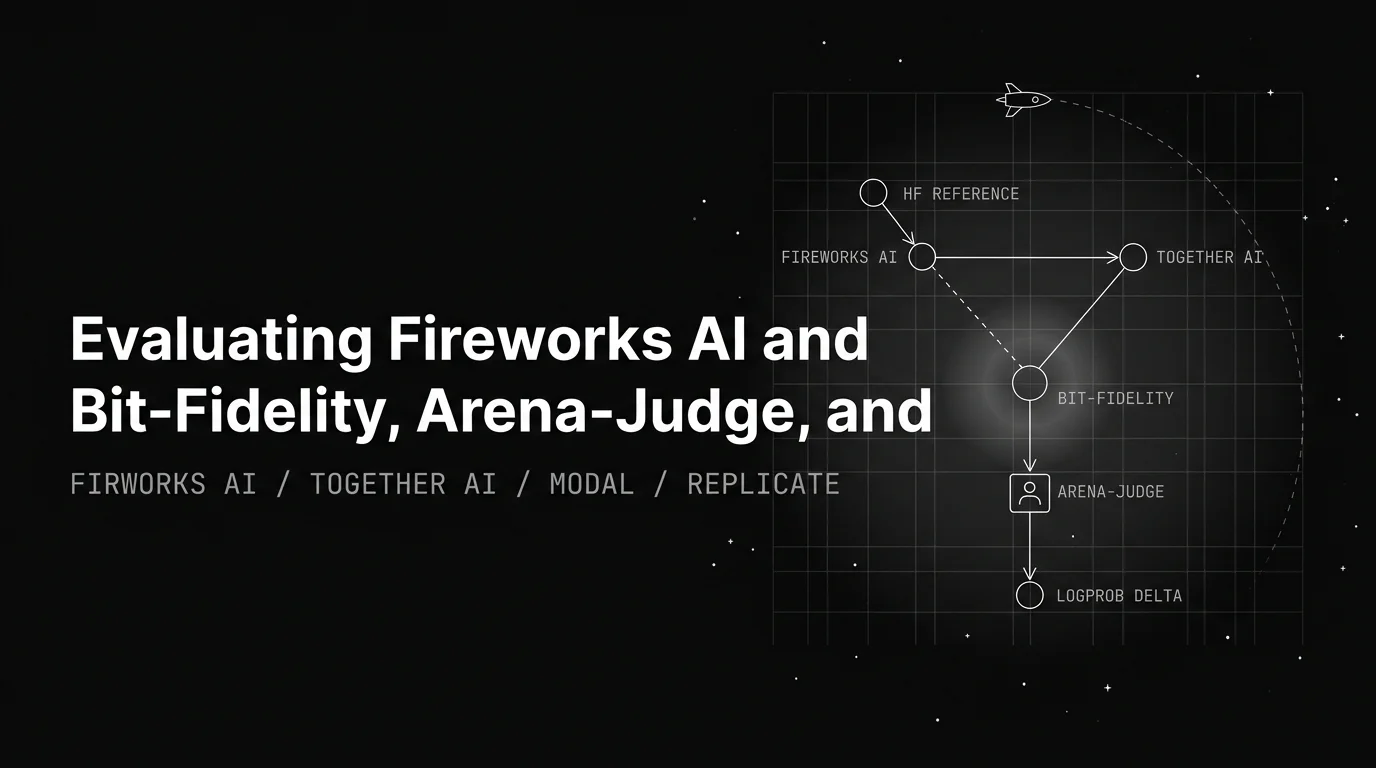
Evaluate Fireworks AI, Together AI, Modal, and Replicate apps in 2026: bit-fidelity, per-provider arena-judge, latency parity, quantization.

Five Fireworks AI alternatives on inference performance, catalog depth, fine-tuning ergonomics. What each actually fixes for production LLM workloads.

Five vLLM alternatives scored on throughput, hardware coverage, quantization, structured outputs, ops burden, plus the platform layer that augments them.