Best 5 AI Gateways for Customer Support in 2026: Latency Budgets, Agent Assist, and Voice AI Passthrough
Five AI gateways for contact centers 2026 scored on sub-300ms agent-assist latency, voice-AI streaming, TCPA and ECPA, post-call audit.
Table of Contents
Originally published May 17, 2026.
A mid-market BPO rolled an agent-assist pilot on a Tuesday and discovered by the end of the week that the gateway it shipped on was buffering streaming tokens for 1.4 seconds before flushing them to the agent screen, that two voice-AI bot legs in California had been recorded without the second-party consent prompt firing, and that the post-call summary on a collections account had hallucinated a refund the agent never offered. This guide compares the five AI gateways contact center operations should consider in 2026, scored against sub-300 ms agent-assist latency, voice-AI streaming continuity, TCPA and ECPA consent capture, GDPR Article 22 automated-decision logging, CCPA personal-information handling, and TILA-Reg Z disclosure capture for collections workloads.
TL;DR: The 5 Best Customer Support AI Gateways for 2026
Future AGI Agent Command Center is the strongest single pick because it bundles an OpenAI-compatible drop-in, the Protect runtime guardrail layer at roughly 65 ms p50 enforcement overhead (the published arXiv 2510.13351 benchmark), 18+ built-in scanners covering PII, prompt injection, hallucination, and topic restriction, per-queue and per-virtual-key budgets, exact plus semantic caching that lifts deflection on repeated questions, and OpenTelemetry-native traces with CSAT eval scores joined per span_id.
- Future AGI Agent Command Center — Best overall. Protect at ~65 ms p50, 18+ scanners (PII, prompt injection, hallucination, topic restriction), per-queue budgets, and CSAT-eval surface joined per span.
- Portkey — Best for a managed cost and audit dashboard with the most fine-grained budget hierarchy. Verify the Palo Alto Networks acquisition timeline before signing multi-year.
- Kong AI Gateway — Best for enterprise contact centers already running Kong as the REST API gateway, where AI traffic should ride the same SLA plane.
- Helicone — Best for lightweight observability with minimal config. Treat as planned migration after the March 3, 2026 Mintlify acquisition.
- LiteLLM — Best for Python-first ML platform teams pinning a known-good commit after the March 24, 2026 supply-chain incident.
Why Customer Support Needs an AI Gateway in 2026
The pattern is the same across live chat triage, voice-AI bot containment, agent-assist rendering, supervisor coaching, and post-call summary generation. Three failure modes drive procurement:
- Voice-AI cutting off mid-sentence on a recorded leg. A gateway buffering tokens for 1.4 seconds before flushing turns a bot’s reply into a stutter, the customer hangs up, and the recorded leg carries a TCPA exposure on top of the lost contact.
- Agent-assist hallucinating a refund policy. The suggestion renders, the agent reads it, the contact center owes a refund nobody approved or absorbs the CSAT hit walking it back.
- Customer PII leaking into a training data set. A chat with a payment card or SSN through a consumer tier with no redaction is a CCPA reasonable-security failure, a PCI exposure, and an FTC Section 5 risk.
The 2026 compliance stack is five layers: TCPA prior-express-written-consent on voice (47 USC 227); ECPA plus state two-party-consent on recording (federal floor 18 USC 2511; California Penal Code 632, Florida 934.03, Illinois 720 ILCS 5/14-2, Maryland CJP 10-402, Massachusetts Wiretap Act, Montana, Nevada, New Hampshire, Pennsylvania, Washington overlay all-party); GDPR Article 22 for automated decisions; CCPA personal-information handling for California residents; and TILA-Reg Z plus FDCPA mini-Miranda capture (15 USC 1692e(11)) on collections. Healthcare-CX overlap queues (Patient Access, member services) inherit HIPAA and CMS HCAHPS scoring downstream.
How We Picked
We used the Future AGI Production Gateway Scorecard for Customer Support, a seven-axis rubric. Every axis maps to either an operational metric (AHT, ASA, CSAT, FCR, deflection rate) or a regulatory artifact the legal team produces on demand.
| # | Axis | What we measure |
|---|---|---|
| 1 | Sub-300 ms p95 latency for live agent assist | P95 gateway-hop overhead at production load; whether the guardrail layer adds a second hop or sits in the same hop |
| 2 | Voice-AI streaming continuity (no buffer-and-batch) | Token-by-token streaming on chat and voice; compatibility with Deepgram, AssemblyAI, ElevenLabs, Cartesia |
| 3 | Call-recording consent capture | Per-request consent token attachment; ability to refuse routing when consent is missing; TCPA plus state two-party coverage |
| 4 | Post-call summary accuracy plus audit | Held-out CSAT-eval scoring against ground-truth; hallucination scanner against retrieved KB context; topic restriction |
| 5 | Agent-vs-customer voice separation | Speaker-channel labels carried as span attributes; diarization integrity preserved into the post-call summary |
| 6 | CRM integration plus cost attribution per ticket | Span attribute keyed by CRM ticket ID, queue, agent role, channel; export into Salesforce, Zendesk, ServiceNow |
| 7 | Regulatory consent management | TCPA, ECPA, state two-party; GDPR Article 22; CCPA; TILA-Reg Z plus FDCPA mini-Miranda for collections |
Disqualifiers: any gateway that buffers tokens to apply a single scanner pass before flushing (kills axis 2), any gateway with no native route-refusal hook for missing consent (kills axis 3), and any gateway where the post-call summary lands in the CRM with no held-out evaluation (kills axis 4).
The 16-Axis Customer Support Capability Matrix
Across the five gateways below, Future AGI Agent Command Center leads on combined Protect latency, scanner depth, CSAT-eval feedback loop, and license clarity. Portkey wins on managed dashboard maturity. Kong wins on API-gateway-grade SLAs. Helicone wins on minimal-config observability. LiteLLM wins on broadest provider list.
| Capability | Future AGI ACC | Portkey | Kong AI Gateway | Helicone | LiteLLM |
|---|---|---|---|---|---|
| Pricing model | Apache 2.0 plus cloud (free to start; pay-as-you-go scales with usage; compliance + enterprise add-ons available) | Source available plus cloud | Plugins on Kong Gateway OSS or Konnect | Apache 2.0 OSS plus cloud (maintenance mode) | Apache 2.0 outside enterprise directory |
| Language and runtime | Single Go binary | Node plus Python SDKs | Nginx plus OpenResty plus Go plugins | Node plus Python SDKs | Python |
| Supported providers | 100 plus | 250 plus | 6 major plus OpenAI compat passthrough | OpenAI plus 25 integrations | 100 plus |
| Deployment options | Docker, Kubernetes, AWS, GCP, Azure, air gapped | Cloud plus self host plus hybrid plus air gapped | Kong OSS, Konnect cloud, hybrid | Docker self host plus cloud | pip install; Docker self host |
| Unified API (OpenAI compat) | Yes (base_url swap) | Yes | Yes (/llm route prefix) | Yes (proxy mode) | Yes |
| Sub-300 ms p95 agent-assist | Yes (Protect at ~65 ms p50) | Yes (verify per-request scanner overhead) | Yes (API-gateway-grade) | Yes (proxy-only) | Partial (Python runtime is the binding factor) |
| Voice-AI streaming continuity | Yes (token-by-token; ASR plus TTS passthrough) | Yes | Yes | Yes | Yes |
| Call-recording consent capture | Yes (span attribute plus route refusal) | Yes (custom headers) | Yes (consumer plugin) | Partial (custom headers; no native refusal) | Partial (metadata plus custom hook) |
| Exact caching | Yes | Yes | Yes | Yes | Yes (basic) |
| Semantic caching | Yes (Qdrant, Pinecone, in-memory) | Yes | Plugin available | Partial | Partial |
| Per-queue and per-agent budgets | Yes (per VK, per tag, per model, per window) | Yes (4-tier hierarchy) | Yes (rate-limit plus quota plugins) | Limited | Yes (basic) |
| Hallucination scanner | Yes (built-in plus held-out eval) | Partial (via PII plus moderation) | Via adapters | Partial | Via adapters |
| Topic-restriction scanner | Yes (built-in) | Yes (via Guardrails or Lakera) | Via adapters | Partial | Via adapters |
| CSAT-eval feedback into routing | Yes (eval-to-route closed natively) | Partial (external eval) | Partial | Partial | Partial |
| Observability | Prometheus plus OTLP traces | Native dashboard plus OTel partial | OpenTelemetry plus Konnect analytics | Native dashboard | OTel partial |
| Open source | Yes (Apache 2.0) | Source available | Yes for Kong core (Apache 2.0) | Yes (Apache 2.0) | Yes (Apache 2.0 outside enterprise) |
The four axes that matter most for customer support in 2026 (sub-300 ms p95 on agent-assist, streaming continuity on voice, consent capture on every voice leg, CSAT-eval feedback into routing) are where the field separates.
Future AGI Agent Command Center: Best Overall for Customer Support AI
Future AGI Agent Command Center tops the 2026 list because it bundles every layer of the compliance stack at the same network hop in one Apache 2.0 Go binary you self-host inside the CCaaS or BPO VPC, and because the self-improving loop closes natively across trace, eval, optimize, and route.
The bundle is an OpenAI-compatible drop-in, the Protect runtime guardrail layer at the published ~65 ms p50 overhead from the arXiv 2510.13351 benchmark, 18+ built-in scanners (PII, secret detection, prompt injection, hallucination, topic restriction, content moderation, data leakage prevention, MCP security), per-virtual-key and per-tag budgets that map to per-queue and per-ticket attribution, exact plus semantic caching, and OpenTelemetry-native traces that feed ai-evaluation via span_id. ai-evaluation (Apache 2.0) ships a 60+ EvalTemplate classes in the ai-evaluation SDK with self-improving evaluators on the Future AGI Platform (CSAT, task completion, faithfulness, tool-use, structured-output, hallucination, groundedness, instruction-following, context relevance), plus unlimited custom evaluators authored end-to-end by an in-product eval-authoring agent that uses tool calling on your code and CCaaS context, plus self-improving evaluators that learn from live production traces (the CSAT rubric sharpens as contact-center traffic flows), plus FAGI’s proprietary classifier model family that runs continuous high-volume per-conversation scoring at very low cost-per-token (lower per-eval cost than Galileo Luna-2). Catalog is the floor, not the ceiling. The full surface is in the Agent Command Center docs; the source ships at the Future AGI GitHub repo under Apache 2.0 for traceAI, ai-evaluation, and agent-opt.
Best for. Contact centers, CCaaS vendors, BPOs, and enterprise CX teams wanting OpenAI compat plus Protect at ~65 ms p50 plus 18+ scanners plus per-queue budgets plus the CSAT-eval feedback loop in one Apache 2.0 Go binary, self-hosted in the CCaaS or BPO VPC.
Key strengths.
-
OpenAI-compatible drop-in. Change
base_urltohttps://gateway.futureagi.com/v1. Agent desktop, post-call summary worker, and voice bot ASR-to-LLM stage all swap on the samebase_url. -
The Future AGI Protect model family at ~65 ms p50 in the same network hop. The published arXiv 2510.13351 benchmark keeps the agent-assist budget inside the sub-300 ms p95 ceiling on a typical 200 ms first-token leg. Protect is FAGI’s own fine-tuned model family built on Google’s Gemma 3n with specialized adapters across four safety dimensions (content moderation, bias detection, security/prompt-injection, data privacy/PII), natively multi-modal across text, image, and audio, a model family, not a plugin chain. The same dimensions are reusable as offline eval metrics so the prod policy and the CSAT rubric stay in sync.
-
Voice path. Streaming continuity preserved token-by-token; agent-vs-customer channel label rides as a span attribute on the ASR-to-LLM hop; consent token from the IVR or voice bot attaches to the gateway span and refuses the route when missing.
-
Per-queue and per-ticket budgets. Per-VK, per-tag, per-model, and per-time-window budgets map to queue tag, agent role, and CRM ticket ID on every span. Shadow experiments route 5% to a candidate model and measure CSAT lift before promoting.
-
Self-improving loop with CSAT-eval feedback. The Future AGI Evaluation pipeline re-scores a held-out sample against a ground-truth answer key, and the optimizer feeds the score back into routing. Gateway, trace, eval, optimize, and route are one product.
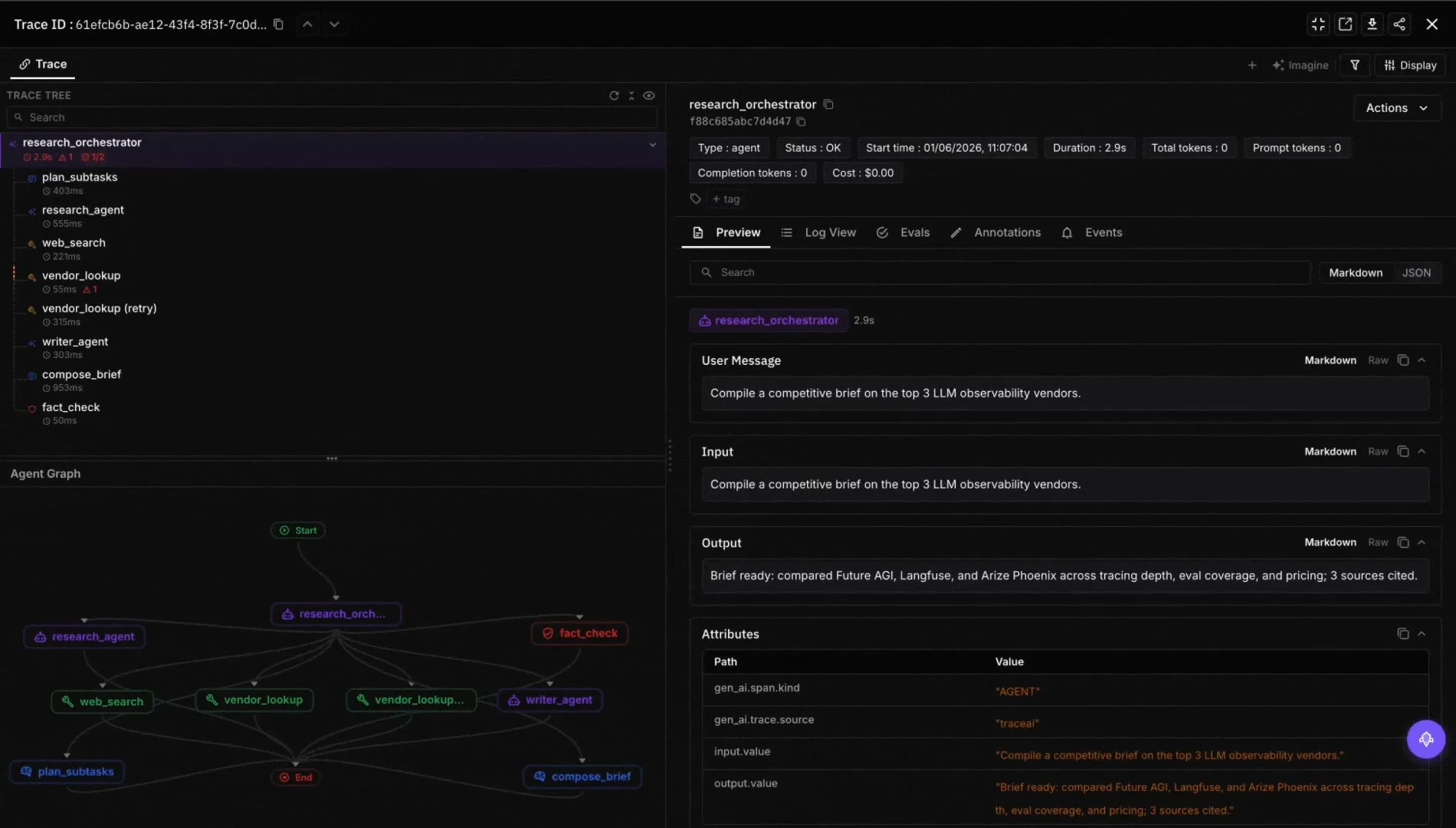
traceAIinstruments 50+ AI surfaces across Python, TypeScript, Java, and C# (including Spring Boot starter, Spring AI, LangChain4j, Semantic Kernel) OpenInference-natively, and Error Feed (the part of the eval stack, the clustering and what-to-fix layer that feeds the self-improving evaluators) sits alongside as the zero-config error monitor: auto-clusters related per-queue and per-ticket failures (50 traces → 1 issue), auto-writes the root cause plus a quick fix plus a long-term recommendation per issue, and tracks rising/steady/falling trend per issue so CSAT regressions get triaged like exceptions rather than buried in QA samples.
- Deployment. Apache 2.0; single Go binary; Docker, Kubernetes, AWS, GCP, Azure, air-gapped or on-prem. SOC 2 Type II at Boost tier and above.
Where it falls short. Full execution tracing for multi-step voice-agent workflows is “In Progress” on the public roadmap; the current path captures every gateway hop as a span, with agent-loop introspection rolling out alongside the existing OTel export. Contact centers needing full agent-loop introspection today should pair ACC with an in-process tracer like OpenLLMetry or Arize Phoenix.
from openai import OpenAI

client = OpenAI(
    api_key="$FAGI_API_KEY",
    base_url="https://gateway.futureagi.com/v1",
)

# Existing OpenAI SDK code unchanged. The gateway runs Protect at
# ~65 ms p50, consent-token enforcement, hallucination scoring
# against retrieved KB context, and per-queue budget enforcement
# at the same network hop. The held-out CSAT-eval sample re-scores
# a percentage of completions and feeds the optimizer.
response = client.chat.completions.create(
    model="azure-openai/gpt-4o",
    messages=[
        {"role": "system", "content": "You are an agent-assist suggestion engine."},
        {"role": "user", "content": "Customer says their bill is wrong. Suggest a response."},
    ],
    extra_headers={
        "x-fagi-queue": "billing-tier-1",
        "x-fagi-ticket-id": "T-883291",
        "x-fagi-consent-token": "tcpa-2026-05-17-v1",
        "x-fagi-channel": "voice",
        "x-fagi-speaker": "customer",
    },
)
Verdict. The strongest single pick if your 2026 customer support infrastructure story is “we want sub-300 ms p95 on agent-assist, streaming continuity on voice, consent capture on every recorded leg, per-queue cost attribution into Salesforce or Zendesk, and a CSAT-eval feedback loop that closes the optimization loop natively, in our VPC, under our existing contracts.”
Portkey: Best for Managed Customer Support Cost and Audit Dashboard
Portkey is the strongest pick when you want a managed cost and audit dashboard out of the box, the most mature semantic cache in production, and a four-tier budget hierarchy that maps to brand, queue, agent, and individual application. It’s what most multi-product CX platforms reach for when “we need spend control across queues next week” is the brief, with the caveat that the Palo Alto Networks acquisition announced April 30, 2026 is expected to close in Palo Alto’s fiscal Q4 2026.
Best for. Multi-product CX platforms, customer support SaaS, and BPOs wanting per-queue or per-tenant budgets, PII anonymization, and a usable cost and audit dashboard without a custom exporter.
Key strengths.
- Exact plus semantic caching with TTL and similarity-threshold tuning; production teams typically see 30 to 60 percent hit rates on agent-assist workloads where the same questions recur.
- Most fine-grained native-dashboard budget hierarchy on the list; natural mapping to a multi-brand BPO.
- 250+ providers; PII anonymization at Enterprise; SOC 2 Type 2, ISO 27001, GDPR audit-log support.
Where it falls short. The April 30, 2026 Palo Alto Networks acquisition hasn’t closed; multi-year contracts should reference the integration plan in writing. Observability is dashboard-first; OTel export exists but is less first-class, making Splunk or Datadog integration a longer first week. An explicit hallucination scanner on the post-call summary lands through PII plus moderation rather than a dedicated scanner; teams running a held-out CSAT-eval wire that loop themselves.
Verdict. The most mature managed cost and audit dashboard for customer support AI in 2026; choose with eyes open on the Palo Alto integration.
Kong AI Gateway: Best for Enterprise Contact Centers Already on Kong
Kong AI Gateway is the strongest pick for enterprise contact centers and CCaaS vendors that already run Kong Gateway as the REST API plane. The AI Gateway ships as plugins on the same data plane, so AI traffic rides the same SLA, RBAC, observability, and policy plane the rest of the platform already runs on.
Best for. Enterprise contact centers, CCaaS vendors, and large BPOs running Kong Gateway OSS or Konnect for REST APIs that want AI on the same plane. Particularly strong for teams holding a four-nines API-gateway SLA and needing the same on the LLM path.
Key strengths.
- AI plugins (AI Proxy, AI Request Transformer, AI Response Transformer, AI Prompt Guard, AI Prompt Template, AI Rate Limiting Advanced) ride on the same Kong data plane your REST APIs run on; one operational story.
- API-gateway-grade SLAs on the same Nginx-OpenResty-Lua stack that powers some of the largest API estates in production. AI plugins are async-friendly and don’t buffer the streaming response.
- Strong RBAC through Konnect; the consumer model, plugin scope hierarchy, and workspace isolation map to per-queue or per-tenant.
- OpenTelemetry plus Prometheus plus Konnect analytics; AI traffic shows up in the same dashboard CX ops already trusts for API traffic.
Where it falls short. The AI plugin surface is smaller than the Future AGI or Portkey scanner libraries; PII redaction, prompt injection scanning, hallucination scoring, and topic restriction are reached through AI Prompt Guard plus custom Lua or a sidecar guardrail service rather than a built-in 18+ scanner library. CSAT-eval feedback into routing isn’t closed inside Kong; teams wire that loop externally. The AI Proxy provider list is narrower than LiteLLM or Portkey for niche providers. For teams not already on Kong, the operational footprint (data plane plus control plane plus plugin management) is heavier than a single Apache 2.0 Go binary.
Verdict. The right pick when the procurement constraint is “AI traffic must ride our existing API gateway and the platform team shouldn’t have to learn a second control plane.” Choose Future AGI ACC when the binding constraint is the deepest built-in scanner library plus the CSAT-eval feedback loop.
Helicone: Best for Lightweight Observability with Minimal Config
Helicone is the one-line proxy that broke open the LLM observability category: drop a base_url swap, get cost, latency, prompt, and response logged to a usable dashboard. Apache 2.0 OSS for the proxy core, cloud for the managed dashboard. After the March 3, 2026 Mintlify acquisition the customer support answer is “yes for greenfield observability where the team hasn’t yet sized the audit and budget problem; treat as a planned migration window for any production deployment that needs the 2026 compliance stack.”
Best for. Early-stage CX teams, lean BPO ops, and product CX engineers wanting token cost, latency, and prompt-response pairs in a usable dashboard with minimal configuration.
Key strengths.
- One-line proxy; observability live in minutes. Session and user-grouping in the dashboard map to a chat-queue conversation thread.
- Apache 2.0 for the proxy core; self-host on Docker for teams that need the data inside their network boundary.
- Usable cost-attribution dashboard out of the box; faster first-week experience than wiring an OTel collector plus a Grafana dashboard.
Where it falls short. Acquired by Mintlify on March 3, 2026; the public posture is maintenance mode while feature development winds down. For a CX team running Helicone in production, the practical move is a migration window in the next 6 to 12 months. The guardrail surface is partial (PII redaction and topic restriction land through external integrations rather than a built-in 18+ scanner library), per-queue budget enforcement and route refusal on missing consent aren’t first-class, hallucination scoring on the post-call summary requires an external evaluator, and CSAT-eval feedback into routing isn’t closed inside Helicone.
Verdict. The right pick for week one of an LLM observability story, and a planned migration target rather than a 2026 procurement bet.
LiteLLM: Best for Python-First Customer Support Teams Post-CVE
LiteLLM is the Python-first proxy that broke open the multi-provider unified API category. Apache 2.0 outside the enterprise directory, 20+ providers via six native adapters (OpenAI, Anthropic, Gemini, Bedrock, Cohere, Azure) plus OpenAI-compatible presets and self-hosted backends, OpenAI-compatible endpoints, and a long tail of internal gateways across customer support, sales-tech, and product-CX. After the March 24, 2026 supply-chain incident the customer support answer is “yes for self-hosted commit-pinned deployments where the CX team has its own contract terms with the underlying model provider.”
Best for. Python-first ML platform teams on FastAPI or uvicorn, wanting broad provider coverage, willing to pin commit hashes, and holding their own upstream contracts to OpenAI, Anthropic, Azure, or Bedrock.
Key strengths.
- Broadest provider coverage of any project on this list (20+ providers via six native adapters (OpenAI, Anthropic, Gemini, Bedrock, Cohere, Azure) plus OpenAI-compatible presets and self-hosted backends).
- Apache 2.0 outside the enterprise directory; trivial to fork or audit; native fit with Python observability (OpenLLMetry, Arize Phoenix, Langfuse).
- Virtual keys with per-key budgets; budget alerts; route declarations mapping to per-queue or per-agent identifiers.
- Active maintainer community; easy to extend with custom adapters (mini-Miranda capture for collections, HCAHPS-domain topic restriction for patient access).
Where it falls short. The March 24, 2026 PyPI compromise. Versions 1.82.7 and 1.82.8 were published by the TeamPCP threat actor after PyPI publishing tokens were exfiltrated via a compromised Trivy GitHub Action in LiteLLM’s CI/CD. The packages shipped a credential harvester, a Kubernetes lateral-movement toolkit, and a persistent systemd backdoor; 40,000+ downloads before PyPI quarantined (Datadog Security Labs writeup). Pin to 1.82.6 or earlier, scan dependency trees, rotate credentials; the full incident response and migration playbook walks through each step. Python runtime is materially slower than Go-binary alternatives at high concurrency; a high-QPS voice path at peak may bump the ceiling. Built-in scanners are partial; PII, hallucination, and topic restriction land through external integrations rather than a native 18+ library. CSAT-eval feedback into routing isn’t closed inside LiteLLM.
Verdict. Still the broadest provider coverage, but the March 2026 incident shifts it from “default pick” to “pin commits and treat as a routing layer with an external compliance stack.”
Compliance Plus Risk Matrix for Customer Support
The failure modes in customer support (a voice bot recording a California call without two-party consent, an agent-assist hallucinating a refund, a PII leak from a chat into a training set, a TILA-Reg Z disclosure missing from a collections leg) carry statutory damages, class-action exposure, and regulator attention.
| Control | Future AGI ACC | Portkey | Kong AI Gateway | Helicone | LiteLLM |
|---|---|---|---|---|---|
| TCPA consent token attachment | Yes (span attribute plus route refusal) | Yes (custom headers) | Yes (consumer plugin) | Partial (no native refusal) | Partial |
| ECPA plus state two-party consent | Yes (per-leg audit attribute) | Yes (per-request metadata) | Yes (request transformer plugin) | Partial | Partial |
| GDPR Article 22 automated-decision logging | Yes (consent or human-review token enforced) | Yes (audit trail) | Yes (plugin plus consumer model) | Partial | Partial |
| CCPA PII redaction in the same network hop | Yes (built-in PII scanner) | Yes (PII anonymization at Enterprise) | Via plugin or sidecar | Via external integration | Via external adapter |
| TILA-Reg Z plus FDCPA disclosure capture | Yes (queue-tagged span attribute) | Yes (custom metadata) | Yes (plugin) | Partial | Partial |
| SOC 2 Type II | Yes (Boost tier and above) | Yes | Yes | Yes (pre-acquisition posture) | Type I (Type II in progress) |
| RBAC plus tenant isolation | Yes (per-VK, per-tag) | Yes (4-tier hierarchy) | Yes (consumer plus workspace) | Partial | Yes (basic) |
Five Real Numbers Every CX Buyer Should Anchor To
The seven-axis rubric only earns its keep if it lands on numbers the contact center operations team already tracks.
-
Sub-300 ms p95 latency on agent-assist. Nielsen’s response-time bands (100 ms instant, 1000 ms upper bound of flow) map onto agent-assist: at 300 ms the suggestion still feels reactive, at 1 second the agent gives up and types it themselves. A gateway adding ~65 ms p50 plus a typical 200 ms first-token leg lands inside the budget; a gateway that buffers tokens for 1.4 seconds doesn’t.
-
Inbound ASA at 28 seconds. The 2024-2025 CCW Digital and ICMI benchmark cohort lands inbound ASA in the 20-40 second band for healthy queues. Agent-assist deflection that shaves 8-12 seconds off AHT bends ASA back into target faster than another headcount hire.
-
Voice AHT of 6 minutes 3 seconds. SQM Group and ICMI reporting puts cross-industry voice AHT in the 5:30 to 6:30 band, with after-call work adding 60 to 90 seconds. A post-call summary that lands in the CRM within 5 seconds of wrap removes most of that ACW tax; a summary that hallucinates a refund lands in the next quarter’s CSAT review.
-
Self-service deflection lift of 25-45 percentage points. Gartner’s 2024 service leader survey and the 2025 CCW Digital benchmark report cohorts seeing chat deflection rise from a 15-25 percent baseline into the 40-65 percent band after a tier-one bot lands. The gateway-driven semantic cache (30-60 percent hit rate) is the production lever inside that lift.
-
CSAT lift of 4-8 percentage points on AI-assisted queues. Forrester’s 2024 service experience research and the 2025 CCW Digital cohort report CSAT lifts of 4-8 percentage points where agent-assist ships with held-out evaluation in the loop, with the higher end concentrated where the suggestion is scored against a ground-truth KB before it renders. The Future AGI self-improving loop with CSAT-eval feedback is the closed-loop version of that lever.
One rule: a gateway adding 200 ms of buffer-and-batch costs more on ASA, AHT, and CSAT than it saves on the per-token bill.
The 2026 Customer Support Gateway Trust Cohort
The Q1 and Q2 2026 trust cohort reshaped procurement for every regulated category that touches an AI gateway, and customer support inherits the same risk register.
- Helicone joining Mintlify (March 3, 2026). Helicone acquired by Mintlify; product in maintenance mode. CX teams already on Helicone should plan a migration window.
- LiteLLM PyPI supply-chain compromise (March 24, 2026). TeamPCP-attributed compromise of versions 1.82.7 and 1.82.8 via a stolen PyPI publishing token (exfiltrated through a compromised Trivy GitHub Action in LiteLLM’s CI/CD). The package shipped a credential harvester, a Kubernetes lateral-movement toolkit, and a persistent systemd backdoor; 40,000+ downloads before PyPI quarantined. Pin to 1.82.6 or earlier; rotate credentials. Source: the Datadog Security Labs writeup.
- Anthropic MCP STDIO RCE class (April 2026). OX Security disclosed an STDIO transport flaw affecting ~7,000 MCP servers and 150M+ downstream downloads. CX teams routing MCP traffic (KB lookups, CRM read-write, outbound actions) should enforce least-privilege tool access, OAuth 2.1, and Streamable HTTP rather than raw STDIO. Coverage: the Hacker News report on the Anthropic MCP design vulnerability.
- Portkey acquired by Palo Alto Networks (April 30, 2026, not yet closed). Announced; expected to close in Palo Alto’s fiscal Q4 2026 subject to customary closing conditions. Roadmap independence is intact through 2026; multi-year contracts should reference the integration plan.
For the next 12 months, license clarity, audit retention, and acquisition independence are part of the customer support gateway buying decision. A cheap gateway you migrate off in six months, or one whose pricing model is in legal redrafting, isn’t cheap inside a contact center procurement cycle that already carries TCPA exposure.
Customer Support AI Gateway Picks by Buyer Profile
| If you are a… | Pick | Why |
|---|---|---|
| Enterprise contact center running agent-assist plus voice bot, OpenAI SDK heavy | Future AGI Agent Command Center | OpenAI compat drop in plus Protect at ~65 ms p50 plus 18+ scanners plus CSAT-eval feedback in one Apache 2.0 Go binary |
| Multi-product CX SaaS with multi-tenant cost and audit reporting | Portkey | Most fine-grained budget hierarchy plus mature managed dashboard |
| Enterprise contact center already running Kong for REST APIs | Kong AI Gateway | AI traffic rides the same API-gateway SLA, RBAC, and policy plane |
| BPO ops team running multi-tenant queues with strict per-brand cost attribution | Portkey or Future AGI ACC | Portkey for the dashboard, Future AGI ACC for Apache 2.0 plus CSAT-eval feedback |
| Early-stage CX team wanting minimal-config observability | Helicone (with migration plan) | Lightweight observability; treat as planned migration after the Mintlify acquisition |
| Python-first ML platform team supporting customer support | LiteLLM (commit pinned) | Broadest provider coverage; pin to 1.82.6 or earlier after the March CVE |
| Healthcare patient-access contact center (HCAHPS-driven) | Future AGI Agent Command Center | 18+ scanners cover PHI plus hallucination plus topic restriction; held-out CSAT-eval scoring before suggestions render |
| Financial-services collections queue (TILA-Reg Z, FCRA, FDCPA mini-Miranda) | Future AGI Agent Command Center | Per-queue topic restriction plus disclosure-capture span attribute plus held-out evaluation against ground-truth scripts |
| Greenfield CX team evaluating gateways before committing | Future AGI ACC free tier | Apache 2.0 self-host; upgrade to Scale tier for SOC 2 plus enterprise support when production traffic begins |
Implementation Pattern with Future AGI
The standard customer support implementation lands in four steps. Full surface in the Agent Command Center docs.
- Swap the
base_url. Change the OpenAI SDKbase_urltohttps://gateway.futureagi.com/v1across agent desktop, voice bot ASR-to-LLM stage, and post-call summary worker. No SDK rewrite. - Attach per-request context as custom headers. Minimum set: queue ID, CRM ticket ID, channel, speaker label, consent token, agent role. Every span carries these for per-queue budgets, per-ticket attribution, and consent enforcement.
- Wire the held-out CSAT-eval sample. The Future AGI Evaluation pipeline re-scores a configurable percentage of completions against a ground-truth answer key from the KB and QA scorecard. The result links to the gateway span via
span_id; the optimizer feeds the score into the next routing decision. - Route refusal on missing consent or disclosure. For voice queues in two-party-consent states (California, Florida, Illinois, Maryland, Massachusetts, Montana, Nevada, New Hampshire, Pennsylvania, Washington, plus civil exposure in Connecticut), the gateway refuses when the consent token is missing. For collections, the gateway refuses when the FDCPA mini-Miranda disclosure attribute isn’t set. Refusal lands as a 412 Precondition Failed.
A standard production rollout lands inside a two-week sprint.
Which AI Gateway Is Right for Your Customer Support Team in 2026?
Customer support AI in 2026 is a stack of TCPA, ECPA, state two-party-consent statutes, GDPR Article 22, CCPA, TILA-Reg Z, FCRA, FDCPA, and (for healthcare-CX overlap) HIPAA controls on top of an AI gateway. That gateway has to hold sub-300 ms p95 on agent-assist, stream tokens through voice without buffer-and-batch, capture a consent token on every recorded leg, score the post-call summary against a held-out ground-truth set before it lands in the CRM, attribute cost per ticket and per queue, and close the loop from CSAT eval back into routing.
Of the five gateways above, Future AGI Agent Command Center is the strongest pick when the buying constraint is OpenAI compat drop in plus Protect at ~65 ms p50 plus 18+ built-in scanners plus per-queue budgets plus the CSAT-eval feedback loop in one Apache 2.0 Go binary self-hosted in the CCaaS or BPO VPC.
Portkey is the right call when a managed cost dashboard is the binding constraint and the Palo Alto integration risk is acceptable. Kong AI Gateway is the right call when the platform team already runs Kong for REST APIs. Helicone is a planned migration target after the Mintlify acquisition. LiteLLM is the right call for Python-first teams that hold their own upstream contracts and pin commit hashes.
For deeper reads:
- The Agent Command Center docs for the full feature surface.
- The Future AGI Protect docs for the runtime guardrail library; the ~65 ms p50 overhead from arXiv 2510.13351 is the latency anchor.
- The Future AGI Evaluation docs for the held-out CSAT-eval pipeline.
- The Future AGI GitHub repo for the Apache 2.0 source on traceAI, ai-evaluation, and agent-opt.
Try Agent Command Center free. OpenAI-compatible routing, Protect at ~65 ms p50, 18+ scanners, per-queue budgets, OpenTelemetry, and the CSAT-eval feedback loop in one Apache 2.0 Go binary.
Related reading
- Best 5 AI Gateways for Compliance Audit Trails in 2026, the compliance and audit-trail comparison
- Best 5 AI Gateways for LLM Cost Optimization in 2026, the five-layer cost stack and the 2026 trust cohort
- Best 5 AI Gateways for Cybersecurity in 2026: Prompt Injection Defense, Tenant Isolation, and SOC 2, the cybersecurity-specific gateway picks
- Best 5 AI Gateways for E-commerce in 2026: Search, Personalization, and Checkout, the ecommerce-specific gateway picks
Frequently Asked Questions
What Is the Best AI Gateway for Customer Support in 2026?
What Is the Latency Budget for AI in a Live Agent-Assist Workflow?
Does an AI Gateway Need to Handle TCPA Consent Capture for Voice AI?
How Does an AI Gateway Prevent an Agent-Assist Hallucination from Reaching the Customer?
How Should a Contact Center Attribute AI Cost per Ticket in 2026?
How Does an AI Gateway Handle GDPR Article 22 for Full-Auto Bot Decisions?
Which AI Gateways Are Still Safe for Customer Support After the 2026 Supply-Chain Events?
Five AI gateways for cybersecurity in 2026 scored on prompt injection defense, tenant isolation, OWASP LLM Top 10, MITRE ATLAS, SOC 2.

Five AI gateways on what compliance officers actually need: tamper-evident logs, 3-10 yr retention, SIEM exports, span granularity, legal hold, frameworks.
Five AI gateways for LLM cost optimization in 2026 scored on the five-layer cost stack, 18+ guardrails, OTel-native cost telemetry, and 2026 trust cohort.
