Best 5 AI Gateways for E-commerce in 2026: Search, Personalization, and Checkout
Five AI gateways for pure-play e-commerce in 2026: product-search recall, recommendation lift, cart latency, GDPR/CCPA consent, PCI-DSS, EU DSA scope.
Table of Contents
Originally published May 17, 2026.
A DTC apparel brand on Shopify Plus ran an AI styling-assistant pilot the week of Black Friday 2025 and discovered three things at once. Catalog search hit a 7.2 times steady-state burst at 7 PM ET peak. The recommendation prompt was routed to a community-tier model that quietly retained prompts for training (a GDPR Article 6 problem the moment an EU shopper hit the page). The cart-abandonment intercept added 940 milliseconds of latency before it could fire on exit-intent, roughly four times the budget Baymard Institute correlates with measurable abandonment lift. In the following Monday’s PCI-DSS SAQ review, one in roughly 8,000 of the assistant’s free-text messages had echoed back the last four of a card number a shopper had pasted into chat. None of those four failures were the model’s fault. They were the gateway’s. This guide compares the five AI gateways pure-play e-commerce teams (Shopify-style storefronts and DTC operators) should consider in 2026, scored on seven axes: product-search relevance and recall, recommendation conversion lift, cart-abandonment intercept latency, multi-currency and multi-locale routing, GDPR and CCPA consent-aware routing, Black Friday peak scaling, and per-storefront cost attribution.
TL;DR: The 5 Best E-commerce AI Gateways for 2026
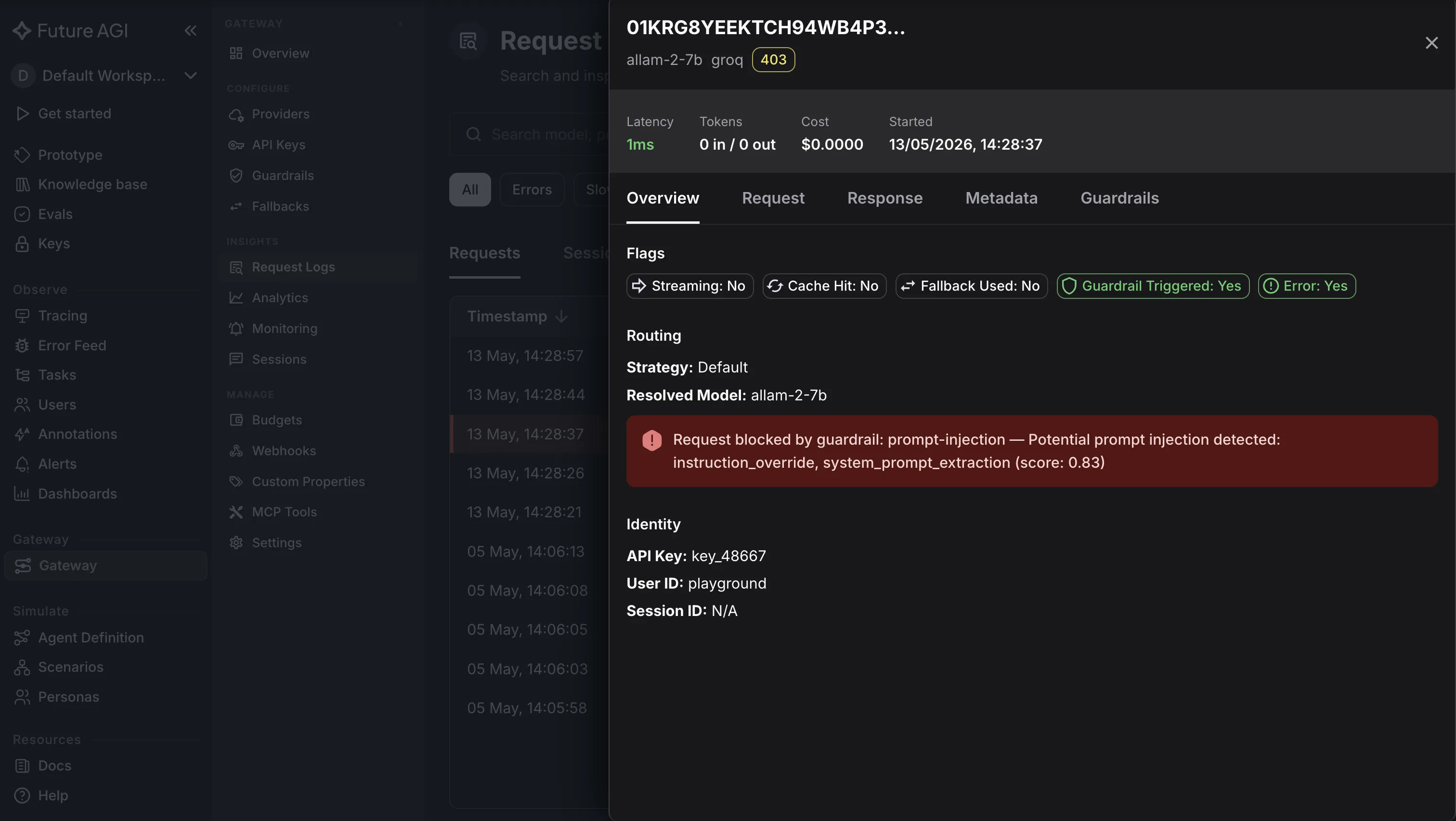
Future AGI Agent Command Center is the strongest single pick for a pure-play e-commerce AI gateway in 2026 because it bundles an OpenAI-compatible drop-in, 18+ guardrail scanners covering PII and PCI cardholder data, a sub-100 ms Protect runtime measured at roughly 65 ms median in arXiv 2510.13351, per-storefront virtual-key budgets, consent-aware routing that suppresses training opt-in for EU traffic, exact plus semantic caching that absorbs Black Friday catalog-search bursts, and OpenTelemetry-native traces with conversion-eval scores joined per span. Procurement now weighs five 2026 events together: EU DSA in full application since February 17, 2024; PCI-DSS v4.0.1 fully enforceable since March 31, 2025; the EDPB November 2025 binding Opinion 08/2024 on consent-or-pay; the LiteLLM PyPI supply-chain compromise of March 24, 2026; and the announced Palo Alto Networks acquisition of Portkey on April 30, 2026.
- Future AGI Agent Command Center — Best overall. PCI and PII guardrails, per-storefront budgets, consent-aware routing for EU traffic, sub-100 ms Protect, and conversion-eval scores joined per span.
- Portkey — Best for DTC brands and marketplaces wanting a managed cost and audit dashboard out of the box. Verify the Palo Alto Networks acquisition timeline before signing multi-year.
- Cloudflare AI Gateway (edge) — Best for storefronts already terminating TLS on Cloudflare needing edge-native analytics at single-digit-ms overhead.
- LiteLLM — Best for Python-first DTC ML platform teams holding their own upstream DPA after the March 2026 incident.
- OpenRouter — Best for early-stage operators using OpenRouter for unified-API dev and benchmarking, never for EU shopper traffic in production.
Helicone is intentionally not ranked. After the March 3, 2026 Mintlify acquisition it’s in maintenance mode; teams already on Helicone should treat the next 12 months as a planned migration window.
How We Scored These E-commerce AI Gateways
We used a seven-axis rubric for pure-digital storefronts (the omnichannel retail variant appears in the companion retail post). Every axis maps to a regulatory artefact or an operational target.
| # | Axis | What we measure |
|---|---|---|
| 1 | Product-search relevance and recall scoring | Whether the gateway routes semantic-search prompts to embedding plus reranker pairs with Recall@K, NDCG@10, and zero-result-rate captured as span attributes |
| 2 | Recommendation-route conversion lift | Whether the gateway exposes a span-level link between recommendation prompts and downstream conversion events |
| 3 | Cart-abandonment intercept latency | P99 added latency on exit-intent-to-first-message; target under 200 ms end-to-end |
| 4 | Multi-currency and multi-locale routing | Whether the gateway exposes currency and locale as routing keys (EU to EU-resident endpoints, JPY catalog to a Japan-localized template, RTL to the right model variant) |
| 5 | Consent-aware routing | Whether the gateway reads the consent string from the CMP on every request: no training opt-in for EU traffic, no personalization for non-consenting shoppers, GPC opt-out for CCPA |
| 6 | Peak-event scaling | Burst-lane isolation; cache hit rate under burst; connection pre-warming; load-shedding rules |
| 7 | Per-storefront cost attribution | Per-brand, per-storefront, per-country, per-feature cost breakdown without a custom exporter |
Axes 3, 5, and 7 decide whether the gateway keeps a pure-play storefront safe and profitable in production.
What the 2026 E-commerce Compliance Stack Demands
The 2026 e-commerce AI compliance stack for a pure-play storefront serving the U.S. and the EU is four layers.
- GDPR Article 6 plus EDPB consent guidelines. The EDPB Cookie Banner Taskforce report (January 18, 2023) hardened the requirements (no pre-ticked boxes, equally prominent reject button). On November 7, 2025 the EDPB adopted binding Opinion 08/2024 on consent or pay, ruling most pay-or-okay models can’t rely on consent under Article 4(11). Schrems II still requires SCCs or an adequacy decision for EU-to-U.S. transfers. The gateway is the enforcement point for the consent string, the residency routing key, and the audit log proving consent state at processing.
- CCPA plus CPRA plus state-by-state expansion. CCPA as amended by CPRA has been fully enforced since July 1, 2023; Global Privacy Control is recognized as a valid opt-out. Eight more states have privacy laws in force as of 2026 (Virginia, Colorado, Connecticut, Utah, Texas, Oregon, Montana, Delaware). The gateway honors the GPC header, suppresses sale-or-share for opted-out shoppers, and routes to a no-training-opt-in upstream when the opt-out is set.
- PCI-DSS v4.0.1 for checkout and post-purchase. PCI-DSS v4.0.1 became fully enforceable on March 31, 2025. Requirements 3, 4, 6.4.3, 11.6.1, and 12.5.1 all bear on an AI checkout assistant. Keep cardholder data inside the PSP iframe (Stripe Elements, Adyen Components, Checkout.com Frames) so the assistant only sees redacted last-four and tokenized references; the gateway tokenizes any PAN that leaks into a free-text message before it reaches the upstream model.
- EU Digital Services Act plus marketplace seller compliance. The DSA has been in full application since February 17, 2024. Article 26 prohibits dark patterns. Article 27 requires platforms to disclose recommender main parameters in plain language and offer a non-profiling option. Article 30 imposes trader traceability (KYC-style verification of marketplace sellers). VLOPs (45 million monthly EU users) inherit Article 34 systemic risk assessment and Article 37 independent audit.
A gateway that ships layers 1 and 3 but skips layer 4 is good for a U.S.-only DTC brand and bad for a marketplace the moment EU traffic crosses ten percent of session volume.
Future AGI Agent Command Center: Best Overall for E-commerce AI
Future AGI Agent Command Center tops the 2026 pure-play e-commerce list because it bundles every layer of the compliance stack at the same network hop in one Apache 2.0 Go binary with a closed conversion-eval self-improving loop.
The bundled capabilities: an OpenAI-compatible drop-in, 18+ guardrail scanners (PII with PAN coverage, secret detection, data leakage prevention, hallucination, MCP security), per-virtual-key budgets sliced per brand, storefront, country, and feature, exact plus semantic caching that lets the seven-thousandth “wireless earbuds under 50 dollars” of the hour return from cache in roughly 4 milliseconds instead of 240, OpenTelemetry-native traces, and a Protect runtime measured at roughly 67 milliseconds median in arXiv 2510.13351.
The closed loop is what other gateways don’t ship. Future AGI exposes three Apache 2.0 layers (traceAI, ai-evaluation, agent-opt), and the Command Center wires them together so a conversion event feeds back as an eval signal that retrains the routing policy. A recommendation prompt converting at 4.1 percent on one variant and 3.4 percent on another moves traffic to the higher-converting variant on the next deploy without a human in the loop.
Best for. Shopify Plus operators, DTC brands on Hydrogen or Next Commerce, headless storefronts on commercetools or Saleor, and pure-play marketplaces under the EU DSA.
Key strengths.
-
OpenAI-compatible drop-in: change
base_urltohttps://gateway.futureagi.com/v1, keep existing SDK code unchanged across product-search, recommendations, checkout assistant, post-purchase support. -
20+ providers via six native adapters (OpenAI, Anthropic, Gemini, Bedrock, Cohere, Azure) plus OpenAI-compatible presets and self-hosted backends; Azure OpenAI under the Microsoft Online Services DPA and AWS Bedrock under the AWS DPA are the two no-training-opt-in defaults for EU storefronts; OpenAI Enterprise plus API is the third common path for U.S. traffic.
-
The Future AGI Protect model family for inline guardrails, ~65 ms p50 text and ~107 ms p50 image (arXiv 2510.13351). Protect is FAGI’s own fine-tuned model family built on Google’s Gemma 3n with specialized adapters across four safety dimensions (content moderation, bias detection, security/prompt-injection, data privacy/PII with PAN coverage), natively multi-modal across text, image, and audio, a model family, not a plugin chain. A dedicated MCP Security scanner sits alongside (relevant after the April 2026 OX Security disclosure of the MCP STDIO RCE class) and the same dimensions are reusable as offline eval metrics so the prod policy and the eval rubric stay in sync.
-
Per-key, per-VK, per-model, per-time-window budgets plus tag-based custom properties so one binary attributes spend per brand, storefront, country, feature, team, or per seller for marketplaces.
-
Consent-aware routing as a built-in rule: the gateway reads the consent string from OneTrust, Didomi, Sourcepoint, or Cookiebot on every request and routes EU shoppers without personalization consent to a no-personalization template against a no-training-opt-in upstream; GPC opt-outs honored on the same surface.
-
OpenTelemetry-native traces and Prometheus metrics on
/-/metrics, withspan_idlinking gateway trace to Mixpanel conversion events.traceAIinstruments 50+ AI surfaces across Python, TypeScript, Java, and C# (including Spring Boot starter, Spring AI, LangChain4j, Semantic Kernel) OpenInference-natively, and Error Feed. the part of the eval stack, the clustering and what-to-fix layer that feeds the self-improving evaluators, turns those traces into named issues with zero config: auto-clusters per-storefront and per-campaign failure traces (50 → 1 issue), auto-writes the root cause plus a quick fix plus a long-term recommendation, and tracks rising/steady/falling trend per issue so checkout-assistant regressions surface like exceptions rather than buried in a dashboard.
- Apache 2.0; single Go binary; Docker, Kubernetes, AWS, GCP, Azure, on-prem, air-gapped or cloud; SOC 2 Type II at Boost (250 dollars per month); HIPAA BAA at Scale (750 dollars per month).
- The ~65 ms Protect runtime keeps the cart-abandonment intercept inside its 200 ms budget with room for the LLM call.
Where it falls short.
- Full execution tracing for multi-step agents (search, reranker, recommendation, then a “send a discount code” tool) is an “In Progress” roadmap item on the Future AGI GitHub repo.
- The native managed dashboard lacks Portkey’s per-tenant chart polish; teams wanting a screenshot-ready cost view in week one run Future AGI alongside Grafana.
- Not edge-resident. Storefronts on Cloudflare Workers wanting the gateway inside the same invocation pay an extra hop versus the Cloudflare-native option.
from openai import OpenAI

client = OpenAI(
    api_key="$FAGI_API_KEY",
    base_url="https://gateway.futureagi.com/v1",
)

response = client.chat.completions.create(
    model="azure-openai/gpt-4o",
    messages=[
        {"role": "user", "content": "I'm a UK size 12 looking for a winter coat under 200 pounds."},
    ],
    extra_headers={
        "x-fagi-storefront": "uk-store",
        "x-fagi-locale": "en-GB",
        "x-fagi-currency": "GBP",
        "x-fagi-consent": "personalization=false; analytics=true",
    },
)
Verdict. The strongest single pick when the buying constraint is OpenAI compat plus consent-aware routing plus per-storefront budgets plus a conversion-eval feedback loop. Portkey is the alternative when a managed dashboard is the binding constraint; Cloudflare AI Gateway is the alternative for an all-Cloudflare storefront where the gateway must live inside the Worker.
Portkey: Best for Managed E-commerce Cost and Audit Dashboard
Portkey is the strongest pick when you want a managed cost and audit dashboard out of the box, the most mature semantic cache in production, and a four-tier budget hierarchy that maps to brand-storefront-country-feature. The Palo Alto Networks acquisition announced April 30, 2026 hasn’t yet closed.
Best for. Multi-brand DTC operators (a holding company running ten DTC labels), marketplaces with per-merchant budgets, and headless commerce teams wanting fine-grained per-tenant enforcement plus a native dashboard without writing a custom Grafana exporter on day one.
Key strengths.
- Exact plus semantic caching with TTL and similarity-threshold tuning; e-commerce teams see 30 to 60 percent hit rates on catalog-search and recommendation workloads, higher on Black Friday because the long-tail prompt distribution compresses around bestsellers.
- Per-key, per-VK, per-model, per-time-window budgets in a four-tier hierarchy mapping cleanly onto brand-storefront-country-feature.
- 250+ adapter library, including private OSS and on-prem Llama variants for self-hosted multilingual embedding models.
- PII anonymization at Enterprise; SOC 2 Type 2, ISO 27001, GDPR audit-log support; HIPAA BAA at Enterprise.
- Usable native dashboard for cost attribution by brand, storefront, country, and feature.
Where it falls short.
- Palo Alto Networks acquisition not yet closed; multi-year contracts should reference the integration plan in writing.
- Observability is dashboard-first; OpenTelemetry export is less first-class, making integration with an existing Splunk, Datadog, or Mixpanel stack a longer first week.
- Source-available core plus closed control plane. The closed conversion-eval feedback loop Future AGI ships isn’t a first-class Portkey primitive; you can wire one with prompt-experiments and an external eval store, but the integration work is on you.
Verdict. The most mature managed cost and audit dashboard for e-commerce AI in 2026. Choose with eyes open on the Palo Alto integration.
Cloudflare AI Gateway: Best for Edge-Native E-commerce on Cloudflare
Cloudflare AI Gateway is the strongest pick for storefronts that already terminate TLS on Cloudflare, run shopper-facing code on Workers, and want the gateway inside the same edge Worker invocation without an extra hop.
Best for. Pure-play storefronts already on Cloudflare Workers, Pages, R2, and KV that want the AI gateway at the same edge PoP.
Key strengths.
- Edge-resident execution at the Cloudflare PoP closest to the shopper; gateway overhead is single-digit-ms because the gateway is a Worker invocation inside the same V8 isolate as the shopper-facing code.
- Five primitives at the edge: Cache (exact-prompt at the PoP), Retry, Rate Limit, Fallbacks, and DLP for PII and PAN exposure. The DLP feature is the named redaction surface in Cloudflare’s taxonomy.
- 30+ named provider routes plus a universal endpoint.
- Logpush to R2 or S3 keeps the audit log inside the Cloudflare data plane, making GDPR data-residency straightforward when shopper traffic lands at an EU PoP.
Where it falls short.
- No native semantic cache. Cloudflare ships exact caching only, excellent for repeat catalog-search but unhelpful for the long-tail recommendation prompt distribution. Storefronts wanting semantic cache run a separate layer in front, adding back the hop the edge-native architecture was supposed to remove.
- No closed conversion-eval feedback loop. You can build one with Workers Analytics Engine plus an external optimizer, but the integration is on you.
- Per-storefront spend caps aren’t a native primitive; Rate Limit caps requests but converting to dollars and exposing a per-brand monthly cap to finance needs custom Workers code.
- Edge-only; no self-host inside your own VPC. For marketplaces under DSA Article 30 retention requiring an in-VPC audit log, a constraint to think through with legal.
- Consent-aware routing is a custom-Workers exercise; teams building EDPB-compliant consent reads typically write 30 to 80 lines of Worker code that Future AGI ships as a configuration toggle.
Verdict. The right pick when the storefront has already committed to Cloudflare. Choose Future AGI when consent-aware routing, semantic caching, per-storefront budgets, or the conversion-eval feedback loop must be built-in primitives.
LiteLLM: Best for Python-First DTC Platform Teams Post-CVE
LiteLLM is the Python-first proxy that broke open the multi-provider unified API category. Apache 2.0 outside the enterprise directory, 20+ providers via six native adapters (OpenAI, Anthropic, Gemini, Bedrock, Cohere, Azure) plus OpenAI-compatible presets and self-hosted backends, powers a long tail of internal DTC gateways. After the March 24, 2026 supply-chain incident the answer is yes for self-hosted commit-pinned deployments where the storefront holds its own DPA; no for the OSS path as a vendor DPA.
Best for. Python-first DTC ML platform teams that operate a FastAPI surface, want broad provider coverage, will pin commit hashes, and hold their own DPA direct to the upstream model provider.
Key strengths.
- Broadest provider coverage here (20+ providers via six native adapters (OpenAI, Anthropic, Gemini, Bedrock, Cohere, Azure) plus OpenAI-compatible presets and self-hosted backends, including community-tier upstreams a DTC team uses in dev to benchmark recall before committing to production).
- Apache 2.0 outside the enterprise directory; trivial to fork or audit before EU shopper traffic crosses the gateway.
- Virtual keys with per-key budgets; budget alerts; native fit with the Python observability stack the typical DTC ML team already runs.
- Easiest gateway here to extend with a custom adapter for a product-attribute redactor a marketplace under DSA Article 30 needs.
Where it falls short.
- March 24, 2026 PyPI compromise. Versions
1.82.7and1.82.8were published by TeamPCP after PyPI publishing tokens were exfiltrated via a compromised Trivy GitHub Action. The packages shipped a credential harvester, a Kubernetes lateral-movement toolkit, and a persistent systemd backdoor; over 40,000 downloads before PyPI quarantined within roughly 40 minutes (Datadog Security Labs). Pin 1.82.6 or earlier; rotate credentials. - Python runtime; materially slower than Go-binary alternatives at high concurrency, which matters at a 12-times Black Friday burst on catalog-search.
- No vendor DPA on OSS self-host; EU shopper traffic requires the storefront to hold the upstream DPA.
- Consent-aware routing and per-storefront budgets are buildable via custom adapters but aren’t built-in policy primitives.
Verdict. Still the broadest provider coverage, but the March 2026 incident shifts it from default pick to pin-commits-and-audit.
OpenRouter: Best for Early-Stage Unified-API Experimentation
OpenRouter is the hosted unified-API service exposing 300+ models across 60+ providers behind one HTTP API with a small percentage credit-based markup. It’s the surface early-stage DTC operators reach for when the brief is “A/B test a recommendation prompt across Claude Sonnet, GPT-4o, Gemini 2.5, and a Llama 3 community model in the same week without writing five SDKs.”
Right for dev and benchmarking. Not right for EU shopper traffic in production: the privacy posture flows through to whichever upstream the route selects.
Best for. Early-stage DTC operators using OpenRouter in development and benchmarking, with a hard production rule never to route EU shopper traffic to a community-tier provider.
Key strengths.
- One HTTP API across 300+ models from 60+ providers; the easiest dev surface for benchmarking recall on long-tail catalog-search prompts against a dozen models in a week.
- Credit-based pricing; budget overhead is roughly 5 to 10 percent on top of the upstream per-token cost.
- Fallbacks across providers when an upstream rate-limits.
- Account-level analytics for spend monitoring and per-model usage breakdown.
Where it falls short.
- Privacy posture flows through to the upstream. A community-tier model that retains prompts for training is a GDPR Article 6 problem the moment an EU shopper’s prompt crosses the route; OpenRouter isn’t the legal counterparty for an EU storefront’s data protection responsibilities.
- No consent-aware routing, no per-storefront budgets beyond the account-level credit pool, no native semantic cache, no closed conversion-eval feedback loop.
- No self-host posture; hosted-only, bad for a marketplace under DSA Article 30 requiring an in-VPC audit log path.
- No built-in DLP or PII scanner library on the scale of Future AGI’s 18+ or Cloudflare’s named DLP feature; PCI PAN redaction is on the storefront.
Verdict. Right for early-stage DTC experimentation; not right for EU shopper traffic in production. Pair OpenRouter in dev with Future AGI in production.
E-commerce AI Gateway Picks by Buyer Profile
| If you are a… | Pick | Why |
|---|---|---|
| Shopify Plus DTC apparel brand with EU and U.S. traffic | Future AGI Agent Command Center | OpenAI compat plus consent-aware routing plus PCI/PII scanners plus sub-200 ms cart intercept in one Apache 2.0 Go binary |
| Multi-brand DTC platform running 10+ labels | Portkey | Four-tier budget hierarchy plus mature dashboard plus 250+ adapters (verify Palo Alto timeline) |
| Headless storefront already on Cloudflare Workers, Pages, R2, KV | Cloudflare AI Gateway | Edge-resident; single-digit-ms overhead; Cache, Retry, Rate Limit, Fallbacks, DLP at the same hop |
| Python-first DTC ML platform with its own upstream DPA | LiteLLM (commit pinned) | Broadest provider coverage; pin to 1.82.6 or earlier after March 2026 CVE |
| Early-stage DTC operator benchmarking community-tier models | OpenRouter in dev, Future AGI in production | Unified-API for dev; never route EU shopper traffic to community tiers in production |
| EU pure-play marketplace under DSA Articles 27 and 30 | Future AGI Agent Command Center | Consent-aware routing as built-in policy plus per-seller cost attribution plus in-VPC audit log |
| Marketplace VLOP (45 million plus monthly EU users) | Future AGI plus Azure OpenAI in EU residency | Article 12 logging plus Article 14 human oversight plus Article 34 systemic-risk evidence |
The Black Friday Burst Pattern: What the Gateway Has to Do
Adobe Analytics measured 11.3 billion dollars in U.S. online sales on Black Friday 2024 and 13.3 billion dollars on Cyber Monday 2024, both record-setting (Adobe 2024 Holiday Recap). Pure-play storefronts running an AI surface see request rates 5 to 12 times steady state for roughly 72 hours.
The gateway has to do four things: keep burst-lane isolation between catalog-search, recommendation, and checkout (so catalog-search saturation doesn’t drain the connection pool that checkout needs); cache aggressively on identical search prompts via exact plus semantic strategies (a 0.92 cosine similarity threshold and 24-hour TTL returns 30 to 60 percent of catalog-search traffic from cache on steady state and 50 to 80 percent on Black Friday because the long-tail prompt distribution compresses around bestsellers); pre-warm provider connections (cold-start TLS under burst adds 80 to 200 milliseconds of avoidable latency); and shed load gracefully on the recommendation path before it shows up on cart (smaller model, then editorially-curated bestseller carousel, then a static “you might also like” list).
Future AGI Agent Command Center, the hosted gateway, and Cloudflare AI Gateway expose burst-lane primitives; LiteLLM and OpenRouter don’t. Future AGI and Portkey ship semantic cache as first-class; Cloudflare ships exact only. The mechanics of semantic caching for LLMs explain why the long-tail prompt distribution compresses so well under a flash sale.
For a pure-play storefront doing 5 to 12 million dollars of Black Friday GMV, the gateway choice is worth measurably more than the 250-to-750-dollars-a-month tier difference. A 1.5 percent conversion lift on a 12 million dollar Black Friday is 180,000 dollars; a 30-minute checkout outage is the month’s gateway bill back several times over.
Marketplace Sellers and the EU DSA Article 30 Trail
Pure-play marketplaces (Etsy-style, Faire-style, Whatnot-style live commerce) carry an obligation single-brand DTC operators don’t: EU DSA Article 30 trader traceability (legal name, address, ID number, payment account, trader self-declaration, product safety compliance), retained through tenure plus six months.
A marketplace that runs an AI copilot for sellers is the operator of an AI gateway, and the audit log it emits is the Article 30 retention artefact. Future AGI Agent Command Center’s per-seller virtual-key plus tag-based properties plus OpenTelemetry-native traces is the surface most marketplaces use. For VLOPs, Article 34 systemic risk assessment and Article 37 independent audit bear directly on the gateway: the audit firm asks for per-request audit log, consent state at each request, model and prompt template versions, and retention path, all shipped as span attributes by default.
The 2026 E-commerce Gateway Trust Cohort
Every e-commerce AI gateway listicle currently ranking on Google treats four 2026 events as if they didn’t happen. They did.
- Helicone joining Mintlify (March 3, 2026). Maintenance mode. Plan a migration window.
- LiteLLM PyPI supply-chain compromise (March 24, 2026). TeamPCP-attributed compromise of
1.82.7and1.82.8; 40,000-plus downloads before quarantine. Pin 1.82.6 or earlier; rotate credentials. - Anthropic MCP STDIO RCE class (April 2026). OX Security disclosed an STDIO transport flaw affecting roughly 7,000 MCP servers and 150 million-plus downstream downloads. Gateways routing MCP traffic (styling-assistant calling a product-attribute tool, checkout assistant calling a payment-token tool) must enforce least-privilege tool access, OAuth 2.1 transport, and Streamable HTTP rather than raw STDIO (Hacker News).
- Portkey acquired by Palo Alto Networks (April 30, 2026, not yet closed). Expected to close in Palo Alto’s fiscal Q4 2026; multi-year contracts should reference the integration plan in writing (press release).
License clarity, DPA definitiveness, and acquisition independence are part of the buying decision for the next 12 months.
Which AI Gateway Is Right for Your Storefront in 2026?
Pure-play e-commerce in 2026 is a stack of GDPR consent, CCPA opt-outs, PCI-DSS v4.0.1 tokenization, EU DSA Article 27 non-profiling toggles, Article 30 seller retention, and a 200 ms cart-intercept budget through a 12-times-steady-state Black Friday burst. The gateway reads the consent string on every request, tokenizes any PAN before it leaves the storefront, holds the burst lane, and produces a per-brand cost line for finance without a custom exporter.
Future AGI Agent Command Center is the strongest pick when the buying constraint is OpenAI compat plus consent-aware routing plus PCI and PII scanners plus per-storefront budgets plus a sub-100 ms Protect runtime plus a closed conversion-eval feedback loop in one Apache 2.0 Go binary. Portkey is the right call when a managed dashboard for a multi-brand DTC platform is binding. Cloudflare AI Gateway is the right call when the storefront has committed to Cloudflare.
For deeper reads: the Agent Command Center docs, Protect docs, Evaluation docs, and the Future AGI GitHub repo.
Try Agent Command Center free. OpenAI-compatible routing, 18+ PCI and PII guardrails, consent-aware routing, per-storefront budgets, and a closed conversion-eval feedback loop in one Apache 2.0 Go binary.
Related reading
- Best 5 AI Gateways for Compliance Audit Trails in 2026, the compliance and audit-trail comparison
- Best 5 AI Gateways for LLM Cost Optimization in 2026, the five-layer cost stack and the 2026 trust cohort
- Best 5 AI Gateways for Customer Support in 2026: Latency Budgets, Agent Assist, and Voice AI Passthrough, the customer-support-specific gateway picks
- Best 5 AI Gateways for Cybersecurity in 2026: Prompt Injection Defense, Tenant Isolation, and SOC 2, the cybersecurity-specific gateway picks
Frequently Asked Questions
What is the best AI gateway for an e-commerce storefront in 2026?
How does GDPR consent apply to AI product recommendations and search?
How does PCI-DSS v4.0.1 apply to an AI checkout assistant?
What does the EU Digital Services Act require of AI recommendations on marketplaces?
How should an AI gateway handle Black Friday and flash-sale peak load?
Which AI gateways are still safe for e-commerce after the 2026 trust events?
Five AI gateways for retail in 2026 scored on personalization PII redaction, Black Friday burst load, 250ms latency, CCPA, PCI DSS v4.0.1, EU DSA scope.

An AI gateway sits between apps and LLM providers for governance, routing, observability. What it is, how it differs from API gateways.

Five AI gateways for PII redaction in LLM calls 2026: seven-axis privacy rubric, detector latency, entity coverage, per-region policy support.
