Best AI Gateway for Claude Code Cost Management in 2026
Six AI gateways scored on Claude Code cost management in 2026: per-developer budgets, semantic cache, audit headers, Opus-to-Haiku fallback.
Table of Contents
It’s the 23rd of the month. Slack pings: “Why did the platform squad already burn 140% of their Claude Code budget?” You open the Anthropic console. Aggregate spend, no per-squad split, no way to pause one team without paging the whole org. You draft an email that begins “Effective immediately, please be mindful of your Claude Code usage.” Everyone ignores it. Next month, same story.
That is the operating reality of running Claude Code at scale in 2026 without a gateway in front of it. The CLI is excellent — the planner, sub-agents, Edit and Read and Bash tools, the 180K-token context window all ship as advertised. Deployed bare across a 200-engineer org, it’s also a budget bleed and a compliance gap. The right gateway gives you three things Claude Code can’t: per-developer budgets, semantic plus exact cache to amortize repeated long-context reads, and a per-call audit trail. It turns Claude Code from an experiment cost into a managed line item.
This is the 2026 cohort, scored on the management-control axes a dev-platform engineer needs when Claude Code spend has stopped being a curiosity and started being a board-deck line item. Six gateways ranked; the workflow that holds the cap without breaking developer flow.
TL;DR
Future AGI Agent Command Center is the strongest pick for Claude Code cost management because it ships per-developer virtual keys with five-level budget hierarchy, exact plus semantic cache that amortizes repeated context, an Opus-Sonnet-Haiku fallback cascade, and SOC 2 Type II + HIPAA-certified policy enforcement behind one Anthropic-compatible base URL. The other five picks below win on specific edges.
- Future AGI Agent Command Center. Best overall. Five-level budgets, semantic + exact cache, downgrade cascade, OTLP audit headers, self-improving routing.
- Portkey. Best for hosted virtual-key budgets with Slack/Teams alerting.
- Helicone. Best for teams under 10 developers who want a daily cap and a Slack ping.
- LiteLLM Proxy. Best when Claude Code traffic can’t leave the VPC.
- OpenRouter. Best for provider arbitration when “always the cheapest Claude-family endpoint” is the policy.
- Cloudflare AI Gateway. Best for teams already on Cloudflare Workers.
Why bare Claude Code breaks at scale
Claude Code is built for one developer, one terminal, one Anthropic key in the shell. The CLI signs the request, opens a streaming connection to api.anthropic.com, runs the agent loop. There’s no concept of “team,” no concept of “cost-center,” no concept of “this prompt contained a secret.” That’s what a great terminal agent looks like. The gap is in the layers above it.
Three failure modes show up the moment adoption crosses a hundred engineers.
The first is the shared-key problem. Most teams start with one platform-issued Anthropic key in a shared password manager. By month three, that key is in fifty .zshrc files, three CI runners, two stale Docker images, and a laptop someone forgot to revoke. Per-developer spend is no longer recoverable. The CFO sees one invoice; the platform team sees a flat distribution of “everyone.”
The second is the long-context cost trap. Claude Code reads source files into context, plans multi-file edits, calls tools, then re-reads after every patch. A single Opus-heavy pairing session at 180K context can run $30-$80. A requests-per-minute rate limit won’t catch it; the session was three requests. Most of the bill is repeated context, not new tokens. Without exact + semantic cache at the gateway, every re-read pays full price.
The third is the audit-trail problem. Claude Code writes session logs to disk, but those logs live on the developer’s laptop. For SOC 2, HIPAA, or a customer-data-exposure investigation, “did a model see this file at any point” has no answer.
These are the failures the gateway pattern absorbs. The CLI doesn’t change. The endpoint does.
The setup: one environment variable, three pillars unlocked
The technical move is small. Claude Code honors ANTHROPIC_BASE_URL for any Anthropic-compatible endpoint. Point it at the gateway, issue one virtual key per developer, and the three pillars come online.
# Before: every developer shares one platform key
export ANTHROPIC_API_KEY=sk-ant-platform-shared-key
claude "refactor the retry policy in src/network/client.ts"

# After: per-developer virtual key, gateway in front
export ANTHROPIC_BASE_URL=https://gateway.futureagi.com/v1
export ANTHROPIC_API_KEY=sk-agentcc-dev-alice-prod
claude "refactor the retry policy in src/network/client.ts"
The developer experience is unchanged. The claude command, the streaming output, the tool calls, the multi-file edits all behave as before. The gateway terminates TLS, reads the virtual key, applies routing and caching, forwards to Anthropic (or the fallback target), and streams the response back. What that one hop buys you is the rest of this post.
The 7 axes we score on
The generic “best AI gateway” axis set (provider breadth, observability, security) is the wrong shape for this question. We scored each pick on seven axes specifically about Claude Code cost management, not generic LLM ops.
| Axis | What it measures |
|---|---|
| 1. Per-developer budgets | Can the gateway enforce a hard dollar cap per developer / team / CI key, and pause Claude Code when breached? |
| 2. Cache for long context | Does the gateway support exact + semantic cache, with per-request override headers? |
| 3. Audit headers + OTLP traces | Does every response carry model-resolved, cost, latency, cache-status headers, with traces exportable to OTel? |
| 4. Provider fallback | Does the gateway fail over Anthropic to Bedrock / Vertex / a second Anthropic key without changing the CLI command? |
| 5. Cheaper-model substitute | Can the gateway downgrade easy turns to claude-haiku-4-5 automatically when a team is over budget? |
| 6. Guardrails on the request path | Does the gateway run Secret Detection and Prompt Injection on the inbound request before it leaves the perimeter? |
| 7. Self-hosted / compliance posture | Can the gateway run inside the VPC, with SOC 2 / HIPAA / GDPR coverage and an OSS license? |
Verdict line at the end of each pick scores all seven.
How we picked
We started from public AI gateways that advertise an Anthropic-compatible endpoint as of May 2026. Three cuts: gateways that only do RPM rate limiting (no dollar caps), gateways without per-key budget enforcement, and gateways whose auto-pause doesn’t return a structured error Claude Code can render. Six survived. Date-bound — re-check the matrix in Q3 2026.
1. Future AGI Agent Command Center: Best for per-developer budgets with semantic cache and audit headers
Verdict: Future AGI ships the five-level budget hierarchy (org, team, user, key, tag), exact + semantic cache backed by Redis, Qdrant, or Pinecone, the x-agentcc-* response headers that survive a SOC 2 review, an Opus-Sonnet-Haiku fallback cascade, and Anthropic alongside Bedrock and Vertex Claude behind one Anthropic-compatible base URL. One Go binary, Apache 2.0, at github.com/future-agi/future-agi.
-
Per-developer budgets at five levels. A request inherits the lowest applicable ceiling. A
ci-claude-runnerkey with a $20 daily hard cap returns 429 when blown; Alice’s $50 monthly soft cap pages her at 80% so she learns about her pace mid-month. Spend is per-trace. -
Cache for long context with two layers. Exact cache (Redis, in-memory) for identical prompts; semantic cache (Qdrant, Pinecone, in-memory) for near-identical reads. Claude Code re-reading
package.jsonfour times in one session pays for one and serves three from cache. Per-request override headers:x-agentcc-cache-force-refresh,x-agentcc-cache-ttl,x-agentcc-cache-namespace. -
Audit headers + OTLP traces on every response:
x-agentcc-model-used,x-agentcc-cost,x-agentcc-latency-ms,x-agentcc-provider,x-agentcc-cache. Same data exports as spans to any OTel collector — Future AGI cloud, Tempo, Grafana, Honeycomb — with virtual-key identity, cost-center, system prompt hash, tool calls, and guardrail verdict attached. -
Provider fallback with sticky-session affinity. Anthropic returns 429 or 5xx; the gateway retries against AWS Bedrock Claude or Google Vertex Claude on the same model family, so
EditandReadtool calls survive the swap. -
Cheaper-model substitute through cost-aware routing. Turns under 10K input tokens auto-route to
claude-haiku-4-5when a cost-center is past its soft threshold.agent-optreads eval-score history ofhaiku-4-5vsopus-4-7on comparable turns and tightens the threshold quarterly. -
Guardrails on the request path. 18+ built-in scanners (Secret Detection, Prompt Injection, PII Detection, Hallucination Detection, others) plus 15 third-party adapters (Lakera Guard, Presidio, Llama Guard, AWS Bedrock Guardrails, others). Protect adapters add ~65 ms text / 107 ms image median per arXiv 2510.13351, below provider RTT noise.
-
Self-hosted / compliance. Single Go binary, Apache 2.0. Runs as cloud, Docker, Kubernetes, or air-gapped on-prem. SOC 2 Type II, HIPAA, GDPR, CCPA certified per the trust page; ISO/IEC 27001 in active audit. Benchmarked at ~29k req/s, P99 21 ms with guardrails on,
t3.xlarge.
Where things get thin: the five-level hierarchy has more knobs than a small team needs day one. agent-opt is opt-in; the downgrade-learning loop comes online once a traffic baseline exists (typically a month).
Pricing: Free tier with 100K traces / month. Scale tier from $99/month. Enterprise custom with SOC 2 Type II + HIPAA, BAA, AWS Marketplace listing.
Score: 7/7 axes.
2. Portkey: Best for hosted virtual-key budgets with Slack alerting
Verdict: Portkey is the most polished hosted-only product for the enforce-and-alert slice. Virtual-key budgets are clean, Slack and Teams hooks are first-class, and the dashboard is the one EMs log into without a battle. It enforces what you write; it doesn’t ship a self-improving routing loop or the semantic cache that amortizes long context.
- Per-developer budgets through virtual keys. Hard cap disables the key; soft alerts fire at configurable thresholds.
- Cache for long context is exact-only by default; semantic cache is an Enterprise feature.
- Audit headers + OTLP traces. Portkey emits
x-portkey-cost,x-portkey-trace-idand supports OTel export. Headers don’t match Anthropic’s native shape, so parsers need a small adapter. - Provider fallback through fallback policies (Anthropic to Bedrock to Vertex) on quota errors.
- Cheaper-model substitute is wireable through metadata-conditional rules, not turnkey.
- Guardrails through a partner catalog (PromptShield, Lakera) plus first-party PII.
- Self-hosted / compliance. Hosted-first; Enterprise offers BYOC. SOC 2 Type II.
Where things get thin: no self-improving optimizer; verify the Palo Alto Networks acquisition timeline (announced March 2026) before signing multi-year.
Pricing: Free tier with 10K requests/day; Production from $49/month per user.
Score: 5/7 axes (missing: semantic cache, self-improving routing).
3. Helicone: Best for lightweight cost management on small teams
Verdict: Helicone is the right pick when the management story is “10 developers, $5K/month, daily cap per developer, Slack ping when it trips.” Drop the proxy in, set the rate-limit policies, and the management overhead matches the budget. Past 20 developers the cracks in policy expressiveness show.
- Per-developer budgets through rate-limit policies. RPM-first; dollar caps work through usage alerts plus a webhook that flips the key off.
- Cache for long context through built-in caching with TTL config; exact cache by default.
- Audit headers + OTLP traces. Helicone proxies the Anthropic response with its own observability layer; OTel export available; per-key cost queryable.
- Provider fallback through failover routing on quota errors.
- Cheaper-model substitute isn’t first-class; budget-aware logic gets coded upstream.
- Guardrails are external. Helicone is observability-led, not guardrail-led.
- Self-hosted / compliance. Self-host supported; SOC 2 Type II. The March 3, 2026 Mintlify acquisition reorients toward developer-docs adjacency; treat as planned migration past the small-team band.
Where things get thin: no optimizer; three-stage cap is hand-wired through webhooks.
Pricing: Free tier with 10K requests/month; Pro from $25/month.
Score: 3.5/7 axes (missing: cheaper-model substitute, guardrails on path, self-improving routing).
4. LiteLLM Proxy: Best for self-hosted cost management inside the VPC
Verdict: LiteLLM Proxy is the pick when Claude Code traffic can’t leave the VPC and the platform team wants source-available Python they can read line by line. Budget primitives are real: team budgets, user budgets, virtual keys, webhook alerts. Polish sits below the hosted alternatives.
- Per-developer budgets through team and user budgets. Hard cap returns 429 once limit hits.
- Cache for long context through Redis-backed exact cache; semantic cache is community-contributed.
- Audit headers + OTLP traces. Cost and tokens export to OTel; response headers are basic. Most teams pair LiteLLM with
traceAIor an OTel sink. - Provider fallback through the fallback list on quota errors.
- Cheaper-model substitute is wireable via
pre_call_checkhooks; a 20-line Python hook rewrites the model to Haiku if under threshold. - Guardrails through callbacks (Lakera, Presidio, custom).
- Self-hosted / compliance. MIT-licensed Python. Pin commits after the March 24, 2026 PyPI compromise advisory.
Where things get thin: no optimizer; observability thinner than Portkey or Future AGI; day-one setup needs a platform-team sprint.
Pricing: Open source under MIT. LiteLLM Enterprise from ~$250/month.
Score: 4.5/7 axes (missing: native audit headers, native cheaper-model substitute, self-improving routing).
5. OpenRouter: Best for provider arbitration
Verdict: OpenRouter is the gateway you choose when the policy is purely “send each Claude Code request to whichever Claude endpoint is cheapest” across Anthropic direct, AWS Bedrock Claude, Google Vertex Claude. Arbitration is the product’s best feature. Per-developer budgets, audit headers, and on-path guardrails are not. Pick for arbitration; layer enforcement on top.
- Per-developer budgets are credit-based at the account level. Per-developer caps inside one account need external wiring.
- Cache for long context isn’t first-class.
- Audit headers + OTLP traces. Returns
openrouter-headers (provider, model, cost). Useful for arbitration audit; thinner than Future AGI or Portkey. - Provider fallback is the core product. One-line config across Claude-family endpoints; sticky-session affinity works for multi-turn agent loops.
- Cheaper-model substitute through the routing API. Pass a
models:list with cheapest first. - Guardrails aren’t on the path. Router, not a policy plane.
- Self-hosted / compliance. Hosted-only. SOC 2.
Where things get thin: account-level credits are the wrong shape for per-developer budgets at a 100-engineer org; no on-path guardrails.
Pricing: Pay-per-token with provider mark-up.
Score: 3/7 axes (best at provider arbitration; weak at per-developer enforcement).
6. Cloudflare AI Gateway: Best for teams already on Cloudflare Workers
Verdict: Cloudflare AI Gateway is the pick when the platform team lives in the Cloudflare console and the latency tax of an extra hop matters more than turnkey dollar budgets. Cache at the edge is real; dollar-denominated budget caps with auto-downgrade still require Worker code as of May 2026.
- Per-developer budgets through rate-limit plus analytics. Dollar caps require a Worker that reads spend and toggles the key.
- Cache for long context at the edge, including semantic-like caching through Workers AI. Best cache-hit latency in the cohort.
- Audit headers + OTLP traces. Cloudflare Logs plus OTel export; per-call audit headers require Worker injection.
- Provider fallback through the Universal endpoint (Anthropic, Bedrock, Vertex in a chain).
- Cheaper-model substitute through Worker code that picks the model per request.
- Guardrails. Firewall for AI ships Secret Detection and PII Detection; Prompt Injection rules are configurable. On-path.
- Self-hosted / compliance. Hosted-only. SOC 2 Type II + ISO 27001.
Where things get thin: dollar-budget primitives lag Portkey and Future AGI; the platform decision is “all-in on Cloudflare” or pick something else.
Pricing: Free tier; Workers Paid from $5/month; AI Gateway bundled.
Score: 4/7 axes (cache leader; weak at per-developer dollar budgets).
Capability matrix
| Axis | Future AGI | Portkey | Helicone | LiteLLM | OpenRouter | Cloudflare |
|---|---|---|---|---|---|---|
| Per-developer budgets | Five-level hierarchy | Per-key hard cap | RPM + webhook | Team + user budgets | Account credits | Worker-coded |
| Cache for long context | Exact + semantic (Redis/Qdrant/Pinecone) | Exact (semantic on Enterprise) | Exact with TTL | Exact + community semantic | Upstream-only | Edge cache |
| Audit headers + OTLP traces | x-agentcc-* + OTLP | x-portkey-* + OTel | Helicone span + OTel | OTel only | openrouter-* headers | Worker-injected |
| Provider fallback | Sticky-session, audit-logged | Fallback policy | Failover | Fallback list | Core feature | Universal endpoint |
| Cheaper-model substitute | Optimizer-tuned | Wireable rules | Failover only | pre_call_check hook | Routing API | Worker code |
| Guardrails on path | 18+ built-in + 15 adapters | Partner catalog | External | Callback-wired | Not on path | Firewall for AI |
| Self-hosted / compliance | Go binary, Apache 2.0, SOC 2 + HIPAA | Hosted + BYOC | Hosted + self-host | MIT Python | Hosted-only | Hosted-only |
Decision framework
Choose Future AGI Agent Command Center if Claude Code spend has crossed the “monthly conversation” threshold and the goal is to make next month’s policy automatically tighter. Semantic cache, five-level budgets, and the optimizer-tuned downgrade turn cost management from a reactive habit into a quarterly review.
Choose Portkey if you want hosted polish, the virtual-key budgets cover your story, and you’ll wire the route-by-budget rules yourself.
Choose Helicone if the team is under 10 developers, the story is “daily cap + Slack ping,” and policy gets re-tuned manually in standup.
Choose LiteLLM Proxy if compliance forbids Claude Code traffic leaving the VPC and the platform team will write the budget-aware hook.
Choose OpenRouter if the policy is “always the cheapest Claude-family endpoint” and per-developer enforcement can live elsewhere.
Choose Cloudflare AI Gateway if the platform team already runs Cloudflare Workers and the edge-cache latency win matters more than turnkey dollar budgets.
Common mistakes when wiring Claude Code cost management
| Mistake | Fix |
|---|---|
| Setting a single hard cap at 100% (Claude Code pauses mid-conversation) | Three-stage cap: alert at 80%, downgrade at 95%, hard pause at 110% |
| Routing alerts to a shared channel (notifications get muted) | Per-cost-center routing to the EM responsible, fallback to a managed channel |
| Skipping cache for long-context reads (pays full price for repeats) | Turn on semantic cache with a per-session namespace; treat cache-hit ratio as a budget signal |
| Treating budget cap as a static rule (engineers paste into Claude.ai web) | Pair the cap with a route-by-budget downgrade so the agent keeps working at lower quality |
Not preserving the anthropic-version header | Pin the version explicitly in the gateway forwarding rule |
| Tagging by developer email instead of cost center | Tag by cost center as primary; developer as secondary attribute |
| Skipping the dry-run before shipping a new cap | Run the proposed cap against the last 30 days of traffic before going live |
| Hardcoding the cheap-model substitute | Wire the cascade as a list (Opus → Sonnet → Haiku) and audit quarterly |
How Future AGI closes the loop on Claude Code cost
The other five gateways treat cost as a static policy: write the cap, enforce the cap, re-tune when reality drifts. Future AGI treats the cap as the input to a self-improving policy. Four stages, each producing evidence the EM and the optimizer can both consume.
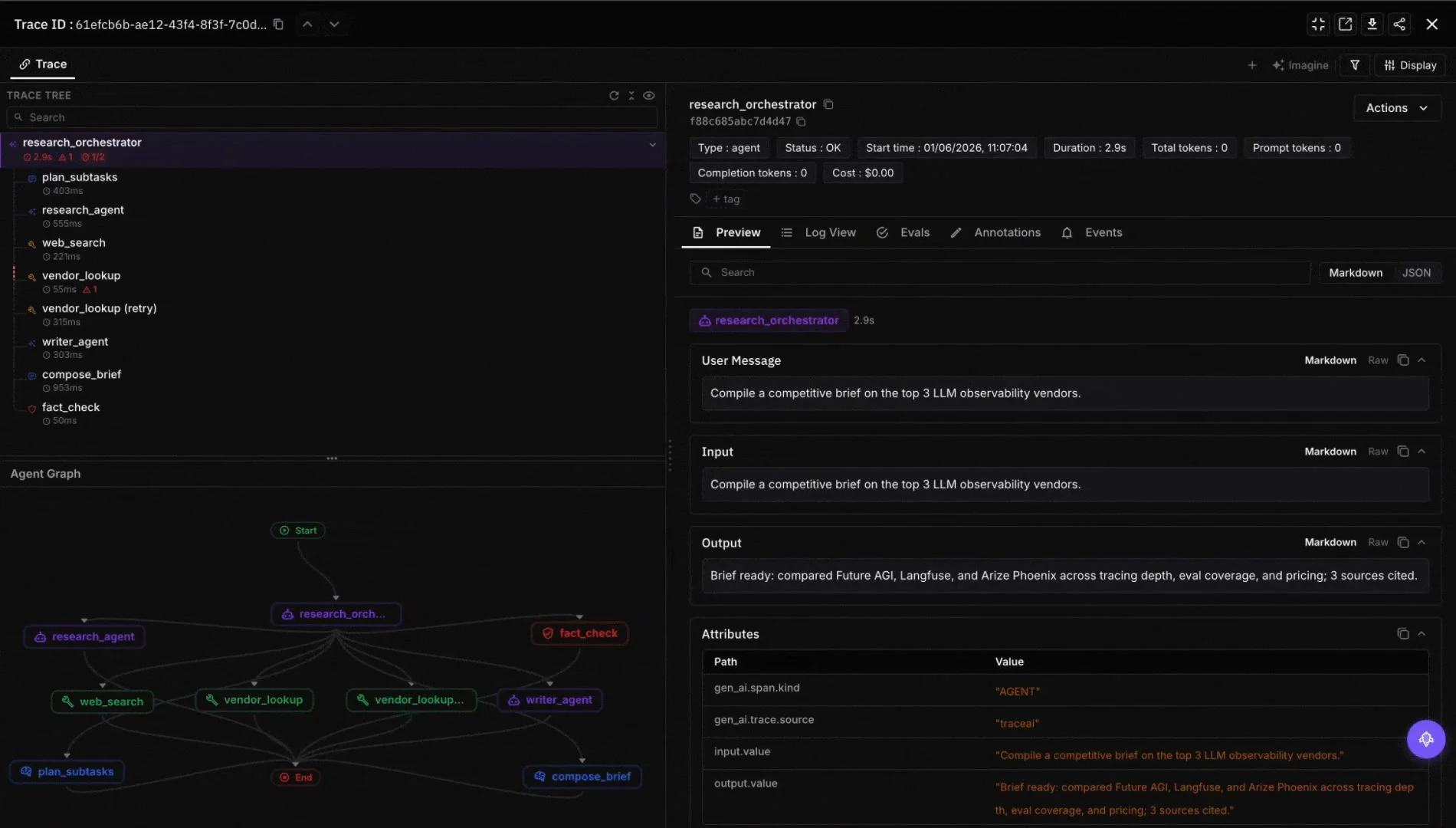
- Trace. Every Claude Code turn produces a span via
traceAIcapturing model, tokens, cost, eval score, cache state, and budget state at request time. Cost-center attribution rides on the span.
- Evaluate.
ai-evaluationscores every turn for code-correctness, faithfulness, tool-use accuracy. 50+ pre-built evaluators plus 20+ local heuristic metrics; lower per-eval cost than Galileo Luna-2. - Optimize.
agent-optships six optimizers (PROTEGI, GEPA, MetaPrompt, BayesianSearch, RandomSearch, PromptWizard) over the same unified Evaluator. It reads breach + trace + eval history and outputs a routing-policy diff: “forplatform-squad, route turns under 10K input tokens toclaude-haiku-4-5between 9am and 5pm; code-correctness regression 0.3%, estimated monthly saving $4,200.”
- Re-deploy. New rule is versioned and signed; rollback fires if scores regress. Each deploy is logged as an audit event tied to the approver’s IdP claim.
Net effect: a team starting at $40,000/month with monthly breaches settles into a steady-state where the cap holds, the loop tunes downgrade thresholds quarterly, and the EM stops getting paged at 9pm on the 23rd. The cap stops being the constraint; it becomes the input to a policy that tightens itself.
Ready to put a gateway in front of Claude Code? Point ANTHROPIC_BASE_URL at https://gateway.futureagi.com/v1, issue one virtual key per developer, attach a budget, and watch the audit trail populate. The Agent Command Center quickstart walks the setup; the caching docs cover the semantic-cache config; the routing features page covers fallback chains.
Related reading
- AI Gateway for Codex CLI in 2026: The Playbook
- Best AI Gateways for Claude Code Caching in 2026
- Best 5 AI Gateways to Monitor Claude Code Token Usage in 2026
- Best AI Gateways for Routing Claude Code in Production
- How to Reduce Claude Code Token Costs by 90 Percent in 2026
- What Is an AI Gateway? The 2026 Definition
Sources
- Anthropic Claude Code documentation, docs.anthropic.com/en/docs/claude-code
- Future AGI Agent Command Center, futureagi.com/platform/monitor/command-center
- Future AGI traceAI, github.com/future-agi/traceAI
- Future AGI ai-evaluation, github.com/future-agi/ai-evaluation
- Future AGI agent-opt, github.com/future-agi/agent-opt
- Future AGI Protect latency benchmarks, arxiv.org/abs/2510.13351 (65 ms text, 107 ms image)
- Portkey AI gateway, portkey.ai
- Helicone proxy, helicone.ai
- LiteLLM proxy, github.com/BerriAI/litellm
- OpenRouter, openrouter.ai
- Cloudflare AI Gateway, developers.cloudflare.com/ai-gateway
Frequently Asked Questions
What does an AI gateway actually add to Claude Code for cost management?
Do developers have to change their `claude` command to use a gateway?
Why does Claude Code spend concentrate in long context rather than RPS?
How do per-developer budgets work when fifty engineers share one Anthropic account?
What does the per-call audit trail actually contain?
How does provider flexibility help if the team only uses Claude?
Where should the secret scanner and prompt-injection guardrail run?
Five tools for Claude Code cost management in 2026: four gateways, the native Anthropic dashboard, and a FinOps platform, scored on chargeback, caps.

Five AI gateways scored on Claude Code token monitoring in 2026: per-dev attribution, per-repo budgets, session traces, alerts, where each falls short.

Five AI gateways scored on caching Claude Code calls in 2026: cross-developer cache scope, semantic-match thresholds, hit-rate, TTL, what each misses.