Top 5 Tools for Claude Code Cost Management in 2026
Five tools for Claude Code cost management in 2026: four gateways, the native Anthropic dashboard, and a FinOps platform, scored on chargeback, caps.
Table of Contents
The finance partner walks into engineering all-hands with a slide: “Claude Code: $187K last quarter, $94K of which we can’t attribute to a team.” Long pause. The CTO promises a chargeback model by next quarter. Six weeks later the slide is the same number with a different decimal point.
Claude Code cost management isn’t one product category, it’s a stack. At the floor is the Anthropic Usage API and native console, free, official, structurally unable to answer “which developer on which repo ran this up.” Above that sits an AI gateway adding per-developer attribution, budget caps, and route-by-budget actuators. Above that sits a FinOps platform joining gateway spend with the rest of the cloud bill so the CFO sees Claude Code next to EC2 and Snowflake.
Most teams shop in one layer and discover at procurement it answers the wrong half of the question. Gateways don’t roll up to a CFO-grade view. FinOps tools don’t enforce caps at request time. The native dashboard does neither.
This is the 2026 cohort of tools for Claude Code cost management, scored on the seven axes that matter when the bill stops being a curiosity. The picks are deliberately heterogeneous: three gateways, the native Anthropic surface, and one FinOps platform that Claude Code never sees but whose absence makes every other layer brittle in front of finance.
TL;DR: pick by the layer you are missing
| Layer you are missing | Pick | Why |
|---|---|---|
| Attribution, caps, route-by-budget, and a feedback loop that reduces spend over time | Future AGI Agent Command Center | Only entry where traces feed an optimizer that auto-tunes the routing policy |
| Hosted gateway with per-key budgets and Slack-native alerts | Portkey | Cleanest enforcement layer if you do not need a self-improving loop |
| Lightweight per-request observability for a small rollout | Helicone | Minimal infra; the right answer below 10 developers |
| Floor-of-the-stack token visibility from Anthropic itself | Anthropic Native Dashboard + Usage API | Free, official, and structurally limited — useful as a check, not as the system of record |
| Roll Claude Code spend into a CFO-grade view across cloud and SaaS | Vantage | LLM-aware FinOps with tags and unit economics; complements a gateway, does not replace it |
What “cost management” actually means for Claude Code
The keyword looks like one thing. Inside the team that owns the budget, it’s four jobs nobody is doing well simultaneously.
-
Attribution. Who spent the money, which developer, repo, branch, cost center. The Anthropic dashboard groups by API key; twelve developers on one team key means attribution is dead at the source. Solving requires intercepting requests and tagging. What an AI gateway exists to do.
-
Enforcement. When a team hits 95%, what happens? In most companies, an email no one reads. Real enforcement requires returning a 429 or transparently downgrading Opus to Sonnet at request time. Only a gateway in the request path can.
-
Forecasting. Will we breach Q3? FinOps work, gateway numbers joined with headcount, Snowflake compute, Datadog spend, projected against the contract commit. Gateways don’t do this; FinOps platforms do.
-
Audit. “Who approved sending this code on April 4?”, partly the gateway’s log, partly the FinOps platform’s allocation lineage.
Teams buy “a cost management tool” and six weeks later discover they covered one of four jobs.
The 7 axes we score on
| Axis | What it measures |
|---|---|
| 1. Per-session attribution | Can the tool group cost by Claude Code session ID, not just by API key? |
| 2. Per-developer chargeback | Can it tag and aggregate by developer email or SSO claim? |
| 3. Budget caps + alerts | Can it enforce a hard or soft dollar cap and page the right human when breached? |
| 4. Post-budget routing | Can it transparently downgrade Opus to Sonnet or Haiku when a team is over budget, at request time? |
| 5. Cache observability | Can it tell you what fraction of input tokens were served from Anthropic’s prompt cache, sliced by developer? |
| 6. FinOps integration | Does it export to a CFO-grade tool that compares Claude Code spend against the rest of cloud spend? |
| 7. Audit trail | Is every request, cap change, and routing-policy edit logged in a SOC-2-presentable form? |
No tool scores 7/7 except the one that ships an optimizer.
How we picked
We started from public products that explicitly support Claude Code or Anthropic API workloads as of May 2026. We cut gateways that don’t preserve Anthropic’s tool-use blocks and FinOps platforms whose Anthropic integration is still on the roadmap. The final five include three gateways, the native Anthropic surface, and one FinOps platform. The heterogeneity is the point, a real cost-management story uses at least two layers, not one.
1. Future AGI Agent Command Center: Best for closing the loop on Claude Code spend
Verdict: Future AGI is the only tool here where traces and breaches feed an optimizer that updates the routing policy on the next deploy. The other four report, enforce, or roll up. Agent Command Center reports, enforces, rolls up, and rewrites the policy so next month’s spend is lower without an EM touching anything.
What it does for Claude Code cost management:
- Per-session traces through
traceAI(Apache 2.0). Session ID is a top-level span attribute. The EM can see the exact turn where context ballooned to 180K tokens and which developer issued it. - Per-developer chargeback through
fi.attributes.user.idon virtual keys. SSO claim flows through; dashboard groups by developer, repo, and cost center. - Budget caps and alerts in three stages, soft alert at 80%, automatic downgrade at 95%, hard pause at 110% with a structured 429. The three-stage default is the recommended ship config.
- Post-budget routing through the budget-aware policy with an Opus → Sonnet → Haiku cascade. The optimizer reads eval-score history and decides which turn classes are safe to downgrade, typical answer is “turns under 10K input tokens, code-correctness regression 0.3%, route to
claude-haiku-4-5.” - Cache observability as a first-class metric. The trace records
cache_read_input_tokensseparately. The dashboard exposes “Claude Code cache hit rate by developer”, useful because the most common reason for a 3x cost jump is one developer whose setup invalidates the prompt cache on every turn. - FinOps integration through OTel export plus tagging compatible with Vantage and Cloudability.
- Audit trail with every policy edit signed against the editor’s IdP claim. SOC 2 Type II certified.
The loop, applied to cost. A breach event is co-located with trace history and eval scores. fi.opt.optimizers (six optimizers (RandomSearchOptimizer, BayesianSearchOptimizer with Optuna teacher-inferred few-shot and resumable runs, MetaPromptOptimizer, ProTeGi, GEPAOptimizer, PromptWizardOptimizer), all sharing EarlyStoppingConfig) outputs a routing-policy diff with the math attached: “for platform-squad, route turns under 10K input tokens to claude-haiku-4-5, code-correctness regression 0.3%, estimated monthly saving $4,200.” The diff ships on the next deploy. Protect guardrails enforce content policy at ~65 ms text median time-to-label (arXiv 2510.13351), so the routing decision adds no perceptible latency.
Where it falls short:
-
The three-stage cap (80/95/110) is opinionated. Teams wanting a single hard cap find the default over-engineered.
-
The optimizer needs ~a month of traffic before stable policy diffs emerge. Day-one runs on static rules.
-
Cache observability surfaces Anthropic API gaps honestly rather than smoothing, useful for honesty, awkward in a finance review.
Pricing: Free tier with 100K traces / month. Scale starts at $99/month. Enterprise custom with SOC 2 Type II, HIPAA, GDPR, and CCPA all certified, BAA available, AWS Marketplace listing.
Score: 7/7 axes.
2. Portkey: Best for a hosted enforcement layer
Verdict: Portkey is the most polished hosted-only gateway for the enforcement half of cost management. Virtual-key budgets are clean, Slack and Teams alerts are first-class, the dashboard is one EMs actually log into. It doesn’t close the loop on the routing policy and it doesn’t roll up to a CFO-grade view; it enforces the policy you write.
What it does for Claude Code cost management:
- Per-session traces through Portkey’s
trace_idheader, wrapper has to set it. - Per-developer chargeback through virtual keys. Each developer’s virtual key fans out to one underlying Anthropic key, preserving bulk pricing. Cleanest implementation in the cohort.
- Budget caps and alerts through per-key hard caps. Threshold alerts route to Slack channels or Teams DMs.
- Post-budget routing is partial. Conditional routing on metadata exists; budget-conditional downgrade requires custom rules. Not turnkey.
- Cache observability is present but shallow. Aggregate metrics on the analytics view; per-developer slicing needs custom exports.
- FinOps integration through CSV export and webhooks. No native Vantage or Cloudability connector.
- Audit trail through Portkey’s activity log. Per-action attribution is solid; long-term retention requires Enterprise.
Where it falls short:
- No optimizer. Last month’s breach pattern doesn’t influence next month’s policy unless an EM manually re-tunes.
- Route-by-budget is wireable, not turnkey. Plan a sprint of metadata-conditional rule work.
- Cache-observability slicing is shallower than Future AGI’s.
- Pricing escalates above 5M requests/month faster than lighter alternatives, matters at 100+ developers.
Pricing: Free tier with 10K requests/day. Scale starts at $99/month. Enterprise custom with SOC 2 Type II.
Score: 5/7 axes (missing: turnkey route-by-budget, self-improving policy, native FinOps roll-up).
3. Helicone: Best for lightweight observability on small teams
Verdict: Helicone is the right answer when the cost story is “ten developers, $5K a month, a per-developer daily cap and a Slack ping when it trips.” Drop in the proxy, configure policies, get on with the week. Past 20 developers, cracks in policy expressiveness show.
What it does for Claude Code cost management:
- Per-session traces through
Helicone-Session-Id. Same wiring caveat. - Per-developer chargeback through
Helicone-User-Id. Aggregation is simple; slicing by repo or cost center is shallower than Portkey’s. - Budget caps and alerts through usage-alert policies. RPM-first; dollar caps work through alerts plus a webhook that disables the key.
- Post-budget routing not present out of the box. Routing is round-robin / failover; budget-aware downgrade has to be coded upstream.
- Cache observability is per-request; aggregated per-developer requires SQL on the warehouse export.
- FinOps integration through Helicone’s export API. No native FinOps connectors.
- Audit trail through the request log. Adequate for internal review; thin for an enterprise auditor.
Where it falls short:
- No optimizer.
- No prompt library, which matters when several developers tweak the same Claude Code instructions and one silently drives up cost.
- Policy expressiveness below Portkey and Future AGI; three-stage caps are hand-wired through webhooks.
- Self-host beyond a few hundred RPS gets operational; the team is open about the limit.
Pricing: Free tier with 10K requests/month. Pro starts at $25/month. Enterprise custom.
Score: 4/7 axes (missing: route-by-budget, self-improving policy, native FinOps roll-up).
4. Anthropic Native Dashboard + Usage API: Best as the floor, not the ceiling
Verdict: The only non-gateway entry. Here because most teams check it first, conclude “Anthropic gives us a dashboard, we’re fine,” and discover four months later it can’t answer any of the four cost-management jobs. Free, official, the canonical source of truth for raw spend. Structurally incapable of attribution, enforcement, or roll-up beyond the per-API-key level. Use it as the check on what the gateway claims you spent, not as the system of record.
What it does for Claude Code cost management:
- Per-session traces. No. Groups by API key, model, and time window. A Claude Code session is invisible here.
- Per-developer chargeback. Partial. Per-developer keys give Usage-API-level spend but lose Anthropic’s volume pricing (each key billed independently). Shared team keys make per-developer chargeback impossible at this layer.
- Budget caps and alerts through organization-level spend limits. Hard ceiling for the whole org; per-developer or per-cost-center caps don’t exist. Alerts are email-based.
- Post-budget routing. No. The console is a billing surface. When the org cap hits, 429s reject across the whole org, pausing every team simultaneously.
- Cache observability is actually good. Usage API exposes
cache_read_input_tokens,cache_creation_input_tokens, and standard input tokens as separate fields. Global cache hit rate is computable. Can’t slice by developer or repo without a layer above. - FinOps integration through the Usage API export. Cloudability, Vantage, and Apptio all ingest from this endpoint.
- Audit trail is the console’s activity log, adequate for invoice reconciliation, thin for SOC 2 evidence about which developer’s code went to the model on a specific date.
Where it falls short:
- The structural ceiling. The dashboard’s atomic unit is the API key. Claude Code’s atomic unit, for management, is the session and the developer. Not a feature gap, a layer choice. Anthropic ships a billing surface, not a chargeback platform.
- No enforcement actuator. Can’t return 429 when one developer’s daily cap is hit, because daily caps per developer don’t exist here.
- No route-by-budget. Reports model used; doesn’t influence model used.
- No team-level pause. Org cap hit pauses every team. No way to pause one squad while another keeps working.
- No tagging. Repository, branch, cost center, project, none exist in the native surface.
Pricing: Free with the Anthropic account. Usage API included.
Score: 1.5/7 axes (cache observability is real; per-developer chargeback ruins your pricing; everything else absent).
The Anthropic dashboard is the foundation. Every other tool in this list reads from it or sits in front of it. It belongs in the stack as the source-of-truth check on the gateway’s accounting. It doesn’t belong as the system that answers EM or CFO questions.
5. Vantage: Best for rolling Claude Code into a CFO-grade FinOps view
Verdict: The only product here that doesn’t sit in the request path. It sits downstream of every cost-bearing system. AWS, GCP, Azure, Snowflake, Datadog, and now Anthropic via the Usage API integration. Its job is putting Claude Code spend in the same allocation report as everything else, so the CFO sees one number for “AI” that ladders into the broader cloud bill.
What it does for Claude Code cost management:
- Per-session attribution. Not natively. Vantage ingests at Usage API granularity unless an upstream gateway has already tagged with session metadata.
- Per-developer chargeback. Depends on what the upstream gateway tagged. The strength is the allocation engine: once data has tags, rules split spend by team, project, business unit, joined with HR rosters.
- Budget caps and alerts through Vantage’s budget feature, downstream, not at request time. Right tool for “we’re trending to breach Q3 by 15%, decide now.”
- Post-budget routing. No. Vantage doesn’t sit in the request path.
- Cache observability through Usage API ingestion.
cache_read_input_tokensis a chartable metric, right place to ask “is the company’s overall cache hit rate trending up as adoption grows.” - FinOps integration is the entire product. Anthropic spend lands in the same unit-economics report as EC2, RDS, Snowflake, Datadog. “Cost per engineer-month including all AI tooling” is answerable here and basically nowhere else.
- Audit trail is solid for cost data and allocation lineage. For “who changed the platform-squad allocation rule on April 4,” Vantage is the system of record.
Where it falls short:
- Not in the request path. Every gateway feature, caps, alerts, route-by-budget, happens elsewhere. Teams buying Vantage thinking it will “stop the bleeding mid-month” are buying the wrong product. It will show the bleeding precisely; it won’t stanch it.
- Granularity ceiling at API-key level without a gateway. Direct-to-Anthropic traffic with shared keys ingests as the same opaque blob as the native dashboard.
- Anthropic integration recency. Shipped late 2025 / early 2026. Solid but slicing assumes daily granularity; sub-daily allocation needs custom exports.
- Forecasting tax. Wide uncertainty bands in the first quarter of data, narrowing later. EMs unfamiliar misread early forecasts.
Pricing: Free tier covers basic cloud cost reporting. Enterprise is typically a percent of cloud spend; expect a four-figure monthly bill once integrated across providers.
Score: 4/7 axes (chargeback only with upstream gateway; FinOps integration is the strength; no request-time enforcement).
Vantage is the ceiling of the stack, not the floor. Pair with a gateway.
Capability matrix
| Axis | Future AGI | Portkey | Helicone | Anthropic Native | Vantage |
|---|---|---|---|---|---|
| Per-session attribution | Native | Header-wired | Header-wired | None | Only via upstream tagging |
| Per-developer chargeback | Native + SSO | Virtual keys | User-id header | Breaks bulk pricing | Via gateway tags |
| Budget caps + alerts | 3-stage native | Per-key hard cap | RPM + webhook | Org-level only | Forecast, downstream |
| Post-budget routing | Native, optimizer-tuned | Wireable | Code upstream | None | None |
| Cache observability | By developer + repo | Aggregate | Per-request | Aggregate via Usage API | Charted via ingestion |
| FinOps integration | OTel + Vantage tags | CSV + webhook | Export API | Direct Usage API | The product itself |
| Audit trail | Signed + IdP-tied | Activity log | Request log | Console activity | Allocation lineage |
| Self-improving policy | fi.opt auto-tunes | Not present | Not present | Not present | Not present |
Decision framework: choose X if
Choose Future AGI Agent Command Center when the budget conversation has become recurring and the goal is to flatten next month’s spend without making it the EM’s part-time job. Dry-run mode plus optimizer-driven policy diffs turn cost management from a habit into a process that improves itself.
Choose Portkey when the team needs a hosted enforcement layer with mature virtual keys and Slack alerts, and route-by-budget rules are wireable in a sprint.
Choose Helicone when the team is small (under 10 developers), the story is “a daily cap and a Slack ping,” and policy gets re-tuned in standup.
Choose the Anthropic Native Dashboard as the floor of every other choice, the source-of-truth check the gateway’s accounting reconciles to. Always open during the monthly review; never the only thing open.
Choose Vantage when Claude Code is one line item among many and the question is “how does AI spend ladder into the broader cloud bill.” Pair with a gateway upstream.
The real answer for most companies past 30 engineers is two of these layers, not one. Future AGI plus Vantage, or the hosted gateway plus Vantage, with the Anthropic Native Dashboard as the reconciliation check. Gateways do enforcement and attribution; Vantage does forecasting and allocation. Complementary, not competitive.
Common mistakes when assembling the stack
| Mistake | What goes wrong | Fix |
|---|---|---|
| Treating the Anthropic dashboard as the system of record | Chargeback impossible past one team key; per-developer attribution requires fragmenting keys, which breaks volume pricing | Put a gateway upstream; treat native dashboard as reconciliation check |
| Buying a FinOps tool first | Vantage shows the bleeding but cannot stop it; mid-month breaches go unenforced | Buy the gateway first; add Vantage when forecasting matters |
| Setting org-level Anthropic spend limits as the cap | When breached, every team is paused at once | Move caps to the gateway, scoped per cost center; keep org limit as a backstop |
| Tagging with developer email only | Per-team auto-cutoff collapses to per-individual | Tag cost center as primary, developer as secondary |
| Ignoring cache hit rate | A developer whose project setup invalidates the prompt cache silently costs 3x more than peers | Track cache hit rate per developer; investigate anyone under 30% |
| Hardcoding the cheap-model substitute | Anthropic deprecates the model later, gateway errors at 95% threshold | Wire the cascade as a list (Opus → Sonnet → Haiku), revisit quarterly |
| Routing all alerts to one Slack channel | Notifications get muted; next breach goes unnoticed | Per-cost-center alert routing to the EM responsible |
| Skipping the dry-run before shipping a new cap | First production day pauses sessions the EM did not predict; trust drops | Run the proposed cap against the last 30 days of traffic before going live |
How Future AGI closes the loop on Claude Code cost management
The other four tools treat cost management as a static stack. Future AGI treats it as a feedback loop. Six stages:
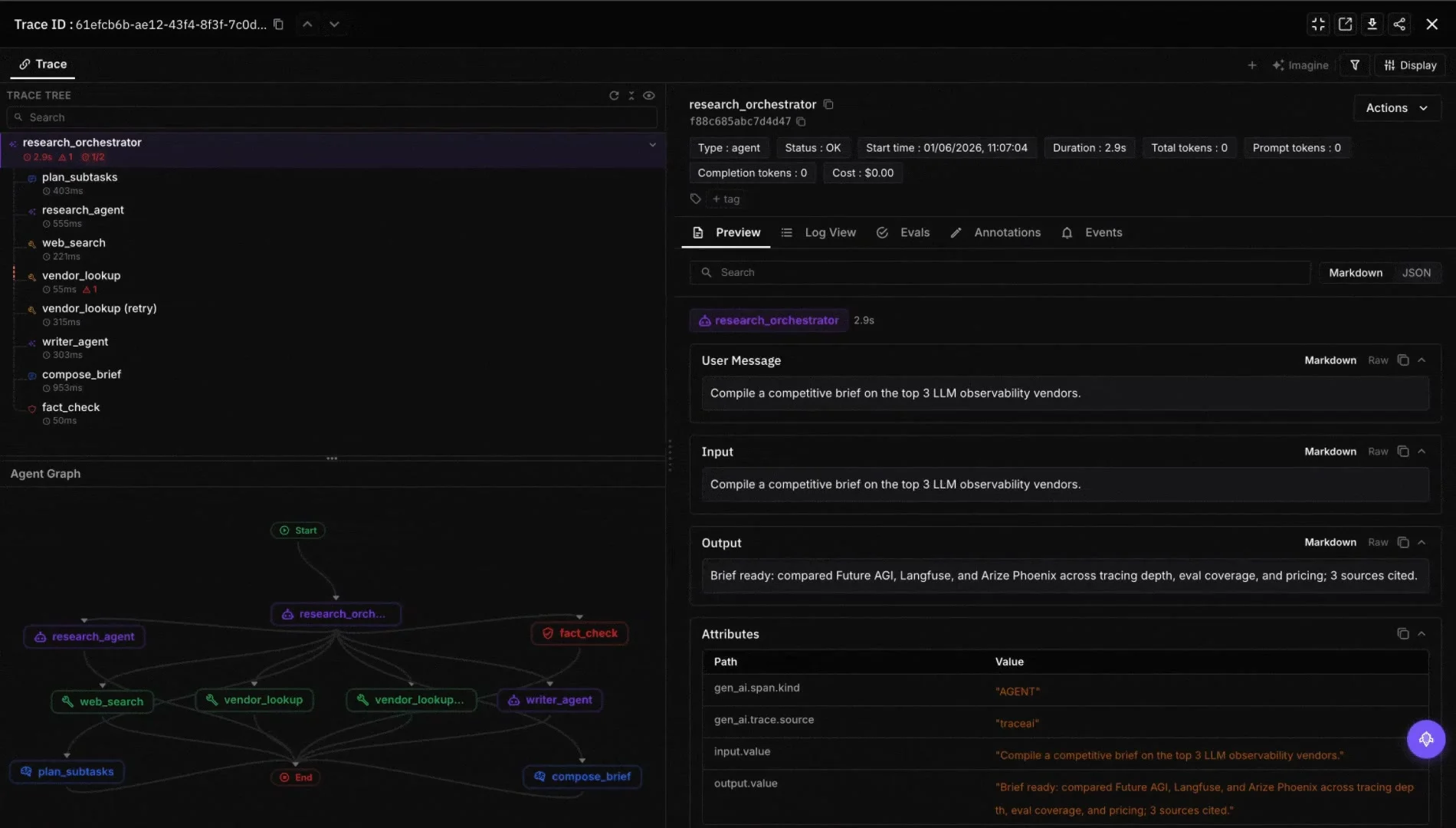
- Trace. Every turn produces a span via
traceAI(Apache 2.0) capturing inputs, outputs, tool calls, model used, cost-center attribution, cache stats, and budget state. OpenTelemetry-compatible, the same data flows into the optimizer and out to Vantage.
-
Evaluate.
fi.evals(Apache 2.0) scores every turn for code-correctness, faithfulness, and tool-use accuracy. The score is co-located with the cost record, the system already knows, per turn, “Opus called when Sonnet would have been enough.” -
Cluster. Low-scoring sessions group by failure mode. Cost-management cluster: “high-cost, low-difficulty turns.” Unit-economics cluster: “low cache hit rate, repeated context.”
- Optimize.
fi.opt.optimizers(six optimizers (RandomSearchOptimizer, BayesianSearchOptimizer with Optuna teacher-inferred few-shot and resumable runs, MetaPromptOptimizer, ProTeGi, GEPAOptimizer, PromptWizardOptimizer), all sharing EarlyStoppingConfig) reads breach + trace + score history and outputs a routing-policy diff: “forplatform-squad, route turns under 10K input tokens toclaude-haiku-4-5weekdays 9am-5pm, code-correctness regression 0.3%, estimated monthly saving $4,200.” EM approves, or auto-approval thresholds ship it.
-
Route. Gateway applies the updated policy with the version logged. Protect guardrails enforce content policy at ~65 ms text median time-to-label (arXiv 2510.13351), budget and safety logic add no perceptible latency.
-
Re-deploy and roll up. Each policy version is signed against the approver’s IdP claim. Trace data exports to Vantage with cost-center tags intact, so the CFO sees realized savings in the forecast, actual savings against prior run-rate, not promised savings against a slide.
Net effect on a 30-engineer team: $40,000/month with monthly breaches becomes a steady state where the cap holds, the optimizer tunes the downgrade threshold quarterly, and the EM stops getting paged on the 23rd. The cap becomes the input to a policy that tightens itself.
Open source: traceAI, ai-evaluation, agent-opt, all Apache 2.0 at github.com/future-agi. Agent Command Center adds the budget-policy UI, dry-run simulator, per-cost-center alert routing, Protect guardrails, RBAC, SOC 2 Type II certified, AWS Marketplace listing.
What we did not include
- LiteLLM. Excellent self-hosted gateway, covered in the gateway-specific siblings. Left out here to make room for the non-gateway entries that distinguish this list from a pure-gateway cohort.
- Cloudability and Apptio. Strong FinOps platforms; Anthropic integration is solid for Cloudability, improving for Apptio. We picked Vantage for its native unit-economics view and faster shipping cadence on the Anthropic Usage API.
- Cloudflare AI Gateway. Strong primitives, but budget caps are rate-limit-first; dollar-denominated caps with route-by-budget still require worker code as of May 2026.
All three are worth a second look in Q3 2026.
Related reading
- Best 5 AI Gateways to Monitor Claude Code Token Usage in 2026
- Best AI Gateway for Claude Code Cost Management in 2026
- Top 5 Enterprise AI Gateways to Track Claude Code Costs in 2026
- What Is an AI Gateway? The 2026 Definition
- Best LLM Cost Tracking Tools in 2026
Sources
- Anthropic Claude Code documentation, claude.ai/docs/claude-code
- Anthropic Usage API, docs.anthropic.com/en/api/usage
- Anthropic Prompt Caching, docs.anthropic.com/en/docs/build-with-claude/prompt-caching
- Future AGI Agent Command Center, futureagi.com/platform/monitor/command-center
- Future AGI traceAI, github.com/future-agi/traceAI
- Future AGI ai-evaluation, github.com/future-agi/ai-evaluation
- Future AGI agent-opt, github.com/future-agi/agent-opt
- Future AGI Protect latency benchmarks, arxiv.org/abs/2510.13351 (65 ms text / 107 ms image median time-to-label)
- Portkey AI gateway, portkey.ai
- Helicone proxy, helicone.ai
- Vantage FinOps platform, vantage.sh
Frequently Asked Questions
What is Claude Code cost management, and what tools cover it?
Can the Anthropic Native Dashboard do per-developer chargeback?
Is Vantage a replacement for an AI gateway?
How do I cap Claude Code spend per developer without breaking flow?
What is cache observability and why does it matter?
Can I combine Future AGI with Vantage?
Is it safe to send Claude Code source code through an AI gateway?
How is Future AGI different from buying Portkey plus Vantage?
Six AI gateways scored on Claude Code cost management in 2026: per-developer budgets, semantic cache, audit headers, Opus-to-Haiku fallback.

Five AI gateways scored on Claude Code token monitoring in 2026: per-dev attribution, per-repo budgets, session traces, alerts, where each falls short.

Cut Claude Code token spend with 5 stackable levers: cache_control, MCP-tool compilation, semantic caching, model right-sizing, pruning. Honest 90% read.