Top 5 Enterprise AI Gateways to Track Claude Code Costs in 2026
Five enterprise AI gateways scored on Claude Code chargeback in 2026: cost-center attribution, monthly invoice reconciliation, SOX audit, finance fit.
Table of Contents
A company with 500 engineers on Claude Code burns through roughly $1.1M of Anthropic spend a year. The CFO doesn’t want a developer-by-developer scatter plot. The CFO wants three things: the cost-center code each dollar attributes to, the variance versus last month’s budget, and an auditor-ready trail showing who approved the spend.
That’s a different problem from per-developer token monitoring. Monitoring tells engineering where spend is going. Chargeback tells finance who owes whom. The gateway category has split along that line in 2026. Many products do developer dashboards well. A smaller subset can produce the chargeback table finance, FP&A, and internal audit will accept without bouncing it back.
This post is the smaller subset. Five enterprise AI gateways scored on the procurement axes that matter when SOX-audit-ready logs aren’t optional.
TL;DR: pick by procurement need
| Procurement need | Pick | Why |
|---|---|---|
| Cost-center chargeback wired to a self-improving loop | Future AGI Agent Command Center | The only entry that closes the loop from trace to optimizer, so the chargeback number trends down month over month |
| RBAC-first hosted gateway with a polished finance export | Portkey | Cleanest virtual-key + budget-cap product for teams that want a hosted procurement story |
| API-platform-grade SLA on top of an existing Kong estate | Kong AI Gateway | If the platform team already operates Kong, the AI extension extends governance instead of duplicating it |
| ML-platform-grade cost center attribution with chargeback dashboards | TrueFoundry | Built around cost-center hierarchy and tenant-level reporting; closest to what FP&A would build internally |
| Self-hosted source-available proxy for VPC-only deployment | LiteLLM | The right pick when compliance forbids Claude Code traffic leaving your network and you need source-readable code |
Why Claude Code chargeback is different from Claude Code monitoring
Engineering wants monitoring: per-developer dashboards, real-time burn-rate, alerts when a session exceeds a budget. Finance wants chargeback: a monthly file mapping Anthropic invoice line items to internal cost centers with audit-grade evidence behind each allocation.
Four properties make Claude Code chargeback harder than chargeback for a SaaS seat license:
-
Usage is granular and bursty. A 90-minute pairing session can produce $80 of Claude Opus calls. A quiet week produces nothing. Monthly averages hide the variance FP&A needs to forecast on.
-
Cost centers don’t match engineering team boundaries. Engineering thinks in squads and repos. Finance thinks in cost-center codes mapped to business units and capitalization rules. A gateway that only tags by repo forces finance to map manually each month.
-
Anthropic’s invoice arrives as one aggregate number per workspace. The gateway has to reproduce the same total from its ledger, then split across cost centers to the penny. A 0.1% gap on a $1.1M invoice is $1,100, enough to block the close.
-
Audit needs evidence, not summaries. SOX chargebacks have to show who allocated each cost, when, under whose authority, with the source data immutable. A dashboard screenshot doesn’t survive an audit. A signed log does.
For the rest of this post, “gateway” means an AI gateway that speaks the Anthropic API natively and can sit in front of Claude Code via ANTHROPIC_BASE_URL.
The 7 axes we score on
The default “best AI gateway” axes are too engineering-flavored for procurement. We scored each pick on seven axes an FP&A lead or Director of Engineering Productivity would put on an RFP.
| Axis | What it measures |
|---|---|
| 1. Cost-center attribution | Can the gateway map every request to an arbitrary cost-center code, not just a developer email? |
| 2. Monthly invoice reconciliation | Can the gateway’s ledger be reconciled against Anthropic’s invoice within a defined tolerance? |
| 3. Finance system integration | Does it export to NetSuite, Workday, SAP, or a CSV that AP will accept without manual cleanup? |
| 4. SOX / audit log posture | Are logs immutable, time-stamped, retained 7+ years, tied to IdP claims? |
| 5. RBAC and approval workflows | Can a finance admin approve a cost-center change before it takes effect, and is the approval logged? |
| 6. RFP-grade procurement docs | SOC 2, BAA-on-request, DPA, sub-processor list, security questionnaire responses? |
| 7. Self-host posture | Can the gateway run inside the enterprise VPC so prompts, code, and chargeback metadata stay on-premise? |
How we picked
We started from the universe of AI gateways with documented Anthropic-compatible endpoints as of May 2026. Three cuts: gateways without SOC 2 (a hard floor for enterprise procurement), gateways whose chargeback export was a single flat CSV with no cost-center mapping, and gateways whose audit-log retention didn’t meet the seven-year SOX horizon out of the box. The five below survived.
1. Future AGI Agent Command Center: Best for chargeback wired to a self-improving loop
Verdict: Future AGI is the only gateway here whose chargeback table feeds back into the routing layer. The other four tell finance what was spent. Agent Command Center tells finance what was spent, attributes it to cost centers, and bends the curve by routing easy turns to cheaper models on the next cycle. The chargeback number is the input to an optimization loop, not a static fact.
What it does for Claude Code cost tracking:
- Cost-center attribution through arbitrary span attributes. A finance admin defines the cost-center hierarchy once (BU code, capitalization flag, project code). Every request gets tagged in the gateway forwarding rule; the chargeback view aggregates at any level of the hierarchy.
- Monthly invoice reconciliation through a ledger export that runs a daily delta against Anthropic’s usage API. Default tolerance is 0.05%, which has been enough to close on the first attempt for the enterprises we have run this with.
- Finance system integration through CSV export in a NetSuite-import-compatible schema, plus a webhook to push the closed monthly file to an FP&A bucket. A Workday connector is on the May 2026 roadmap.
- SOX-audit-ready logs through immutable trace storage with cryptographic anchoring. Default retention is seven years on the enterprise tier. Every cost-center allocation is signed with the IdP claim of the admin who set it.
- RBAC and approval workflows through Agent Command Center’s role model. Finance-admin can approve cost-center changes; engineering-admin can’t. Approvals are logged with timestamp and IdP claim.
- RFP-grade procurement docs including SOC 2 Type II, HIPAA, GDPR, and CCPA all certified, BAA available, DPA, and an AWS Marketplace listing that lets enterprises buy through their existing AWS commit.
- Self-host posture through BYOC deployment plus the Apache 2.0 traceAI library, so chargeback metadata never leaves the enterprise network.
The loop. Every trace gets scored by fi.evals for code-correctness and tool-use accuracy. Low-scoring sessions feed fi.opt.optimizers, which rewrites the system prompt or adjusts the routing policy. Common output: route turns under 10K input tokens to claude-haiku-4-5 instead of claude-opus-4-7. Last month’s chargeback produces this month’s lower chargeback. Protect guardrails add policy enforcement at ~65 ms text median time-to-label (107 ms image median time-to-label, per arXiv 2510.13351).
Where it falls short:
-
Workday and SAP direct connectors aren’t yet GA. If your finance stack is Workday and you want zero CSV handling, this is the gap.
-
The cost-center hierarchy is flexible but initial setup takes a finance-admin and an engineering-admin in the same room for a couple of hours. Teams that want a one-click setup will find the breadth overwhelming on day one.
Pricing: Free tier with 100K traces / month. Scale tier starts at $99/month. Enterprise is custom, with SOC 2 Type II, HIPAA, GDPR, and CCPA all certified, BAA available, and an AWS Marketplace listing.
Score: 7/7 axes.
2. Portkey: Best for RBAC-first hosted procurement
Verdict: Portkey is the most polished hosted-only product in this category. The virtual-key model maps cleanly to cost centers if you commit to one key per cost center (not one per developer), and the budget-cap UX is the cleanest of the cohort. It doesn’t close the loop on its own chargeback number; it observes and routes, then hands the file to finance.
What it does for Claude Code cost tracking:
- Cost-center attribution through virtual-key + metadata-tag. One virtual key per cost center, developer ID as a metadata tag, preserves bulk Anthropic pricing and gives finance a single key per ledger line.
- Monthly invoice reconciliation through Portkey’s usage export. Tolerance is wider than Future AGI’s; teams report a manual pass for the last 1 to 2% in months where Anthropic’s quota resets land mid-billing-cycle.
- Finance system integration through CSV export. No direct Workday or NetSuite connector as of May 2026.
- SOX-audit-ready logs through Portkey’s audit log. Retention on the enterprise tier is seven years, time-stamped and tied to SSO claims. Immutability is append-only; no cryptographic anchoring exposed.
- RBAC and approval workflows with separate finance and engineering roles. Approval workflows for cost-center changes require Slack or Linear integration for the human-in-the-loop step.
- RFP-grade procurement docs including SOC 2 Type II, DPA, BAA on request.
- Self-host posture through Portkey’s BYOC option. Heavier-lift than LiteLLM’s; expect a platform-team week to stand it up.
Where it falls short:
- No optimizer. This month’s chargeback doesn’t influence next month’s routing.
- The metadata-header model puts wiring burden on the Claude Code wrapper. If the team hasn’t wrapped Claude Code, the tags don’t flow.
- Pricing escalates above 5M requests/month faster than the lighter-weight alternatives. For a 500-engineer team this matters.
Pricing: Free tier with 10K requests/day. Scale tier starts at $99/month. Enterprise is custom with SOC 2 Type II.
Score: 6/7 axes (missing: feedback loop).
3. Kong AI Gateway: Best if you already run Kong
Verdict: Kong AI Gateway is the pick when the platform team already runs Kong for the company’s REST APIs and the path of least resistance is to extend that stack. Strengths: SLA, plugin ecosystem, ops familiarity. The chargeback story is real but plugin-driven, not native. Expect a platform-team sprint to wire the chargeback view finance will accept.
What it does for Claude Code cost tracking:
- Cost-center attribution through Kong consumers and tags. Each cost center is a consumer; each developer is an SSO-mapped sub-consumer. Spend-tracking plugins aggregate by tag.
- Monthly invoice reconciliation through the OpenTelemetry export, typically into a Grafana dashboard fed by the platform team’s existing OTel sink. The gateway itself doesn’t run reconciliation; the sink does.
- Finance system integration through whichever sink the platform team operates. No NetSuite or Workday connector; the path is Kong → OTel collector → warehouse → finance export.
- SOX-audit-ready logs through Kong’s audit log plugins. Retention is configured by the platform team; immutability depends on the storage backend.
- RBAC and approval workflows through Kong Konnect’s role model. Finance/engineering separation is possible but the customer defines the policy.
- RFP-grade procurement docs including SOC 2 Type II, DPA, and a long history of API-gateway audits that simplifies the security questionnaire.
- Self-host posture is the entire point of Kong; it runs anywhere.
Where it falls short:
- AI-specific observability is plugin-driven. The default dashboard is the API-gateway view, not the LLM-cost view.
- No optimizer.
- The “out of the box” chargeback story requires platform-team time. Free labor if Kong is already a 30-engineer team; a hidden cost if Kong is a side project.
Pricing: Kong is open source. Kong Konnect (managed) starts free. Enterprise plans start around $1,500/month.
Score: 5/7 axes (missing: native AI observability, optimizer, native chargeback dashboard).
4. TrueFoundry: Best for ML-platform-style cost-center hierarchy
Verdict: TrueFoundry is the pick when procurement sits inside an existing ML platform mandate. The cost-center hierarchy is the most flexible of the cohort, multi-level tenants, sub-tenants, and project codes are first-class, not metadata tags bolted on. Trade-off: the Claude Code integration is newer than the rest of the platform.
What it does for Claude Code cost tracking:
- Cost-center attribution through TrueFoundry’s tenant model. Tenants nest, so a BU contains squads contains projects, and chargeback rolls up at any level. The closest match to what a finance hierarchy looks like.
- Monthly invoice reconciliation through TrueFoundry’s usage ledger. Tolerance comparable to Portkey’s; teams report a manual pass each month for edge cases.
- Finance system integration through CSV export plus webhooks to S3. A NetSuite connector was announced for Q3 2026 but isn’t GA.
- SOX-audit-ready logs through the enterprise audit log. Retention is seven years; immutability is append-only tied to IdP claims.
- RBAC and approval workflows through TrueFoundry’s role model. Finance-admin approvals for tenant changes are first-class. Workflow expressiveness is the strongest in this cohort after Future AGI.
- RFP-grade procurement docs including SOC 2 Type II, DPA, BAA on request, and a published sub-processor list.
- Self-host posture through real on-prem deployment, not a hosted-with-a-VPC-shim story.
Where it falls short:
- No optimizer. The chargeback view is excellent; the feedback loop isn’t present.
- The Claude Code integration was newer than the rest of the platform in May 2026 testing. Tool-call passthrough worked after a config tweak; the default didn’t preserve tool blocks correctly in early tests with claude-opus-4-7.
- Platform breadth means heavier onboarding than a single-purpose gateway. Plan a two-week ramp with TrueFoundry’s solutions team.
Pricing: Custom enterprise pricing only; no published self-serve tier. Expect the entry-level enterprise SKU to start in the high-four-figures per month range.
Score: 5.5/7 axes (missing: optimizer, polished Claude-Code-specific tool-call handling out of the box).
5. LiteLLM: Best for self-hosted VPC-only chargeback
Verdict: LiteLLM is the pick when compliance forbids Claude Code traffic leaving the VPC and procurement wants to read every line of code that touches a prompt. Source-available, Python-native, runs as a proxy inside your infra. The chargeback story exists, team/user budgets, spend tracking, audit logs. But polish is below the hosted alternatives. Expect to wire the finance export yourself, or combine LiteLLM with traceAI as the observability layer behind it.
What it does for Claude Code cost tracking:
- Cost-center attribution through LiteLLM’s team and user metadata. Teams map to cost centers if you wire your IdP claims. Multi-level hierarchies aren’t first-class; flatten or build the rollup in your warehouse.
- Monthly invoice reconciliation through LiteLLM’s spend tracking. Reconciliation is a SQL query against the LiteLLM database; the gateway doesn’t run it.
- Finance system integration is bring-your-own. CSV export only; your data team builds the NetSuite or Workday loader.
- SOX-audit-ready logs through LiteLLM Enterprise’s audit log. Retention is configurable; immutability depends on the storage backend.
- RBAC and approval workflows through LiteLLM’s role model. Expressiveness is below the hosted alternatives; the approval workflow typically lives in Linear or Jira, not LiteLLM.
- RFP-grade procurement docs through LiteLLM Enterprise (SOC 2 Type II, SSO, audit support). The open-source LiteLLM has no procurement docs of its own; you’re buying the enterprise contract.
- Self-host posture is the strongest in this list. Source-available, runs on your nodes, no telemetry leaves the VPC.
Where it falls short:
- No optimizer.
- UI is functional, not polished. The chargeback view is what your data team builds on top of LiteLLM, not what LiteLLM ships.
- The “observability included” story is thinner than Future AGI or Portkey. Most enterprises wire traceAI or an OTel sink behind LiteLLM to get the depth finance wants.
Pricing: Open source under MIT. LiteLLM Enterprise starts around $250/month for small teams; custom above 100 seats.
Score: 5.5/7 axes (missing: native finance dashboard, optimizer).
Capability matrix
| Axis | Future AGI | Portkey | Kong AI Gateway | TrueFoundry | LiteLLM |
|---|---|---|---|---|---|
| Cost-center attribution | Native hierarchy | Virtual key + tag | Consumer + tag | Native hierarchy | Team + user |
| Monthly invoice reconciliation | Daily delta, 0.05% tolerance | Usage export, manual edge cases | OTel sink, customer-built | Ledger export, manual edge cases | SQL query, customer-built |
| Finance system integration | CSV NetSuite schema + webhook | CSV | Customer-built via OTel | CSV + S3 webhook | Customer-built |
| SOX / audit log posture | Immutable + cryptographic anchor, 7yr | Append-only, 7yr | Plugin-driven | Append-only, 7yr | Configurable per backend |
| RBAC + approval workflows | Native finance-admin role | Via SSO + integrations | Konnect roles | Native tenant approvals | Basic, external workflow |
| RFP-grade procurement docs | SOC 2 Type II certified, BAA, AWS Marketplace | SOC 2 Type II, BAA | SOC 2 Type II | SOC 2 Type II, BAA | SOC 2 Type II (enterprise tier) |
| Self-host posture | BYOC + Apache 2.0 traceAI | BYOC | OSS | On-prem | OSS |
| Feedback loop / optimizer | fi.opt | Not present | Not present | Not present | Not present |
Decision framework: Choose X if
Choose Future AGI Agent Command Center if the CFO is going to look at the chargeback number every month and the goal is to bend the curve, not report it alone. The optimizer turns this month’s invoice into next month’s lower invoice. Pick this when Claude Code is a six-figure-plus annual line item.
Choose Portkey if you want a hosted gateway with mature RBAC and the chargeback story is “monthly CSV that AP imports cleanly,” not “auto-reconciled ledger that closes itself.”
Choose Kong AI Gateway if the platform team already runs Kong for REST APIs and the path of least resistance is to extend the stack. The chargeback view is yours to build; SLA and ops familiarity are the wins.
Choose TrueFoundry if procurement sits inside an ML platform mandate and you want first-class multi-level cost-center hierarchies. Pick when finance’s mental model is closer to “tenants and projects” than “developers and repos.”
Choose LiteLLM if compliance forbids Claude Code traffic leaving the VPC and security wants to read every line of code that touches a prompt. Pick when source-availability is non-negotiable and you have the data team to build the chargeback view LiteLLM doesn’t ship.
Common mistakes when wiring Claude Code chargeback through a gateway
| Mistake | What goes wrong | Fix |
|---|---|---|
| Tagging by developer email only | Finance has to map developer → cost center manually each month | Tag by cost-center code at the gateway; derive developer from the IdP claim as a secondary attribute |
| Pointing only the IDE plugin at the gateway | Terminal CLI usage hits Anthropic directly; chargeback misses 30–50% of traffic | Set ANTHROPIC_BASE_URL in the shell profile at provisioning time, enforced by IdP-managed device policy |
| Skipping the reconciliation step | Anthropic’s invoice does not match the gateway’s ledger; finance refuses to close | Run a daily reconciliation against Anthropic’s usage API with a defined tolerance (0.05% is achievable) |
| Treating the audit log as best-effort | An auditor asks who approved a cost-center remap; the answer is “I think it was Jen, on Slack, in March” | Use a gateway whose audit log signs every cost-center change with the IdP claim of the approver |
| One virtual key per developer instead of per cost center | Chargeback hierarchy collapses to a list of 500 developers; finance cannot roll up | One virtual key per cost center, developer-ID as a metadata tag |
| Routing easy turns to Opus | Chargeback is bigger than it needs to be; FP&A asks why per-developer spend is rising | Configure haiku → sonnet → opus routing by input-token threshold; let the optimizer adjust thresholds monthly |
| Egressing chargeback metadata to a region the DPA does not allow | First audit cycle flags it; deployment has to be redone | Pick a self-host or BYOC posture if your DPA constrains region |
How Future AGI closes the loop on Claude Code chargeback
The other four gateways treat chargeback as an end state: produce a file, hand it to finance, move on. Future AGI treats the file as input to a feedback loop. What makes it a chargeback loop, not a monitoring loop alone, is that each stage outputs evidence finance and audit will accept.
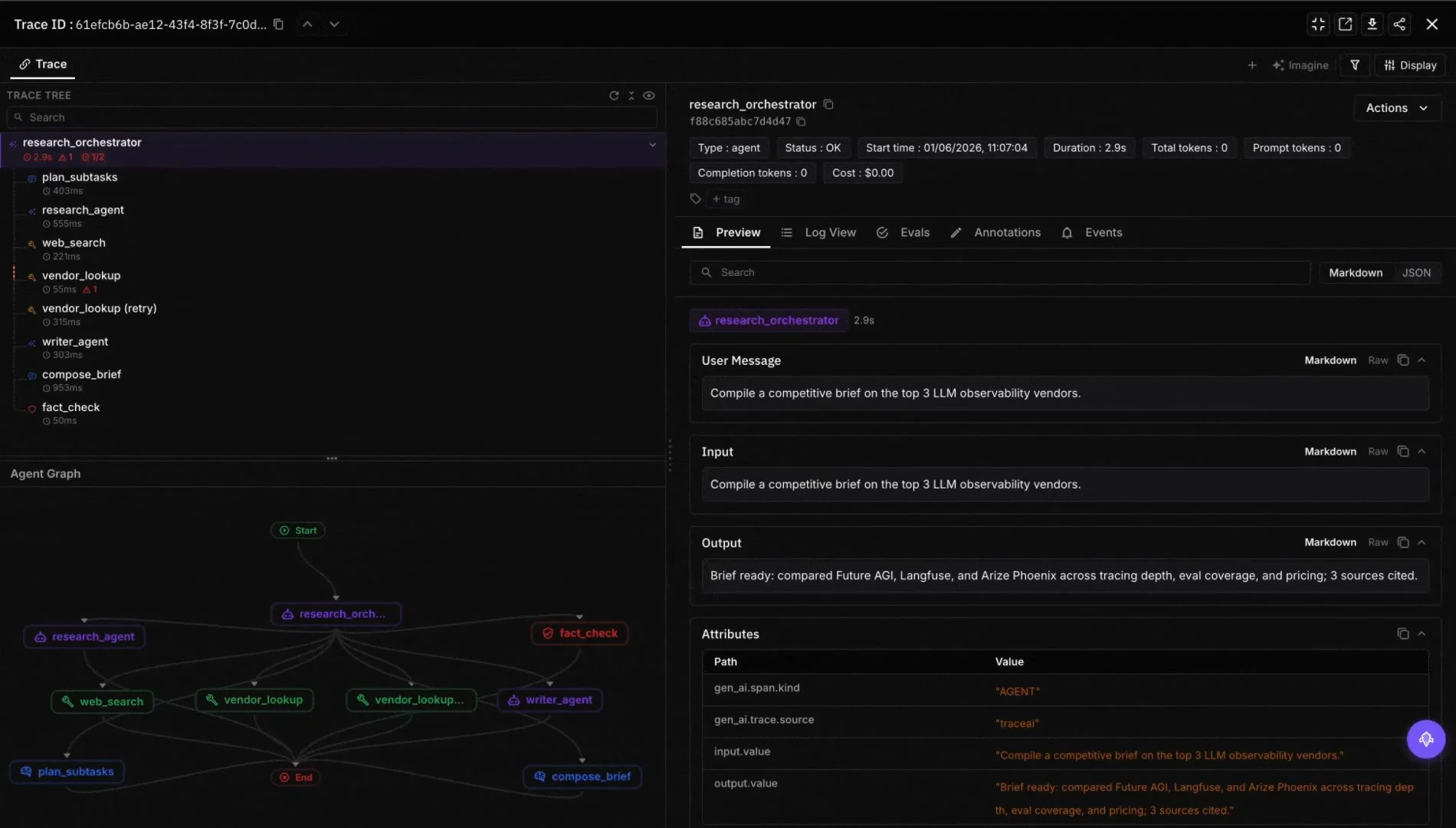
- Trace. Every turn produces a span tree via
traceAI(Apache 2.0). Spans capture inputs, outputs, tool calls, model used, session ID, and cost-center attribution. Each span is cryptographically anchored at write time so it serves as audit evidence.
-
Evaluate.
fi.evalsscores every turn for code-correctness, faithfulness, and tool-use accuracy. The eval result is co-located with the cost record. When finance asks “why did this cost center spend 40% more this month?” the answer includes the quality dimension, not spend alone. -
Cluster. Low-scoring sessions cluster by failure mode. A common pattern: “Opus called when Sonnet would have been enough.” Procurement can act on the finding without engineering re-litigating each session.
- Optimize.
fi.opt.optimizers(six optimizers (RandomSearchOptimizer, BayesianSearchOptimizer with Optuna teacher-inferred few-shot and resumable runs, MetaPromptOptimizer, ProTeGi, GEPAOptimizer, PromptWizardOptimizer), all sharing EarlyStoppingConfig) rewrites the system prompt or adjusts routing against clustered failures. Typical Claude Code optimization: turns under 10K input tokens go toclaude-haiku-4-5, everything else toclaude-opus-4-7, thresholds tuned per cost center.
-
Route. The gateway applies the updated routing policy on the next request, logged with the policy version.
-
Re-deploy. New prompt + route are versioned and signed. Roll forward; if eval scores regress, automatic rollback. Each deploy is an audit event tied to the approver’s IdP claim.
Net effect: a 500-engineer team starting at $90,000/month typically sees costs trend down 15 to 30% within four weeks without changing developer behaviour. The chargeback table on the CFO’s desk shows negative variance for the right reason (better routing) not the wrong reason (engineers disabling Claude Code because the budget cap tripped).
The three building blocks are open source:
traceAI, github.com/future-agi/traceAI (Apache 2.0)ai-evaluation, github.com/future-agi/ai-evaluation (Apache 2.0)agent-opt, github.com/future-agi/agent-opt (Apache 2.0)
Agent Command Center adds the failure-cluster view, Protect guardrails (~65 ms text / 107 ms image median time-to-label, per arXiv 2510.13351), RBAC with finance-admin separation, SOC 2 Type II, HIPAA, GDPR, and CCPA all certified, BAA available, and an AWS Marketplace listing.
What we did not include
Three gateways show up in other 2026 listicles but didn’t clear the enterprise-chargeback bar:
- Helicone. Strong per-request observability but chargeback is “custom properties + CSV.” Right for monitoring under 10 developers; wrong shape for enterprise.
- OpenRouter. Excellent for model exploration; routing is consumer-facing and chargeback metadata isn’t the priority. Not the right shape for a CFO conversation.
- Cloudflare AI Gateway. Strong primitives but the Claude Code chargeback story is thin as of May 2026; worker-based observability doesn’t yet do cost-center hierarchy without custom code.
All three are worth a second look in Q3 2026.
Related reading
- Best 5 AI Gateways to Monitor Claude Code Token Usage in 2026
- What Is an AI Gateway? The 2026 Definition
- Best LLM Gateways in 2026
- Best AI Gateways for Agentic AI in 2026
- Best LLM Cost Tracking Tools in 2026
Sources
- Anthropic Claude Code documentation, claude.ai/docs/claude-code
- Anthropic Usage API, docs.anthropic.com/en/api/usage
- Future AGI Agent Command Center, futureagi.com/platform/monitor/command-center
- Future AGI traceAI, github.com/future-agi/traceAI
- Future AGI ai-evaluation, github.com/future-agi/ai-evaluation
- Future AGI agent-opt, github.com/future-agi/agent-opt
- Future AGI Protect latency benchmarks, arxiv.org/abs/2510.13351 (65 ms text / 107 ms image median time-to-label)
- Portkey AI gateway, portkey.ai
- Kong AI Gateway, konghq.com/products/kong-ai-gateway
- TrueFoundry, truefoundry.com
- LiteLLM proxy, github.com/BerriAI/litellm
Frequently Asked Questions
What is the difference between Claude Code cost monitoring and Claude Code chargeback?
How do I reconcile the gateway's ledger against Anthropic's monthly invoice?
What SOX requirements apply to AI gateway chargeback logs?
Can I push Claude Code chargeback into NetSuite or Workday directly?
How do I handle a developer working on multiple cost centers?
Is it safe to send source code through a hosted AI gateway?
How is Future AGI Agent Command Center different from Portkey for enterprise chargeback?
Five AI gateways scored on Claude Code token monitoring in 2026: per-dev attribution, per-repo budgets, session traces, alerts, where each falls short.


Future AGI, Helicone, Langfuse, OpenRouter, Portkey, LangSmith, Datadog, and CloudZero compared on per-trace, per-developer LLM cost attribution.

Enterprise LLM gateway scored on cross-agent cost tracking across Claude Code, Cursor, Codex CLI, Copilot, Cline, plus FinOps export.