Best 5 AdalFlow Alternatives in 2026
Five AdalFlow alternatives on optimizer breadth, gateway, observability, language coverage. What each actually fixes outgrowing PyTorch-style prompt libs.
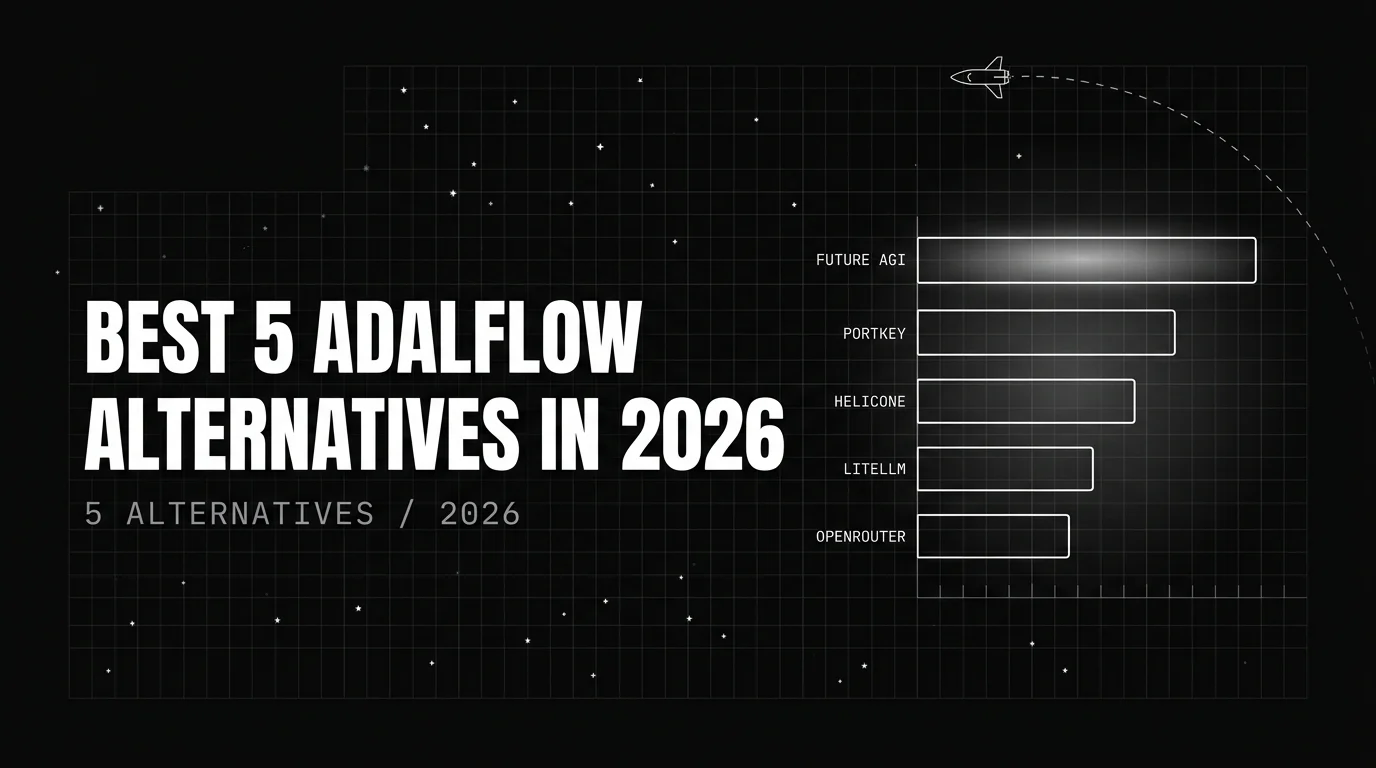
Table of Contents
AdalFlow’s pitch is appealing in isolation: a PyTorch-style library that treats prompts and agents as parameters you optimize with gradients-by-text. Define a task, plug in evaluators, run the optimizer, watch the loss go down. For research-style notebooks and small projects, it works. The problem shows up the moment a team tries to run the same loop in production. AdalFlow stops at the optimizer boundary. No native gateway, no runtime observability, no guardrail layer, no path off Python.
This guide ranks five alternatives worth migrating to and walks through the migration that always bites: rewriting AdalFlow’s Python optimizer classes into a runtime where the optimizer is wired to live trace data.
TL;DR: pick by exit reason
| Why you are leaving AdalFlow | Pick | Why |
|---|---|---|
| You want optimization wired to a gateway, observability, and guardrails | Future AGI Agent Command Center | Optimization loop unified with runtime trace, eval, and Protect guardrails |
| You want the most direct optimizer-only comparison | DSPy | Stanford-backed compiler with the largest optimizer ecosystem and community |
| You need observability depth before optimization | Arize Phoenix | OSS tracing-first platform with eval and prompt-iteration on the side |
| You need a hosted prompt-and-eval workbench | Langfuse | Production-ready prompt management, tracing, and evaluation with self-host |
| You need an experiment-style eval product with TypeScript reach | Braintrust | Eval-first product with first-class JS/TS support and dataset workflows |
Why people are leaving AdalFlow in 2026
Four exit drivers show up repeatedly in the AdalFlow GitHub issue tracker, Reddit /r/LangChain and /r/LocalLLaMA threads on optimizer choice, the DSPy Discord, and conversations with mid-market AI teams over the last two quarters.
1. Narrow scope: optimizer-only, no runtime surface
AdalFlow’s design centers on the optimization loop, Trainer, Component, and Parameter classes that wrap prompts and let you call trainer.fit() over a dataset. That’s the entire product. No gateway, no virtual-key system, no production trace store, no guardrail layer, no RBAC dashboard. Teams who tried to grow AdalFlow into a runtime tool ended up bolting three or four other libraries onto it. By the time you wire it to a gateway plus observability plus guardrails, the integration surface is larger than adopting a platform with all four built in.
2. Smaller community than DSPy or Phoenix
AdalFlow’s GitHub repo sits at roughly 3.5K stars as of May 2026. DSPy clears 25K with an active Discord; Arize Phoenix clears 6K under a well-funded observability company. AdalFlow’s documentation is thorough but the example surface is thin, third-party tutorials are scarce, and Stack Overflow coverage lags every alternative in this list. Teams hitting a non-trivial bug describe two or three days slogging through source instead of finding a fix in a Discord thread.
3. No native gateway or runtime observability
Optimization without observation is a dead-end. AdalFlow captures trainer-time traces during a .fit() run, but the moment the optimized prompt deploys, the trace surface goes dark. Production token cost, per-session latency, tool-call success rate, faithfulness on live traffic, none of that’s captured. Teams that adopted AdalFlow for the optimizer ended up needing Langfuse, Phoenix, or Future AGI for runtime visibility anyway, which made the AdalFlow layer redundant.
4. Python-only
AdalFlow is a Python library; no JS, TS, or Go bindings on the roadmap. Teams whose agent surface is in TypeScript (LangGraph.js, Mastra, Vercel AI SDK) can’t adopt it without a Python sidecar or a rewrite. The alternatives in this list either run multi-language (Future AGI, Langfuse, Braintrust) or are Python-native with a richer ecosystem (DSPy, Phoenix).
What to look for in an AdalFlow replacement
The default “best optimizer” axes are necessary but not sufficient. Score replacements on the seven that map to the surfaces a serious team actually needs once they outgrow the optimizer-only model:
| Axis | What it measures |
|---|---|
| 1. Optimizer breadth | Does the platform ship multiple algorithms (text-gradient, Bayesian, evolutionary) or just one? |
| 2. Gateway integration | Is the optimizer wired to a runtime gateway, or is it standalone? |
| 3. Native observability | Does the platform capture production traces by default, or only training-time? |
| 4. Eval library | Is the evaluation layer first-class, or BYO? |
| 5. Guardrails / Protect layer | Is there a runtime safety layer with measured latency, or none? |
| 6. Language coverage | Python only, or also TypeScript / JavaScript / Go? |
| 7. Self-improving loop | Can production traces feed the optimizer automatically, or is each run manual? |
1. Future AGI Agent Command Center: Best for unifying optimization, gateway, and observability
Verdict: Future AGI is the only platform in this list that closes the loop end-to-end: traces from the gateway feed the eval suite, eval scores feed the optimizer, the optimizer rewrites prompts and routing policies, and the updated artifacts go back into the gateway on the next request. AdalFlow gives you the middle node in that loop (the optimizer) and asks you to stitch the rest yourself. Future AGI ships the whole graph.
What it fixes versus AdalFlow:
- Optimization unified with runtime.
agent-opt(Apache 2.0) ships ProTeGi (text-gradient, the closest analog to AdalFlow’s gradient-by-text), Bayesian, and GEPA optimizers behind one API — the six optimizers compared post breaks down where each one fits. It’s wired totraceAI(Apache 2.0) for trace ingestion andai-evaluation(Apache 2.0) for scoring, so the optimizer reads production data instead of training-set traces. AdalFlow’sTrainer.fit()runs against a static dataset; FAGI’s runs continuously against the live stream.
- Gateway and observability native, not bolted on. Agent Command Center is the runtime surface, virtual keys, routing, fallback, cost dashboards by session and route, RBAC, AWS Marketplace. Adopting FAGI replaces the AdalFlow optimizer plus the gateway plus the observability sink with one stack.
- Guardrails with measured latency. The Protect layer runs hallucination, PII, prompt-injection, and policy checks inline with a median 65 ms text-mode overhead (107 ms image-mode) per arXiv 2510.13351. AdalFlow has no guardrail concept.
- Multi-language SDK. Python is first-class, TypeScript and JavaScript SDKs are supported. Node teams don’t need a Python sidecar.
Migration from AdalFlow: Each adalflow.Component becomes an agent-opt task with an objective, an evaluator, and a parameter list. Trainer.fit() becomes an optimizer run (ProTeGiOptimizer.optimize(...) for text-gradient parity, BayesianOptimizer for hyperparameter-style search). Dataset format converts from AdalFlow’s Sample to FAGI’s task-completion schema, a 30-line converter handles the common case. Once migrated, the same prompt can receive optimizer pressure from live production traces, which AdalFlow can’t do. Timeline: five to eight engineering days for under 20 optimized prompts and one production agent.
Where it falls short:
-
The platform surface is larger than AdalFlow, which makes the first-week learning curve heavier. A team that only wanted the optimizer won’t touch the gateway or Protect on day one.
-
The visualization of optimizer trajectories is actively in development. DSPy’s notebook-friendly outputs are concise and ergonomic; teams whose primary optimizer workflow is “inspect intermediate trajectories in a notebook” should preview the FAGI visualization before standardizing.
Pricing: Free tier with 100K traces/month. Scale tier from $99/month with linear per-trace scaling above 5M (no add-on multipliers). Enterprise with SOC 2 Type II and AWS Marketplace.
Score: 7 of 7 axes.
2. DSPy: Best for direct optimizer comparison
Verdict: DSPy is the closest like-for-like replacement if your reason for leaving AdalFlow is community size and optimizer breadth, and you’re happy staying optimizer-only. Stanford NLP-backed, MIT-licensed, with the largest community of any prompt-optimization framework. You give up the production runtime surfaces; you gain the deepest optimizer toolbox in the open-source ecosystem.
What it fixes versus AdalFlow:
- Optimizer breadth. DSPy ships MIPROv2, BootstrapFewShot, COPRO, BootstrapFinetune, and several research-grade optimizers in one package. AdalFlow’s catalog is narrower and moves more slowly.
- Community and ecosystem. 25K+ stars, an active Discord, hundreds of public notebooks, and integrations with Phoenix, Langfuse, and Future AGI for the observability and runtime layers DSPy doesn’t ship. When you hit a bug, somebody has hit it already.
- Composable program model.
ModuleandSignaturelet you compose multi-step programs the optimizer treats as one object to tune. AdalFlow’sComponentmodel is similar but less mature for multi-hop agents.
Migration from AdalFlow: Conceptually direct, Component becomes dspy.Module, Parameter becomes a Signature field, Trainer becomes MIPROv2.compile or BootstrapFewShot.compile. The hardest part is evaluator translation; AdalFlow’s evaluator API and DSPy’s metric API differ enough that a thin wrapper is the cleanest path. Timeline: three to five engineering days for the optimizer swap, plus a week if you also need to add an observability layer (Phoenix or Langfuse) for production traces.
Where it falls short:
- No gateway, no native observability, no guardrails. You pair DSPy with Phoenix, Langfuse, or Future AGI for those surfaces.
- The optimizer is the entire product; production runtime concerns are out of scope.
- Python-only, same as AdalFlow.
Pricing: Open source under MIT. No hosted product; Stanford NLP and the community maintain it.
Score: 4 of 7 axes (missing: gateway, native observability, guardrails).
3. Arize Phoenix: Best for observability-first teams
Verdict: Phoenix is the right pick if your reason for leaving AdalFlow is “we can’t see what production is doing, so optimization is shooting in the dark.” Phoenix is observability-first. OpenTelemetry-native LLM tracing, eval, and prompt-iteration tooling under one OSS umbrella (Apache 2.0). The optimizer is a smaller part of the surface than in DSPy or AdalFlow, but the runtime observability layer is the strongest in this list outside Future AGI.
What it fixes versus AdalFlow:
- Production observability by default. OpenInference instrumentation for LangChain, LlamaIndex, DSPy, and the OpenAI SDK ships in-box, so production traces flow into the same tool the optimizer reads. AdalFlow’s trace surface stops at the training run.
- Eval library with prompt-iteration. Phoenix’s eval module covers task-completion, faithfulness, hallucination, and tool-use rubrics; the prompt-iteration UI runs side-by-side comparisons across versions on the same dataset.
- Arize-Pro tier for enterprise. OSS Phoenix covers most needs; teams needing SLA, SSO, and managed scale move to Arize-Pro without rewriting their Phoenix code.
Migration from AdalFlow: Phoenix doesn’t replicate AdalFlow’s gradient-style optimizer; instead the workflow is trace production, evaluate, iterate prompts using Phoenix’s experiment tool. Many teams pair Phoenix with DSPy for the optimizer half. AdalFlow evaluators map mechanically to Phoenix’s Evaluator interface; the trainer loop becomes a Phoenix experiment with explicit prompt versions on each side. Timeline: four to seven engineering days, longer if you want DSPy on top for autonomous optimization.
Where it falls short:
- No native gateway. Phoenix is an observation and eval layer, not a runtime proxy.
- The optimizer story is “use DSPy or another tool”; Phoenix itself isn’t a direct optimizer.
- Guardrails are out of scope.
Pricing: Phoenix OSS is free under Apache 2.0. Arize-Pro is custom enterprise pricing.
Score: 4 of 7 axes (missing: optimizer parity, gateway, guardrails).
4. Langfuse: Best for hosted prompt-and-eval workbench
Verdict: Langfuse is the pick when your team wants a production-ready hosted (or self-hosted) workbench that covers prompts, traces, evals, and datasets, and you’re content with a more conservative optimizer story. Langfuse v3 added a prompt-experiment UI that mimics part of the optimizer loop, but the gradient-style automation in AdalFlow isn’t there. Langfuse keeps a human in the loop on prompt edits by default.
What it fixes versus AdalFlow:
- Production-grade prompt management. Versioned prompts with rollout flags, label-based deployment (
production,staging,canary), audit logs. Far more sophisticated than AdalFlow’s parameter object. - Trace and eval coverage. Native OTel ingestion, evaluators that run on a schedule against incoming traces, and datasets that wire evaluators to specific test cases.
- Multi-language SDKs. Python, TypeScript, and a community Go SDK. Node teams move off AdalFlow’s Python-only constraint cleanly.
Migration from AdalFlow: AdalFlow evaluators map to Langfuse evaluators. Trainer.fit() becomes a Langfuse prompt-experiment with the dataset attached and the evaluator running on each variant. Langfuse doesn’t auto-rewrite prompts the way AdalFlow does; teams pair it with DSPy or Future AGI when they want the optimization loop closed. Timeline: four to six engineering days for trace, prompt-registry, and eval migration; another week if pairing with a separate optimizer.
Where it falls short:
- No gradient-style optimizer in the product. Prompt iteration is human-driven with experiment scaffolding around it.
- The gateway surface is light; teams typically pair Langfuse with LiteLLM, Future AGI, or Portkey for runtime routing.
- Guardrails layer is a recent addition and less mature than Future AGI’s Protect.
Pricing: Open source under MIT. Hosted Cloud from $59/month; Pro and Team tiers; Enterprise with SOC 2 Type II.
Score: 5 of 7 axes (missing: native optimizer, mature guardrails).
5. Braintrust: Best for eval-first teams with TypeScript reach
Verdict: Braintrust is the pick when the team is JS/TS-heavy, the eval and dataset workflow matters more than the optimizer, and a polished hosted UI is worth a hosted-only model. Braintrust treats every prompt change as an experiment with a paired eval run, which is closer to AdalFlow’s spirit than Langfuse’s prompt-versioning model, but the optimizer surface is still human-driven rather than gradient-style.
What it fixes versus AdalFlow:
- TypeScript-first eval surface. The JS/TS SDK is the most polished in this list, with first-class Vercel, Next.js, and Node integrations. TypeScript agent teams move off AdalFlow’s Python-only constraint without a rewrite.
- Experiment-driven prompt iteration. Every prompt edit creates an experiment that runs the linked eval against a fixed dataset and surfaces the diff. More rigorous than ad-hoc editing and close to AdalFlow’s trainer in spirit, with a human picking the winner.
- Hosted polish. Consistently rated the cleanest eval workbench in 2025 to 2026 G2 reviews and Reddit threads.
Migration from AdalFlow: AdalFlow evaluators become Braintrust scorers; the training dataset becomes a Braintrust dataset; the trainer loop is replaced with a Braintrust experiment loop that proposes prompts (manually or via a separate optimizer plugin). Timeline: four to six engineering days; pairing with DSPy or Future AGI for the optimizer half adds another week.
Where it falls short:
- Not OSS. Hosted only, which is a non-starter for teams whose security posture requires self-hosting.
- No native gradient-style optimizer; the workflow assumes humans or external optimizers propose prompt variants.
- No gateway, no guardrails layer.
- Above $1K/month MAU the pricing curve gets steep faster than Langfuse or Future AGI.
Pricing: Free tier for under 1K traces/month. Pro and Enterprise tiers with custom pricing.
Score: 4 of 7 axes (missing: native optimizer, gateway, guardrails).
Capability matrix
| Axis | Future AGI | DSPy | Arize Phoenix | Langfuse | Braintrust |
|---|---|---|---|---|---|
| Optimizer breadth | ProTeGi + Bayesian + GEPA | MIPROv2, COPRO, BootstrapFewShot, BootstrapFinetune | Pair with DSPy | Human-driven experiments | Human-driven experiments |
| Gateway integration | Native (Agent Command Center) | None | None | Pair with LiteLLM/FAGI | None |
| Native observability | OTel + sessions + RBAC | None | OTel-native, strongest OSS | OTel-native, mature | Experiment-level traces |
| Eval surface | ai-evaluation Apache 2.0 — 50+ rubrics + unlimited custom evaluators authored by an in-product agent + self-improving | Plug-in metrics | Phoenix eval module | Langfuse eval | Braintrust scorers |
| Guardrails / Protect | FAGI Protect model family (Gemma 3n fine-tuned, multi-modal, ~65 ms p50 text) | None | None | Light, recent addition | None |
| Language coverage | Python + TS + JS | Python only | Python + JS (OpenInference) | Python + TS + Go | TS-first, also Python |
| Self-improving loop | Yes — traces feed optimizer | Manual compile calls | Manual via DSPy + Phoenix | Manual experiment runs | Manual experiment runs |
Migration notes: what breaks when leaving AdalFlow
Three surfaces always need attention when rewriting AdalFlow optimizer code into a richer platform.
Rewriting Component and Parameter classes
AdalFlow’s Component wraps a prompt and exposes parameters() for the optimizer to tune. Translation to any destination follows one pattern: identify the trainable text fields, the evaluator, and the dataset, then re-express them in the destination’s idiom.
In agent-opt (Future AGI), the pattern is a Task with an objective (the AdalFlow forward pass), a Dataset (the AdalFlow training data, converted), and a Scorer (the AdalFlow evaluator, wrapped). Optimizer choice, ProTeGi for text-gradient parity, Bayesian for hyperparameter-style search, GEPA for evolutionary search, drops into the same call site. A 30-line script handles the common case; complex multi-step Component graphs need a manual pass.
In DSPy, Component becomes dspy.Module, Parameter becomes a Signature field, the trainer becomes MIPROv2.compile, BootstrapFewShot.compile, or COPRO. AdalFlow’s scalar evaluator wraps as a dspy.Evaluate.metric callable.
In Langfuse or Braintrust the rewrite is heavier because there’s no gradient-style optimizer. The pattern is prompt-as-versioned-artifact + evaluator-as-scheduled-job + experiment-as-comparison-run, with a human picking the winner. Most teams keep DSPy or agent-opt for the optimizer and Langfuse for the workbench around it.
Translating the trainer loop
AdalFlow’s Trainer.fit() proposes parameter updates, evaluates, accepts or rejects, and persists. Every destination has an equivalent, but the persistence story differs: agent-opt writes optimized prompts directly to the FAGI prompt registry, version-tagged, ready for the gateway to pick up. DSPy uses program.save()/program.load() and leaves promotion to the team. Langfuse and Braintrust wrap persistence in the prompt registry and the experiment-result tag, trainer-like loops become “create a version, attach an evaluator, run the experiment, mark the winner, promote the label.”
Production-trace plumbing (the gap AdalFlow leaves widest)
AdalFlow has no concept of production traces. Migrating to any of the five alternatives means doing work that wasn’t done at all before: instrument the agent runtime, ship traces to the destination platform, score live traffic, and (for Future AGI) wire the optimizer to consume those scores. Typically the highest-value part of the migration and the longest, plan one to two weeks of work for a non-trivial agent.
Decision framework: Choose X if
Choose Future AGI if your reason for leaving AdalFlow is more than optimizer-feature-count, you also want production traces, gateway routing, evaluation, and guardrails wired into the same loop, so the optimizer reads live data and writes back to a runtime artifact the gateway serves. Pick this when AdalFlow’s scope was the limiting factor.
Choose DSPy if you’re happy staying optimizer-only and pairing with separate observability and gateway tools. Pick this for research-heavy workflows where the optimizer is the centerpiece.
Choose Arize Phoenix if your reason for leaving is “we can’t see production, so optimization is shooting in the dark.” Pick this when observability depth matters more than gradient-style optimization, paired with DSPy or Future AGI for the optimizer half.
Choose Langfuse if you need a hosted (or self-hosted) workbench for prompts, traces, evals, and datasets with human-in-the-loop iteration. Pick this when production rigor and prompt-registry quality matter more than gradient-style automation.
Choose Braintrust if your agent runtime is in TypeScript and you want eval-first, experiment-driven prompt iteration with the cleanest UI in the category. Pick this for JS/TS-heavy teams where hosted-only is acceptable.
What we did not include
Three products show up in other 2026 AdalFlow alternatives listicles that we left out: TextGrad (the academic project that inspired the text-gradient approach in both AdalFlow and DSPy’s COPRO, interesting research but not a runtime product, so not a migration target); LangChain Hub (a prompt repository, not an optimizer; the wrong shape for an AdalFlow exit); MLflow (excellent for classical ML experiment tracking but its LLM optimizer story lags every entry in this list as of May 2026, worth a second look in 2027).
Related reading
- Best 5 DSPy Alternatives in 2026
- Best 5 Arize Phoenix Alternatives in 2026
- Best 5 Langfuse Alternatives in 2026
Sources
- AdalFlow GitHub repository, github.com/SylphAI-Inc/AdalFlow
- AdalFlow documentation, adalflow.sylph.ai
- DSPy GitHub repository, github.com/stanfordnlp/dspy
- DSPy documentation, dspy.ai
- Arize Phoenix GitHub repository, github.com/Arize-ai/phoenix
- Langfuse GitHub repository, github.com/langfuse/langfuse
- Braintrust documentation, braintrust.dev
- Future AGI Agent Command Center, futureagi.com/platform/monitor/command-center
- Future AGI traceAI, github.com/future-agi/traceAI (Apache 2.0)
- Future AGI ai-evaluation, github.com/future-agi/ai-evaluation (Apache 2.0)
- Future AGI agent-opt, github.com/future-agi/agent-opt (Apache 2.0)
- Future AGI Protect latency benchmark, arxiv.org/abs/2510.13351 (65 ms text, 107 ms image)
Frequently Asked Questions
Why are people moving off AdalFlow in 2026?
What is the closest like-for-like alternative to AdalFlow?
How do I migrate AdalFlow optimizer classes to another framework?
Is there an open-source AdalFlow alternative?
Which AdalFlow alternative supports TypeScript?
How does Future AGI Agent Command Center compare to AdalFlow?
Does Future AGI's optimizer support the same algorithms as AdalFlow?
Five DSPy alternatives scored on production runtime, optimizer breadth, instrumentation, what each fixes when research-grade prompt optimization hits prod.

Five Arize Phoenix alternatives scored on prompt management, gateway integration, evaluation maturity, fixes once OSS-only tracing stops being enough.

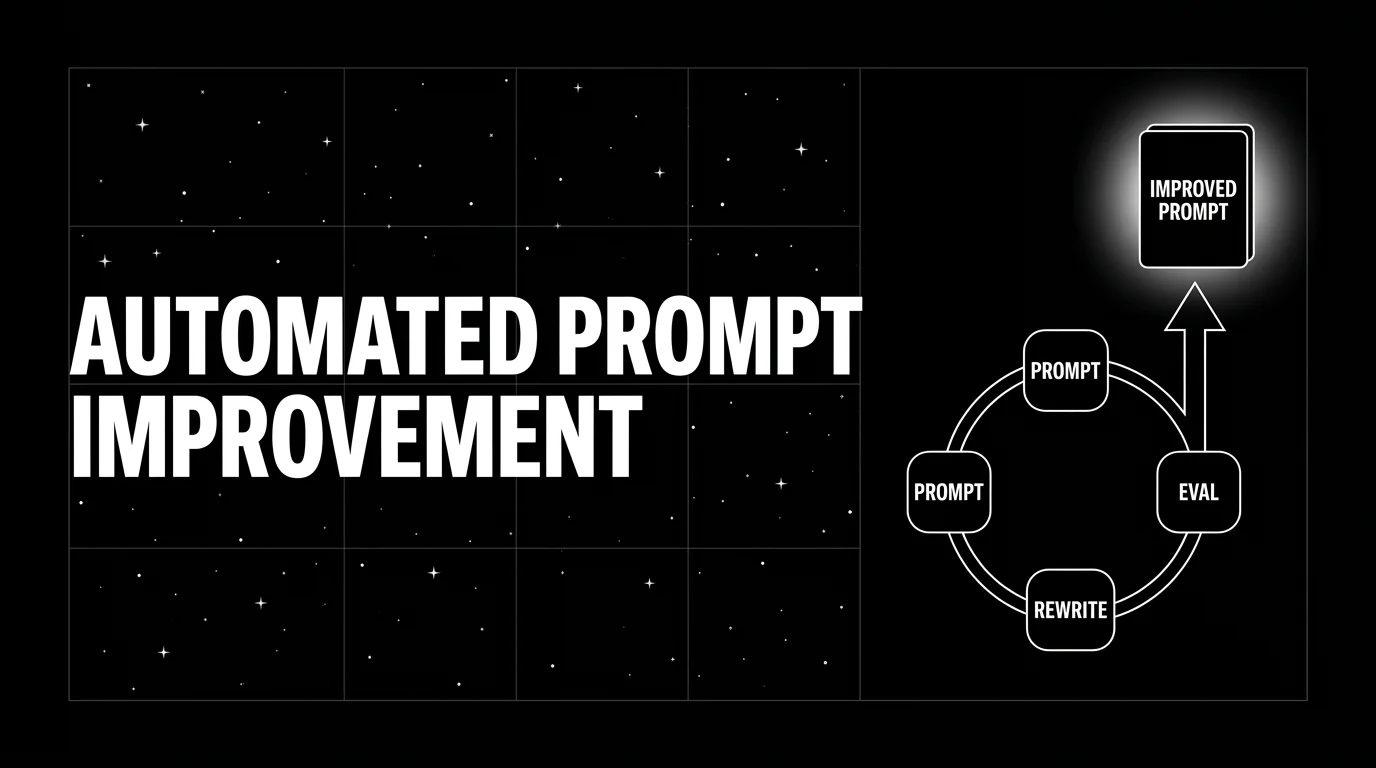
Automated prompt improvement in 2026 with six named optimizers (ProTeGi, GEPA, PromptWizard, MetaPrompt, BayesianSearch, RandomSearch) wired into CI.