Best 5 Arize Phoenix Alternatives in 2026
Five Arize Phoenix alternatives scored on prompt management, gateway integration, evaluation maturity, fixes once OSS-only tracing stops being enough.

Table of Contents
Arize Phoenix is the cleanest OTel + OpenInference tracing UI in the open-source LLM observability cohort. That’s also its ceiling. Once a team needs a versioned prompt registry, a gateway that ties cost back to traces, a non-Python SDK, or an optimizer loop that uses trace data to rewrite prompts automatically, Phoenix runs out of surface and the upgrade path lands on hosted Arize AX, where pricing escalates faster than most mid-market teams budgeted for. The same OTel + OpenInference foundation that makes Phoenix easy to adopt also makes it cheap to leave: re-point the exporter and existing instrumentation flows into the new backend.
This guide ranks five alternatives and names what each fixes versus Phoenix.
TL;DR: pick by exit reason
| Why you are leaving Phoenix | Pick | Why |
|---|---|---|
| You want trace data to feed back into prompts and routing | Future AGI Agent Command Center | Closes the loop from trace through eval to optimizer to gateway |
| You want hosted OSS-friendly tracing with mature prompt mgmt | Langfuse | Self-hostable, OpenInference-compatible, depth in prompts and datasets |
| You want a drop-in gateway plus observability in one box | Helicone | Per-request cost, sessions, and proxy in one UI |
| You want raw gateway throughput with eval integration | Maxim Bifrost | Go gateway tuned for high-RPS, paired with Maxim’s eval stack |
| You want enterprise gateway plus prompt registry in one platform | Portkey | Hosted gateway with virtual keys and Prompt Studio (post-Palo Alto) |
Why people are leaving Arize Phoenix in 2026
Five exit drivers show up across Phoenix’s GitHub discussions, the Arize community Slack, Hacker News threads, /r/LLMOps migration posts, and G2 reviews from the last two quarters.
1. OSS observability without first-party prompt management
Prompt management isn’t a first-class surface, no versioned prompt store with diff views, environment promotion, or a registry other gateways can pull from at request time. Teams either keep prompts in a repo file, glue on a third-party registry, or upgrade to Arize AX. For a team that adopted Phoenix expecting OSS to cover the whole loop, this is the first friction point.
2. No native gateway
Phoenix is a backend for traces. No proxy, no virtual-key system, no per-developer chargeback, no rate-limiting, no fallback routing. Teams stitch in LiteLLM, Portkey, Helicone, Bifrost, or build one in-house. Trace and gateway data live in different systems; tying cost back to traces becomes a join across two stores.
3. Hosted Arize AX pricing escalates above 5M traces per month
The upgrade path from Phoenix is Arize AX, the same vendor’s hosted product with prompt management, online evaluation, and SSO. Workloads shared in /r/LLMOps show AX going from a manageable line item below 5M traces per month to four- and five-figure monthly bills above 10M. The Phoenix-to-AX upgrade is often where teams realize they’re evaluating other hosted backends anyway.
4. Python-first SDK
Phoenix’s instrumentation is excellent in Python. TypeScript and JVM surfaces are thinner, usable for raw OTel emission, but missing higher-level helpers for prompt registries, dataset uploads, and eval runners. Teams building agents on Node.js, Deno, or the JVM hit this gap repeatedly.
5. No native optimizer loop
Phoenix shows traces, runs evaluations, and highlights regressions. Taking those eval scores and automatically rewriting prompts or shifting routing isn’t part of the product. Teams that want a self-improving loop bolt on DSPy, ProTeGi, or build their own optimizer harness.
What to look for in an Arize Phoenix replacement
The default “best LLM observability” axes are necessary but not sufficient for a Phoenix exit. Score on the seven that map to the surfaces you’re actually migrating off:
| Axis | What it measures |
|---|---|
| 1. OTel + OpenInference compatibility | Does the backend accept the exact instrumentation Phoenix already emits? |
| 2. First-class prompt management | Versioned prompt store with diffs, environments, and SDK pulls — native, not bolt-on |
| 3. Native gateway integration | Proxy, virtual keys, per-developer chargeback — in the same product |
| 4. Cost curve above 5M traces/mo | Does the per-trace marginal cost flatten or escalate as volume grows? |
| 5. Non-Python SDK depth | Are TypeScript, JVM, and Go surfaces production-grade? |
| 6. Eval + optimizer loop | Does the backend use its own eval scores to rewrite prompts or shift routes? |
| 7. Self-host posture | Can the backend run inside your VPC, fully air-gapped from the vendor? |
1. Future AGI Agent Command Center: Best for closing the loop
Verdict: Future AGI is the only backend in this list that fixes Phoenix’s biggest weakness, traces inform humans but never the prompts or the gateway. Agent Command Center captures the OpenInference trace, scores it against ai-evaluation’s rubric library, clusters failures, runs agent-opt to rewrite the prompt or shift the route, and pushes the change back into the registry and gateway for the next request. Phoenix is a tracing UI with an eval add-on; FAGI is a tracing UI wired to an optimizer.
What it fixes versus Phoenix:
- Prompt management and the loop. A first-class prompt registry with Jinja2, environment promotion (dev/staging/prod), and version diffs. Eval scores from
ai-evaluation(Apache 2.0) feedagent-opt(Apache 2.0), which rewrites prompts via six optimizers — ProTeGi, GEPA, Bayesian, MetaPrompt, RandomSearch, PromptWizard. Phoenix’s prompt story is “track it yourself”; FAGI’s is “the registry is self-improving.”
- Native gateway. Hosted gateway with virtual keys, per-developer chargeback, fallback routing, and budget caps. Cost and trace data in the same dashboard row.
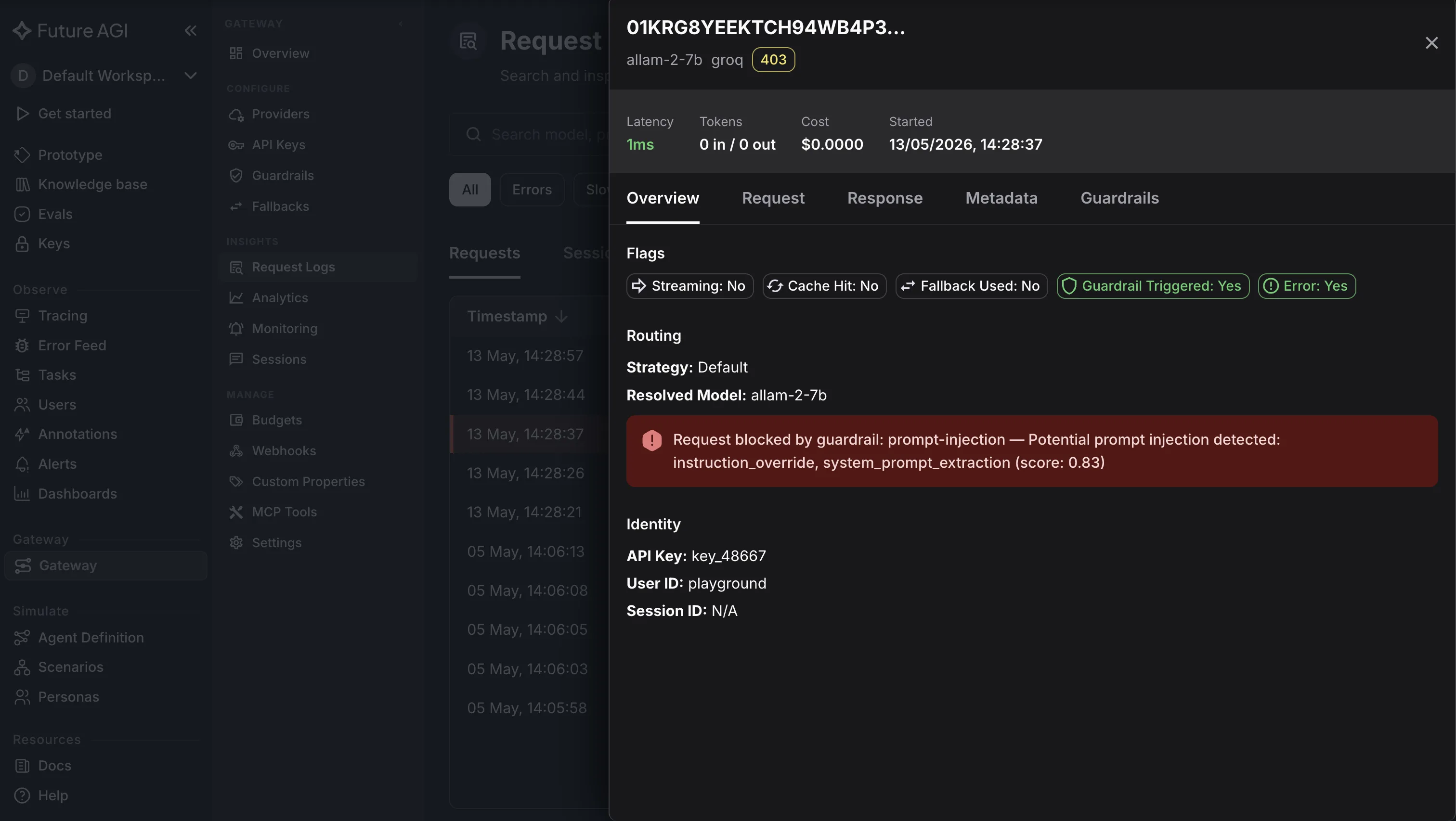
- The Future AGI Protect model family as the inline guardrail layer. Protect is FAGI’s own fine-tuned model family built on Google’s Gemma 3n with specialized adapters across four safety dimensions (content moderation, bias detection, security/prompt-injection, data privacy/PII), natively multi-modal across text, image, and audio, a model family, not a plugin chain. Independent benchmarking (arXiv 2510.13351) puts latency at ~65 ms p50 text and ~107 ms p50 image, fast enough to keep on the request path. The same four dimensions are reusable as offline eval metrics so the prod policy and the eval rubric stay in sync.
- Non-Python SDK depth. TypeScript and Go SDKs are first-class.
traceAI(Apache 2.0) instruments 50+ AI surfaces across Python, TypeScript, Java, and C# (including Spring Boot starter, Spring AI, LangChain4j, Semantic Kernel) across Python, Node.js, Java, and C# with the same OpenInference-native data model.
- OSS instrumentation plus Error Feed.
traceAI,ai-evaluation,agent-optall Apache 2.0, adopt the libraries before adopting the hosted Command Center. Error Feed sits alongside as the part of the eval stack, the clustering and what-to-fix layer that feeds the self-improving evaluators: zero-config, auto-clusters related trace failures into named issues (50 traces → 1 issue), auto-writes the root cause plus a quick fix plus a long-term recommendation per issue, and tracks rising/steady/falling trend per issue so regressions surface like exceptions rather than buried in trace search, the wedge a pure tracing UI doesn’t close.
Migration from Phoenix: Re-point the OTel exporter at FAGI’s collector and existing instrumentation flows in unchanged. The FAGI importer reads Phoenix’s dataset export format and preserves run metadata. Timeline: three to five engineering days including a shadow-export period.
Where it falls short:
-
The optimizer carries a learning curve; a pure exporter swap won’t exercise
agent-optin week one. -
Trace-list density (filters, saved views) is actively in development. Phoenix’s filter and saved-view ergonomics are a real strength; teams who live in the trace list daily should preview the FAGI workflow before standardizing.
Pricing: Free tier with 100K traces/month. Scale from $99/month with linear per-trace scaling above 5M. Enterprise with SOC 2 Type II and AWS Marketplace.
Score: 7 of 7 axes.
2. Langfuse: Best for self-hostable OSS-friendly tracing
Verdict: Langfuse is the pick when the Phoenix exit is about prompt management and dataset depth and the requirement stays “open source, OTel-friendly, runs in our VPC.” MIT core, the most popular OSS LLM observability project on GitHub after Phoenix itself, and a mature prompt registry with versioning, environment promotion, and SDK-side pulling.
What it fixes versus Phoenix:
- First-class prompt management. Langfuse Prompts ships a versioned store with environment labels, production rollouts, and an SDK that pulls the right version at runtime. Diff views are native. This is the single biggest gap Phoenix has and Langfuse closes.
- OpenInference + OTel compatibility. Accepts OTel spans with OpenInference semantic conventions, so Phoenix instrumentation re-targets cleanly.
- Self-host posture. OSS self-host runs on Postgres + ClickHouse + Redis. Production-tested at companies running 50M+ events per month.
- Datasets and evaluations. CSV import, programmatic creation, and a UI that lets non-engineers curate eval sets, comparable to Phoenix’s surface and slightly ahead on the UI side.
Migration from Phoenix: Re-point the OTel exporter; OpenInference spans flow in. Phoenix datasets export and import directly. Timeline: four to six engineering days including shadow-export validation.
Where it falls short:
- No native gateway. Pair with LiteLLM, Helicone, Portkey, or FAGI for routing and virtual keys.
- No optimizer loop. Traces and eval scores inform humans, not the registry.
- Self-host scale-out beyond a few thousand spans per second needs ClickHouse tuning.
Pricing: Open source under MIT. Cloud Hobby free; Pro from $59/month per seat; Team and Enterprise custom.
Score: 5 of 7 axes (missing: native gateway, optimizer loop).
3. Helicone: Best for gateway plus observability in one box
Verdict: Helicone is the pick when the Phoenix exit is driven by the absence of a gateway and the requirement is “one product for routing and observability, friendlier price below 10M requests per month.” Drop-in proxy with a clean dashboard for per-request cost, sessions, and prompts. Helicone acquired Mintlify in March 2026; parts of the docs surface have folded into Mintlify’s stack, minor today, possibly a roadmap signal.
What it fixes versus Phoenix:
- Native gateway. Proxy first, observability second. Per-request cost, virtual keys (“proxy keys”), session tagging, rate-limiting. The cost-by-session dashboard is the surface Phoenix users build manually in Grafana.
- Friendlier pricing below 10M req/mo. Pro starts at $25/month. For teams whose Phoenix-to-AX upgrade quote came back at four figures, Helicone usually undercuts substantially.
- Self-host option. OSS self-host (Apache 2.0) runs on Postgres + ClickHouse. Lighter than Langfuse’s stack; scale-out beyond a few hundred RPS gets non-trivial per the project’s docs.
- OpenInference compatibility. Accepts OTel spans with OpenInference conventions.
Migration from Phoenix: Re-point the OTel exporter. If you adopt the gateway, swap base_url on the OpenAI or Anthropic SDK to Helicone’s proxy URL. Helicone Prompts is less feature-rich than Langfuse or FAGI, so many teams keep prompts in-repo as Jinja2 post-migration. Timeline: three to five engineering days for the exporter swap; two to four more for the gateway.
Where it falls short:
- No optimizer.
- Prompt registry is the weakest in this list; in-repo prompts often beat it.
- Self-host operations get harder above a few hundred RPS.
- The Mintlify acquisition is recent enough that some surfaces are still in flux.
Pricing: Free tier with 10K requests/month. Pro from $25/month. Enterprise custom.
Score: 5 of 7 axes (missing: optimizer, deep prompt registry).
4. Maxim Bifrost: Best for high-throughput gateway plus eval integration
Verdict: Maxim’s Bifrost is the pick when the workload is high-concurrency, the gateway’s own latency budget matters, and the team is willing to consolidate gateway and evaluation onto the same vendor. Go-based, benchmarks above Python proxies on RPS per node, paired with Maxim’s eval and dataset products.
What it fixes versus Phoenix:
- Native gateway with throughput. Go proxy, not a Python wrapper. Maxim’s benchmarks claim sub-millisecond overhead at p50; independent reproduction is ongoing.
- Eval and dataset integration. Maxim ships an eval suite and dataset product; Bifrost shares data models with both. Gateway-side data lands in eval dashboards without an export pipeline.
- OpenInference compatibility. Accepts OTel + OpenInference spans cleanly.
- Self-host posture. Go binary, container, helm chart, or VM. Maxim’s hosted control plane is optional.
Migration from Phoenix: Exporter re-point plus optional base_url swap if you adopt the gateway. Dataset migration uses Maxim’s importer, less battle-tested than Langfuse’s or FAGI’s. Timeline: five to eight engineering days.
Where it falls short:
- No optimizer loop.
- Maxim’s full platform is hosted-first; the OSS Bifrost gateway is excellent but the eval and dataset products are tied to the SaaS.
- Younger than Phoenix, Langfuse, or Helicone; ecosystem (Terraform providers, third-party dashboards) is thinner.
Pricing: Bifrost gateway open source. Maxim’s hosted platform pricing custom, typically anchored to seat count and trace volume.
Score: 4 of 7 axes (missing: optimizer, mature ecosystem; partial prompt registry).
5. Portkey: Best for enterprise gateway plus prompt registry
Verdict: Portkey is the pick when the Phoenix exit is driven by “no gateway” and “no prompt management” and the team wants one hosted product to cover both. Palo Alto Networks announced the acquisition of Portkey on April 30, 2026, clears procurement for some enterprises, creates SMB-pricing uncertainty for others.
What it fixes versus Phoenix:
- Native gateway with virtual keys. Each developer or service holds a Portkey-issued key that fans out to one underlying provider key, preserving bulk pricing while exposing per-identity attribution.
- First-class prompt registry (Prompt Studio). Versioned prompts with environment promotion and server-side rendering. Heavier than Langfuse, lighter than FAGI (no optimizer wired in).
- Observability tied to the gateway. Trace and cost data live in the same product.
- Enterprise procurement. Post-acquisition, rides Palo Alto’s compliance posture (SOC 2, ISO 27001, HIPAA-eligible).
Migration from Phoenix: Trace re-point requires using Portkey’s gateway as the LLM proxy, change base_url on the OpenAI or Anthropic SDK plus the OTel exporter. In-repo prompts import into Prompt Studio cleanly. Eval depth lags Phoenix, so you may keep evaluations on Langfuse, FAGI, or Phoenix itself. Timeline: five to seven engineering days.
Where it falls short:
- No optimizer.
- The Palo Alto acquisition creates 12-to-24-month uncertainty about the SMB SKU; prior Palo Alto security acquisitions saw standalone SMB tiers narrow within two years.
- Vendor lock-in around Prompt Studio: Portkey-dialect templates with custom filters mean a future exit costs more than the Phoenix-to-Portkey migration in.
- Eval depth lags Phoenix and Langfuse.
Pricing: Free tier with 10K requests/month. Production from $99/month. Enterprise custom (Palo Alto sales contact post-acquisition).
Score: 4 of 7 axes (missing: optimizer, deep eval, OSS self-host of the full product).
Capability matrix
| Axis | Future AGI | Langfuse | Helicone | Maxim Bifrost | Portkey |
|---|---|---|---|---|---|
| OTel + OpenInference compatibility | Native | Native | Native | Native | Via gateway path |
| First-class prompt management | Native + optimizer | Native (mature) | Basic prompts module | Hosted via Maxim | Native (Prompt Studio) |
| Native gateway | Yes | No (pair externally) | Yes (proxy-first) | Yes (Bifrost, Go) | Yes (virtual keys) |
| Cost curve above 5M traces/mo | Linear, no multipliers | OSS + Cloud per-seat | Friendly below 10M | Hosted, custom | Escalates above 5M req/mo |
| Non-Python SDK depth | TypeScript + Go first-class | TypeScript native, JVM via OTel | TypeScript + others | Multi-language via OTel | TypeScript + others |
| Eval + optimizer loop | Yes (ai-evaluation + agent-opt) | Eval yes, optimizer no | No | Eval yes (Maxim), optimizer no | No |
| Self-host posture | BYOC + OSS instrumentation | MIT, full self-host | Apache 2.0, full self-host | OSS Go binary | Hosted-only for full product |
Migration notes: what breaks when leaving Phoenix
Three surfaces need attention.
Re-pointing the OTel exporter
The cheapest part of the migration and the whole reason Phoenix is easy to leave. Swap the exporter endpoint in your OTel SDK from https://app.phoenix.arize.com/v1/traces (or your self-hosted URL) to the new backend’s collector, update the auth header, and existing openinference-instrumentation-* packages flow data into the new system without code changes.
The safer pattern is shadow export for a week or two: configure two exporters in parallel, validate span counts and attribute preservation, then drop Phoenix. This catches differences in how each backend interprets optional OpenInference attributes (llm.token_count.completion, llm.tool_calls, custom attributes you may have added).
Migrating datasets and evaluation runs
Phoenix exports datasets as JSON via the SDK. Langfuse and FAGI ship importers that read Phoenix’s export directly. Helicone, Bifrost, and the hosted gateway require a mechanical schema rewrite, tedious if you have hundreds of datasets.
Evaluation-run history is harder. The historical record of which evaluator scored which dataset at which prompt version typically doesn’t survive a backend migration, re-establish the baseline on the new system with a week of parallel evaluator runs.
Replacing prompt management
Phoenix users typically store prompts in-repo and reference them by import. Moving to Langfuse, FAGI, or Portkey: convert each prompt to the backend’s template format, upload via SDK, replace the import with a registry pull. Moving to Helicone or Bifrost: the in-repo pattern stays. The SDK-side change (from prompts import RAG_PROMPT becomes client.prompts.get("rag-prompt", version="prod")) is small per call site but adds up, and changes the deployment story (prompt changes no longer require a code deploy).
Decision framework: Choose X if
Choose Future AGI if your reason for leaving is more than “we need a prompt registry”, you also want eval scores to feed back into prompt rewrites and routing decisions, so cost and quality curves bend favorably over time.
Choose Langfuse if your reason for leaving is prompt management and you want to stay on an open-source, self-hostable backend. The optimizer loop is on your roadmap, not theirs.
Choose Helicone if your reason for leaving is “we also need a gateway” and you’re well below 10M requests per month.
Choose Maxim Bifrost if your reason for leaving is gateway latency at high concurrency and you’re willing to consolidate gateway and eval onto the same vendor.
Choose Portkey if your reason for leaving is “gateway plus prompt registry, both hosted, enterprise procurement” and the Palo Alto acquisition is a positive for your org.
What we did not include
Three products show up in other 2026 Phoenix alternatives listicles that we left out: LangSmith (excellent for LangChain-native teams but tied to LangChain in a way Phoenix isn’t, not apples-to-apples for framework-agnostic users); Datadog LLM Observability (capable trace UI but prompt registry and eval surfaces are thinner, and Datadog’s pricing curve usually exceeds AX’s at the same scale); New Relic AI Monitoring (similar shape to Datadog’s offering).
Related reading
- Best 5 AI Gateways for Compliance Audit Trails in 2026, the compliance and audit-trail comparison
- Best 5 AI Gateways for LLM Cost Optimization in 2026, the five-layer cost stack and the 2026 trust cohort
- Best 5 AI Gateways for LLM Observability and Tracing in 2026, the OpenTelemetry-native observability ranking
- Future AGI vs Helicone in 2026: Self-Improving Runtime vs Lightweight Observability, the head-to-head against the per-request observability layer
Sources
- Arize Phoenix, github.com/Arize-ai/phoenix
- OpenInference semantic conventions, github.com/Arize-ai/openinference
- Arize AX pricing, arize.com/pricing
- Langfuse, langfuse.com/docs/prompts, github.com/langfuse/langfuse
- Helicone, github.com/Helicone/helicone; Mintlify acquisition March 2026, helicone.ai/blog
- Maxim Bifrost, getmaxim.ai/bifrost
- Portkey, portkey.ai/docs
- Palo Alto Networks press release on Portkey acquisition, April 30, 2026, paloaltonetworks.com/company/press
- Future AGI Agent Command Center, futureagi.com/platform/monitor/command-center
- traceAI, ai-evaluation, agent-opt (Apache 2.0), github.com/future-agi
- Protect latency benchmark, arxiv.org/abs/2510.13351 (65 ms text, 107 ms image)
Frequently Asked Questions
Why are people moving off Arize Phoenix in 2026?
Is Arize Phoenix going away?
Can I keep my OpenInference instrumentation after migrating?
What is the closest like-for-like alternative to Phoenix?
Is there an open-source Arize Phoenix alternative I can self-host?
How does Future AGI Agent Command Center compare to Phoenix?

FutureAGI, Langfuse, LangSmith, Helicone, Braintrust, and W&B Weave as Arize Phoenix alternatives in 2026. Pricing, OSS license, OTel coverage, tradeoffs.


Honest 2026 comparison of the best Arize AI alternatives: Future AGI, Langfuse, LangSmith, Braintrust, Datadog. Pricing, gateway, eval depth, license.

Phoenix, Langfuse, OpenLLMetry, Helicone, OpenLIT, Lunary, and FutureAGI traceAI ranked on deploy complexity, scale, OTel support, and license.