AI Voice Agents For Customer Service: A Practical Playbook
AI voice agents for customer service resolve routine calls end to end. See which workflows to automate first, the metrics that prove it works, and how to test before launch.
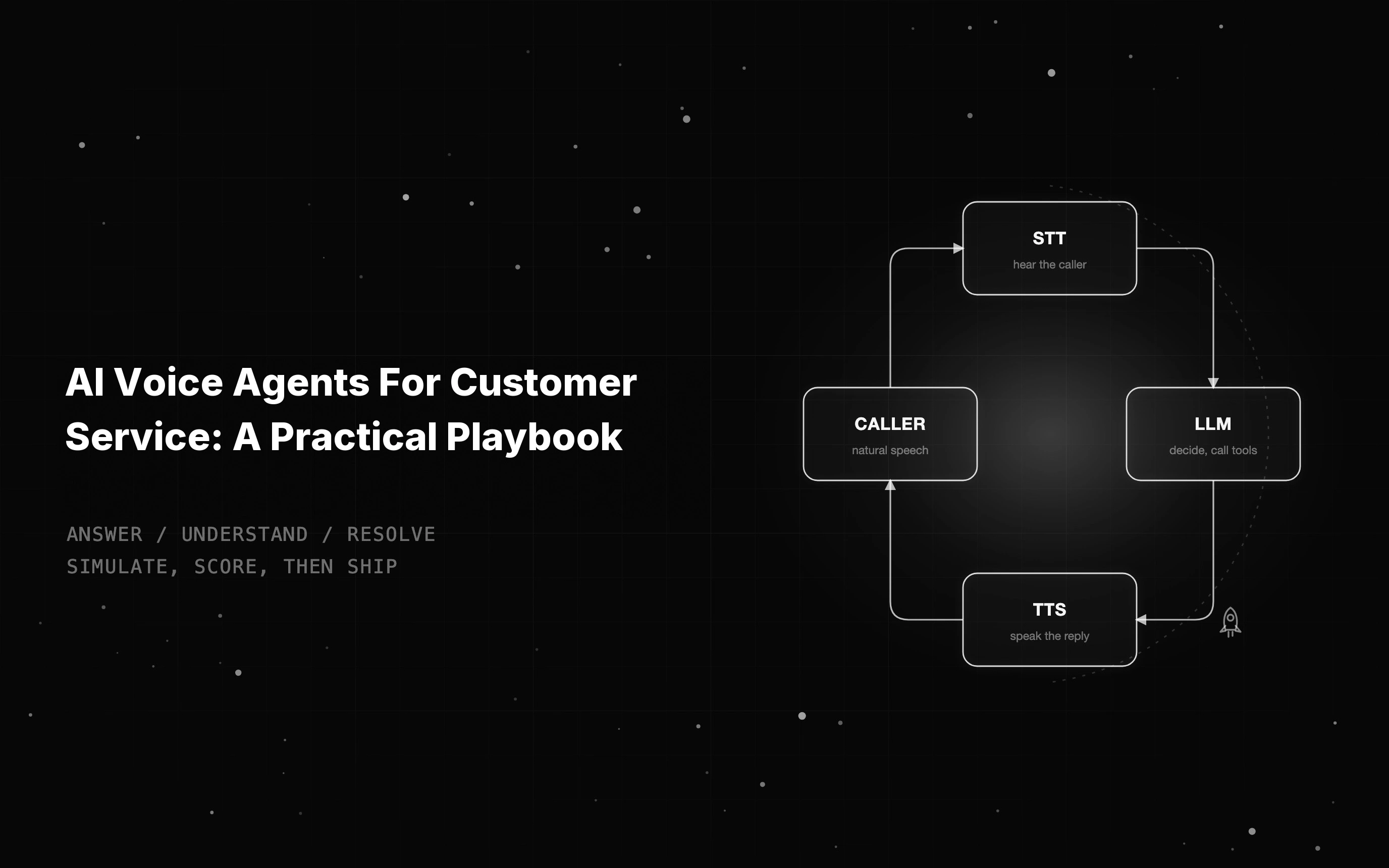
Table of Contents
It is Monday morning on a support line. The queue fills with the same calls it filled with last Monday: where is my order, reset my password, what is my balance, how do I return this. A rep answers the same script for the fortieth time while a caller with a hard problem waits eleven minutes on hold.
By most industry estimates, 40 to 60% of the calls into a typical support line are a small set of repeatable questions. They do not need judgment. They need a lookup, a verification, and a clear answer. Yet they consume the same human attention as the escalations that actually require a person, and that mismatch is where both cost and burnout come from.
This playbook is about closing that gap with an AI voice agent, and doing it concretely. Not a feature tour. What to automate first, how the pipeline works, the metrics that tell you it is working, how to test it before it touches a real caller, and where it breaks.
TL;DR
- Depending on the vertical, 40 to 60% of support calls are a few repeatable questions, and those are what a voice agent should take off your reps first.
- An AI voice agent answers calls in natural speech and resolves issues through a speech-to-text, LLM, and text-to-speech loop wired to backend systems.
- Automate high-volume, low-risk, verifiable workflows. Keep disputes, cancellations, and anything with legal exposure with a human.
- Containment is not resolution. A call handled without a human but never solved is a hidden failure, so always track both together.
- Simulate calls across accents, noise, and interruptions before any real traffic, and score the transcripts on resolution and latency.
Most customer service calls are the same handful of questions
Pull the logs and the pattern is hard to miss. The bulk of a support line’s volume is not complex; it is the same few asks arriving over and over, phrased a dozen different ways. Order status. Password and PIN resets. Account balances. Returns. None of these need a human’s judgment, only a lookup and a clear spoken answer.
The minutes are only part of the cost. These calls sit in the same queue as the escalations that need a person, so a caller with a hard problem waits while a rep reads the shipping script for the fortieth time. That is bad for the customer on hold and worse for the rep burning out on repetition. A voice agent’s first job is to pull the repeatable calls out of that queue so people handle the ones that actually need people.
What an AI voice agent for customer service actually is
An AI voice agent for customer service is software that answers a phone call, understands natural speech, and resolves the caller’s issue in conversation. Under the surface it runs a loop: speech-to-text turns the caller’s words into text, a language model works out intent and decides what to do, backend calls fetch or change data, and text-to-speech speaks the reply. The caller just talks.
That is a real break from the two systems it gets confused with. An IVR is a menu tree: press one for billing, press two for support. It routes, it does not resolve, and it pushes the effort onto the caller. A text chatbot understands language but lives in a chat window, not on the phone, and many of the highest-volume support contacts still arrive as calls.
AI voice agents sit where those two fall short. They take natural speech instead of keypresses, handle open-ended questions instead of fixed options, and can take real backend actions like looking up an order or resetting a credential. If you are choosing between platforms, voice agent monitoring is one of the first capabilities to check, because an agent you cannot observe is one you cannot improve.
| Capability | IVR | Text chatbot | AI voice agent |
|---|---|---|---|
| Input | Keypad / menu | Typed text | Natural speech |
| Handles open-ended asks | No | Some | Yes |
| Backend actions | Limited | Yes | Yes |
| Channel | Voice | Text | Voice |
| Caller effort | High | Medium | Low |
The table makes the boundary concrete. IVR and chatbots each solve part of the problem. A voice agent is the first option that takes a spoken, open-ended request and carries it through to a backend action without making the caller adapt to the machine.
Which support workflows to automate first
Not every call is a good candidate, and picking wrong is how these projects lose trust early. The triage is three questions. Is it high volume, so automating it actually moves the numbers? Is it low risk, so a mistake is recoverable and not harmful? Is the outcome verifiable, so you can confirm the agent solved it rather than just ended the call?
When all three are yes, automate. Order status is the textbook case: callers ask constantly, the answer is a lookup, and you can check whether the tracking detail you read out was correct. Password and PIN resets fit the same shape, as do appointment scheduling, balance and account checks, store hours and location questions, and starting a return or exchange. These are the calls that fill the queue and drain the reps, and they are exactly the ones a voice agent handles well.
The other side of the line matters just as much. Low-volume, high-risk calls stay with people. Billing disputes involve judgment and often an unhappy customer. Cancellations frequently need a retention conversation a script cannot carry. Anything with legal, medical, or financial exposure, or a caller in distress, belongs with a trained human, not because the model cannot form sentences but because the cost of getting it wrong is too high.
A useful way to hold the line: automate the calls where a wrong answer costs a few minutes, and keep the calls where a wrong answer costs a customer, a complaint, or a compliance problem. Start narrow, prove the easy workflows, and widen the scope only once the metrics say the agent has earned it.
How AI voice agents work (STT to LLM to TTS)
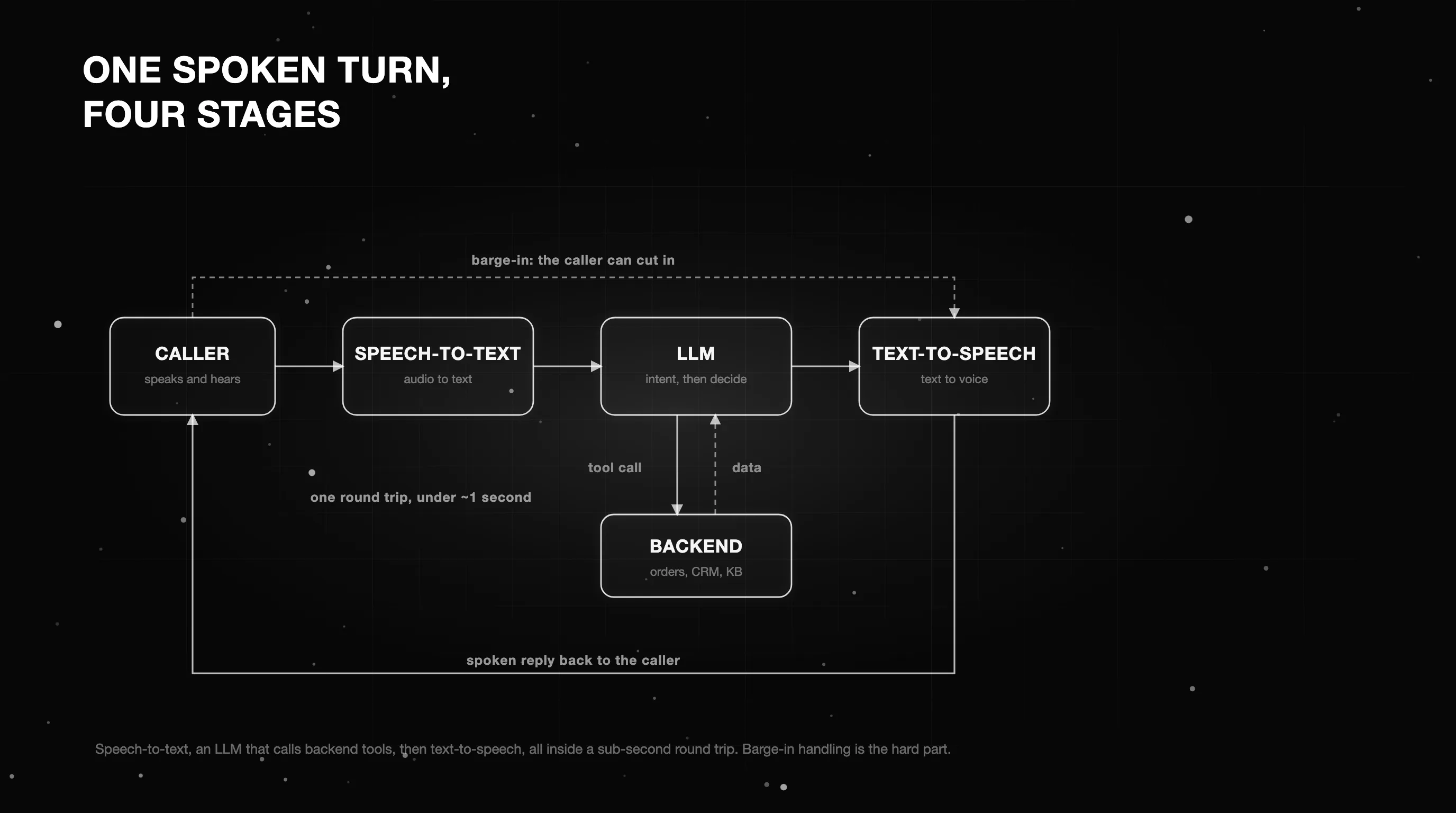
Under the conversation is a pipeline with four stages and a tight time budget. First, speech-to-text transcribes the caller’s audio into text as they speak. Second, a language model reads that text, works out intent, and decides the next step, which is often a tool call: look up the order, verify identity, book the slot. Third, backend systems return real data. Fourth, text-to-speech turns the reply back into a spoken voice.
The whole loop has to close fast. In natural conversation people expect a reply in about half a second; the natural gap between human turns is around 200 milliseconds. Past a second the pause feels robotic, callers start repeating themselves, and the exchange falls apart. That budget is split across every stage, so transcription, model reasoning, backend calls, and speech synthesis each get only a slice. Latency decides everything here: it is the difference between a conversation and an awkward standoff.
The integration surface underneath all of this is where a platform choice shows up. Future AGI’s voice providers reference documents how voice agents connect through Vapi, Retell, and Bland.ai, which is the layer that actually dials calls and carries the audio.
Interruptions and turn-taking
The happy path is easy. The hard part is what happens when the caller cuts in. Real people interrupt. They start answering before the agent finishes, correct a wrong assumption mid-sentence, and talk over hold music. A good agent handles barge-in: it stops talking the moment the caller speaks, listens, and picks up the new intent instead of finishing its scripted line. Get turn-taking wrong and the agent feels deaf, which is the fastest way to send a caller hammering the zero key for a human.
The metrics that tell you it is working
An AI voice agent is only as good as what you can measure on it, and customer service AI lives or dies on a handful of numbers. Six matter most. Containment rate is the share of calls handled without a human. Resolution rate is the share where the caller’s problem was actually solved. Response latency is the round-trip time per turn. Interruption rate captures how often the agent talks over the caller. Talk ratio compares agent airtime to caller airtime. CSAT is post-call satisfaction.
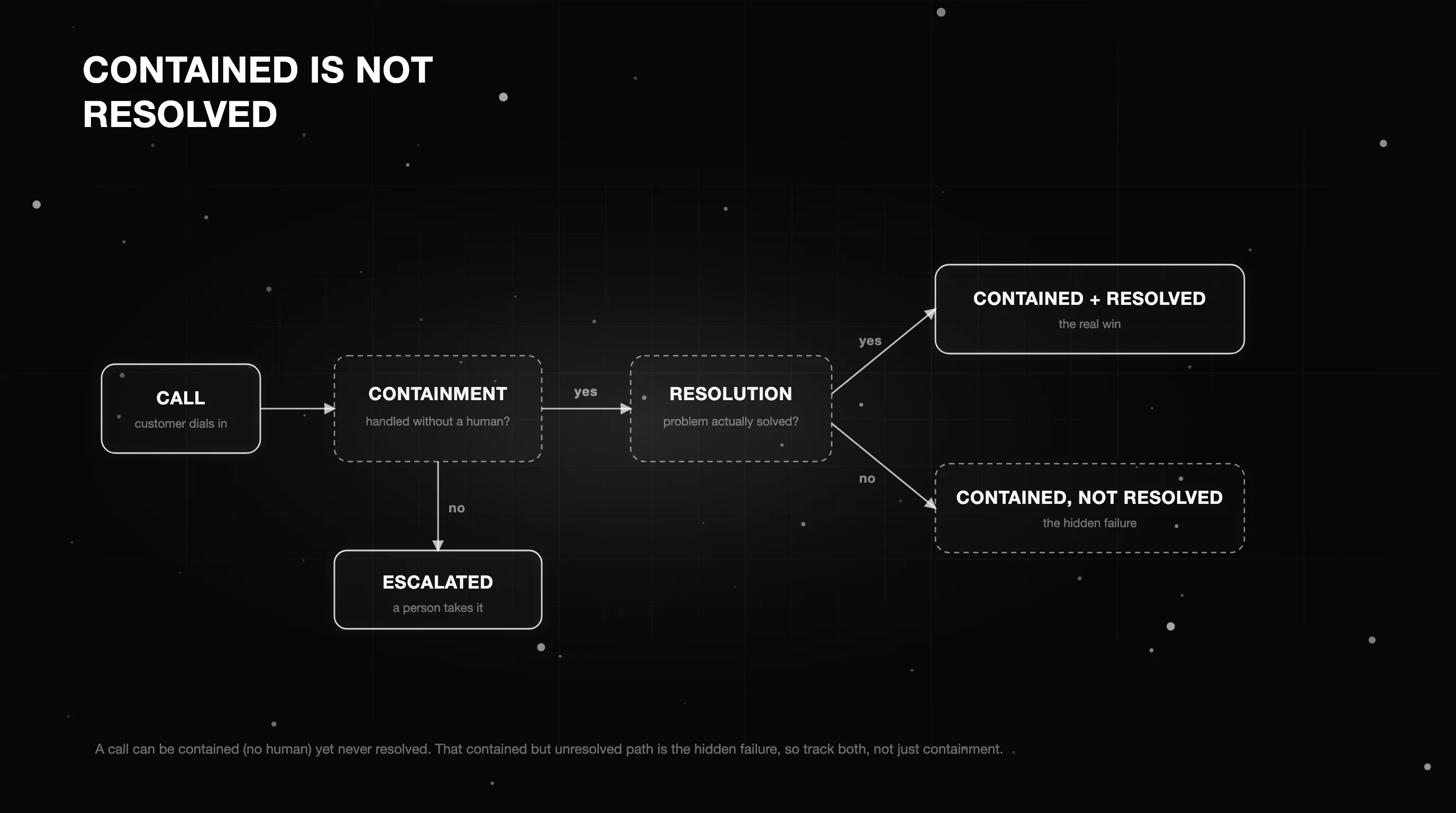
The trap sits between the first two. Containment and resolution look similar and measure opposite things at the edges. A call can be fully contained, no human ever touched it, and completely unresolved, because the agent ended the call without solving anything or trapped the caller in a loop. Optimize containment alone and you reward exactly that failure. Resolution is the true-north metric; containment is only good news when resolution moves with it.
| Metric | What it measures | Watch for |
|---|---|---|
| Containment rate | % handled without a human | Gaming it by trapping callers |
| Resolution rate | % problems actually solved | The true-north metric |
| Response latency | Turn round-trip time | Over 1s feels robotic |
| Interruption rate | Agent talks over caller | High means poor barge-in |
| Talk ratio | Agent vs caller airtime | Agent monologue is bad |
| CSAT | Post-call satisfaction | Pair with resolution |
Most of these are recorded signals you can pull straight off the call, not soft impressions. Future AGI documents the voice call metrics it captures per call, including latency, interruption counts and rate, talk ratio, speaking pace, and an overall score that serves as the call’s CSAT, so the numbers in the table map to fields you actually get. If you want the fuller framework for scoring conversations, this guide on how to evaluate voice AI agents breaks the measurement down by end-task, pipeline stage, and conversation coherence.
Fitting a voice agent into your support stack
A voice agent does not run alone; it plugs into the stack your support team already uses. On one side is telephony, the phone numbers and call routing that connect callers to the agent. On the other are the systems it needs to actually help: the CRM for customer context, the ticketing system for logging and follow-up, the knowledge base for answers, and the order or account systems it reads and updates. An agent wired to all of these can resolve; one wired to none can only talk.
Roll it out in stages. Start in shadow mode, where the agent listens to real calls and drafts what it would do without touching the caller, so you can score it against reality first. Move to assisted, where it suggests answers to a human rep in real time. Only then go autonomous on the specific workflows the metrics say it has earned. Each stage buys evidence before you hand over more risk.
Handoff design is the part teams underestimate. When the agent escalates, it should be a warm transfer: the human picks up with the full transcript, the caller’s verified identity, and the context already gathered, not a cold restart that makes the customer repeat everything. A clean handoff is the difference between escalation feeling like progress and feeling like punishment. Watching all of this in production is a discipline of its own, and strong CX AI observability is what tells you whether the seams between agent, tools, and humans are holding.
How to test a voice agent before it touches real callers
The reference playbooks tend to skip the step that saves you: testing the agent before a real customer ever reaches it. Voice has a wide input space. Accents, background noise, people who mumble or talk fast, callers who interrupt, and edge intents the happy path never covered all show up in production whether or not you planned for them. The way to find those failures is to simulate calls across that range and score the transcripts on resolution, latency, tone, and interruption handling before you route a single live call.
You do not need a platform to start reasoning about the numbers. Even a tiny call log tells you something once you compute the basics. The snippet below takes a handful of calls and prints containment, resolution, and a latency percentile.
import statistics

calls = [
    {"handled_by_agent": True,  "resolved": True,  "latency_ms": 820},
    {"handled_by_agent": True,  "resolved": False, "latency_ms": 1120},
    {"handled_by_agent": False, "resolved": True,  "latency_ms": 640},
]

def containment_rate(calls):
    return sum(c["handled_by_agent"] for c in calls) / len(calls)

def resolution_rate(calls):
    return sum(c["resolved"] for c in calls) / len(calls)

def p95_latency(calls):
    xs = sorted(c["latency_ms"] for c in calls)
    return statistics.quantiles(xs, n=20)[-1] if len(xs) > 1 else xs[0]

if __name__ == "__main__":
    print(f"containment={containment_rate(calls):.0%}")
    print(f"resolution={resolution_rate(calls):.0%}")
    print(f"p95_latency={p95_latency(calls):.0f}ms")
Run it and you get containment=67%, resolution=67%, and p95_latency=1360ms. The two rates match here by coincidence, not because they measure the same thing: one call was handled by the agent but never resolved, and a different call was resolved only after a human took it. That is the contained-but-unresolved gap in miniature. Notice too that the p95 of 1360ms sits above the slowest actual call of 1120ms, because three data points force the percentile to extrapolate. It is a reminder that these numbers only mean something at real sample sizes, which is the whole reason to simulate at volume.
To run this against actual voice traffic, Future AGI’s guide to run a voice simulation walks through dialing simulated calls through a provider and reading how they landed. For the live side, this guide to voice AI observability for Vapi covers what to watch once the calls are real.
Future AGI for testing and monitoring customer-service voice agents
Everything above points to one need: a way to rehearse a voice agent before launch and keep watching it after. Future AGI’s Simulation is built for exactly that. It rehearses your agent on hard conversations, scores each call, and surfaces what fails before a customer hits it, running simulated calls through voice providers like Vapi, Retell, and Bland.ai.
The measurement side is documented, not improvised. The per-call metrics Future AGI records include latency, interruption counts and rate, talk ratio, speaking pace, and an overall score that doubles as the call’s CSAT, and you can write custom evaluations that score transcripts on resolution and tone the way your support team actually judges a call. The open-source core is Apache-2.0 and self-hostable if you want it in your own environment; the code lives on GitHub.
If your support surface is broader than voice, the same approach carries over. Here is how to build and evaluate a support agent end to end.
Put your first workflow live without guessing
Go back to that Monday-morning queue and the fortieth “where is my order” call. With one workflow automated well, that call now gets answered in natural speech, resolved against the real order system, and logged, while your reps spend their attention on the escalations that actually need a person. The burnout math changes because the boring calls stop landing on people.
You do not get there by automating everything at once. Pick a single high-volume, low-risk, verifiable workflow. Order status is a good first bet. Simulate it across accents, interruptions, and the messy phrasings real callers use, set a resolution threshold you are willing to stand behind, and ship it in shadow mode so it proves itself against live calls before it answers any. Measure containment, resolution, and CSAT together. When the numbers hold, widen the scope one workflow at a time. That is how a voice agent goes live without guessing.
Frequently Asked Questions
What is an AI voice agent for customer service?
How are voice agents different from IVR?
What metrics measure voice agent performance?
What is the difference between containment and resolution?
How do you test an AI voice agent before launch?
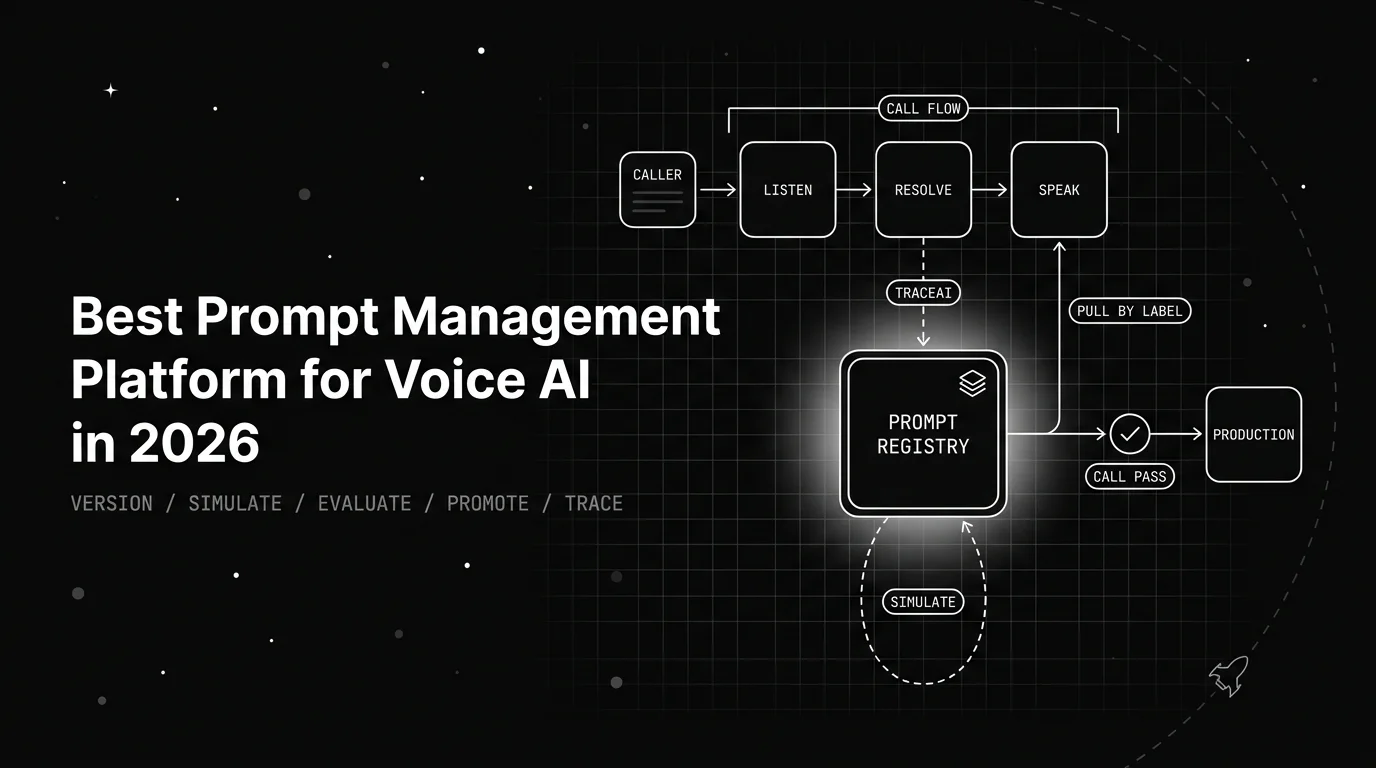
Prompt management for voice AI: Future AGI versions each voice-agent prompt, simulates it against synthetic callers, and gates promotion on resolution and tone.

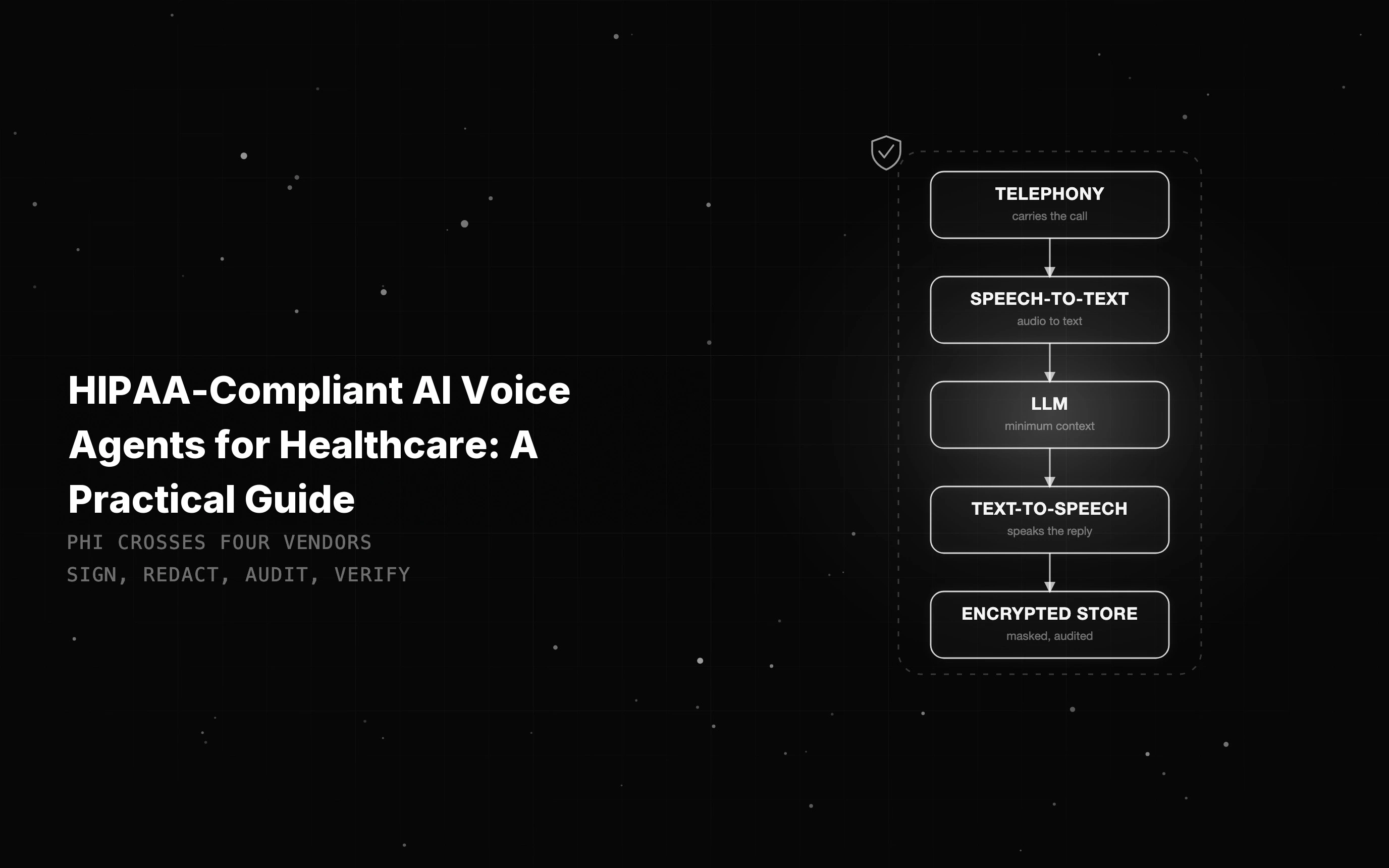
HIPAA voice agents carry patient PHI across telephony, STT, an LLM, and TTS. See the safeguards they need and how to evaluate a vendor.

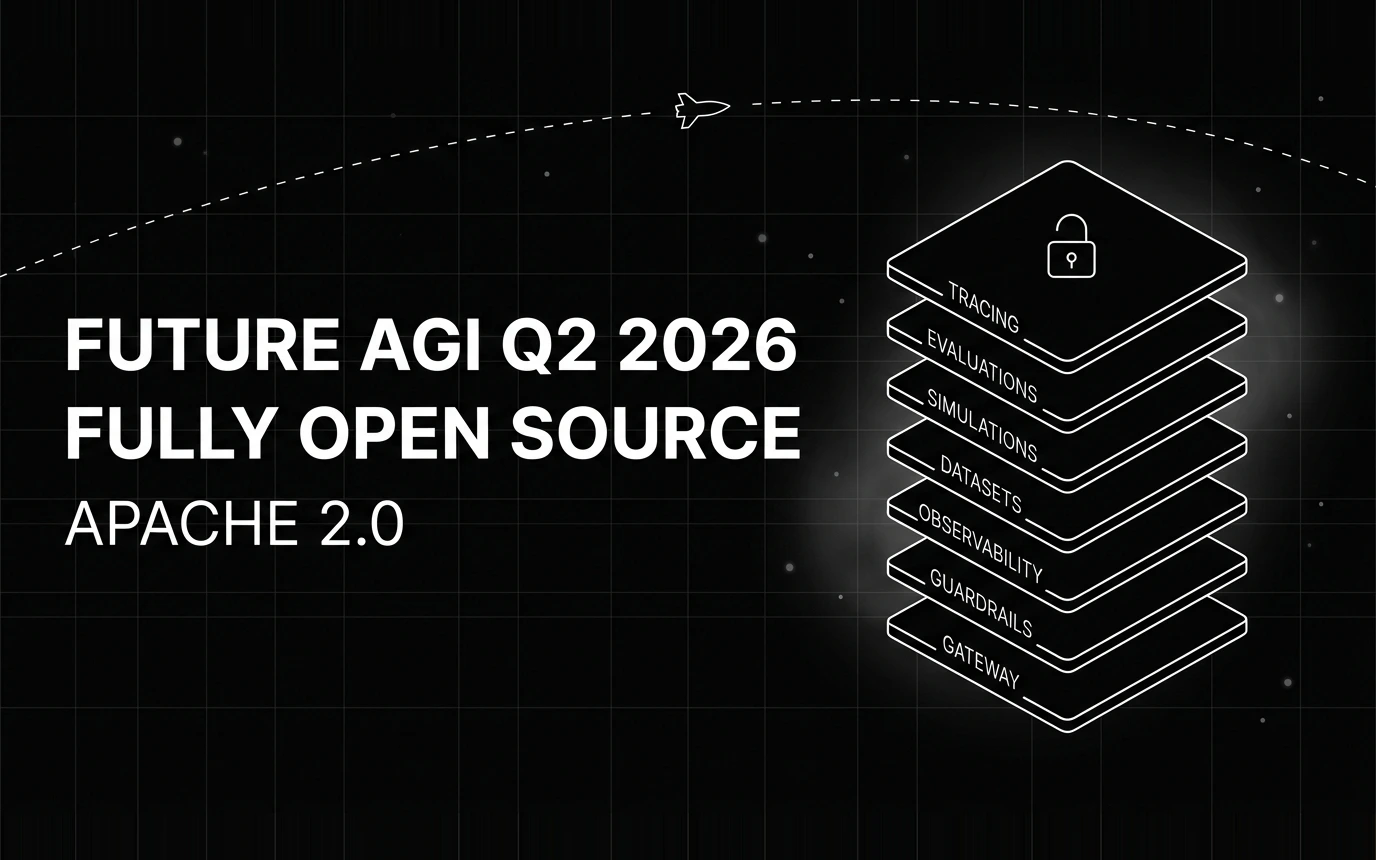
Inside Future AGI open source in Q2 2026: the platform shipped under Apache 2.0, Error Feed and the Agent Command Center went live, traces hit billions.